
Introduction
A questioned document laboratory typically covers two main areas of expertise: document examination and handwriting examination.
Recommended handwriting examination procedures began over a century ago and remain the best practice method in this field today. Document examination, including determination of conventional and digital printing methods, is an evolving field as new technologies in document production and copying are introduced.
Whereas typewriter printing used to be a significant proportion of document preparation some thirty years ago, it has been surpassed by digital methods such as toner and inkjet printing. Travel documents have evolved from preparation by quality conventional printing methods to microcosms of security printing and biometric technology.
In light of the constant changes in the world of document preparation and new technologies that have become available for the production and examination of forged and counterfeit documents, an interest was expressed to determine the best practice for current questioned document laboratories.
A short survey was prepared with questions regarding several areas of questioned document examinations, including working methods, instrumentation, certain aspects of training and bibliography, and a question on the legitimacy of graphology in relation to the field of handwriting comparison.
The survey’s objectives:
Determination if “classic” methods were still in practice and therefore could still be considered “current” despite the number of years that they have been in use.
Updating as to which document examination instrumentation is most widely used.
Assessment if new methods of document examination should be considered for introduction in a continuously evolving laboratory.
Understanding which instrumentation and bibliography materials are considered both effective and valuable for document examiners.
Identifying the true value, if any, of training in graphology for a certified document examiner.
The results of the survey may be considered as a “best practice” setup for a questioned document laboratory, especially if a high percentage of laboratories operate in a similar way. Moreover, they can empower QD laboratories that follow the practices cited by most of the participating laboratories and help others to consider introducing certain instrumentation or methods.
Method
The following survey was sent to questioned document laboratories around the globe via three international lists of questioned document examiners.—See Table 1.
Table 1.
The survey.
| QUESTION | YES | NO | |
|---|---|---|---|
| 1 | Does your lab do handwriting examination? | ||
| 2 | In the case file, do your handwriting experts draw the letters found in the Q* documents by hand? | ||
| 3 | Does your lab do document examination? | ||
| 4 | Does your lab have a VSC** or Projectina? If so, what model? | ||
| 5 | Does your lab have an ESDA***? | ||
| 6 | Does your lab have a microscope? | ||
| 7 | Does your lab have a Raman spectrometer? | ||
| 8 | Are there any other instruments you would regard as critical for use in a document examination lab? Please specify. | ||
| 9 | Does your lab use GCMS**** or other methods for ink dating? Please specify. | ||
| 10 | Does your lab do "Bitmap" analysis? | ||
| 11 | Are your document examiners required to know Photoshop? | ||
| 12 | Do you regularly use Photoshop in your lab for casework? If so, which version? | ||
| 13 | Does your lab conduct chemical analysis of inks and /or toners? | ||
| 14 | Does your lab do proficiency tests? If so, which ones? | ||
| 15 | Can you recommend two of your favorite books on questioned document and handwriting examination? | ||
| 16 | Are your handwriting experts required to have any training in graphology (determination of personality traits through handwriting)? |
[i] *Q = Questioned
**VSC = Video Spectral Comparator
***ESDA = Electrostatic Detection Apparatus
****GCMS = Gas Chromatography Mass Spectrometry
The survey was emailed to the following professional forensic document associations:
The “International Docexam List” is open to members of the American Society of Questioned Document Examiners (ASQDE), the Australasian Society of Forensic Document Examiners Inc (ASFDE Inc) and the American Board of Forensic Document Examiners (ABFDE), all of whose members are recognized document examiners, and their guests.
The European Network of Forensic Science Institutes (ENFSI) has two groups of member laboratories in the field of questioned document examination—The European Network of Forensic Handwriting Experts (ENFHEX) for handwriting comparison and the European Document Examiners Working Group (EDEWG) for experts in document examination. The mailing lists for both of these groups are composed solely of members or associate members of the two groups.
It should be noted that membership in any of the above-mentioned organizations is not an automatic process but is awarded to each applicant, be it an individual or a laboratory, government-affiliated or in private practice, after scrutiny of their training, methods of practice and workload.
All answers received were copied onto an Excel worksheet after which each individual question was analyzed.
By the time of this writing, 90 questionnaires were returned from 32 countries worldwide:
Australia, Austria, Bosnia Herzegovina, Canada, China, Croatia, Czech Republic, England, Estonia, France, Germany, Greece, India, Ireland, Israel, Italy, Macedonia, Netherlands, New Zealand, Norway, Oman, Poland, Portugal, Romania, Scotland, Singapore, Slovak Republic, South Africa, Spain, Sweden, Switzerland, United States of America (USA).
Results and Discussion
The Survey asked for yes or no answers. Discussion shows additional comments that were made.
Questions 1 and 2:
Does your lab do handwriting examination?
In the case file, do your handwriting experts draw the letters found in the questioned (Q) documents by hand?
82% of overall respondents in the field of handwriting examination stated that they always or sometimes draw the letters found in the questioned documents by hand, (80% of government laboratories and 85% of private laboratories). The factor most often cited that affects the decision to sometimes draw the letters by hand is the complexity of the questioned handwriting/signature. The use of software was mentioned by only five responders.
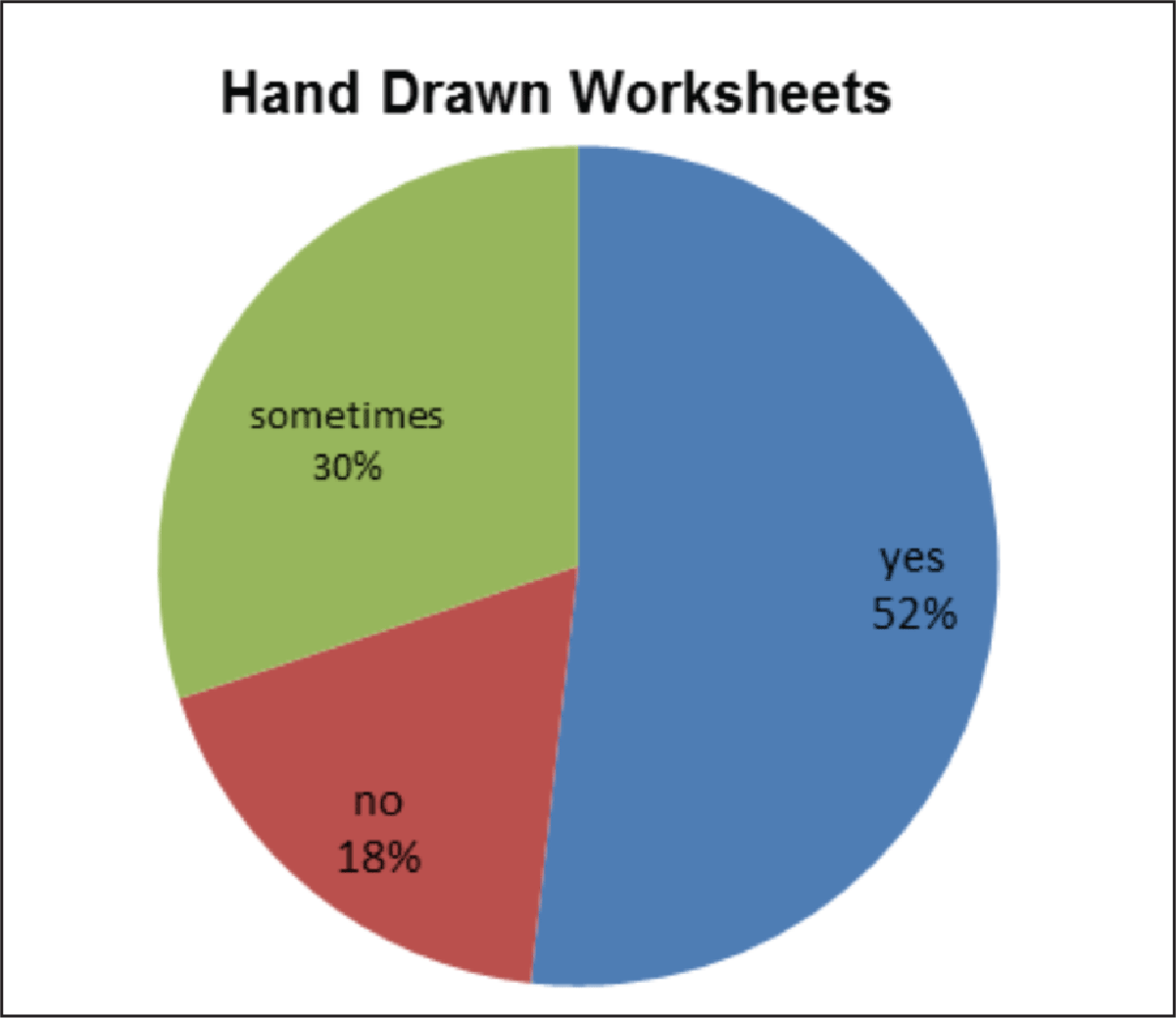
Figure 1.
Overall distribution of experts drawing worksheets by hand.
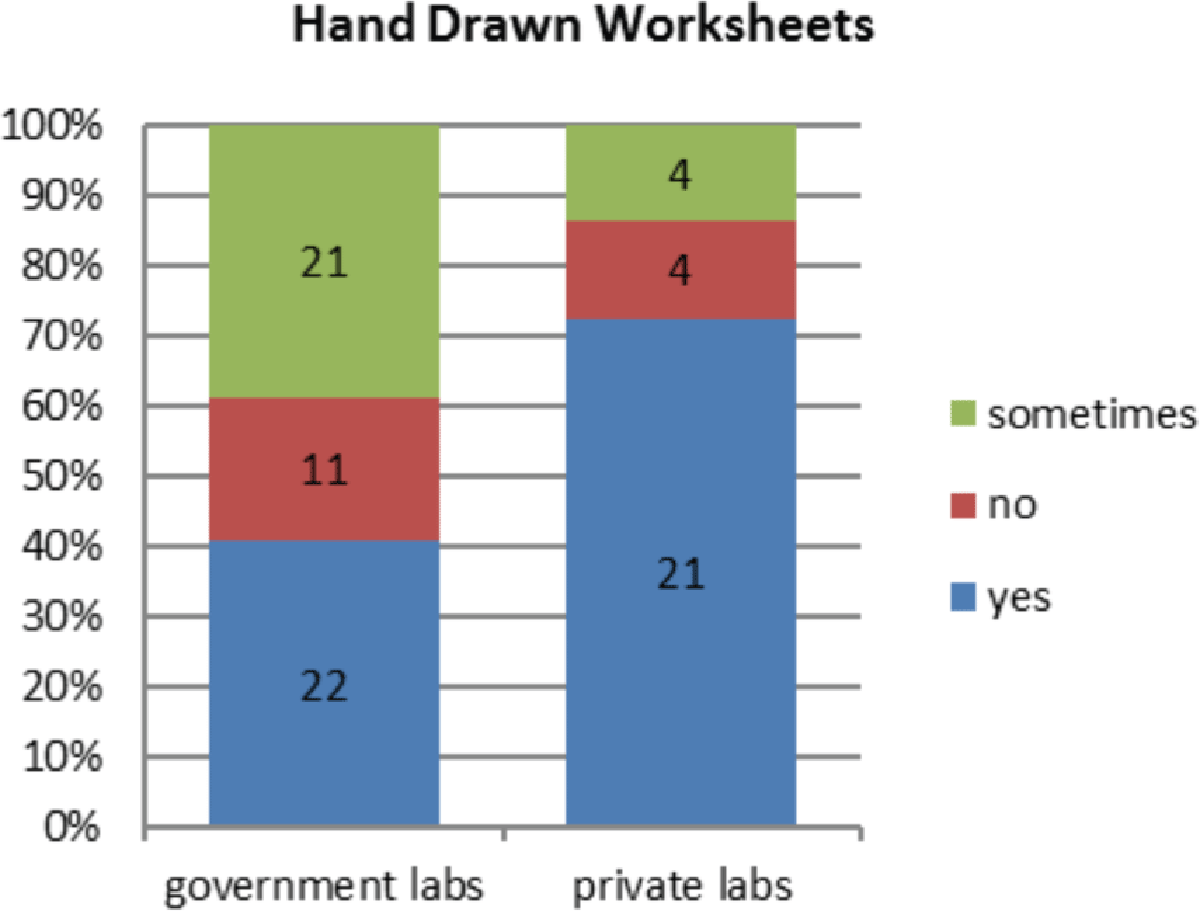
Figure 2.
Distribution of hand drawn worksheets between government and private labs. The numbers on the bar chart indicate the number of labs.
Question 3:
Does your lab have a VSC or Projectina? If so, what model?
74% of both government and private laboratories use a version of Foster + Freeman’s Video Spectral Comparator (VSC); 18% of government laboratories and 6% of private laboratories use a version of Projectina’s Docubox. Both instruments have very similar specifications and so the choice of which instrument to buy may be based on price, customer service and familiarity with previous versions of the product.
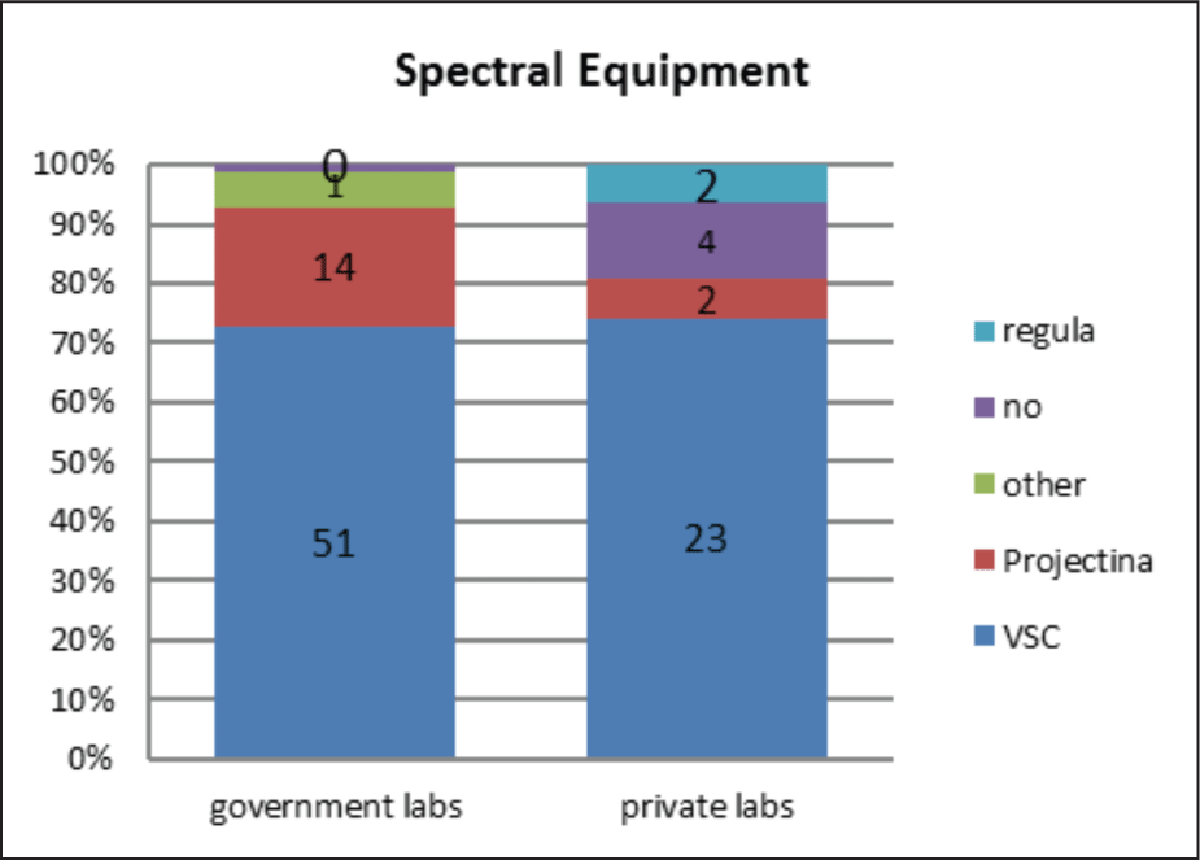
Figure 3.
Distribution of spectral equipment models between government and private labs.
Question 4:
Does your lab have an Electrostatic Detection Apparatus (ESDA)?
The wording of this question should have been more general: “Do you have any instrument for revealing indented writing impressions”. Some laboratories may have replied negatively due to them having an instrument other than an “ESDA” for indented writing visualization. 92% of laboratories stated that they have apparatus for visualization of indented writing; 88% replied that they have an ESDA; 4% have a Docubox or Vacubox.
Question 5:
Does your lab have a microscope?
All participants gave a positive answer to this question: a microscope is essential equipment in every questioned document laboratory.
Question 6:
Does your lab have a Raman spectrometer?
Almost 70% of the laboratories do not have an accessible Raman spectrometer. 10% can use a Raman instrument in a different laboratory. Most laboratories that do own a Raman spectrometer are government laboratories.
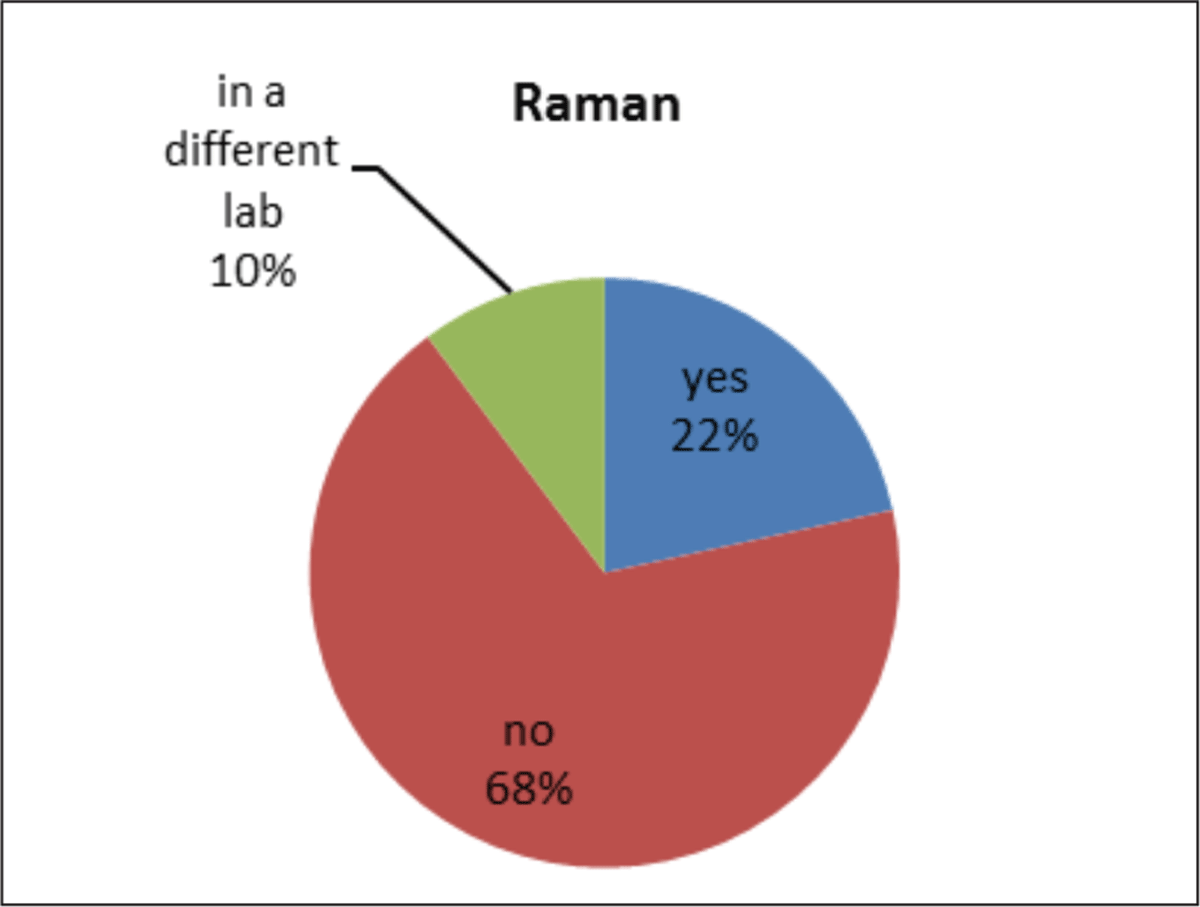
Figure 4.
Overall distribution of use of Raman spectrometer.
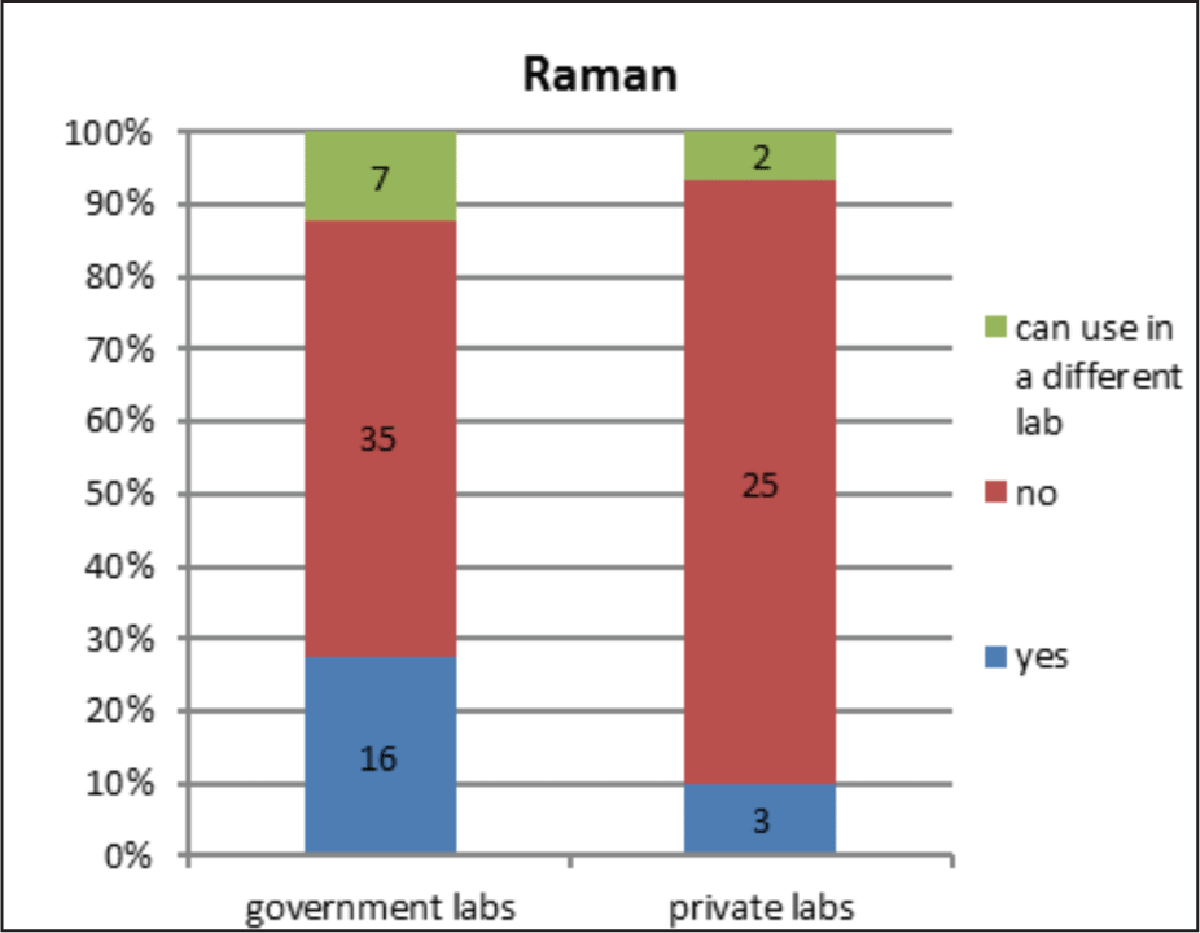
Figure 5.
Distribution of Raman spectrometer between government and private labs.
Question 7:
Are there any other instruments you would regard as critical for use in a document examination lab? Please specify.
In compiling the answers to this question, instruments that were mentioned only once were not included in the pie chart, as well as those that are part of the VSC/ Projectina technical specifications.
Instruments mentioned only once were: Keyence confocal laser scanning microscope, soft Xray, reflective microscope, colorimeter, Foster & Freeman ECCO, gelsight and the Ribbon Analysis Workstation (RAW) reader.
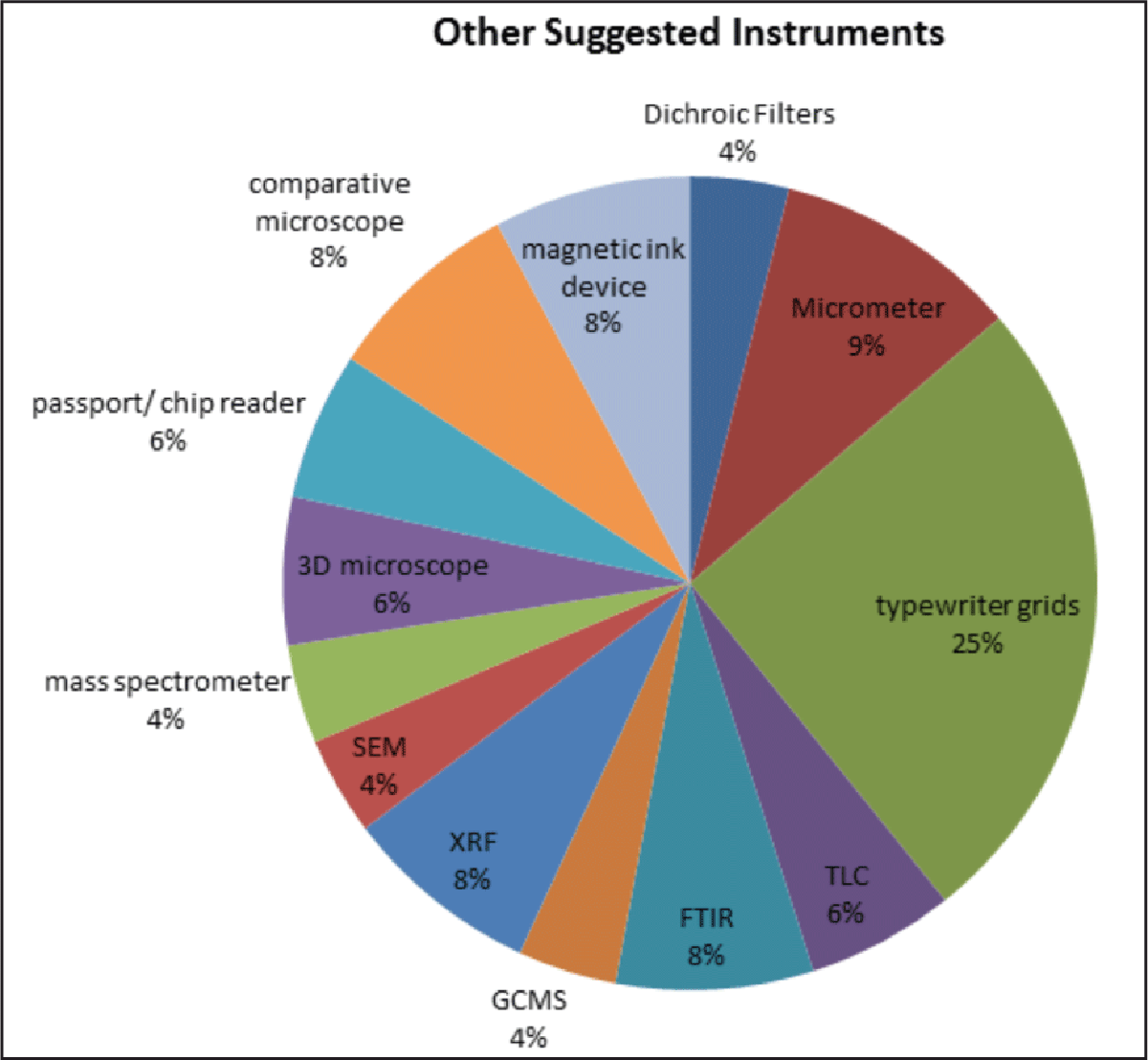
Figure 6.
Overall distribution of other suggested instruments
TLC = Thin Layer Chromatography
FTIR = Fourier Transform Infrared
GCMS = Gas Chromatography Mass Spectrometry
XRF = X-Ray Fluorescence
SEM = Scanning Electron Microscope
Question 8:
Does your lab use GCMS or other methods for ink dating? Please specify.
77% of the participating laboratories do not conduct ink dating tests at all. 12% of the laboratories outsource their ink dating cases to different laboratories and 11% carry out ink dating tests in their own labs.
The main instruments mentioned for ink dating (in descending order) were GCMS, High Pressure Liquid Chromatography (HPLC), Liquid Chromatography Mass Spectrometry (LCMS), TLC.
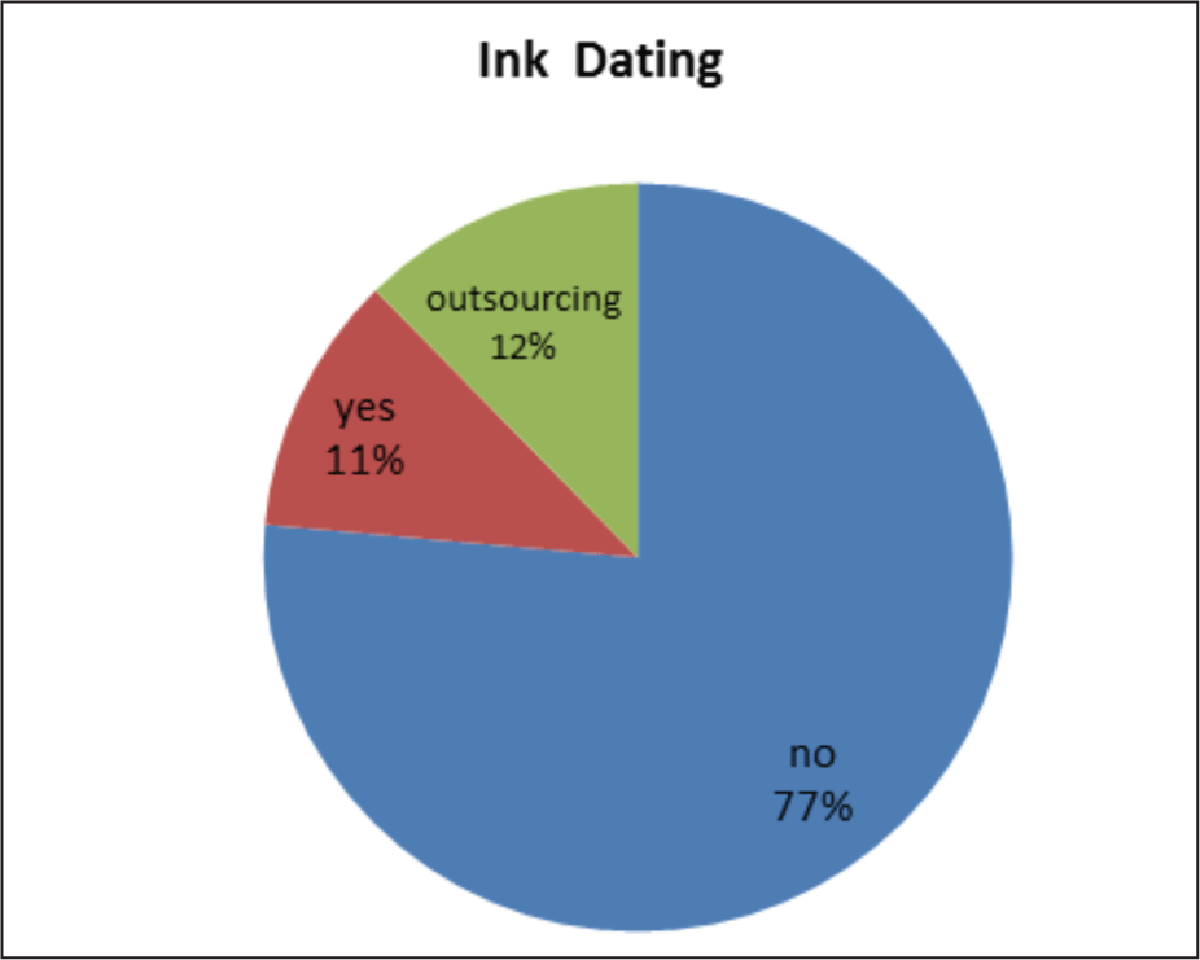
Figure 7.
Overall distribution of ink dating
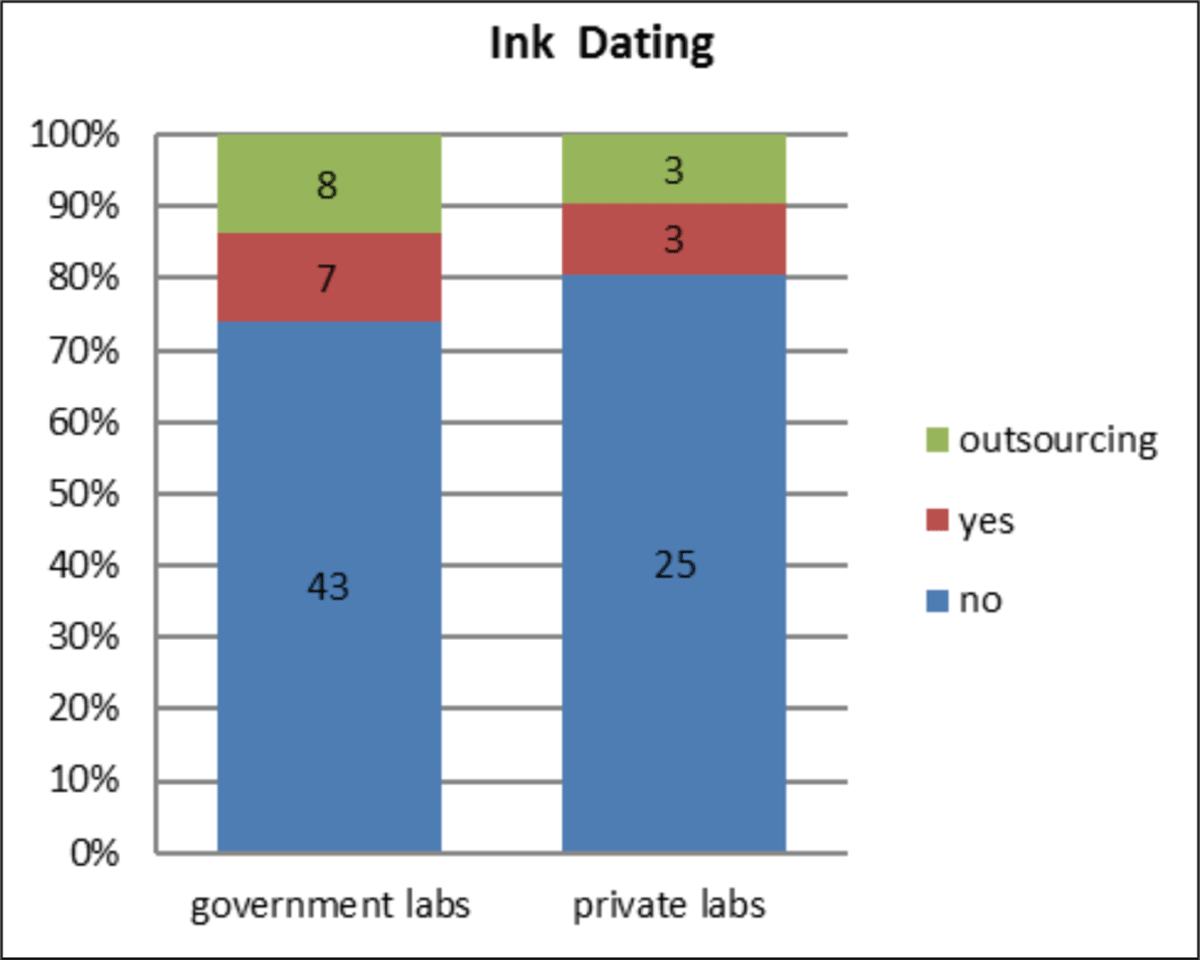
Figure 8.
Distribution of ink dating between government and private labs
Question 9:
Does your lab do “Bitmap” analysis?
The Bitmap is a program for decoding the “yellow dot” patterns found on certain color laser printed documents and is distributed to some police or central bank laboratories. The question should have included the term “yellow dots” as well as “Bitmap”.
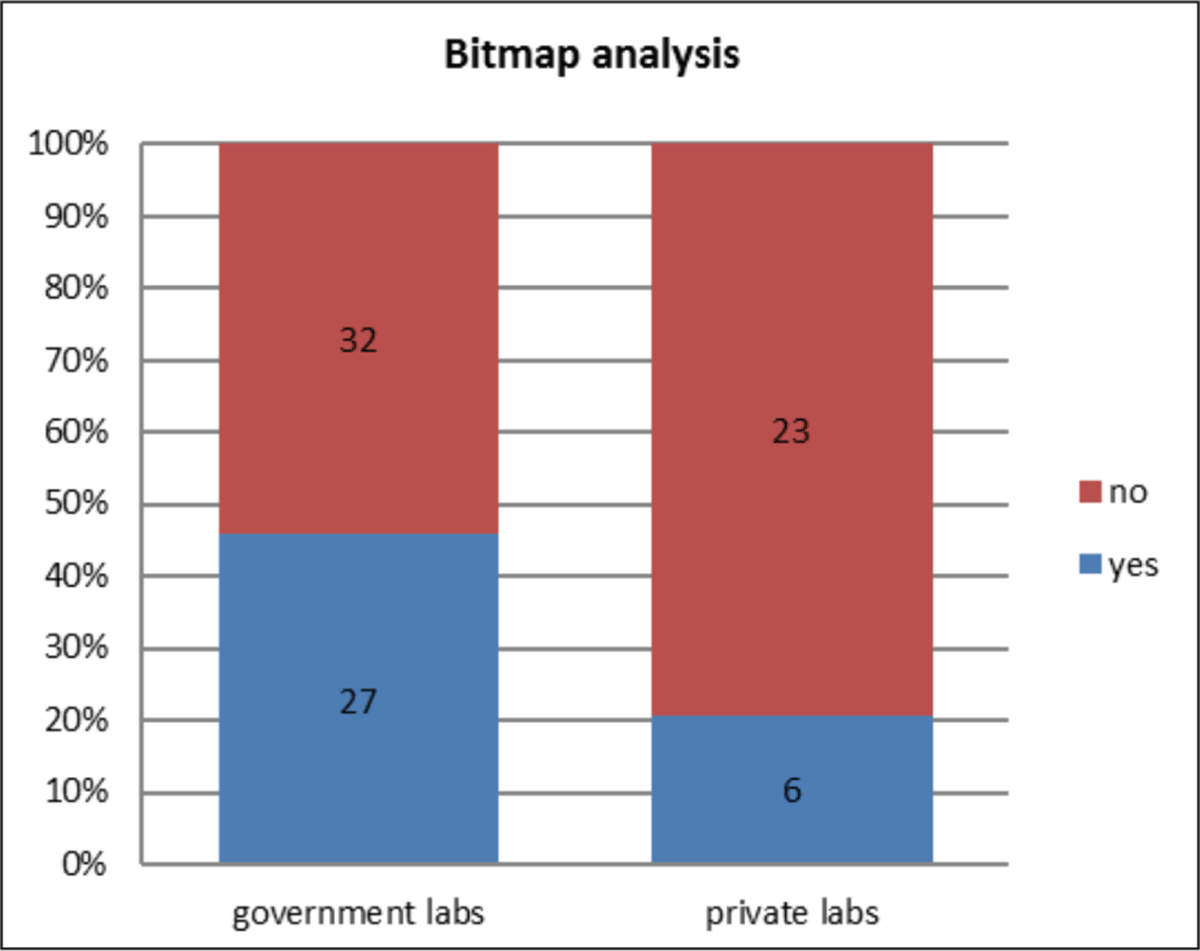
Figure 9.
Distribution of Bitmap analysis between government and private labs
Questions 10 and 11:
Are your document examiners required to know Photoshop?
Do you regularly use Photoshop in your lab for casework? If so, which version?
Photoshop training is required in 69% of the laboratories, though some participants stated that their Photoshop training is very basic.
The use of Photoshop software as a tool for casework varies: some of the laboratories use it regularly, some use it occasionally when appropriate, and only six participants stated that they do not use Photoshop for casework.
The most common Photoshop software mentioned is the full Creative Suite (CS) version.
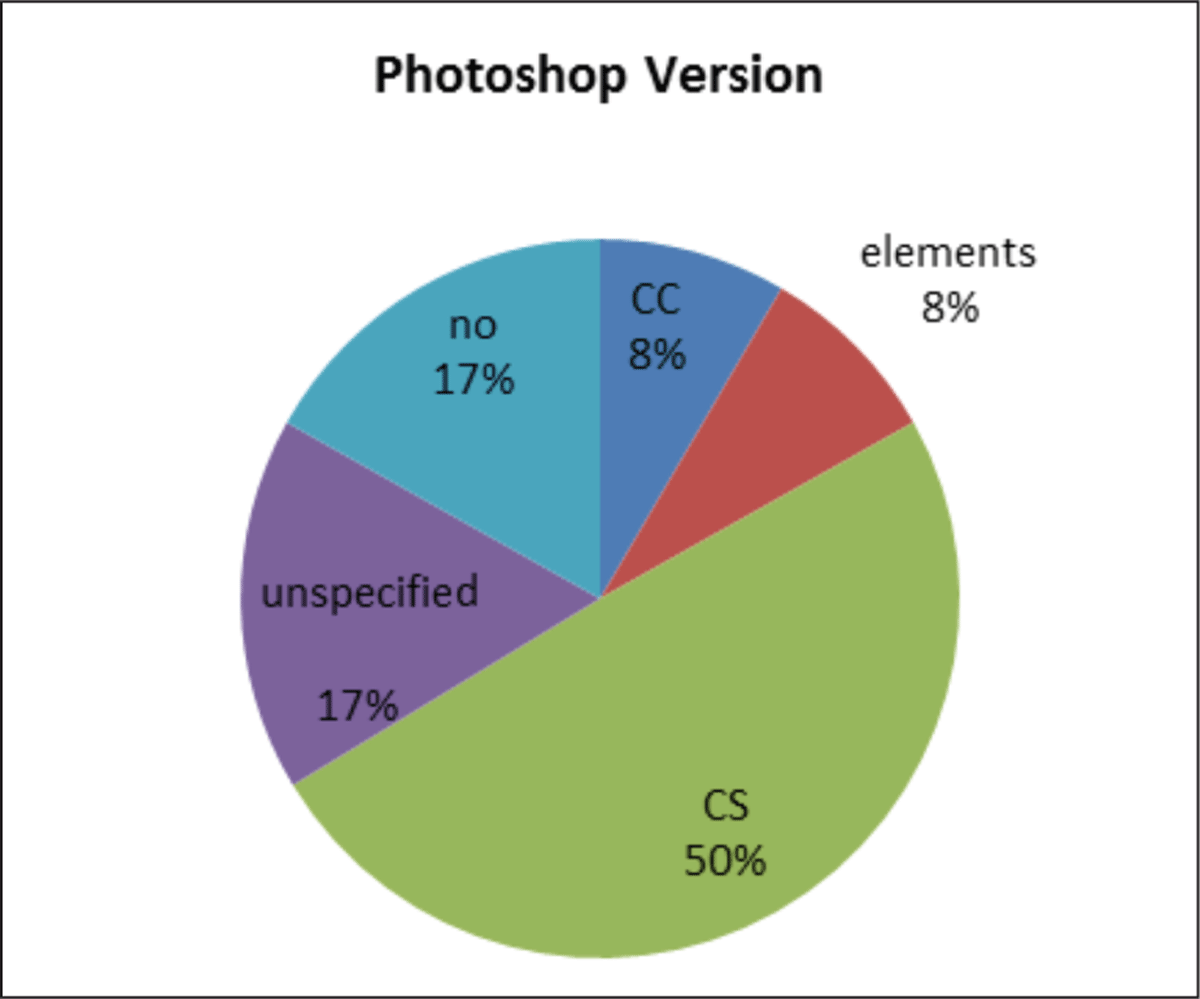
Figure 10.
Overall distribution of Photoshop version.
CC = Creative Cloud
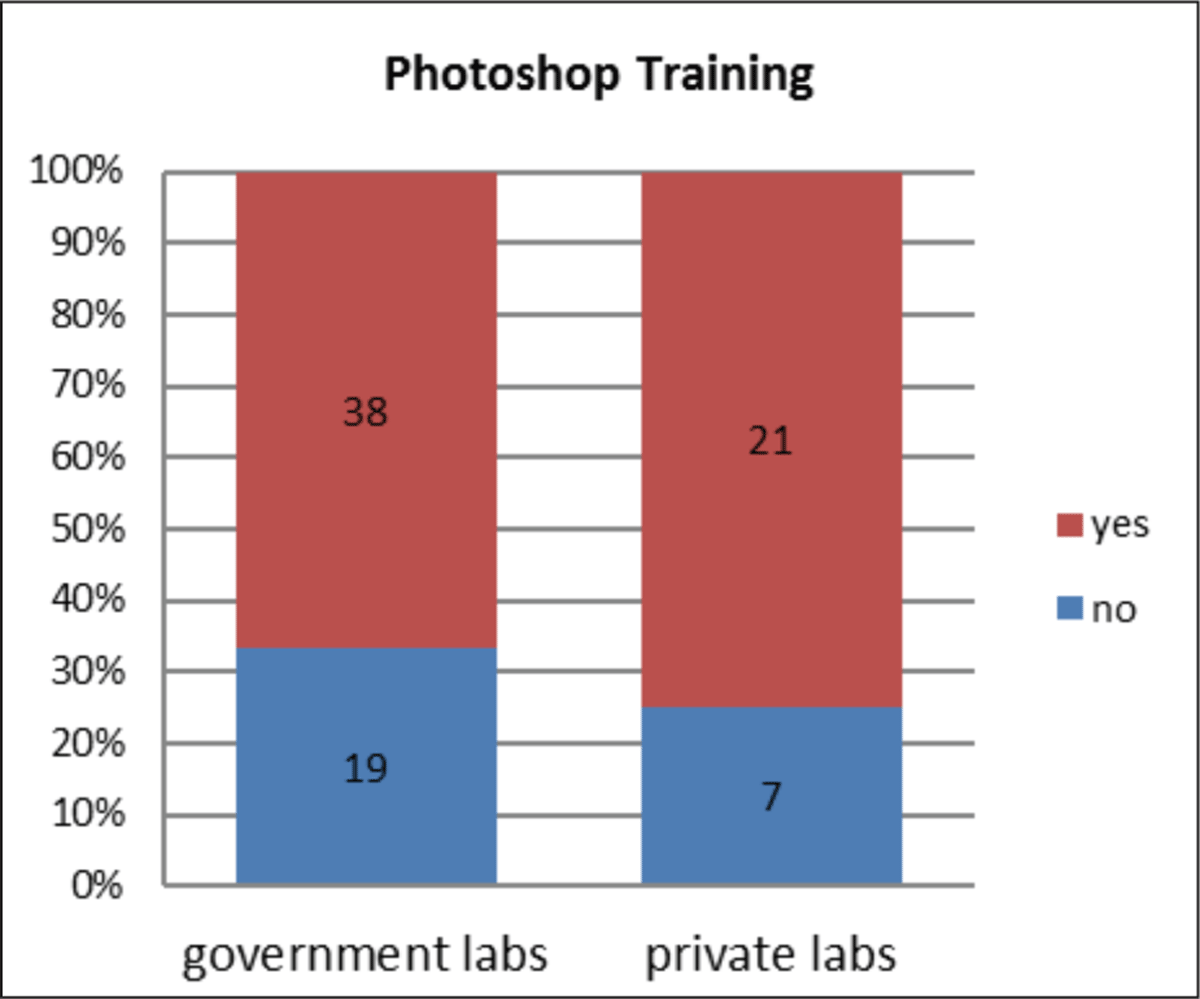
Figure 11.
Distribution of Photoshop training between government and private labs.
Question 12:
Does your lab conduct chemical analysis of inks and /or toners?
50% of the laboratories do not conduct chemical analysis of inks and or toners, 39% do and 11% outsource to other laboratories either inside or outside of their organization.
The wording of the question did not require specification as to what methods are used for the chemical analysis but some laboratories chose to elaborate—TLC, FTIR, GCMS, LCMS and HPLC were mentioned.
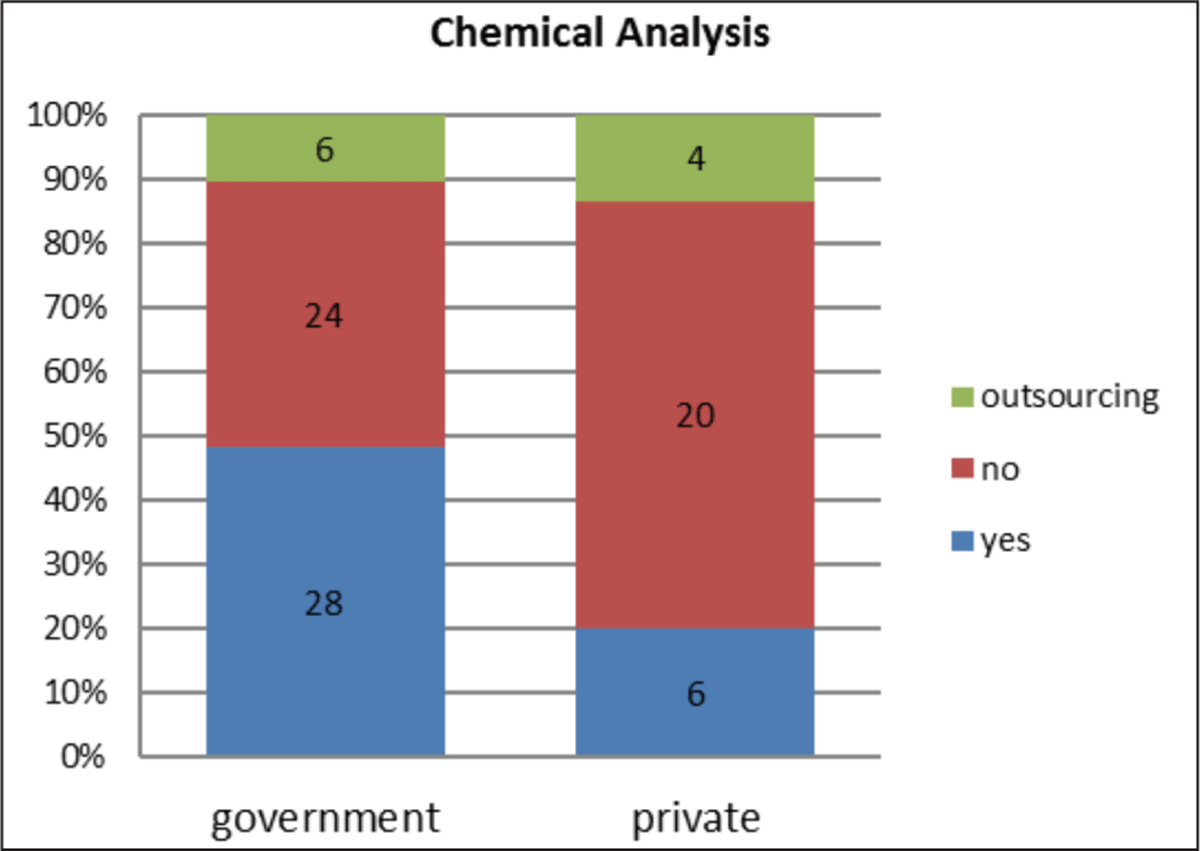
Figure 12.
Distribution of conduction of chemical analysis between government and private labs.
Question 13:
Does your lab do proficiency tests? If so, which ones?
82% of the laboratories take proficiency tests; only 10% of government laboratories do not take the tests whereas 40% of the private laboratories are not tested regularly.
36% of the participants in the survey are laboratories from the United States which can explain why the Collaborative Testing Service (CTS) proficiency test was the one mentioned most often.
The significance of participating in an external, independent test is that a case presented in a proficiency test is the only situation in which the expert receives feedback on the accuracy of his/ her conclusions.
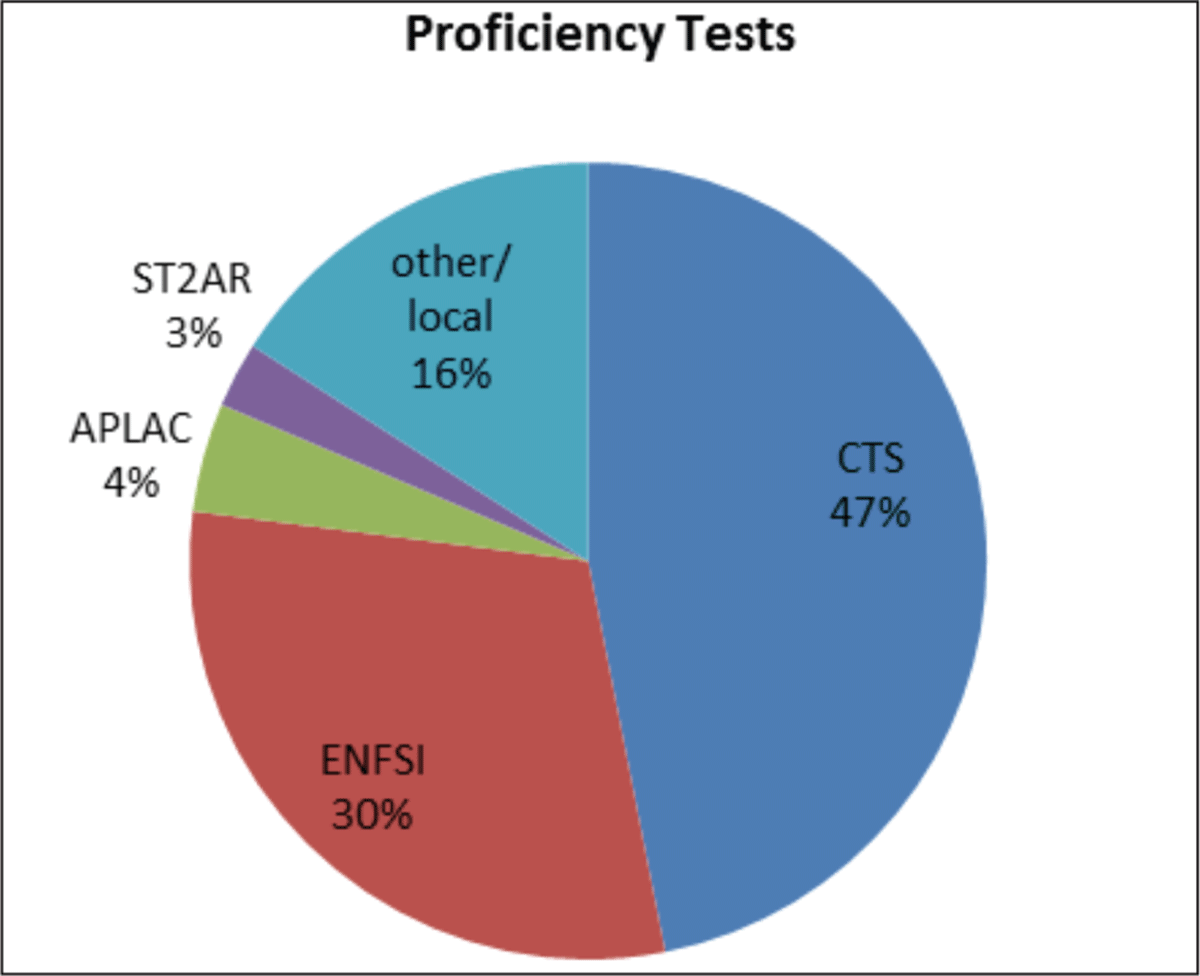
Figure 13.
Overall distribution of proficiency tests.
APLAC = Asia Pacific Laboratory Co-operation
ST2AR = Skill Task Training Assessment & Research Inc.
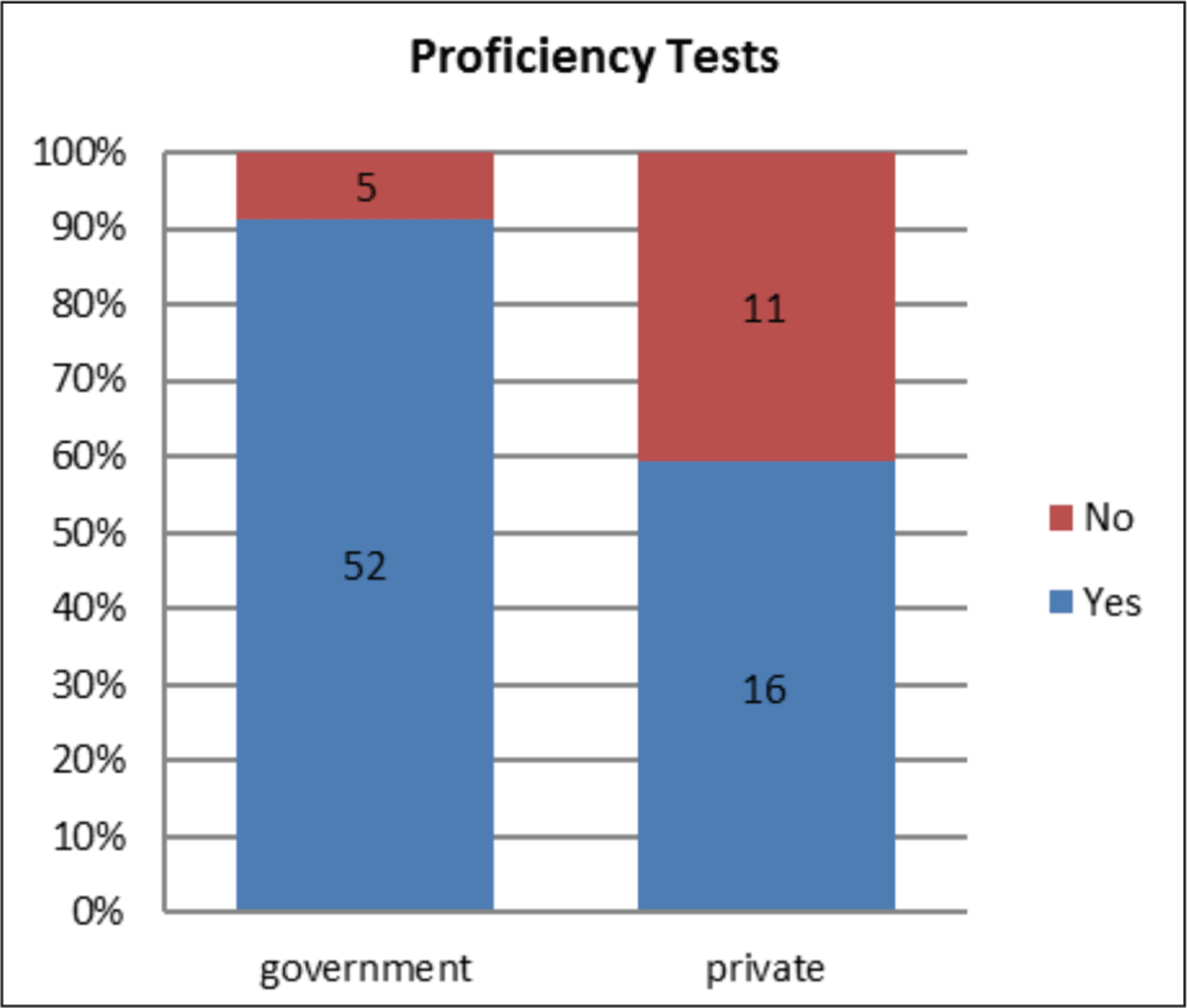
Figure 14.
Distribution of proficiency tests between government and private labs.
Question 14:
Can you recommend two of your favorite books on questioned document and handwriting examination?
Since most of the books regarding questioned document examination have very similar titles we chose to present the book chart by name of authors only.
Books that were mentioned only once were not included in the bar diagram shown below. Some participants recommended more than two books.
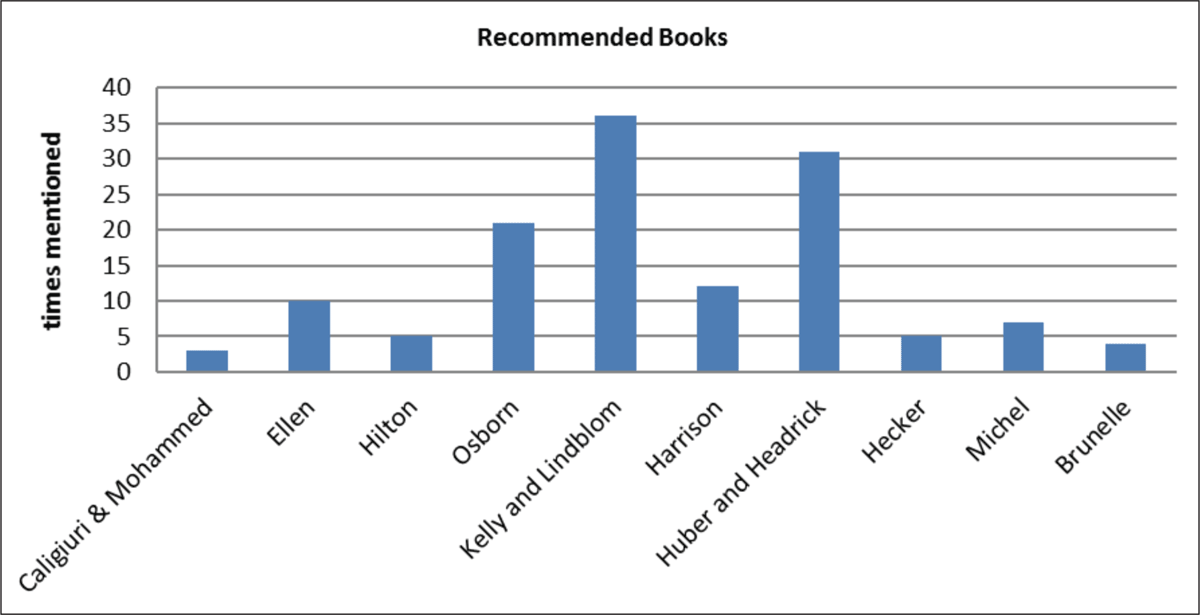
Figure 15.
Overall distribution of recommended books.
Question 15:
Are your handwriting experts required to have any training in graphology (determination of personality traits through handwriting)?
This question raised the most comments. Most participants expressed the major difference between handwriting comparison and graphology.
There were only two positive answers:
“yes”
“yes. Training during 1 year only, at the beginning of the internal training to see a lot of types of writing but we don’t use the graphology in our cases.”
Other answers such as “yes, in order to teach the difference between graphology and handwriting comparison” were analyzed as “no” answers.
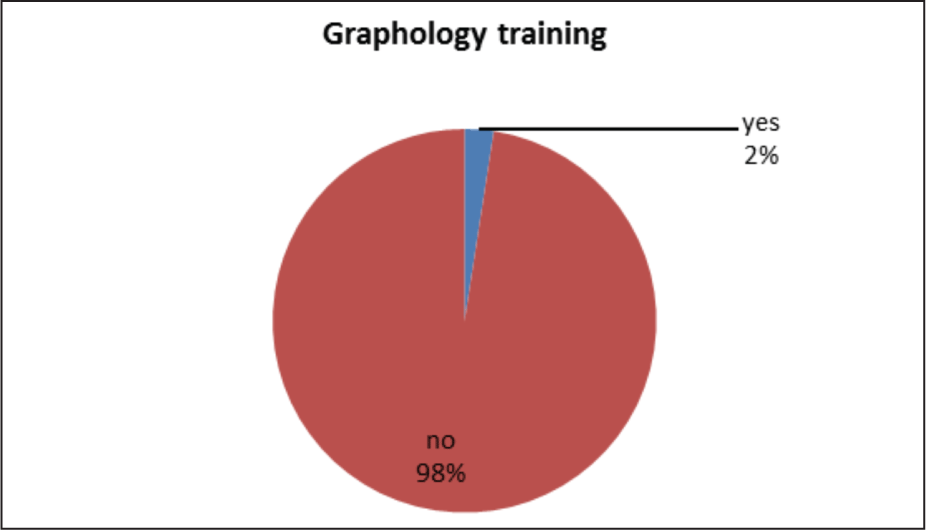
Figure 16.
Overall distribution of required graphology training.
The background for asking this specific question was a comment made by a local graphologist who regards herself as a document examiner about the added value of graphology training in handwriting comparison. She stated on her website that handwriting experts in Germany are required to undergo graphology training as part of their overall document examiner program.
From the result of this survey not one of the nine German participants supported her statement.
Conclusions
The results of this survey demonstrate that there is a high level of uniformity in some of the methods and instrumentation of questioned document laboratories worldwide, such as microscopes and electrostatic detection devices.
The survey shows that the questioned document community works with both time-independent methods such as drawing handwriting characteristics in the case file by hand, but also embraces modern technologies such as Photoshop software and chemical analyses where appropriate.
Chemical analysis in document examination is performed by a small percentage of QD laboratories that have specialized in this area.
In the area of proficiency testing, it was very noticeable that 40% of private laboratories do not take proficiency tests, a result that should perhaps be specially noted.
Acknowledgements
The authors wish to thank the questioned document community for taking part in the survey. The high response helps to strengthen the conclusions that can be drawn and validate our working methods.
Disclaimer: No external funding was received at any stage of conduction of the survey.