
Introduction
Current ink dating approaches use chemical methods that either analyze the “static” (compositional) characteristics of questioned inks or the “dynamic” (aging) characteristics of inks. In 1996, Antonio Cantu published comprehensive reviews of ink dating methods that had been used in the frame of the static and dynamic approaches [1, 2].
Most of the numerous publications on ink dating center on the analysis of 2-phenoxyethanol (2-PE)2 and similar high boiling solvents (the solvents with boiling points over 2000C) present in conventional oil/glycol-based (further referred to as oil-based) ballpoint inks. Though oil-based ballpoint pen inks are still widely used, waterbased ballpoint pen inks, such as gel and rollerball pen inks, have gained popularity and may be used to execute handwritten entries on questioned documents. Many water-based ink formulations contain high boiling solvents as well. One such solvent, 2-pyrrolidone (2-PD),3 has been used for decades in formulating water-based inks used in Pilot rollerball pens, which are among the most popular rollerball pens in the United States4 and other countries. In the last two decades, multiple researchers have studied the processes of natural aging of writing, stamp pad and inkjet inks on paper. Most of these studies measured a gradual loss of high boiling solvents (due to evaporation and lateral diffusion into paper from ink lines), including such inks’ solvents as 2-PE, benzyl alcohol, N-methyl-2-pyrrolidone, 2-PD, diethylene glycol, glycerin, etc. The results of these studies have been reported in scientific literature (see Table 1 that follows).
This work was conducted with the aim to determine how long after a writing was written with a rollerball ink, a gradual loss of the solvent 2-PD both in the ink and areas of paper adjacent to the ink’s lines would correlate with the actual “age” of the writing.
Ink Dating—The “Static” and “Dynamic” Approaches
There are two approaches to chemically determine the age of inks on documents. One determines and compares the “static” (compositional) characteristics of questioned inks with those of a collection of inks, each having a known production date; the other determines the “dynamic” (aging) characteristics of inks [1, 2].
The “Static” Ink Dating (Ink Availability) Approach
The “static” approach deals with the inks’ analytical profiles that do not change with age. In the framework of this ink dating approach, the analyst analyzes the chemical composition of inks on a contested document with the aim to determine whether these inks were commercially available on or prior to the date appearing on the document. For example, if the questioned document’s date precedes the manufacturing date for the ink used to sign the document, it is established that the document could not have been signed on the date it bears.
The “Dynamic” Ink Dating Methods—Ink Aging Approaches
The “dynamic” approach measures the characteristics of an aging ink that change with time. In the framework of this approach, the following two ink-aging sub-approaches are currently used in casework in various countries:
Ink Aging Approach 1—Sequential Extraction Technique that measures the rate of aging (thickening, hardening, setting) of the resin, a component of oil-based ballpoint ink; and
Ink Aging Approach 2—Ink aging methods that measure the gradual loss with time of the high boiling solvents contained in ink on paper.
Ink Aging Approach 1—The Sequential Extraction Technique (“SET”)
The methodological basis (theoretical and practical aspects) for the SET was developed by Dr. Cantu in the 1980s. According to the SET’s underlying theory (generally accepted by the scientific community of forensic chemists and ink dating specialists), the extent to which an oilbased ballpoint5 ink can be extracted by a socalled “weak” solvent decreases in a monotonic manner as the ink ages on paper. The initial applications of the SET were based on the analysis of ink dye components [3]. At present, the SET that analyzes ink dye components is considered unreliable by the overwhelming majority of ink dating specialists and forensic document examiners [4, 5, 6, 28]. It is generally accepted that the ink aging methods that analyze ink semi-volatile components are significantly more credible than the ink aging methods that analyze ink dye components [6].
The SET that analyzes ink semi-volatile components, most often the solvent 2-PE, determines the rate, D%, at which the resin, a component of ballpoint ink, is aging (i.e. thickening, hardening, setting) at the time when the ink is being examined [7, 8, 9, 10]. This method has proven reliability in outside proficiency testing using “blind” samples of ballpoint ink entries of different ages (outside proficiency tests in 1995, 2001, and 2011) [7, 10].
As an oil-based ballpoint ink ages on a document, the value of D% gradually decreases down to zero during a certain period of time, which is mainly dependent on the ink composition and the storage conditions. Under normal environmental conditions (ca. 22°C plus/minus 8°C), this period of time can be as short as approximately 6 months, for fast aging ballpoint inks, and as long as approximately 2 years, for slow aging ballpoint inks.
Ink Aging Approach 2—A group of ink aging methods, including the Solvent Loss Ratio Method (“SLRM”), that measure gradual disappearance (due to evaporation and diffusion into paper) of ink semi-volatile components (high boiling solvents) from ink on paper
The underlying theory of the ink aging methodology that measures a gradual loss of high boiling solvents from ink on paper is unanimously accepted as it is based upon the fundamental scientific principle with which we live every day; namely, any solvent (liquid) left in an open environment evaporates over time (e.g., water in a glass evaporates over time). That is, “as ink ages on paper, the content of volatile components in the ink decreases. The rate of evaporation of ink volatile components is maximal right after ink was placed on paper; then it slows down, and finally levels off after a certain period of time that is a function of both the ink formulation and storage conditions” [8].
SLRM—This ink aging method determines the rate, R%,6 at which the semi-volatile component content of ink decreases at the time when the ink is being examined. This method was first reported in 1996 as an ink aging method that measures the Rate of decrease of volatile components R% [7], and then, in 2002, the method was renamed as SLRM [11] (see more on the history of the SLRM in [12]).7 For nearly two decades, the method has been used in casework by the Forensic Sciences Division of the Canada Border Services Agency (CBSA) for determining the approximate age of ballpoint ink on paper.
The results of numerous scientific studies (in total, the aging of hundreds of different oil- and water-based ballpoint inks have been studied8) show that the gradual loss with time of the high boiling solvents contained in ink on paper can typically correlate with the actual age of the ink within only the first several months after the ink was placed on paper. The publications that report the results of these studies are listed and discussed in Table 1.
Table 1
Peer-reviewed articles and published (in conference proceedings) papers that discuss the ink aging methods which measure the gradual disappearance of high boiling solvents from ink on paper (listed in chronological succession)9
| Year | Author(s) | Reported scope of applicability | The essentials of the reported method |
|---|---|---|---|
| 1985 | Stewart | < 70 days | Stewart conducted a “preliminary study” of a gradual loss with time of the solvents contained in ballpoint ink on paper and stated that if an ink contained at least two solvents, A and B, and solvent A is more volatile (evaporates faster) than solvent B, then: – the relative content of the A and B solvents (i.e., the A/B ratio) starts decreasing as soon as the ink was placed (and thus began “drying”) on paper; and – the A/B ratio correlates with the age of the ink on paper during a certain period of time after the ink was placed on paper. As an illustration showing how this ink aging parameter (A/B ratio) changes with the age of ink, the article contains an aging curve “A/B ratio—Age of Ink” obtained for one (unnamed) ballpoint ink. Though the aging curve leveled of ca. 70 days after the ink was placed on paper, the author claimed that “[c]ertain ballpoint pen ink formulations were shown to have reproducible aging curves up to one-and-one-half years after placement on paper” [13]. However, the article contains no experimental data that would support this claim. |
| 1993 | Aginsky | < 2 months | Aginsky studied the aging of a slow aging ballpoint ink (made in Italy) by measuring the above “A/B ratio” (using two high boiling solvents— phenoxyethoxyethanol and 2-PE) approximately every 2 weeks. The “A/B ratio—Age of Ink” aging curve obtained for this ink leveled off within less than two months after the ink was placed on paper [14]. Based on the published experimental data, it is clear that the scope of applicability of the “A/B ratio” ink aging approach proposed by Stewart is very limited—less than two months after an ink’s placement on paper. Besides, this approach is applicable only to a relatively small percentage of ballpoint inks that contain at least two high boiling solvents. Finally, as no “A/B ratio—Age of Ink” experimental data obtained for a representative set of ballpoint inks has yet been published, this approach still remains at the same “preliminary study” level as when reported in 1985. Also, the author introduced two ink-aging methods that both used the quantitation of the inks’ semi-volatile components—the high boiling solvents that “boil higher than 200°C” [14, p. 1145]. |
| 1996 | Aginsky | Several months (oil-based ballpoint inks; water-based inks including rollerball inks, inkjet inks, etc.) | Two new ink-aging methods were reported in 1996 [7]. Both methods were developed for dating inks “which contain comparatively high boiling solvents (those that boil higher than 200°C)” [14]. One method (the above “SET”) was designed to date oil-based ballpoint inks, and the other was the first ink-aging method applicable for both conventional (oil-based) ballpoint inks and water-based inks of various types, such as rollerball and porous tip pen inks, as well as stamp pad and inkjet printing inks. The latter ink-aging method (now known as “SLRM”) was described as a method for “Dating Inks by Evaluating Decrease of the Evaporation Rate [R%] of Ink’s Vehicle Solvents Due to Aging.” The ink samples of various ages taken from the above oil- and water-based inks were extracted by acetonitrile, and the concentrations of the inks’ high boiling solvents in the extracts obtained were determined by GC-MS. For the Senator (Germany) black oil-based ballpoint ink tested, the content of the solvent PE was measured and the aging curve “R%—Age of Ink” leveled off within less than 6 months after the ink was placed on paper. For MonAmi (Korea) black rollerball and Trotto black porous tip pen inks, as well as a Mosbitchim (Russia) violet stamp pad ink (all three inks are water based), the content of the solvent Diethylene Glycol (b.p. 245°C) was measured and the aging curves leveled off within 4 months after each of the inks was placed on paper. Finally, for an HP (USA) inkjet ink tested (this ink is also water based), the content of the solvent 2-Pyrrolidone was measured and the aging curve leveled off within less than 9 months after the ink was placed on paper [7]. |
| 2002 | Aginsky | 6 months | This conference paper reviewed the state of the art in the area of ink aging analysis in 2002. In particular, the paper discusses the ink aging methods that are based on the analysis of 2-PE and other high boiling solvents present in ink on paper, and it states that, “The vehicle-to-dye ratio method [and the] ink dating method that evaluates the decrease in the evaporation rate of ink volatile components as a function of the ink age allow one to obtain a good correlation between the ink aging parameter measured and the actual age of ink for a period of time comprising up to six months after the ink has been placed on paper (document)” [8]. |
| 2002 | Gaudreau and Brazeau | 10 months | The authors of this conference paper [11] stated that, ”Once the ink is applied to paper, the aging process with respect to changes that are significant and measurable over certain time periods start. Solvent evaporation is the first [aging] process to begin. It has been well established that ink solvents on paper will decrease over time. The rate of evaporation is fast and nearly constant following the application of the ink to paper”, and then they theorized that the process of the solvent evaporation “stabilizes over a period of approximately six to eighteen months and is not significant much beyond two years after the ink has been applied to paper.” [Emphases added] The authors described their use of the SLRM as follows. First, the content P of the solvent 2-PE is measured in A) a set (“set A1”) of ink-on-paper samples taken from the questioned entry, and B) a set (“set B1”) of paper blank samples taken from areas in a close proximity (immediately next) to ink lines of the questioned entry. Then the content PT of the 2-PE is measured for similar sets of ink-on-paper samples (“set A2”) and paper blank samples (“set B2”) after these samples were subjected to an artificial aging that mimics their natural aging. The premise is that if an ink on paper were “fresh” (less than several months old), then a substantial amount of 2-PE will evaporate from both the ink-on-paper samples (“set A2”) and paper blank samples (“set B2”) during the process of their artificial aging. And vice versa, if an ink on paper were “old” (say, several years old), then A) the content of 2-PE will not (substantially) decrease after the aging of the ink-on-paper samples, and similarly B) the content of 2-PE will not (substantially) decrease after the aging of the paper blank samples.10 Finally, the value of R% characterizing the solvent loss ratio is calculated as it was first described by Aginsky in 1996 [7]: R% 5 100 x [(P – PT) / P]. The following two “broad time thresholds” for evaluating the actual age of ink on paper using the SLRM were reported by the authors in this 2002 paper: if the value of R% is larger than 50%, then the age of the ink is less than 150 days, and if the value of R% is larger than 25%, then the age of the ink on paper is less than 300 days (i.e., less than 10 months).11 In 2010, the 25% threshold was abandoned by the CBSA laboratory12 (as the SLRM, when using this threshold, had shown multiple false-positive results13) and revised to an “R% value larger than 35% indicating the age of the ink to be less than 18 months.”14 |
| 2003 | Andrasko | 4 to 6 months | This ink-aging technique (it uses a combination of headspace solid-phase microextraction, solvent extraction, and GC-MS for monitoring a decrease of the solvent 2-PE levels in ballpoint inks as they age on paper) was reported as being able to “reveal if an ink is fresh (4–6 months old at most)” or more than one year old [16]. |
| 2004 | Wilson, LaPorte, and Cantu | Ca. 6 months (rollerball and gel inks) | The authors detected and identified multiple high boiling solvents in gel (glycerin, etc.) and rollerball (2-pyrrolidone, etc.) inks on paper and determined that the contents of these solvents were decreasing as the gel and rollerball inks were aging on paper. In particular, it was determined that the “glycerin peak was very abundant in the fresh [ink] sample, as well as in the week-old sample, and was [small but still reliably] detectable in samples aged 6 months” [21]. |
| 2006 | Wang et al. | 3 months | The study in China of 74 different blue ballpoint ink formulations (“of domestic and international origins”) was a continuation of the previous similar studies done by Bezhanishvili et al. [17] and Aginsky [14]. Writing samples were produced every 2 weeks for 10 months. This ink aging method uses gas chromatography to measure the amount of two high boiling solvents, 2-PE and/or benzyl alcohol, extracted from a sample of ink on paper and spectrophotometry to measure the amount of phthalocyanine or triarylmethane dyes extracted from the same ink sample. For each of the 74 inks tested, the 2-PE/dye ratio was decreasing with the age of ink, and the aging curve leveled off within three (3) months after the ink was placed on paper. For the inks that contained benzyl alcohol, the benzyl alcohol/dye ratio was decreasing with the age of ink within up to two (2) months after the ink was placed on paper. To make sure that results were repeatable, each test was repeated 5 times. Based of the results obtained, Wang et al. concluded that this ink aging method could only be used for determining the approximate age of ballpoint ink on document if the actual age of the writing is less than 3 months [18]. |
| 2006 | Xu et al. | 3 months (rollerball and gel inks) | The natural aging of six water-based inks (Zebra, Schneider, Staedtler, and Montblanc roller ball and gel pen inks) was studied using gas chromatography by measuring the decrease of the content of high boiling solvents in each ink as the ink was aging on paper. The aging curves obtained for each of the inks analyzed leveled off within three months after the ink was placed on paper. In addition, the authors studied the aging of the same inks using the SLRM (described above) and, based on the results obtained, they proposed the following threshold definitions [19]: 30% < R% < 80%: the ink is fresh (less than 10 days old); 0% < R% < 30%: the writing age is between 10 and 90 days; and R% 5 0: the ink is over 90 days old. Xu et al. concluded that the reported ink-aging method, which is based on using gas chromatography for measuring the loss of high boiling solvents from inks on paper, “can be applied effectively for determining the relative age and absolute age of roller and gel ink entries … The method requires neither a questioned ink formula identification nor known inks for comparison” [19, pp. 142–143]. |
| 2007 | Brazeau and Gaudreau | < 6 months | In this study, three solvents “having high boiling point (ca. 200–240°C),” benzyl alcohol, N-methyl-2-pyrrolidone, and 2-PE, were quantified in both ink and paper “by the analysis of the headspace above the paper surface using the SPME technique.” The authors concluded that their “results are consistent with a similar study reported [16], where the method can be applied to detect whether inks are less than 6 months old.” Also, they suggested that, using their method, “the approximate age of an ink could be inferred from one or a series of SPME readings” [20]. |
| 2007 | Weyermann et al. | Ca. 2 weeks | Liquid extraction followed by GC-MS was used to measure the quantitative decrease of solvents from ink entries made with a blue Parker ballpoint pen. “Quantities of ethoxyethoxyethanol, dipropylene glycol, phenoxyethanol and phenoxyethoxyethanol were studied in ink entries up to 1.5 years old, thus allowing to calculate aging curves for this particular pen. The low quantities of solvents (in the microgram range for a 1 cm ballpoint entry) were found to decrease quickly after deposition of the ink on paper through the competitive processes of evaporation and diffusion. Losses of up to 75% of solvents were observed after a few seconds. The amount of ethoxyethoxyethanol [boiling point 196°C] stopped decreasing after about 10 days (quantities reached the nanogram range for a 1 cm ink entry), while the aging curves of dipropylene glycol [b.p. 230°C], phenoxyethanol [b.p. 247°C] and phenoxyethoxyethanol [b.p. 287°C] level off considerably after 2 weeks” [31]. Experiments were also conducted to determine the limits of the lateral diffusion of the above solvents from the Parker ballpoint ink lines into the paper (Igepa Plus multifunctional bright-white paper) at certain controlled (normal) laboratory conditions. Based on the lateral diffusion experiments, it was suggested that “for quantitative analysis not only the ink stroke itself, but also several mm of the adjacent paper should be used for extraction of the solvents.” Finally, the authors concluded that though “precise dating would not be possible” (due to the unknown initial composition of the questioned ink and typically unknown storage conditions), nevertheless “age boundary limits could eventually be determined [that will cover] all possible situations: any kind of paper, ink type and storage conditions. This could help determine if an ink stroke is fresh, old or very old” [31, p. 126]. |
| 2008 | Tomcik and LaPorte | < 6 months (water-based inks) | This study was a continuation of the previous work that detected and identified multiple high boiling solvents in gel (e.g., glycerin) and rollerball (e.g., 2-pyrrolidone) inks on paper and determined that the contents of these solvents were decreasing as the gel and rollerball inks were aging on paper [21]. In 2008, based on the dynamic approaches to ink dating involving solvent evaporation, the authors studied the natural aging of fiber tip, gel, rollerball, and fountain pen inks on paper. As each ink was aging on paper, the decreasing content of a particular solvent in the ink was measured by GC/MS (ink samples were extracted by acetonitrile) with a one-month interval between measurements [22]. |
| 2008 | Bügler et al. | Several months | Bügler et al. used GC-MS to analyze over 300 different ballpoint inks chosen randomly from a reference collection at the Forensic Science Institute of the Bavarian State Bureau of Investigation and used 85 of the inks to study their aging on paper over a period of 1.5 years. Specifically, the authors monitored the evaporation rate of the high boiling solvents 2-PE (found in over 95% of the inks analyzed), benzyl alcohol, and N-methyl-2-pyrrolidone, as well as several other semi-volatile components of the inks. The authors stated that, “solvent evaporation from ink on paper can be divided into an initial fast process, and after a few hours to days, the evaporation slows down and reaches a low, steady rate.” They introduced an improved (mass independent) version of the SLRM, in which a two-step thermo desorption of the solvent 2-PE (first at a low temperature and then at a high temperature) is used instead of a liquid extraction of 2-PE. It was established that “fresh ink releases a relative amount of solvent at a certain low temperature in a defined period of time, which decreases as the ink ages. As a consequence, this relative amount of solvent [2-PE] released at a certain low temperature, and its decrease with time, can be used [as an age-dependent parameter] to estimate ink age. This age-dependent parameter was studied in 85 different inks ranging in age from 1 week to 1.5 years. Bügler et al. conclude the article as follows: “Practical casework confirmed that the dating procedure described herein can be applied to ink entries with a maximum age of several months” [23].15 |
| 2010 | Ezcurra et al. | < 2 months | In this study, two experiments were conducted [30]. Experiment 1—A Bic (USA) medium point blue ballpoint ink was used to prepare writings (signatures) on multiple pages of 80 g multipurpose white paper, which were separated in four groups, A through D: A (one page), B (2 pages), C (3 pages), and D (5 pages). In each of the four groups, only one page (the last page in groups B, C and D) was signed. As the ink of the signatures was aging naturally, ink samples were taken from the signatures, extracted in acetonitrile, and the loss of 2-PE from the aging ink was measured by GC-MS. In each of the four groups (‘documents’ A through D), the aging curve “Content of 2-PE—Age of Ink” leveled off within 2 months after the ink’s application to paper. The authors concluded that, “[t]he number of pages in a document and the location of the signature on the 1 st or the last page [in the multipage document] had no influence on the kinetics of PE evaporation.” Experiment 2—For ‘document’ D, the lower page of which (page 5) was signed with the Bic ink, the vertical diffusion of the 2-PE from the Bic ink on page 5 into the paper of the upper four pages was measured—first 1 hour (test A) and then 5 months (test B) after page 5 had been signed. Test A showed that “a small amount of the volatile component [2-PE]” diffused from the area bearing the signature on page 5 into similar in size and location areas on page 4 (the first page above the writing on page 5) and page 3. No detectable amounts of the 2-PE (above the limit of detection) were found on pages 1 and 2. Test B showed that 5 months after page 5 had been signed no detectable amounts of the 2-PE (above the limit of detection) were found on any of the four pages above page 5. Thus, the results of the A test show that “a [transient] cross-contamination [of the pages adjacent to the signature page is possible if, for example, a multipage] document is signed in the same area on 2 or more pages.” At the same time, the results of the B test show that the transient cross-contamination of pages 3 and 4 lasted for only a relatively short period of time—less than 5 months. The authors did not make an effort to determine how much less than 5 months that period of time was. |
| 2012 | Kirsch et al. | 3.5 months | The authors studied the natural aging of 161 different blue and black ballpoint ink formulations. The content of the solvent 2-PE in each ink aging on paper was measured (using high performance liquid chromatography) every four weeks over a period of 350 days. The decrease of the PE content with the age of ink was evaluated using Neumann trend tests. For all inks tested, the aging curves leveled off within 3.5 months [24]. In this work, the authors monitored the aging behavior of each ink rather than using the calculated (predetermined) R% threshold values. |
| 2012 | Bügler | 6 months | The application of the above improved version of the SLRM (that utilizes thermo desorption of 2-PE) to 80 different ballpoint inks showed significant variations in slopes of aging curves between different inks. The aging curves obtained for slow aging inks leveled off after ca. 4 months. It was concluded that the “method is applicable if ink is not older than a few months” and that the only scientifically sound conclusion in an ink aging case (when using this version of the SLRM) is either “Ink fresher than 6 months” or “Case is Inconclusive” [25]. |
| 2012 | Koenig and Weyermann | < 2 months | When studying the aging of fast, medium and slow aging inks, the authors revealed that the ink aging parameter R% was correlating with the age of the inks only within less than two months after the inks were placed on paper. In other words, the (statistically valid) decrease of the 2-PE levels in the inks aging on paper was determined only for the inks the age of which was less than two months. Also, the authors have found that the ink aging parameter R% depends not only on the age of ink but also on the writing pressure: R% significantly increased with increased writing pressure (i.e., with increased amount of ink deposited by the ballpoint pen on paper) [26]. |
| 2013 | Su-Yeon Kim et al. | 7 months (gel inks) | The forensic scientists from South Korea have studied the aging of gel pen inks manufactured in South Korea, Japan and Germany. They measured the decrease of the content of high boiling solvents in each ink as the ink was aging on paper. The authors concluded that a measurable decrease of the content of the inks’ high boiling solvents correlated with the age of the inks within up to 7 months [27]. |
| 2014 | Filippov and Shapovalov | < 18 months (gel ink) | Liquid extraction followed by GC-MS was used to measure the quantitative decrease of high boiling solvents (glycerin, diethylene glycol, etc.) during the natural aging of gel and rollerball inks on paper. When gel inks containing glycerin were examined, chemical derivatization of glycerin (using the derivatizing agent BSTFA) was used to increase the sensitivity of the analysis and repeatability of the quantitative results. The authors have developed an ink-aging technique for dating gel ink that contain glycerin. First, the concentration (C1) of glycerin in ink on paper is determined by conducting two or three (depending on the amount of ink available for the examination) quantitative GC-MS analyses of the ink. (For each quantitative GC-MS analysis, six micro discs of ink on paper 0.9 mm in diameter each are taken). Then, after the ink on the paper is aged naturally at controlled laboratory conditions (normal room temperature and humidity) for 30 days, another two or three measurements of the concentration (C2) of glycerin in the ink are conducted. As similar as possible ink samples should be taken for both examinations performed 30 days apart (according to the published recommendations for performing ink aging tests using the solvent loss ratio method [7, 10, 11, 12]). The loss, R%, of glycerin during the 30-day natural aging of the ink is calculated as follows: R% = 100 x (C1—C2) / C1 The age of the ink is evaluated using the following threshold definition: if R% is significantly larger than 13%, it indicates that the age of the ink is less than 18 months [33]. |
| 2014 | Li et al. | < 6 months (rollerball ink) | The results of the natural aging of 30 black gel pen inks manufactured in China were reported. Ink samples were applied to paper every two weeks for ca. 2 years. Liquid extraction followed by GC analysis were used to measure the decrease of the content of four high boiling solvents (1,2-propylene glycol, diethylene glycol, ethylene glycol, and glycerol) in each ink as the ink was aging on paper. The authors concluded 1) that a measurable decrease of the content of the inks’ high boiling solvents correlated with the age of the inks within less than 6 months, 2) that “the loss of [the inks’ solvents] occurred quickly under UV-induced aging conditions”, and 3) that the “natural and UV-induced aging conditions are related, which can be used to identify whether the questioned document has been artificially aged with UV radiation” [35]. |
| 2014 | Aginsky | < 6 months(rollerball and oilbased ballpoint inks) | The aging of 14 conventional ballpoint and one water-based (rollerball) inks was studied using SLRM (some of the ballpoint inks were also examined using SET). Each ink contained the solvent 2-PE. The decrease of the 2-PE content in an ink on paper with the age of the ink was observed only for rather “fresh” writings, specifically for those the age of which did not exceed a few (sufficiently less than six) months. It was concluded that “SLRM is capable of monitoring/measuring only a relatively fast and thus short (not longer than six months) age-dependent process in ink on paper—the process of the ‘evaporation’ of phenoxyethanol (or other high boiling volatile components of ink) from ink strokes” [10]. |
| 2015 | Koenig et al. | < 100 days | Liquid extraction followed by GC-MS analysis were used to study the aging of “middle, slow and fast” aging ballpoint inks. First, the quantity of the solvent PE (as well as 7 other high boiling solvents present in the inks) in ink on paper was monitored (measured by GC-MS) as a function of time (ink’s age). No decrease of any of the solvents “was statistically observed anymore after 100 days” of the inks’ aging. Secondly, the authors noted that not only “PE quantity” but also R% values (the ink aging parameter calculated when using SLRM) were influenced by the writing pressure, even when the “sample collection procedure” (for each measurement of R%, 10 pairs of samples were collected) was conducted in accordance with published recommendations, and finally they suggested that more research would be needed to determine whether it is possible to reduce the influence of the writing pressure [36]. |
| 2017 | Koenig and Weyermann | “few months” | The aging of 25 ballpoint inks (”chosen as representative of the different ageing behaviours observed in previous studies”) was studied by measuring the content of the solvent PE (and multiple other high boiling solvents present in the inks) and calculating various ink aging parameters, including “PE quantity” and R%. The authors concluded that these aging parameters “presented a descending trend over the whole time range, demonstrating their potential to date a document created a few weeks to a few months before the analyses” [37]. Two other conclusions of this study are as follows: “[A] Two different ink dating methods were implemented and different validation criteria were studied, i.e. their field of implementation, their repeatability and their robustness. While the method using liquid extraction (SLR method) appeared to be valid, the method using a thermodesoption extraction (TD-GC/MS method) was not sensitive enough and lacked of robustness. [B] Three different interpretation models were developed (threshold approach, trend tests and likelihood ratio calculation) and evaluated in relation to their rate of success and potential false response. The threshold and likelihood approaches were both suitable to interpret ink dating results, although their success rates were low and limited to specific cases (especially when the hypothesised counterfeit age is younger than few months). The trend tests, in their current state in the literature, were not suitable to interpret ink dating results and had to be modified in order to increase their reliability. A threshold, based on slope calculation seemed to be more promising” [38]. |
The comparison of the multiple ink-aging techniques considered in Table 1 shows some technical differences in certain aspects of the reported procedures (e.g., a monitoring of the evaporation of high boiling solvents either during a coarse of the natural aging of the ink or using certain techniques to induce the artificial aging of the ink that will mimic its natural aging; use of various sample preparation techniques—liquid extraction, headspace solid-phase microextraction, or thermodesorption of high boiling solvents from ink samples taken from written entries). Nevertheless, all the ink-aging techniques considered in Table 1 are very similar (methodologically they are essentially identical) as they all:
measure gradual disappearance of high boiling solvents from the inks aging on paper, and
allow the analyst to reliably discriminate between “fresh” (age less than several months) and old (age sufficiently larger than one year) ink writings.
The experimental data discussed in Table 1 show that the gradual loss with time of the high boiling solvents contained in both oil- and waterbased inks on paper can typically correlate with the actual age of the ink within less than six months after the ink was placed on paper.
Methods and Materials
Inks
The natural aging on paper of the blue, black, red, and green inks of 19 Pilot rollerball pens (acquired in 1995 through 2015) was studied in this work. Below is the list of the pens used in this study to prepare writing samples:
– Pilot Precise V5 blue rollerball pen (acquired in 2001)
– Pilot V-Ball Grip blue rollerball pen (2006)
– Pilot Precise Grip Needle Point blue rollerball pen (2007)
– Pilot Precise V5 blue rollerball pen (2009)
– Pilot Precise V5 blue rollerball pen (2010)
– Pilot Precise V7 RT blue rollerball pen (2010)
– Pilot Precise V7 RT blue rollerball pen (2014)
– Pilot Precise V5 blue rollerball pen (2015)
– Pilot Precise V5 RT blue rollerball pen (2015)
– Pilot Precise V7 RT blue rollerball pen (2015)
– Pilot Precise V5 black rollerball pen (1995)
– Pilot Precise V5 black rollerball pen (2001)
– Pilot Precise V5 black rollerball pen (2010)
– Pilot Precise V5 RT black rollerball pen (2010)
– Pilot Precise V5 black rollerball pen (2015)
– Pilot Precise V7 black rollerball pen (2015)
– Pilot Precise V5 red rollerball pen (2015)
– Pilot Precise V7 red rollerball pen (2015)
– Pilot Precise V5 green rollerball pen (2015)
Writing Samples
Writing samples were prepared over a span of one to 16 months, and some—over a span of 5 to 20 years. The writing samples included repetitions of the overlapping numerals “0,” ovals, crossed horizontal and diagonal lines, and handwritten notations that related to the make and model of the pen and/or ink cartridge. Each writing sample typically occupied 10 to 20% of a letter-sized sheet of white paper.
Paper
The writing samples were prepared on the white papers of different types varying in the composition, thickness, and whiteness. The paper samples used included as follows:
HP Office paper (92 brightness, 20 lb weight, manufactured in USA), A4 copy paper (unknown manufacturer), OfficeMax Multi Purpose paper (96, 20 lb, USA), Boise Multi-Use copy paper (92, 20 lb, USA), OfffceMax Laser paper (96, 24 lb, USA), and papers from different At-A-Glance Weekly/Monthly Appointment books (acid free paper, USA). The black inks were placed on all of the above papers, and the blue inks—on all but the A4 one. The red and green inks were placed on the OfficeMax Multi Purpose paper.
Sampling Devices
A hypodermic needle-like apparatus, the Harris Micro-PunchTM (Electron Microscopy Sciences, Hatfield, PA), which removes ca. 0.5-mm samples (micro plugs) of paper and ink-on-paper. The bored out paper and ink samples were removed with a plunger. For some of the freshly made known dated ink entries (that contained very high concentrations of 2-PD) ink samples were cut from paper as ca. 1.5 mm (ca. 1-mm wide) slivers of ink-on-paper using a sharp scalpel. The Harris Micro-Punch was not used to take ink samples from the freshly written (“wet”) ink entries to avoid a potential contamination of the inner walls of the needle of the Micro-Punch with 2-PD or any other volatile components that are present in very high concentrations in the ink on paper while the ink is still “wet.”
Taking Ink and Paper Samples
In this study, for each measurement of the content of 2-PD, two to three ink samples (0.5 mm in diameter each) were taken either A) from single ink lines or B) from areas of the intersection of two written lines and/or from areas in which two written lines practically completely overlapped, such as retracing (a stroke written back over the preceding stroke in the reverse direction). As the ink was aging on paper, additional two to three 0.5-mm samples were taken to monitor changes in the content of the solvent 2-PD in the aging ink. These additional ink samples were taken (in accordance with the published recommendations [7, 10, 11, 12]) from the areas immediately adjacent to the 0.5-mm holes remained in the single ink lines or areas of intersection/retracing of two ink lines after the previous sampling. This was done to ensure that, for each ink the natural aging of which was studied, all ink samples that were chemically examined (compared) to monitor a loss of the 2-PD during the natural aging of the ink were taken from the areas of ink lines that looked as similar as possible in all pertinent aspects, such as the ink coverage, as well as the appearance and distribution of the ink within each area chosen for taking ink samples. Paper blank samples were taken from areas in close proximity to ink lines—from areas within small handwritten loops or immediately next to points of intersections of two ink lines.
Extracting Vessels
Grace 2-mL capped, screw thread, standard mouth, clear vials containing Alltech 100-microliter glass inserts with self-centering polyethylene springs.
Extraction Procedure
Two to three 0.5-mm ink samples were placed in a small glass vial described above and extracted, for 15 minutes, with two microliters of chloroform containing various known concentrations of deuterated phenoxyethanol (up to 0.2 ng/µL) used as an internal standard. (Both 2-PD and deuterated phenoxyethanol are easily soluble in the extracting solvent chloroform). Paper blank samples were extracted similarly. One microliter of each extract obtained was analyzed by GC-MS. GC Conditions and MS parameters
Ink extracts were analyzed using an Agilent 6850 gas chromatograph equipped with a split/splitless injection system interfaced with an Agilent 5975C mass selective detector.
Other hardware and parameters of the GC-MS analyses were as follows:
Column: DB-5MS, 30 m x 0.25 mm ID x 0.25-micrometer film thickness (cross-linked 5%-phenyl-95%-dimethylpolysiloxane)
Inlet liner: splitless, single-taper, deactivated glass wool
Carrier: Helium (column flow 1 mL/min) Oven program: Isothermal for 1.2 min at 36oC, program 15oC/min to 270oC and hold for 15 min
Injection: 1 µL, pulsed splitless, 260oC
Pressure pulse: 120 kPa until 1.2 min
Purge flow to split vent: 30 mL/min at 1.2 min
GC/MS transfer line: 280oC
Tune: autotune
Scan range: 45 – 450 atomic mass units (amu) SIM mode: detector set to monitor molecular ions of 2-PD (85 amu) and deuterated PE (140 amu)
The limit of detection and limit of quantitation of 2-PD were approximately 0.002 ng/µL and 0.01 ng/µL, respectively.
Results
During the process of natural aging on paper (at normal environmental conditions) of each of the Pilot rollerball inks studied in this work, a decrease in the content of the solvent 2-PD in the ink was observed. The resulting data that illustrates the loss of the 2-PD from the inks during their natural aging on paper is shown in Figure 1.
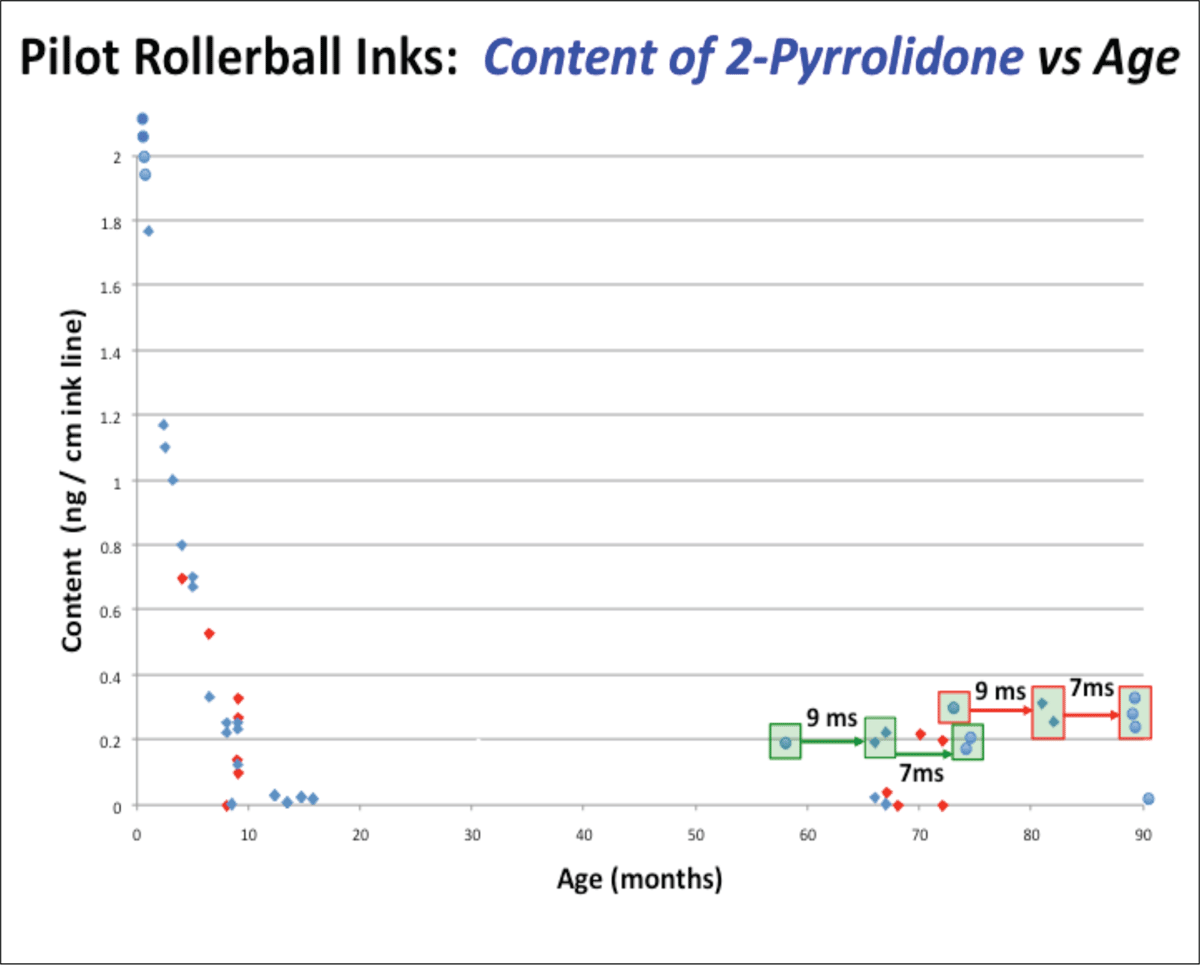
Figure 1
The content of the solvent 2-PD in the inks of known dated entries written with Pilot Precise V5 blue rollerball ink (data point depicted as blue diamonds and balls) and other Pilot rollerball inks of blue, black, red, and green colors (red diamonds). All the data points shown in this Figure were obtained when examining areas where two written lines completely overlapped (areas of intersection or retracing). The data points highlighted in green illustrate the processes of aging of two a priori old inks—ca. 5-year old (the data points in three boxes with green edges) and ca. 6-year old (the data points in three boxes with red edges) Pilot Precise V5 blue rollerball inks. The data shows the absence of further aging (further loss of the 2-PD) of these two old inks during the 16 months (first 9 months and then another 7 months) of their additional natural aging on paper.
Additionally, the loss of 2-PD from areas of paper in close proximity to ink strokes (mainly the paper’s areas inside short written loops) written with the above inks was observed. Paper blank samples are taken from inside short written loops because those areas of paper (inside the loop of a written letter or signature) should typically contain more of the ink’s solvent than any equal in size areas of paper either outside the loop of a written letter or next to ink strokes such as straight lines or gently sloping curves (see Figure 2).
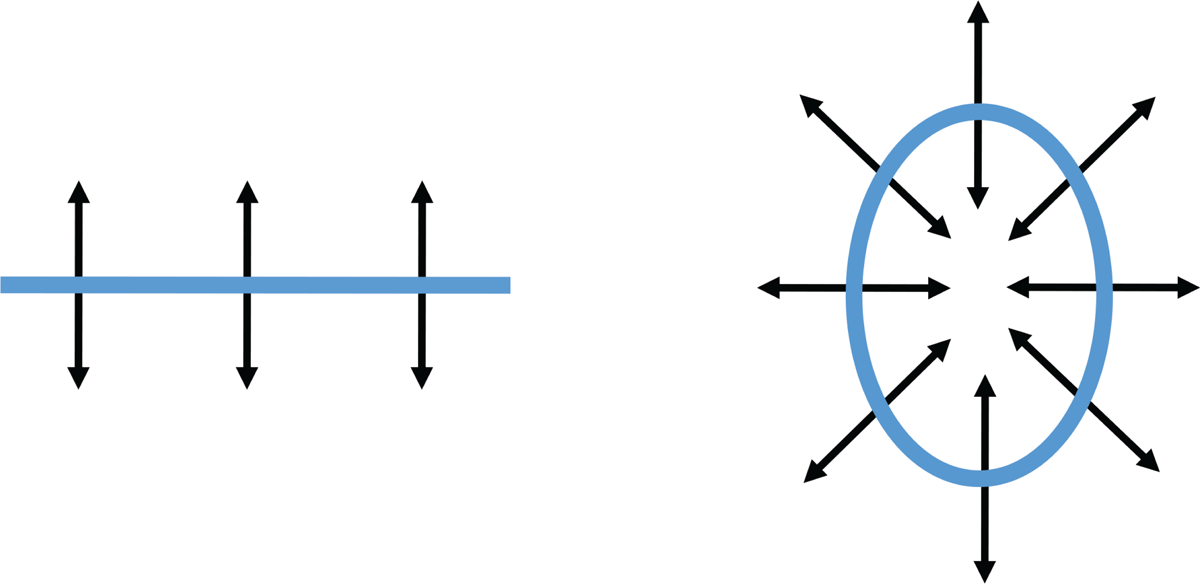
Figure 2
Solvent diffusion (shown with the arrows) away from a straight line (left) and diffusion inside and outside the loop of the letter “o” (right). (For more details see Figure 5 and the discussion concerning this figure in a paper by Weyermann et al. [28]).
The resulting data that illustrates the loss of 2-PD from areas of paper in close proximity (immediately next) to ink strokes is shown in Figure 3.
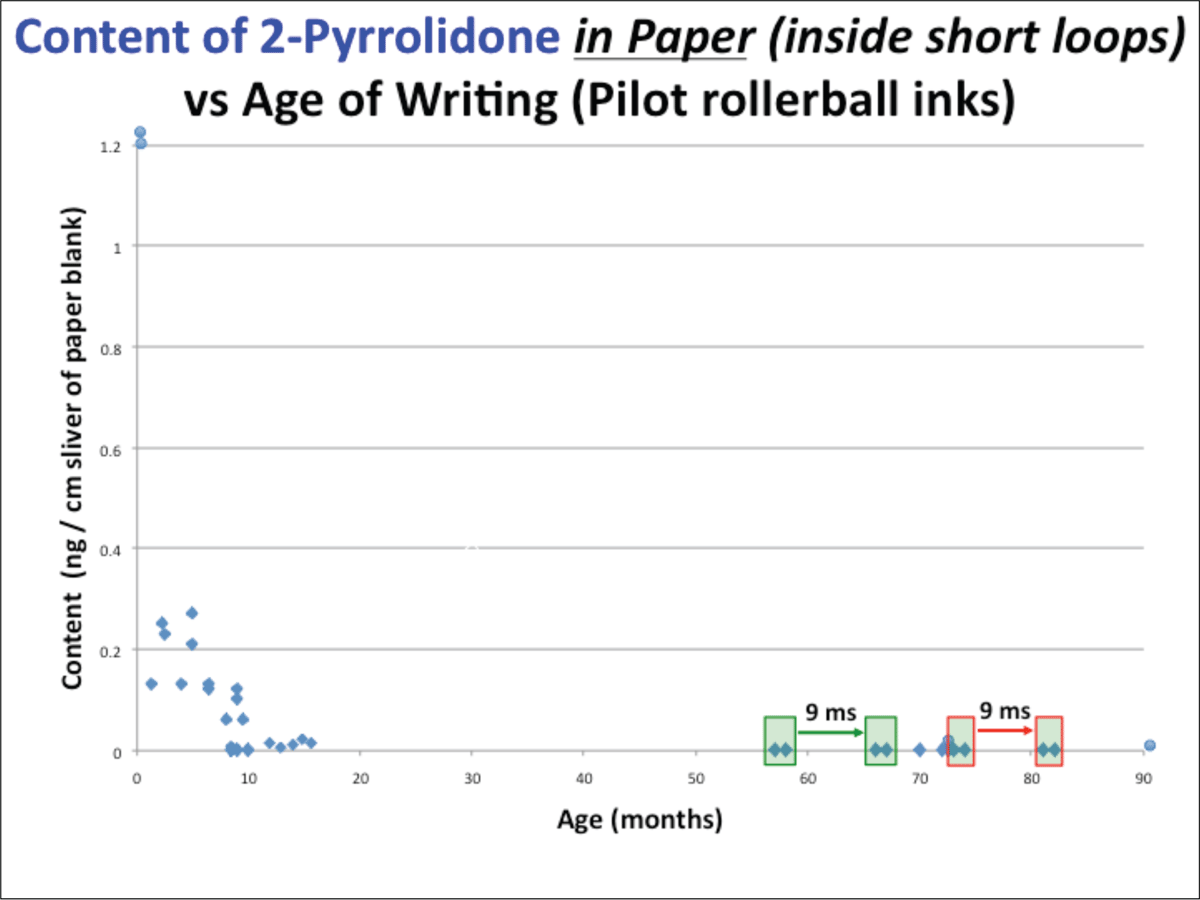
Figure 3
The content of the solvent 2-PD in the paper blank samples taken in close proximity to ink strokes (from the paper’s areas located inside written loops) of known dated entries written with Pilot rollerball inks of blue, black, red, and green colors (most of the data points, including those highlighted in green, relate to Pilot Precise V5 blue ink).
Discussion
Taking Ink Samples—The flow of water-based (‘liquid-like’) inks from rollerball pens is far more consistent than the flow of oil-based (‘paste-like’) inks from conventional ballpoint pens. Besides, unlike conventional ballpoint pens, rollerball pens typically do not produce skips and striations in written lines. Moreover, ‘liquid-like’ rollerball inks produce much more homogeneous ink lines (complete and practically uniform coverage across the width of the inked line) than ‘pastelike’ oil-based inks. For these reasons, when applying the ink aging methods, such as SLRM, to rollerball inks, one can take less amount of ink samples than that one has to take for oil-based ballpoint inks. The published recommendations regarding the sampling of oil-based ballpoint inks aimed at minimizing the sampling errors (caused by unequal amount of ink in samples taken from ink on paper) that affect the ink aging results obtained by the SLRM. Such sampling errors are unavoidable when the age of conventional ballpoint inks is evaluated using the SLRM. This is because these inks provide incomplete and irregular inking across the paper fibers that, in its turn, leads to significant variations in the content of the ink’s high boiling solvent in any two ink samples taken from the inked line, even if these samples were taken from adjacent areas of the ink line which look similar in thickness (degree of pressure), appearance and arrangement (distribution) of ink. At the same time, due to the excellent homogeneity of rollerball inks’ lines, the sampling error for these inks is significantly smaller than that for oil-based ballpoint inks, and therefore one does not need to take as many rollerball ink samples for the ink aging tests as it is recommended for oil-based ballpoint inks.
In this study, ink samples were taken according to the published recommendations [7, 10, 11, 12]. The ink samples were removed both from single ink lines and from the areas of the writings where two lines written by rollerball inks completely overlapped (areas of intersection and retracing). The latter was done to increase the scope of applicability of the ink aging method. The matter is that if two ink lines (written with constant pen pressure) intersected, then the layer of the ink on paper in the point of the intersection is significantly thicker than the thickness of each of the single lines. Thicker layers of ink (areas of intersection and retracing) will a priori “dry” for a longer period of time than thinner layers (single ink lines). That is, the content of any high boiling solvent in an area of retracing will be decreasing for a significantly longer period of time than the content of the same high boiling solvent in a single line of the same ink on paper. This evident deduction was confirmed by the experiments that showed that the natural aging curves “Content of 2-PD—Age of Ink” obtained for the inks tested in this study leveled off within less than 6 months, when single ink lines were tested, and within less than 12 months, when the areas of retracing and intersection of two ink lines were tested.
Analysis of Ink Samples—The data in Figure 1 shows that for each of the inks tested in this study, the content of the solvent 2-PD was decreasing during a certain period of time (up to less than 12 months) following the application of the ink to paper, and afterward no additional loss of the 2-PD was detected. For all types of paper and most of the inks tested in this work, the solvent 2-PD was practically completely lost within less than 12 months after the inks’ placement on paper (after that only trace amounts of 2-PD were detected by GC-MS). However, some of the tested inks did not lose the 2-PD completely. These inks (to be exact, the inks’ “binders”—non-volatile vehicle components, such as resins) were capable of retaining some residues of 2-PD in quantities that were reliably detected and quantified by GC-MS even in several years old inks on paper. It is important to note that these residual amounts of the solvent 2-PD (0.2 to 0.3 ng/cm ink line; see Figure 1) remained at the same level (did not decrease) when these several years old inks continued aging on paper. Graphically, the aging behavior of such inks that do not lose the solvent 2-PD completely during their natural aging on paper, can be described as follows. First, the “exponential-like” aging curve “Content of 2-PD—Age of Ink” decreases rather fast during the first weeks of the ink’s aging, and then the decrease slows down (during several months of the ink’s aging) transforming the aging curve into a virtually straight line that goes somewhat above and practically parallel to the horizontal axis of the graphic “Content of 2-PD—Age of Ink” (i.e., the aging curve decreases practically exponentially until it levels off and becomes a non-zero horizontal asymptote16). As an example, one can see from Figure 1 that, for each of the two a priori old inks, ca. 5-year old (the data points in three boxes with green edges) and 6-year old (the data points in three boxes with red edges) Pilot V5 blue rollerball inks, the content of the solvent 2-PD in the old ink (measurement A) remained practically unchanged as the ink continued aging on paper for another 16 months—first 9 months (measurement B) and then another 7 months (measurement C). This data clearly shows the absence of further aging (further loss of the 2-PD) of these two old inks during the 16 months of their additional natural aging on paper.
Analysis of Paper Blank Samples—The data in Figure 3 shows that for each of the inks tested in this study, a content of the solvent 2-PD in the areas of paper located in a very close proximity (immediately next) to ink strokes was decreasing at a measurable rate during the first several months after the inks’ placement on paper. For all types of paper and all of the inks tested in this work, the paper in close proximity to ink lines had lost the solvent 2-PD within less than 12 months after the inks’ placement on paper, and after that the GC-MS either did not detect the 2-PD at all or detected it at trace levels.
Thus, the results obtained in this study show that the aging tests that monitor/measure the loss of the high boiling solvent 2-PD from A) rollerball ink on paper and B) the paper itself (paper blank samples taken in close proximity to the ink’s lines) both provide valuable information about the actual age of the ink on paper, and thus the examination results obtained for both of these materials, ink and paper, compliment each other.
Case Example
In a civil case, the key issue was whether a contested document, which bears a printed text (solid black toner) and a handwritten signature, was signed in 1997, as dated (Hypothesis H1), or significantly later than 1997 (Hypothesis H2). The results of the microscopic, thin-layer chromatographic (TLC), and GC-MS examinations of the ink of the questioned (Q) signature showed that the signature was written with a Pilot Precise V5 blue rollerball pen ink.
Analysis of Ink Samples—The first examination of the Q signature using GC-MS began in June 2015, i.e. approximately 18 years after the document was purportedly signed. It was determined that the ink of the signature contained the solvent 2-PD. It was also determined that the content of the 2-PD in the ink of the signature (ca. 1 nanogram per 1-cm ink line) was significantly higher than that in strokes of multiple Pilot Precise V5 blue ink entries of several years old.
The second examination of the Q signature using GC-MS was conducted nine months later—in March 2016. It was determined that the ink of the signature still contained the solvent 2-PD, but the solvent’s concentration was significantly lower (approximately five times less) than that discovered in the same areas of the lines of the ink of this signature when it was initially examined in June 2015, i.e. nine months prior to the second examination (see Figure 4).
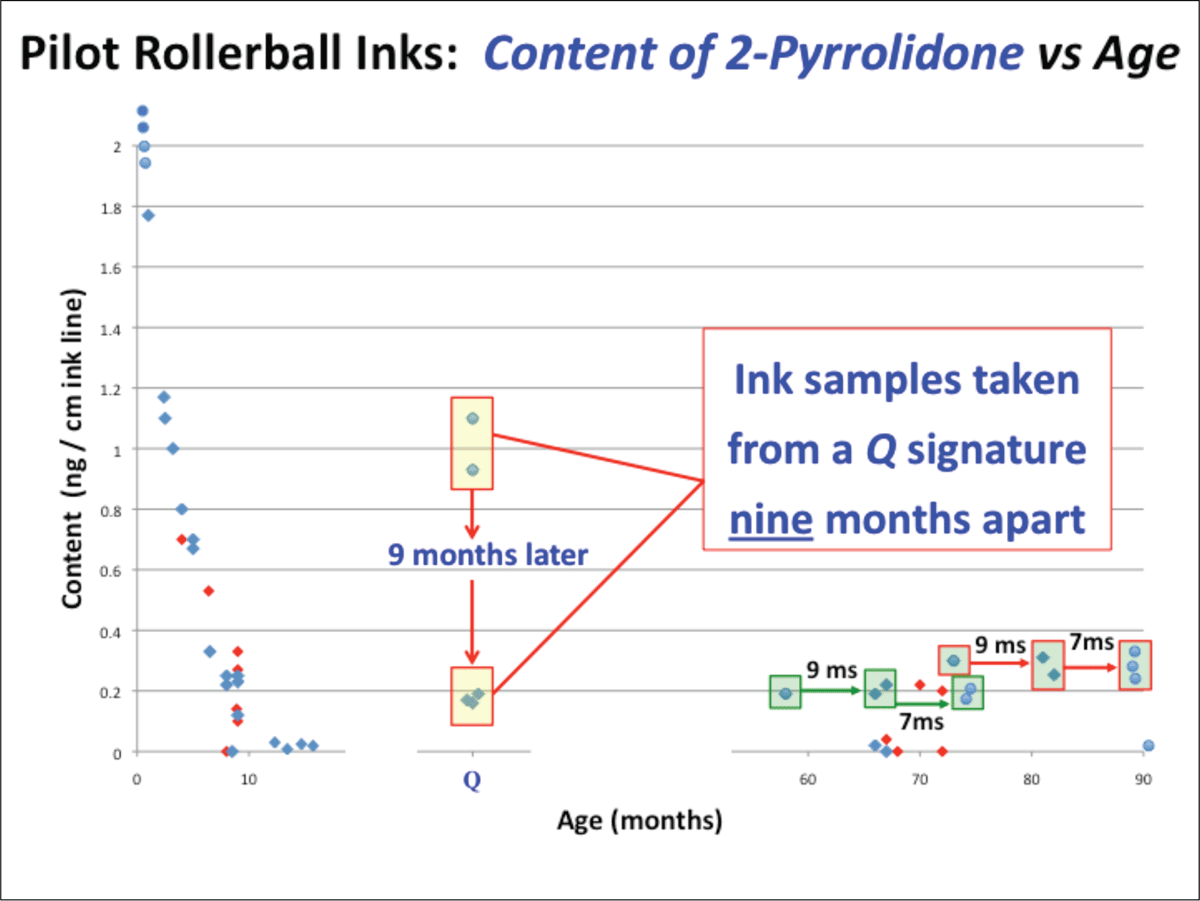
Figure 4
(A) The data points highlighted in yellow: the content of the solvent 2-PD in the ink of the Q signature was, in average, ca. 1.0 nanogram (ng) per 1-cm (about 0.4-inch) ink line in June 2015,17 and it decreased down to ca. 0.2 ng/cm ink line by March 2016. (B) The other data points on the graphic are the same ones shown in Figure 1 above. All the data points shown in this Figure were obtained when examining areas where two written lines completely overlapped (areas of intersection and retracing).
Such a significant loss (evaporation) of the solvent 2-PD from the ink of the Q signature that had taken place during the 9-month period of time between the first (June 2015) and second (March 2016) examinations evidences that at the June 2015 examination the ink of the signature was still in the active stage of its aging, which is inconsistent with this ink being as old as it purported to be—18 years old. Neither water-based (rollerball or gel) nor oil-based ballpoint inks exist that, being several years old (not to mention 18 years old), would be aging (loosing the inks’ solvents) at a rate significantly greater than zero.
Analysis of Paper Blank Samples—At the first examination of the Q signature using GC-MS in June 2015, it was determined that the paper of the contested document in close proximity (immediately next) to the ink lines of the signature also contained (as the ink of the signature did) the solvent 2-PD. Moreover, it was determined that the content of the 2-PD in the paper areas located in close proximity to the ink strokes of the signature (ca. 0.75 ng per 1-cm “line”/”sliver” of paper) was significantly higher than the content of the 2-PD in the paper immediately next to the strokes of multiple Pilot Precise V5 blue ink entries of several years old. It is very unlikely that the paper near ink lines of an 18-year old signature written with any water-based writing ink would contain significant amounts of the ink’s solvent. Also, it is important to note that the paper inside written loops of the Q signature contained essentially as much 2-PD as the ink lines themselves (compare the pertinent data in Figure 4 and Figure 5 that follows). Based on this author’s experience, such a high content of the ink’s high boiling solvent in the areas of paper located inside written loops occurs only while the ink on paper is still ‘wet’ and the ink’s high boiling solvent (in this case it is 2-PD) is still diffusing in significant amounts from the ink into the paper.
At the second examination of the contested document in March 2016, it was determined that the paper in close proximity to the ink strokes of the Q signature still contained the solvent 2-PD, but the solvent’s concentration in the paper was significantly lower (approximately six times less) than that discovered in the same areas of the paper at the initial examination in June 2015, i.e. nine months prior to the second examination (see Figure 5).
Such a significant loss (evaporation) of the solvent 2-PD from the paper’s areas near the Q signature that had taken place during the 9-month period of time between the first (June 2015) and second (March 2016) examinations evidences that in June 2015 the ink of the signature was still in the active stage of its aging (because the significant amounts of the 2-PD were still diffusing from the ink lines into the paper of the document), which is inconsistent with the ink of the signature being 18 years old. It is extremely unlikely that paper near an 18-year old water-based (rollerball or gel) ink entry would A) contain significant amounts of the ink’s solvent, and B) continue losing the solvent (through its evaporation) at a rate significantly greater than zero.
It should be noted that the solvent 2-PD was not detected (above the limit of detection) in any toner-on-paper (printed text of the document) or paper blank samples that were taken from the areas of the document that were not near the Q signature.18
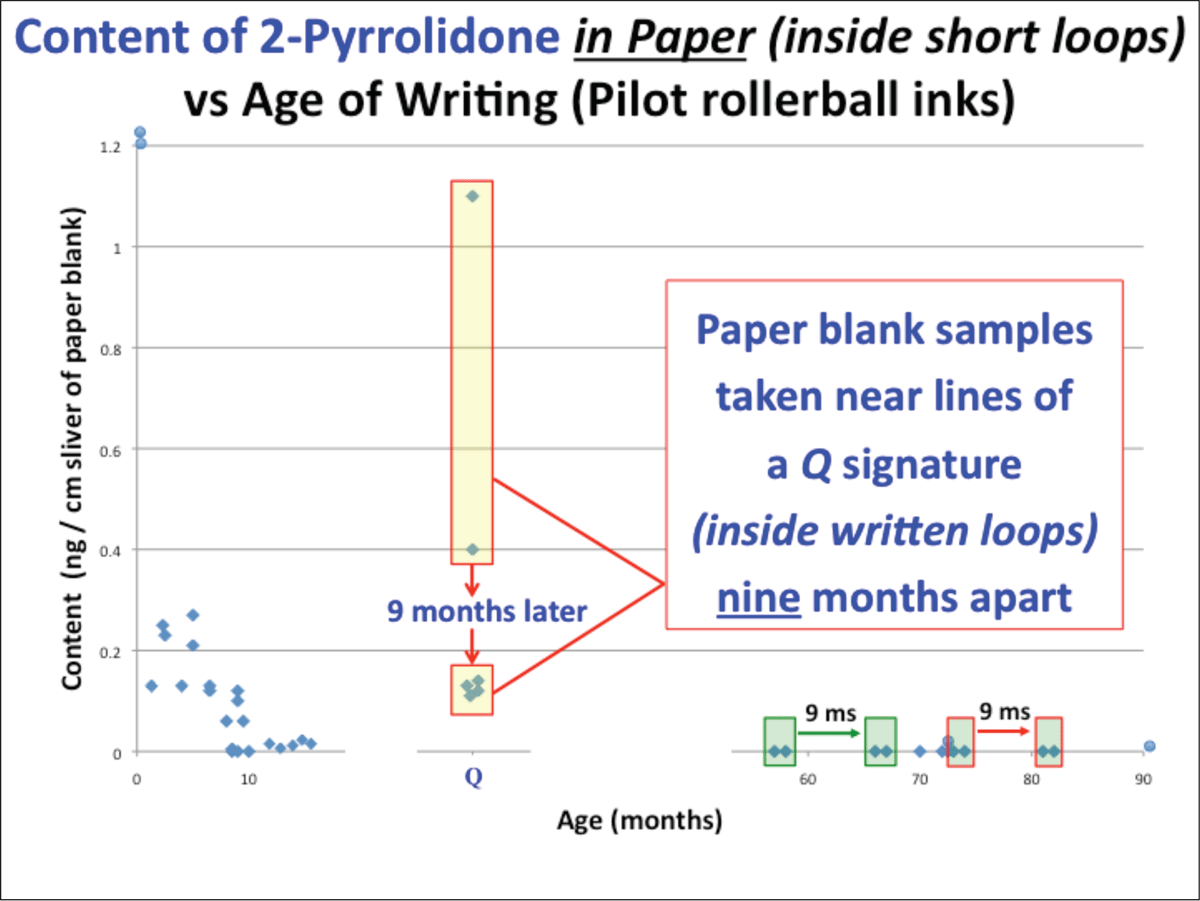
Figure 5
(A) The data points highlighted in yellow: the content of the solvent 2-PD in the paper blank samples taken in close proximity to ink strokes (from the paper’s areas located inside written loops) of the Q signature was, in average, ca. 0.75 ng per 1-cm sliver of paper in June 2015,19 and it decreased down to ca. 0.13 ng per 1-cm sliver of paper by March 2016. (B) The other data points on the graphic are the same ones shown in Figure 3 above.
Having evaluated the examination results described above, this author concluded that these results strongly supported the proposition that the Q signature was written on the contested document significantly later than 1997 (the above Hypothesis H2), and that these results provided essentially no support for the proposition that the signature was written in 1997, as dated (Hypothesis H1).
Conclusion
This paper analyzes the exparimental data reported for the ink aging method that measures a gradual loss (due to evaporation and diffusion into paper) of high boiling solvents from ink on paper—both oil/glycol-based inks (conventional ballpoint inks) and water-based inks (rollerball and gel ballpoint pen, felt tip pen, stamp pad, and inkjet inks). The numerous experimental data obtained for ballpoint ink lines written with medium-to-strong pen pressure, evidence that the scope of applicability (SOA) of the ink-aging method for determining the age of ballpoint ink on paper does not exceed six months.
Also, this paper shows that for certain types of water-based inks, such as rollerball inks, which produce ink strokes homogeneously filled with ink within the confines of ink lines, the SOA of the method can be extended beyond the above 6-month limit and achieve up to ca. 1 year, if the writing to be tested contains sufficient quantities of ‘thick’ layers of ink on paper, such as the areas of retracing and intersection of two ink lines. Thus, the study conducted in this work that monitored a gradual loss (due to evaporation, diffusion into paper) of the high boiling solvent 2-pyrrolidone (2-PD) from strokes written with various Pilot rollerball inks has shown that the rate of the loss of the 2-PD from inks after their placement on paper, as well as from paper in close proximity (immediately next) to ink strokes, may correlate with the age of the inks during up to 12 months following the application of the inks to paper (the natural aging curves “Content of 2-PD—Age of Ink” obtained for the inks tested in this study leveled off within less than 6 months, when single ink lines were tested, and within less than 12 months, when the areas of retracing and intersection of two ink lines were tested). Hence, it follows that a monitoring of the gradual loss (with age) of 2-PD both from the ‘thick’ lines of inks on paper and from paper in close proximity to the inks’ lines allows one to distinguish between fresh (less than 12 months old) and old (significantly older than one year) writings.
Notes
[1] Presented at the Annual Meeting of the Australasian Society of Forensic Document Examiners, Sydney, Australia, April 27-29, 2016, the 9th International Congress of Experts in Forensic Document Analysis (SIPDO 2016), Medellin, Colombia, October 1-5, 2016, and the 75th Meeting of the American Society of Questioned Document Examiners, San Diego, California, August 28–September 1, 2017.
[2] 2-PE is a high boiling organic solvent (boiling point is 247°C) that is used for manufacturing the majority (ca. 90% [17]) of oil/glycol-based ballpoint inks.
[3] 2-PD is a high boiling organic solvent (boiling point is 245°C) that is used for manufacturing some water-based rollerball pen and inkjet inks.
[4] Several major chain stores, such as Staples Inc., OfficeDepot, Target, and Walmart, advertise Pilot Precise V5 pen as “America’s #1 Selling Rolling Ball Pen.”
[5] The SET has been developed for determining the age of conventional (oil-based) ballpoint inks. It is this author’s opinion that, due to significant differences in the relative amounts and chemical properties (and therefore in the mechanisms of aging) of the resins present in oil-based and water-based inks, the SET is not applicable to dating water-based inks on paper.
[6] R% is not truly a rate (in the sense of a change per unit time), but rather an ink aging parameter that can be associated with a rate in that a high value implies a high (fast) rate and a low number implies a low (slow) rate. Mathematically, this ink aging parameter can be considered as the derivative of a function (R% is a function of the age of ink on paper) at a chosen input value that describes the best linear approximation of the function near that input value. In other words, the derivative at a point of a function (R%) of a single variable (age of ink) is the slope of the tangent line to the graph (the aging curve “ink aging parameter R% - age of ink”) of the function at that point.
[7] The SLRM is based on using the accelerated aging of ink for preparing artificially aged ink samples that mimic aged writing, as if the ink had been aged naturally. Thus, instead of obtaining the natural aging curve for the ink being analyzed, the SLRM obtains the accelerated aging curve, which “can be thought as equivalent to ‘squeezing’ the time/age axis of the natural aging curve (beginning at a specified ink age). That is, the accelerated aging curve takes on the shape of the natural aging curve (beginning at a specified ink age) with its time/age axis shrunk” [11, p. 7]. That is, the SLRM is the ‘accelerated-aging’ version of the ‘natural-aging’ methodology that ‘monitors’ (measures) the evaporation of high boiling solvents from inks on paper.
[8] Solvent evaporation is the first aging process to begin after any ink (either ‘oil-based’ or ‘water-based’) was applied to paper. Therefore, in this paper, all pertinent experimental data obtained by the ink aging methods that monitor/measure the gradual loss of high boiling solvents from ink on paper, which has been published for both ‘oil-based’ and ‘water-based’ inks, is discussed and arranged in tabular form for comparison (see Table 1 that follows).
[9] Multiple studies on the subject published in languages different than English were not included in this table.
[10] Subsequent to the presentation of the 2002 paper, one of the authors has stated that unless an ink on paper is “fresh” (less than several months old), the solvent PE is typically either not detected at all in paper blank samples taken from areas in a close proximity (immediately next) to ink lines or it is detected in such paper blank samples in very small (trace) amounts [15]. Similar results have been obtained by Weyermann [29] and Aginsky [9].
[11] “Including experimental error […] 300 days is the latest point on the [aging] curve [“R% - Age of Ink”] where R% can be equal-to or greater than 25. This value would allow us to state that ink has been applied to paper less than 300 days preceding the date of analysis. R% values are less than 25 after 300 days”[11, p. 9].
[13] The analysis of an extensive set of experimental data (286 R% values), which had been obtained by the CBSA laboratory by 2010 when examining numerous ballpoint inks using SLRM (further referred to as the “2010 experimental data”), showed that if one were to apply the above 25% threshold to the “2010 experimental data”, then multiple inks not only older than 10 months, but sufficiently older than 2 years would show falsepositive results (i.e., multiple inks, which were known to be older than 2 years, showed R% > 25%) [34].
[14] This new 35%-threshold was reported by Gaudreau and Aginsky in a conference paper presented in 2010 [12]. Note: No aging curves and/or corresponding numerical data were reported in the 2010 paper (or in any other publication thereafter) that would show that the ink aging parameter R% did correlate with the age of a certain ink(s) during a timeframe as long as 18 months (i.e., that the decrease of R% with the age of ink was statistically valid during up to 18 months after the ink’s placement on paper). Furthermore, a recent evaluation of the “2010 experimental data” showed that numerous false-positive results were obtained even if one were to use this new (revised) 35% threshold. This clearly shows that the 35% threshold is unacceptable and should not be used with the SLRM [34].
[15] The validation studies of this ink-aging technique conducted recently [32] showed that more accurate results were obtained by monitoring the aging behavior of the ink (by measuring the loss of the solvent PE over time) than by comparing the R% values (obtained for each ink) with the predetermined R% threshold values. The monitoring of the aging behavior of ink on paper “allows the detection of a tendency (i.e., a statistical trend) on several measurements made over time. If a tendency is detected, it is concluded that the ink is still aging (e.g., < 6 months old). If no trend is detected, then no conclusion can be drawn concerning the age of the ink entry. This model is more suitable because the aging curves proved to be more reproducible than absolute [R%] values” [32].
[16] The content of the 2-PD continues decreasing with time, but the slope of the graph “Content of 2-PD—Age of Ink” becomes too close to zero, and thus any additional decrease in the content of the 2-PD that might be still occurring becomes too small to be accurately measured (i.e., even if there is a small loss of the 2-PD from an ink on paper, it no longer correlates with the ink’s age).
[17] The difference in the 2-PE content in the two ink samples (each sample contained two 0.5-mm microplugs of ink on paper) analyzed in June 2015 is 1.1 - 0.9 = 0.2 ng. That is, the data deviate by ca. 10% from the average (mean value) of 1.0 ng. Based on this author’s experience, such a dispersion of the measurement data as 10% above and below the arithmetic mean is quite typical when measuring the content of a high boiling solvent in ink lines, especially when relatively ‘fresh’ inks on paper are analyzed. Anyway, the difference between the two ink samples analyzed in June 2015 is significantly less than an almost 80% loss of 2-PD when comparing the 2-PD content in the two ink samples analyzed in June 2015 and in three ink samples analyzed 9 months later - in March 2016.
[18] Some trace amounts of the solvent 2-PD were detected in multiple areas of the paper of the document located relatively far (several centimeters) from the Q signature. This can be explained as follows. First, the lateral diffusion of a particular solvent from ink line into the paper depends on many variables, e.g., the physical and chemical properties of the solvent, the thickness and chemical composition of the paper, the thickness of the ink line, and storage conditions. Secondly, if document “A”, which bears a relatively fresh writing ink (the ink that is still evaporating and diffusing into the paper), is placed, say, in a two-page file folder (or between other documents that would create a “sandwich” with the “A” document in the middle), the ink’s high boiling solvent becomes “partially encapsulated” inside the file folder, and therefore, instead of evaporating in ambient air, it will be “forced” to continue spreading further into the paper of the “A” document away from the ink line. Moreover, being to some extent restricted by the folder (by the pages of the folder located above and beneath the “A” document) from evaporating into ambient air, the solvent’s vapor will desorb from and then partially absorb back into the paper of the “A” document many times (multiple acts of desorption and sorption) when “travelling” (as vapor) away from the ink line. As a result of that, trace amounts of the solvent can well be detected even at the edges of the “A” document.
[19] The significant difference in the 2-PE content in two paper blank samples, A (1.1 ng of 2-PD) and B (0.4 ng of 2-PD), analyzed in June 2015 (each sample contained two 0.5-mm microplugs of paper), is explained as follows: sample A was taken a few millimeters closer to the point of the intersection of two ink strokes (inside a written loop) than sample B. When a high boiling solvent diffuses from an ink line into the paper its concentration in the paper is maximum immediately next to the ink line and it sharply decreases in the areas of the paper that are only a few millimeters away from the ink line. The two microplugs of paper of sample A were taken significantly closer to ink lines, and therefore sample A contained significantly larger amounts of 2-PD (1.1 ng) than the two microplugs of paper of sample B (0.4 ng). Anyway, both paper blank samples, A (1.1 ng of 2-PD) and B (0.4 ng), which were analyzed in June 2015, showed a significantly higher content of the 2-PD than any of the four paper blank samples analyzed 9 months later—in March 2016.