
Introduction
Comparison of handwriting to determine authorship or non-authorship requires the Forensic Document Examiner (FDE) make numerous subjective judgments, such as whether the evidence presented is too limited to warrant a conclusive or even qualified opinion. One of the reasons handwriting can be identified is that, given a sufficient amount of writing, it is highly unlikely that two people will produce the same handwriting in terms of the combination of its characteristics. Found and Rogers (1) describe the judgment of whether there is a sufficient amount of evidence in a writing sample to give a reliable opinion as “complexity assessment.” They point out that even if two writings are similar in every respect, low complexity writing can be easily simulated without indication of the simulation process or, alternatively, another writer may exhibit the same combination of handwriting characteristics with no observable differences.1
Recent studies have revealed that understanding and judging complexity is vital to the reliability of opinions. In research involving the ability to discern between genuine and simulated signatures, FDEs gave more correct opinions on signatures of high complexity than those with low complexity (2, 3).
Standard procedures for examining handwriting (4) direct the examiner to “(d)etermine if there is a sufficient quantity of writing,” but research on what is meant by “sufficient” is lacking. Early literature on questioned document examinations does not mention complexity or define sufficiency of writing, but assertions are made that certain qualities such as fluency and legibility make a writing sample more difficult to simulate. Osborn (5) maintained that slow, careless, and unskilled writing is easier to simulate than fluent and dexterous writing. Harrison (6) stated that “The type of signature which is the most difficult to forge is not that which approximates to a florid and practically illegible scrawl, but one which is carefully and accurately written with shaded strokes, and in which every letter can be distinguished.”
Brault and Plamondon (7) studied the problem of identifying simulations through automatic signature verification and recognized that precision of these systems could be improved by establishing a special value that quantifies how difficult it would be for the typical simulator to imitate a particular signature. They developed an “imitation difficulty coefficient” based on a formula that models the complex processes involving perception, memorization, and muscle coordination the imitator employs to execute a simulation. Line length, stroke duration, and angularity of turning points were included in the formula. The higher the difficulty coefficient, the larger the variation in one person’s genuine signature can be and, therefore, the lower the threshold for a new signature to be accepted as valid. However, the authors concluded that their model could be improved by including how the simulator perceives and memorizes the signature to be imitated, a subject for further study.
In more recent research, Found and Rogers (8) analyzed which factors make a signature difficult to simulate, but limited their study to variables that could be observed and counted in a static signature. In this way, an FDE can calculate the complexity of a questioned signature in order to provide quantitative support for a conclusive opinion or as an indication that caution should be exercised. It was discovered that the number of turning points and line intersections or retraces best explain the FDE’s assessment of signatures as being low, medium, or high complexity. The Found and Rogers (8) model could predict over 70% of experts’ perceptions of complexity. This study, however, did not take signature style into account. Alewijnse, et al. (9) also studied the factors that contribute toward signature complexity, including the total line length and legibility along with turning points and intersections as predictor variables in her complexity formula. Their results were consistent with the Found and Rogers’ complexity model.
This study attempts to expand on previous research by including dynamically sampled kinematic features in developing models for different signature styles that best explain variability in the FDE’s perception of complexity. This would be particularly useful in the relatively new endeavor of comparing electronically captured signatures, where kinematic data is recorded as the subject signs on a tablet or other digitizing device. A formal draft methodology to conduct such examinations is in development (10). In traditional static signature comparisons, the FDE may not be able to calculate kinematic features like stroke duration, speed, and pressure, but examiners often infer these measures (11). We also follow up on the work of Alewijnse and examine whether signature legibility or style2 impacts the relationships between kinematic features of a signature and the FDE’s perception of complexity.
Methods and Materials
Participants and Signatures
We obtained natural signatures from 123 individuals recruited from the Los Angeles Police Department, Forensic Science Division and the Los Angeles County Sheriff’s Department, Scientific Services Bureau. Study subjects were 56 male and 67 female, with an age range of 21 to 70 years old. Ten subjects were left-handed writers, and three identified themselves as ambidextrous. Subjects signed informed consent forms to participate in this study.
Signatures were written on a blank check template placed over a Wacom Intuos® Pro digitizing tablet with a 22.3 x 14 cm active area. The tablet has a sampling rate of 132 Hz, RMS accuracy of 0.001 cm, and 2048 levels of pen pressure. MovAlyzeR®3 software was used for on-line recording of signatures. The software allows precise extraction of pen movement in the horizonal direcion (x), vertical direction (y), and pressure (z) dimensions from each pen stroke. The signature line of the template was approximately 3 inches long, with one inch of vertical space above it. Each person contributed five signatures written within the same session. Subjects used a Wacom inking pen so that the original inked signature was obtained along with the recorded data.
Complexity Ratings
Five FDEs with an average (sd) of 28.8 (8.9) years of experience performed the complexity ratings. Raters were emailed a document, where each page consisted of 300 dpi images of the five inked signatures from a single writer in order to give the FDE an idea of the writer’s range of variation. The participants were instructed to think of complexity in terms of the ease of which the signature could be simulated without detection by an FDE. Raters were asked how difficult it would be to successfully simulate the signature using a five-point scale: Easy, Fairly Easy, Medium, Difficult, or Very Difficult. Numbers were assigned to these labels with 1 for Easy, 2 for Fairly Easy, 3 for Medium, 4 for Difficult, and 5 for Very Difficult. For the purpose of statistical analyses, an overall complexity score was derived from the mean rating from the five FDEs.
Subjective ratings, even by expert examiners, can be inconsistent. To address this issue, we excluded from further analyses signatures that had ratings varying by more than one level across the five FDEs. Fifteen (12.2%) signatures met criteria for exclusion. Thus, we report results from the remaining 108 signatures associated with relatively consistent complexity assessments. This included 30 text-based, 44 mixed, and 34 stylized forms. Figure 1 shows examples of signatures written in the three styles.
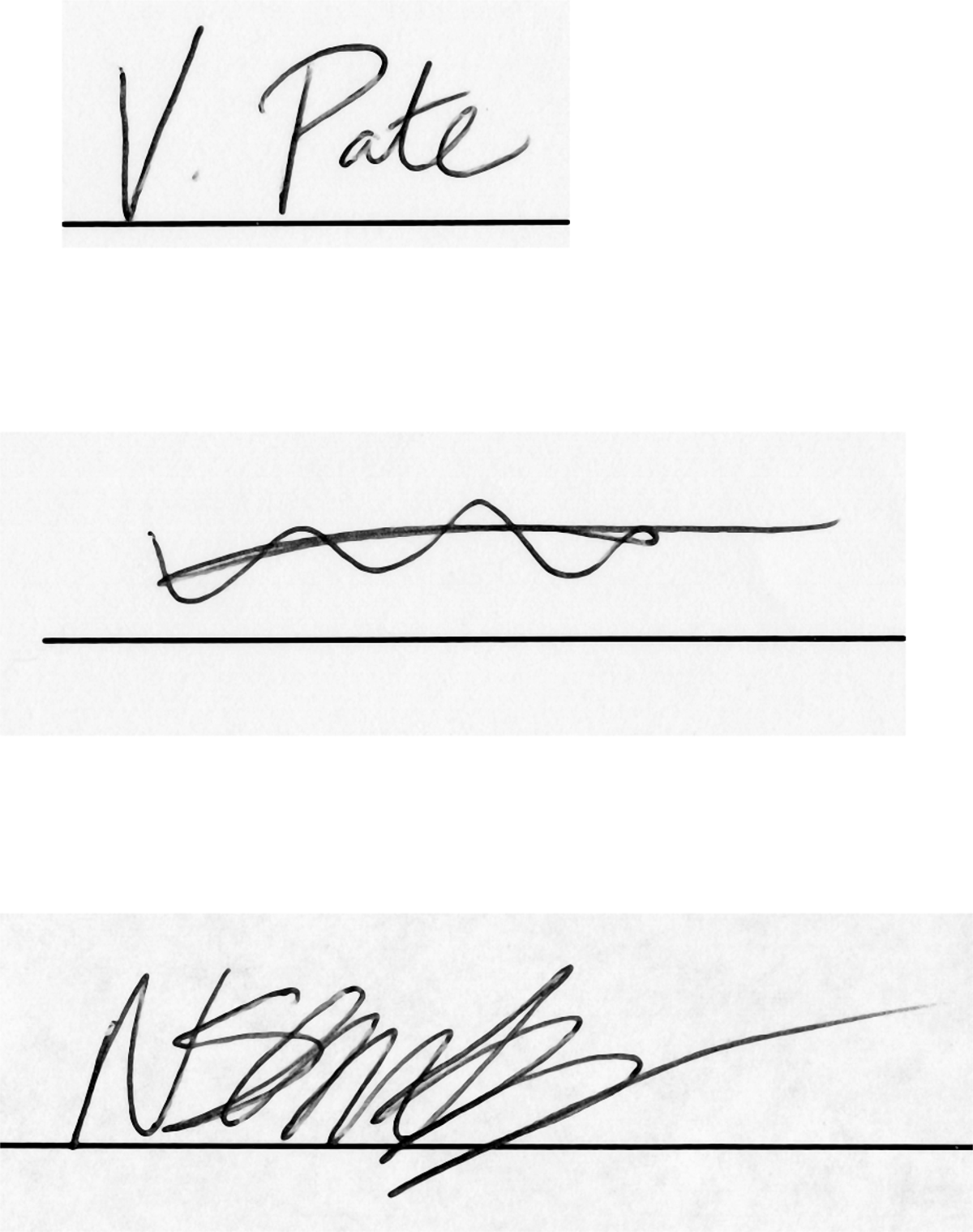
Figure 1
Examples of a text-based (top), stylized (middle), and mixed style (bottom) signature.
Embedded within the packets of 108 signatures were duplicates of seven signatures to test intrarater consistency. FDE reliability was examined by subjecting the complexity judgments of the seven repeated signatures to an intraclass correlation coefficient (ICC) test. Results revealed an ICC of 0.99 for 35 pairs of complexity judgments, suggesting very high test-retest reliability among the five FDEs. Of the 35 reliability pairs, only two (5.7%) had complexity ratings that differed by more than one point.
Kinematic Analyses
MovAlyzeR® software was used to extract kinematic stroke features from each signature. Multiple kinematic parameters along with pen pressure were extracted from vertical and horizontal pen strokes. Parameters examined in this study included vertical and horizontal stroke amplitude, vertical stroke velocity and acceleration, vertical stroke duration, slant, road (trace) length, straightness variability, pen down duration, normalized jerk (smoothness), and pen pressure. Vertical and horizontal stroke movements were segmented using the local minima of the absolute velocity time curve, that is, the time points when vertical pen movement direction changes (13). Features associated with upstrokes were examined separately from downstrokes since it is likely variables such as slant, pen pressure, and velocity would be influenced by stroke direction. The mean and standard deviation were calculated for each kinematic variable across the five repetitions for each of the 108 writers. Table 1 shows the stroke features extracted from MovAlyzeR®, along with a brief description.
Table 1
List of stroke features extracted from MovAlyzeR and their definitions1
| Variable | Definition |
|---|---|
| Absolute Size | Absolute size of a vertical stroke in cm, calculated from the vertical and horizontal sizes |
| Average Absolute Velocity | Average (amplitude/time) absolute vertical velocity for a single stroke, in cm/second |
| Average Normalized Jerk | A measure of handwriting smoothness across all strokes, normalized for stroke duration and length |
| Average Pen Pressure | Average of pen pressure values over a stroke (ranging from 0–2047 units) |
| Stroke Duration | Time interval in seconds for a single vertical stroke, identified as movement occurring between two successive x-axis zero-velocity crossings (i.e. at the point of a change in stroke direction). |
| Horizontal Size | Horizontal vector difference between the beginning and end of a stroke, in cm |
| Loop Surface | Area of the loop enclosed by the previous and present stroke, in cm2 |
| Number Peak Acceleration Points | A measure of handwriting smoothness measured at the stroke level defined as the number of acceleration inversions (i.e. changes in direction) |
| Number of Strokes | Segmentation by absolute velocity minima, similar to number of turning points |
| Peak Vertical Acceleration | Instantaneous vertical acceleration, in cm/sec/sec |
| Peak Vertical Velocity | Instantaneous vertical velocity, in cm/sec |
| Road Length/Trace Length | Length of segment in cm from beginning to end |
| Slant | Stroke angle and its direction (see Stroke Duration for definition of segment) in radians |
| Straightness Error | Normalized standard deviation of the stroke trajectory from a straight line |
Statistical Analyses
One-way analyses of variance (ANOVA) were used to test effects of signature style on stroke kinematics and FDE judgment of signature complexity. Results with p-values ≤ 0.05 were considered statistically significant. For significant effects, post-hoc Scheffè tests were used for paired comparisons.
We used stepwise multiple regression analyses to model the relationship between judgments of signature complexity and kinematic features. Three models were generated, one for each signature style. Using a backward stepwise approach, features with F-ratios ≤ 3.99 were automatically removed from the potential model. Kinematic variables found to be highly correlated with othervariables (i.e. collinearity) were excluded from the regression analyses. Independent variables remaining in the final models were then combined to generate a single composite “kinematic score” to estimate signature complexity. These multivariate predictive models based on stroke kinematic scores can be used to explain a significant portion of the variability in FDE judgments of complexity.
Results
Table 2 shows the means and standard deviations for each kinematic feature and the complexity scores for signatures for the three signature styles. The effects of signature style on stroke kinematics were statistically significant for several features including: peak vertical velocity for downstrokes and upstrokes (p < 0.001), horizontal size for downstrokes (p < 0.01) and upstrokes (p < 0.0001), absolute vertical size for downstrokes and upstrokes (p < 0.0001), absolute average vertical velocity for downstrokes (p < 0.0001) and upstrokes (p < 0.0001), roadlength for downstrokes and upstrokes (p < 0.0001), and straightness error for downstrokes (p < 0.05) and upstrokes (p < 0.01). Kinematic features that did not differ between signature styles included stroke duration, the two measures of handwriting smoothness (average normalized jerk and number of acceleration peaks), and pen pressure.
Table 2
Mean and standard deviation for each kinematic variable and complexity score, separated by style.
| Stylized (n = 34) | Mixed (n = 44) | Text-Based (n = 30) | |||||
|---|---|---|---|---|---|---|---|
| Variable (Mean) | Stroke Direction | Mean | SD | Mean | SD | Mean | SD |
| Duration, sec | Down | 0.13 | 0.04 | 0.14 | 0.03 | 0.14 | 0.02 |
| Up | 0.15 | 0.04 | 0.17 | 0.05 | 0.17 | 0.03 | |
| Peak Vertical Velocity, cm/s | Down | –7.99 | 3.84 | –6.53 | 3.03 | –4.73 | 1.74 |
| Up | 7.54 | 3.97 | 6.21 | 2.93 | 4.45 | 1.52 | |
| Peak Vertical Acceleration, cm/sec/sec | Down | –209.00 | 135.49 | –93.46 | 452.53 | –107.98 | 44.91 |
| Up | 190.42 | 113.62 | 185.16 | 390.96 | 95.29 | 40.03 | |
| Horizontal Size, cm | Down | –0.39 | 0.56 | –0.16 | 0.32 | –0.07 | 0.11 |
| Up | 0.94 | 0.76 | 0.53 | 0.32 | 0.30 | 0.13 | |
| Straightness Error | Down | 0.03 | 0.02 | 0.04 | 0.02 | 0.04 | 0.02 |
| Up | 0.03 | 0.02 | 0.04 | 0.02 | 0.05 | 0.02 | |
| Slant, radians | Down | –1.78 | 0.41 | –1.74 | 0.37 | –1.72 | 0.29 |
| Up | 0.77 | 0.33 | 0.85 | 0.30 | 0.87 | 0.24 | |
| Loop Surface | Down | 0.00 | 0.19 | 0.02 | 0.06 | 0.01 | 0.01 |
| Up | 0.00 | 0.10 | –0.02 | 0.03 | 0.00 | 0.01 | |
| Absolute Vertical Size | Down | 1.06 | 0.55 | 0.74 | 0.37 | 0.45 | 0.13 |
| Up | 1.32 | 0.70 | 0.89 | 0.48 | 0.54 | 0.11 | |
| Average Absolute Velocity | Down | 8.53 | 4.35 | 5.99 | 2.74 | 3.65 | 1.10 |
| Up | 9.53 | 5.12 | 6.24 | 2.93 | 3.84 | 0.99 | |
| Roadlength/Trace Length | Down | 1.21 | 0.65 | 0.92 | 0.49 | 0.55 | 0.16 |
| Up | 1.54 | 0.84 | 1.12 | 0.71 | 0.70 | 0.17 | |
| Average Normalized Jerk | Down | 23.22 | 33.54 | 52.51 | 97.40 | 54.12 | 75.89 |
| Up | 23.60 | 33.90 | 53.69 | 99.83 | 52.84 | 71.20 | |
| Number of Acceleration Peaks/Stroke | Down | 1.34 | 0.45 | 1.39 | 0.38 | 1.32 | 0.22 |
| Up | 1.56 | 0.38 | 1.76 | 0.65 | 1.68 | 0.33 | |
| Total number strokes | Both | 32.97 | 12.93 | 52.84 | 20.50 | 81.84 | 21.11 |
| Mean Pen Pressure | Down | 553.02 | 161.28 | 535.28 | 106.58 | 499.72 | 100.72 |
| Up | 521.55 | 172.03 | 485.64 | 118.21 | 448.16 | 94.54 | |
| Complexity Score | 3.14 | 1.06 | 3.54 | 0.90 | 4.19 | 0.60 | |
The mean FDE judgment score for signature complexity was significantly greater for textbased signatures than either mixed style (p < 0.02) or stylized signatures (p < 0.0001). Mean complexity scores for mixed and stylized signatures were not significantly different from each other.
Table 3 shows the results of the multiple regression analyses for estimating signature complexity for three signature styles. Models ranged in size from three (text-based) to eight variables (mixed style). These models accounted for 71%, 76%, and 79% of the variation in complexity judgment for text-based, stylized, and mixedstyle signatures, respectively.
Table 3
Formulas and results from multiple regression analysis for 30 text-based, 44 mixed, and 34 stylized signatures. Shown are kinematic variables reaching statistical significance as independent predictors of complexity perception.
| Signature Style | Kinematic Model | ANOVA | R2 |
|---|---|---|---|
| Stylized | Complexity = 0.16 – (0.802*Horizontal Size Down) + (0.1217*Peak Vertical Velocity Up) – (0.0824*Average Absolute Velocity Up) + (0.0769*Total Strokes) | F(4,29) = 23.37; p < 0.0001 | 0.76 |
| Mixed | Complexity = –1.75 + (0.14*Peak Vertical Velocity Down) – (0.00052*Peak Vertical Acceleration Down) – (0.8557*Slant Down) + (15.75*Straightness Error Up) + (1.4835*Slant Up) + (0.246*Average Absolute Velocity Up) – (0.638*Road length Up) + (0.0363*Total Strokes) | F(8,35) = 16.54; p < 0.0001 | 0.79 |
| Text-Based | Complexity = 3.71 – (13.371 * Duration Down) + (1.4511*Road length Up) + (0.0164*Total Strokes) | F(3,26) = 21.18; p < 0.0001 | 0.71 |
Figures 2, 3, 4 show the relationships between a composite kinematic score calculated from the kinematic models shown in Table 3 and the mean FDE signature complexity score for three signature styles.
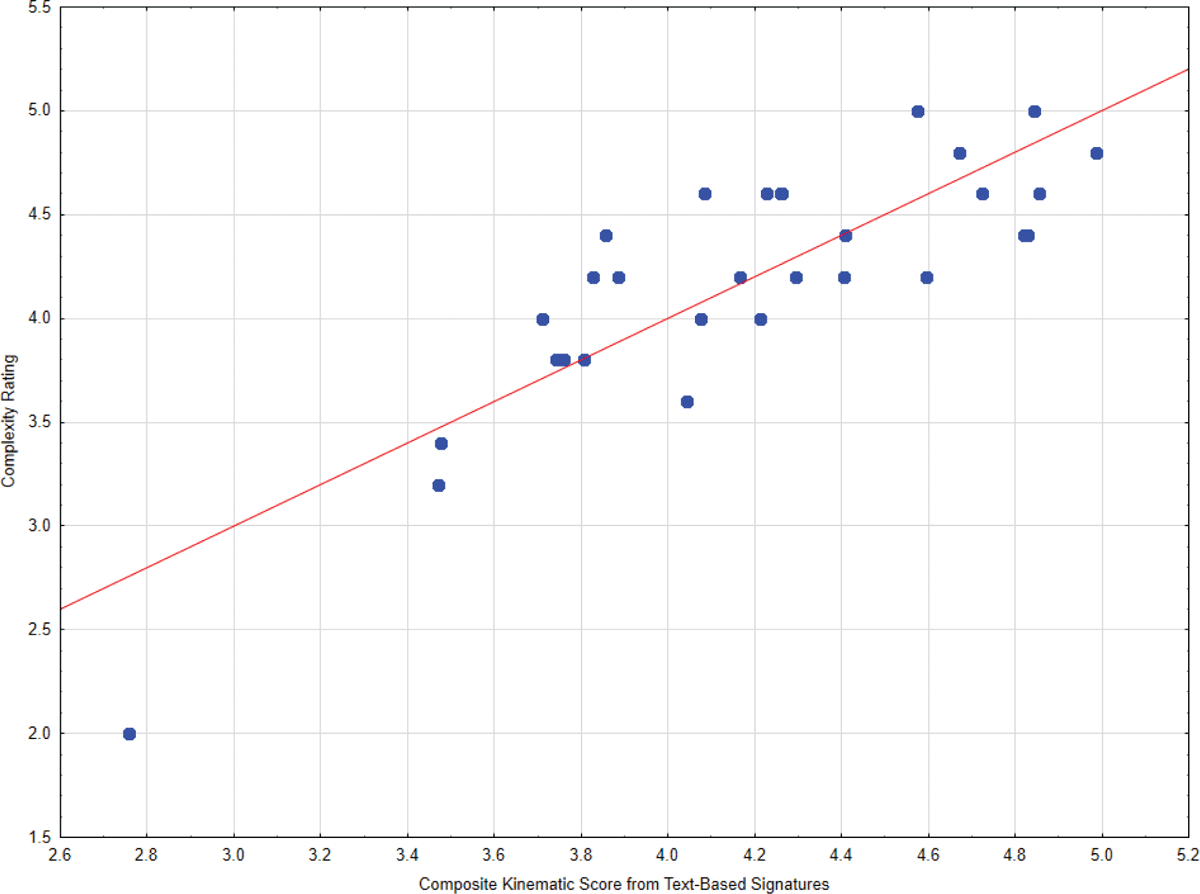
Figure 2
Scatterplot showing relationship between the composite kinematic scores (x-axis) and FDE perception of signature complexity (Y-axis) with line of best fit for text-based signatures.
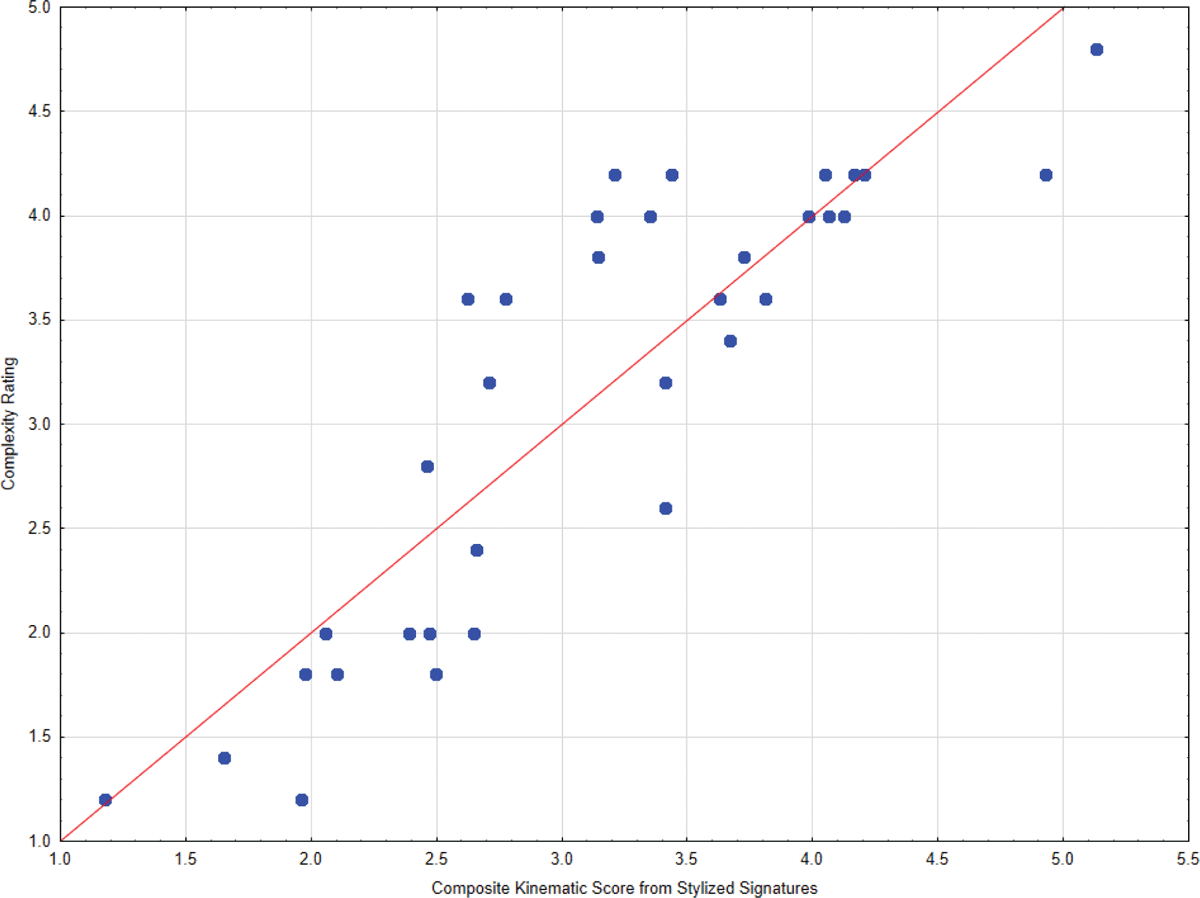
Figure 3
Scatterplot showing relationship between the composite kinematic scores (x-axis) and FDE perception of signature complexity (Y-axis) with line of best fit for stylized signatures.
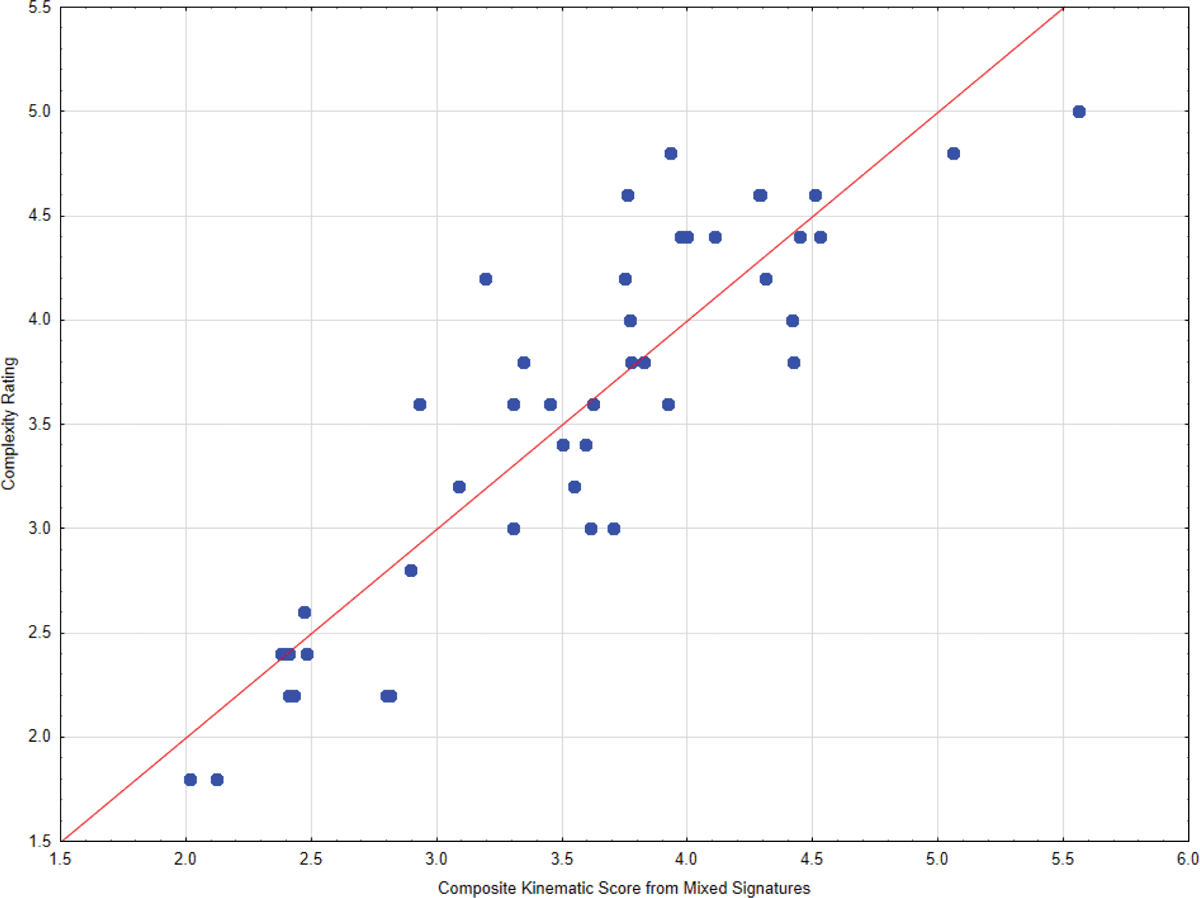
Figure 4
Scatterplot showing relationship between the composite kinematic scores (x-axis) and FDE perception of signature complexity (Y-axis) with line of best fit for mixed style signatures.
From the statistical models shown in Table 3 and associated scatterplots shown in Figures 2, 3, 4, one can empirically derive a complexity score using dynamically obtained signature features. For example, for a given writer having a stylized signature (Figure 3), it is possible to estimate how FDEs would judge the complexity of the signature with 76% accuracy based solely on the composite scores calculated from the equation in Table 3.
Discussion
Results of this study reveal significant associations between kinematic parameters and FDEbased assessment of complexity and that these associations varied with signature style. For text-based signatures, the combination of mean duration of downstrokes, mean trace length of upstrokes, and total number of strokes are associated with complexity perception. For stylized signatures, mean horizontal size for downstrokes, mean peak vertical velocity and average absolute velocity for upstrokes, and number of strokes together predict variation in complexity assessment. Lastly, mean peak vertical velocity and acceleration for downstrokes and mean straightness error, trace length, and average absolute velocity for upstrokes, together with slant and total number of strokes are associated with complexity perception for mixed-style signatures. These findings underscore the importance of sensitive kinematic analyses of temporal and spatial features in understanding signature complexity.
Since there was a strong relationship between signature style and complexity evaluation, it was necessary to study the relationship between kinematic data for each style separately. Otherwise, it would be difficult to discern to what extent the kinematics are showing an association to style rather than complexity perception. While the statistical models predicting signature complexity differed across the three styles, the total number of strokes was a significant feature characterizing complexity for all signature styles.
Our results confirm that the number of strokes, which is roughly the same as the number of turning points, is indeed a strong predictor of FDE complexity assessment as reported by Found and Rogers (1), but numerous kinematic variables in combination with number of strokes can better explain the variability in complexity perception. Features related to speed (duration, peak vertical velocity, peak vertical acceleration, and average absolute velocity) also played a role, supporting assertions found in prior FDE literature that the more rapidly a signature is written, the more difficult it would be to accurately execute its pictorial form. Results also support the assertion that FDEs consider text-based (entirely legible) signatures more difficult to simulate than illegible ones, as reported by Harrison (6).
The kinematic models developed in this study can be particularly useful in electronic signature comparisons. Assuming the software can be configured to capture the same variables and can similarly segment signatures to count the number of strokes, the complexity score can be automatically calculated to provide supplemental quantitative data.
In the National Research Council’s 2009 publication, “Strengthening Forensic Science in the United States,” (14) it was asserted that forensic disciplines “need to develop rigorous protocols to guide…subjective interpretations and pursue equally rigorous research and evaluation programs.” This study is an attempt to clarify the thought process by which an FDE derives an authorship or non-authorship opinion, by dissecting and quantifying subjective complexity assessment, one of the numerous judgments made. As such, the present research may be considered a “white box” study aimed at elucidating internal processes leading to the judgment of signature complexity. The notion that complexity could be quantifiable is an attractive one in terms of adding objectivity to the FDE’s numerous subjective judgments that contribute to the overall authorship opinion. However, complexity assessment is only one judgment the FDE makes when determining an appropriate opinion. Even if complexity can be measured, the evidence in its entirety still needs to be evaluated. Because each case contains a different mix of quantity and quality of exemplars and questioned writing, no blanket statement can be made as to how much is “sufficient.” A medium or high complexity signature may warrant a limited or inconclusive opinion when too few exemplars are submitted or the exemplars were not written contemporaneously with the questioned signature. Conversely, a lower complexity signature may warrant a stronger opinion when there are multiple questioned signatures with a limited range of variation and the exemplars provided also fit in that range. Therefore, a complexity measure would be useful to supplement but not replace complexity perception. In the event the calculated value differs from the subjective evaluation, the FDE would need to justify why the measured complexity value is inadequate for that set of circumstances.
It’s important to note that the present study modeled the FDE’s perception of complexity, which is assumed to be more accurate than a layperson’s based on superior performance on writer identification and signature comparison performance tests of the two groups (15, 16). However, the only true measure of a signature’s complexity or the success of a simulation is how likely it is to pass as genuine. Examining reliability of authenticity opinions through error rates and confidence level testing at different complexity levels may illuminate the true nature of complexity and could indicate where training is needed in complexity assessment. This will be the subject of follow-up research. It is possible these models could be improved after feedback and training.
Notes
[2] Because the likelihood of two people having a pictorially similar signature is small, we focus on complexity in terms of ease of simulation in this paper.
[3] To characterize legibility, we categorize signature styles as text-based, mixed, or stylized as described in (12). Text-based signatures are those where every letter can be recognized, and stylized signatures have no recognizable letters. Mixed signatures have both legible and illegible elements.
Acknowledgments
The authors wish to express their deepest gratitude to the five Forensic Document Examiners who generously gave their time and expertise to rate the complexity of 123 signatures; to Dr. Linton Mohammed for his valuable advice, assistance in preparation of the study, and proofing of the manuscript; to the staff of the Los Angeles Police Department, Forensic Science Division and Los Angeles Sheriff’s Department, Scientific Services Bureau for providing their handwriting samples; and to the Los Angeles Police Department and Los Angeles Sheriff’s Department for providing their support for this project.