
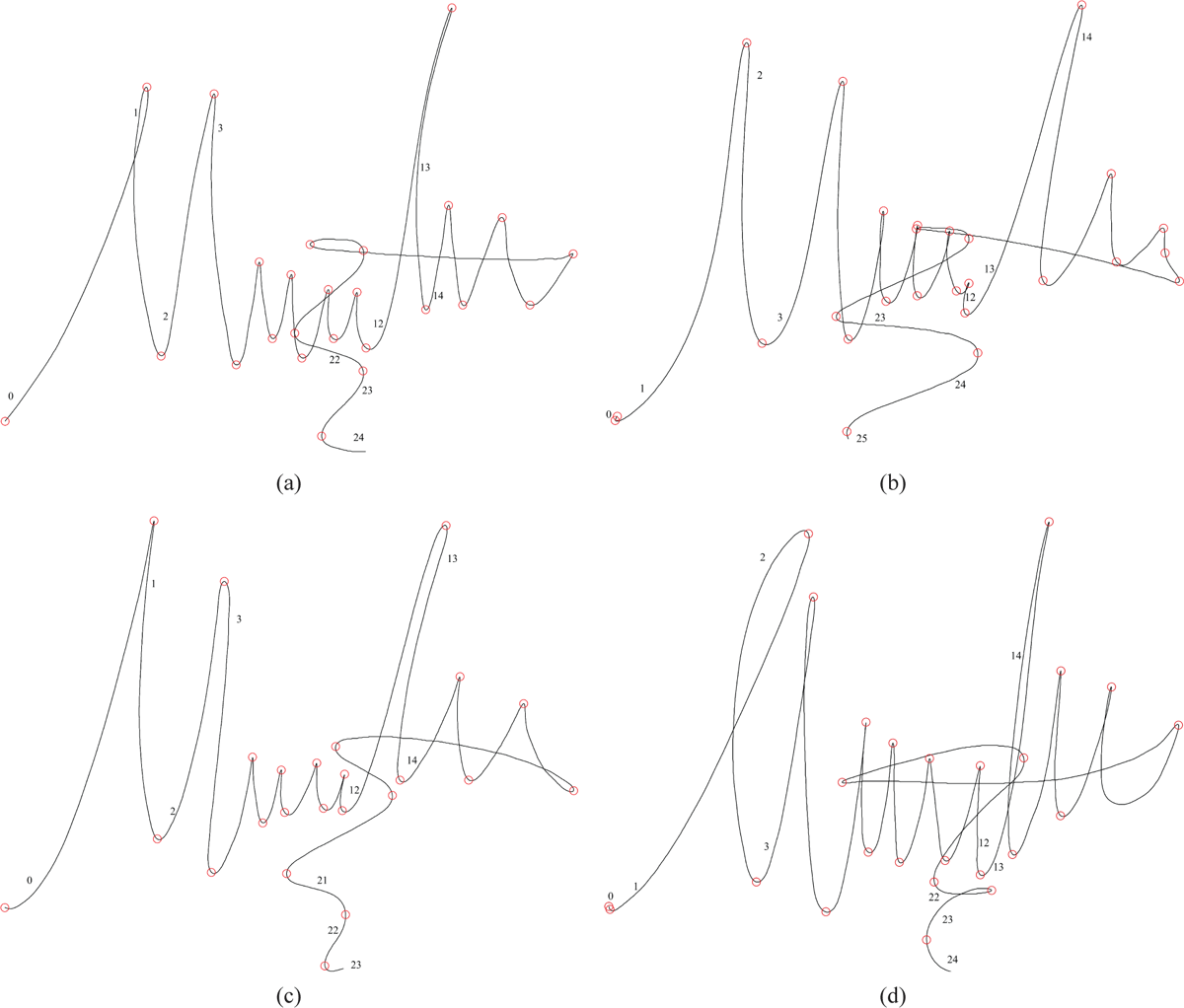
Figure 1.
Some signatures extracted from the dataset used for the experimentation. (a), (b) and (c) are genuine signatures produced by a writer, whereas the signature (d) is an attempt to forge them made by another writer. The signatures (a) and (b) are used as references in the example presented in this paper whereas (c) and (d) are used as questioned signatures. The red dots represent the segmentation points produced by the stroke segmentation algorithm. To ease the reading, some strokes are numbered in figure.
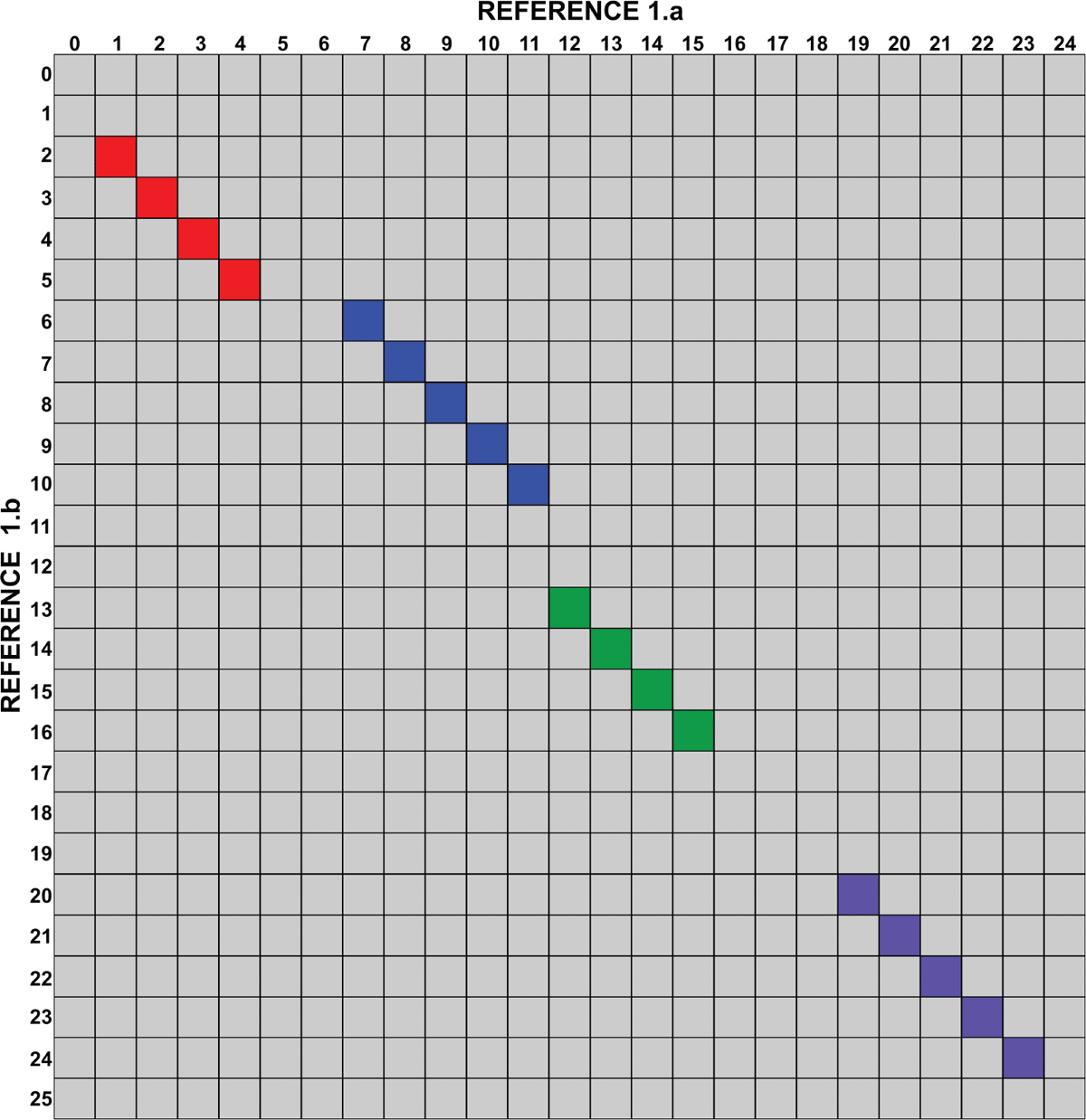
Figure 2.
The saliency map obtained by comparing the two references (the signatures in the Figures 1.a and 1.b). The number of each row/column refers to the numbering of the strokes as in Fig. 1. In red, blue, green and violet are highlighted the four LSSSs found in the map that represent the stability regions of the two signatures. The LSSSs are represented in Figure 3 on the two references segmented in strokes.
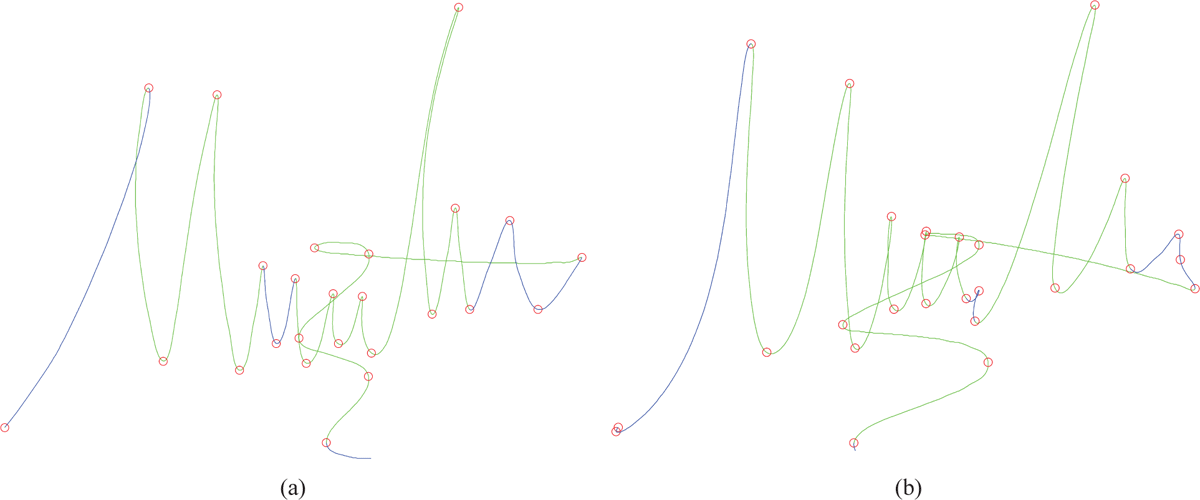
Figure 3.
In green are painted the stability regions detected by matching the ink of the reference signatures shown in Figure 1.a and 1.b. The target points are in red. Note that the first and the second stability regions are separated by two strokes in the reference (a), while there is no break between them in the reference (b). The second and the third stability regions are separated by two strokes in the reference (b), while there is no break between them in the reference (a). The third and the fourth stability regions are separated by three strokes in both references.
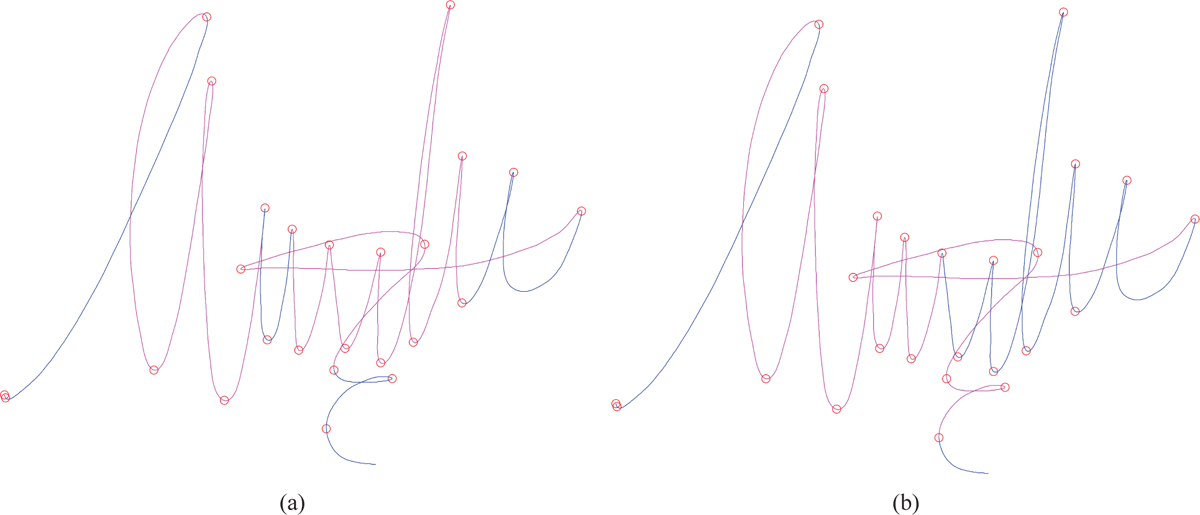
Figure 4.
The stability regions found on the questioned signature in Figure 1.d when compared with reference 1 in Figure 1.a and with reference 2 in Figure 1.b. The longest common sequences of strokes between the reference 1 and the questioned and between reference 2 and the questioned are painted in magenta in (a) and (b), respectively. None of the strokes belonging to the two longest common sequences have a duration compatible with the corresponding strokes in the two references. As a consequence, the questioned is correctly classified as a forgery.
Table 1
The time duration of the strokes belonging to the first stability regions in Figures 3.a, 3.b, 4.a and 4.b. The questioned signature is represented in Figure 1.d. Note that the time duration of the stokes of the stability regions of the references is much smaller than the time duration of the stokes of the stability regions of the questioned. Note that none of the strokes belonging to the questioned signature and reported in this table satisfy the equation 2.
| Index and Time Duration of Each Stroke Belonging to a Sequence | ||||
| First LSSS on Reference 1 | 1 (151.67 ms) | 2 (145 ms) | 3 (131.67 ms) | 4 (90.67 ms) |
| First LSSS on Reference 2 | 2 (136.05 ms) | 3 (146.99 ms) | 4 (129.64 ms) | 5 (100.45 ms) |
| Stokes belonging to the Questioned Signature that match with the First LSSS on Reference 1 and Reference 2 | 2 (316 ms) | 3 (252 ms) | 4 (280 ms) | 5 (206.67 ms) |
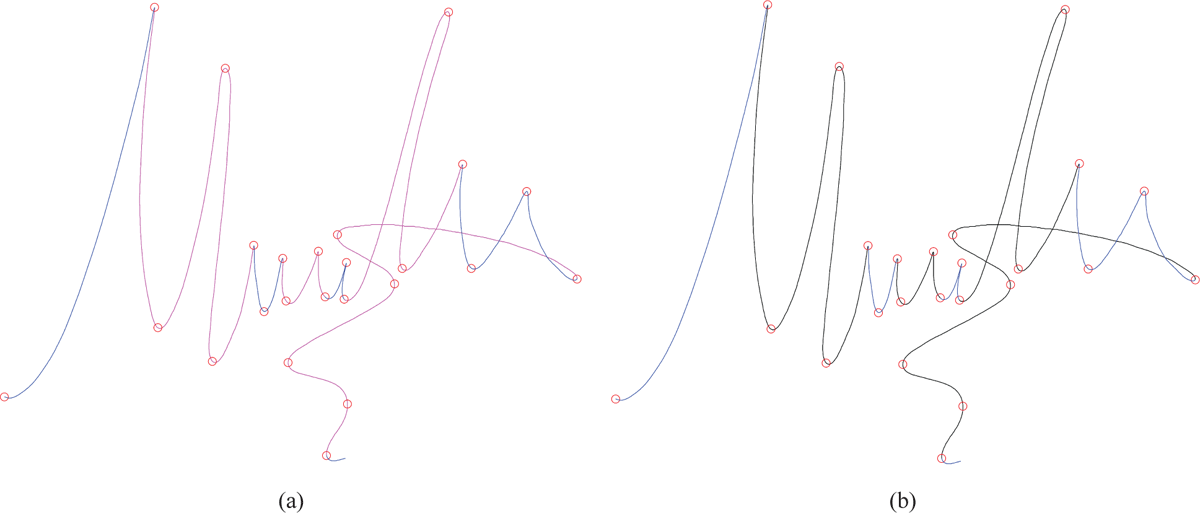
Figure 5.
The stability regions found on the questioned signature in Figure 1.c when compared with reference 1 in Figure 1.a The longest common sequences of strokes between the reference 1 and the questioned are painted in magenta in (a). The strokes belonging to the longest common sequences with a time duration compatible with the corresponding strokes in the reference are painted in black (b). All the strokes satisfy the equation (2) and so the same set of strokes are painted in magenta and in black.
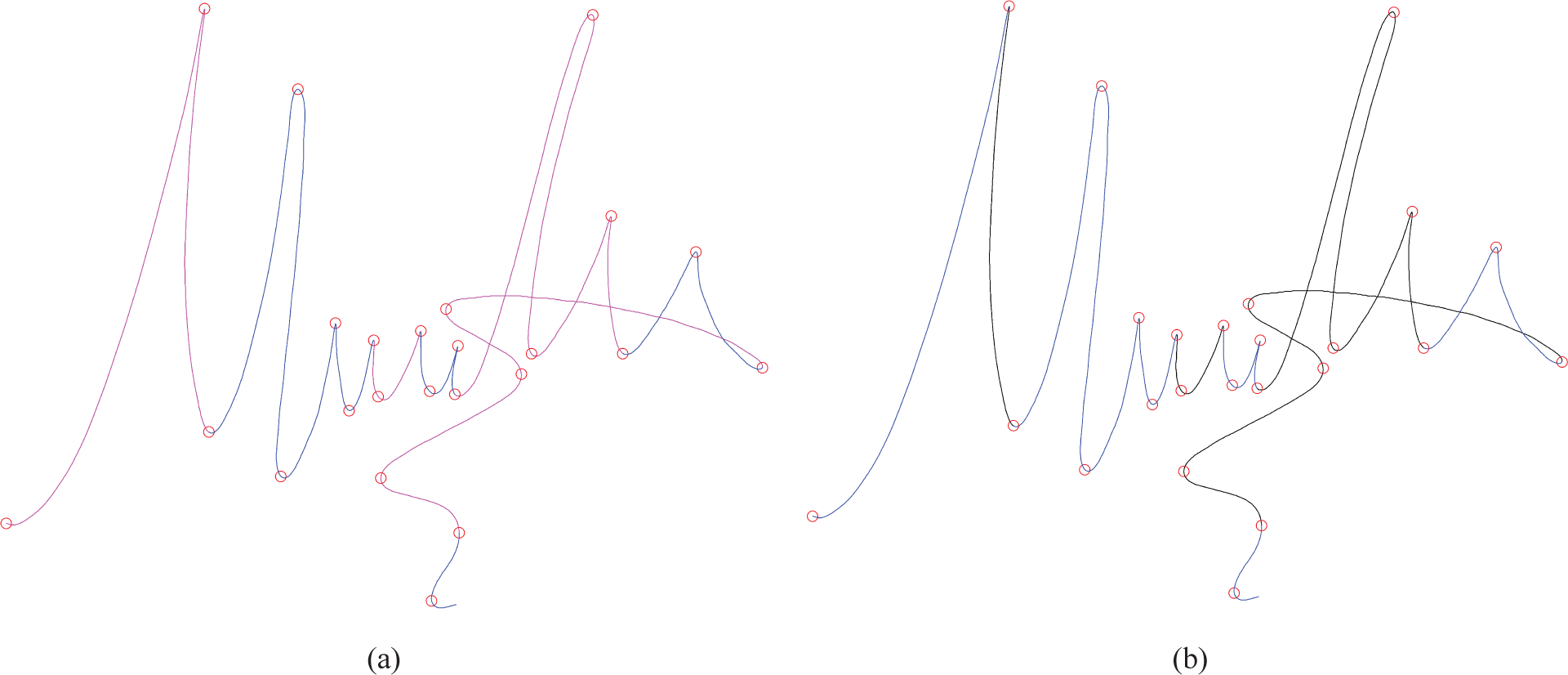
Figure 6.
The stability regions found on the questioned signature in Figure 1.c when compared with reference 2 in Figure 1.b The longest common sequences of strokes between the reference 1 and the questioned are painted in magenta in (a). The strokes belonging to the longest common sequences with a time duration compatible with the corresponding strokes in the reference are painted in black (b). Only the first stroke do not satisfy the equation (2) and it is removed from the first LSSS.
Table 2
The time duration of the strokes belonging to the last stability region in Figures 3.a, 3.b, 5.a and 6.a. The questioned signature is represented in Figure 1.c. Note that the difference in the time duration of the stokes belonging to the stability regions of the references and of the questioned is much smaller than in the case reported in Table 1. All the stokes belonging to the questioned signature and reported in this table satisfies the equation 2 therefore the strokes are similar in shape and time.
| Index and Time Duration of Each Stroke Belonging to a Sequence | |||||
| Last LSSS on Reference 1 | 19 (131.19 ms) | 20 (52.94 ms) | 21 (66.38 ms) | 22 (58.25 ms) | 23 (52.41 ms) |
| Last LSSS on Reference 2 | 20 (127.50 ms) | 21 (51.82 ms) | 22 (74.93 ms) | 23 (68.71 ms) | 24 (79.15 ms) |
| Stokes belonging to the Questioned Signature that match with the last LSSS on Reference 1 | 18 (131.94 ms) | 19 (67.78 ms) | 20 (76.00 ms) | 21 (64.81 ms) | 22 (50.06 ms) |
| Stokes belonging to the Questioned Signature that match with the last LSSS on Reference 2 | 18 (131.94 ms) | 19 (67.78 ms) | 20 (76.00 ms) | 21 (64.81 ms) | ____ |
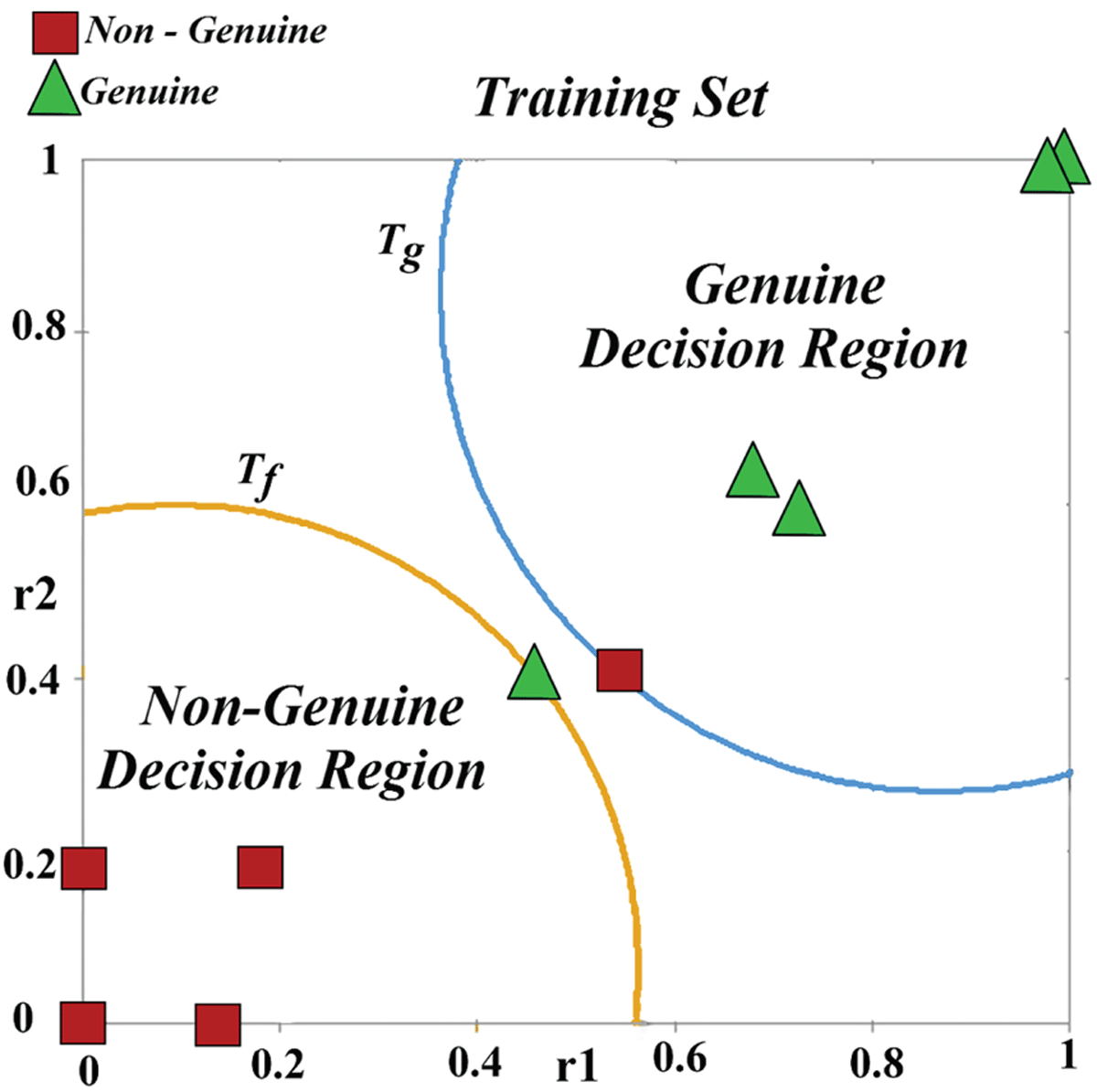
Figure 7.
Model of the signer. The space S defined by the references, the decision region and the signatures belonging to the training set.