Introduction
Reports over the past decade have detailed a range of shortfalls associated with forensic science disciplines and have increased awareness of the important need for empirical studies to be undertaken to test existing theory, particularly with respect to pattern evidence. The pattern evidence disciplines (handwriting, fingerprints, shoe impressions, tool marks) have been criticized for a lack of focussed and appropriately designed validation testing of their underlying assumptions11-28. Court rulings such as the 1993 United States Supreme Court, Daubert v. Merrell Dow Pharmaceuticals, have clearly stated that if scientific evidence is to be admitted, its probative value should be assessed against critical and robust testing of the theories on which the techniques are based, and evidence of error rates, peer review and acceptability by the relevant scientific community should be considered29, 30. Additionally, the 2009 National Research Council of the National Academy of Sciences further highlighted serious deficiencies in the underlying scientific methodology of many forensic science disciplines31. Despite practitioners’ belief that those areas of forensic science pertaining to the pattern recognition disciplines have probative value, it is imperative that critical examination of the underlying beliefs, assumptions and methodologies of disciplines such as forensic handwriting examination be scrutinised and tested for soundness.
One commonly held premise in forensic signature examination is that the occurrence of unexpected pen lifts in a questioned signature, when compared to a population of known signatures, strongly contributes to the determination that the signature is simulated. On face value, this principle would appear to be well supported, with many historical citations attesting to the validity of the observation. Osborn (1946) refers to pen lifts as one of the distinctive qualities of a forgery. Harrison (1964, 1966) documents the special importance of pen lifts, instructing the examiner to expect more pen lifts in a forged signature than a genuine. Hilton (1982) cites a number of qualities where a forgery is apt to differ from the known signature, including unnatural pen lifts, and Ellen (1989) states that the forgery is completed with more strokes than are present in the original1, 2, 3, 4, 5.
Historical references notwithstanding, the belief does not appear to have been empirically verified with any scientific rigour. Citations regarding pen lifts as an indicator of forgery behaviour are in the main anecdotal, un-validated and lacking in any statistical underpinning. Relatively contemporary commentaries also support the historical position as to the important properties of pen lifts, and highlight the commonly referred to association of pen lifts with non-genuine writings. Masson (1996) refers to pen lifts as symptomatic of spurious writing, Nickell (1996) refers to unnatural pen lifts in association with nongenuine writing, Huber and Headrick (1999) state that simulations frequently contain too many pen lifts or pen lifts in the wrong locations, Black et al (2003) assert that the pen lift is more likely to occur in simulated signatures, Vastrick (2004) cites unusual pen lifts as a common characteristic of simulation and Alkahtani et al (2010) include pen lifts as one of the principal line quality signals indicative of forgery behaviour6, 7, 8, 9, 10, 11.
The study described here attempts to make a contribution to the existing pool of empirical data regarding the underlying assumptions associated with forensic handwriting examination. Here we focus on the significance of the presence or absence of pen lifts in questioned signatures when compared to relevant populations of known signatures, in order to provide an insight into whether pen lift characteristics play a role as a predictor of simulation behaviour.
Method
Nineteen skilled, tertiary educated, adult writers were recruited to provide known signature samples. These individuals were asked to provide fifteen repetitions of their own genuine signature in one sitting, resulting in a pool of 285 known signature samples. Each signature was executed using a Wacom Intuos Duo inking/digitising pen, and was written within a 118 x 38mm printed box on a single A4 (REFLEX brand) 80gsm sheet of paper placed upon a Wacom digitising pad. Electronic data was processed using the Neuroscript Movalyzer Ver.6.6 software. Each of the known signature samples was assessed by the experimenters to ensure that they were of sufficient complexity to warrant examination and comparison within a forensic case work scenario, and relatively representative of signatures found in the general population. Signature complexity was determined using a statistical complexity model which has been previously reported32, 33
Further to the known signature providers, an additional eight individuals were recruited as simulators. These individuals were also skilled adult writers. The simulators were provided with five arbitrarily selected examples of each of the nineteen model signatures on which to base their simulation attempts. Simulators were allowed one minute to familiarise themselves with each model signature prior to commencing their simulations. Participants were not permitted to practice prior to commencing their fifteen attempts. Using the same method of collection as described for the genuine signatures, the eight simulators were directed to attempt to simulate each of the nineteen known signatures, fifteen times, one signature per page. This process resulted in a pool of 2280 signature simulations, comprising 120 simulation attempts per known signature.
Pen lift incidence in both the known and simulated signatures was recorded manually by inspecting and documenting the visible presence of pen lift within each signature. For the purpose of this study, pen lifts were defined as a line break within the signature formation, where the pen had clearly left the writing surface before being placed back on the paper to continue the signature. The terminal pen lift or completion of the signing event was not included in the total recorded pen lifts per signature. Pen lifts associated with diacritic placements, such as may appear over the letters ‘i’ and ‘j’, were included in the total pen lift count, as was the placement of punctuation marks, such as might be used after the first initial in a signature. Observance of pen lift was peer reviewed and further confirmed by review of the electronic signature capture. The recorded data was examined for statistical significance using SPSS v21.0 (SPSS Inc, Chicago). Examples of known and simulated signatures, including pen lift counts, are provided in Figures 1 and 2 respectively.
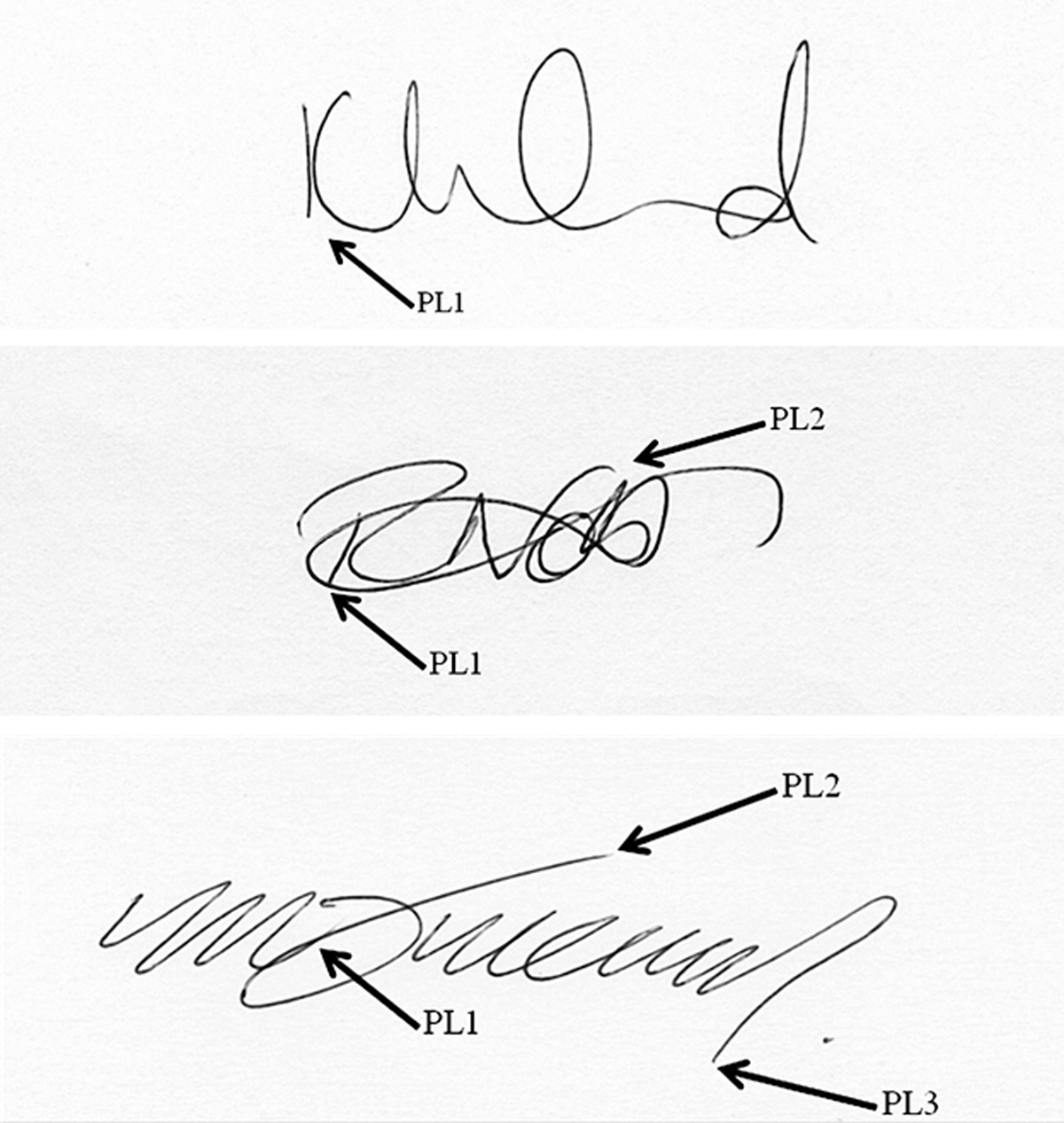
Figure 1.
Example of three genuine signatures containing one, two and three pen lifts respectively. Regions where pen lifts occur are notated as PL indicating ‘pen lift’, followed by a number indicating whether the lift is the first, second or third lift within the signature formation.
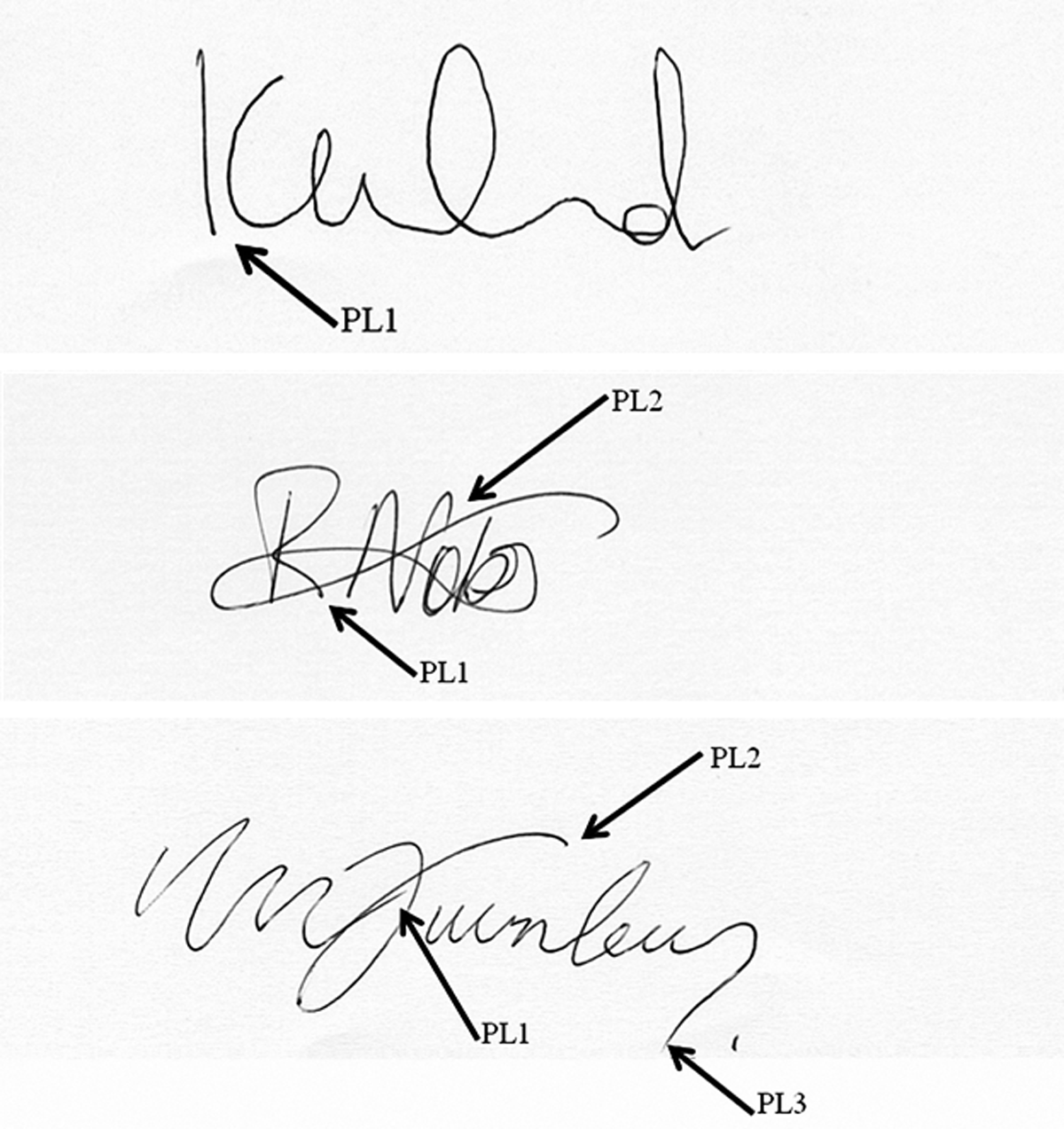
Figure 2.
Example of three simulated signatures containing one, two and three pen lifts respectively. Regions where pen lifts occur are notated as PL indicating ‘pen lift’, followed by a number indicating whether the lift is the first, second or third lift within the signature formation.
Results and Discussion
Number of pen lifts
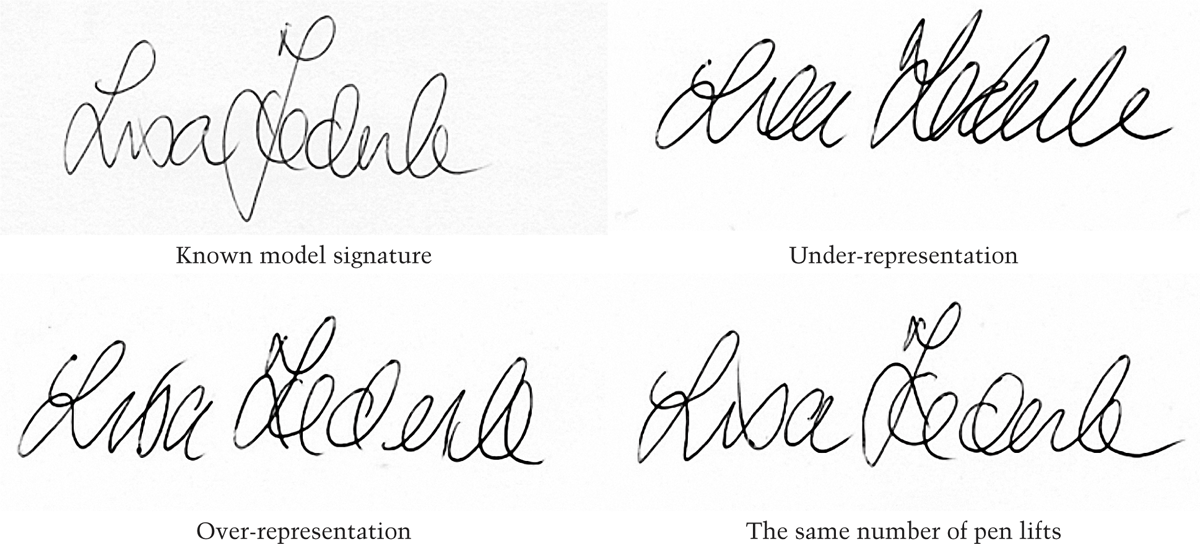
In both the known and simulated signatures, overall pen lift distribution ranged from between 0-6 pen lifts per signature, with an average incidence in both the known and simulated signatures of two pen lifts per signature. Of the total simulation attempts, 506 of the total 2280 simulated signatures demonstrated an over-representation of pen lifts. Under-representation of pen lift was observed in 264 of the 2280 simulation attempts. In 1510 of the total 2280 attempts recorded, the simulators were able to faithfully replicate the number of pen lifts within a given signature (see Table 1). No significant differences were observed in the number of pen lifts observed in the known population, compared to the number of pen lifts observed in the simulated population of signatures (F1 = 2.799, p = 0.09). When considering only simulated signatures which under- or over-represented the pen lifts, that is removing those simulation attempts that accurately replicated the number of pen lifts in a known model signature, significantly more over-representations were observed (χ2 = 144, p < 0.0001). It should be noted that four of the known signatures contained no pen lifts, and therefore could not be under-represented. A selection of model signatures and simulated counterparts, illustrating over representation of pen lifts, under representation of pen lifts and contemporaneous pen lift replication is provided in Appendix 1.
Table 1
Number of simulated signatures that illustrated an over-representation, an underrepresentation or no difference in pen lifts, as compared to the known model signatures.
| Gross pen lift incidence in simulated signatures | Number of simulations |
| Over Representation | 506 |
| Under Representation | 264 |
| No Difference | 1510 |
| Total | 2280 |
Each of the fifteen known signature replicates showed consistent numbers of pen lifts (F14 = 0.516, p = 0.923). However, as would be expected, significant differences were observed between the 19 known signatures in the number of pen lifts in each signature (F18 = 1006.5, p < 0.0001). As might be predicted, there was found to be a highly significant positive correlation between the complexity level rating of a signature, and pen lift incidence (F2 = 28.3,p < 0.0001, r2 = 0.307). Of the known model signatures used for the trial, 5 signatures were determined to be highly complex, 10 signatures were determined to be of intermediate complexity and 4 signatures were determined to be of low complexity. This complexity distribution range was indicative of other studies into complexity rating amongst signatures, in that it is thought that the majority of signatures in the general population are of sufficient complexity such as to warrant an opinion as to authorship in a forensic examination type scenario34. As such, we postulate that as complexity within a signature increases, so does the likelihood of natural pen lift incidence, an observation shared by Franke’s 2009 study where it was reported that both known writers and simulators tend to pause more often when executing signatures of higher level complexity35. Examples of a high complexity and a low complexity signature are included in Figures 3 and 4 respectively.
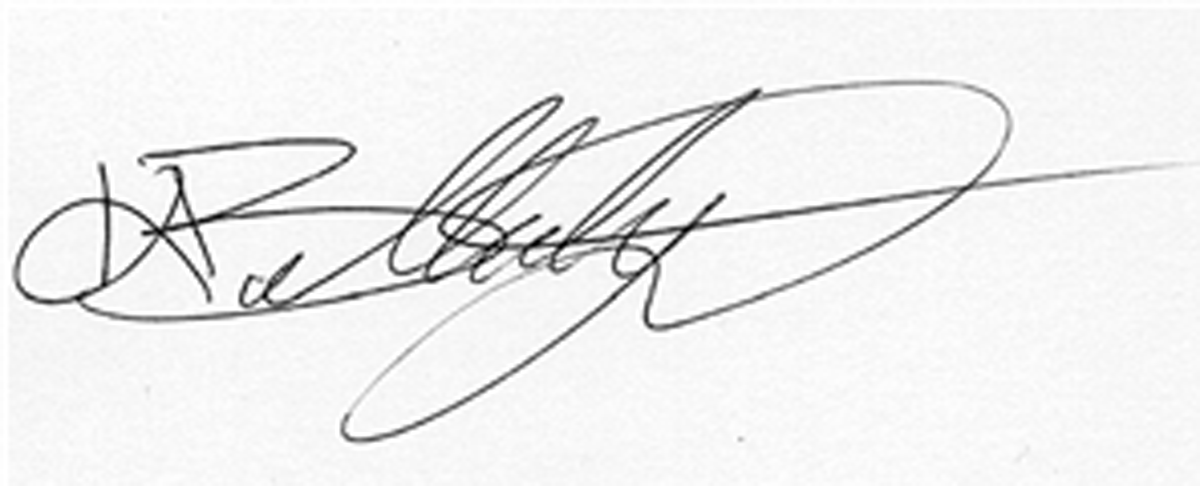
Figure 3.
A highly complex signature, exhibiting 4 pen lifts.
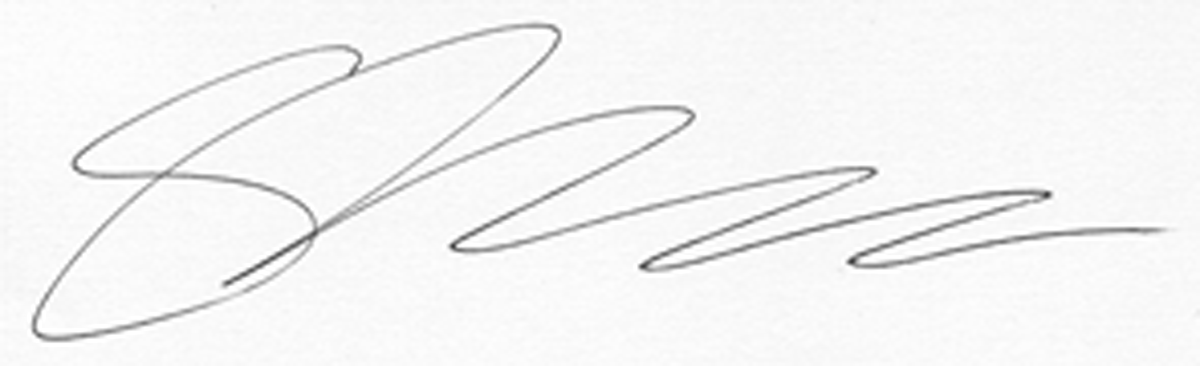
Figure 4.
A low complexity signature, exhibiting no pen lifts.
Significant differences were observed between the eight individual simulators, in their ability to mimic the known pen lifts (F7 = 25.4, p < 0.0001). However, there were no consistent patterns between and within the simulators, with individual simulators over-representing pen lifts in some signatures, and under-representing pen lifts in others. There was a significant interaction between the known signatures and simulators (F126 = 21.6, p < 0.0001), where pen lifts in some signatures were more consistently over-represented by some simulators, and consistently under-represented by others (Figures 5, 6 & 7). There was no indication of a practice effect between the simulation attempts one through to fifteen for all eight simulators (F14 = 0.616, p = 0.854).
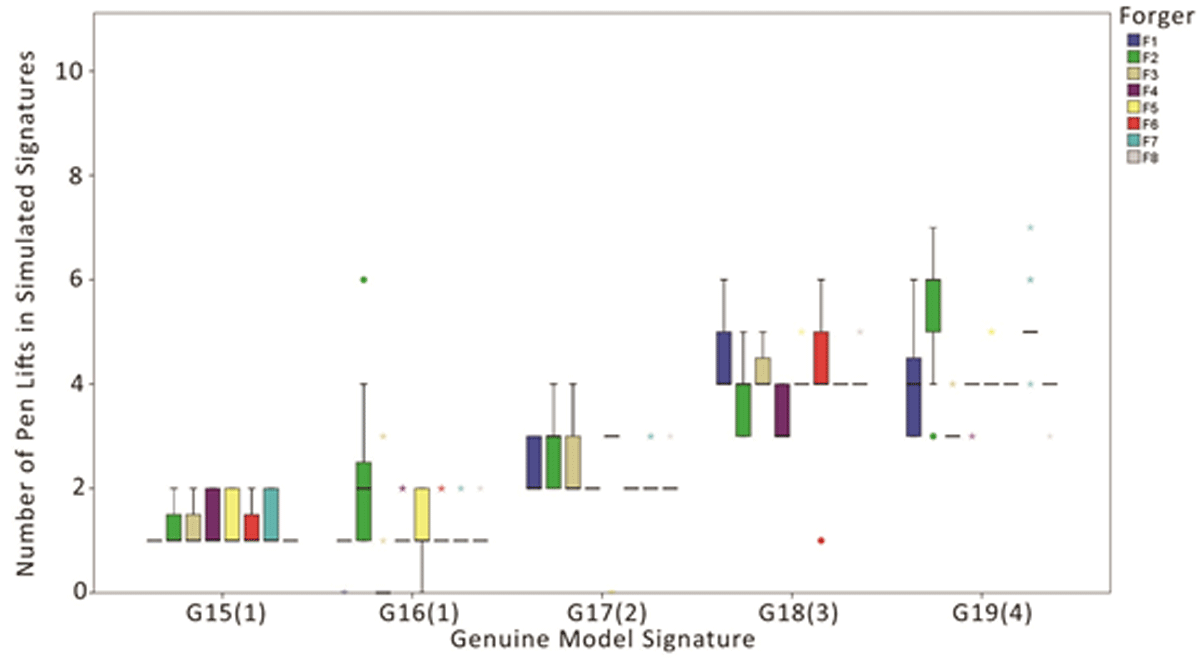
Figure 5.
High complexity signatures. Incidence of pen lifts in simulated signatures across the eight individual simulators for high complexity signatures. Bracketed Figures along the x axis indicate the number of pen lifts in the known model signature. Within the graph, solid lines indicate the median number of pen lifts recorded, boxes extending either side of the median illustrate the inter-quartile distribution (25–75% of data points) and whiskers defining maximum and minimum recorded pen lift. Circles illustrate suspected outliers, and asterisks indicate extreme outliers. The above graph illustrates that the majority of simulation attempts accurately replicated the number and placement of pen lift as observed in the high complexity model signatures.
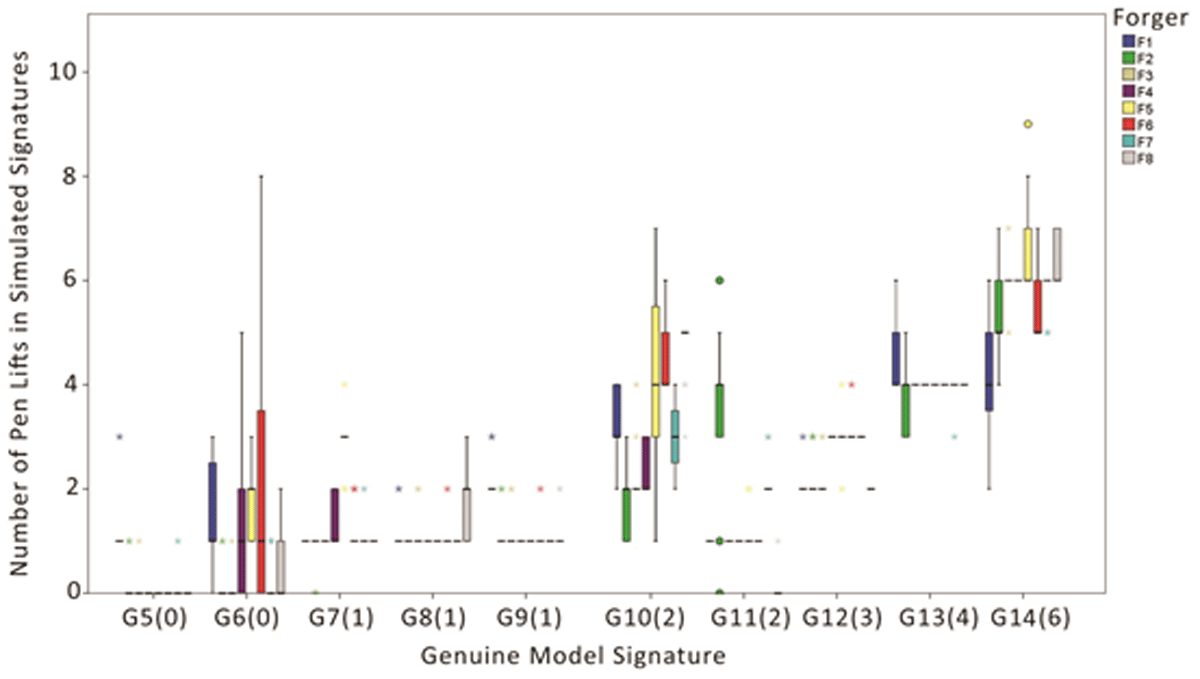
Figure 6.
Intermediate complexity signatures. Incidence of pen lifts in simulated signatures across the eight individual simulators for intermediate complexity signatures. Bracketed Figures along the x axis indicate the number of pen lifts in the known model signature. Within the graph, solid lines indicate the median number of pen lifts recorded, boxes extending either side of the median illustrate the inter-quartile distribution (25-75% of data points) with whiskers defining maximum and minimum recorded pen lift. Circles illustrate suspected outliers. Asterisks indicate extreme outliers. Whilst a larger degree of variation in pen lift is observed in the simulation attempts of these intermediate complexity signatures as compared to the low complexity simulation attempts depicted in Figure 7, the majority of pen lifts within simulation attempts by all forgers closely mimics that which is observed in the model signature formations. It remains undetermined as to why some forgers and some signature models illustrated larger degrees of variation amongst pen lift incidence.
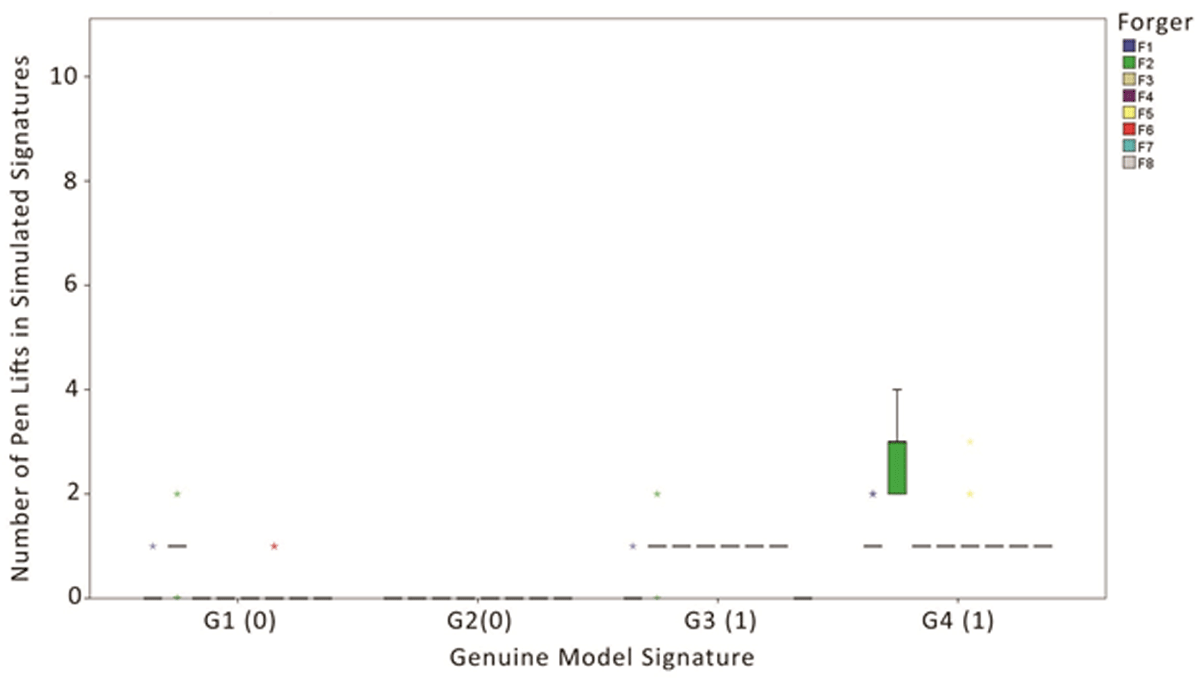
Figure 7.
Low complexity signature. Bracketed Figures along the x axis indicate the number of pen lifts in the known model signature. With low complexity signatures, the majority of simulations accurately replicated pen lift incidence as observed within the known model formations. Pen lift occurrence within this data set is relatively stable for this level of signature complexity, with little variation and few outliers. Only one individual (Forger 2) displayed pen lift variation as evidenced by the distribution range seen in this forger’s simulation attempts at this complexity level.
Of the nineteen known model signatures used, three included the use of a form of diacritic or punctuation representation, by way of a full stop or period at the end of the signature formation or between initials within the signature formation. The simulation attempts of these ‘punctuated signatures’ tended towards an under representation of pen lift by way of omission of these punctuation events. Whilst not examined for statistical significance due to the low number and variability of punctuation type and placement, it may be worth investigating further with a larger data set of both ‘punctuated’ and ‘non-punctuated’ signature formations (Figures 8 & 9).
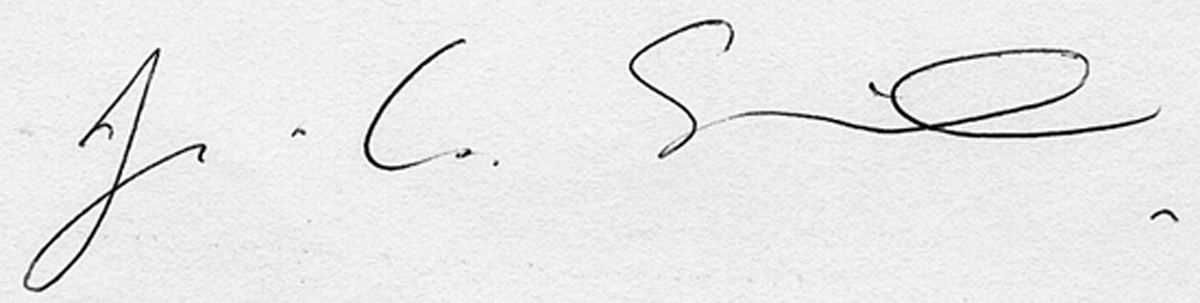
Figure 8.
A punctuated known model signature formation. Note the punctuation marks in the form of periods between the first and second letters, within the body of the signature and at the completion of the signature formation. Simulation attempts of this signature, collectively returned an under representation of pen lift across all simulators. The under representation took the form of punctuation omissions, therefore, reducing the number of pen lifts present in the simulation attempts.
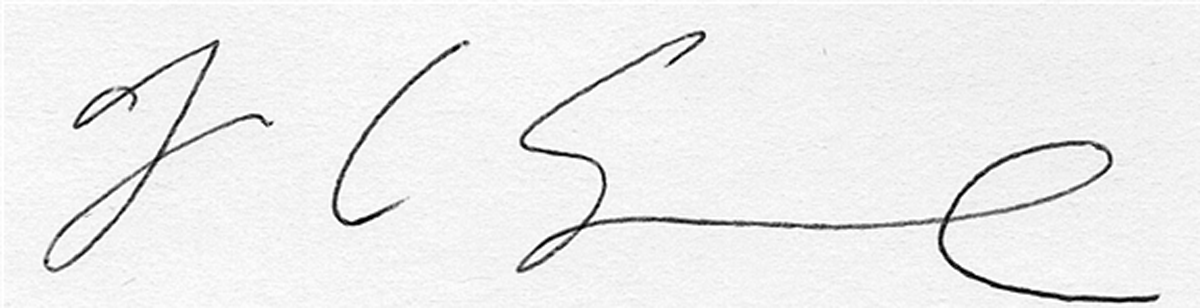
Figure 9.
A simulation attempt of the known signature formation provided in Figure 8. Note the lack of punctuation between letters, within the body of the signature and at the completion of the formation, as compared to the known model signature.
Pen Lift Placement
It is not just the number of pen lifts observed and compared between known and questioned signatures that is often reported as supportive evidence towards forming an opinion as to the authenticity of questioned writings, but also pen lift placement. Therefore, the data set was further explored by examining each simulation attempt with respect to where the pen lift occurred. If the pen lifts within a simulation attempt correlated with both the number and placement of that occurring in the known signature formation i.e. were accurately replicated, these incidences were removed from the data set, so that all that remained were pen lifts extraneous to that which occurred within the known signature formations (see Table 2).
Table 2
Number of simulated signatures that illustrated an over-representation, or underrepresentation of pen lifts, extraneous to that occurring within the known model signatures.
| Extraneous pen lift incidence in simulated signatures | Number of simulations |
| Over Representation | 352 |
| Under Representation | 264 |
| Total | 616 |
The remaining data set was examined for statistical significance using non parametric testing, due to non-normality of the data. Overall, the incidence of non-corresponding pen lift placement in the simulated signatures was found to be nonsignificant (Wald Z = 0.783, p = 0.434). Although there were slightly more pen lifts observed in the simulations of the highly complex known signatures, there was no significant overall correlation between the complexity of the known model signatures and the median number of unexpected pen lifts in the simulated signatures (ρ = –0.065, p = 0.483) (Figure 10). Likewise, there was no correlation observed between the number of pen lifts observed in the known model signatures and the unexpected pen lifts documented in the simulation attempts (ρ = –0.081, p = 0.380). Inter-forger differences were also examined, with no significant differences observed between the individual forgers and the number of unexpected pen lifts documented (K7 = 7.104, p = 0.418). A significant effect, however, was observed between the known signature model and the number of unexpected pen lifts observed in the simulation attempts across all forgers (K14 = 33.6, p = 0.002). As such, it can be inferred that some model signatures resulted in a collective over-representation of unexpected pen lifts across all simulators and simulation attempts, whilst other known model signatures elicited a significant under-representation of pen lifts in the simulation attempts, across all simulators (Figure 11). These signatures were examined further to investigate if some feature type, such as complexity level or basic structural type, such as previously reported36 was common to this grouping. Further investigation revealed both a mix of complexity levels, including simplistic, intermediate and high complexity signatures and a mix of basic structural types, including text-based, mixed and stylized signatures amongst this group. Therefore, the reasoning as to why some signatures in this trial generated a consistent response from the simulators by way of either under- or over-representation, remains unexplained. As previously discussed, the known signature pool contains signatures representative of that found in the general population, therefore, it is not thought that a larger data set of known model signatures might explain this observance. Further analysis with a larger simulator pool may be beneficial, to observe if the trend continues across a larger pool of simulators.
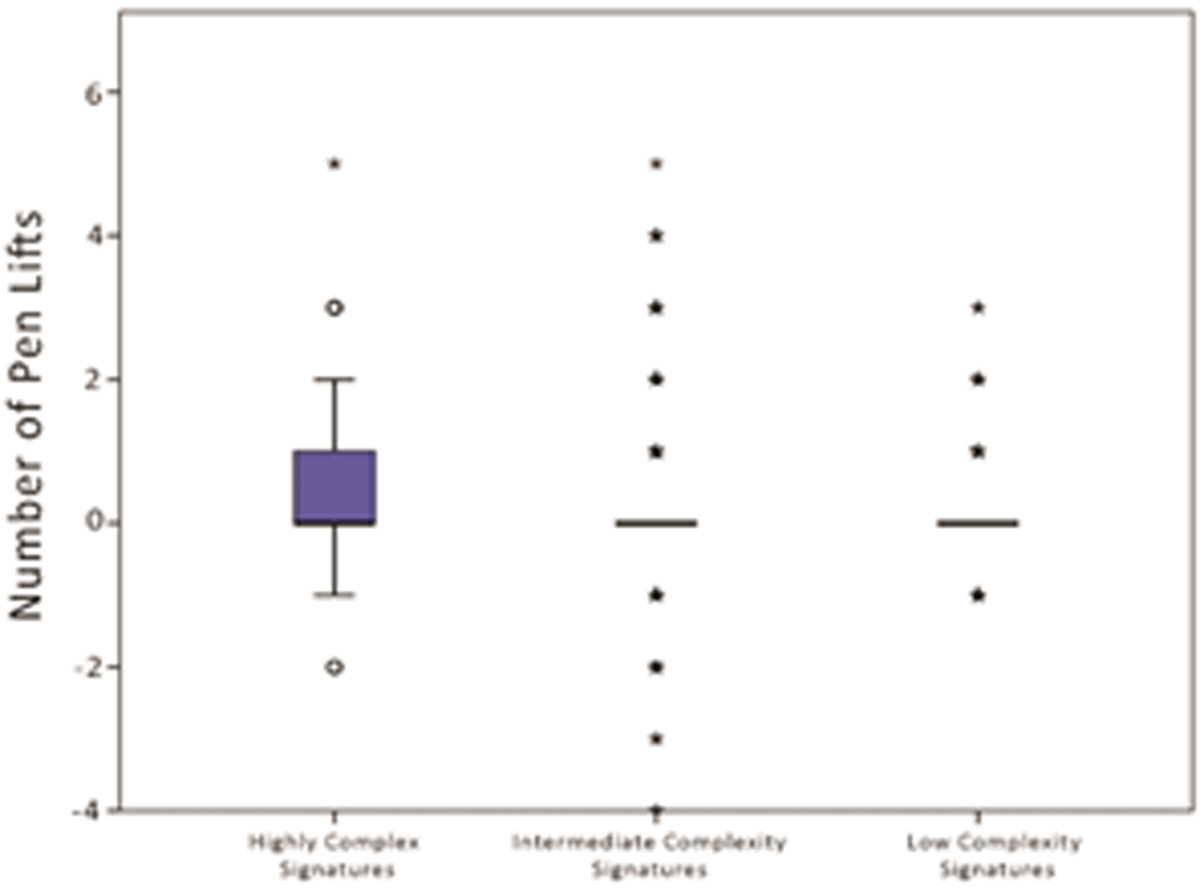
Figure 10.
Number of extraneous pen lifts in the simulated signatures according to complexity level rating of the known model signature. The graph illustrates more extraneous pen lifts in the simulations of the highly complex known signatures, however, there was no significant overall correlation between the complexity of the known model signatures and the median number of extraneous pen lifts in the simulated signatures (ρ = –0.065, p = 0.483). The solid lines represent the median number of pen lifts made by each simulator, with a coloured box covering the 25% and 75% percentiles. The whiskers (lines extending from the coloured box) represent the highest and lowest values observed, excluding the outliers (circles and asterisks).
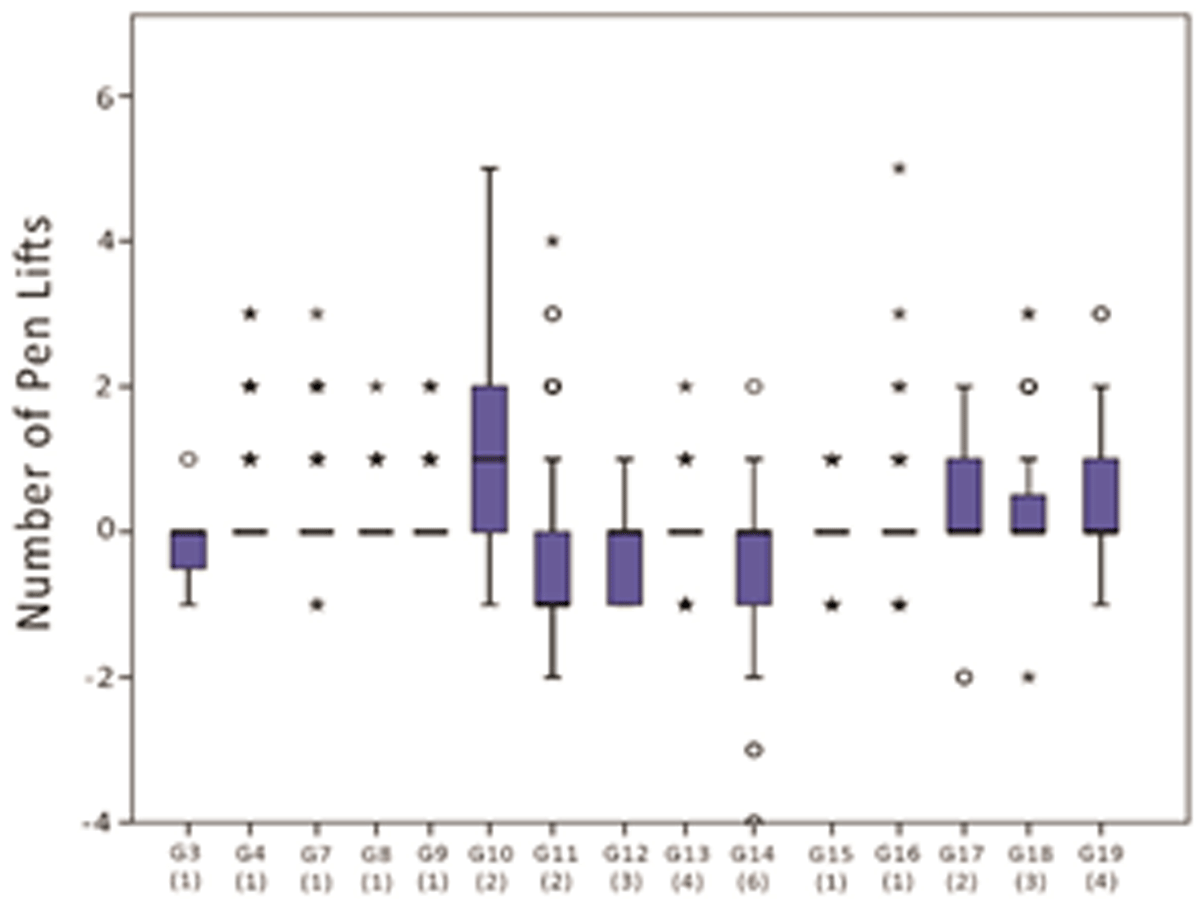
Figure 11.
Number of pen lifts across all eight simulators and all simulation attempts per known model signature. The number of pen lifts in the known model signature is noted in brackets beneath the x axis. The graph illustrates how some model signatures (G10, G17, G18, and G19) resulted in a collective over-representation of unexpected pen lifts across all simulators and simulation attempts, whilst other known model signatures (G3, G11, G12, and G14) elicited a significant under-representation of pen lifts in the simulation attempts, across all simulators. Note how the simulation attempts of the known model signature identified as G10 exhibits a significant over representation of pen lifts, in contrast to the under-representation observed in the simulation attempts of the model signature G14. Data points G1, G2, G5 and G6 are absent from the X axis in the above table as they represent the model signature formations that did not have any pen lifts and therefore could not exhibit an over or under representation in the simulation counterparts. The solid lines represent the median number of pen lifts made by each simulator, with coloured boxes covering the 25% and 75% percentiles. The whiskers (lines extending from the coloured boxes) represent the highest and lowest values observed, excluding the outliers (circles and asterisks), circles illustrate suspected outliers, asterisks indicate extreme outliers.
Conclusion
Overall, a range of over-and under-representation of pen lifts in simulated signatures as compared to their model counterparts was observed. The differences between the known and simulated formations were found to be statistically non– significant. However, of the 2280 simulated signatures, 616, 27% were found to have unexpected pen lifts as compared to the model signature formations, lending support (albeit lacking statistical significance) to the literary citations on the observance of pen lifts in simulated signatures. Forensic Handwriting Examiners should exercise caution when viewing historically typical forgery indicators such as pen lifts in isolation. It is when historically typical indicators of forgery behaviour such as pen lift are observed in combination with other documented forgery indicators such as line quality disturbances, size variation, pen direction differences and pictorial dissimilarities that pen lift occurrence may take on greater statistical significance. It is suggested that further studies with a larger pool of simulators and more stringent selection of model signature types would be beneficial, in order to limit the influence of any extreme performers i.e. very good simulators or conversely very poor simulators, which should broaden the range of data capture, providing a better picture for statistical analysis.
Appendices
Appendix 1
Figures 12, 13, 14 and 15. Examples of known model signatures and three associated simulation attempts, exhibiting under-representation, over-representation and the same number of pen lifts, respectively.
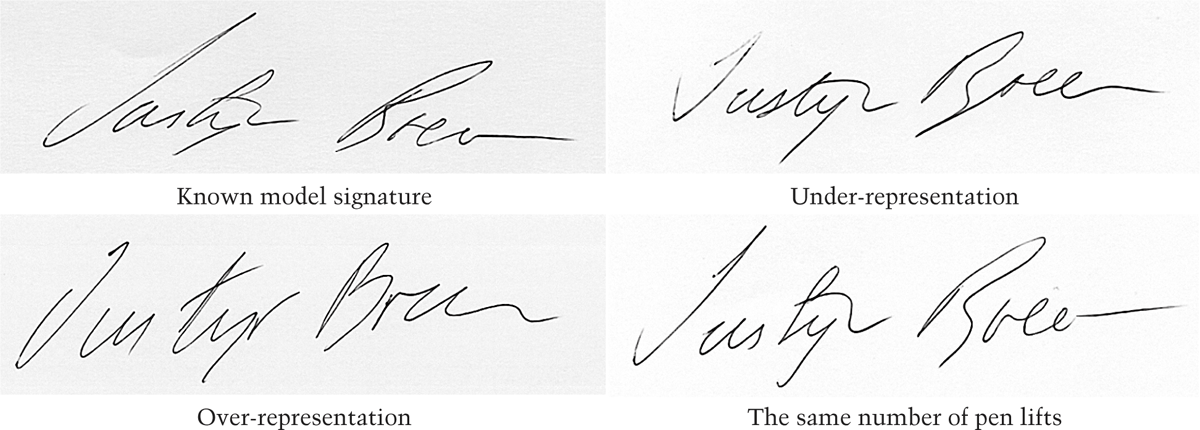
Figure 12.
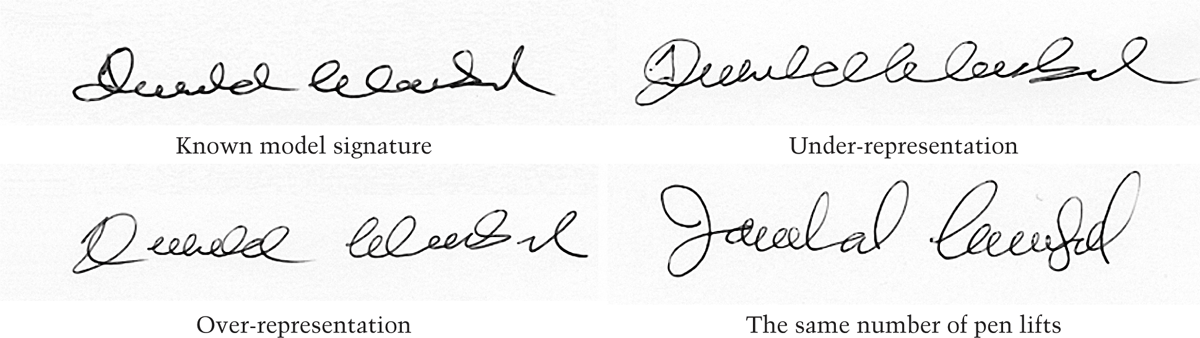
Figure 13.
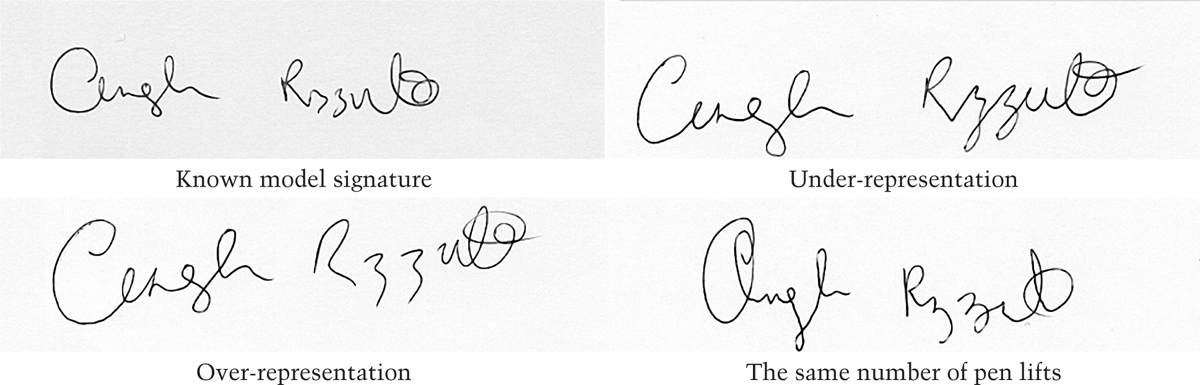
Figure 14.