
1 Introduction
Signatures are socially accepted as an authentication medium and they are widely used as proof of identity in our daily lives. It has also been accepted as an official means to verify identity for legal purposes on documents such as cheques, credit cards, wills etc. Automatic signature analysis by computers has received wide research interest in the field of pattern recognition. There are two different ways to recognize the signature: identification and verification. Verification involves confirming or denying a person’s claimed signature. On the other hand, identification decides the signature group among the number of groups where the claimed signature belongs.
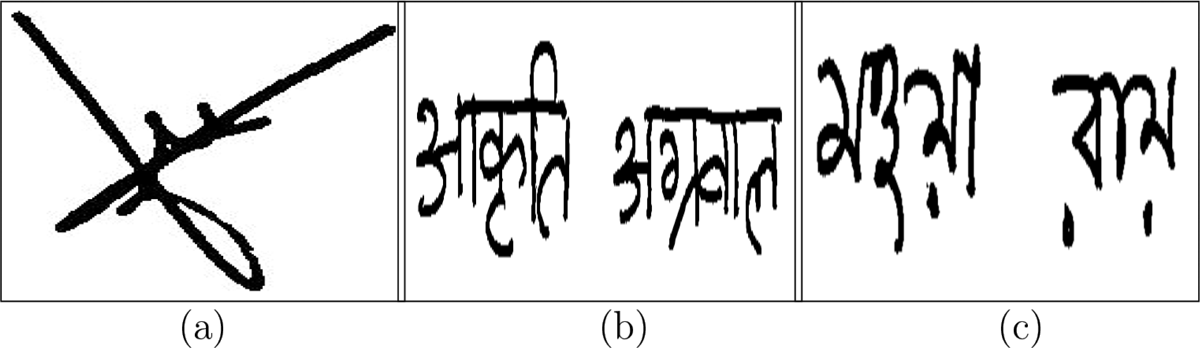
Figure 1
Sample off-line signatures of (a)English, (b)Devnagari, and (c)Bangla scripts.
The handwritten signature is therefore well established and accepted as a behavioral biometric. Considering the large number of signatures verified daily through visual inspection by people, the construction of a robust and accurate automatic signature identification system has many potential benefits for ensuring authenticity of signatures, reducing fraud and other crimes. A signature analysis (i.e. identification or verification) system and the associated techniques used to solve the inherent problems of authentication can be divided into two classes: (a) on-line methods [4] to measure temporal and sequential data by utilizing intelligent algorithms [7] and (b) offline methods [6] that use an optical scanner to obtain handwriting data written on paper. Bricen˜o et al. [1] proposed an signature identification algorithm based on Angular Contour Parameterization. Here, signatures parameters with spatio-temporal information with Hidden Markov Models (HMMs) as classifier have been used for identification of off-line signatures. Off-line signature analysis deals with the signatures, which appear in a static format [13]. Signature identification is also a task of interest for content-based document retrieval based on signature information. Signature-based document retrieval methods have been discussed in a few proposed works [2, 14, 17, 3]. It is a common organizational practice nowadays to store and maintain large databases which is an effort to move towards a paperless office. Large quantities of administrative documents are often scanned and archived as images (e.g. “Tobacco-800” [5] dataset) without adequate index information. As a consequence of that, such practice has created a tremendous demand for robust ways to access and manipulate the information from document image repositories.
Only a very few research publications employing signatures of Indian script have been considered in the field of non-English-based signature identification. To fill this gap, an identification scheme for multi-script off-line signatures is proposed. In an experiment [10], a signature identification scheme was considered where background and foreground information of the signature images were used. In an another experiment, Pal et al. [11] used Zernike moments and Histogram of Gradient (HoG) features with SVM classifier towards multi-script offline signature identification. Recently, a two-stage approach for English and Hindi off-line signature identification and verification was proposed by Pal et al. [12]. The main aim of their approach was to demonstrate the significant advantage of signature script identification in a multi-script signature verification environment. In this study, a large dataset of English, Hindi, and Bangla have been considered. The proposed approach is simple and computationally efficient which can be applied to real-time applications. Moreover, the proposed approach takes the advantage of spatial arrangement of the feature descriptors, which makes it very efficient for signature identification task and improves the performance.
The rest of the paper is structured as follows. Section II explains the proposed signature identification methodology. The experimental results are presented in Section III. Finally, conclusions are presented in Section IV.
2 Proposed Methodology
An efficient patch-based SIFT descriptors with Spatial Pyramid Matching (SPM)-based scheme is applied for the proposed signature identification task. The feature extraction module has three components. A flow diagram of signature identification system is presented in Fig.2. First, SIFT descriptors are extracted from the signature and quantised using the Kmeans clustering algorithm. Next, the SPM-based scheme is applied for the representation of an image. Finally, the SVM is employed for classification. In Section 2.1, Section 2.2, and Section 2.3 the general idea of the SIFT-descriptors, SPM and the feature extraction technique are described, respectively.

Figure 2
Flow diagram of a complete signature recognition system. A knowledge base was created using the training signatures and test samples were recognised using the knowledge base.
2.1 SIFT descriptor
The SIFT (Scale-Invariant Feature Transform) [9] is a local shape descriptor to characterize local gradient information. Here, 128-dimensional vector for each keypoint is extracted which stores the gradients of 4 × 4 locations around a pixel in a histogram bin of 8 directions. The SIFT descriptor is scale and rotation invariant. The gradients are aligned to the main direction, which makes it a rotation invariant descriptor. Different Gaussian scale spaces are considered for the computation of a vector to make it scale invariant. The blue circles in Fig.3(a), 3(c) and 3(e) represent the 16 × 16 SIFT patches of English, Hindi, and Bangla signatures, respectively, and Fig.3(b), 3(d) and 3(f) show graphical representation of English, Hindi, and Bangla SIFT descriptors of 4 bins and 8 orientations, respectively.
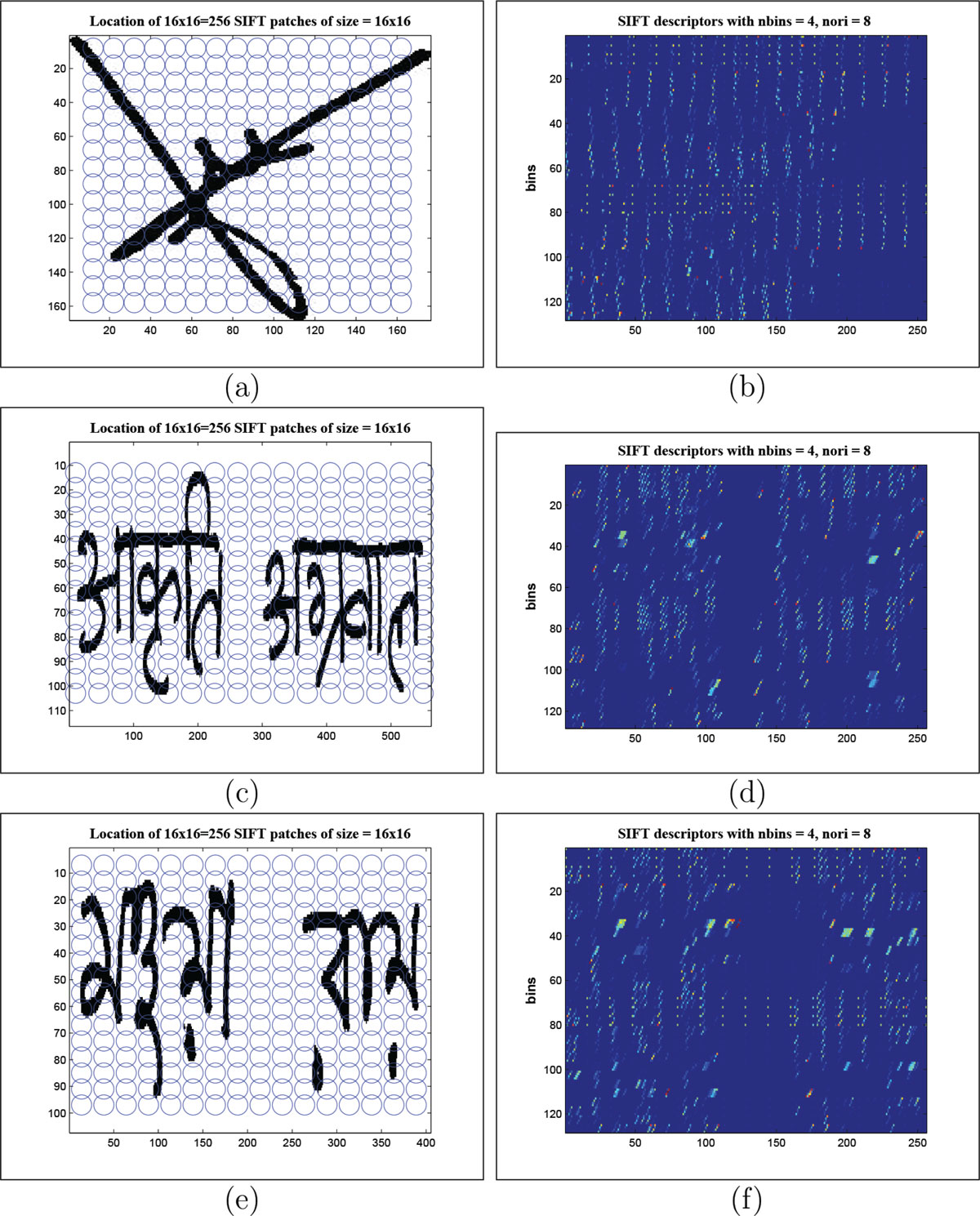
Figure 3
Blue circles represent 256 (of 16x16) SIFT patches of (a) English, (c) Hindi, and (e) Bangla signatures. SIFT descriptors with 4 bins and 8 orientations of signatures (b) English, (d) Hindi, and (f) Bangla are presented.
2.2 Spatial Pyramid Matching (SPM)
The SPM is an extended version of Bag-of-Features (BoF) model, which is simple and computationally efficient. As BoF model discards the spatial order of local descriptors, it restricts the descriptive power of the image representation. The limitation of BoF is vanquished by SPM [8] approach, which is successfully applied on image categorization tasks. An image is partitioned into 2l × 2l segments where l = 0, 1, 2, …., n; represents different resolutions. Next, the BoF histograms are computed within each of the 2l segments, and finally, all the histograms are concatenated to form a vector representation of the image. SPM is equivalent to BoF, when the value of the scale l = 0. Here, the pyramid matching is performed in two-dimensional image space and use a traditional clustering technique in feature space. The number of matches at level l is given by the histogram intersection function:
1
[TeX:] \documentclass[10pt]{article} \usepackage{wasysym} \usepackage[substack]{amsmath} \usepackage{amsfonts} \usepackage{amssymb} \usepackage{amsbsy} \usepackage[mathscr]{eucal} \usepackage{mathrsfs} \usepackage{pmc} \usepackage[Euler]{upgreek} \pagestyle{empty} \oddsidemargin -1.0in \begin{document} \[ I(H_{X}, H_{Y})=\sum_{i=1}^{D} min(H_{X}(i), H_{Y}(i)) \] \end{document}Finally, the representation of the image for classification is the total number of matches from all the histograms, which is given by the definition of a pyramid match kernel:
2
[TeX:] \documentclass[10pt]{article} \usepackage{wasysym} \usepackage[substack]{amsmath} \usepackage{amsfonts} \usepackage{amssymb} \usepackage{amsbsy} \usepackage[mathscr]{eucal} \usepackage{mathrsfs} \usepackage{pmc} \usepackage[Euler]{upgreek} \pagestyle{empty} \oddsidemargin -1.0in \begin{document} \[ K_{\Delta} (\Psi(X), \Psi(Y))= \sum_{i=0}^{L} {1\over 2^{i}} N_{i} \] \end{document}where Ni is the number of newly matched pairs at level i and the value is determined by subtracting the number of matches at the previous level from the current level.
3
[TeX:] \documentclass[10pt]{article} \usepackage{wasysym} \usepackage[substack]{amsmath} \usepackage{amsfonts} \usepackage{amssymb} \usepackage{amsbsy} \usepackage[mathscr]{eucal} \usepackage{mathrsfs} \usepackage{pmc} \usepackage[Euler]{upgreek} \pagestyle{empty} \oddsidemargin -1.0in \begin{document} \[ N_{i} = I(H_{i}(X), H_{i}(Y))- I(H_{i-1}(X), H_{i-1}(Y)) \] \end{document}2.3 Feature Extraction and Classification
SPM-based feature: This section briefly describes the feature extraction method from signature for signature identification. First, the signature image is divided into 16 × 16 patches. The higher dimensional SIFT descriptors of 16 × 16 pixel patches are computed over a patch. Next, K-means clustering technique is applied on the patches from the training set for the generation of codebook. The typical vocabulary size for our experiments is 256. Finally, an SPM scheme is employed to generate the feature vector, which is then fed to the SVM classifier [15]. In our experiment, the image is divided into 2l × 2l segments in three different scales l = 0, 1, 2. 21 (16+4+1) BoF histograms are computed from these three levels, and all the histograms are concatenated to get the final vector representation of an image. The equation below represents the pyramid match kernel for three scales:
4
[TeX:] \documentclass[10pt]{article} \usepackage{wasysym} \usepackage[substack]{amsmath} \usepackage{amsfonts} \usepackage{amssymb} \usepackage{amsbsy} \usepackage[mathscr]{eucal} \usepackage{mathrsfs} \usepackage{pmc} \usepackage[Euler]{upgreek} \pagestyle{empty} \oddsidemargin -1.0in \begin{document} \[ K_{\Delta} = I_{2}+{1\over 2} (I_{1}-I_{2}) + {1\over 4} (I_{0}-I_{1}) \] \end{document}Classifier: SVM is a popular classification technique which can successfully be applied to a wide range of applications [15]. So, in our experiments, we have used an SVM as the classifier. SVMs are defined for two-class problems and they look for the optimal hyperplane which maximizes the distance, the margin, between the nearest examples of both classes, named support vectors (SVs). Given a training database of M data: xm|m = 1, …, M, the linear SVM classifier is then defined as: [TeX:] \documentclass[10pt]{article} \usepackage{wasysym} \usepackage[substack]{amsmath} \usepackage{amsfonts} \usepackage{amssymb} \usepackage{amsbsy} \usepackage[mathscr]{eucal} \usepackage{mathrsfs} \usepackage{pmc} \usepackage[Euler]{upgreek} \pagestyle{empty} \oddsidemargin -1.0in \begin{document} \[ f(x)=\sum\nolimits_{j} \alpha_{j}x_{j} + b \] \end{document} where xj are the set of support vectors and the parameters αj and b have been determined by solving a quadratic problem. The linear SVM can be extended to various non-linear variants, details can be found in [15]. In our experiments, the Gaussian kernel SVM outperformed other nonlinear SVM kernels, hence we are reporting our recognition results based on the Gaussian kernel only. The hyper parameters of SVM are set as follows; kernel type = RBF, γ = 1 and C = 1. The best results have been achieved by setting the above values of these parameters which are tuned using a validation process. The Gaussian kernel is of the form:
5
[TeX:] \documentclass[10pt]{article} \usepackage{wasysym} \usepackage[substack]{amsmath} \usepackage{amsfonts} \usepackage{amssymb} \usepackage{amsbsy} \usepackage[mathscr]{eucal} \usepackage{mathrsfs} \usepackage{pmc} \usepackage[Euler]{upgreek} \pagestyle{empty} \oddsidemargin -1.0in \begin{document} \[ k(x,y) = e^{{-\gamma \Vert x-y\Vert}^{2}} \] \end{document}Here, the SVM classifier is employed for multi-class signature identification. The signature identification experiment is repeated 6 times with different randomly selected training and test images.
Results and Discussion
Experimental Dataset: 7200 (300 classes with 24 samples in each class) genuine signatures from publicly available GPDS [16] dataset, 7200 (300 × 24) genuine Hindi signatures and 4800 (200 × 24) genuine Bangla signatures are considered for this experiment. Here, 200 Bangla signature classes are available at present. The Hindi and Bangla dataset were collected from individuals of different professions namely students of different age groups, teacher, research scholars, etc. The same experiment has also been conducted on the combined dataset of 19200 (7200 + 7200 + 4800) signatures. A preformatted form was used to collect signatures of Indian scripts (Devnagari and Bangla) from individuals of different profession. Although all the signature dataset contain genuine and forged signatures, we only considered genuine signatures and 24 signatures are available in each class. The dataset was randomly divided into training, validation and test sets, using 70% of the data for training, 15% for validation and 15% testing. A 6-fold cross validation technique was used for computing the identification accuracy.
Quantitative Results: The signature identification experiment on all the datasets demonstrates the excellent performance of our proposed approach. Table 1 and Table 2 shows the results when the experiment is repeated for 6 times for both the datasets using Linear SVM as a classifier. We have done a comparative study with Bag-of-Features (BoF)-based approach with the proposed SPM-based approach. Table 1 and Table 2 show the results obtained from the BoF-based and SPM-based approach, respectively. BoF-based method in our experiment uses only first label of matching where SPM-based approach uses 3 levels of matching.
Table 1
6-fold cross validation results from signature identification experiment using Bag-of-Features approach. Columns F1-F6 represent the accuracy in percent (%) of the 6-folds.
| Signature Dataset | F1 | F2 | F3 | F4 | F5 | F6 | Overall |
|---|---|---|---|---|---|---|---|
| GPDS | 96.32 | 96.91 | 96.42 | 96.34 | 96.76 | 96.78 | 96.59 |
| Devnagari | 90.98 | 90.84 | 91.05 | 90.95 | 91.01 | 91.16 | 91.00 |
| Bangla | 94.69 | 94.46 | 94.29 | 94.08 | 94.57 | 94.37 | 94.40 |
| Combined | 92.85 | 93.14 | 93.08 | 92.82 | 93.03 | 93.00 | 92.99 |
Table 2
6-fold cross validation results from signature identification experiment using SPM- based approach. Columns F1-F6 represent the accuracy in percent (%) of the 6-folds.
| Signature Dataset | F1 | F2 | F3 | F4 | F5 | F6 | Overall |
|---|---|---|---|---|---|---|---|
| GPDS | 99.97 | 99.97 | 99.91 | 99.96 | 99.97 | 99.96 | 99.95 |
| Devnagari | 99.16 | 99.27 | 99.32 | 99.30 | 99.20 | 99.23 | 99.25 |
| Bangla | 99.59 | 99.50 | 99.55 | 99.55 | 99.66 | 99.63 | 99.57 |
| Combined | 99.29 | 99.39 | 99.33 | 99.31 | 99.29 | 99.31 | 99.32 |
6-fold cross-validation results are presented for each script along with the results on combined dataset. 96.59%, 91%, 94.40%, and 92.99% overall accuracy have been achieved using English (GPDS [16]), Devnagari, Bangla, and a combined dataset using the BoF-based approach, respectively. However, significant improvements in accuracy have been achieved using the SPM-based approach as compared to the BoF-based approach. 99.95%, 99.25%, 99.57%, and 99.32% accuracy have been achieved using English (GPDS), Devnagari, Bangla, and the combined dataset respectively, using the SPMbased approach.
The ratio between True Positive Rate (TPR) and False Positive Rate (FPR) (i.e., ROC curve) is presented in Fig. 4. It shows the performance of the signature identification experiment for English (GPDS), Devnagari, Bangla, and the combined dataset. Fig. 4 also shows the comparison of performance between the BoF-based and SPM-based approaches on the same dataset.
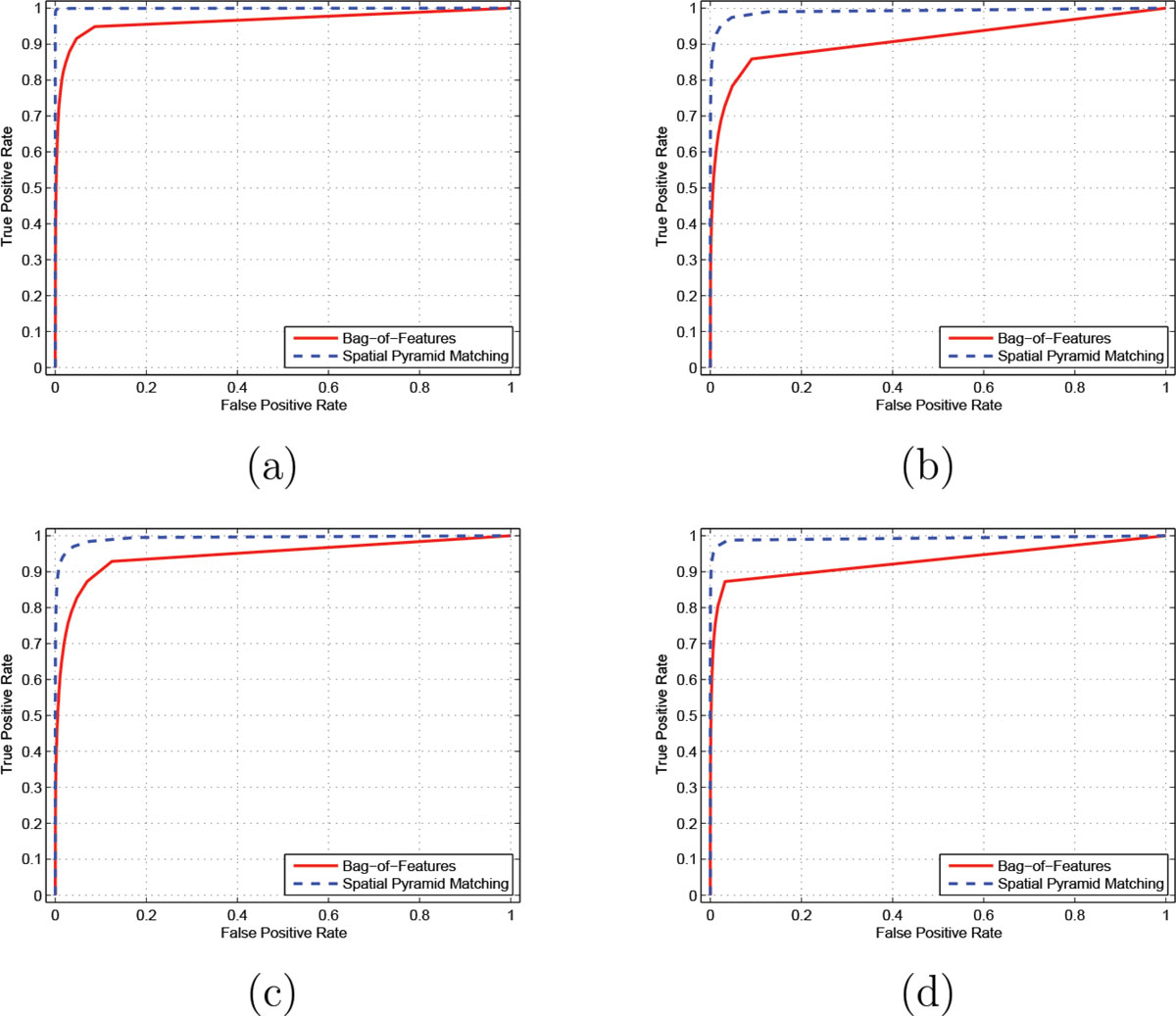
Figure 4
The ROC curves represent the performance of the Bag-of-Features (red) and the Spatial Pyramid Matching approach (blue dotted) on the signature identification experiment. A comparison between BoF-based and SPM-based techniques on different scripts (a) English, (b) Devnagari, (c) Bangla, and (d) combined, are shown here.
A comparative study of performance with the previously proposed approaches on signature identification have been presented in Table 3. An accuracy of 84.64% was reported by Bricen˜o et al. [1] and Pal et al. [11] proposed an accuracy of 92.14%.
Conclusion
Signature identification is a task of interest for authentication of personal identity, contentbased document retrieval based on signature information, etc. In this paper, we propose an approach for efficient identification of signatures regardless of the script used. Three different scripts namely English, Hindi and Bangla have been considered here for the experiment. The signature identification task is performed using SIFT-descriptors with an SPM-based feature and SVM classifier. The empirical results of the experiments are encouraging and compare well with other stateof-the-art approaches in the literature. As we do not use any script dependent features, this method can also be applied to other scripts as well. A comparative study with BoF-based approach reveals the robustness of the proposed technique.