
Introduction
Forensic Document Examiners are frequently called upon to determine whether alterations have occurred to a questioned document. Such alterations could include a simple addition or a more advanced creation of an entirely fraudulent document. In such cases, the Forensic Document Examiner may rely on various portions of the document in order to make such a determination, including fonts, line spacing, and, occasionally, line intersections.
This research was conducted as a result of a case involving a questioned contract. The contract had had a single, wet-ink signature in question. The initial examinations of the document were focused on the authenticity of the signature. A thorough examination of the signature led to a conclusion that it was genuine. The question at issue then became whether the document was created before or after the signature. Upon examination, there were a limited number of small intersections between the wet-ink signature and the toner printing. The intersections were examined microscopically for evidence, such as reflectance of light by the wet-ink above the toner, that would suggest the order in which the toner and wet-ink were placed on the page. The examinations with microscopy were inconclusive as the wet-ink in the intersection was added to the document with low pressure.
Throughout the last two decades, numerous techniques have been developed for the examination of intersecting entries, including the use of ESDA by Radley (2007), chromacity measurements by Liu (2007), and toner removal by Novotny (2005). Prior research has shown toner removal as an effective method for determining if writing ink is present underneath the toner; however, the results of such testing must be viewed with caution as writing inks may penetrate the toner. For this research, toner removal was tested further in order to see if previously untested variables could enhance the reliability of the test. The first variable to be tested was the effectiveness of different sharp instruments in toner removal. The second variable to be tested was if the toner removal could be performed more effectively if the document was pre-treated through freezing. The theory behind freezing the document was that the cold could potentially allow for the toner to chip off more easily, thereby resulting in less damage to the document.
Given the destructive nature of the testing being researched, this data has been compiled as a theoretical exercise. Destructive testing should be used solely as a last resort, and any examiner conducting such testing should exercise caution.
Methods and Materials
For this research, a test sheet was developed that allowed for the collection of both toner-first and ink-first samples on a single page for three different pens (Figure 1). Within each section there were two rows delineated by arrows at each end. While a 60-point font size is unlikely to be encountered in casework, it was the goal of this research to test the method under ideal conditions with a larger area of intersection. In the first row, 20 vertical bars (60-point font size) were preprinted between the arrows. In the second row, the arrows were the same distance apart; however, the vertical bars were not yet printed. A second test sheet was then developed to print only the 20 vertical bars (60-point font size) in the second line for each of the three sections. While laser printers are known to produce toner spatter, there was no evidence of toner spatter near the intersections being tested. At least 24 hours lapsed between each step of the printing of the test sheets, the drawing of the lines, the subsequent printing of the second line of vertical bars, and the toner removal.
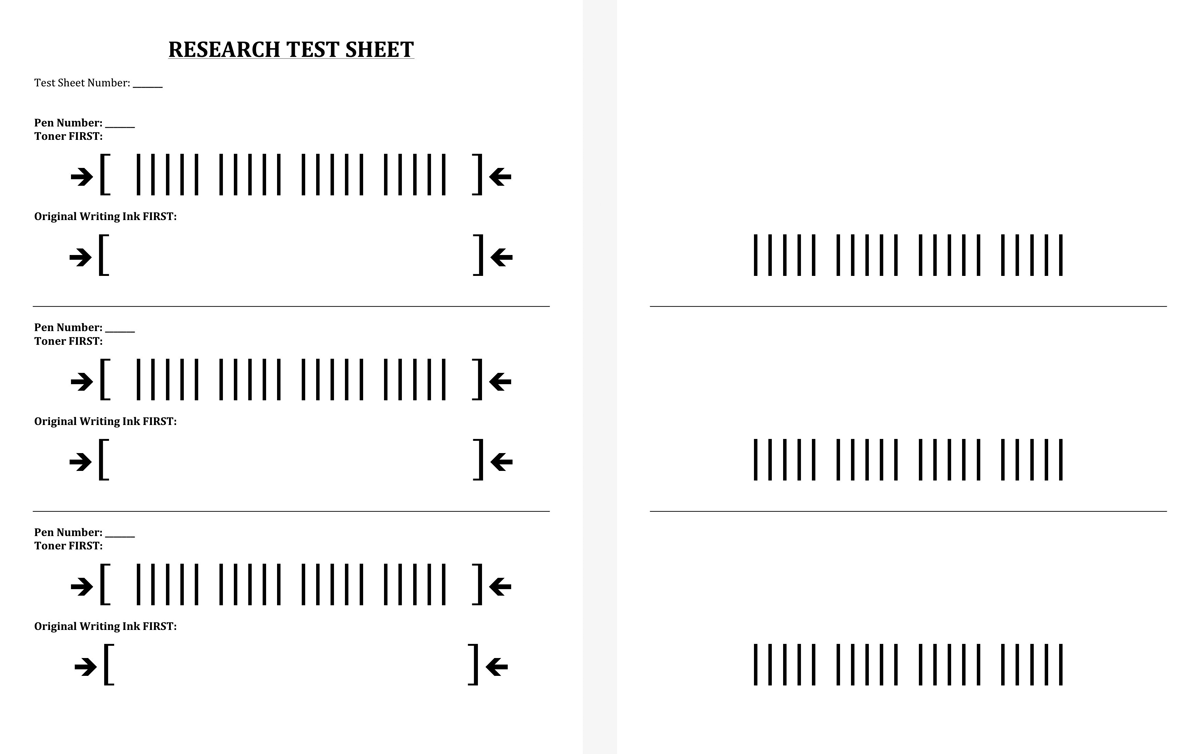
Figure 1
Test Sheets. The original test sheet (left image) was printed first and subsequently had 2 lines drawn on it with each pen, yielding toner-first samples. The second test sheet (right image) was then printed on the same sheet, yielding ink-first samples.
For this research, a variety of 15 pens were tested (Table 1). These pens were chosen to allow for a representative sample of ballpoint and roller ball mechanisms as well as both fluid and gel inks. In addition, several erasable pens were also tested to see if the techniques would be effective. For each pen, two lines were drawn. The first line was drawn between the arrows on the top line, which had the 20 pre-printed toner vertical bars. The second line was drawn between the arrows on the bottom line, where there were no vertical lines.
Table 1
List of the 15 pens tested.
| Brand | Model of Pen | Ink Type | Color |
|---|---|---|---|
| Uni-ball | Insight Fine | Fluid | Black |
| Uni-ball | Insight Fine | Fluid | Blue |
| Uni-ball | Insight Fine | Fluid | Red |
| Pentel | EnerGel Deluxe Fine | Gel | Black |
| Pentel | EnerGel Deluxe Fine | Gel | Blue |
| Pentel | EnerGel Deluxe Fine | Gel | Red |
| Pilot | Frixion Ball Erasable Fine | Gel | Black |
| Pilot | Frixion Ball Erasable Fine | Gel | Blue |
| Pilot | Frixion Ball Erasable Fine | Gel | Red |
| Xeno | Retractable Ballpoint | Fluid | Blue |
| Bic | Round Stic Medium | Fluid | Black |
| Staples | Comfort Stic | Fluid | Blue |
| Pilot | G2 Fine | Gel | Blue |
| Uni-ball | Signo 207 Retractable | Gel | Red |
| Uni-ball | Signo 207 Retractable | Gel | Blue |
For each pen there were a total of 40 intersections examined (20 with toner-first and 20 with ink-first). The first 10 intersections of each group were examined with no pre-treating of the document, while the second 10 intersections of each group were examined after pre-treating the document by placing it in a freezer for at least 24 hours. The freezer was set to 5°F, which was independently verified with a second thermometer. The actual toner removal was completed with two different instruments. In half of the samples, the toner was removed using the backside (dull edge) of an X-Acto razor blade, and in the second half, the toner was removed using a sewing needle with a diameter of 0.5 mm.
In order to determine the effectiveness of the methods being tested, an error rate was calculated through a forced call protocol. The error rate was calculated through examining the results of each intersection and determining if the intersection showed evidence of wet-ink being present underneath the toner. If there was no evidence of wet-ink present underneath the toner, the conclusion was that the toner was first. If there was evidence of wet-ink present underneath the toner, the conclusion was that the ink was first. Based on these procedures, if a tonerfirst intersection showed evidence of wet-ink underneath the toner as a result of the wet-ink penetrating the toner, then the conclusion was considered an error.
Results and Discussion
Toner Removal Without Freezing
The standard toner removal without freezing the documents yielded expected results (Figure 2). The X-Acto razor blade allowed for more complete removal of the toner, but was prone to also removing some of the ink and paper as well. The needle removed less of the toner, thereby resulting in a lower probability of removing the ink underneath and destruction of the paper. Overall, the standard toner removal had an error rate of approximately 28%. The error rate was high to a large degree due to inks that completely penetrated the toner.
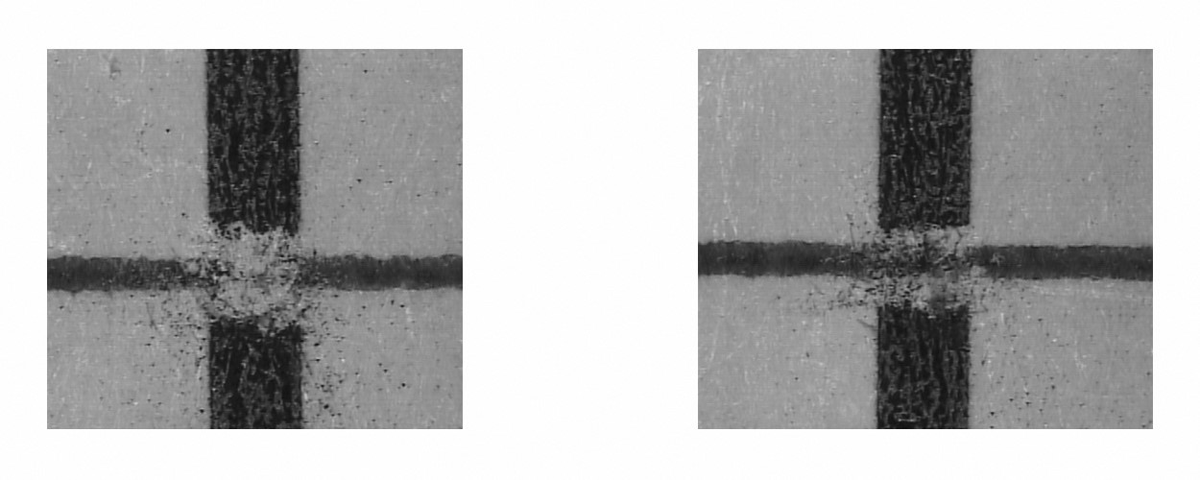
Figure 2
Standard Toner Removal Results. Examples of intersections of toner and the Uniball Insight Fine Blue pen after standard toner removal. A toner-first intersection using the X-Acto razor blade (left image) and an ink-first intersection using the needle (right image).
The results for several pens were also of interest. It was noted that the toner removal process proved ineffective for intersections with the Bic Round Stic Medium Black pen. The ink-first intersections showed no evidence of the ink underneath the toner; however, in one toner-first intersection, it was noted that there might be slight penetration by the ink. The toner removal process also proved ineffective for all three erasable inks. The act of removing the toner also removed the inks. These results will be discussed later in this paper.
Toner Removal After Freezing
The toner removal completed after freezing yielded limited results (Figure 3). The X-Acto razor blade performed similarly to the standard toner removal process without freezing. The needle, however, removed far less toner than it had during the standard toner removal process. Overall, the toner removal with freezing had an error rate of approximately 23.6%. The error rate was high to a large degree due to inks that completely penetrated the toner.
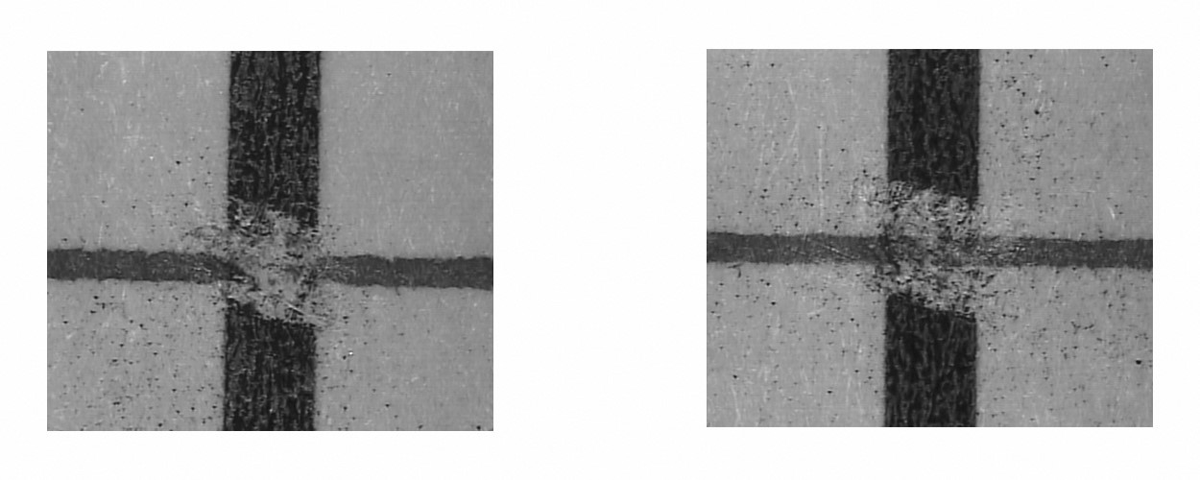
Figure 3
Toner Removal After Freezing Results. Examples of intersections of toner and the Uniball Insight Fine Red pen after freezing. A toner-first intersection using the X-Acto razor blade (left image) and an ink-first intersection using the X-Acto razor blade (right image.)
The results for several pens were also of interest. This technique was found to be reliable for the Bic Round Stic Medium Black pen. The toner-first intersections had evidence of wet-ink being present underneath the toner as a result of the ink penetrating the toner. The ink-first intersections had evidence of wet-ink being present underneath the toner. The results for the Bic Round Stic Medium Black pen are important because they contrast with the observed result from the standard toner removal. It was noted that the toner removal process also did not fully remove the ink for the erasable inks.
Erasable Inks
When the second set of lines on the page with the erasable inks was printed, all 3 inks faded dramatically to the point of being barely visible to the naked eye. According to the manufacturer, the pens are not supposed to be exposed to temperatures greater than 140° Fahrenheit or the ink will become colorless. (The internal temperature of the printer could not be measured to confirm if that temperature was reached.) As expected, the toner removal process removed the ink on the ink-first samples. The intersections were then examined using the spot filter on a VSC to visualize the ink and make a determination. The documents were then frozen for the second set of testing, and upon removal from the freezer, it was noted that the inks were again visible. According to the manufacturer, the pens will again write if exposed to temperatures below 14° Fahrenheit. After completing the toner removal, it was noted that, in several ink-first intersections, the ink was still present (Figure 4).
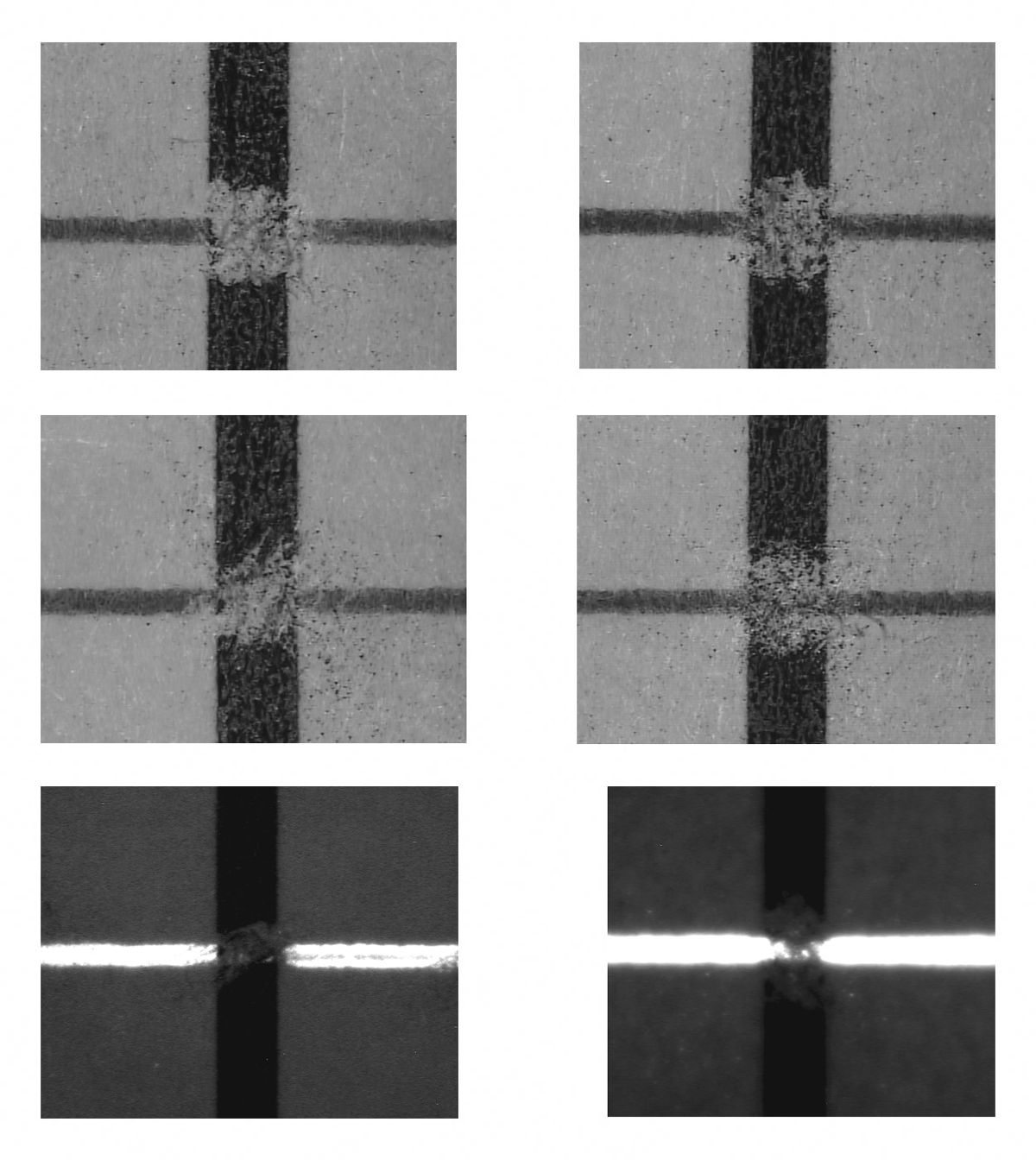
Figure 4
Erasable Inks. In the top row are toner-first (left image) and ink-first (right image) intersections with Pilot Frixion Ball Erasable Fine Blue pen after standard toner removal. The ink line is not visible in the ink-first sample. In the second row are toner-first (left image) and ink-first (right image) intersections when the toner removal was conducted after freezing. Note that the ink line is present in the ink-first sample. In the third row are toner-first (left image) and ink-first (right image) intersections imaged with a spot filter of the VSC.
Conclusions
For this research, techniques for toner removal in sequence examinations of intersections between original writing ink and toner printing were tested for their reliability. The results of this research indicate that although toner removal can be accomplished effectively by a skilled Forensic Document Examiner with practice, due to the penetration of some inks through toner, the error rate is unacceptably high.
The first variable tested during this research was whether it was more effective to use a blade (such as an X-Acto razor blade) or a sharp point (such as a sewing needle). While the blade was more effective for removing the majority of toner in a given area, it was also more prone to removing the ink underneath and damaging the paper. Toner removal with the X-Acto razor blade had an error rate of approximately 26.3%. The needle was more effective in removing the surface of the toner itself, thereby limiting the potential for removing the ink underneath or destroying the paper. Toner removal with the needle had an error rate of 25.3%. The needle’s results were not as visibly clean as those of the blade (Figure 5). Ultimately, the error rates for both instruments were relatively similar.
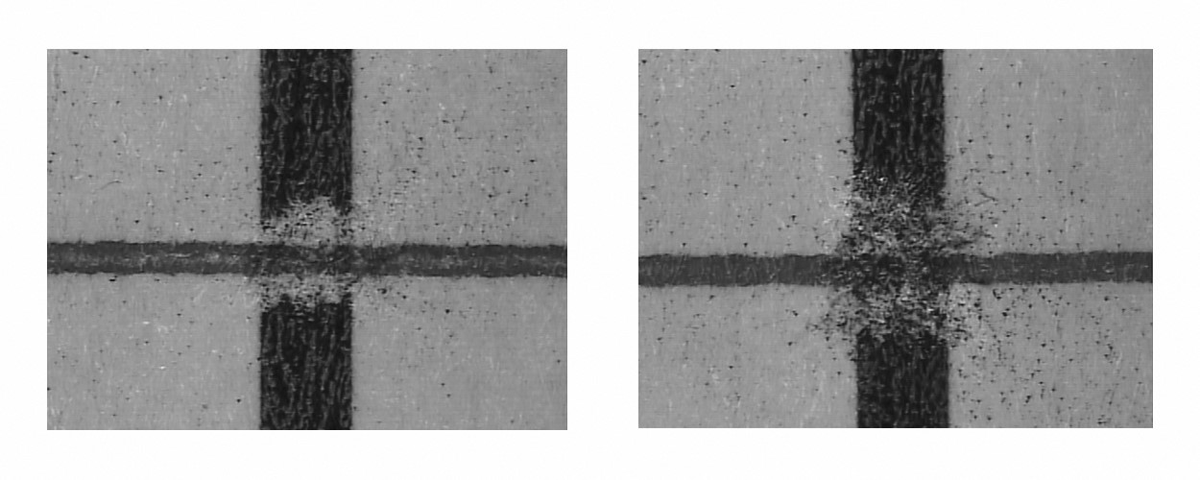
Figure 5
Comparison of Toner Removal Instruments. Examples of intersections of toner and the Pentel Energel Deluxe Fine Red pen after freezing and toner removal. An ink-first intersection using the X-Acto razor blade (left image) and an ink-first intersection using the needle (right image) show results were common for each instrument.
The second variable tested during this research was whether the method was more effective if the document was frozen prior to removal of the toner. For a small number of the inks tested, removing toner after freezing yielded more accurate results than were obtained from the standard toner removal process (Figure 6). The standard toner removal process had an error rate of approximately 28%, while the toner removal process with freezing had an error rate of approximately 23.6%. Given these results, it is likely that freezing can be of some benefit to toner removal examinations. However, it must be emphasized that, due to the penetration of some inks through toner, any results obtained through this process will be of limited value.
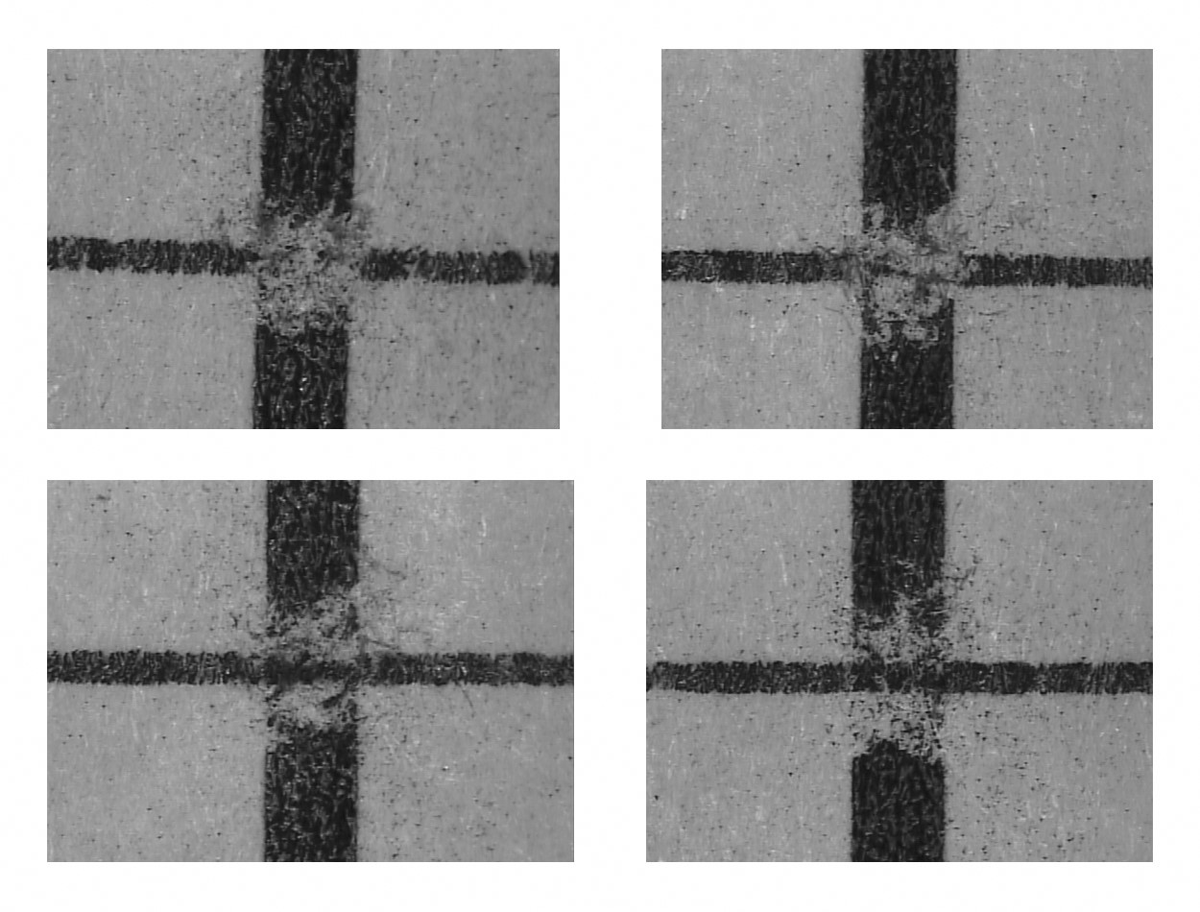
Figure 6
Comparison of Standard v. Freezing. In the top row are toner-first (left image) and ink-first (right image) intersections with the Bic Round Stic Black pen after standard toner removal. In the second row are toner-first (left image) and ink first (right image) intersections with the Bic Round Stic Black pen after freezing and toner removal. Note that the bottom-left image indicates that the ink penetrated the toner.
While not a primary variable in this research, the application of toner removal to intersections with erasable ink produced valuable results. The toner removal process did not fully remove the ink when the document was frozen prior to testing. More notably, the use of alternative light sources in addition to the toner removal process proved useful in making sequencing determinations when the writing ink was no longer visible.
The results of this research show that toner removal in sequence examinations is of limited value. While the statistics generated as a result of this research are limited by the relatively small sample size of pens used, they still show the high potential for the penetration of toner by various inks.
Acknowledgements
My sincere thanks to John Paul Osborn for allowing me conduct this research. I would also like to thank Alexander Nieliwocki and Sean Patrick McCann for their assistance in the toner removal process. Finally, I would like to thank Tom Vastrick for his guidance on the final paper.