
Introduction
Disguised and simulated writings are challenging for forensic handwriting experts (FHEs) when assessing authorship. Previous research has reported that authorship opinions on these writing types attract higher inconclusive and misleading rates than natural writing does (Found & Rogers, 2005, 2008). While research by the authors has found that FHEs have a skill over laypeople in correctly determining the writing process of pairs of naturally written and disguised writings (Bird, Found & Rogers, 2010a), there does not appear to be a skill (in either FHEs or laypersons) associated with determining the process of production of individual samples that are either naturally written or disguised (Bird, Found & Rogers, 2012a). Unpublished research by the authors has explored the skill of FHEs in discriminating between disguised and simulated writing samples and found that while the strength of the evidence of an FHE was greater when they gave an opinion that a sample was simulated rather than disguised, the probative value of the evidence for both disguised and simulated writings is low (Bird, Found & Rogers, 2010b).
The task of discriminating between disguised and naturally written samples has been found, in further unpublished research by the authors, to be affected by the success of the disguise strategy employed. Those disguised writings that display many of the writer’s natural writing characteristics were often mistaken for being naturally written (Bird, Found & Rogers, 2012b). This means that when examining questioned natural and disguised samples, FHEs had a tendency to call disguised samples natural. Furthermore, when examining questioned disguised and simulated samples there appears to be a propensity for calling simulated samples disguised (Bird, Found & Rogers, 2010b). These results suggest that FHEs’ expectations of the predictor features of these unnatural writing types are not accurate.
This paper investigates the relationship between FHEs’ responses on the process of production of questioned disguised and simulated handwriting samples and their verbal statements relating to the features they observed as indicative of the particular unnatural writing behaviour. A clear relationship between FHEs’ verbal statements and correct responses will enable elucidation of predictor features of disguised versus simulated writings.
Methods
Participants
Results reported here are from FHEs who provided independent opinions on the process of production of the supplied handwriting samples. Twenty-nine FHEs from 12 countries took part in the trial. All of the participants were authorised by their employers to release opinions regarding the authorship of questioned handwriting and signatures. At the time of data collection, 24 FHEs were working in government laboratories and five were working privately.
Materials
The trial consisted of 100 pairs of handwritten text, each with a naturally written comparison sample (100 different writers) and a questioned sample that was either disguised by the comparison writer or written by another writer attempting to simulate the comparison writer’s handwriting features. The writings, all of a specific text, were made using one of two makes of ballpoint pen and the same make of white paper. The samples were scanned at 600dpi and laserprinted into a booklet as well as converted into high-resolution PDF files. For the disguised writings, no directions were given to the handwriting providers as to how to disguise their handwriting. Fifty-nine writers provided the sixty-six freehand simulated samples used in the trial.
Procedure
Participants were provided with a sample booklet of laser-printed images of the handwriting samples and a DVD containing PDF files of the samples. Each participant was given an answerrecording booklet and informed that each sample pair consisted of a naturally written comparison sample and a questioned sample that was either disguised by the comparison writer or simulated by a different writer attempting to copy the handwriting features of the comparison writer. Participants were asked to make an assessment as to whether the questioned sample was disguised or simulated, or if they could not say. They recorded their response for each of the questioned samples in the answer recording booklet by entering a code (D disguised, S simulated, or I inconclusive). If an inconclusive opinion was given, the participant was required to record an additional forced opinion (D or S) for the handwriting sample; however, not all participants did so.
In addition to the process opinion, participants were instructed to record in the answer booklet the feature(s) they observed which indicated the process when they gave an unforced opinion. Recording this observation was optional in the case of a forced opinion.
Observations of 29 FHEs who provided both unforced opinions and observations are considered in this paper.
Ethics approval
Approval for this study was obtained from the La Trobe University Human Ethics Committee on the basis that the handwriting providers and test participants gave full consent for samples of their handwriting, or research data provided by them respectively, to be included in published material, on the condition that neither their name nor any other identifying information be used.
Analysis
The observations recorded by FHEs regarding the features they observed as indicative of either disguise or simulation behaviour were free text. The groups’ observations were reviewed so that suitable identifiers could be developed. This led to the collation of a list, aligned to features commonly reported in the literature (Alford, 1970; Harrison, 1958, Keckler, 1997; Konstantinidis, 1987; Regent, 1977; Totty, 1991) and used in other research by the authors (Bird, Found & Rogers, 2010a, 2012a, 2012b). This list was further refined by grouping features together which relate to a common theme, to facilitate statistical analysis. The groupings (factors, in the statistical analysis) are given in Table 1. The identified factors, as shown in Table 1, are SPEED, CONSTRUCTION, SIZE, SPACING, NEATNESS, SLOPE, PRESSURE, FORMAT and TREMOR.
Table 1
Groupings of observed features into factors.
| Factor | Observed features |
|---|---|
| Speed | Writing speed |
| Construction | Altered letter construction/style Disconnected letter forms Altered ascenders or descenders Altered initial or terminal strokes Angularity Altered stroke order Unusual/awkward letter forms/embellished Proportions No attempt to simulate Connectivity Inconspicuous significant dissimilarities Diacritic Similarities in letter forms/details Imitation of obvious features |
| Size | Letter size |
| Spacing | Spacing |
| Neatness | Neatness Retracing/overwriting Corrections Lack of internal consistency |
| Slope | Altered slope |
| Pressure | Apparent writing pressure |
| Format | Altered baseline Altered punctuation Spelling Margin habits |
| Tremor | Complexity/skill level Fluency |
To ascertain how the identified factors are associated with FHEs’ responses, Population-Average Generalised Estimating Equations (PA-GEE) with binomial distribution and LogitLink was applied (Liang & Zeger, 1986). Also taken into account was how FHEs’ responses compared to the actual behaviour employed (disguised or simulated) for each questioned handwriting sample. There were 29 subjects in the sample set, but each subject contributed 100 repeated observations (one ‘observation’ for each of the 100 questioned samples). As the repeated observations are nested within the separate subjects, the data set exhibits a typical two-level structure (see Figure 1). The PA-GEE was applied because of the multi-level data structure. However, there was no real advantage to apply other hierarchical or multi-level models such as the Generalised Linear Mixed Model (GLMM), where the fixed and random effects must be specified. The repeated observations are assumed to be correlated in an exchangeable pattern in PA-GEE. Theoretically speaking, this specification is most appropriate and it has been proved that the results would remain consistent if the working correlation matrix is mis-specified. Analysed with Stata 11.0 (Stata Corp, Texas, USA), all statistical tests were conducted at 5% level of significance. Tests were undertaken using the unforced responses of the 29 participants. The model was analysed to determine if there were significant differences in the factors associated with correct or incorrect answers when taking into account the handwriting behaviour, i.e. if different factors are associated with obtaining a correct (or incorrect) answer for disguised versus simulated samples.
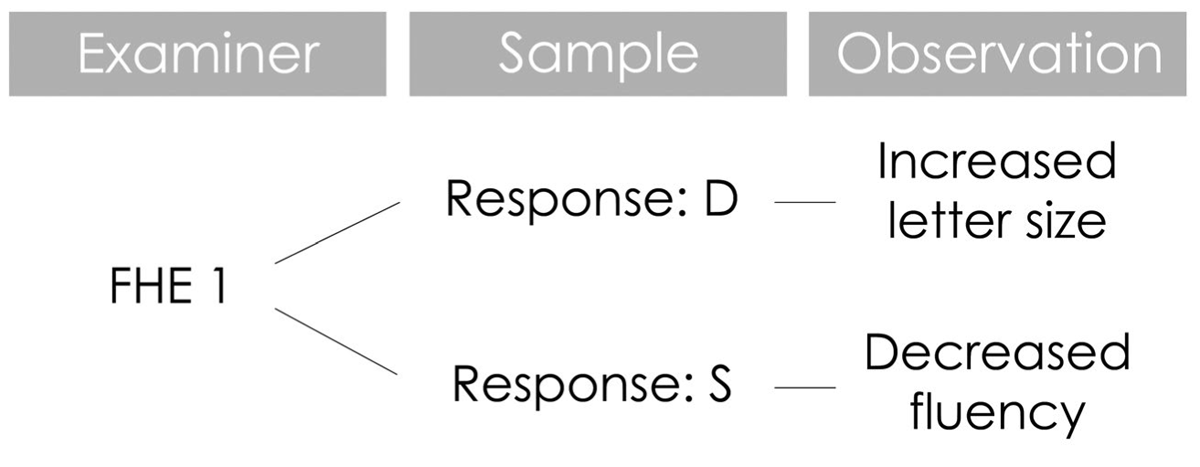
Figure 1
Example of the nested two-level structure of data for a FHE.
Results
Table 2 gives the results for the model, where examiners were willing to offer an opinion as to whether a questioned sample was disguised or simulated. It should be noted that where a significant Adjusted Odds Ratio (AOR) is above unity (i.e. greater than 1) for a feature, there was a higher chance of obtaining a correct answer for samples of that handwriting type. Conversely, where a significant AOR is below unity (i.e. less than 1), there is a higher chance of obtaining an incorrect answer for samples of the relevant handwriting type.
Table 2
PA-GEE analysis with binomial distribution, logit link and exchangeable working, including handwriting type.
| Disguised | Simulated | |
|---|---|---|
| Factor | Adjusted Odds Ratio (AOR) | Adjusted Odds Ratio (AOR) |
| SPEED | 2.82 | 0.82 |
| CONSTRUCTION | 1.17 | 1.42* |
| SIZE | 2.55 | 0.48* |
| SPACING | 0.51 | 0.98 |
| NEATNESS | 1.00 | 1.01 |
| SLOPE | 5.33* | 0.36* |
| PRESSURE | 5.87 | 0.80 |
| FORMAT | 0.48 | 1.70 |
| TREMOR | 0.78 | 1.64* |
| *Statistically significant at 5%. | ||
For disguised samples, the only factor significantly related to a FHEs’ responses is SLOPE, which has a positive relationship. Conversely, for simulated samples, there is a higher chance of having a correct answer without SLOPE. SIZE is also significantly, negatively associated with FHEs’ responses for simulated samples, while CONSTRUCTION and TREMOR are significantly, positively associated with responses.
Discussion
These results suggest that the identification of altered slope in a questioned sample when compared to a naturally written sample may be a predictor of disguise behavior (Figure 2). Harrison (1958) states that deliberate changes to slope are rarely constant in disguised writings. This internal inconsistency in slope may also assist in detecting the disguise strategy in individual handwriting samples. If altered slope is not observed as a feature in the comparison of questioned and naturally written samples, this may be a predictor of simulation behaviour.
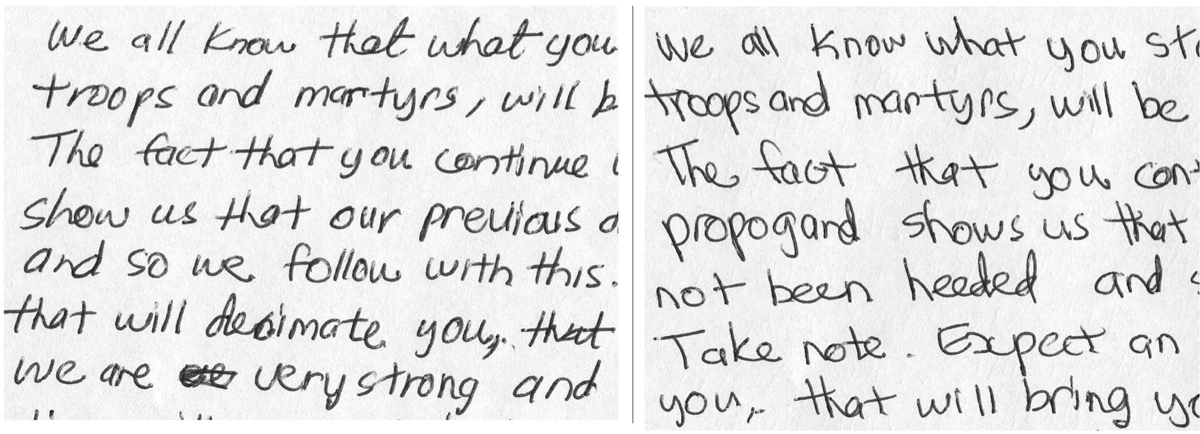
Figure 2
Naturally written sample (left) and disguised sample (right) displaying an alteration in slope.
Slope and size are both relatively obvious features in handwriting as opposed to stroke order, stroke direction or writing pressure, for example. It may thus be supposed that these obvious features are copied reasonably well by simulators; hence the greater chance of a correct answer in the absence of their observation by FHEs in questioned simulated samples.
The positive association of letter construction and tremor features with a correct answer for simulated samples, along with these features not being significantly associated with answer for disguised samples, means that they may be used as predictors of simulation behaviour in questioned samples (Figure 3).
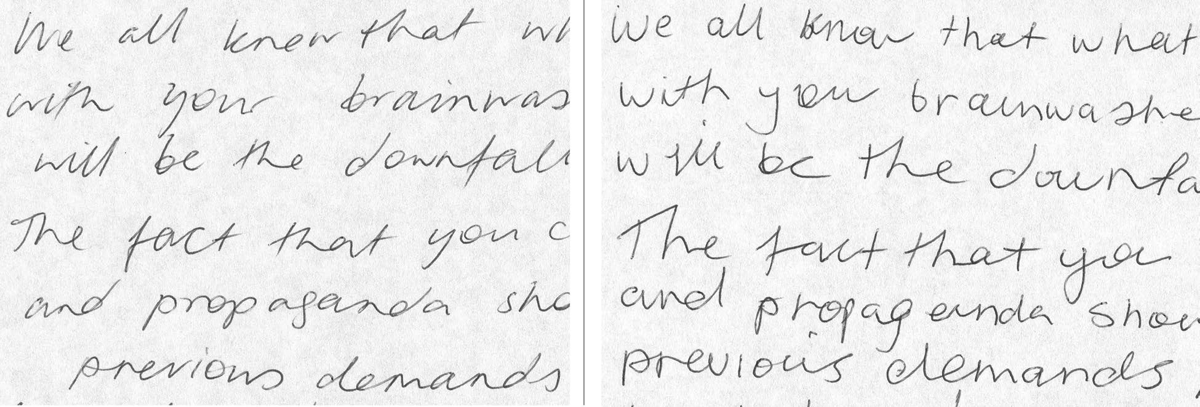
Figure 3
Naturally written sample (left) and simulated sample (right) showing similarities in gross aspects of letter construction, but with the simulated sample exhibiting decreased fluency.
A limitation of the analysis undertaken revolves around the diversity in disguise strategies. Although the literature reports some disguise strategies as commonly used (altered slope, letter design, size, see Huber & Headrick, 1999), the success of disguise, even when the same strategy was employed, varied widely from writer to writer (Bird, Found & Rogers, 2012b). Any single predictor feature will only be relevant in cases where the particular strategy (or by-product) has been employed (or is observable), so will not apply to all disguised samples.
Conclusion
The results of this study suggest that observations of altered slope, differences in features of construction and size and the presence of tremor may be used as predictors to discriminate between disguise and simulation behaviour. Observing an alteration in slope was found to be significantly associated with correct answers for disguised samples while observations relating to construction and tremor were significantly associated with correct answers for simulated samples. The absence of observations relating to size is also significantly associated with correct answers for simulated samples.
Acknowledgments
The statistical analysis reported in this paper was undertaken by Dr Siew-Pang Chan, Senior Lecturer, Mathematical Sciences, La Trobe University, Australia, to whom we are very grateful. Our thanks are also extended to the handwriting providers and forensic handwriting examiners who generously gave their time to participate in this study.