
Introduction
If a forensic handwriting examiner does not find any difference between a questioned signature and reference specimens of the writer (i.e. every feature of the questioned signature falls within the variation range of those of the reference specimens), the question that usually follows is: could it be a simulation by a capable forger? If a perfect simulation does not seem to be very probable if the signature is complex, it must be recognised that in case of simple signatures, a perfect simulation may be easier to reach. Note that in this study, a perfect simulation is defined according to Huber and Headrick (1999) as “a forgery that will not be detected as such by a competent examiner.”
Cases concerning simple signatures are not uncommon. Most writers tend to simplify their signatures over time (Balbuena Balmaceda 1985) and this simplification can make the signature less secure. Nevertheless, the signature does not lose its judicial value.
Many papers have been devoted to studying the simulation of signatures. Some authors have discussed the relationship between the difficulty of the simulation and the signature complexity (Brault et al., 1993; Found et al., 1996 and 1998a/b; Huber et al., 1999; Sita et al., 2002). Since then, models for evaluating the complexity of a signature have been developed (Alewinjse et al., 2009; Brault et al., 1993; Found et al., 1996). Moreover, some studies focusing on the best reproduced characteristics by forgers were published (Alewinjse et al., 2009; Al-Musa Alkahtani et al., 2010; Black 1963; Black et al., 2003; Conway et al., 1982; Found et al., 1999; Gek Kwee et al., 2006; Hayoz 2003; Herkt 1986; Horan 1985; Leung et al., 1993). Some of them also tested the feasibility of a “perfect” simulation. Finally, we could find only one author (Zappitelli 2000) who concluded that the perfect simulation does indeed exist. Furthermore, some papers looked at specific classes of forgers (Dewhurst et al., 2008; Buglio et al, 1997; Lee 1998; McCarthy 1984; Totty 1995); Dewhurst provided evidence of differences in the quality of simulations between two different populations of forgers (calligraphers vs lay people). However, the research did not focus on signature complexity, and, specifically, simulation of “simple” signatures.
The present research was planned to test empirically the hypothesis of the existence of perfect simulations, in particular, in challenging cases where the questioned signature is considered to be simple. The supplementary objective of this study was to relate the influence of the forger’s skills, the forger’s age, and the time the forger dedicated to the task, to the quality of the simulation.
Methods and Materials
1. Signature collection and selection
To test the hypothesis of the existence of a perfect simulation, signatures of 78 persons were first collected. The signatures were written with a blue ballpoint pen on a white sheet of A4 paper. Each person was requested to sign four times on three different days (a total of twelve signatures) in order to obtain a sample of the variation of the writers’ signatures.
Once the signatures were received, they were classified either as simple or complex. The definition of simplicity was based on two sources of information. Firstly, signature simplicity was defined by antagonism to signature complexity, such as defined in other articles (Alewinjse et al., 2009; Brault et al., 1993; Found et al., 1996). Secondly, 38 people with handwriting expertise (people from the School of Criminal Justice of the University of Lausanne and members of national police forensic science departments) were asked to answer the question, “What is a simple signature?”
The simplest signatures were selected and analysed according to standard forensic document examination procedures (ENFSI 2004). The general aspect and particular characteristics were observed. The layout, the regularity and the aspect of the twelve reference signatures for each sample were examined. Additionnally, the elements of style, such as the horizontal and vertical spatial extensions together with the full signature were measured and the proportions calculated. Spaces between elements were measured, as well as some angles. The orientation of the baseline and the number of strokes were documented. Finally, the analysis was concentrated on some execution elements such as shapes, stroke direction and line quality. To conclude, an indication of pressure and speed was expressed. Elements of style and execution were designated according to Huber and Headrick (1999).
2. Simulation phase
To test whether the simulation quality is influenced by the forger’s skills, three populations of forgers were chosen: people with a background in design (14), people with knowledge of handwriting expertise, i.e. students following the document examination courses of the School of Criminal Justice of the University of Lausanne, hereafter SCJ (19) and people from the general population (19).
The 52 forgers were divided into two groups A and B. Forgers of a given group had to simulate the same series of 3 signatures. This was considered to represent a reasonable task for each forger.
Each forger was asked to complete a questionnaire about age, handedness, profession (degree, years of study, and years of formation and practice in their domain) and time dedicated to the simulation task.
The two groups of forgers were composed as presented in Table 1. The groups are comparable in composition in order to enable a comparison of simulation quality between them.1
Table 1
The detailed composition of the two groups of forgers A and B.
| Group A 1 architect with a diploma from an artistic school and the architecture Academy with 9 months of experience 1 graphic designer with a professional school degree and 3 years of experience 1 student from an artistic school 1 painter from the Art Academy of Brera and the University of Paris VIII with 35 years of experience 1 criminalist known for his simulation skills 7 students at SCJ (3 at BSc and 4 at MSc level) 3 commercial employees 1 railway leader 1 carpenter 1 student from the hotel school 1 teacher 1 fiscalist 1 student in physiotherapy 1 laboratory assistant | Group B 1 building designer with 4 years of school and 14 years of experience 1 architect with a diploma from a Swiss University and 5 years of experience 1 graphic designer with a professional school degree and 5 years of experience 3 architects with a professional school degree and 2, 6 and 32 years of experience respectively 2 building designer with thirty-two and thirty-nine years of experience 1 graphic designer (the person gave us only this information) 1 student of the third year of the IPS 11 students at SCJ (at MSc) 1 psychologist 1 commercial employee 1 retired 2 teachers 1 student in psychology 1 student in urbanism 1 unemployed 1 chef |
Each forger was requested to produce freehand simulations with a blue ballpoint pen on a white sheet of A4 paper. For each signature to be simulated, forgers were provided with scans of the 12 reference specimens sampled during the collection phase. Simulations were collected in the same conditions as the original signatures to reduce the influence of the support and the writing instrument on the results of the last phase of the research (expertise phase). Freehand simulation was required since according to Mathyer (1960) and Herkt (1986), this represents the most complex type of simulation to detect. Each forger was asked to produce the best simulation she/he could reach (with about two months of time to practice).
Each simulation was scanned at 800dpi by the forgers and analysed by the research team. First, signatures presenting signs of simulation such as tremor, blunt endings, patching and unexpected penlifts were excluded. All the remaining signatures were then examined following the same procedure as the reference collection. After this analysis step, the results of simulations of a given signature were compared between forgers of a same population. Following the comparison, the best simulations of each signature of each population of forgers were selected.
3. Expertise phase
Three signatures chosen for the quality of the simulation results were presented to Swiss documents experts selected on a voluntary basis. Two cases were submitted to each expert in the form of a non-official proficiency test. Each of both cases included 8 reference specimens and 4 questioned specimens of the signature of a given writer (see Fig.1). Images of the signatures were sent to the experts by e-mail (scanned at 800dpi). For each case, the 4 questioned specimens included a reference signature and three simulations. The latter were the best simulations of each population of forgers. For each questioned signature, experts had to give an opinion based on a verbal scale proposed by Found et al. (Found et al., 2001, 2003 and 2008, see Table 2). The experts were allowed to write comments on the test. Additionally, each expert was asked to report his/her number of years of experience and the number of signature cases/examinations handled per year. Among 24 National experts to whom the test was sent, 6 answers were received.
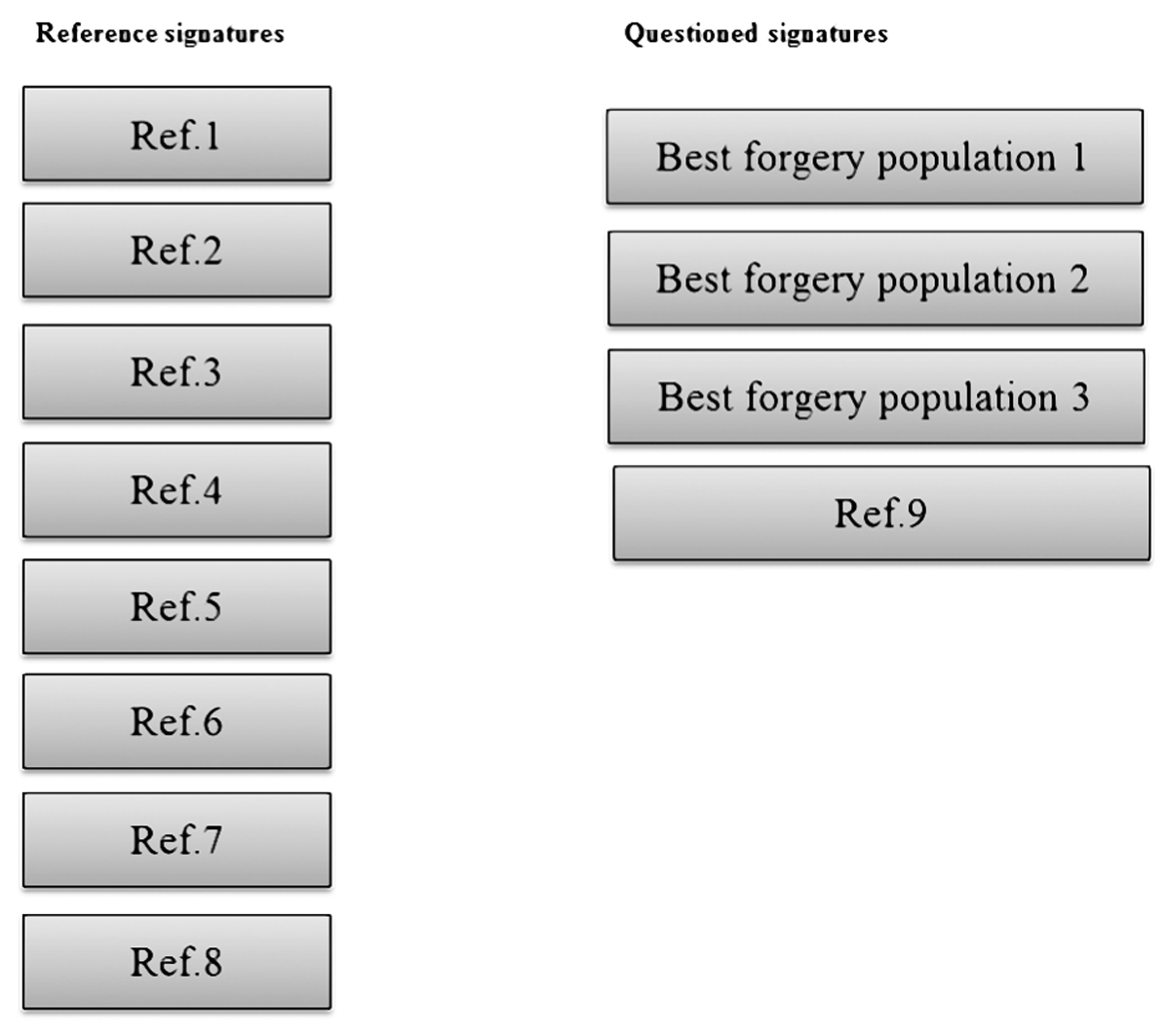
Figure 1
Example of case submitted as proficiency test. Each expert received 8 reference signatures and 4 questioned signatures. The 4 questioned signatures included the best imitations of the three populations of forgers and a reference.
Table 2
| Level 1 The questioned signature was written by the writer of the signature specimen (“very strong support […]”) |
| Level 2 There are indications that the questioned signature was written by the writer of the signature specimen |
| (“moderate support […]”) |
| Level 3 No opinion can be expressed as to whether or not the questioned signature was written by the writer of the signature specimens (“inconclusive opinion”) |
| Level 4 There are indications that the questioned signature was not written by the writer of the signature specimens (“moderate support […]”) |
| Level 5 The questioned signature was not written by the writer of the signature specimens (“very strong support”) |
Results and discussion
Signature collection
Between the 38 people with handwriting expertise, 19 individuals defined a simple signature as a signature “simple to simulate,” 32 as a signature “with no particular graphical characteristics” (with normal dimensions, low number of intersection points, readable, with large variability between specimens and with a poor line quality). Finally, taking into consideration both the literature on the topic and answers to the questionnaire, a signature was considered to be simple when it was
readable,
in a known alphabet,
with a poor line quality,
short,
with a small number of turning points and line intersection and superimposition2
with many stroke interruptions
with a large variability between specimens.
Based on the above-mentioned criteria, 6 simple signatures with particular characteristics were retained among the 78 signature collection. These 6 signatures represented different types of simple signatures. They were also selected in order to prepare two groups of 3 signatures presenting (at least partially) comparable simplicity features between both groups, since they were later submitted to two groups of forgers (see following section Simulation phase).
The first signature (A1) is characterized by the poorest line quality and appears to be the simplest signature following the other listed criteria. B1 presents the largest variability between specimens and looks like a drawing more than a written signature. Signatures A2 and B2 have the lowest number of intersections, superimposition and turning points. B2 and A3 are the most readable signatures, while A2 and B3 are the least readable ones (excepting B1, which is rather a drawing). Signatures are shown in Figure 2 (partially obscured for personal protection, even if participants accepted the use of their signature for research purposes).
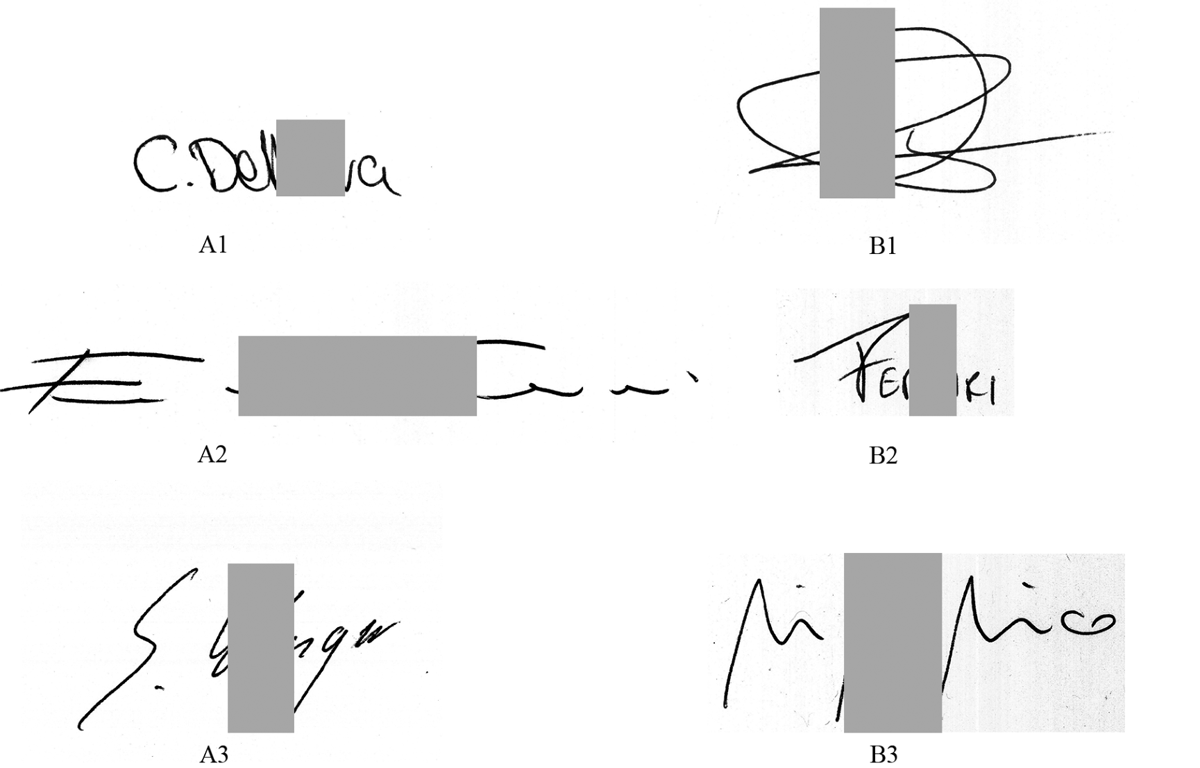
Figure 2
The 6 selected signatures.
Simulation phase
The results analysis and the comparison between the simulations and the reference specimens showed some trends. Firstly, general aspect and signature dimensions were well reproduced by every forger. This is in agreement with the results of Horan (1985) and Leung et al. (1993), according to which forgers uppermost concentrate on obviously visible characteristics, such as shape and dimensions.
The comparisons of the simulations between the populations of forgers confirmed the influence of the profession on the simulation quality highlighted by Dewhurst et al. (2008) and Hayoz (2003). The analysis showed a better dexterity of the professional designers, which results in a better line quality and fluency. Moreover, proportions were better reproduced in this population of forgers, which may be explained by the attention they pay to spatial details. In her work on calligraphers and laypersons, Dewhurst et al. (2008) explain this skill by a developed visual capability, good graphical habits and a better control of the motor program given their daily utilisation.
Students in forensic science demonstrated a higher capacity to identify stroke sequence and stroke direction. Given their knowledge in the domain, these persons concentrate more on details that can remain unnoticed by others. Finally, concerning the general population, results were inconsistent between them. Really good and very poor simulations were produced within this population of forgers. These findings seem to indicate that simulation skills are different from individual to individual but tendencies exist between forgers of a same population.
The simulations of the designers and students in forensic science showed some variation in spacing between the different elements of the signature by increasing or decreasing them. Sometimes pen lifts were added, which enabled the forgers to maintain a good line quality by making room for breaks during the simulation process. Brewester (1932) already noticed these features that are important to observe in order to detect simulated signatures.
In general and independently from any of the population, our research confirmed the difficulties simulators had accurately reproducing slant, baseline orientation and shape at turning points previously observed by Alewinjse et al., (2009), Brewester (1932), Found and Rogers (1996), and Osborn (1929). Our research also confirmed the difficulties in accurately reproducing capital letters and initials observed by Brewester (1932), Conway (1982) and Harrison (1966), who concluded that the beginning and end of a signature are the most difficult parts to reproduce due to their position. According to these authors, the signature centre is the part where the forger gains confidence and furnishes the better reproduction.
Comparing the quality of the simulations, it appeared that a signature is easier to simulate if the reference specimens present a large variation between them. According to Osborn (1929), a high degree of variation between reference specimens indeed leaves much flexibility to the forger. It was also found in the present research that the forgers tended to improve dynamic features of signatures initially showing a poor line quality. This is not in agreement with the statement of Osborn (1929) defining a hesitant trait as simpler to reproduce.
Forgers commented that they were aware of their simulations’ problems but seemed incapable of overcoming this. This indicates that bad results (i.e. simulations showing differences with the reference specimens) are not only due to a bad perception of the signature characteristics but also to motor difficulties in reproducing observed movements.
Given the results and the difficulty indicated by the forgers, the expertise should focus on slant, baseline orientation and shape of letters (especially capital letters and initials) and also on proportions and line quality.
Finally, the findings showed that a signature is easier to simulate if the forger is familiar with its characteristics. People who slant their own signature to the left are better at simulating left slanted signatures. This is also the case with some particular shapes. Regarding readability, while for some people the signature was easier to simulate because of their facility to memorise the movement (knowing the letters to be reproduced), for some readability was rather an obstacle because during the reproduction process their own habits resurfaced. One of the forgers commented: “I cannot do the letter like that because it is not in my habit, so I turned the paper upside-down to see the letters as a drawing rather than a letter.” By referring to the three phases of the simulation process detected by Brault and Plamondon (1993), the explanation of the facility to simulate a signature with which the forger is familiar becomes clarified. In the first memorisation phase, the similarity between the signature to simulate and the forger’s signature facilitates the memorization by reducing the information to retain. Similarities between the signature to be simulated and the signature of the forger will facilitate the phase of construction of a new motor program. The last phase of execution is the only one that needs to be refined through training.
No relationship could be established between the quality of the simulation and parameters such as age and time dedicated to the task.
Expertise phase
All the simulations obtained in this study and for each population of forgers, are of medium to good quality. Only a few signatures were immediately excluded due to obvious evidence of simulation. Three signatures (A1, B1 and B3), chosen for the quality of the simulation results, were presented to Swiss documents experts in a proficiency test (see Figure 1). Examples of simulations obtained for these signatures are presented in Figure 3.
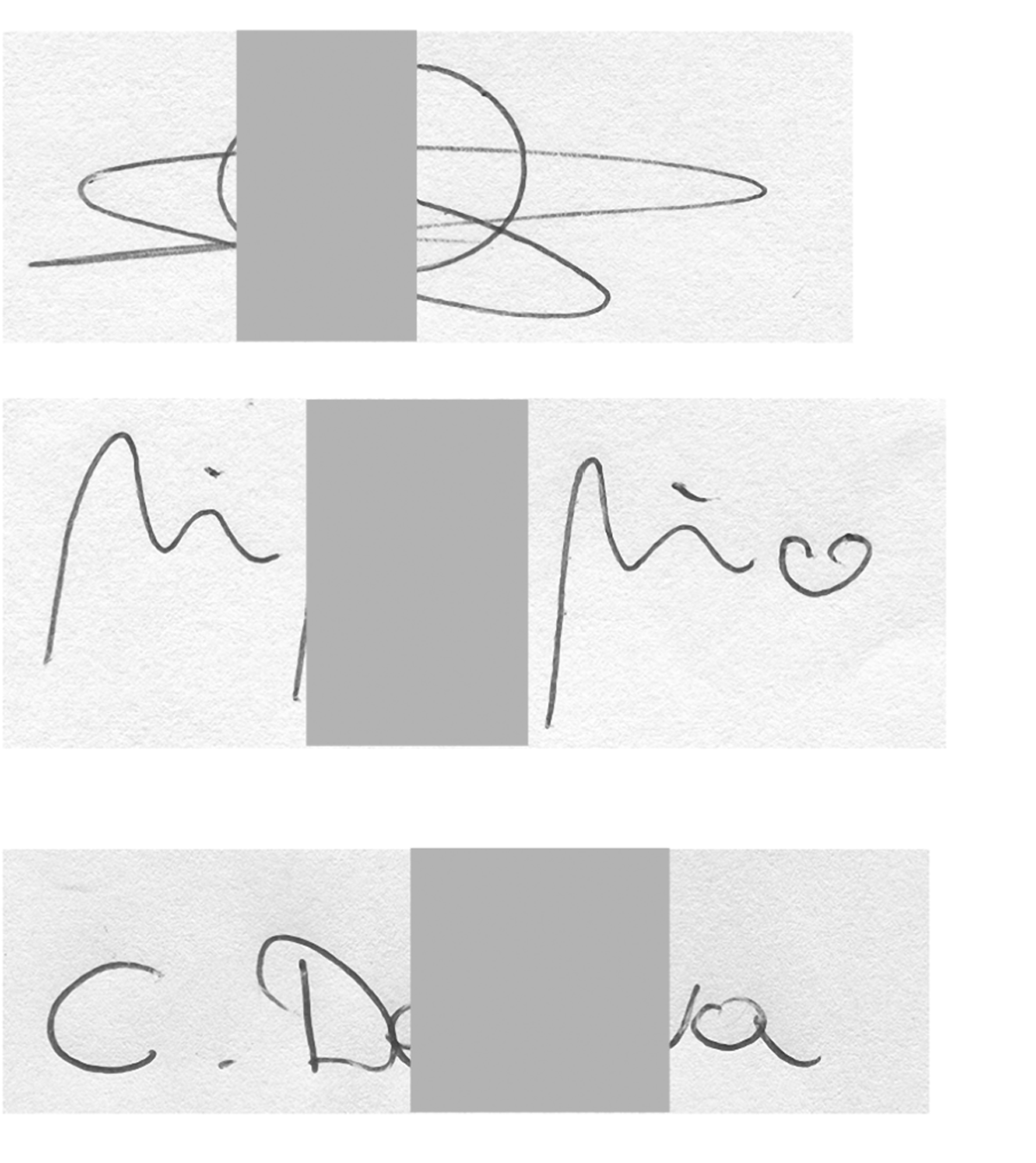
Figure 3
Examples of simulations obtained for signatures B1, B3 and A1.
The years of experience and the number of cases examined per year for each expert are presented in Table 3. The answer of each expert is summarized in Table 4.
Table 3
Information about the experts participating in the study.
| Expert 1 | 25 years of experience | 30 cases/year |
| Expert 2 | 9 years of experience | 80 cases/year |
| Expert 3 | 37 years of experience | 20 cases/year |
| Expert 4 | 9 years of experience | 60 cases/year |
| Expert 5 | 1 year of experience | 3 cases/year |
| Expert 6 | 8 years of experience | 30 cases/year |
Table 4
Results of the document examination experts. Numbers refer to Table 2. See Figure 2. Some experts answered by selecting two levels, with one not preferred (the one in brackets).
| Signature A1 | ||
| Simulation from | Conclusions of the expert 5 | Conclusions of the expert 6 |
| Designers | 5 | 4-(5) |
| Forensic Science Students | 4 | 3-(4) |
| General population | 5 | 5 |
| Signature B1 | ||
| Simulation from | Conclusions of the expert 3 | Conclusions of the expert 4 |
| Designers | 4-(5) | 4 |
| Forensic Science Students | 3-(4) | 3 |
| General population | 4-(5) | 3 |
| Signature B3 | ||
| Simulation from | Conclusions of the expert 1 | Conclusions of the expert 2 |
| Designers | 4-(5) | 4 |
| Forensic Science Students | 3-(4) | 4 |
| General population | 4-(5) | 5 |
These results show that the number of years of experience had an impact on the strength of evidence. Indeed, the more the years of experience, the more definitive the opinion, on either side of the scale. No influence was found between the number of cases treated per year and the answers given by the experts.
Furthermore, facing simulations made by the forensic science students, experts gave more restrained opinions, nearer the inconclusive range (i.e. level 3), than opinions expressed on simulations produced by designers or by the general population. This may be due to the better quality of the simulations made by the forensic science students.
Nevertheless, taking inconclusive answers as correct, none of the answers given by the six experts was incorrect. Indeed, none of the opinions regarding simulated signatures pointed toward the identification side of the scale (i.e. levels 1 and 2). Assuming that a perfect simulation leads to an expert opinion pointing toward the identification side of the scale, no perfect simulation was reached in this study. The remarkable thing is that conditions were chosen to make simulations easier by submitting to forgers signatures defined as simple on the basis of criteria recognised in the field of signature examination. The findings of the present research do not support the hypothesis that a perfect simulation is possible. They rather support that a perfect simulation is not possible given the most unfavourable scenario used in this study. In that sense, the results of this study are not in agreement with Zappitelli (2000).
However, this research presents some limitations. In particular, this study is limited to forgers, who acted as volunteers and were not rewarded for their required work. Therefore it is impossible to exclude with certainty the presence in the population of a subject who has the capacity to simulate a signature perfectly. But as Osborn says (Osborn 1929) “[It is…] fortunate that the rare one or two out of hundreds who might do this act well are seldom inclined to do it and the one who attempts it is usually not well qualified.” A further, major, limitation is also the few respondents to the proficiency testing experiments. Conclusions are, therefore, more qualitative than quantitative.
Conclusion
This work was designed to test the hypothesis of perfect signature simulations, defined as one that no expert can detect (Hilton 1982; Huber et al., 1999; Osborn 1929). To make the simulation process as easy as possible, this work focused on simple signatures. The results do not support the hypothesis that a perfect simulation is possible.
Additionally, this study confirmed the influence of graphical ability on simulation results. The analysis of the simulations provided by three populations of forgers showed a better capacity from the forensic science students to reproduce some details such as stroke sequence and stroke direction, and a better dexterity from the professional graphic designers resulting in a more accurate line quality and proportions. The general population showed inconsistent results in the capacity to reproduce simple signatures; really good and very bad simulations were produced within this population of forgers.
Finally, the observations showed that graphical compatibility between the signature to be simulated and the signature of the forger made the simulation process easier. The difficulty encountered by all the forger populations in the reproduction of slant, baseline orientation, capitals and initials seems to indicate the importance of these parameters for the expertise.