
1 Introduction
Space heating in buildings accounts for around 30% of energy-related CO2 emissions in the EU, making the decarbonisation of the building sector one of the most urgent priorities for meeting climate objectives. Under the European Climate Law (EC, 2021), the EU has committed to reduce greenhouse gas emissions by at least 55% by 2030, strengthen ambition by 2040, and reach climate neutrality by 2050.
Large-scale deployment of efficient heat pumps is indispensable to creating cleaner, climate-friendly buildings and meeting the EU climate targets.
The Ecodesign Regulation is a key instrument in driving efficiency and sustainability across energy-related products, including heat pumps. Together with the Energy Labelling Regulation, it sets minimum performance requirements and informs consumers about product performance. Revised documents for the Ecodesign Regulation are expected to be sent for scrutiny by the Council and the European Parliament before summer. They include a new test methodology for heat pumps, the compensation method, which will apply to heat pumps with a declared heating capacity equal or lower than 70 KW.
Trustworthy and transparent performance data are essential to build consumer confidence and accelerate technology adoption. Policy makers, professionals and end users rely on reliable figures equally – such as Coefficient of Performance (COP), Seasonal Space Heating Energy Efficiency (ηs,h), and heating capacity under different conditions – to make informed choices, calculate running costs, and size systems correctly. Testing methods must be robust across a wide variety of product and controller designs. They must also prevent circumvention and avoid generating energy performance data that does not reflect realistic appliance operation. Otherwise, the credibility of heat pumps could be undermined, jeopardising their widespread adoption and the decarbonisation of the building sector. State of the art methodologies ensuring close to real-life testing are key to create a level-playing field, foster innovation in heat pump design and their controls, and ultimately support R&D efforts of manufacturers.
The March 2026 draft Ecodesign Regulation includes the main concepts of the load-based method, as proposed by (Palkowski et al., 2019; Wachau et al., 2023; BAM, 2025). The main idea is to let the native heat pump controls operate the unit during the test without interference by the staff of the test laboratory or the manufacturer. This is an important step towards real-life operation.
This paper explores the main shortcomings of the current methodology based on fixed compressor speeds and solutions provided within the load-based methodology, as well as the impact of the differences on the Seasonal Coefficient of Performance (SCOP). It analyses the current draft Ecodesign Regulation and compares it with the load-based methodology as originally developed by BAM. Finally, it gives the conclusions and outlook regarding open questions and ways to deal with them.
The data used in this paper originates from three main sources. The first comprises published results obtained from long-term in-situ measurements. The second consists of laboratory measurement data generated within several projects conducted and supported by the authors on the development and verification of the load-based method. The third source includes dedicated research on the technical background of selected issues addressed in this paper. The latter includes additional analysis of the field testing data provided by ADEME, in-depth analysis of losses during cycling operation, laboratory tests data analysis regarding the inclusion of the back-up heater and defrost operation.
2 Shortcomings of the current methodology and possible improvements by the implementation of the load-based methodology
2.1 What has been criticised in the current methodology?
The current methodology is based on fixing the compressor speed for each of the part load conditions related to the outdoor air temperature and reference climate to obtain the target capacity. The methodology is described in detail in standards EN 14511 Parts 1 to 4 (CEN, 2022a) and EN 14825 (CEN, 2022b).
It has been increasingly criticised over the past six to seven years as well as backed by many but not all manufacturers (VHK, 2019; Simo et al., 2019). This criticism has emerged alongside rapid technological advancements in heat pump controls and the widespread integration of compressors, pumps, and fans with variable speed drives.
Critics emphasise that the current method does not adequately represent real-life operating conditions and may fail to incentivise genuine improvements in efficiency and adaptability (Malenković, 2025). In some cases, it may even discourage innovation.
The main issues identified include:
native controls shut off,
fixed compressor speed,
cycling operation below the modulation range not adequately considered,
real back-up heater not included,
incomprehensive consideration of defrost operation,
two testing methods for hybrid heat pumps leading to deviating results.
In most discussions, these issues have been raised without a detailed examination of their technical background or concrete recommendations. In this work, particular attention has been dedicated to identifying the underlying causes of these problems and propose solutions.
The following chapter provides a brief description of the load-based methodology. This is followed by a more detailed discussion of the issues outlined above, together with data from our own testing and proposals for improvement based on the load-based methodology.
2.2 The load-based test methodology
The load-based methodology will not be described in detail, only an overview of main features for better understanding of the following text will be provided. BAM (2025) offers a good description of the current development status of the methodology. In short, the fixed compressor method focuses on maximum control of the refrigerant cycle whereas load-based methods request the heat pump to meet heat loads in the context of a heating system.
The main difference to the fixed-speed testing is that the load-based methodology allows heat pump controls to freely set all parameters to achieve target capacities and outlet heat sink temperatures. This is a major step forward, as it prevents artificial optimisation of the settings to the test conditions. Since the native control is fully active and operational, it opens further possibilities to include other features of real-life heat pump operation such as on-off cycling or auxiliary consumption.
When testing according to the load-based method, the laboratory needs to provide a target load for the heat pump and a corresponding water return temperature. In the first version of the methodology, developed by the German Federal Institute for Materials Research and Testing (BAM) in collaboration with independent research and testing institutes, the load was static and controlled by the laboratory via mass flow or temperature difference in a one or two hydraulic circuit test set up, as described in (Palkowski et al., 2019).
However, (Wachau et al., 2023) and (Göbel et al., 2022) show that test stand inertia must be aligned to ensure comparable operation across laboratories, mainly due to differences in controls and hydraulic setups. Both physical and virtual alignment solutions were discussed and evaluated.
Physical inertia requires buffer tanks sized according to the rated heat output and is subject to uncertainties from tank stratification and mixing, heat losses, and test bench control settings (e.g. PID parameters). It also requires additional effort and space for tank installation and storage.
Virtual inertia uses an emulator of the building and heat distribution system to directly compute the return temperature and typically requires no additional hardware. This approach is well established in hardware-in-the-loop testing in research institutes and increasingly in manufacturers’ R&D labs. Independent groups worldwide developed similar load-based test methods for air-to-air units (IEA, 2024), all relying on room emulators to align test rig inertia.
The first emulator version, developed by RWTH Aachen with BAM and the Austrian Institute of Technology (AIT), used a two-mass model (Göbel et al., 2026). Further discussions led to an evolution towards a one-mass model (1MM), considered simpler while representative enough. The single mass represents the heating system, while the building is neglected. This simplification assumes constant indoor temperature and is adequate for short performance tests, as building inertia generally exceeds that of heating systems.
A report on the round robin test organised by BAM and performed at eight different laboratories (Erden and Wachau, 2025) stated that the changes and additions to the test rigs to implement the emulator were manageable and did not significantly influence the normal laboratory operation.
Throughout this text, the term “load-based methodology” refers to the methodology developed and proposed by BAM. The term “compensation method” refers to the implementation of the load-based methodology within the Ecodesign Regulation, as proposed by the EC. The term “fixed method” refers to the methodology applied in the recent Ecodesign Regulation and EN standards.
2.3 Criticised issues and ways for improvement
2.3.1 Native controls shut off: fixed method
The native controls of the heat pumps have a major influence on the behaviour and, thus, on the efficiency of the heat pumps at different operating conditions. The controls:
set and control the compressor speed (or on-off cycle, when needed) to reach target loads and supply/mean temperatures,
set and control all other relevant parameters of the refrigeration circuit such as opening of the expansion valve, fan and liquid pump speeds,
trigger and execute the defrost sequence according to the implemented control strategy and parameter settings,
manage oil return, if needed,
decide on usage and control the power of back-up heaters, if included,
monitor energy delivery and efficiency and adjust the operation according to the implemented algorithm to meet the demand in the most efficient way.
Advanced controls can go a step further and apply self-learning algorithms to improve operation, incorporate weather forecast etc.
Currently, some control functions may be active during testing, others inactive, and some must be manipulated to perform the test according to the relevant harmonised standards. This may vary across products. Generally, during laboratory testing, the staff needs to access deeper levels of the control algorithm to set the parameters “according to the manufacturer’s specifications”, which can – and often do in practice – lead to altering any number of parameters to enhance the performance of the unit. Some appliances have special “test modes” to make testing easier for the test laboratory with parameters which may or may not correspond to the ones used in real installations. Currently, no provisions to prevent “tuning” of the appliance for the test are in place. This can lead to results that significantly diverge from real-life behaviour and does not provide a fair comparison between products with sophisticated versus basic controls.
To put this issue in perspective and quantify the possible impact on the efficiency, (Malenković, 2025) reported on test results obtained using simplified load-based method and compared them to values reported by the manufacturer based on tests where control parameters were significantly altered. This resulted in difference of seasonal heating efficiency ηs,h of 26% for medium temperature application and 37% for low temperature application.
2.3.2 Native controls shut off: load-based approach
In the load-based methodology, the native controls are on during the test. The only changes from the factory settings are allowed to set the heating curve or the supply temperature to reach the defined operating condition and to set the water mass flow for appliances with fixed mass flows. In this way, all other control features are intact, and the behaviour of the appliance is well comparable to real-life installations.
2.3.3 Fixed compressor speed: fixed method
At each operating condition (i.e. part-load), the test must currently be performed with a fixed compressor speed and in continuous operation, regardless of the control capabilities of the appliance. Continuous operation means that the compressor must always be on, except for short time periods at the beginning and the end of the defrost sequence. For each of the capacity control types, this may impose a significant deviation from the real-life behaviour:
cycling operation not possible,
not tested whether the heat pump can operate at all rotational speeds with native controls on (minimum or maximum value, frequency exclusions for noise/vibration, etc.),
different operating behaviour at start-up after defrost due to inactive controls.
For single-speed heat pumps, the imperative of continuous operation means that all part-load conditions are tested at full capacity at specific, part-load related operating conditions. This is a significant deviation from the real-life behaviour, during which the compressor turns on and off at certain intervals. Intermittent operation causes energy losses due to start-up compressor sequence and idle periods. While the standard introduces factors and procedures to account for those losses, these approximations do not cover all the loses, as discussed in the next chapter. This leads to differences in measured COPs and, consequently, in the calculated seasonal efficiencies.
For staged appliances, if the required part load cannot be met within 10% margin at any given stage, the COPbin will be calculated by interpolation between the COPd values obtained for the two closest stages with continuous compressor operation. With this approach, on-off losses and other effects of cycling operation are not considered. This is significantly different from the real behaviour. Below the capacity of the lowest staged capacity, the measurements are carried out in the same way as for single-stage units.
For capacity-controlled heat pumps, the compressor speed needs to be adjusted to obtain a capacity as close as possible (<10% deviation) to the required part load while avoiding on-off operation. This can be achieved by altering the controls as outlined in chapter 2.3.1. In a vast majority of present-day domestic heat pumps, the compressor can vary its rotational speed and does so throughout the operation to adapt its heating capacity to the heating demand or to ensure efficient and failure free operation (e.g. defrosting, oil return). Forcing the compressor to always run with the same speed alters the behaviour of the whole system compared to its normal behaviour and affects its performance (Melograno et al., 2026). Furthermore, when doing so, additional limitations to compressor speed are generally not considered – some speeds may be excluded in the control algorithm because of higher noise levels, minimum required speed for oil return etc. Below the minimum compressor speed, these appliances are tested as single-stage units. This is almost always the case for the D operating condition at 12 °C outdoor air temperature but, increasingly, also for the C condition at 7 °C. This is because an increasing number of products are physically the same but differ in their declared design heating capacity (Pdesignh).
2.3.4 Fixed compressor speed: load-based approach
The compressor speed is controlled by the appliance itself according to the heat load and other operation parameters. The heat pump controls are free to operate the compressor according to the algorithm and given operating conditions. All other control features including restricted speeds, oil return, cycling operation, defrost sequence etc. remain intact.
2.3.5 Cycling operation below the modulation range: fixed method
Cycling operation can be a consequence of heating capacity modulation or of the thermostat control behaviour. It is always accompanied with energy losses in the refrigerant circuit.
For inverter driven appliances, cycling occurs at lower heating loads.
For staged appliances, the cycling may occur at any part load below the bivalent temperature Tbiv.
For single speed appliances, cycling occurs at all part loads below bivalent temperature Tbiv.
Cycling also occurs due to the controls, when e.g. the room thermostat reaches the set temperature. This is application-specific and is not further discussed in this paper.
ADEME et al. (2025) states that the COPs derived from the field measurement data for part load D were significantly lower than the ones declared by the manufacturers. It suggests that the desirable correction to the COPd, based on measured actual COP data, averages at 29%. Even though the low COP observed for part load D may be partially due to possible effects of the system layout and installation quality, it shows the magnitude of the error of the current methodology.
Measurements carried out for the present paper at Heat Pump Performance Lab GmbH (HPL) confirmed this and showed a substantial difference between COPbin values obtained using the standardised method and the ones obtained from load-based tests with cycling operation, see Figure 1. COPbin measured and corrected according to EN 14825 with fixed compressor speed and the one measured according to the compensation method (1MM without cycling) applying the same correction method, deliver the same value within the uncertainty of measurement. In both cases, no cycling operation is allowed.
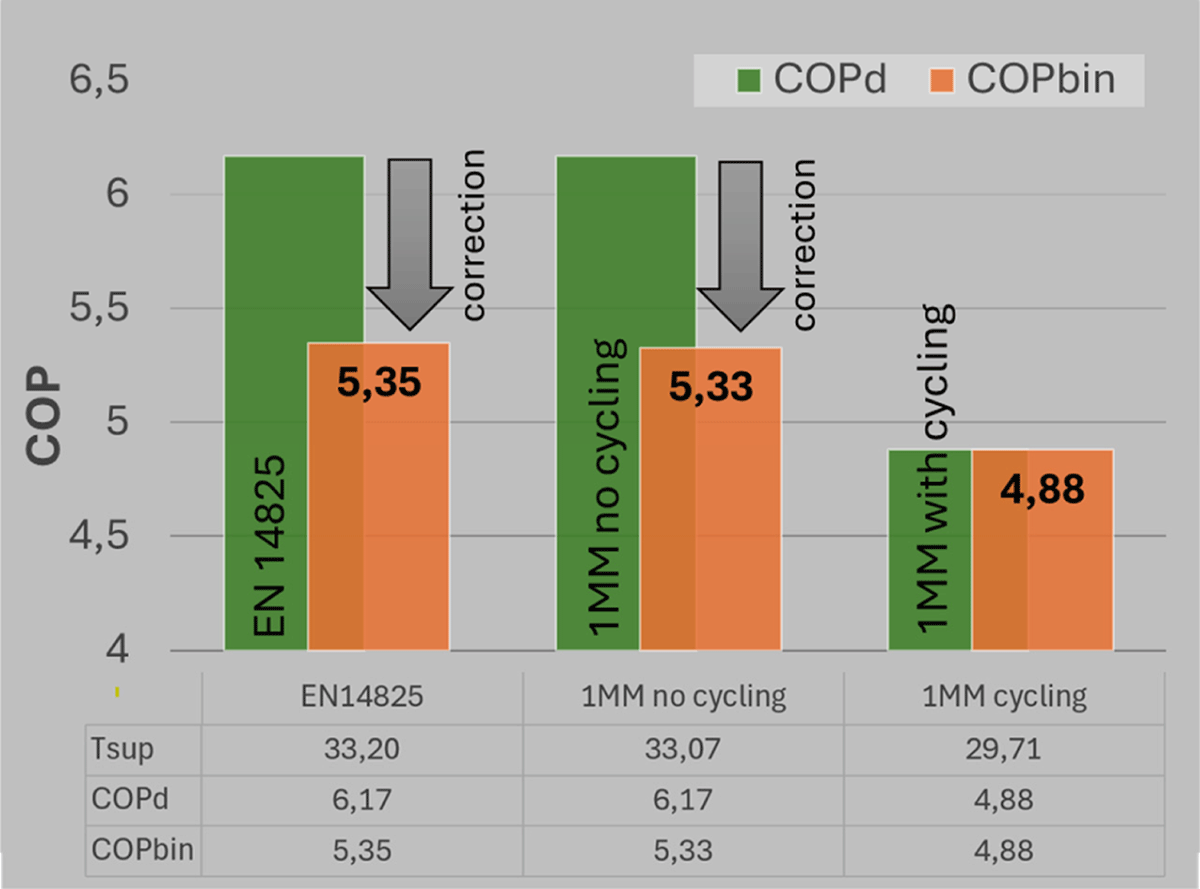
Figure 1
COPd and COPbin values for three different test methodologies measured at the same heat pump and at the same operating condition.
When tested according to the load-based method as proposed by BAM, with native controls adjusting the capacity by cycling operation (1MM with cycling), the resulting COPbin is 8.4% lower. It is lower by 22.5% from the uncorrected measurement with continuous operation (COPd). This is in the range that was suggested by (ADEME et al., 2025).
An in-depth analysis of the losses during cycling operation is presented, using real measurements and a one-factor-at-a-time approach to quantify the different loss mechanisms, in Figure 2. The upper graph shows that efficiency decreases with decreasing part-load in cycling operation (first three measurements from the left) due to longer off periods, which cause larger start-up losses (lower graph). In the lower graph, an analysis of influencing factors on the efficiency during cycling operation is shown. There is a small positive effect of temperature spread across the condenser, as part load decreases. Temperature lift has an increasingly negative effect with decreasing part load, as the heat pump is trying to maintain an average supply temperature by increasing it during compressor-on phases. Start-up losses due to thermal losses, inertia, oil viscosity, pressure equalisation, among other effects, show the same tendency. Currently, with the correction procedure, only the losses due to temperature lift (by proportionally increasing the supply temperature to compensate for compressor-off period) and standby losses (with the introduction of the coefficient of degradation Cd) are considered, not the compressor-start losses (green bar). There is thus a gap between the efficiency calculated through application of the degradation factor (measurement without cycling) and the efficiency measured when cycling happens.
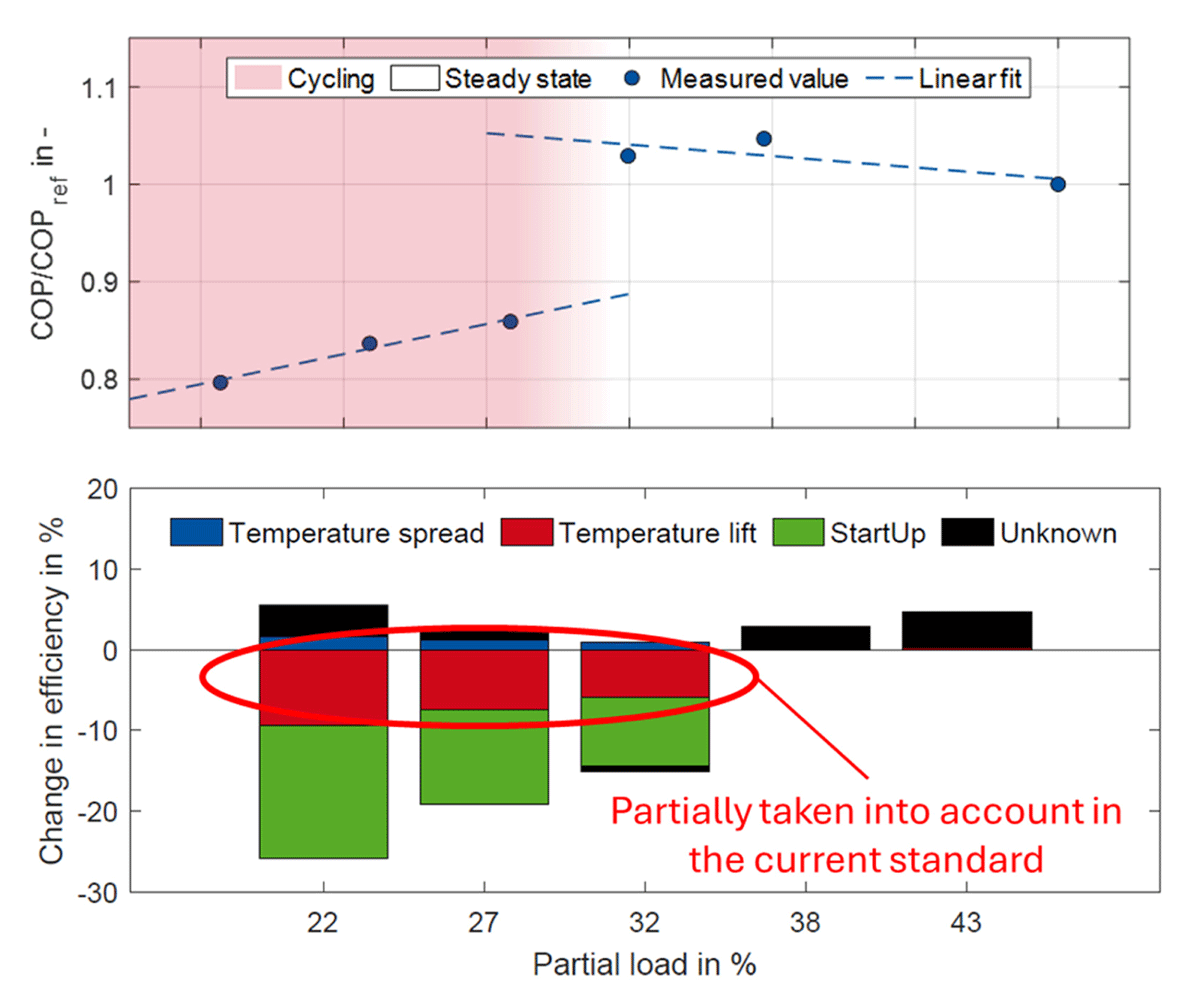
Figure 2
Measurement of COP at different part load conditions (above). Analysis of influencing factors on the efficiency during cycling operation at different part load conditions (below).
2.3.6 Cycling operation below the modulation range: load-based approach
To obtain values closer to the real-life operation, cycling is included in the methodology. Values reported by BAM (Erden and Wachau, 2025) show that the reproducibility is comparable to the values from current methodology. The round robin test performed at different laboratories on two monoblock air-to-water units at part load condition D using the load-based method showed reproducibility values of 2.93% (5 labs) and 3.11% (recently updated to 3.27% for 6 labs), which is in the same range as for other part load conditions which include intermittent operation due to defrost. It is also in the same range as the reported values for intermittent operation due to defrost in the ECOTEST (Malenković et al., 2019) study, which evaluated the current methodology with fixed compressor speed.
2.3.7 Back-up heater: fixed method
The electric back up heater controls can have a significant influence on the overall efficiency of the heat pump in real installations. For example, (ADEME et al., 2025); (Günther et al., 2025) report this from the analysis of long-term field measurement data. Standardised measurements tend to scale down this influence:
Influence of the back-up heater on the COP is only considered below Tbiv (for air-to-water appliances usually –7 °C) and, thus, the test conditions E (–10 °C) and A (–7 °C), which have a relatively small influence on the seasonal efficiency.
An ideal control of the back-up heater is assumed, with no losses.
Reports mentioned above found that the back-up heater is turned on when not needed, that the controls are not precise, etc. In some appliances, the back-up heater is turned on e.g. during defrost operation also above the bivalent temperature, under certain conditions. Currently, these effects are neither tested nor is this energy consumption considered in the efficiency calculation.
Figure 3 presents measurement data from a laboratory test using the load-based method at bivalent temperature. It shows that the back-up heater supports the refrigerant cycle after the defrost sequence and during capacity deterioration (peeks in electricity consumption) to keep the supply temperature and the heat energy delivery constant.
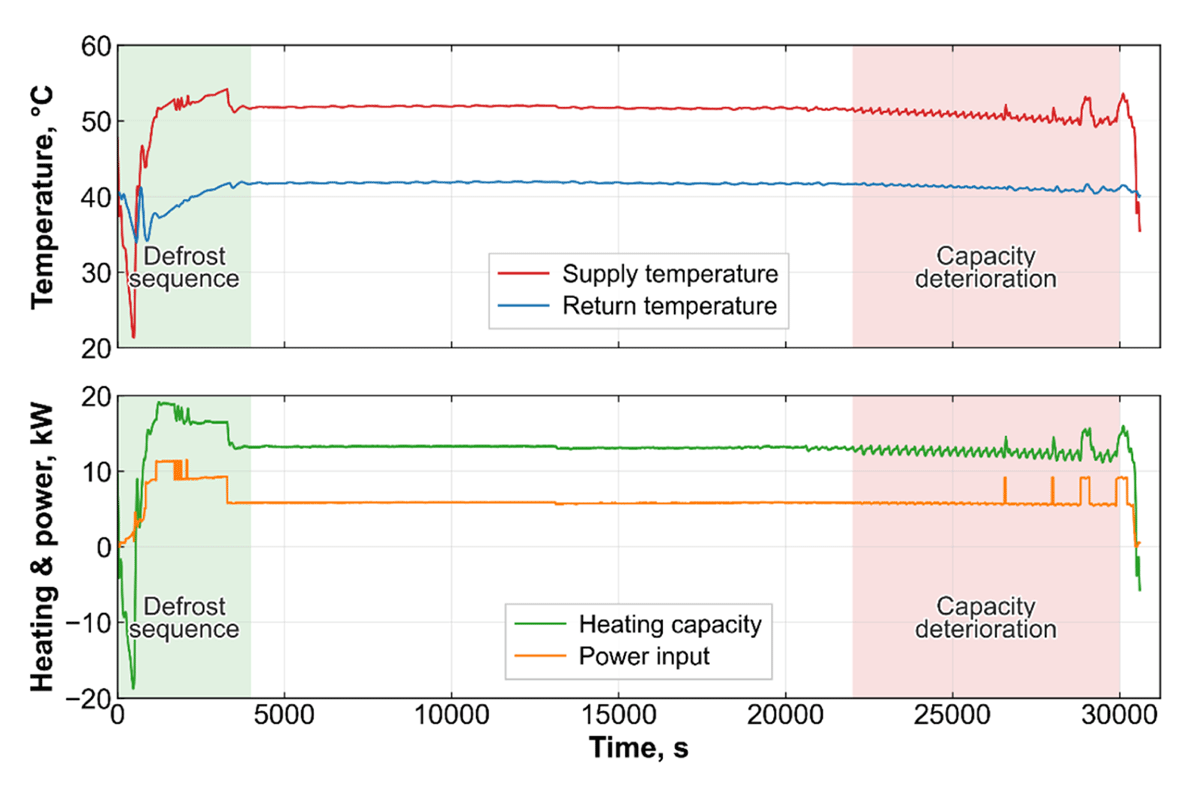
Figure 3
Laboratory measurement of an air-to-water heat pump at bivalent temperature (–7 °C).
Figure 4 shows measurement data from another heat pump operating at bivalent point. The control of the heat pump activates the back-up heater periodically (bottom), turning on all three power stages simultaneously without obvious reason. This causes peaks of about 8 K in the supply temperature (top). However, the unit fails to reach the target capacity of 7.55 kW.
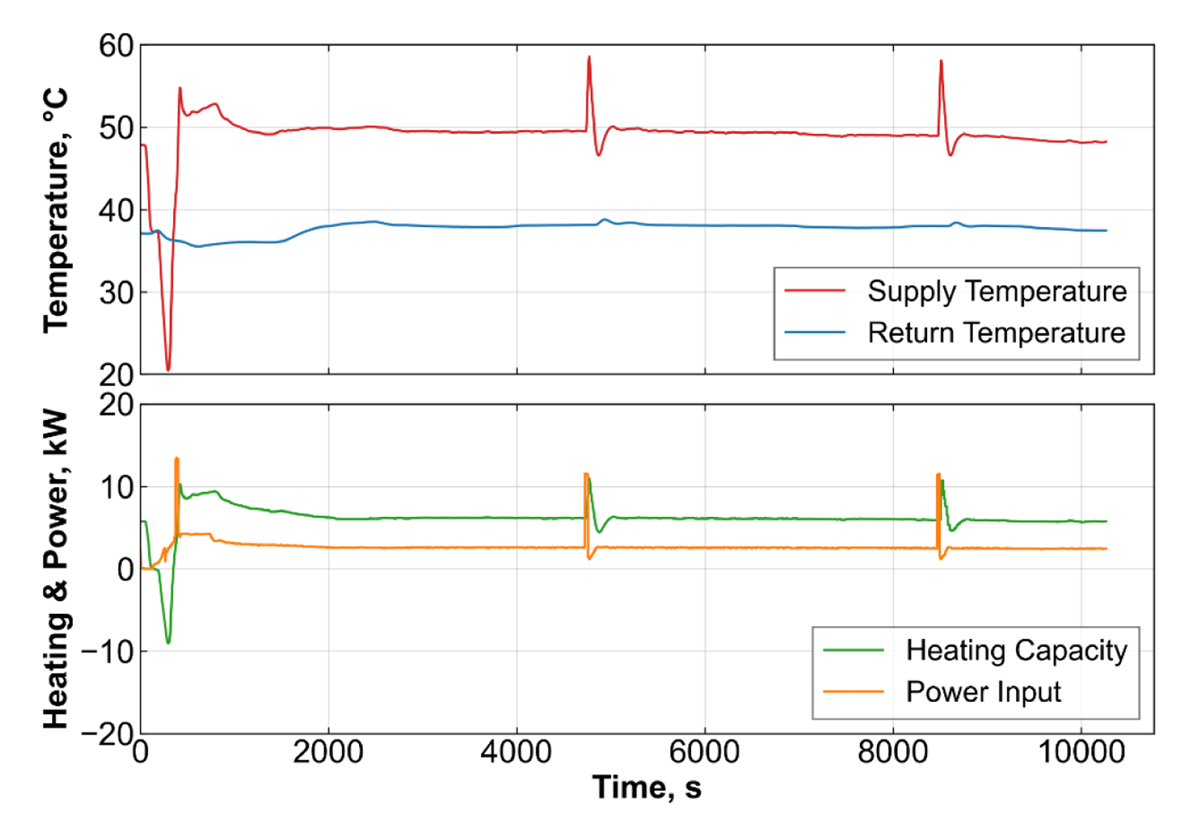
Figure 4
Laboratory measurement of an air-to-water heat pump at bivalent temperature (–7 °C). Spikes in electric power input originate from the electric back-up heater.
Even though the reports mentioned at the beginning of the chapter state that the back-up heater contributes on average around 1.5% to 2.5% to the overall heating energy delivered, there are installations in which this share increases up to 15%. The share of back-up heater for domestic hot water preparations (DHW) is even higher, averaging at 17%, as reported by (ADEME, 2025; Günther et al., 2025). They also report that the controls are responsible for inefficient back-up heater usage in DHW context.
It would seem favourable to incentivise more efficient back-up heater controls by including it into the testing.
2.3.8 Back-up heater: load-based approach
Models including physical back-up heaters are tested with controls turned on. If the back-up heater is not part of the system, there are different options being investigated. A simulation coupling a heat pump model with integrated electrical back-up heater and a building model showed higher efficiency when the BUH was active during the test compared to the standard procedure with the BUH deactivated and the capacity correction applied after the test in the SCOP calculation. The reason was the lower supply temperature of the heat pump when the BUH is active. In the standard test procedure, the heat pump must reach the supply temperature setpoint without support from the BUH.
An evaluation of differences in COP values between different approaches to the energy consumption of the back-up heater using laboratory measurement data is currently ongoing.
2.3.9 Consideration of defrost operation: fixed method
Defrosting is essential to ensure failure-free and energy-efficient operation of the appliance at mid to low outdoor temperatures. Depending on the heat pump design, dimensioning of relevant components and operation strategy (controls), the frequency and the defrosting sequence itself may vary among products at the same operating condition. (Klingebiel, 2025) showed that, for a given unit, an optimal defrost initiation time exists for each set of the influencing parameters. While climate conditions and heating capacity are dominant influencing factors, the authors emphasise that the absolute value of the optimal defrost timing is unit-specific and influenced by the design and control characteristics of the heat pump, such as evaporator design, refrigerant choice, and compressor control strategy. Hence, defrost is an important feature to assess the quality of the product, since the parameters to trigger defrost, its mechanism, duration and energy usage considerably affect the efficiency of the unit. Testing must reflect the real-life defrosting operation of the appliance and give the right incentives to manufacturers for optimisation.
Figure 5 shows measurement data for an air-to-water heat pump measured at part load condition B (outdoor air temperature of 2 °C and heating water supply temperature of 42 °C) to illustrate two issues:
The data acquisition period for the efficiency evaluation is often too short to include representative behaviour of the heat pump;
The supply temperature is not reflecting the real heat demand as compliance with the required set value is assessed only at the beginning of the data acquisition period.
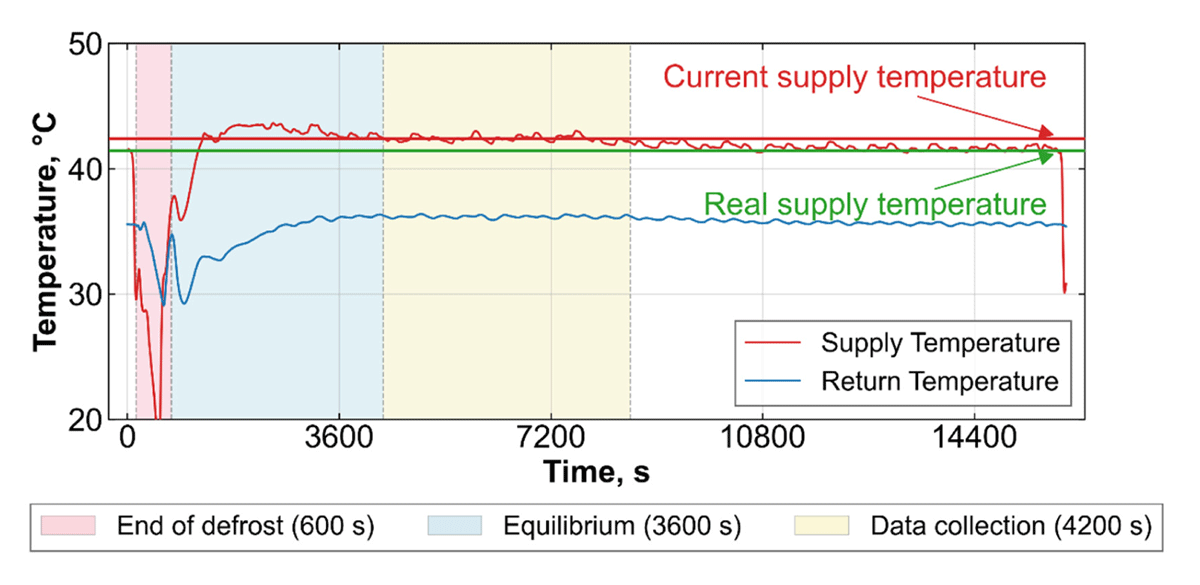
Figure 5
Measurement data of an air-to-water heat pump operating at part load B. Red line represents the supply temperature, blue line the return temperature.
According to current standards, following a brief stabilisation of the supply temperature, a 60-minute equilibrium period precedes data acquisition. If the supply temperature remains sufficiently stable and no defrosts or other transient events occur, efficiency data are recorded for 70 minutes under steady-state conditions. Under transient operation, the data acquisition period is extended to 180 minutes; complete cycles are evaluated if at least one cycle occurs, otherwise the full 180 minutes are assessed.
Compliance of the measured supply temperature with the target values defined in the regulation is considered fulfilled if the target values are met at the beginning of the data acquisition period, while the effects of defrost and other dynamic events during the measurement are not considered.
2.3.10 Consideration of defrost operation: load-based approach
There is no distinction between steady-state and transient operation. The data acquisition period should be long enough to set proper incentives for the product development with optimised defrost (hardware + controls) but also to account for any other intermittencies like cycling operation. (BAM, 2025) proposes evaluating at least three complete defrost cycles when defrost operation occurs, with the maximum data acquisition time limited to 6 hours. However, a minimum acquisition time is also required to avoid incentivising control optimisations that do not reflect real-life operation. Figure 6 (top) shows the temperature difference of one heat pump with very long intervals between defrost cycles (>10 h) and another with intervals of around 2.8 h (bottom). Under the current methodology, both would be classified as “steady state”, although the resulting COP differences would be 3.7% and 4.7%, respectively. The minimum acquisition time therefore needs to balance test duration and evaluation accuracy. This work is still ongoing.
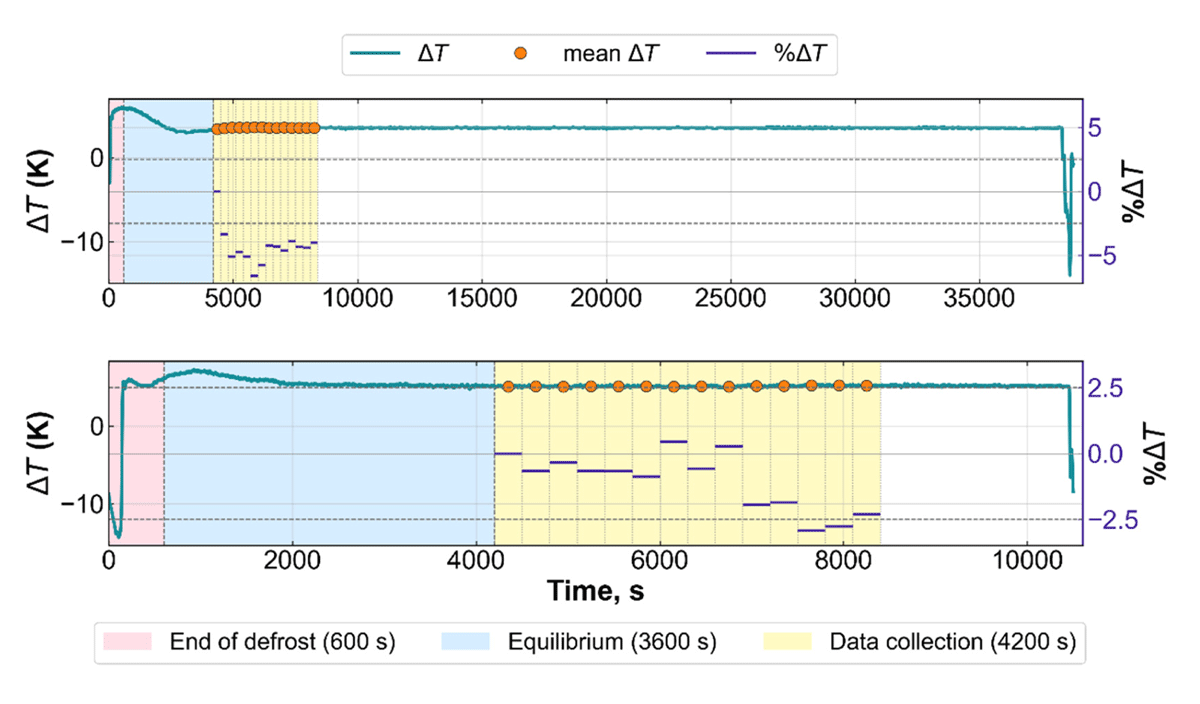
Figure 6
Temperature difference between the supply and return water flow (ΔT) for two different heat pumps at the same operating condition and the relative change of temperature difference with the first 5 min period of data acquisition period as the reference value.
Regarding the supply temperature, the average value of the whole data acquisition period is considered. Taking the cycle from Figure 5 as an example, the difference between real (full cycle) and the supply temperature according to the current standard is 0.9 K. This has an influence on the COP of 2% to 3%. Depending on the defrost pattern, this difference in temperatures and, hence, in the efficiency can vary.
2.3.11 Test methods for hybrid heat pumps
In the draft regulations shared by the European Commission (EC, 2026), hybrid heat pump is defined as encased assembly or assemblies designed as a unit consisting of a master control, a heat pump and one fuel heat generator. The definition should underline the importance of a master control, which optimises the operation of two heat generators for space heating and possibly water heating.
In the current version of the EN 14825 standard, two test methods for hybrid heat pumps are described:
Combined method – both the heat pump and the fuel heat generator are tested as one unit, according to EN 14825;
Separate method – the heat pump and the fuel heat generator are tested separately, according to two different standards – EN 14825 for the heat pump and e.g. EN 155102-2 for the gas boiler.
Bulut et al. (2022) carried out hardware-in-the-loop measurements on two hybrid heat pumps. Figure 7 shows that Hybrid 1 increases the share of heating energy delivered by the heat pump as the heat source temperature rises, reflecting rising heat pump efficiency and reduced heating load and supply temperature requirements.
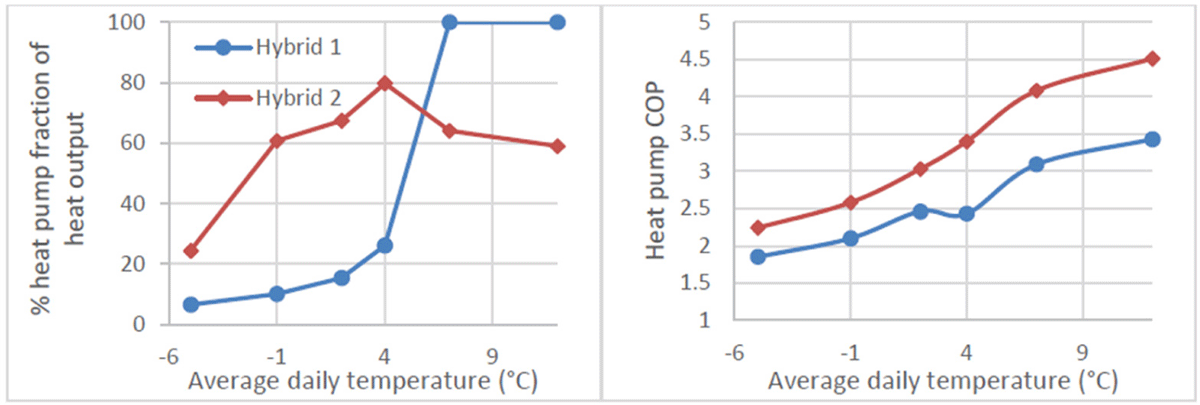
Figure 7
Results of a hardware-in-the-loop measurement of two different hybrid heat pumps according to the compensation method. Source: (Bulut et al., 2022).
In contrast, Hybrid 2 decreases the share of energy delivered by the heat pump from 4 °C towards higher air temperatures and lower heating loads. This behaviour cannot be captured when using the separate testing method, which assumes idealised control operation. As a result, the calculated efficiencies may significantly deviate from actual performance under real operating conditions. Hybrid 2 would possibly be rated as more efficient than Hybrid 1 using the separate method, or the combined method with master control turned off – contrary to their relative real-life performances.
With the introduction of the compensation method, the master control must be in operation during testing. This is a very important step forward as the master control is critical to the efficiency of hybrid heat pumps in real-life operation. Consequently, both heat generators should be tested simultaneously to accurately capture their real operating behaviour and interaction. Hence, it seems appropriate that only the combined method should be used with out-of-the-box principle with a precise guidance regarding master control settings.
Further, testing with the separate method can lead to issues with the control. The behaviour of the heater under test may be altered by not allowing the other heat generators to operate, particularly at operating conditions in which both heat generators should be delivering heating energy.
2.3.12 Test methods for hybrid heat pumps: load-based approach
The load-based method proposes the combined test methodology only. However, to account for add-on heat pumps, as well as manufacturers who offer a wide range of combinations between different heat pumps and fuel boilers, the concept of a virtual boiler is currently explored.
Add-on heat pumps or retrofit hybrids have a significant market share in some countries. They comprise of a heat pump with a master control, which can be added to an existing heating system and connected to the boiler controls via standardised communication protocols. Currently, they are tested as ordinary heat pumps at operating conditions which are significantly different from the ones in retrofit installations.
The definition of the hybrid heat pump in the current draft regulation does not allow to test and rate these products as hybrid heat pumps because they are not sold together with a specific fuel boiler. Introduction of the compensation method with possible usage of building models to emulate the heating loads opens the possibility to introduce virtual boilers to test these products.
By using the virtual boiler, add-on heat pumps could be tested under more realistic conditions. The manufacturer would have to provide information on the boiler type and capacity (e.g. gas as fuel, maximum and minimum capacity, modulation range) that the add-on heat pump is intended to be combined with, in such a way that the model can be parameterised accordingly. Information about the communication protocol used by the master control should also be easily available, so that the signals can be used for the communication with the model.
2.4 Performance difference between two methods
ADEME et al. (2025) compared Seasonal Coefficient of Performance (SCOP) values measured in the field with those declared by the manufacturers following the current testing methodology. The results show that measured SCOP values are in 85% of cases lower than the declared ones. The median value of the measured SCOP is by 17% lower than the median of the declared values.
According to the study, the causes for this discrepancy can be divided into two categories:
Factors that cannot be fully addressed in a product testing methodology, due to differences in testing and real operation conditions. These include climate conditions, heating curve settings, installation quality, system layout and user behaviour.
Factors that could be better addressed in the current methodology, explicitly mentioning power modulation and cycling operation.
BAM collected SCOP values for different heat pumps obtained from load-based measurements performed by independent laboratories and compared them to measurements and declared values, respectively, according to EN 14825, Figure 8. The SCOP values measured with the load-based method were, on average, 13.3% lower for average reference climate and medium temperature application.
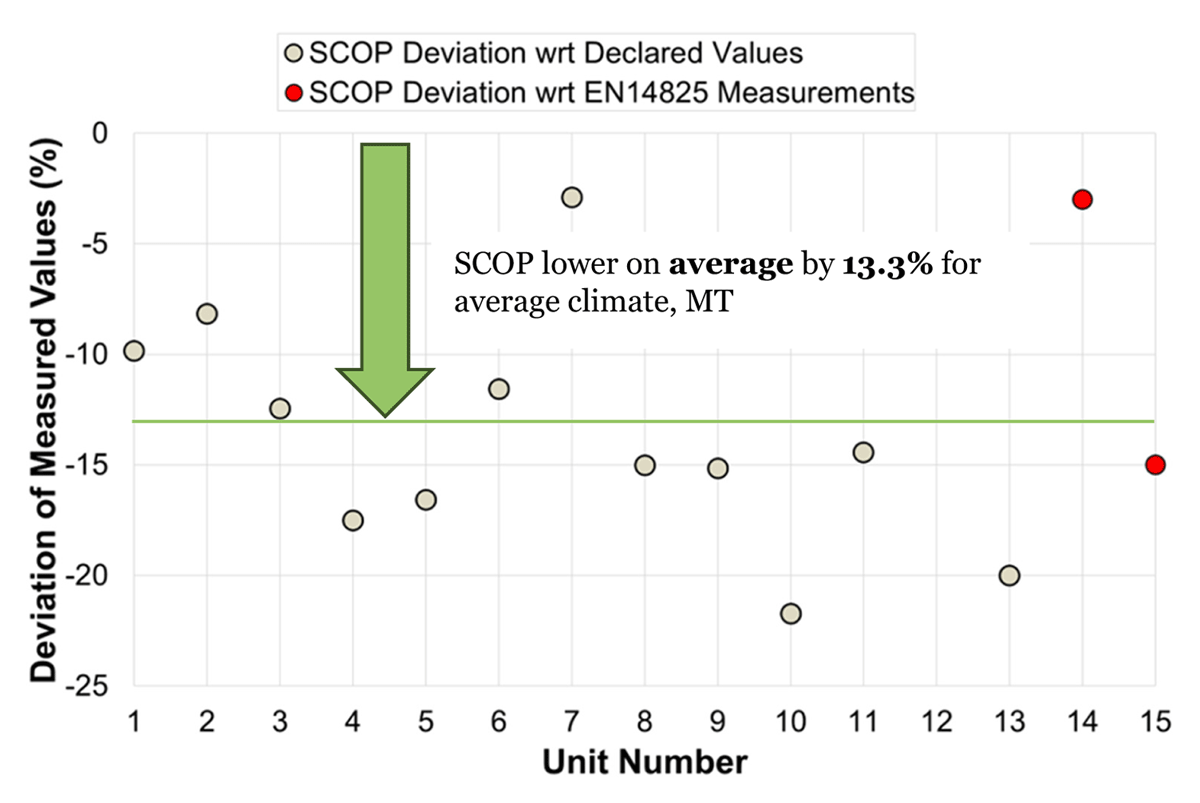
Figure 8
Comparison between measured SCOP values obtained from load-based measurement including a building model, and SCOP values from declarations by the manufacturers (grey dots) or measurements according to EN 14825 (red dots).
The load-based measurements were carried out following the (BAM, 2025) test guidelines using a building model. The tests allowed cycling operation below the modulation range, included the physical back-up heater active during the measurements (except for heat pump 14), and supply temperature determined from the entire data evaluation period (full cycles, mean value including defrost operation and on-off cycles). The data acquisition periods were chosen to capture more representative operating periods reflecting dynamic behaviour of the heat pumps.
Notably, the observed performance gap is consistent with the findings of (ADEME et al., 2025). Efficiency values obtained from the measurements with the load-based method are in better agreement with the field measurements.
3 Analysis of the current draft regulation regarding implementation of improvements proposed within the load-based method and new concepts
The draft revised regulation was finalised by the Regulatory Committee in March 2026 (EC, 2026) and is now moving forward through the remaining EU legislative process. It introduces several novelties and updates compared to the Regulations currently in force. This version has been used for the analysis.
The main difference to the present regulation regarding heat pumps is the introduction of the compensation method, which is essentially based on the load-based method as proposed by BAM. The draft introduces the compensation method 48 months after entry into force of the Regulation. However, heat pumps with rated heating capacity of more than 70 kW will continue to use the current methodology. Its improvement, therefore, needs to remain a goal for the relevant standardisation committees and for future revisions of the Regulation. In the latest revision, it has been stated that it is allowed only to fix the compressor and the circulator frequencies for measurements using the fixed method. Other components, such as fan speed and expansion valve opening, shall be controlled according to the native controls of the unit during the test. This adds clarity for manufacturers and market surveillance which parameters are allowed to be altered to ensure quasi steady-state operation and limits fixing control parameters to the necessary minimum.
Although based on the load-based methodology proposed by BAM, the compensation method presented by the EC differs in some features. Table 1 provides a comparison.
Table 1
Overview of issues criticised in the current methodology and proposed solutions by the Regulatory Committee and BAM. Issues without remarks are considered to be solved by the methodology.
| ISSUE WITH CURRENT METHODOLOGY | COMPENSATION METHOD IN THE LATEST DRAFT REGULATION | LOAD-BASED METHOD AS PROPOSED BY BAM |
|---|---|---|
| Native controls / fixed compressor speed | Both methodologies do not override native controls and the compressor speed is not fixed. | |
| Cycling operation | Cycling is optional for compensation method; if “modelled”, the current approach with Cd factor should be applied. If used, incentives through control correction factor F(1) = 0 (issue solved partially) | Not an issue, since cycling is explicitly always allowed. |
| Back-up heater | If the appliance is placed on the market with a back-up heater, it should be on and considered at all operating conditions throughout the test. If not, the same procedure as in the current methodology should apply. (issue solved partially) | Back-up heater included in the testing if integrated. If not, modelled assuming an ideal virtual back-up heater operating in real-time. |
| Consideration of defrost operation | The supply temperature for operating conditions including defrost and cycling should be obtained from the average value of the entire data acquisition period. Data acquisition times for different operation modes not defined. | The supply temperature for operating conditions including defrost should be obtained from the average value of the entire data acquisition period. Data acquisition times defined to capture at least three full defrost or on-off cycles but limited to a maximum test time. No minimum test time proposed. |
| Hybrid heat pump testing | Both separate and combined methods should be allowed. (issue not solved) | Only combined method allowed. Concept of a virtual boiler is being explored. |
Another important regulatory novelty is the introduction of the mean temperature approach applied exclusively to appliances with variable flow rates. In this approach, test points specify only the mean of supply and return temperature. The actual supply and return temperatures then stabilise during the test according to the heat pump’s temperature control.
Under the current regulation, all heat pumps are tested at identical supply temperatures, regardless of control features, namely constant or variable water mass flow at the indoor heat exchanger. As a result, return temperatures may differ for different control types at the same part load, and consequently the mean heat-supply temperature also differs.
Mean temperature is a key parameter in heating system design, as it determines heat output and efficiency. Moreover, it provides a suitable common basis for comparing the efficiency of different products, enabling fair comparisons. Therefore, using mean temperature instead of supply temperature as the reference parameter appears beneficial for ensuring a level playing field among heat pumps.
With the introduction of the compensation method combined with a building model, the mean temperature gains importance as key parameter for calculating the heat transfer from the heating system to the building. It also allows heat pumps with variable water flow to be tested using their native controls, since they may slightly increase supply temperature or temperature difference to optimise the heat output or overall efficiency by lowering hydraulic losses.
Finally, appliances using CO2 as refrigerant operate more efficiently at higher temperature spread (i.e. higher supply and lower return temperatures). Therefore, the mean temperature approach also offers a fair comparison for these products.
4 Conclusions and outlook
Current testing methodology with fixed compressor speed presents several significant issues:
low representativeness of real-life behaviour and performance,
reproducibility issues due to changing the control parameters,
independent testing is challenging or impossible due to the need to enter deeper controls level, which is often not possible without guidance from the manufacturer.
Most of these issues are well documented and were raised in the review process of the Ecodesign Regulation. However, technical background on underlying mechanisms and quantification of the influence on the heat pump performance in the context of standardised testing was lacking.
Analysis of laboratory and field data showed that the influence of the back-up heater can be substantially higher for some appliances and that it is often active above the bivalent temperature, contrary to current methodological assumptions. An in-depth assessment of cycling operation revealed significantly higher inefficiencies, particularly during compressor start-up after idle periods. Laboratory analysis of defrost behaviour also identified major differences in post-defrost start-up sequences, highlighting the importance of properly defining the data acquisition period and the temperature level, especially in the context of load-based testing. These findings also underline the necessity to provide manufacturers with appropriate incentives to optimise both hardware components and control strategies.
Comparison of laboratory measurements based on the current method with both load-based testing and published field studies revealed significant discrepancies in efficiencies, whereas load-based measurements showed much better agreement with values from real installations.
The introduction of the compensation method for appliances with a rated heating capacity of ≤70 kW in the current draft Regulation is therefore an important step forward, particularly in improving the representativeness of real-life operation. It also reduces opportunities for circumvention and artificially enhanced performance figures, while strengthening the autonomy of testing institutes by removing the need to obtain product-specific operating instructions from the manufacturer, an important aspect for market surveillance authorities. As the current methodology will remain applicable to certain product categories, limitations on adjustable control parameters have also been proposed.
However, an analysis of the draft Regulation showed that there are still issues not fully solved due to partial implementation of the load-based methodology:
cycling operation is possible, but not mandatory;
if the appliance is placed on the market without a back-up heater, the same approach as in the current methodology should be used, which does not take into account the real controls of the appliance;
hybrid heat pumps can be tested both with the separate and the combined method.
On the other hand, concepts like the mean temperature approach were introduced for variable mass flow appliances, which is an important feature to provide fair comparison of products with different operation characteristics.
The compensation method can achieve its full potential in representing real-life operation only through a more complete implementation of the load-based methodology, especially regarding the issues mentioned above. An important aspect of the load-based methodology, including the features presented in this paper, is that it not only improves the agreement between measured performance parameters and real-life operation, but also incentivises product designs and control strategies better aligned with actual operating conditions. This was not the case with the current methodology and its identified limitations. As a result, the efficiencies observed by end users are expected to be closer to those declared by manufacturers, improving technology acceptance, providing a more realistic basis for product selection, and strengthening the credibility of energy labelling. The methodology also rewards heat pump designs and control strategies that respond more effectively to varying loads, and better protects the European market from low-quality products with artificially inflated efficiency declarations.
By introducing the compensation method for hydronic systems, the EU will become a frontrunner in performance rating for this product group, with the potential to transfer its knowledge and experience internationally, for example through ISO standardisation. Current international efforts to develop similar methodologies are mainly focused on air-to-air heat pumps and air conditioners. Despite the different product focus, these initiatives have reached very similar conclusions regarding applicability and the representativeness of real-life operation.
Recent round robin tests by BAM have shown good reproducibility of the load-based method and demonstrated the implementation on existing test stands at feasible cost across multiple laboratories. Ongoing work focuses on refining the method and currently concentrates on analysing round robin test data to derive permissible deviations for a future test standard.
Finally, the work in the CEN standardisation committees to validate the proposed concepts in the Regulation and to prepare the methodology for standardisation is ongoing in parallel. One of the important tasks of the relevant standardisation group is to further prescribe some aspects of the implementation of the proposed methodology . A dedicated HORIZON project dealing with some open issues should provide a basis for this work.
Additional File
The additional file for this article can be found as follows:
PowerPoint Slides
PowerPoint Slides relating to this article. DOI: https://doi.org/10.66506/essp.8-249-26.s1
Data Accessibility Statement
Some of the original data used in this paper can be shared upon request, however most is covered by confidentiality agreements.
eceee paper ID
8-249-26