
Introduction
The transition toward a circular and climate-neutral economy has become a central objective of EU sustainability policy. Regulatory initiatives such as the European Green Deal and the Ecodesign for Sustainable Products Regulation (ESPR, 2024, June 13) as well as the Green Claims Directive (European Commission, 2023) establish a comprehensive framework aimed at reducing environmental impacts across product life cycles and support consumers in their intentions on pro-environmental decision-making via transparent and evidence-based communication.
As a horizontal framework, ESPR potentially applies to almost all physical products placed on the EU market (including components and intermediate products), with only a limited set of exclusions (e.g., food and feed, medicinal products). A core element of the ESPR framework is also the improvement of product information, including the development of standardised consumer-facing labels (see ESPR, 2024, June 13, article 7(7) on information requirements and article 16 dealing with labels for ESPR). Such labels are not simply communication tools but function as policy instruments designed to reduce information asymmetries, support sustainable market choices, and strengthen the visibility of environmental criteria at the point of sale while establishing standards for product development.
The effectiveness of such a sustainability label for products depends on several behavioural and contextual factors. European consumers operate in increasingly saturated information environments, where numerous labels and claims compete for attention. According to cognitive load and heuristic decision-making theories, individuals rarely process detailed sustainability information analytically; instead, they rely on intuitive cues such as colour schemes, scales, or familiar symbols. Label design therefore plays a decisive role in ensuring that sustainability information is noticed, understood, and used.
Labels can be categorised along several key dimensions that structure their diversity (see also Nakaishi & Chapman, 2024, page 3 for an overview). First, they differ in terms of governance: labels may be mandatory or voluntary. Mandatory labels are required by law, such as the EU Energy Label, which must be displayed on household appliances under EU regulation. In contrast, voluntary labels are adopted at the discretion of producers, such as the EU Ecolabel, which firms can choose to apply for if they meet environmental criteria. Second, labels vary by their function and informational logic. Comparative labels provide standardised metrics that allow consumers to compare products – for example, the A–G scale of the EU Energy Label ranks products by efficiency. By contrast, endorsement labels signal compliance with predefined standards without enabling direct comparison, such as the EU Organic Logo, which indicates adherence to EU organic farming rules but does not rank products. Third, labels can be distinguished by their issuing authority. Some are created and administered by public actors, including EU institutions or national regulators, as in the case of the EU Energy Label. Others are developed by private actors, such as NGOs or multi-stakeholder organisations; for example, the Fairtrade International label is widely used in the EU market but governed by a non-governmental organisation. Hybrid arrangements also exist, where public frameworks coexist with private certification schemes. Hence, labels are not a uniform policy instrument but a heterogeneous set of tools that differ in their design, purpose, and institutional origin. In this paper we target the design of a future mandatory and comparative label, similar to the EU Energy Label and in accordance with the ESPR.
The application of heuristics is closely related to trust, which therefore represents another critical determinant of label effectiveness. In a context marked by concerns about greenwashing, the perceived credibility of institutional backing, transparency of verification processes, and clarity of communication shape whether consumers rely on sustainability information. While EU-level governance structures can strengthen credibility, they must be communicated unambiguously to diverse consumer groups.
European markets are also characterised by demographic and cultural heterogeneity. Differences in environmental attitudes, institutional trust, and information literacy across Member States and socio-demographic groups influence how labels are perceived and interpreted. Designing a harmonised EU-wide label therefore requires evidence-based insights that account for this variability and identify common ground.
Finally, a new label building on ESPR must function within an existing landscape of sustainability labels, including the EU Energy Label and the EU Ecolabel. In line with ESPR, consumers should be protected from confusion with existing labels. However, the ESPR label will not replace the existing EU Energy Label. It will also exist in parallel with the EU Ecolabel and other existing EN ISO 14024 type I eco-labels. Within the ESPR regulation, these labels “are not to be considered misleading or confusing labels, provided that the criteria developed under those labelling schemes are at least as strict as the ecodesign requirements” (ESPR, 2024, June 13, preamble, paragraph 48). The interaction with these established schemes affects recognition, salience, and potential cognitive overload. The behavioural effectiveness of a new label is therefore central to the broader policy objective: if consumers do not meaningfully engage with the label, its ability to contribute to circularity, resource efficiency, and climate goals will be constrained.
This study therefore aims to develop recommendations for ESPR label development by examining how design characteristics, informational structures, and contextual factors in general influence consumer recognition, engagement, and decision-making in relation to eco-labels. In doing so, it considers a broad range of labelling approaches, including both comparative and non-comparative as well as voluntary labels, in order to capture the full diversity of existing environmental information systems.
Labels as decision cues for consumer choices
Eco-labelling or sustainability labelling has become a central instrument in European sustainable consumption policy, aimed at reducing information asymmetries by signalling verified environmental performance (European Commission, 2024; Gorton et al., 2021). Yet, growing evidence suggests that the effectiveness of labels depends less on the mere provision of information and more on how such information is designed, communicated, and embedded within consumer decision environments (White et al., 2019). The way information is displayed is especially important as recent research highlights that consumers typically make decisions under time pressure and cognitive constraints, relying on heuristic processing rather than detailed information evaluation (Oswald et al., 2022). Consequently, eco-labels function primarily as intuitive cues.
Against this background, this paper conducts a structured review of empirical studies from the past five years to derive evidence-based design implications for a new eco-label within the EU context.
Aim and research questions
The aim of this study is to identify the most important principles for designing a new eco-label that is most likely to be effective for consumer decision-making in Europe. It aims at providing a generic template for label design under ESPR regulation. For each product regulated under ESPR that will showcase a label (see also ESPR working plan, European Commission, 2025) a specific product parameter depending on the hotspot of the product will be included. Hence, the framework must contain a certain modularity and capture the idea that a varying amount of information is presented on the physical, product-specific label. This modularity also makes sense as the range of products covered by the regulation is highly heterogeneous including products like detergents, clothes or furniture.
To achieve this, the review examines which label characteristics in general may enhance consumer recognition, understanding, and engagement in complex purchasing environments. Although the ESPR label will be mandatory and comparative, findings from studies on non-comparative and voluntary labels remain valuable, as they may yield insights applicable to the design of the ESPR label. Drawing on a literature review, the research addresses the following questions:
Which factors increase label comprehension and recognition? This includes visual salience, colour schemes, typography, symbol clarity, standardised placement, and consistency with existing EU labelling formats.
Which factors enhance consumer engagement? This explores informational depth, rating systems, emotional framing, digital integration, perceived usefulness, and simplicity versus detail trade-offs.
How do perceptions vary across demographic groups and across Europe? This question investigates differences related to age, income, education, cultural background, and environmental attitudes, as well as differences between European countries.
How do multiple labels on a single product interact? This examines complementarity, redundancy, cognitive overload, and prioritisation effects within multi-label environments.
Method
For the literature review addressing questions (a) through (d), we combined two complementary approaches to capture the relevant research articles: (1) a systematic search and (2) expert input. This combination ensured a broad range of studies were considered to address the different research questions. This review includes studies on a range of energy and eco-labels, encompassing both comparative and non-comparative as well as mandatory and voluntary labels. While not all label types are directly compatible with the ESPR requirements, findings from across this broader set of labels – for example regarding label comprehension, design effectiveness, and consumer behaviour – remain relevant to the research questions addressed here.
For the systematic search, we developed multiple search strings covering the European market (see Table 2 in the Supplementary File) and applied them to the following databases: Web of Science, Scopus, Google Scholar, and Zenodo. Given the limitations of Google Scholar and Zenodo for combining search strings, we used a simplified search string for these databases. In contrast, Scopus and Web of Science offer sophisticated options for systematic search, therefore we developed multiple search strings addressing the different questions. Acknowledging the value of literature reviews as a knowledge source, we included an additional search for review papers. In total, we conducted 16 searches.1 Figure 1 illustrates the screening process that led to the identification of relevant papers. Only articles published in the last five years – between 2020 and 2025 – were included (latest extraction date: August 29, 2025). We chose to limit the time frame as we assumed that more recent papers build up on an cite older key literature. If a database yielded more than 20 results for a search, only the 20 most relevant articles were retained.2 Overall, we identified 285 studies through the various database searches. Several successive steps refined the literature corpus, including the removal of duplicates (n = 118) and exclusion of studies deemed insufficiently relevant based on abstract or full-text screening. Relevance was deemed insufficient if a publication did not address any of the research questions. Ultimately, we identified 30 articles as key papers, which we then read and analysed (see Table 1 in the Supplementary File for the list of articles analysed).
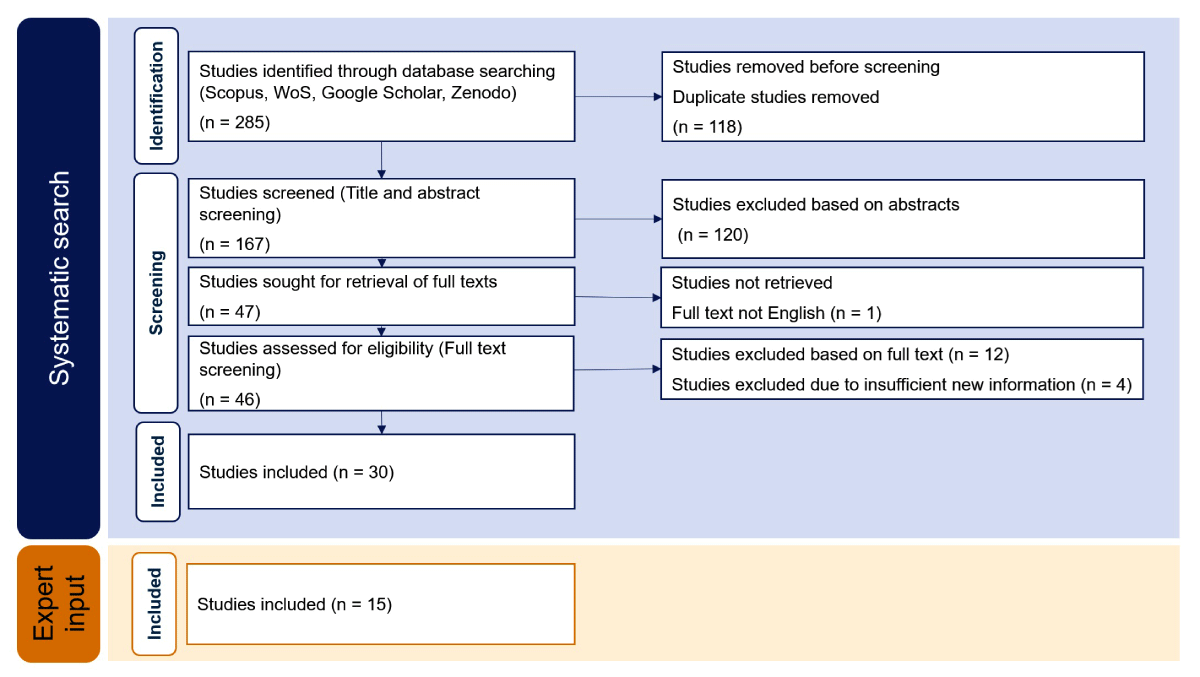
Figure 1
Adjusted PRISMA Flow Chart.
For the expert input, additional relevant studies were collected to minimise the risk of key studies missing from the review. The expert input included grey literature such as reports from research projects. Using this approach, 15 additional studies were included, of which four were published before 2020, the oldest in 2013. Hence, in total we analysed 45 articles for the literature review.
For the analysis, we used an Excel spreadsheet. Information extracted from each paper was systematically recorded in designated columns. These columns encompassed various elements, including all research questions, information on the label studied (e.g., label name, addressed product category), and information on the regional scope of the country as well as the data used (see Table 1 for an overview). Of the 45 papers read, 15 papers dealt with the EU Energy Label or slight modifications to it, one paper explicitly investigated the EU Ecolabel, while the remaining 29 papers explored other labels, such as the organic production logo of the EU (i.e. green leaf) or hypothetical labels. Based on this spreadsheet, we drafted the results section following a narrative synthesis approach, structured by research question.
Table 1
Overview of Paper Characteristics.
| PAPER CHARACTERISTIC | NUMBER OF PAPERS |
|---|---|
| Covered labels | |
| EU Energy Label (or slight modifications) | 15 |
| EU Ecolabel | 1 |
| Other labels (including hypothetical labels) | 29 |
| Label type | |
| Mandatory | 18 |
| Voluntary | 14 |
| Hypothetical | 17 |
| Comparative | 32 |
| Non-comparative | 18 |
| Product categories covered | |
| Household appliances | 17 |
| Other electronic appliances | 7 |
| Food and beverages | 13 |
| Clothing | 3 |
| Other | 5 |
| No specific product category | 5 |
| Countries covered | |
| More than one EU country | 22 |
| Austria | 2 |
| Belgium | 1 |
| Germany | 6 |
| Greece | 1 |
| Ireland | 2 |
| Italy | 1 |
| Netherlands | 1 |
| Poland | 1 |
| Spain | 3 |
| Non-EU country | 11 |
[i] Note. If a paper covered multiple categories (e.g., both household appliances and other electronic appliances), it was counted in each relevant category. Therefore, the sum of papers per category does not necessarily equal the total number of papers reviewed (n = 45).
Results
Factors to enhance label comprehension and recognition
Label comprehension and recognition are closely intertwined and can strongly influence each other. While comprehension refers to how easily a user can understand the meaning of the information presented, recognition concerns how quickly and reliably they can identify familiar elements such as symbols, layouts, or visual cues. If a label is difficult to recognise – due to unfamiliar icons, inconsistent layouts, or poor visual hierarchy – users may struggle to locate key information, which directly impairs comprehension. Conversely, even highly recognisable elements can fail if their meaning is unclear or open to interpretation.
Research shows that label comprehensibility increases when designs are simple, distinctive, and easy to process (Hay et al., 2024; Meis-Harris et al., 2021; Nakaishi & Chapman, 2024). Categorical scales, particularly alphabetical A–G formats, are widely understood and tend to outperform numerical scales in supporting quick and intuitive decision-making. Experimental studies confirm that consumers show higher willingness to pay and better comprehension when exposed to alphabetical scales (Bergener et al., 2025; Faure et al., 2021; London Economics & Ipsos, 2014). Given the inherent idea of the EU Energy Label expressing that a higher ranking will come with future energy and cost savings for the consumer this higher willingness to pay signals consumer comprehension and not general readiness to pay based on the presence of an A–G scale. However, categorical information often dominates attention, leading to the well-documented “class valuation effect,” where consumers focus on the class rating at the expense of other details (Andor et al., 2019; He et al., 2022; Kesselring, 2025). Continuous scales may mitigate this bias but are generally less intuitive for consumers and may be less understandable (London Economics & Ipsos, 2014). However, it remains unclear whether, or if so when, a rating system using a continuous scale would deter consumers from choosing an environmentally friendly product. Providing clear scale explanations, such as depicting the range of the possible classes, can improve label effectiveness, while adding the meaning of the label (i.e. energy), may improve understandability, particularly for consumers that are generally less familiar or interested in energy efficiency aspects (Elsen & Leenheer, 2022).
Colour is another important design factor influencing both understandability and recognition. Colour-coded and traffic-light systems consistently enhance recognition, comprehension, and preferences across product categories (Jürkenbeck, 2023; Kolber & Meixner, 2023; Liva et al., 2025). Colour associations guide consumer choices – for instance, green indicating environmental friendliness – and can effectively draw attention in retail settings (Bauw et al., 2024; Hay et al., 2024; Operate, 2022). Further, Bengart and Vogt (2023) compare different label options for several electricity products, finding that traffic-light labels increased the share of choices for low-emission electricity compared to text-based labels, but not compared to grayscale labels – indicating that, potentially, other colour-coded schemes that are barrier-free (e.g. the Viridis colour scale) can be similarly useful.
Additional information included in the label can be useful if the information is easy to read and understand (Meis-Harris et al., 2021) and not excessive (Nakaishi & Chapman, 2024). Textual clarifications improve evaluations of otherwise purely symbolic labels (Hartmann et al., 2025) and are often preferred by consumers, with many favouring bilingual formats (i.e. national language and English) for accessibility (Liva et al., 2025). Clear and meaningful label names further support understanding and uptake (Operate, 2022). Numerical information, however, can be confusing when units are unfamiliar (e.g. indicating biodiversity loss with “PDF”, i.e. potentially disappeared fraction of species), leading some consumers to prefer visual or icon-based data representations (Dütschke & Schneider, 2017; Hay et al., 2024). Eye-tracking evidence shows that poorly designed icons can be overlooked, though familiarity can improve users’ ability to locate and interpret them (Operate, 2022).
Factors for consumer engagement and decision making
Knowledge and awareness as well as trust in the label have been identified as relevant drivers for comprehension and effectiveness of labels (Codagnone et al., 2013; Meis-Harris et al., 2021; Nakaishi & Chapman, 2024). Label trust can be enhanced by a high degree of transparency and rigor in the label certification process (Nakaishi & Chapman, 2024) and can be influenced by trust in the institution being associated with the label (Gorton et al., 2021). In addition, positive perception of the label has been found to be related to the intention or willingness to use the label in purchasing decisions (Berden & Hung, 2025; Dihr et al., 2021). Furthermore, the certifying body can impact whether a certain label is regarded in purchasing decisions. For instance, in studies from Germany and Serbia, knowledge of third-party certification has been shown to positively influence label use (Gorton et al., 2021). In their literature review Majer et al. (2022) found evidence that governmental labels are more effective than non-governmental labels e.g. from NGOs. Further, studies point towards the role of individual consumer factors in label effectiveness. For instance, environmental attitudes as well as environmental concern have been found to be related to behaviour when buying products with the EU Ecolabel (Recio-Román et al., 2024). Studying the EU Energy Label, Guetlein et al. (2025) identified energy literacy to be related to label effectiveness: for individuals who have a higher ability to make informed and deliberate choices in the domain of household energy consumption, the EU Energy Label was more effective.
Embedded QR code and accessibility for additional information
A QR code integrated into an EU label is a smart design choice, as it allows for the provision of detailed and up-to-date product information without cluttering the label itself. This design flexibility is especially valuable in the European context, where diverse informational needs and multiple languages must be addressed efficiently and accessibly for all consumers. Studies generally show a positive consumer attitude toward QR codes as a way to access additional product information. In the focus group study by Hay et al. (2024), participants appreciated QR codes and linked websites for providing more detailed explanations, although they questioned their practicality for quick or impulse purchases, particularly in supermarket settings. QR codes were perceived as more useful for higher-value products or items of smaller size. Similar results were reported by Liva et al. (2025), who found that participants preferred labels including QR codes over those without such digital extensions. Further evidence comes from Cordero-Gutiérrez et al. (2025) who demonstrated that QR-enabled access to traceability information increased perceived transparency and strengthened purchasing intentions. Hunka et al. (2025) likewise showed that consumers favour QR-based access to chemical content information in clothing over printed on-label details.
Despite this overall positive perception, studies on actual usage indicate that engagement with QR codes remains low. Denny (2022) found only minimal scanning behaviour when QR codes were added to product labels, and Liva et al. (2025) report that nearly one-third of participants had not scanned a QR code at all in the previous month. This gap between perceived usefulness and real-world engagement suggests that QR codes may serve best as optional extensions rather than as central elements of label communication. However, they may support label effectiveness by signalling transparency.
Variations across demographic groups
Research on demographic differences in eco-label perception and use shows heterogeneous and often context-dependent patterns. From the perspective of consumer heterogeneity theory, socio-demographic characteristics influence how individuals process sustainability information, yet their effects are neither universal nor uniform across product categories. Systematic reviews such as Majer et al. (2022) highlight that evidence on demographic variation remains inconsistent, suggesting that label effectiveness cannot be generalised across populations.
Some studies identify meaningful subgroup differences: Jacobs et al. (2025), using cluster analysis for a hypothetical multi-level eco-label for mobile phones, show that younger and more highly educated consumers are overrepresented in segments with strong preferences for higher eco-score ratings. This aligns with socio-psychological models of pro-environmental behaviour, which posit that environmental concern and knowledge – more prevalent among younger, educated groups – strengthen responsiveness to sustainability cues. In a Dutch sample, Berden and Hung (2025) find that intention to use the Eco-Score food label tends to decrease with age; additionally, employment status as well as income are associated with (greater) subjective knowledge of the Eco-Score (measured as an index that was formed by respondents’ answers on their perceived subjective knowledge regarding the environment, and the Eco-score ranging from ‘Not at all knowledgeable’ to ‘Extremely knowledgeable’). Furthermore, both gender and age were significantly related to objective knowledge of the label (measured through six true or false statements regarding the label). Recio-Román et al. (2024) report that eco-label purchasing behaviour is more common among older adults, women, individuals with higher education levels, and urban residents. In contrast, Taillie et al. (2024) find that eco-scores exert stronger perceptual effects on older adults and men, suggesting that responsiveness may depend on baseline sustainability awareness and pre-existing beliefs rather than demographic traits alone.
Concerning variations across European countries, some studies indicate differences; however, no clear pattern emerges. Therefore, no inferences about other labels or contexts can be drawn. In their literature review Majer et al. (2022) discussed two studies utilising data from several European countries that compare national samples: Banovic et al. (2019) and Grunert et al. (2014) reported some country differences, for instance that participants in the UK used labels most in their decision-making; in contrast, Polish participants reported using labels least (Grunert et al., 2014). Research by Nakaishi and Chapman (2024) compared label awareness across EU countries. They found, for instance, that France has a relatively high awareness of the EU Energy Label and the EU organic production logo (i.e. leaf-shaped logo), while the awareness of the EU Ecolabel and EU Energy Label is relatively low in Romania (Nakaishi & Chapman, 2024). In their study of modifications to the EU organic production logo, Hartmann et al. (2025) showed that small design changes, such as adding ‘Bio EU certified’, improved signal clarity and induced more favourable perceptions of the label. The organic label is a mandatory mark for the sale of organic products, but it is not a comparative label. However, with regard to a potential ESPR label as a mandatory mark, this finding highlights that a clarification of its meaning through additional text could be important in order to inform consumers from different socio-demographic groups within the EU about what the new label signifies – including in comparison to previous and parallel labels. Overall, existing research suggests that demographic characteristics are related to label perception, but their effects are highly context-specific and probably shaped by environmental attitudes, product familiarity, and cultural norms and possibly also by socio-economic resources. A universal demographic profile of “label-responsive consumers” therefore cannot be established.
Interactions among labels
The presence of multiple sustainability labels on a single product can influence consumer perception in both positive and negative ways, depending on the consistency, clarity, and informational load of the combined labels. Evidence shows that complementarity effects can occur when labels convey coherent information: for example, Zhu et al. (2023) find that the EU organic logo displayed alongside the Chinese organic certification increases willingness to pay in a Chinese sample, while Torres-Peña et al. (2025) report no adverse effects on comprehension when several eco-labels appear together in their study on olive oil. In such cases, multiple labels appear to strengthen perceived credibility or reinforce environmental signalling.
At the same time, other studies highlight substantial risks of cognitive overload and reduced salience. Liva et al. (2025) demonstrate that adding extra labels can diminish attention to key information, such as waste-sorting symbols, suggesting that informational competition can hinder label effectiveness. Importantly, the interaction between labels becomes particularly problematic when the underlying ratings diverge. Berden and Hung (2025) show that while the co-presence of Eco-score3 and Nutri-score can improve correct environmental assessments, conflicting signals (e.g., a poor Eco-score paired with a strong Nutri-score) reduce evaluation accuracy. A similar pattern is observed by Dorisse et al. (2025), who find that conflicting valence labels increase consumer confusion and may even depress purchase intentions.
Together, these findings suggest that the effectiveness of multi-label environments hinges on consistency and cognitive manageability. Harmonised or integrated approaches – such as composite scoring systems or differentiated scales – may mitigate confusion and help consumers navigate complex product information. For a new eco-label, careful coordination with existing EU and national labelling systems will therefore be essential to avoid conflicting cues, protect salience, and ensure that sustainability information supports rather than complicates consumer decision-making.
Discussion
This review addressed four interrelated questions: (a) which factors increase label comprehension and recognition, (b) which factors enhance consumer engagement, (c) how perceptions vary across demographic groups and European countries, and (d) how multiple labels on a single product interact. The aim was to derive general design recommendations useful for ESPR label design. Together, the findings reveal that eco-label effectiveness is not determined by any single design feature but emerges from the interplay of visual design, informational architecture, consumer characteristics, and the broader labelling environment. In the following a short overall summary and evaluation will be given and implications will be derived on both theory and practice.
Summary and evaluation of findings
Focusing on the design itself, simple, intuitive designs – such as categorical A–G scales and colour-coded systems – consistently improve recognition and comprehension. However, these designs can also create biases, such as the “class valuation effect,” where consumers overlook detailed information. Trust emerges as a critical factor, influenced by perceived transparency, institutional credibility, and rigorous certification processes. Additionally, demographic diversity and cultural variability across Europe shape label perception and use – however, no universal profile of a “label-responsive consumer” could be identified. Demographic effects are inconsistent and likely mediated by environmental attitudes, product familiarity, and cultural context. A harmonised EU-wide label must therefore aim for broad accessibility rather than targeting specific consumer segments. Finally, multi-label interactions highlight that the ESPR label in particular will not operate in isolation. Consistent signals across labels reinforce credibility, while conflicting cues increase confusion and may suppress purchase intentions. Careful harmonisation with existing EU schemes in visual language, scale logic, and informational hierarchy is therefore essential. Digital tools and digital data carriers like QR codes hold promises for enhancing engagement and fostering positive perceptions of labels – provided that consumers actually use them to obtain further information about a specific product. However, their real-world usage remains currently unclear. In sum, effective (ESPR) labels should combine intuitive visual formats with modular information layers, leverage institutional credibility, ensure coherence with existing labelling systems, and be validated across diverse consumer groups to maximise inclusivity and impact.
Limitations
This study faces several limitations that should be taken into account when interpreting the findings. First, the systematic review was restricted to publications from the past five years, based on the assumption that recent research builds on earlier foundational work. While this approach ensures topical relevance, it may exclude influential older studies that possibly extended to other factors. For instance, our review identified hardly any studies including empirical evidence on how label design in detail influences purchasing decisions in a statistically sound and quantifiable manner. This may reflect a broader gap in the existing literature rather than a limitation of the search strategy alone, and underlines the need for further empirical research on the direct impact of label design on consumer purchasing behaviour – particularly in the context of mandatory comparative labels such as the one envisaged under the ESPR. Although the expert input was not restricted to the past five years and partly compensates for this limitation, it cannot fully eliminate the risk of missing important earlier evidence. Second, despite employing a systematic search strategy across multiple databases and complementing it with expert input, the review cannot guarantee full completeness. Relevant studies published in languages other than English, or embedded in grey literature not indexed by major databases, may have been overlooked. This leads to a bias towards countries in Western Europe which have a longer history of contributing to current academic research. Third, the heterogeneity of research designs, product categories, and label types across the included studies limits the comparability of results. Many findings depend strongly on specific experimental settings, cultural contexts, or product attributes, which constrains the generalisability of conclusions. It should be noted that approximately 35% of the reviewed studies focus on the EU Energy Label, which inevitably shapes the findings and conclusions of this review. The EU Energy Label may represent a special case in that higher efficiency classes translate directly into tangible monetary savings for consumers – a feature that may enhance consumer motivation to engage with the label and could therefore influence findings on comprehension and effectiveness. This may not apply to all product categories covered under the ESPR. However, given that the mandatory comparative label introduced under the ESPR is expected to follow a similar design logic to the EU energy label, insights drawn from this label are likely to be particularly relevant and transferable to the ESPR context. Fourth, evidence on demographic variation and cross-country differences remains inconsistent and sometimes thin, due to small sample sizes or limited geographic coverage in many studies. Finally, the review synthesises predominantly self-reported measures of perception and intention, which may not always translate into actual purchasing behaviour. These limitations highlight the need for further empirical and cross-national research to deepen understanding of eco-label effectiveness. Finally, the use of labels by marginalised groups or individuals with disabilities has been largely neglected.
Theoretical implications and future research
The findings emphasise the need for further exploration of heuristic decision-making and trust mechanisms in eco-label effectiveness. Future research should investigate how design elements, such as colour schemes or categorical scales, interact with cognitive biases in influencing consumer decisions. Additionally, studies could explore the role of digital tools, like QR codes, in enhancing transparency and trust. Importantly, linking perception studies with actual purchasing decisions in both online and offline store environments is crucial to understand how label design translates into real-world behavioural changes. Furthermore, it is important to investigate whether there are any interactions between factors such as the presentation environment (online–offline) and the design of the label. This would help clarify whether consumer preferences observed in controlled settings lead to sustainable choices in practice. Furthermore, research should establish the cognitive limits for processing label information, particularly in the context of increasingly complex labels. Determining the optimal balance between informativeness and simplicity could prevent cognitive overload, ensuring that labels effectively communicate sustainability criteria without overwhelming consumers. Building on our review, an open question is whether a single (aggregated) score is needed or would be helpful for the consumers in particular for an ESPR label. Future research could test when a “headline score” helps versus when separate dimension scores (or modular, product-specific “hotspot” sets) better support comprehension and trust – particularly in multi-label environments and in relation to the EU energy label. Lastly, there is a pressing need to examine the impact of cultural and demographic diversity on label effectiveness and on the comprehensibility of its elements, particularly in underrepresented EU regions, and identify common ground across groups. Longitudinal studies could assess how consumer engagement with eco-labels evolves over time, particularly in multi-label environments, to better inform the development of harmonised and adaptive labelling systems.
Practical implications for ESPR label design
Designing effective eco-labels requires careful consideration of multiple factors to balance simplicity and informativeness while addressing consumer needs and diversity. Key design principles based on this review include:
Use intuitive formats: Implement categorical scales (e.g., A–G) and traffic-light colour schemes to ensure quick recognition and comprehension.
Provide additional elements in a structured and standardised way: Essential information must be mandatory and consistently presented by manufacturers to ensure transparency and comparability and to avoid cognitive overload. At the same time complementary elements such as concise textual clarifications and accessible digital extensions (e.g., QR codes) should be included to enrich the information layer. These extensions should be designed as optional “deep dives” for the consumers who seek more detailed insights, thereby enhancing engagement without increasing cognitive load for those who prefer a quick overview. This could be achieved by defining a clear hierarchy of information, where core content is always visible and standardised, while supplementary content is accessible on demand through intuitive, low-friction entry points.
Reinforce trust: Ensure transparency in certification processes and leverage credible institutional backing, such as EU governance, to strengthen consumer confidence in the label.
Harmonise with existing labels: Coordinate with established schemes like the EU energy label to prevent conflicts and maintain consistency across sustainability labels.
Conclusion: where to go from here
Effective eco-label design requires attention to multiple interacting factors: recognition, engagement, trust, and contextual variables such as demographic diversity and multi-label environments (see Figure 2).
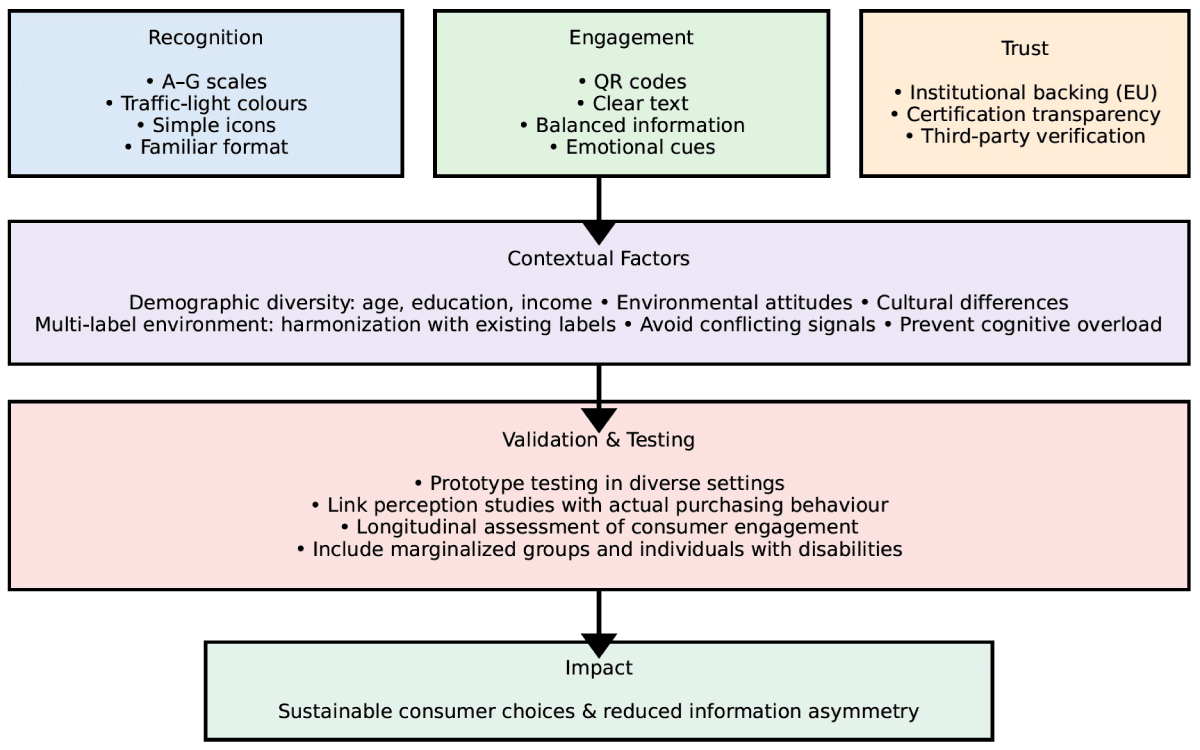
Figure 2
Conceptual framework for effective eco-label design.
To advance label development, future efforts should prioritise evidence-based design and real-world testing of label drafts to assess how these factors translate into actual consumer decision-making. Research should explore the cognitive limits of label complexity to strike the right balance between simplicity and informativeness. Harmonisation with existing labels – at least under the regulation of the European Commission – is essential to ensure consistency and avoid confusion in multi-label environments. There might be conflicts – as the example of the industry Unified Water Label4 for shower heads illustrates – between the desire to establish an effective label and the risk of imitating or plagiarising the EU energy label. The core risk, however, lies not only in imitation but in consumer confusion and the dilution of trust: similar label designs can suggest equivalence, while underlying methodologies, verification processes, and levels of stringency differ significantly. This opens the door to selective adoption by manufacturers and contributes to a fragmented labelling landscape, ultimately undermining comparability and informed decision-making. Moreover, addressing inclusivity by involving marginalised groups, individuals with disabilities, and underrepresented regions in validation studies has the potential to broaden the impact of label initiatives. As a next step, testing prototypes across diverse consumer settings, as emphasised in the framework, will provide actionable insights to refine designs and maximise the contribution of future ESPR Labels to sustainable production and consumption.
Additional Files
The additional files for this article can be found as follows:
Supplementary File
List of articles analysed in literature review (Table 1) and search strings (Table 2). DOI: https://doi.org/10.66506/essp.8-171-26.s1
PowerPoint Slides
PowerPoint Slides relating to this article. DOI: https://doi.org/10.66506/essp.8-171-26.s2
Notes
[2] The search strings used are provided in Table 2 in the Supplementary File. The search strings can be used to replicate our search results. Generally, they included the following words: label, energy OR eco* OR environment*, eu* OR europe* as well as words referring to the respective research question. If possible, we limited the results to relevant disciplines. For instance, the search string to address question (i) General understanding for Scopus reads: TITLE-ABS-KEY (label* w/15 ( energy OR eco* OR environment*) AND (eu* OR europe*) AND (effective* OR attitud* OR behav* OR intention* OR attent* OR interest* OR recogn* OR understand* OR perce* ) ) AND PUBYEAR > 2019 AND ( LIMIT-TO ( SRCTYPE, “j” ) ) AND ( LIMIT-TO ( SUBJAREA, “ENER” ) OR LIMIT-TO ( SUBJAREA, “ENVI” ) OR LIMIT-TO ( SUBJAREA, “SOCI” ) OR LIMIT-TO ( SUBJAREA, “MULT” ) OR LIMIT-TO ( SUBJAREA, “NEUR” ) OR LIMIT-TO ( SUBJAREA, “BUSI” ) OR LIMIT-TO ( SUBJAREA, “ECON” ) OR LIMIT-TO ( SUBJAREA, “EART” ) OR LIMIT-TO ( SUBJAREA, “PSYC” ) OR LIMIT-TO (SUBJAREA, “DECI”).
[3] Scopus, Web of Science, and Google Scholar allow search results to be sorted by relevance, determined through metrics such as keyword frequency and placement within a document. More details on the relevance algorithms of Scopus and Web of Science are available on their respective websites. We relied on these relevance rankings to efficiently address diverse research questions within time constraints. By searching across multiple databases, we still ensured broad article coverage.
[5] See www.uwla.eu.
AI statement
Parts of this manuscript were supported by the use of generative AI tools (Microsoft Copilot and Claude Opus 4.6) for text refinement, language editing, and structuring. All conceptual work, methodological decisions, data analysis, and interpretation of results were conducted by the authors. The authors carefully reviewed, verified, and, where necessary, adapted all AI-assisted text to ensure accuracy, academic integrity, and compliance with ethical standards. No AI tools were used to generate or analyse empirical data.
Disclaimer
The authors of this paper are involved in the currently ongoing study on technical assistance on the setting up of labels under the ESPR and on the preparation of an implementing act on their layout. This paper presents original research related to that study however it reflects solely” with “that study; however, it reflects solely the views of the authors, and the European Commission is not liable for any consequence stemming from the reuse of this publication.
Author Contributions
Josephine Tröger – Conceptualisation, Methodology, Writing – Original Draft, Funding acquisition, Project administration.
Hannah Janßen – Methodology, Investigation, Writing – Original Draft, Writing – Review & Editing, Investigation, Formal analysis.
Elisabeth Dütschke – Conceptualisation, Methodology, Writing – Original Draft, Writing – Review & Editing, Supervision.
eceee paper ID
8-171-26