
Introduction
The transport sector accounts for roughly 15% of global emissions (United Nations Environment Programme (UNEP) 2025). To meet the EU’s climate goals of climate neutrality by 2050, transport remains a key sector that needs to decrease its emissions. Alternatives to fossil fuels are critical to diminish reliance on fossil fuel supply and increase resilience. The vast majority – around 90% – of global transport energy is supplied by fossil fuels (International Energy Agency (IEA) 2023a). A strong dependence on fossil fuels can exacerbate energy vulnerabilities and geopolitical tensions (Alreshidi et al. 2025) as can also be witnessed in context of the Strait of Hormuz blockade at present. Beyond these considerations, policy instruments such as the EU Emissions Trading System for energy carriers apart from electricity (EU ETS 2) and greenhouse gas (GHG) reduction quotas for fuel suppliers are central to supporting the uptake of alternative fuels.
Electrification of transport has emerged as a critical pathway for reducing emissions, enhancing energy security, energy efficiency, and increasing the uptake of renewable energy (United Nations Economic Commission for Europe (UNECE) 2025a). In Norway, nearly all (95.9%) of newly registered cars are electric (Reuters 2026). Other alternative fuels, that is, synthetic fuels, hydrogen, and biogas, are often dismissed as economically non-viable, particularly for road transport; further, an increase in biofuel demand can exacerbate food security concerns due to increased land-use demand (Hasegawa et al. 2018). Moreover, the scalability of biofuels is constrained by the limited availability of sustainable feedstocks, competing land uses, and high production costs (IEA 2023b). Globally, alternative fuels represent a small fraction compared to e-mobility. Of the $2.3 trillion that were invested in the global energy transition in 2025, electrified transport attracted $893 billion, followed by renewable energy ($690 billion) and grid infrastructure ($483 billion), far exceeding investments in nuclear, hydrogen, and carbon capture technologies (BloombergNEF 2026).
However, there is a great spatial dispersion in both the use and the potential to efficiently produce, transport, and use clean electricity, hydrogen, biogas, and synthetic fuels. While in Brazil and Sweden the use of liquid biofuels is already equivalent to 15–16% of the combined supply of fossil oil and liquid biofuels (for transport and heat production), in most other countries liquid biofuel use is substantially lower, indicating that major steps will still be needed for it to compete with fossil oil (IEA Bioenergy 2024).
Many factors contribute to this dispersion, such as regional renewable energy potential, local production costs, infrastructure availability, geo-spatial situation, and transport and storage constraints. All of them dictate efficiency on a system level. To decarbonise the mobility system, make the energy supply more resilient, and increase cost-effectiveness, there is a need to consider the entire value chain from production through transport, transmission, and storage to use in order to identify the most systemically efficient solutions, the specific context in which they take place, and all relevant aspects that influence the systemic efficiency of the transport sector.
Current discourse on sustainable mobility often reflects an insufficient simultaneous consideration of determinants of system-level efficiency, as well as neglecting the context in which alternative fuels are produced, transported, and used. Discussions tend to focus on energy carrier procurement costs and conversion efficiency at a specific location (e.g., Germany). However, they often overlook differences in availability, infrastructure, production costs, and existing transport options, all of which vary considerably across regions worldwide. This article addresses this systemic and contextual gap by identifying key factors that influence the systemic efficiency of alternative fuels and that must be considered and coordinated simultaneously. Focusing on individual efficiencies along the value chain is necessary but insufficient to reach climate neutrality; for example, increased efficiency gains in heavy vehicles, such as ships and planes, could not prevent them from becoming the fastest-growing source of greenhouse-gas emissions globally (Intergovernmental Panel on Climate Change 2022). Applying a systemic efficiency approach represents a more holistic way of finding solutions for decarbonisation and energy security that are suitable to the specific situation of any given location across the globe.
The UN proposes a suitable and encompassing definition of sustainable mobility, which is referred to as “the provision of services and infrastructure for the mobility of people and goods – advancing economic and social development to benefit today’s and future generations – in a manner that is safe, affordable, accessible, efficient, and resilient, while minimizing carbon and other emissions and environmental impacts” (UN 2016). The environmental, social, and economic dimensions highlighted in this definition constitute the overarching goal of systemic efficiency: encompassing the reduction of transport sector emissions while maintaining mobility freedom, which is primarily determined by affordability, accessibility, and availability.
Moreover, typical discourse often focuses on the most common vehicles, i.e. road vehicles, maritime transport, planes, and trains. Given the systemic approach we adopt with respect to efficiency, we work with a broad and inclusive definition of sustainable mobility that, based on UNECE (2025b), includes “all types of current and future means that are not immobile and require […] [energy] to transport people or goods or execute a service while changing location”. Bridging the molecules-versus-electrons debate, the focus is on various net-zero fuels (i.e., all types of energy carriers, including e-fuels and other renewable or low-carbon fuels: combustible liquid fuels such as bioethanol and sustainable aviation fuels (SAF); gaseous fuels such as hydrogen and biogas; as well as electricity). Given the complexity and heterogeneity of transport systems globally and the contexts in which they manifest, central determinants for assessing systemically efficient solutions are proposed. Systemic efficiency represents a perspective that considers the interaction of various dimensions and factors in a technologically neutral and context-sensitive way. It recognises that, despite ongoing trends such as rapid improvements in battery technologies and declining costs, no one-size-fits-all solution exists and outcomes depend on context. Adopting this approach allows for a more holistic assessment of which alternative fuel is most efficient on a system level in a specific context. The main question that this article aims to answer is which determinants dictate the systemic efficiency of alternative fuel pathways across varying spatial, sectoral and end-use contexts.
Methodology
The heuristic approach to systemic efficiency builds on the systemic efficiency perspective of Buettner, Czeschlik and König (2024a) and the UNECE Group of Experts on Energy Efficiency (2024), and the concept of location efficiency (UNECE 2025b), as well as insights from a panel discussion during the 34th Meeting of the Committee on Sustainable Energy of the United Nations Economic Commission for Europe (UNECE 2025c) and the corresponding Report of the Committee on Sustainable Energy on its Thirty-Fourth Session (UNECE 2025d). It also draws on professional exchanges with practitioners across different levels of the energy system, including technicians, management consultants, decision-makers, politicians, government officials, engineers and homeowners.
From these sources arose the recognition of the intricate interconnections between e-mobility, and by extension all other alternative fuels, and clean electricity, energy efficiency, renewable integration, low-carbon gases and responsible resource management. It was found that this complexity calls for more extensive cross-sectoral dialogue and policy coordination. Furthermore, it concluded that key challenges constitute a multi-factor optimisation problem that needs to be addressed with consideration of the specific context and location and that cannot be solved a priori without an understanding of both. The multi-factor optimisation problem recognises that several factors need to be considered simultaneously and implemented accordingly to increase systemic efficiency. While the framework of systemic efficiency is intended to be universally applicable, selected examples in this text serve to illustrate its application.
Conceptual framework
Systemic energy efficiency asks how effectively the technical, economic, organisational, and human dimensions of a system are coordinated and aligned with locally available resources and contextual conditions to increase energy resilience, save costs, and curb emissions (Buettner, Czeschlik & König 2024a). Systemic efficiency, as defined here, refers to a heuristic framework that is conceptualised procedurally rather than metrically. Unlike metrically defined quantitative analyses (e.g., Life Cycle Assessment), this framework represents an organising principle that helps aim at optimally coordinating how energy demand, energy generation (potential), materials, infrastructure, and data are planned and operated together (UNECE 2025e). Systemic efficiency is a sequence of efficiencies along the value chain. That necessarily includes diverse stakeholders from various industries working together to design resilient and sustainable mobility systems by applying a lifecycle perspective and using digital tools as enablers (UNECE 2025e).
Systemic efficiency is critically influenced by the location and accessibility of things and energy-, as well as resource considerations. Location efficiency denotes efficiency on a system level that is achieved by strategically placing infrastructure or other assets. Given the system-level perspective, efficiency gains are achieved by considering a system of locations, rather than a singular location of a specific thing (e.g., charging infrastructure). Energy efficiency is a key component of systemic efficiency and a central lever, as it determines the amount of fuels required.
Applied to the transport system, systemic efficiency requires “establish[ing] clarity about (A) the aspired goal” (e.g., sustainable mobility), “(B) available and feasible input factors” (e.g., site-specific conditions and infrastructure assets), “(C) desired outcomes” (e.g., affordability, accessibility, and energy security), and “(D) knowledge of the current state” (Buettner et al. 2024a) (e.g., the existing technical infrastructure and vehicle systems, critical resource materials). With respect to the elements it considers, it encompasses technical, organisational, economic, behavioural, resource-specific, and site-specific dimensions, as illustrated in Figure 1.
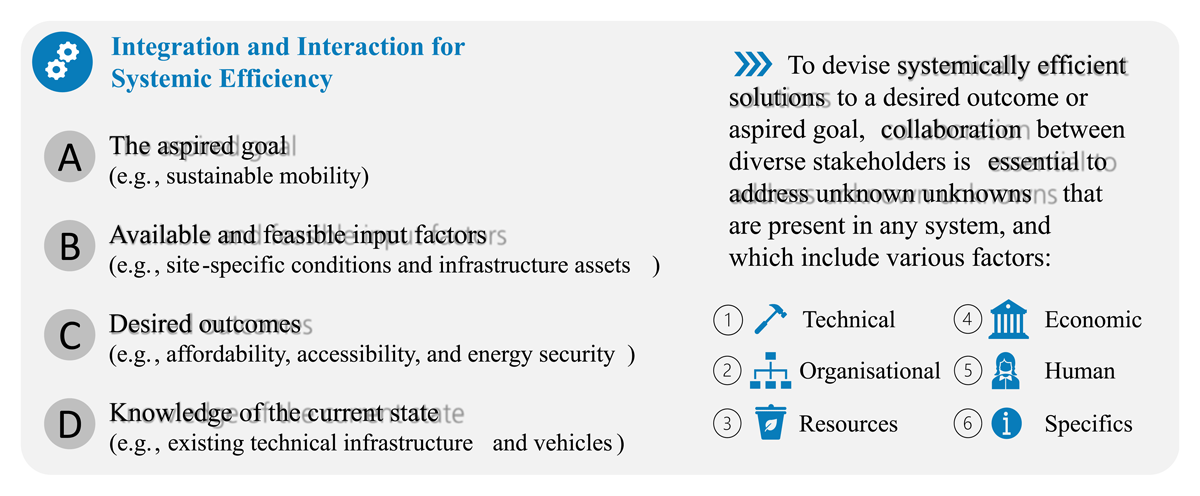
Figure 1
Framework for systemic efficiency in sustainable mobility. Adapted from Buettner et al. (2024b).
To enhance systemic efficiency in the transport sector, multiple elements must be considered and aligned – like the interlocking parts of a cogwheel – to keep the system running smoothly and effectively. There are at least five prerequisites for a sustainable propulsion transition, building on the framework proposed by UNECE (2025b), which are summarised in Figure 2. First, sufficient amounts of clean energy (i.e., but not limited to electricity) are required. Globally, the share of renewable energy that fuels transport is highly unequal – in Brazil and Sweden this share is 26% and 30%, while in most other countries the share is between 4% and 8% (IEA Bioenergy 2024). Second, grid infrastructure and sufficient storage capacity are needed in the right places so that energy is available where it is needed. To cope with the inherent variability of wind and solar energy generation and the rising demand for electricity, investments in grid expansion, energy storage systems, and grid-stabilising measures are essential. The third decisive factor is the rapid development of charging infrastructure and (green) petrol and charging stations. In mid-2025, the EU had surpassed 1.1 million public charging points (Mobility Portal 2025), while their distribution is still highly uneven (EIT Urban Mobility 2025). Fourth, vehicles need to be coordinated to fit the desired purpose across different sectors (passenger transport, heavy-duty transport, aerial transport, marine transport). Particularly in e-mobility and in urban areas, multi- and intermodality of various modes of transport (e-bikes, e-scooters, e-buses, etc.) are critical to reaching one’s destination, since this almost always involves a change in the means of transportation. Finally, basic underlying principles that need to be warranted are accessibility, justness, and awareness, for if they are lacking, even well-developed charging networks and affordable electric vehicle (EV) models may see limited uptake, as potential buyers remain uncertain or uninformed.
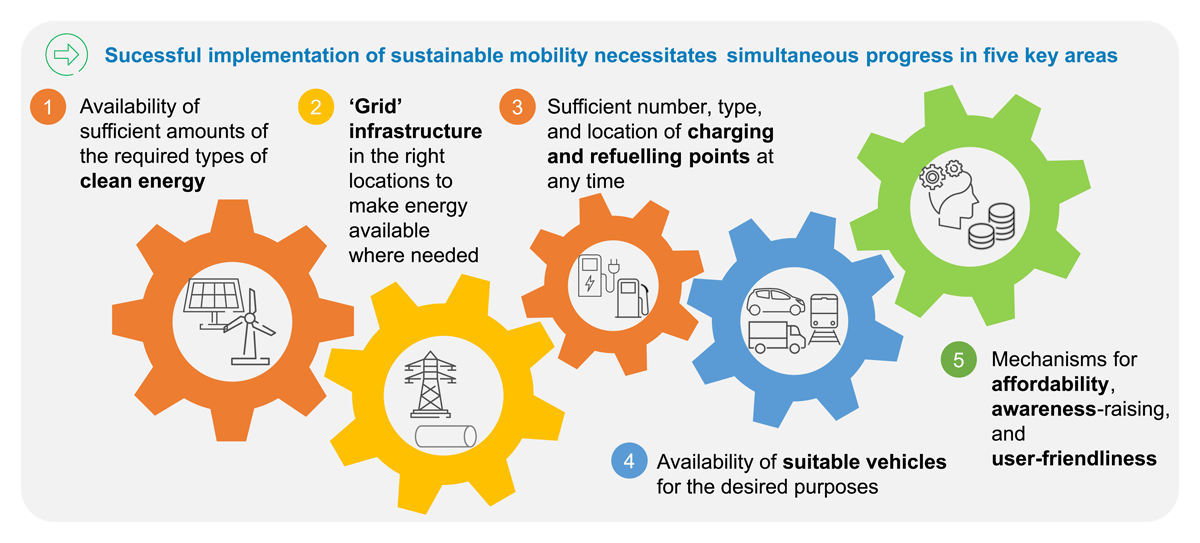
Figure 2
Systemic prerequisites for a successful sustainable mobility transition. Adapted from Buettner (2024).
These five prerequisites need to be met simultaneously. Despite the efforts undertaken towards meeting these prerequisites, it needs to be understood that distance anxiety, infrastructure and geographical realities, traffic density/frequency, mode and expansion viabilities, as well as technical limitations will unavoidably result in a continued, but declining share of combustion-powered vehicles across the globe. This can be expected, notably, where the average useful life of the vehicle is typically decades (i.e. ships, planes, trains, trucks).
Energy carriers in spatial contexts
There are various dimensions and factors that determine the systemic efficiency and site-specific suitability of alternative fuels. To increase the systemic efficiency, multiple factors must be simultaneously thought together, which results in a multi-factor optimisation-challenge for sustainable mobility. Building on the factors identified by Buettner (2024), critical factors include:
Renewable energy potential: wind, wave, and tidal energy potential, geothermal energy potential, solar irradiation, biomass availability, land availability.
Production costs at location: CAPEX, OPEX, electricity prices.
Conversion efficiency across the full value chain: electrolysis, synthesis, reconversion.
Transport and distribution losses: grid losses, pipeline compression, liquefaction energy.
Energy density of the carrier.
Existing infrastructure: grid capacity, overhead lines, rail electrification, pipeline networks, ports, refuelling systems.
Storage and balancing options: geological storage, batteries, thermal storage.
Grid integration: congestion, firm capacity requirements, reinforcement needs.
Operational use-case characteristics: cargo type, transport distance, frequency, urban vs. rural operation, general geo-spatial context (such as deserts, mountains, etc., permafrost areas), climate zone and population density, vehicle type.
In the mobility context, the systemic efficiency framework is applied in the format of location efficiency, a principle for spatial organisation. By linking transport, energy, industry, and infrastructure through coordinated land-use planning, distances for energy production, transport, and transmission can be reduced, which in turn diminishes infrastructure needs, lowers costs, and reduces transport demand. The aforementioned factors are prerequisites that need to be considered simultaneously to assess the most suitable alternative fuel in a way that takes regional and behavioural specificities into account. For example, hydrogen produced in a wind-rich location may exhibit low electricity costs. However, losses during electrolysis, compression or liquefaction for transport or reconversion into fuel cells may diminish the overall efficiency. If transport requires long distances, direct electrification may be more favourable. If, on the other hand, ammonia export infrastructure exists in the region, converting hydrogen into ammonia for shipping may overall enhance the systemic efficiency. Thus, the interaction between geographical, technological, and infrastructural aspects within the broader energy system determines the optimal energy carrier.
Direct electrification
Direct electrification in road transport can be implemented through stationary charging infrastructure, such as depot or public charging stations, as well as through dynamic charging systems, including overhead catenary systems or other electric road technologies. While overhead catenary systems stand in some competition with stationary charging points for battery electric vehicle (BEV) long-distance trucks, their development may also be synergistic. While stationary charging points constitute a more flexible system, especially in the early market phase, overhead catenary systems have the potential to diminish pressure on the construction of charging stations and enable the possibility of dynamic charging (Gnann et al. 2023). Publicly, there is a certain level of discord among large OEMs (Original Equipment Manufacturers) regarding catenary road trucks. While Daimler has been dismissive of electric road systems, Scania has been supportive of them (ibid.).
Direct electrification is typically a highly energy-efficient pathway since it involves fewer steps from the production of renewable energy to the electric drivetrain compared to hydrogen and synthetic fuels. Quantitative analysis indicates that using zero-carbon electricity directly in battery electric vehicles delivers the highest GHG-reduction benefit per unit of energy among different road transport powertrain options. Specifically, per unit of energy, BEVs deliver roughly twice the GHG benefit of fuel cell electric vehicles (FCEVs) and three times that of e-fuels in internal combustion engine vehicles (ICEVs) (Malins 2022).
However, in a context with weak grids and large distances between supply and demand (e.g., an island archipelago, or scarcely populated areas), fast-charging heavy vehicles would require large grid connection capacity and could necessitate oversized local generation and storage to meet peak electricity demand. Where grid connection capacity or charging infrastructure is insufficient and a large legacy fleet of internal combustion engine vehicles remains in operation, drop-in synthetic- or bio-fuels may become – and temporarily remain – the dominant decarbonisation option. Moreover, at locations with a local surplus of renewable energy, hydrogen or synthetic fuel pathways may be a better system fit, while direct electrification requires adequate grid capacity.
In urban contexts, on the other hand, direct electrification may be a more systemically efficient option. Typically, shorter distances in these contexts allow for micro-mobility that reduces vehicle weight, material demand, charging time, and battery size. Thus, it may also diminish infrastructure stress. In addition, EVs can support the electricity system through smart charging, vehicle-to-grid, and charging during hours with renewable energy surplus. Also, given frequent acceleration and braking in urban contexts, energy that would be lost in those situations in internal combustion engine vehicles (ICEVs) can be recovered in EVs. Thus, urban contexts can be a suitable environment for direct electrification.
Direct electrification can also contribute to reducing renewable energy curtailment. When wind or solar generation temporarily exceeds electricity demand, EVs can absorb part of this surplus through flexible charging. In this way, transport demand can help stabilise the electricity system and support the local integration of renewable energy. Hydrogen and synthetic fuels can also make use of surplus electricity, but their production requires additional conversion steps and therefore involves higher energy losses. These pathways are often implemented at larger scales and in more centralised places, whereas direct electrification can help balance renewable generation and demand more locally.
Hydrogen
Uptake of low-emission hydrogen is constrained by high costs, uncertain demand and regulatory environments, and slow infrastructure development (IEA 2025). Land use and material demand also constitute concerns. Although FCEVs improve climate performance, they can cause substantially higher demand for land use and materials. In a 2050 net-zero renewable scenario, land use is more than double that of BEVs, and mineral and metal use can be nearly ten times higher than that of ICEVs (Deng et al. 2025).
Green hydrogen production requires renewable electricity, water, water treatment systems, compression or liquefaction, storage facilities, as well as infrastructure for electrolysis and transport, such as pipelines, shipping, or trucking. Large quantities of renewable energy resources are abundant in regions such as Norway (hydropower), the Sahara (solar power), or the North Sea (wind power). Hydrogen can therefore enable the spatial decoupling of renewable energy production and final energy use, as it can be transported over long distances more easily than electricity. FCEVs can achieve substantial life-cycle GHG reductions, but only when supplied with hydrogen produced from renewable electricity (International Council on Clean Transportation 2025). In regions where renewable energy availability and infrastructure remain limited, FCEV pathways based on blue hydrogen may serve as a transitional solution (Deng et al. 2025).
Hydrogen can be transported in various forms, including compressed gaseous hydrogen, liquid hydrogen, ammonia, methanol and liquid organic hydrogen carriers. Ammonia and methanol can be utilised as maritime fuels without reconversion to hydrogen (Dave et al. 2025). However, the decarbonisation of supply for hydrogen appears more achievable than that of ammonia or methanol, largely due to the additional steps required, such as the Haber–Bosch process or synthesis (McKinlay et al. 2020). Hydrogen becomes systemically efficient where abundant renewable electricity is available and large-scale or long-duration energy storage is required.
For countries such as Germany, the import of hydrogen is necessary to meet national hydrogen targets. Considering the entire supply chain, a comparative study by Dave et al. (2025) assessed the supply chain efficiencies of three import routes to Germany. Supply chain efficiency refers to the “ratio of energy content of delivered fuel […] to the total energy consumption covering all the considered stages of the supply chain” (Dave et al. 2025). It investigated the overall supply chain efficiency for maritime applications based on three individual supply chain routes. Concretely, the study examined maritime transport between Namibia, Norway, and Algeria to a destination port in Germany. Gaseous hydrogen was transported to Germany via pipelines, while hydrogen derivatives, ammonia and methanol from Namibia and Algeria were transported via ships. The calculated energy included the production of hydrogen via both steam methane reforming with carbon capture and storage or water electrolysis, as well as the conversion, storage, transport via pipeline or ship, and bunkering of the fuels in the port of Wilhelmshaven (ibid.). It was found that the supply chain efficiency varied between roughly 42% and 50% across the analysed countries (ibid.). The comparatively long transport route from Namibia resulted in a comparatively low overall supply chain efficiency. In addition, the distance between supply and demand locations influences the economic viability of different transport options. Long-distance transport of hydrogen may be more economical via shipping, whereas pipelines may be better suited for shorter distances.
To enhance location efficiency, hydrogen deployment should prioritise locations where supply chain steps can be spatially concentrated. Port regions, in this regard, can serve as hydrogen hubs, as they combine import infrastructure, storage facilities, industrial demand and maritime bunkering in close proximity. Such clustering strongly increases location efficiency and reduces additional inland transport.
Synthetic fuels/biogas
E-fuels refer to energy carriers produced from electrolytic hydrogen through synthesis with carbon or nitrogen. So-called drop-in e-fuels such as e-kerosene, e-diesel and e-gasoline are compatible with existing refuelling infrastructure and a vast global supply chain of fuel distribution networks (e.g., pipelines, tankers). However, synthetic fuels further require infrastructure for capture (e.g., direct air capture, carbon capture at industrial sites), storage, and transport of carbon emissions via pipelines or shipping. Alternative e-fuels such as e-ammonia or e-methanol are relatively easy to produce compared to carbon-based e-fuels (International Transport Forum (ITF) 2023) but require investments in infrastructure and end-use equipment (IEA 2023b).
From the point of view of manufacturers, e-fuels can serve as a convenient way to use renewable energy and substitute internal combustion engine vehicles (ICEVs), since existing logistics and fuelling infrastructure could be utilised. In addition, e-fuels can act as chemical storage of surplus energy from renewable electricity that cannot be handled by the grid.
E-fuels are often argued to decarbonise aviation and maritime transport, which require low-carbon, energy-dense fuels. Yet, their current market share is minimal; for instance, sustainable aviation fuels (SAF) account for only 0.1% of kerosene use today (ITF 2023). However, large-scale projects are currently being developed, especially in regions with high renewable energy potential, such as desert areas with strong solar irradiation or coastal regions combining wind and solar resources. For example, e-ammonia projects are being developed in regions with combined PV and wind resources, including desert areas in the Middle East, Africa, Australia, Chile, and the United States (IEA 2023b). Conversely, e-fuels may also be suitable for supplying energy to regions with limited renewable energy potential and/or insufficient infrastructure.
E-fuels are typically recognised as CAPEX-intensive. Particularly when eLNG and eDiesel are supplied (with their Carbon components) through Direct Air Capture technology (instead of carbon emissions from emission intensive industrial facilities captured through CCUS), the CAPEX intensity is very high (Prussi et al. 2022). Moreover, due to the additional steps involved in using the energy compared to the two former pathways, more energy is lost in the conversion process. By 2030, low-emission e-fuels may become cost-comparable with fossil fuels, driven by cost reductions induced by the development of more electrolysers, the utilisation of sites with high-quality renewable resources, and optimised project design (IEA 2023b).
From an energy efficiency perspective, it is critical to utilise heat during e-fuel production. Heat released during the process may not match local heat demand. Yet, the released heat may be used to cover the plant’s own heat requirements; for example, high-temperature heat generated from the synthesis process can be used for high-temperature electrolysers or for CO2 capture units (IEA 2023b). Producing e-fuels would be systemically efficient where sufficient renewable energy, land, CO2 sources, and local demand to utilise heat as a by-product coexist.
Discussion
This article discussed various decarbonisation pathways and factors that determine the systemic efficiency of alternative fuels along the entire value chain. Given the system-level perspective that was applied, there are constraints to this approach, since the analysis cannot discuss every factor in great depth. Thus, the list of system-level factors is not exhaustive and should rather be considered a heuristic framework that can help structure a more holistic approach to assessing the site-specific suitability of decarbonisation pathways. Table 1 summarises the key inputs, energy sources, and infrastructure requirements, as well as the enablers and barriers of each energy carrier that influence its deployment within a given transport system. However, the suitability of each energy carrier depends on a context-sensitive assessment of these elements.
Table 1
Systemic characteristics of alternative energy carriers.
| ENERGY CARRIER | INPUTS, ENERGY SOURCES, AND INFRASTRUCTURE REQUIREMENTS | KEY ENABLERS | KEY BARRIERS |
|---|---|---|---|
| Direct electricity | Renewable electricity (wind, solar, hydro); batteries and critical minerals; grid-based transmission; charging infrastructure (stationary and dynamic) | High energy efficiency; direct renewable integration; grid balancing (smart charging, V2G); local use reduces transport needs | Grid capacity constraints; peak load management; charging infrastructure rollout; limited long-term storage means; material demand |
| Hydrogen | Renewable electricity and water for electrolysis; compression/liquefaction; storage; transport via pipelines, trucks, or ships; port and hub infrastructure | Enables long-distance energy transport; large-scale and long-duration storage; spatial decoupling of production and use; clustering in industrial hubs | High costs; multiple conversion losses; infrastructure gaps; water demand; handling complexity and safety requirements |
| Synthetic fuels (carbon-based e-fuels, incl. SAF, e-diesel, e-kerosene, methanol) | Renewable electricity via hydrogen; CO2; synthesis and refining; transport via existing liquid fuel infrastructure (pipelines, tankers, ports, airports) | Drop-in compatibility with existing infrastructure; high energy density; suitability for long-distance transport; storage of surplus renewable energy | Very energy-intensive production; high CAPEX; dependence on sustainable CO2 sources; multiple conversion losses; low current scale |
| Gaseous and bio-based fuels (biogas/biomethane) | Organic waste, residues, manure, sewage; upgrading systems; distribution via gas grids or local transport and storage infrastructure | Circular use of waste streams; compatibility with existing gas infrastructure; regional production potential | Limited sustainable feedstock; competing uses (e.g. land, food); methane leakage risks; limited scalability |
Systemic efficiency requires several aspects to be considered before investing heavily into some alternative fuel technologies. Investing massively in (bridge) technologies like e-fuels or natural gas for standard vehicles risks an ‘infrastructure lock-in’, a situation in which the sunk cost of investments are too high to swiftly change to other technologies that may be preferable in the future. Thus, while policies shall support technological innovation, they should also avoid new dependencies.
At the same time, discussions on alternative fuels should not overlook broader sustainable mobility goals for which the development of alternative fuels is necessary but not sufficient. There are advantages to active transport (e.g., walking and cycling), including improved public health, reduced congestion, and lower energy and infrastructure demand, that, for instance, cars irrespective of the fuel that they are supplied with cannot equally provide.
These interlinkages highlight the necessity for policy coordination that holistically addresses not only which alternative fuels are most suitable for a specific location, but also how they relate to broader transport sector goals overall and which other factors (e.g., active transport) also contribute to a more sustainable mobility system. Moreover, a more holistic policy approach also requires considering efficiencies along the entire value chain simultaneously rather than separately. Doing so may be complex and time-intensive but contributes to more informed and lasting decision-making for economically viable and environmentally favourable options. Further, any transition towards sustainable mobility systems will be a shift taking place over decades. As emissions arising from mobility need to shrink swiftly, there is the need to address both the energy needs of existing and potentially long-lasting stock of vehicles as well as new, increasingly electric vehicles while also seeking multi-modal solutions and location-efficient planning that reduces the need for energy-dependent mobility.
Thus, across the five cogwheels introduced earlier, it is necessary to consider circularity, recyclability, and remanufacturing by design in any hardware utilised on the path towards sustainable mobility. This is important to ensure that resources can be reclaimed, thereby saving costs and emissions. Regarding storage of energy to serve sustainable mobility, “it is always an equation of distance, security, durability, charging speed and weight that are critical factors”. Finding a fitting constellation of measures and modes, that is economic, efficient and sustainable “is a multi-factor optimization problem that we have in front of us and there artificial intelligence (AI) can help us in the dynamic modelling and self-learning to ever improve what we are doing based on the impact of the learning that we have just made.” (Buettner 2025). Conceptually, this is “the emissions in greenhouse gases plus the cost of mobility both per kilometre, per person [or kg of produce] depending on the location”, meaning in recognition of the geo-spatial, political and infrastructural opportunities and constraints, as well as energy generation, conversion and transport potentials, efficiencies and costs with particular attention also paid to existing transport patterns, energy and general security considerations and infrastructure costs. Attempting to provide a solution towards this optimisation problem, the following formula can serve as conceptional starting point (ibid.):
This formula highlights the interaction between emissions, system costs, location, and type of end-use, all of which determine the suitability of an energy carrier. Consider, for example, two pathways for decarbonising road freight transport in a coastal region with a moderately strong grid, port infrastructure, and access to renewable energy. Direct electrification may minimise conversion losses, thereby lowering overall emissions per unit of mobility output. However, meeting energy demand for heavy-duty freight transport may require investments in grid expansion, charging infrastructure, and storage capacity, thereby increasing system costs (this is of particular relevance where the traffic and population density is scarce). By contrast, hydrogen could be produced locally, which would involve additional conversion steps and thus higher energy losses. However, hydrogen can enable energy storage and reduce peak electricity demand on the grid. Thus, in this example, while electrification may reduce emissions, the hydrogen pathway may lower system costs. This comparison highlights the trade-offs between different pathways that need to be considered when assessing the most suitable option.
A systemic efficiency approach to sustainable mobility requires adopting a technology-neutral and context-sensitive approach. This approach shall not imply policies trying to foster the development of each alternative fuel equally. The proposed approach merely provides input for consideration, while the output shall be reassessed critically in the individual context. Considering the suitability of diverse technologies for a specific context can lower emissions and enhance energy security by more carefully assessing overall emissions and save costs by strategically placing the most fitting investments for the specific context.
Conclusion
The analysis highlighted that efficiencies along the entire value chain contribute to overall systemic efficiency. Considering the systemic efficiency of alternative fuels provides a more holistic approach to assessing which alternative fuels are suited to a specific time and location. No decarbonisation pathway is systemically more efficient than another by itself but must be considered in a specific context and designed in a location-efficient manner.
Electrification may represent the most energy-efficient decarbonisation pathway where strong electricity grids, short transport distances, and suitable charging infrastructure are available. Hydrogen and synthetic fuel pathways become preferable where renewable energy is abundant and in the latter case where there is no other more economical way to absorb unavoidable emissions from industry (i.e. process-related emissions). These technologies can more efficiently supply energy to more distant demand areas. While synthetic fuels may be more suited to aviation and maritime transport because their high energy density allows long-distance travel without the weight and space constraints associated with batteries, a systemic perspective reveals that their overall efficiency ultimately depends on the interaction of multiple factors such as renewable energy availability, infrastructure access, geography, population and traffic density, transport distances, and conversion losses.
Which technological pathway is most suitable for achieving sustainable mobility depends on the context. In light of this, policymakers should not follow one-size-fits-all strategies but adopt a technology-neutral and context-sensitive approach. Such an approach can enhance energy resilience, improve infrastructure investment decisions, and lower transport emissions. Drawing on the analysis, it is recommended that policymakers follow sound and systematic processes. Systemic efficiency is proposed as a starting point for this. Specifically, the proposed four-step process may help policymakers systematically assess context-specific conditions, align sustainable mobility objectives with site-specific resources and infrastructure, and identify the most suitable mix of technologies. Consequently, sustainable mobility strategies should incorporate systemic and location-efficient solutions as a coordinated policy approach that integrates energy, transport, geography and infrastructure, and also considers behavioural, organisational, and institutional aspects.
While the application of systemic efficiency to sustainable mobility provides a useful starting point for strategically conceptualising alternative fuel pathways, a quantitative analysis would greatly complement and facilitate the application of this conceptual framework. Current efforts by the UNECE Task Force on Measuring Sustainable and Resilient Infrastructure highlight the need for a shared conceptual basis and coherent approaches to assessing infrastructure globally (UNECE 2026). Further research can build on this effort and operationalise systemic efficiency quantitatively to analyse location-specific full system costs of energy for the comparison of competing technological pathways.
Additional File
The additional file for this article can be found as follows:
PowerPoint Slides
PowerPoint slides presented at the eceee Summer Study 2026, relating to this article. DOI: https://doi.org/10.66506/essp.6-251-26.s1
Data Accessibility Statement
This study does not rely on primary data, datasets, or code. All information used is derived from publicly available literature and sources cited in the reference list.
Author Contributions
All authors contributed to the conceptualisation and development of the study. Tom Zetsch led the drafting process of the manuscript, while Dr. Stefan M. Buettner and Benoît Lebot contributed to critical revisions and refinement of the arguments. All authors reviewed and approved the final version of the manuscript and agree to be accountable for all aspects of the work.
eceee Paper ID
6-251-26