
Table 1
Pros and cons of the four possible indicators for the main colour scale, where ZEV stands for zero emissions vehicle, and EV stands for electric vehicles.
| CO2 EMISSIONS – TAILPIPE | CO2 EMISSIONS – WELL TO WHEEL | TANK TO WHEEL FINAL ENERGY USE | PRIMARY ENERGY USE | |
|---|---|---|---|---|
| Drives innovation | No incentive for improving ZEVs | Gives incentive for improvement | Gives incentive for improvement | Gives incentive for improvement |
| Promotes energy efficiency | No differentiation of ZEVs | Differentiates between ZEVs | Somewhat exaggerates the relative efficiency of EVs | Yes, reflects the energy systems perspective but cannot take into consideration when (time of day/season) the energy is used |
| Promotes electrification | ZEVs promoted strongly | Yes | Yes | Weak promotion of EVs |
| Shows benefits of alternative fuels | Does not reflect actual climate impact | Shows actual climate impact | Does not reflect actual climate impact as fossil fuels are favouritised | Biofuels get worse ranking than fossil fuels |
| Differentiation within powertrain category | No differentiation of ZEVs | Yes | Yes | Can lead to inaccurate differentiation for dual-fuel vehicles |
| Differentiation between powertrain categories | ZEVs promoted strongly | Yes | Somewhat exaggerated promotion of EVs | Can favouritise fossil fuels and be unfavourable for electricity |
| Stability of data and over time | Stable over time, WLTP values | Values can be calculated in different ways and change over time | Stable over time, WLTP values | Primary energy factor for electricity and hydrogen can be calculated in different ways. Varies over time. |
| Internationally viable | Same in all countries | Differs between country/region | Same in all countries | Differs between country/region |
| Communicable | Easy to communicate but gives too little information | Difficult to communicate but more accurate information | Easy to communicate | Difficult to communicate |
Table 2
Preliminary class thresholds for passenger cars.
| CLASS | MAX (kWh/100 km) |
|---|---|
| A | 11.5 |
| B | 13.8 |
| C | 16.6 |
| D | 20 |
| E | 24 |
| F | 29 |
| G | 35 |
| H | 42 |
| I | 50 |
| J | 300 |
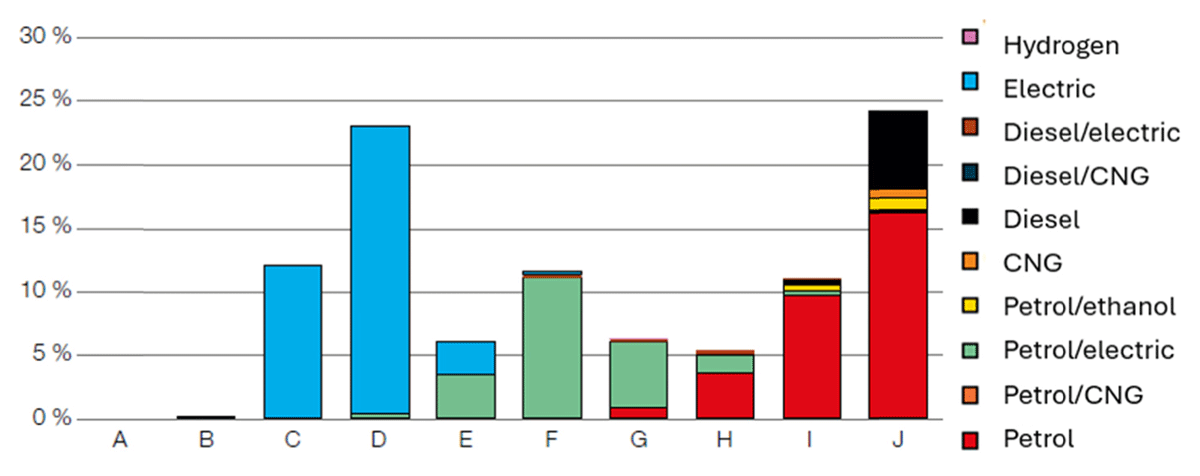
Figure 1
Passenger cars market share’s placing on A–J scale shown by powertrain category.
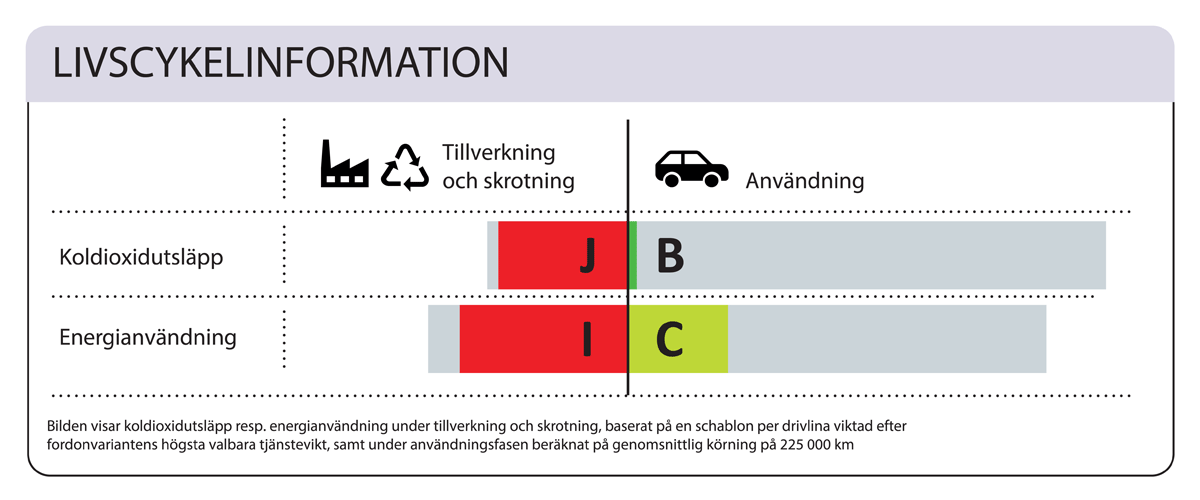
Figure 2
Early proposal for life cycle information based on default values calculated on vehicle type, weight and powertrain, showing CO2 emissions and energy use, during manufacture and end-of-life on the left, and use phase on the right. This example is for an electric vehicle.
Table 3
IVL’s summary of relevant initiatives and methods to calculate the LCA of a vehicle, at time of analysis in December 2024.
| METHOD | SCOPE | ENVIRONMENTAL ASPECTS | TYPE OF METHOD | THIRD PARTY VERIFICATION | TIME-PLAN | RELEVANT FOR SWEDISH LABELLING SCHEME |
|---|---|---|---|---|---|---|
| Green NCAP | Whole vehicle | Climate impact | Labelling of vehicles based on default values | N/A | Published | Yes, for a default-value based scheme |
| PCR for passenger cars | Whole vehicle | 8 aspects | LCA-method | Yes | Published | Yes, as basis of vehicle-specific data from manufacturers |
| Tran-Sensus LCA | Whole vehicle | Several categories in addition to climate impact. | LCA-method | Yes | 2023–2025 | Yes, as basis of vehicle-specific data from manufacturers |
| GBA Rulebook | Batteries | Climate impact | LCA-method | Yes | Published | Yes, for batteries as input in label |
| UNECE IWG LCA | Whole vehicle | Climate impact | LCA-method | Highly likely | 2023–2025 | Yes, as basis of vehicle-specific data from manufacturers |
| Catena-X Rulebook | Components | Climate impact | LCA-method | Yes | Published | No |
| HIQ-LCA | Batteries | N/A | Improved generic LCA data | N/A | 2023–2025 | No |
| GREET | Whole vehicle | Climate impact | Builds on LCA-method with possibility to calculate simplified LCA:s in a tool | N/A | Published | Yes, for a default-value based scheme |
| CATARC | Whole vehicle | Climate impact | Simplified LCA-method | Not known | Published | Yes, partially |
| EU Battery regulation | Batteries | Climate impact | LCA-method | Yes | 2024 (but not yet published) | Yes, for batteries as input in label |
| LCA method, EU regulation 2023/851 | Whole vehicle | Likely climate impact | LCA-method | Highly likely | End of 2025 | Yes, as basis of vehicle-specific data from manufacturers |
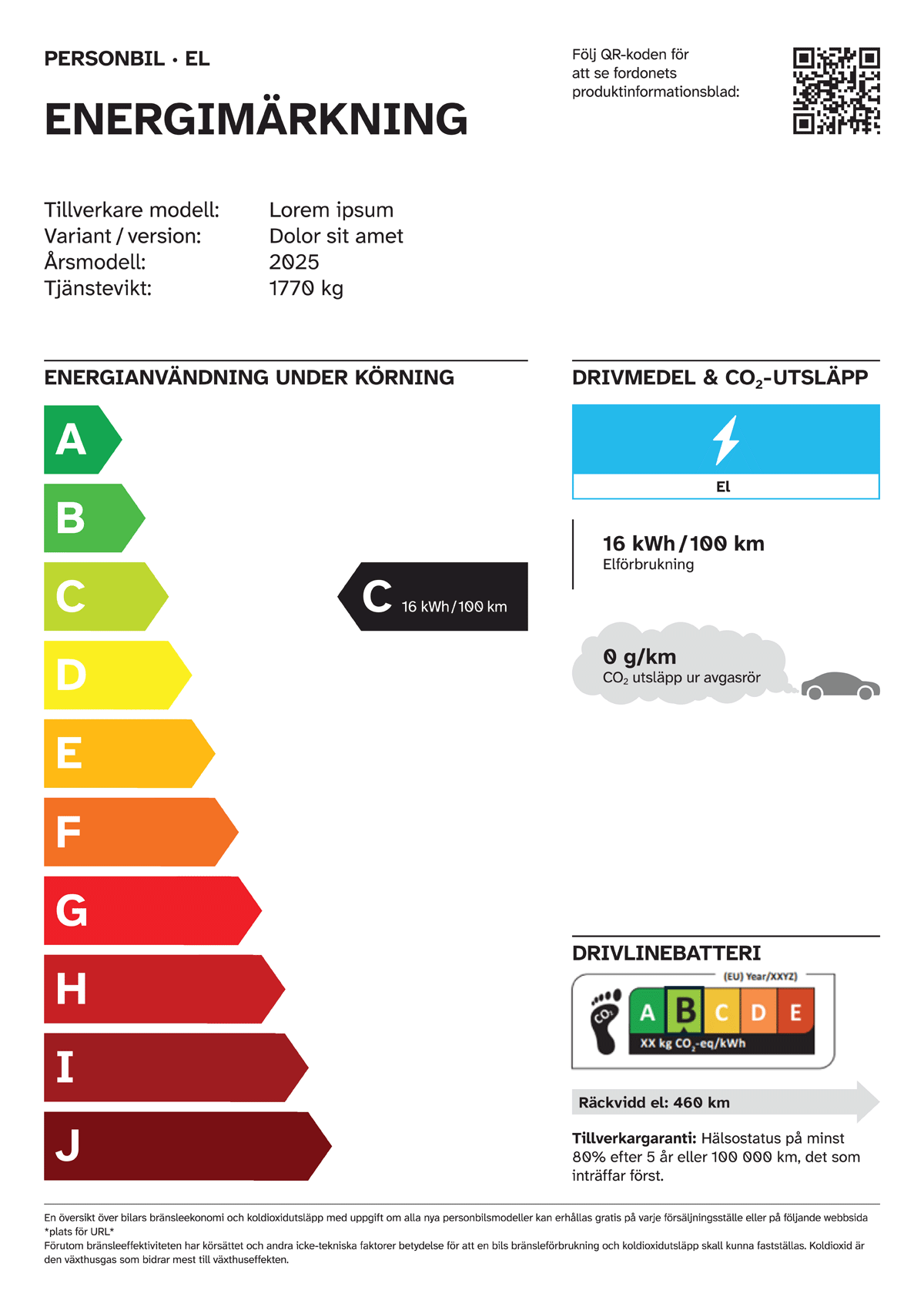
Figure 3
Label proposal for electric passenger car.
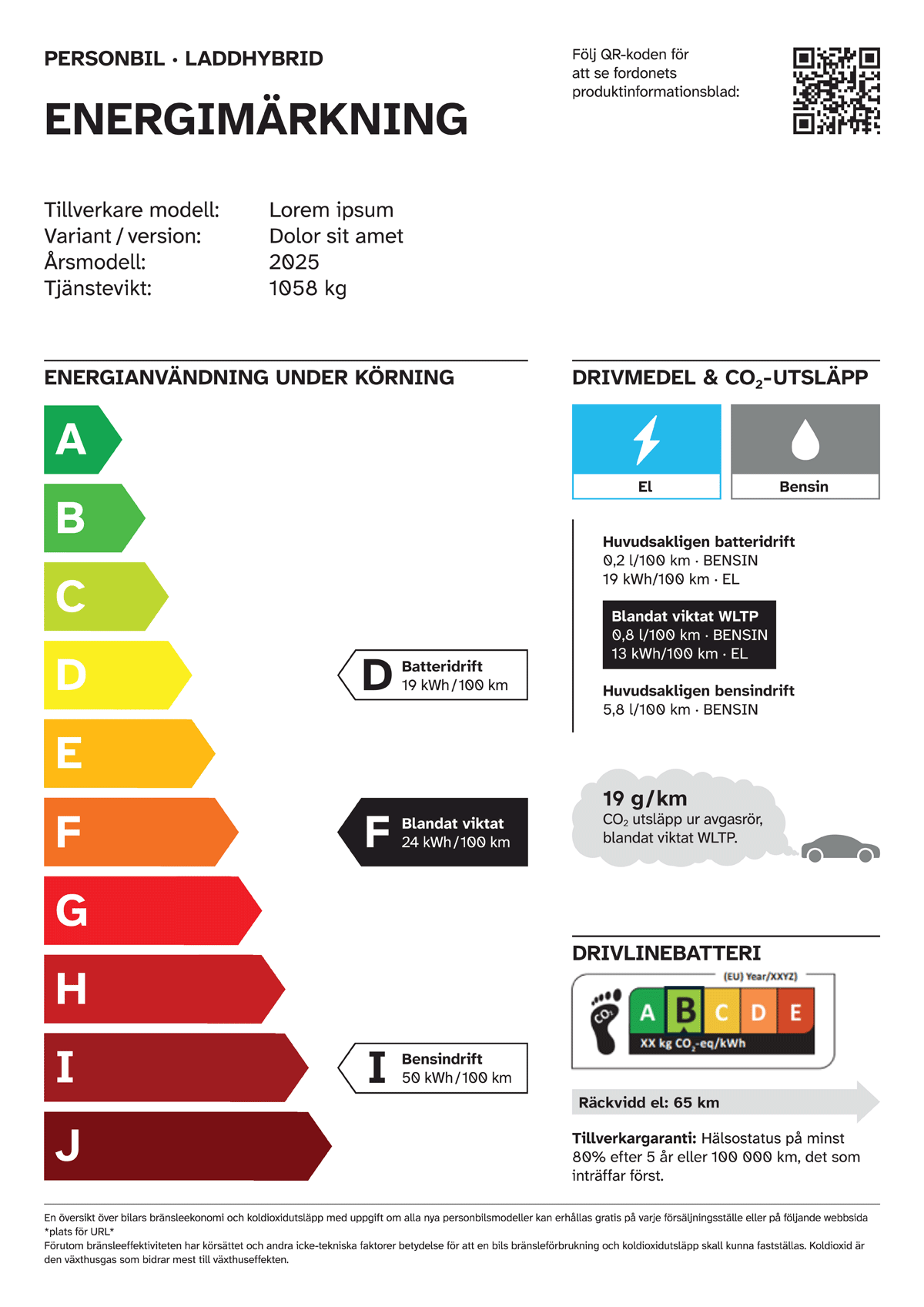
Figure 4
Label proposal for plugin hybrid passenger car.