
Introduction
The Clean Energy Package (CEP) (EU, 2019a) formally introduced Energy Communities (EC) into European legislation, defining the governance and legal attributes of Renewable Energy Communities (REC) and Citizen Energy Communities (CEC) (EU, 2018; EU, 2019a). RECs can be viewed as a subset or type of CEC, having a narrower geographical scope with a requirement that shareholders and members are co-located with renewable energy projects that are owned and developed by the REC (Roberts et al., 2019). Both entities champion open and voluntary participation by citizens, and citizen/stakeholder governance whose primary purpose is to provide environmental, economic or social community benefits rather than financial profits. Member States are mandated by the directives to ensure that ECs have non-discriminatory access to energy markets, enabling them to provide a range of energy-related services in pursuance of these aims. In tandem to the CEP, the Renewable Energy Directive (EU, 2019b) casts citizens as co-owners of the energy transition, conferring democratic accountability to the changes proposed by the directive in energy system governance, ownership and control. However, the meaning of the term ‘citizen’ is contested and capable of being used to derive or justify different interpretations of the directive.
Two main ideas shape how citizenship is understood: civic-republican and liberal citizenship (Dobson, 2006). Both are based on the idea of a fixed territory defined by the state. Civic-republican citizenship focuses on people’s duties and responsibilities to that territory, while liberal citizenship focuses on the rights people receive from it. In both approaches, the boundary between public and private life is rarely questioned, meaning that rights and responsibilities are usually not seen as extending into the household. The political dominance of neoliberalism has promoted liberal citizenship, framing citizens as rational individuals pursuing personal advancement within market rules, with duties to the state limited to accepting the right of all citizens to pursue this course. This detaches citizenship from community and side steps any responsibility of the citizen to address wider equity and justice issues (Dietz, 1987; Delanty, 1998; Dobson, 2006). Over the past three decades, environmental politics has often been addressed through an “alternative hedonist” approach encouraging people to make ethical consumption choices based on concern for others. As a result, environmental responsibility has been added to liberal citizenship, but only in a limited and superficial way (Soper, 2007; Loukianov, et al., 2024). Dean (2001) argued that environmental politics rendered traditional liberal and civic-republican models of citizenship redundant by introducing new intergenerational rights (e.g., to clean air), expanding citizenship beyond the nation-state, and creating responsibilities grounded in climate justice and accountability. The dominant economic model that frames citizens as rational responders to market signals has also been critiqued, noting the inconsistent commitment of the state to market regulation. These challenges have opened space for an alternative citizenship definition, namely ecological citizenship with ideals that include social justice through equal ecological space, extending citizenship into private life, asymmetrical obligations based on ecological impact, and global, intergenerational responsibility aligned with Brundtland orientated sustainable development principles (Dobson, 2006).
Collectivist approaches such as ECs that emphasise community governance structures, diverse community typologies and obligations that address global and intergenerational justice and equity may foster transition from liberal through civic-republican to these ecological definitions of citizenship (Kenis, 2016). Indeed, it can be argued that for the EC movement to meet the objectives described in the CEP and the recast RED mandates that citizens embark on this citizenship journey. It is certainly difficult to envisage shared ownership, participatory governance, and locally grounded initiatives (Huggins, 2025), citizen acceptability and active engagement in the sustainable energy transition (Jans et al., 2024) and empowered communities actively participating in energy-saving initiatives (Lodewijk et al., 2024) where liberal citizenship is dominant. Interestingly, Lennon & Dunphy (2024) commented that participation in a CEC was often framed by participants as a type of ‘journey’ which changes and evolves as the individuals’ own experiences and levels of knowledge change and evolve. This idea of the CEC as a journey metaphor is also present in transition theory literature (Gregg et al., 2020). It is argued that ECs can act as triggers or accelerators of the energy transition, creating new conditions for consumers to then become citizens who engage with one another and with other actors, encouraging collective/cooperative behaviour that generates or reinforces social innovation. The facilitation of the citizen journey requires parallel development of engagement frameworks as engagement strategies often lack a clear theoretical foundation, fail to define the causal mechanisms through which change is expected to occur, and are rarely empirically tested or evaluated within specific contexts (Goes et al., 2026).
This paper describes how a community-centred engagement framework has been designed to initiate citizen transition. Its design has been informed by a review of citizen participation and participation techniques. The framework addresses three interrelated challenges identified in the literature: (i) how to equip citizens with the knowledge, skills and confidence required to participate meaningfully in local energy decision-making; (ii) how to support communities in collectively articulating and sustaining shared visions of their energy futures; (iii) how can frameworks be designed that are explicable and robust enough to be facilitated by citizens in the absence of expert support, accentuating citizen input and the potential of their longitudinal value. The framework was designed for two European ECs; one where its deployment was facilitated by practitioners, the other by community members themselves.
Citizen Participation
The starting point for considering citizen participation is Sherry Arnstein’s seminal work that analysed the ways in which citizens become involved in planning processes and city regeneration programmes (Arnstein, 1969). This proposed a ‘ladder of citizen participation’ that started with deliberate manipulation of the citizen, moving through degrees of tokenism to citizen power and control (Table 1). Arnstein commented that in principle nobody in authority objected to citizen participation. In practice, however, characteristics of the citizen presented for participation (e.g., ethnicity, gender, social class) often determined which rung on the ladder the institution placed them.
Table 1
Arnstein’s ladder of citizen participation.
| FORM OF PARTICIPATION | LEVEL OF PARTICIPATION |
|---|---|
| Citizen Power | Citizen control |
| Delegated power | |
| Partnership | |
| Tokenism | Placation |
| Consultation | |
| Informing | |
| Non-participation | Therapy |
| Manipulation |
Carduillo and Kitchin (2019) modified Arnstein’s approach to produce a ‘Scaffold of Smart Citizen Participation’, more applicable to participation and empowerment of citizens in smart city initiatives in Dublin. A rung was added to the ladder to include consumerism as a form of participation with choice as its attendant level of participation. This reflected changes to market arrangements for energy service provision such as prosumerism and dynamic tariffing. Wahlund and Palm (2022) argued that participation type was a discretizing feature that proceeded on a continuum from consumer through activist to politician, perhaps a modified Arnstein’s ladder laid on its side (Figure 1). This may accommodate ecological forms of consumerism fostered by alternative hedonism that extends consumerist participation beyond tokenist engagement.
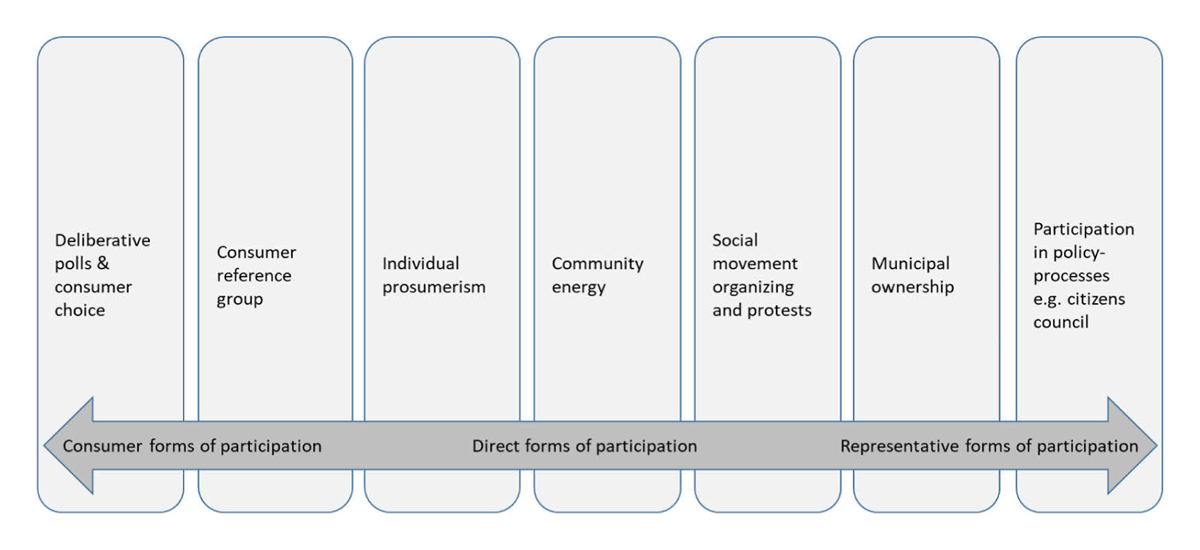
Figure 1
Participation types involved in energy projects (Wahlund & Palm, 2022).
These processes evaluate and describe states or layers of citizen participation, conceptualised as hierarchical or staged models of engagement, describing varying degrees of influence, power, and decision-making authority.
It is interesting to consider both ‘participation layers’ and the ‘EC as a citizen journey’ motifs when considering how engagement frameworks might be developed. ECs are expected to produce, consume, store, sell and share renewable energy, and access energy markets directly or via aggregation. They are expected to be models of collaborative citizen/stakeholder governance. This marks ECs out as complex socio-technical-economic constructs. The capacity of citizens to meaningfully contribute to their technical, regulatory and market governance will require mediation by engagement frameworks designed to support transition through different layers of participation. This may result in engagement that is not merely symbolic but embedded structurally, with citizens actively participating in, influencing, and benefiting from the local energy transition in order that the CEP’s objectives are met (EU, 2018; 2019a).
As an entry layer to engagement, citizens who might be expected to be interested lay people will require development in energy literacy to be able to engage meaningfully in the establishment of an EC. This would then allow citizens, in the next layer to participate with other stakeholders to construct visions or imaginaries, creating a shared understanding of EC aims and objectives. These two initial participation layers are discussed in more detail below.
Energy literacy
Over the past decade, energy literacy has attracted increasing academic interest, yet there is still no agreed-upon definition of the concept neither the scale defining the level of energy literacy (Martins, Madaleno and Dias, 2020). Brounen et al. (2013) characterise energy literacy in terms of awareness of one’s own energy consumption, understanding of how retail energy prices are determined, willingness to adopt energy-saving practices, and motivation to search for and use information about energy.
Low energy literacy manifests itself as misjudgements in energy use, overestimating visible uses like lighting and undervaluing significant but less visible uses such as heating. With respect to minimising energy consumption, curtailment measures are overestimated compared to efficiency improvements (Attari et al., 2010; Sovacool, 2009). Citizens with low energy literacy often do not understand where energy comes from, how it is generated, or how it flows through energy systems (e.g. grids, storage). This limits their ability to conduct broad critical appraisal of energy systems in any meaningful sense or navigate energy tariffs, technology/control adoption (Calver et al, 2024). For people to participate meaningfully in an initiative such as EC would require a basic understanding of how energy systems operate, how energy is produced, which sources it relies on, how it is used, and how citizens are embedded within these interdependent systems (Drevenšek and Tajnšek, 2022). Moreover, actively participating within the EC itself includes how to engage in collective decision-making, requires appropriate knowledge and engagement frameworks that move beyond tokenism.
Imaginaries
Imaginaries help to produce systems of meaning and shared senses of belonging, it guides how we collectively see and order the world in its histories as much as its futures (Jasanoff and Kim, 2009). As summarised by Jasanoff and Kim (2009), imagination, viewed as an organized field of social practices, serves as a key ingredient in making social order and as phenomena that could be articulated and propagated by local, regional, and global actors. The “power to imagine futures” can only take shape publicly through collective effort (Kuchler and Bridge, 2018). Examples might include visions of how global systems designed for provision of decarbonised energy or mobility might be configured. Scientists and technologists are “constantly trying to understand the present by borrowing from a cautiously imagined emergent future, filled with volatility, and uncertainty, but in which faith in practices of technoscience become even more complexly and interestingly constructed” (Marcus 1995, p. 4). Developing Shared Imaginaries focuses on using creative and narrative approaches to help participants visualise energy transitions across time and place. Through storytelling, mapping, or envisioning exercises, citizens and stakeholders can make visible both past and future trajectories of energy change. These imaginaries allow participants to build collective visions of desired futures utopias that can guide back casting exercises for planning transitions (Longhurst and Chilvers, 2019; Smith et al., 2017; Kuchler & Stigson, 2024).
Participation techniques
Over the past three decades, different methods have been developed to encourage citizens to take more active roles in energy systems during the low-carbon transition. Many of these techniques have been applied elsewhere over much longer time frames, stretching back beyond Arnstein’s description of citizen participation. A number of papers have provided a review of these practical methods and procedures that have been used to allow citizen, consumer and stakeholder participation in some form of energy transition (Rowe and Frewer, 2000; Pallett et al., 2019; Huttunen et al., 2022).
Non-participatory and consultative approaches have long been used by governments and institutions to elicit public perceptions, primarily through tools such as surveys, focus groups, and public meetings. While these methods are cost-effective thus widely applied, they have been criticised as tokenistic forms of engagement that gather opinions without transferring meaningful decision-making power to citizens (Arnstein, 1969). It is useful to review participatory techniques to help design the methodological stages developed in this research.
Co-creation
Co-creation is often guided by the initiative of researchers and, when effectively managed, has the potential to produce novel technical solutions that improve the usefulness and acceptance of artefacts whilst fostering citizen learning and empowerment. Typically, activities take place in workshop settings with participation managed as a formal process (Shortall et al., 2022). These processes generally unfold in multiple stages, for example, Blanke et al. (2025) describe a two-stage co-creation approach in which the first online workshop develops community goals and future visions with citizen representatives, local energy stakeholders, and project researchers, while the second face-to-face workshop engages a broader citizen group, including the local mayor, to co-create mock-ups of ICT tools for energy community management guided by output from the on-line workshop. Rowan et al. (2024) developed the ACeT methodology, a multi-stage process for collaboratively developing visions and roadmaps, which moves from informing, consulting, and deliberating to co-creating desirable futures, integrating new public service concepts, social innovation initiatives, and policies, before creating and testing prototype services and initiatives that support the development of ECs.
Measuring behaviour and encouraging behaviour change
Measuring and encouraging behaviour change has been another dominant approach in participatory energy research. Grounded in the Theory of Planned Behaviour (Ajzen, 1991), these initiatives seek to influence how people use energy by addressing attitudes, intentions, and social norms. Although deployment of these methods is widespread, they oversimplify human decision-making, ignoring social and material contexts that shape everyday practices. Despite such critiques and an evidence base that is weak, behavioural approaches continue to dominate interventions aimed at promoting modification in how people purchase and use appliances and energy systems.
Behavioural change processes can be split into two groups. The first involves a consequence strategy, assumed to influence determinants after the behaviour has happened, either through positive reinforcement of desired behaviour or by attachment of negative consequences to undesired behaviour (Abrahamse et al., 2005) (Table 2).
Table 2
Consequence strategies used to influence behaviour.
| ACTIVITY | DESCRIPTION |
|---|---|
| Feedback | Information about household energy consumption, energy saving or time of use of energy. Can be continuous or periodic (daily, weekly, monthly). Can be comparative to encourage competition and social comparison |
| Rewards | Fiscal or non-monetary rewards allocated based on achievement of understandable and measurable goals. |
The second involves antecedent interventions, aimed at shaping factors that influence environmentally significant behaviours. For example, providing households with information on energy-saving options addresses knowledge gaps, enabling more informed choices and reducing energy consumption. Alternatively, the activity attempts to recast social norms that then influence the citizens future activity. Examples of activities include information provision, goal setting and peer influence (Abrahamse et al., 2005) (Table 3).
Table 3
Antecedent intervention strategies used to influence behaviour.
| ACTIVITY | DESCRIPTION |
|---|---|
| Information provision | Addresses knowledge-deficit, using and different techniques that include leaflets, posters, information sheets, newsletters, videos, blogs, social media, digital platforms, comic strips. |
| Goal setting | Assumes that citizens’ environmental behaviour is influenced by goals that are either hedonic (pleasure seeking), gain (status seeking) or normative (seek to act appropriately). |
| Peer influence | Techniques include social modelling that defines local champions to promote a preferred behaviour and definition of subjective norms by for instance comparing household energy consumption to a cohort average. |
| Gamification | Wraps learning about specific subject matter, e.g. demand response into a game setting. By playing the game, the citizen learns about the activity and how to apply it to modify their energy consumption behaviour. |
Research orientated participatory processes
Research-oriented participatory processes have emerged as a way of offering real-life, user-centred innovation ecosystems where social and technical solutions are co-developed and tested. However, results can be difficult to generalize beyond local settings, and projects often depend on short-term funding. Power imbalances among participants and unclear evaluation frameworks may also limit their transformative potential and long-term impact.
Research-oriented participatory processes involving Living labs provide a useful platform for experimenting with low-carbon technologies and governance approaches in real-world settings, enabling collaboration among citizens, researchers, policymakers, and industry. This can generate context-rich insights and accelerate social learning around energy transitions. However, their research value is sometimes overstated. Findings are often highly place-specific and difficult to scale or replicate. Many projects rely on short-term funding cycles that limit longitudinal evaluation of systemic change. Participation can also be uneven, with more vocal or well-resourced actors shaping outcomes.
Participatory processes involving commercial business models
For ECs to proliferate in line with targets will require radically altered energy markets, accessed through operation of a commensurate array of business models. Development, testing and domestication of these business models can be considered as a mediating theme around which participatory process can grow (Adams et al. 2021). Business models can facilitate transition either by acting as intermediaries between the existing socio-technical regime and the new technology or by being the innovation itself, allowing existing technologies to be used in radically different ways (Bidmon & Knab, 2018). The business model has the primary responsibility for distributing benefits from ECs to citizens and as such may play a key role in how trust in these new institutions develops and how their market presence grows (Massey et al. 2018).
Massey et al. (2018) proposed a Public Engagement Network in which prosumers participate in energy trading designed to provide cross-stakeholder benefits, with models such as P2P trading, self-consumption, and transactive energy generating both economic and social value, depending on the actor’s perspective. These approaches enhance community agency, energy independence, local benefits, social connections, and environmental responsibility, though justice and equity were rarely central, with participation skewed toward younger, affluent, educated homeowners. Incorporating energy sharing as a core business model principle could embed energy justice, democracy, and a just transition (Diestelmeier & Cappelli, 2023), recognising energy as a common commodity distributed through solidarity rather than purely commercial supply.
Participatory processes orientated around justice
CEP explicitly frames the low-carbon transition as not merely a technical or economic challenge but a question of justice, requiring structural changes in governance, ownership, and management of energy systems across member states. Addressing decarbonisation alone is insufficient; issues such as fuel poverty, distributional inequities, representational recognition, and procedural transparency must also be central (Sovacool et al., 2017). Evidence suggests that conventional top-down approaches are inadequate to achieve these outcomes, as entrenched hierarchies often marginalise local voices. Revez et al. (2020) demonstrate that combining participatory action research (PAR), which leverages grassroots knowledge, with Delphi panels of expert assessment can effectively reconcile local perspectives with technical expertise, producing transition principles that are both just and actionable. Young et al. (2023) further argue that citizen engagement must be evaluated through multiple dimensions of justice-recognition, procedural fairness, and equitable distribution emphasising that processes should prioritise community needs, local understanding, and intergenerational engagement rather than technical imperatives alone. Frameworks such as The Voicer, which integrate capabilities, responsibilities, and learning, provide actionable guidance, highlighting that meaningful participation is essential for democratic and equitable energy transitions. Collectively, these findings make a compelling case that justice-oriented, participatory approaches are not optional but fundamental to the legitimacy and success of the European energy transition.
Participatory process oriented around activism
Activism-oriented participation challenges traditional power dynamics by positioning citizens as leaders rather than subjects of engagement. Power imbalances between citizens and experts have been reported when participatory processes are research oriented (Turnhout et al., 2020). When citizens initiate participation on their own terms, it becomes an act of empowerment and political expression. Citizens can now own the participation process and direct it towards strengthening marginalised or unexamined issues (Hess & Sovocool, 2020). Groups such as Demand Energy Equality exemplify this approach by creating community-led projects that tackle systemic issues like fuel poverty and climate change. Their actions ranging from public workshops to creative interventions demonstrate how activism can expand the scope of participation beyond formal institutions.
Observatories
Finally, observatories serve as repositories of participatory knowledge, cataloguing examples, case studies, and tools that document how citizens engage in sustainability transitions Participedia has curated practical and academic examples of democratic, participatory innovations covering a broad sustainability transition field to answer the question what kinds of participatory processes work best, for what purposes, and under what conditions (Fung and Warren, 2011; Participedia, 2026). The UKERC Public Engagement Observatory (UKERC, 2026) catalogues participatory processes that have been used in situations associated with energy, climate change and net zero. Although primarily academic, these observatories provide valuable insights into evolving participatory landscapes, supporting cross-learning among practitioners, policymakers, and researchers.
Summary
Top-down engagement approaches that focus only on providing information or influencing behaviour often remain limited and risk tokenism. To support meaningful co-production in the energy transition, engagement frameworks need to be transparent, inclusive, and co-designed with communities from the outset. Different participation methods should be matched to different stages of engagement, allowing a broader framework that supports citizens’ involvement over time. This helps move beyond isolated activities towards a more continuous and structured “citizen journey” in ECs. The next section presents two such engagement frameworks designed to support the initial stages of participation in energy communities.
Engagement framework – literacy and imaginary layers
At the core of the derived here approach is the Energy Literacy Game (ELG) – a learning toolkit designed to build foundational energy knowledge, stimulate imagination, and support collaborative scenario-building. The game can be tailored for various demographic groups (adults, elderly, children), using strategies matched to their learning styles and pre-existing knowledge. The ELG design process adapts the Sanders et al. (2010) framework, which structures co-design around three dimensions:
Form: The nature of participant interaction (making, telling, enacting).
Purpose: Objectives such as probing, immersing, understanding, or generating ideas/exploring futures.
Context: Activity setting, group composition, facilitator roles, and relationships among participants.
Participatory learning
Figure 2 presents the methodological framework for participatory learning that we have developed. This phase is structured into four sequential stages, each designed to progressively engage participants in collaborative knowledge building. The framework provides a participatory approach to learning, ensuring that participants actively contribute to and shape the understanding of energy systems and potential pathways for sustainable energy future.
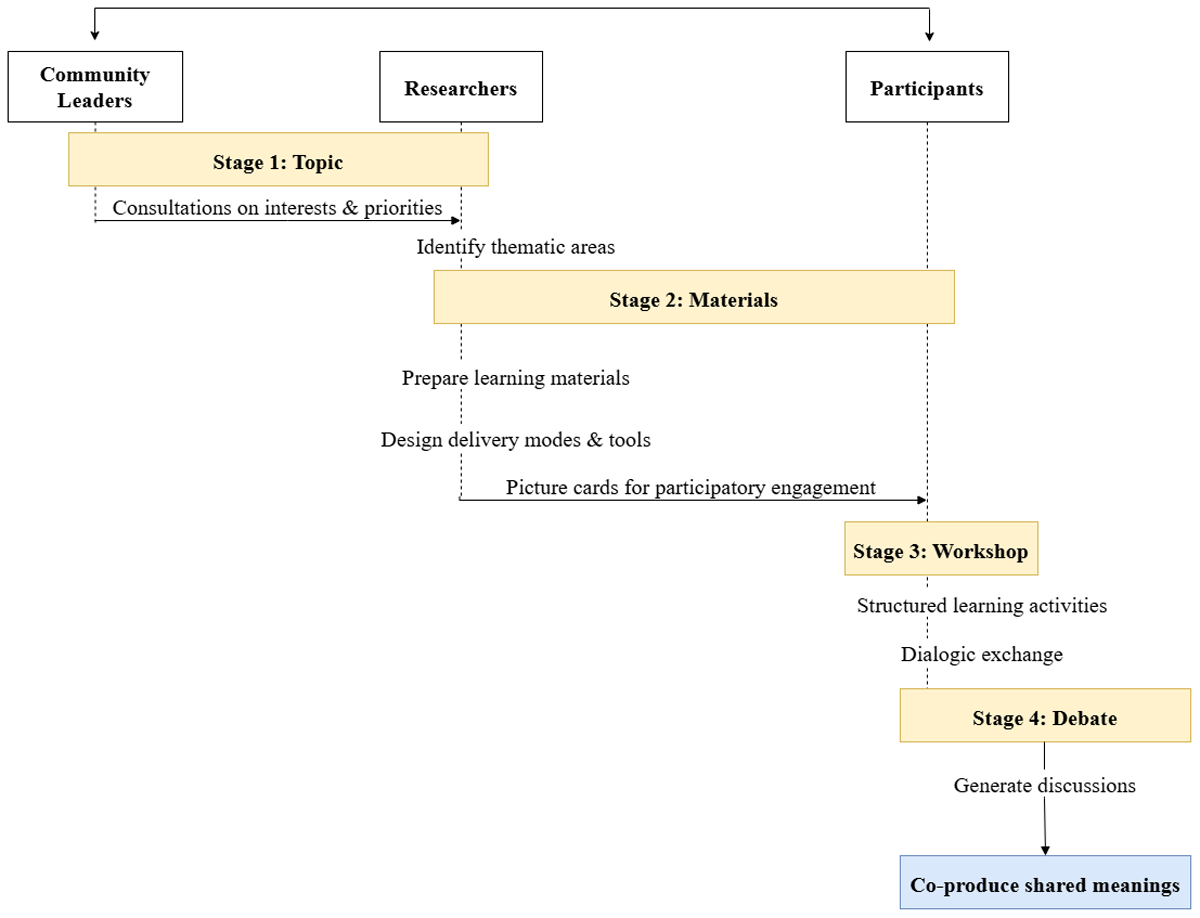
Figure 2
Methodological Framework for Participatory Learning.
The ELG is structured in four stages (Participatory Learning):
Topic: Topics is identified through consultations with community leaders (local representatives) to ascertain the interests, priorities, and existing levels of knowledge/understanding within the EC and to identify thematic areas.
Materials: Researchers prepare the learning materials and design the modes of delivery, including the selection of appropriate pedagogical formats and facilitation tools. Here, participants were encouraged to engage in a participatory manner using picture cards to discuss and learn about various terms related to EC. ‘Picture cards’ are a visual tool used in participatory methods to facilitate discussion, brainstorming, and idea-sharing among participants. Studies show that collaborative brainstorming with cards can speed up idea refinement and iteration, leading to more structured design discussions and improved communication between design partners (Lucero & Arrasvuori, 2010).
Workshop: The literacy session is implemented, during which participants engage in structured learning activities and dialogic exchange.
Debate: The discussions generated in the session are analysed to co-produce shared meanings and interpretations that are collectively endorsed by the community.
Table 4 illustrates the topics of picture cards co-designed for two EC pilots participating in the Horizon Europe project InterPED (interped.eu). The selection of session topics was carried out in consultation with local partners to ensure relevance and contextual appropriateness. Initial meanings are defined for each topic area and housed on adaptable picture cards. These meanings, co-created with community leaders act to initiate discussion. The objective is not to reach a consensus on shared meaning. This may be achieved, indeed the initial meanings provided for each topic may achieve this. However, meanings may remain contested and require generation of further topic areas to accommodate a plethora of opinion. The overarching objective is that participants demonstrate improved comprehension of concepts relevant to their EC, permitting them to then meaningfully contribute to the development of a shared vision for the future.
Table 4
Picture card topics for participatory learning.
| TOPIC | ||||
|---|---|---|---|---|
| ENERGY | STORAGE | GRID | PEOPLE | |
| Subtopic | Building | Electrical battery | Grid scenarios | Practices |
| Solar | Thermal | Flexible charging | Comfort | |
| Wind | Tariff | |||
This is a methodology stemming from activity theory focusing on how the human mind works, as a product of interaction with people and artefacts in the context of everyday activity (Kaptelinin and Nardi, 2012). Picture cards are often used in community workshops, focus groups, or design sessions, especially when engaging diverse participants, including those with varied literacy levels or language barriers. Participants use the picture cards during workshops to discuss the key terms, helping them co-create shared meanings. The cards act as a facilitation tool to support dialogue, clarify concepts, and guide collective discussion rather than being an end product in themselves. The shared meanings of various terms will be used to create shared imaginaries for the community. This method is a valuable tool for citizens and practitioners as it visually clarifies concepts, aiding comprehension and recall. This enhances the identification of explicit problem-solving strategies compared to traditional verbal methods (Barendregt and Bekker, 2008).
Co-creating shared vision for the energy future
In the second step of this approach, participants will be asked to envision their community in 10 years by creating storyboards that reflect their needs, concerns, and interests, following Bezold (2010)’s recommendation of three scenarios. Using topics established in the previous learning session, they depict their community as an evolving EC. After agreeing on shared meanings, the process establishes a common conceptual foundation that informs the future visioning exercise, enabling participants to brainstorm and design their preferred energy futures (Figure 3). This approach supports inclusive and informed energy community decision-making. There is a strong fear of initiatives resulting from co-creation would not achieve the level of rigour required for a regulatory process (Flostrand, Eriksson and Brown, 2019) which underscores the necessity of literacy as initial part of co-creation (Butler, Parkhill and Pidgeon, 2013).
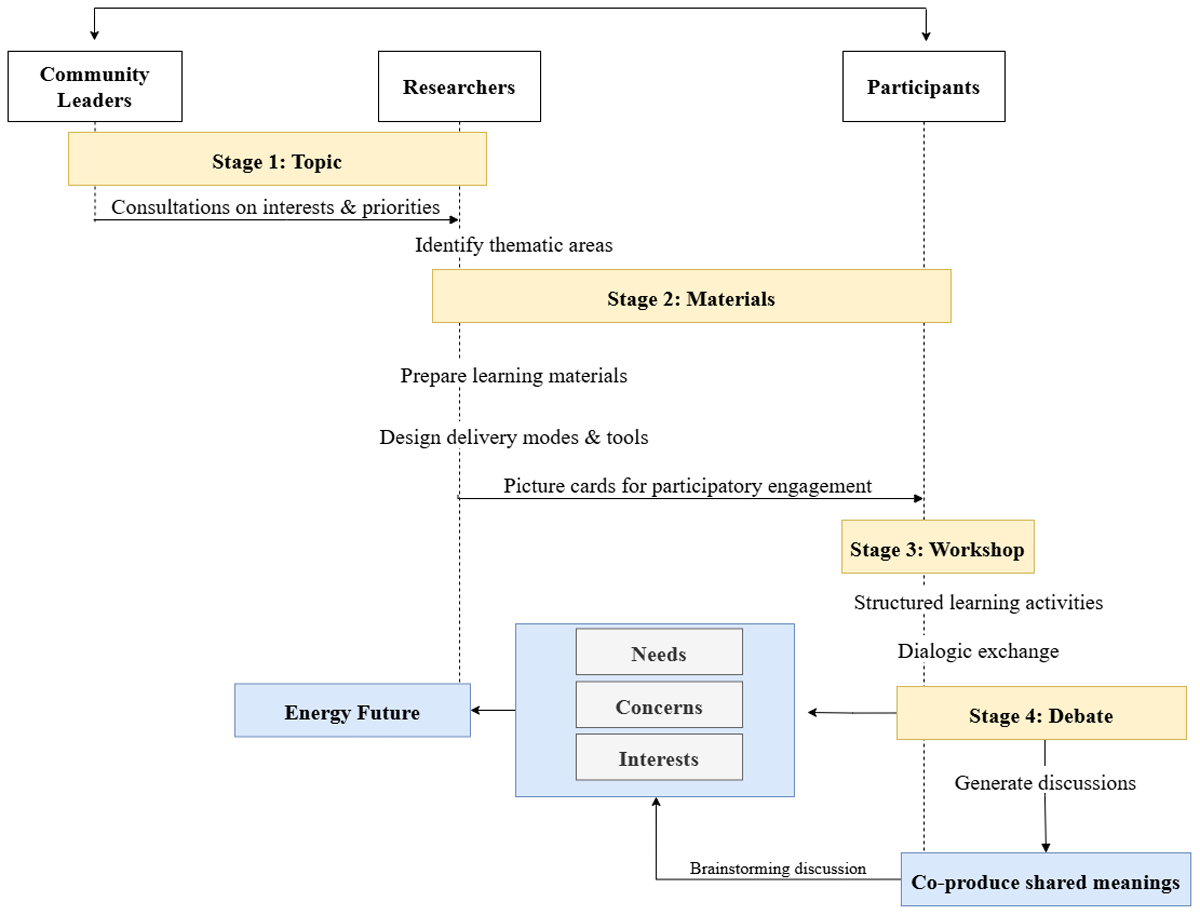
Figure 3
Methodological framework for co-creating future energy scenarios.
The following describe the questions of each visioning storyboard:
What are your NEEDS (mandatory attributes) for the community to have in 10 years in terms of energy future?
What are your INTERESTS (desirable attributes) for the community to have in 10 years in terms of energy future?
What are your CONCERNS (barriers to achieve desirable attributes) for the community to have in 10 years in terms of energy future?
These storyboards will then be used to assist in envisioning what their EC might look like in 10 years. This process will encourage participants to reflect not only on desirable outcomes but also on the pathways and conditions that might enable such futures to emerge. The outcomes of this phase will generate a set of collectively constructed visions that capture the community’s aspirations, priorities, challenges and perceived opportunities for development. These visions will serve as a rich qualitative foundation for the subsequent development of actionable scenarios based on the community’s own vision, ensuring that future strategies are rooted in shared understanding and collective aspiration. Grounding scenario development in community-generated insights will ensure that future strategies are informed by local knowledge and shared values. Moreover, participatory visions can focus on barriers (e.g., social, institutional, and infrastructural) to change, offering a clearer basis for addressing obstacles that commonly constrain local energy transitions. Co-created scenarios also open up a space to explore and negotiate governance and policy, helping citizens and stakeholders to better understand roles and responsibilities, context-sensitive goals for net zero pathways, linking local priorities to broader decarbonisation targets. The gained confidence and knowledge are expected to support ongoing engagement beyond the sessions through continued participation in workshops or community governance processes, helping to move participation beyond tokenistic consultation towards more meaningful and sustained involvement in decision-making.
Conclusion and future recommendations
The emergence of ECs under the European CEP represents an important institutional acknowledgment of citizens as active agents in the energy transition. While conventional forms of participation, can play a valuable role, they often remain focused on individual actions and consumption practices. Such recognition therefore needs to be accompanied by deliberate efforts to cultivate capacities for collective agency and sustained engagement. This involves extending beyond market-oriented and individualised forms of participation toward more democratic and collaborative approaches that enable citizens to engage in shared decision-making and contribute to long-term ecological transitions. A community-centred engagement framework designed for initial participatory layers is presented here. It responds directly to these imperatives by integrating energy literacy with participatory co-creation of place-based energy imaginaries, addressing persistent barriers to meaningful citizen participation identified in energy transition scholarship. By enabling citizens to acquire the knowledge, confidence and collective capacity necessary for sustained engagement in local energy decision-making, such frameworks hold promise for supporting ECs not just as organisational forms but as catalysts for evolving citizenship from liberal self-interest toward ecological engagement. Ultimately, realising the transformative potential of ECs in the European energy transition will depend on processes that nurture collective imagination, learning, and action, elements central to ecological citizenship and equitable, just climate pathways.
In the next phase of the research, the framework will be deployed and tested through two pilot cases, where participatory processes will be implemented to support citizen engagement in local energy decision-making. These pilots represent contrasting governance, community and sectoral settings. Findhorn Ecovillage (Scotland) provides a well-established intentional community with long-standing commitments to sustainability, including existing renewable energy infrastructure such as wind and solar photovoltaic systems and elements of microgrid operation. The site encompasses residential and commercial buildings. The community is characterised by progressive stakeholder engagement practices and a diverse user base that includes permanent residents, temporary residents, and visitors, offering a rich environment for exploring participatory energy governance. Long standing political support for community energy initiatives has been provided by both the UK and Scottish Governments.
In contrast, Alba Iulia (Romania) represents a mid-sized European city that has been actively pursuing smart city, net-zero, and Positive Energy Districts (PED) initiatives within a more conventional municipal governance framework. The city combines ambitious technological innovation with evolving approaches to citizen participation, making it a valuable setting for examining how participatory energy literacy and co-creation processes can be integrated within formal urban governance structures. Political support in Romania for these community oriented, energy initiatives is nascent with for instance the concept of the prosumer only receiving legal recognition within market rules in the last two years.
Together, these two pilots will enable comparative insights into how the framework performs across distinct socio-institutional contexts of community-led and municipally driven energy transitions. These pilots will provide an opportunity to evaluate how energy literacy development and collective envisioning can strengthen the capacity of communities to actively participate in emerging energy systems and energy community initiatives. Through these pilots, the framework will be refined by examining how citizens acquire knowledge and collective capability to engage in long-term energy governance and visioning energy future.
Further conceptual development work is required to improve participatory strategies designed to be owned and governed by participants, over the lifetime of their involvement in the EC. This is critical to take account of the nature of ECs of all forms, intended to be disruptive systems within regional and national energy systems and therefore exist for a long period of time. The imaginary of a journey introduced here to describe how citizens move from a consumer centric vision of participation through stages towards activities that encompass the necessary aspects of justice and equity if the low carbon transition is to address climate change appropriately. Participatory strategies are required that support the citizen on this journey. It is also essential to explicitly examine power dynamics within research participation in sustainability transitions, placing greater emphasis on citizen empowerment and learning, as well as on evaluating the outcomes and benefits that participatory processes generate for those involved (Huttunen et. al., 2022).
Overall, this research contributes to the growing recognition that community-centred and participatory approaches will be fundamental to achieving an inclusive and resilient energy transition. By foregrounding community voices and co-creation processes, the proposed methodological framework seeks to support the development of more engaged and energy-literate citizens who can actively shape their local energy futures. As the global energy landscape continues to evolve, strengthening participatory capacities and energy literacy will remain central to ensuring that the transition to net-zero is both just and equitable, reinforcing the principle that sustainable energy solutions must be developed with communities rather than merely delivered to them.
Additional File
The additional file for this article can be found as follows:
PowerPoint Slides
PowerPoint Slides relating to this article. DOI: https://doi.org/10.66506/essp.5-098-26.s1
Author Contributions
Tasniva R. Mumu: Writing original draft, review and editing, Conceptualisation, Methodology. Andrew Peacock: Writing – review and editing, Conceptualisation, Methodology, Supervision, Funding acquisition.
eceee paper ID
5-098-26