
Introduction
The role of neighbourhood heating and cooling networks in decarbonising heat supply
The shift from fossil fuels to renewable energy sources and other zero-carbon solutions in the heating and cooling sector has been notably slow. In 2021, the renewable energy share in the H&C sector stood at approximately 23% across all EU Member States, significantly trailing behind the power sector (37.5%).
Increasing the share of renewables for heating and cooling in urban and sub-urban areas is particularly challenging for two reasons. Firstly, there are several limitations for extending decarbonised conventional, high-temperature district heating systems:1
In many supply areas existing high-temperature district heating systems are already operating at, or near, their maximum capacity. This lack of capacity will increase in the near future, as existing district heating systems many of which are still fossil fuel dependent begin to decarbonise. Furthermore, the integration of locally available renewable energy sources into conventional district heating systems is challenging due to discrepancies in grid temperature levels.
District heating requires high heat density in the supplied area. Consequently, areas with a lower heat density and areas situated at a greater distance from existing district heating pipelines are usually not viable for district heating supply.
Residents are often reluctant to connect to larger district heating systems, because they are afraid of losing control and independence over their heat supply.
Secondly, there are also limitations for decarbonising individual heating systems. Whereas the substitution of individual fossil heating systems for individual renewable heating systems is in most cases technically and economically feasible in single family or terraced houses, in urban and suburban settlement structures we observe the following limiting factors:
Space limitations, for example for drilling geothermal probes, for the necessary PV installations, or for the installation of individual air heat pumps, whereby in this case the space limitations come from the fact that the noise emission of air heat pumps require sufficient distance from the neighbouring property, which is often difficult to arrange in (sub)urban areas.
Economic disadvantages, partly due to space limitations and partly from the inability to access economies of scale, which are typical for many technical decarbonisation measures, i.e. these measures are highly capital-intensive investments, however, the costs per each additional user decrease.
Against the background of these limitations, neighbourhood H&C networks have an important role to play by filling the gap for heat supply decarbonisation (cf. Figure 1). From a technical perspective, these networks can be described as low temperature district heating (LTDH or fourth-generation district heating, 4GDH) or ambient temperature district heating systems (ATDH or fifth-generation district heating and cooling, 5GDHC). 5GDHC are often also referred to as anergy networks.
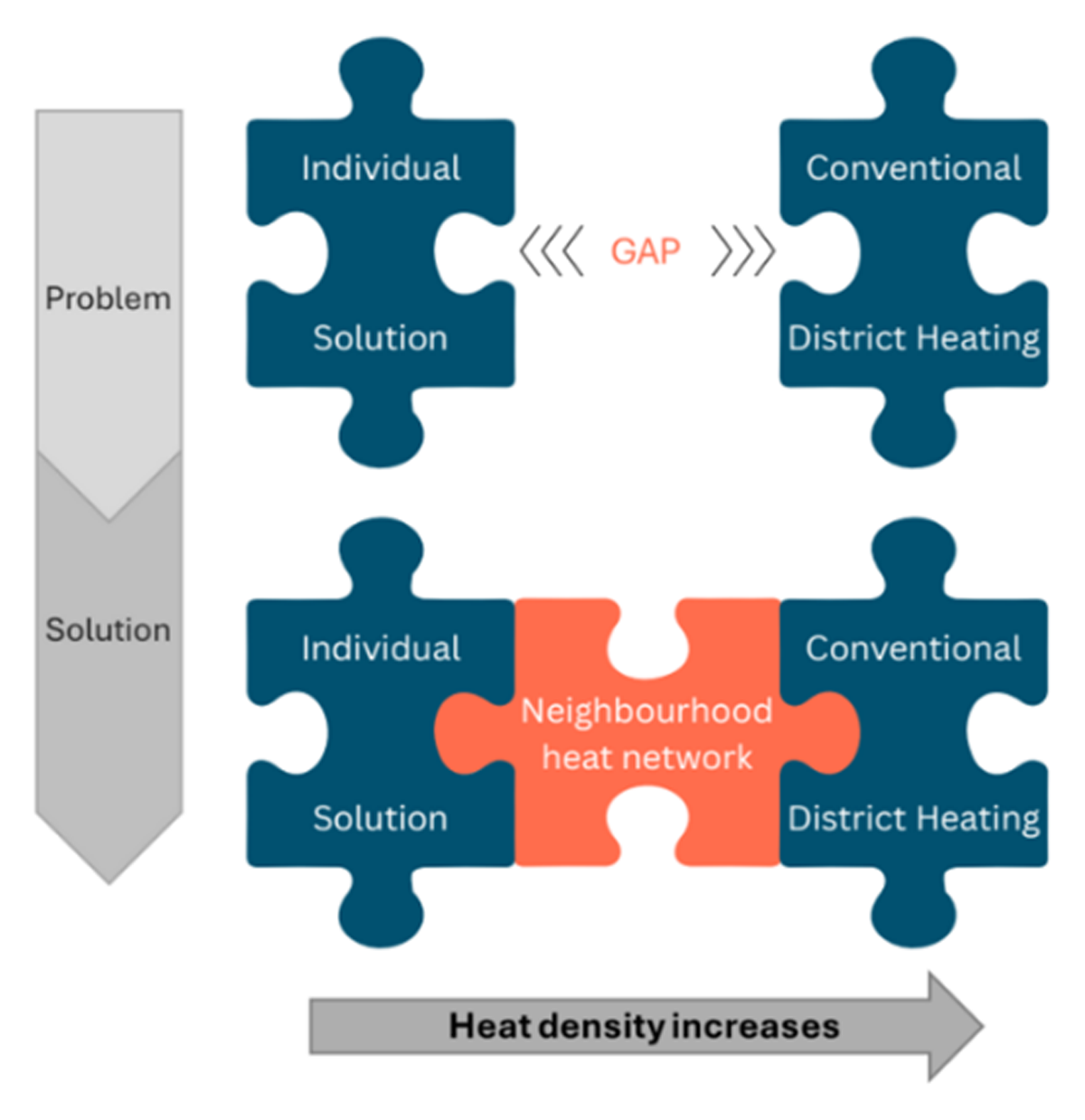
Figure 1
Gap closed by neighbourhood H&C networks.
In 4GDH, supply temperatures remain sufficient to cover both space heating and domestic hot water demand (typically around 60°C), in most cases without any temperature boost at the building level, keeping the system boundary comparable to conventional district heating networks. In contrast, 5GDHC, the thermal energy from low-temperature sources like geothermal probes, groundwater or rivers is distributed in the form of cold water and raised to the required temperature in the individual buildings or flats using end-user heat pumps (cf. Figure 2).
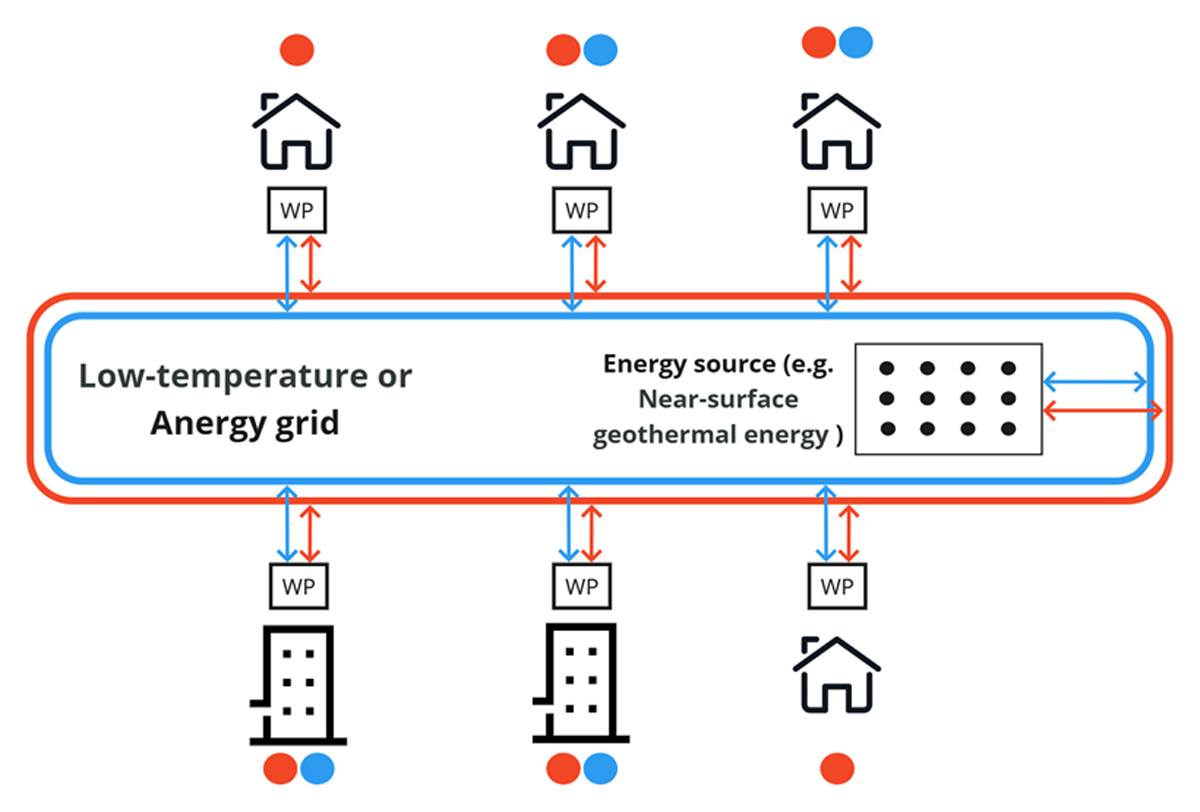
Figure 2
Basic configuration of a neighbourhood H&C networks.
Current state of research and methodological approach
Regarding the technical definition of the neighbourhood H&C networks the study builds on the concepts of 4GDH described by (Lund et al., 2014) and 5GDHC referred to by (Boesten et al., 2019; Buffa et al., 2019; Gudmundsson et al., 2021). Still, while the term “generation” implies a chronological succession, Lund et al. (2021) argue that 5GDHC specifically integrates the cooling aspect and is a complementary technology with its own merits, that may coexist in parallel with other 4GDH technologies. Consequently, our study integrates both types of state-of-the-art district heating and cooling and focuses on smaller-scale, neighbourhood-driven projects to realize those systems in the identified “gap” between conventional district heating and individual solutions.
Organizational and economic approaches are central to the realization of neighbourhood H&C networks, therefore different concepts of ownership, operation and pricing have to be studied. This results in the possible involvement of municipalities, (energy) cooperatives and private companies. Based on a survey of several ambient temperature district heating systems, Rinner & Osthorst (2025) underline that there is no standard solution. They also highlight that especially in projects that are driven by cooperatives or that located in heterogenous neighbourhoods, consumers trust in pricing, operation and security of supply is a crucial element for successful realization. Energy cooperatives can empower citizens to realize sustainable energy solutions beyond available market solutions and thereby drive the implementation of new technologies (Drewing, 2021). In Germany, for example, there has been a significant growth in the number of district heating cooperatives in recent years, however, the focus of these initiatives has been to use of heat from bioenergy-plants in conventional district heating systems (Drewing, 2021; von Obernitz, 2024). In the literature, municipalities are also highlighted as important stakeholders, particularly regarding the actual and future ownership of heat supply systems (e.g. Djørup et al., 2020).
Against the background of the current state of research, our study is based on practical experience and draws primarily on insights gained from specific implementation projects. In particular, it addresses the following questions:
How have neighbourhood H&C networks in selected EU countries developed, and what characteristics can be observed in practical implementation projects?
Which organisational and financial models are available to implement neighbourhood H&C networks? Which of these models are best suited to which baseline conditions? And what billing models are connected to the organisational and financial models?
Finally, which energy policy framework conditions are appropriate for accelerating the roll-out of neighbourhood H&C networks?
Overview of good practice examples
In contrast to new construction areas, which are often built as nearly-zero energy quarters or even positive energy districts and where the use of neighbourhood H&C networks as defined above is increasingly common, in existing neighbourhoods only a limited number of examples exists. In our study, examples of neighbourhood H&C projects in Austria, the Czech Republic, Germany and the Netherlands are analysed, these are all countries that have good potential for neighbourhood H&C networks due to their climate conditions.
Initially, a list of existing examples and projects that are still under development was compiled. For each project information on the name, location, clients, building structure, technology of the network, categorised development stage and further information on the operator was collected. Figure 3 gives an overview of the status of the identified projects in the participating countries. 70 existing projects have been identified, many of them being 5GDHC systems in Germany, as described by (Wirtz, 2026). Furthermore, around 20 projects in advanced stage of development were identified and around 30 projects that are in an early development stage. For two thirds of the identified examples the operator type was clear, with 35% being run by private companies, 32% by municipal utilities, 12% by municipalities und 20% by cooperatives.
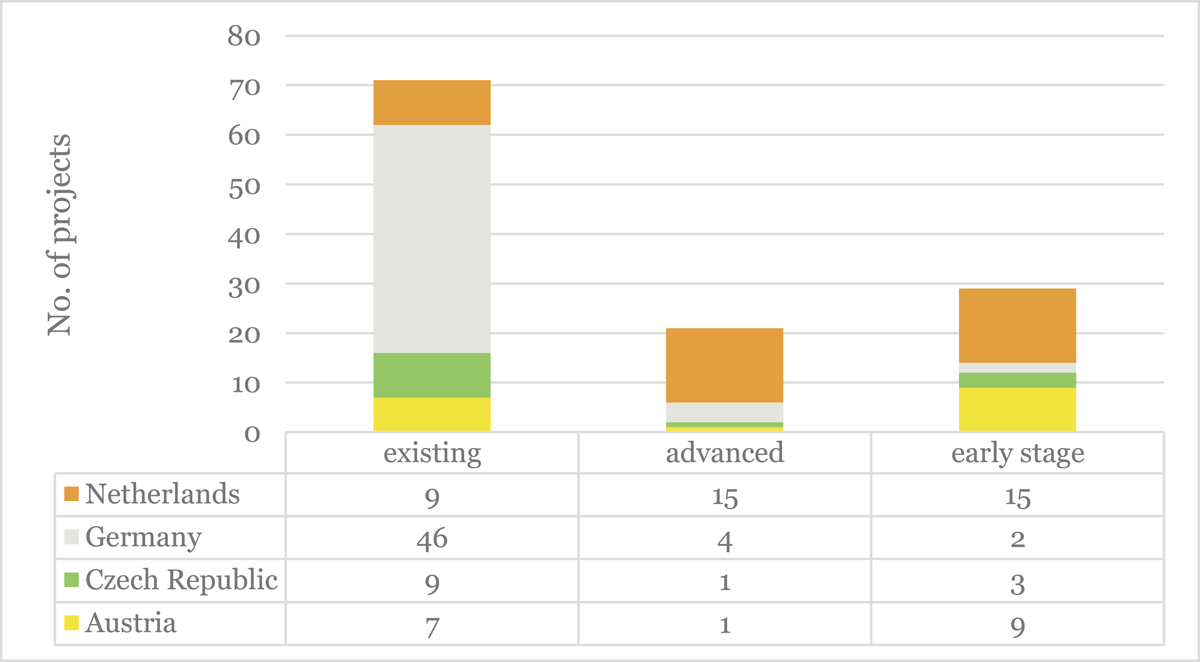
Figure 3
Status of identified neighbourhood H&C projects in the participating countries.
The following section describes in detail two specific cases to illustrate some of the key features of neighbourhood H&C projects.
“Cold village heating” in Rech
The project “cold village heating” in Rech (“Kalte Dorfwärme Rech”) was initiated after the flood catastrophe of the river Ahr in Germany in 2021. Buildings needed to be reconstructed or fundamentally renovated including introducing new heating systems, meanwhile, the road surfaces needed to be refreshed. This confluence led the municipality of Rech to turn this problem into an opportunity, leveraging synergies between rebuilding the city’s infrastructure and laying the cold district heating network. Consulting and conceptual support was provided by the energy agency of the federal state and the University of Applied Sciences in Mainz.
A passive geothermal anergy network (5GDHC) was established to supply low-temperature energy, with decentralized heat pumps being used for heating and cooling (see Table 1 and Figure 4). Currently, there are 53 buildings connected; and once in the final development stage, the network will contain approximately 500 connection points with a 2 MW connected heating load and four ground probe fields with 20 probes each, totalling nearly 10,000 m in length. Furthermore, the uninsulated network pipes (polyethylene) themselves contribute a considerable share to the energy absorption from ground. The ground probe fields are installed stepwise as the connection load increases, which helps preliminary financing and thus lowers heat production costs.
Table 1
Characterisation of “cold village heating” in Rech.
| LOCATION | RECH IM AHRTAL, GERMANY | SUPPLY TEMP. | 5–25°C |
|---|---|---|---|
| Year | 2024 | Heat Source | Ground probe fields |
| Distance | 4 km | Operator | Municipality |
| Buildings | 53, rural area | Billing | Capacity Pricing |
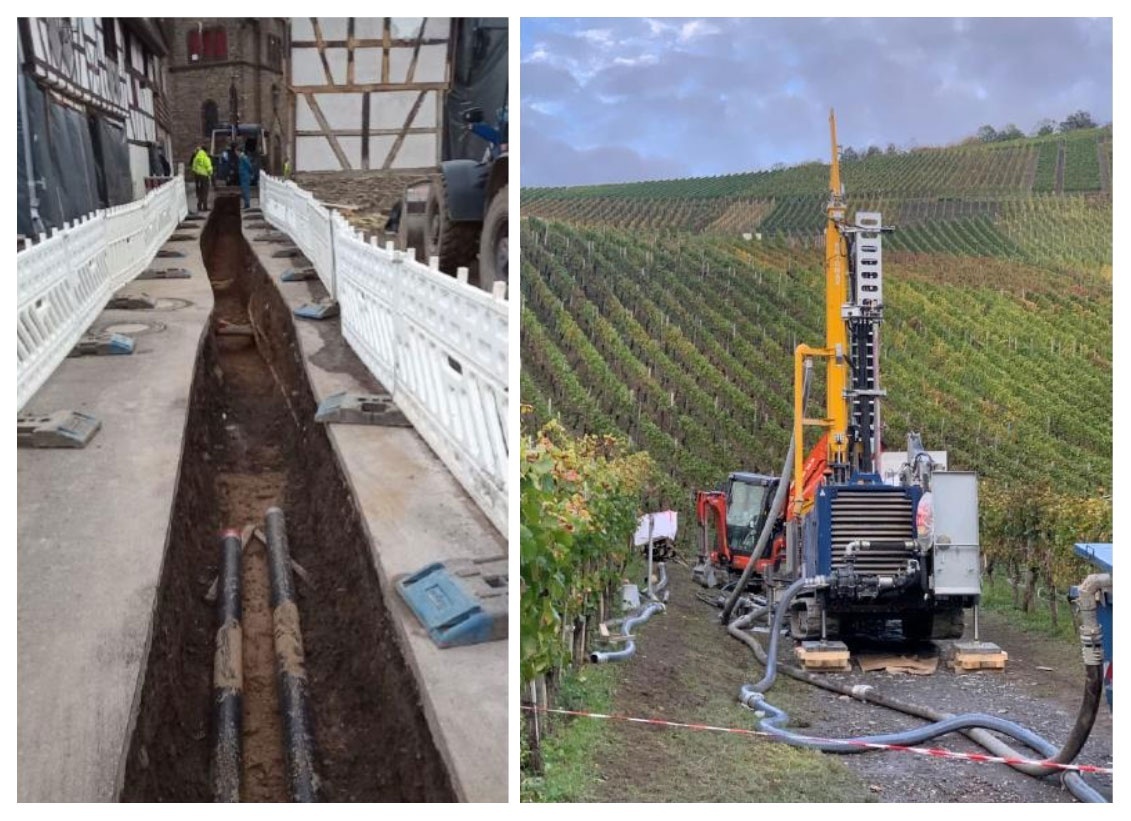
Figure 4
Construction phase of the anergy grid in the city of Rech (left) and exploiting of the borehole heat exchanger field (right) (Ngahan & Giel 2022).
According to the current business and billing model, heat pumps were purchased and installed individually by the customers (property boundary “evaporator”, cf. section below on billing models). As the network is operated as a passive anergy network, total electricity consumption is accounted for at the customer level. Therefore, customers are charged only a monthly capacity price of €80/kW peak load, plus a fixed price for operation, maintenance, and repair costs. Excluding heat pump capital costs, this results in heat supply costs of approximately €0.11–0.12/kWh.
Simon-Denk-Gasse, Vienna: Small-scale anergy grid
The Simon-Denk-Gasse project in Vienna illustrates the implementation of a neighbourhood heating and cooling network in a dense urban residential setting. The project connects five existing residential buildings constructed in a similar period with comparable technical conditions. A 5GDHC network is being established, utilising local groundwater potential through wells as the primary heat source, and distributing the thermal energy up to defined property boundaries, while heat upgrading and final use occur within the individual buildings. The system also integrates peak-load coverage and renewable electricity generation; the system also enables reversible operation to provide cooling in summer (see Table 2 and Figure 5).
Table 2
Characterisation of neighbourhood H&C network in Simon-Denk-Gasse, Vienna.
| LOCATION | VIENNA, 9th DISTRICT | SUPPLY TEMP. | 12°C |
|---|---|---|---|
| Year | 2025 | Heat Source | Groundwater well |
| Distance | – | Operator | Sozialbau AG (housing cooperative) |
| Buildings | 5 | Billing | Different for each building (depending on the applicable housing law) |
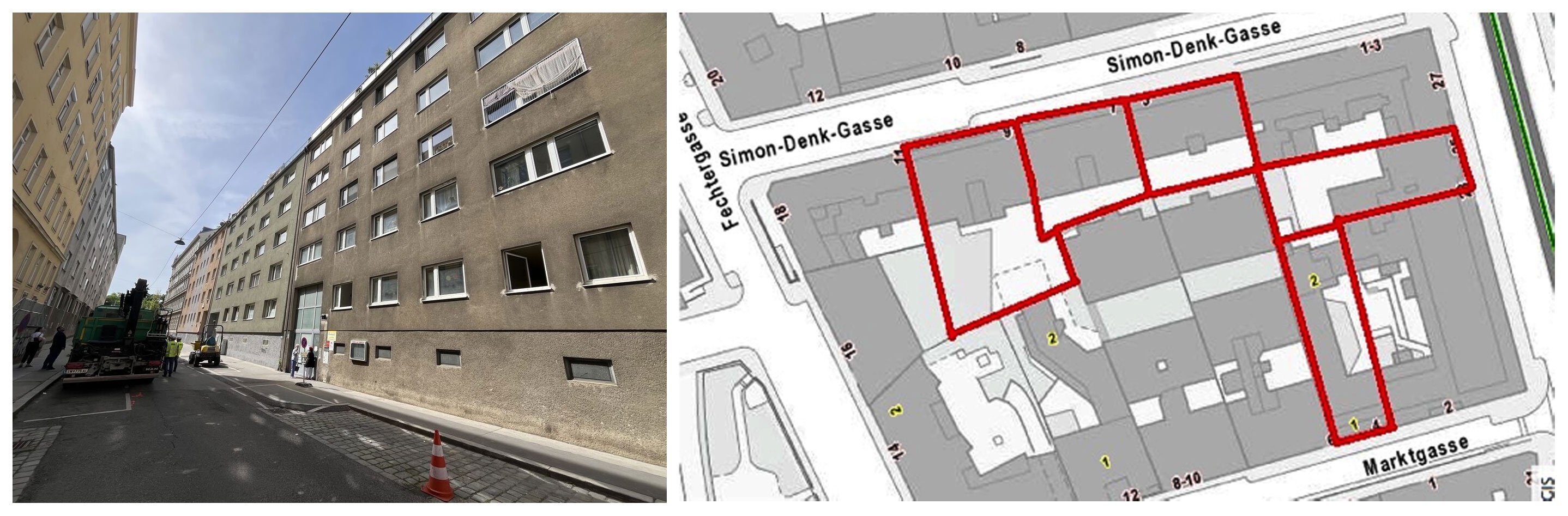
Figure 5
Post-war buildings as a typical building type in Simon-Denk-Gasse, Vienna, and the properties in the street block (Photo credit: SOZIALBAU AG).
Organisationally, the project was initiated by a housing cooperative, which expanded the concept from an initial two-buildings to a block-wide solution involving additional neighbouring properties. The legal and operational framework is based on private-law agreements and easements regulating cooperation and shared renewable energy use. Financing structures differ depending on tenure arrangements, combining public support with long-term amortisation mechanisms. Through early stakeholder involvement and transparent communication with building and flat owners as well as residents, trust was established early on, which proved to be an important factor for the successful implementation of the project (Sozialbau AG, 2026).
Driving forces behind neighbourhood H&C networks
The analysis of good practice examples confirms that neighbourhood H&C networks, being cross-property solutions, have several important advantages that facilitate the decarbonisation of heat supply, especially in urban and suburban areas. These advantages can be summarised as follows:
Economies of scale: Extending the system boundary beyond a single building, often leads to more cost-effective solutions However, there is a trade-off between the improvement in the cost-benefit ratio that can be achieved through cross-property projects and additional costs incurred to expand the network.
Solutions to space limitations: With a cross-property approach, limitations that exist on one property can in many cases be compensated by another property involved in the project, e.g. through the joint use of a heating centre, by enabling drilling of geothermal probes on neighbouring property, or through the optimal placement of a PV system on the neighbouring property. Otherwise, space limitations can often become a “game stopper” for a decarbonisation project for one single property.
Better access to renewable heat sources: Some heat sources, such as groundwater or waste heat from data centres or similar, can only be used efficiently through a network-based solution.
Cooling as a “side-product”, the hidden champion: Many of the technical concepts for neighbourhood H&C networks include a low-cost cooling component that leads to a significant improvement in summer comfort through the use of a suitable source (in particular near-surface geothermal energy, groundwater) and the use of suitable low-temperature dissipation systems (e.g. panel heating, convector radiators). As summer heat is an increasingly critical problem in many European cities, this argument of low-cost cooling is an attractive one, as demonstrated in the good practice examples.
Faster implementation paths for entire neighbourhoods: Decarbonising individual properties one after the other takes a very long time because a multitude of individual investment decisions have to be made and are decided at different times. Investing in a network has the chance to create momentum that eases the investment decisions of individual residents. In addition, financial resources can be pooled so that financing the investment is less of a burden from an individual perspective.
These advantages are specifically relevant in areas with medium to high heat density where conventional district heating is not economically viable or does not meet required capacity.
Organisational and financial models
Unlike conventional district heating, neighbourhood H&C networks rely on decentralised heat sources and on-site temperature upgrading (e.g., via heat pumps). This has a major impact on the way that costs and risks are distributed across stakeholders thereby leading to organisational and financial models that differ in certain respects from those used for district heating.
To define suitable organisational and financial models for neighbourhood H&C networks, four structural elements are particularly important:
the services and responsibilities that must be organised across the project lifecycle;
the financing streams that cover investment and operating costs;
whether the project follows a bottom-up or top-down approach, determining who initiates the project, takes over the initial preparation (e.g. planning and participation processes), holds decision-making power, and assumes key responsibilities; and
the billing method applied.
Services to be organised
The first step is to define the system boundaries and the services that must be organised. Clear system boundaries determine which tasks and risks are managed by which stakeholders (e.g. individual building owners, energy service providers, inhabitants or other institutions). System boundaries are primarily determined by the technical set-up of the neighbourhood heating and cooling network, including energy source(s), the distribution network, the heat upgrading concept (centralised versus building-level heat pumps, depending on the selected low-temperature or anergy configuration), and the heat dissipation systems (e.g. radiators) within the dwelling units. This technical delineation provides the basis for structuring services and assigning roles and responsibilities across stakeholders (cf. Figure 6) (Leutgöb et al., 2025).
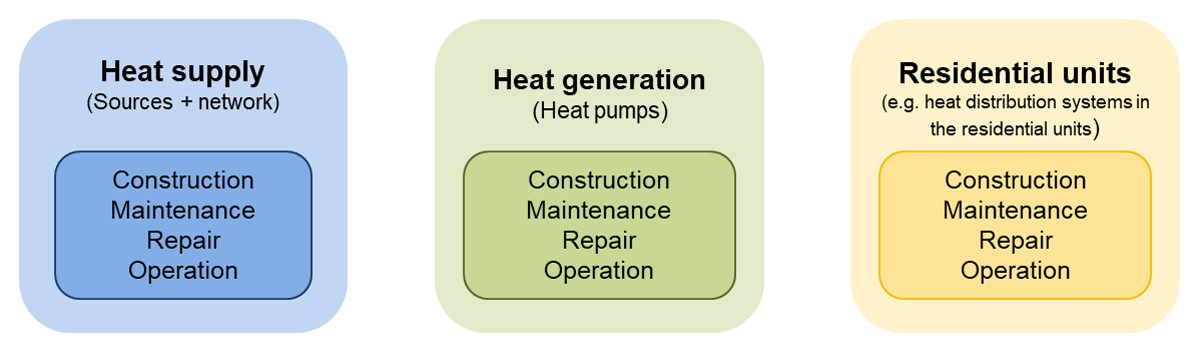
Figure 6
Assignment of roles and responsibilities related to the development of a neighbourhood H&C network.
Financing streams
The sources for financing neighbourhood H&C networks can combine equity contributions, public funding (grants and subsidies), and ongoing payments from users.
From a cash-flow perspective, it is useful to distinguish financing streams that cover capital expenditure (CAPEX) – such as equity, subsidies, and debt – from those that cover operating expenditure (OPEX), primarily through recurring user payments (tariffs and service fees). The CAPEX-OPEX balance depends strongly on the technical configuration. In anergy-type neighbourhood H&C networks (i.e., cold-water grids), upfront investment in network infrastructure and source development often dominates total costs, whereas the operating costs of the network and source-side equipment are very low.
Investment costs can be recovered through long-term contributions by the project participants, complemented by heat- and/or cooling-related charges over the operating period (for details cf. section on billing models). However, the feasibility and design of such cost-recovery mechanisms depend on national legal frameworks and therefore require a country-specific legal assessment, for example on tenancy and housing law provisions, consent requirements among owners or tenants, and regulations governing the allocation and billing of heating costs.
Bottom-up versus top-down approaches
In the following section, we distinguish organisational and financial models for neighbourhood heating and cooling networks based on the initiating actor and the distribution of decision-making power and responsibilities (see Table 3). Bottom-up models are initiated and governed by local stakeholders (property owners or residents), whereas top-down models are led by institutional actors (municipalities, utilities, energy service companies).
Table 3
Bottom-up and top-down approaches.
| BOTTOM-UP | TOP-DOWN |
|---|---|
| Property owner model | Municipal utility model |
| Heating community model | Energy service model |
Property owner model
In a property owner model (see Table 4), a single property owner or a group of property owners develops, finances, and operates the heat supply system and supplies heat to the properties via private-law agreements. The initiating owner can be an individual owner, a housing association, or a housing cooperative, typically leveraging an “anchor” building as the investment and operational base. The concrete design of this model is strongly shaped by national legal frameworks, as contract design, consumer protection requirements, and the permissibility of third-party heat supply can differ across countries (Leutgöb et al., 2025).
Table 4
Advantages and disadvantages from the users’ perspective – property owner model.
| ADVANTAGES | DISADVANTAGES |
|---|---|
|
|
Financing typically combines the owners’ equity, available public funding, and – depending on project scale – debt financing. Investment costs are recovered by payments at the beginning coming from each property owners as well as through long-term heat supply charges paid by the connected properties, as specified in bilateral or multi-party private-law agreements, frequently related to easements in the land register. This model has been used in the practice example Simon-Denk-Gasse in Vienna, as described above.
Heating community model (e.g. through cooperative)
In a heating community model (see Table 5), building owners and/or end-users establish a dedicated legal entity (e.g., a cooperative, association, or limited liability company) to develop and operate the neighbourhood heat supply. This structure can facilitate broad participation while providing a formal mechanism for capital mobilisation and long-term governance.
Table 5
Advantages and disadvantages from the users’ perspective – heating community model.
| ADVANTAGES | DISADVANTAGES |
|---|---|
|
|
Municipalities can play an enabling role (e.g., initiating and moderating the set-up and providing information), while operational responsibility remains with the community entity.
Financing commonly combines member equity (e.g., cooperative shares), public funding, and – depending on scale and creditworthiness – debt financing. Investment costs are recovered through long-term payments by members, usually via heat supply charges and/or service fees paid to the community organisation (Braumann, 2025).
Municipal utility model
In a municipal utility model (see Table 6), the municipality acts as the heat supplier and system operator, usually through a municipality-owned or municipality-affiliated utility company. Planning, investment, construction, and operation are fully under municipal control, without appointing an external third-party operator as the primary asset owner. Ownership and investment risk remain with the municipality. The municipality remains the central decision-maker, responsible for strategic direction, investment decisions, tariffs, and long-term development. However, the municipality can bring in external parties for specific technical and operational services when needed. The municipal utility model is the closest model to a conventional district heating supply.
Table 6
Advantages and disadvantages from the municipal perspective – municipal utility model.
| ADVANTAGES | DISADVANTAGES |
|---|---|
|
|
Financing typically combines municipal funds, public subsidies, and debt. Capital requirements are high upfront, with refinancing achieved through long-term heat tariffs and/or service fees (cf. chapter on billing models below). In general, the feasibility of this model depends on the municipality’s financial strength (Rinner & Osthorst, 2025). However, the involvement of a municipal utility can reduce the burden on public debt because utilities operate as separate accounting entities, provided that investments can be covered predominantly by revenue from the sale of heat.
If a municipality-owned or affiliated utility already exists, it is logical for them to take on the role of operator. This approach benefits from the municipalities’ professional expertise and established operational routines, which facilitate implementation and stakeholder communication. In this case, the model closely resembles the energy service model.
Another option is to use a Special Purpose Vehicle (SPV) to isolate financial risks and manage specific infrastructure projects, thereby enabling the municipality to retain control while collaborating with external investors or service providers.
Energy service model
In an energy service model (see Table 7), an external energy service provider (sometimes called an ESCO) develops and operates the heat supply assets and neighbourhood heating network up to a defined handover point (e.g., the building connection). The provider finances the investment and recovers costs through long-term supply agreements, with payments for delivered heat based on contractually defined tariffs. This model is well-suited for areas with high heat density and strong connection rates, where stable demand supports financial viability. Municipalities without their own utility may choose this approach to ensure implementation of a larger scale network beyond a bottom-up project.
Table 7
Advantages and disadvantages from the municipal perspective – energy service model.
| ADVANTAGES | DISADVANTAGES |
|---|---|
|
|
The municipality plays an enabling role, typically setting the political framework, facilitating land access, and granting usage rights or concessions. Through procurement processes like public tenders, municipalities can influence which energy service providers or utility companies are selected. However, this requires additional resources for procurement and coordination (cf. section on procurement procedures below).
Decision tree for the selection of a suitable organisational and financial model
The decision tree (see Figure 7) provides structured guidance on how different organisational and financial models for neighbourhood H&C networks relate to specific starting conditions and decision contexts. It is based on the analysis of neighbourhood H&C projects in Austria, the Czech Republic, Germany, and the Netherlands. While model selection cannot be reduced to a mechanical application of a flowchart – and additional contextual factors may become relevant – the decision tree serves as a heuristic tool to narrow down feasible options at an early stage of project development.
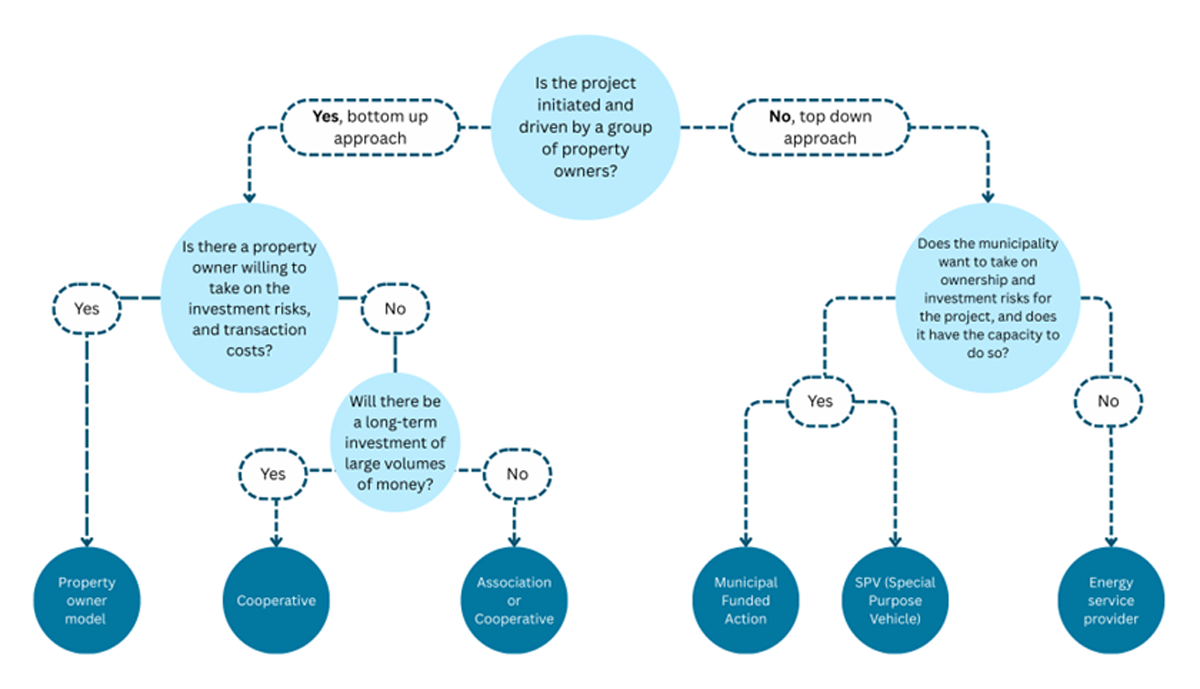
Figure 7
Decision tree for selecting organisational models in neighbourhood H&C projects (source: e7 GmbH).
As discussed in the chapter above, the first distinction concerns whether the project is initiated and driven by a group of property owners (bottom-up approach) or by institutional actors such as municipalities or energy service companies (top-down approach).
Across both bottom-up and top-down pathways, a central question is who is willing and able to assume investment risks and initial transaction costs? Closely linked to this is the issue of financing capacity. In the case of municipalities, for example, the availability of financial leeway – i.e., the ability to take on additional debt without breaching fiscal constraints – can be a decisive factor in determining whether ownership and investment risks can be retained within the public sector (Rinner & Osthorst 2025). However, the involvement of a municipal utility may offer a solution to overcome financial limits.
On the bottom-up side, the decision tree further differentiates between a property owner model and a heating community model. Where a single property owner is willing and able to assume investment risks and transaction costs, a property owner model may be feasible. Where risks and investments are shared among multiple stakeholders over a longer time horizon, the choice of an appropriate legal entity becomes critical. For long-term, jointly financed infrastructure projects, legal forms that allow risk-sharing, capital accumulation, and stable governance – such as cooperatives – are more suitable than looser association-based structures.
In addition to governance and financing considerations, the technical system configuration also influences model selection. The definition of system boundaries – such as whether the organisational entity covers only the distribution network or also central generation, decentralised heat pumps, metering, and billing – directly affects asset ownership, operational complexity, and risk allocation. Technical choices (e.g., centralised versus decentralised use of heat pumps) therefore interact with organisational feasibility and financing structures.
Overall, the decision tree highlights that the choice of organisational and financial model depends less on abstract preferences and more on concrete factors such as risk allocation, financing capacity, governance willingness, and institutional context.
Billing models
Compared to conventional high-temperature district heating networks, neighbourhood H&C networks, can be far more complex depending on their technical configuration, ownership structure, and service boundary.
Billing models are closely linked to investment recovery. Given the high upfront capital requirements of neighbourhood networks, tariff structures must be designed to enable repayment over realistic periods. This creates a structural tension, especially in existing neighbourhoods where compulsory connection is often absent, or buildings are connected sequentially over an extended period of time. Networks developed gradually, e.g. with installation of geothermal probe fields in multiple stages, and are economically advantageous, as the investments are adapted to connection of households. From a billing perspective, gradual extensions of the networks add complexity, as billing models must accommodate changing cost structures as the network grows.
In 4GDHC networks the system boundaries are comparable to conventional networks. Billing follows established patterns of fixed base and capacity price and variable components tied to actual energy consumption. A specific instrument proposed for 4GDHC networks are so-called motivation tariffs, which introduce penalties for high return temperatures and rewards for low return temperatures, creating direct financial incentives for consumers to adapt their building systems to low-temperature supply (Garay et al. 2019; Lund et al. 2022).
Anergy networks (5GDHC) present a substantially more complex billing environment. The system boundary is large, encompassing the heat source or sink, network energy gains and losses, decentralised heat pumps, their electricity consumption, and potentially also centralised or decentral pumping energy. Heating and cooling can be billed separately, and seasonal differentiation between summer and winter operation is sometimes beneficial. Wirtz, Schreiber & Müller (2022) provide an empirical analysis of billing approaches across 53 districts with anergy networks in Germany, where they distinguish between billing at the condenser (34 districts) or evaporator (8 districts) of the decentralised heat pump. Most common is a combination of fixed price and variable pricing for heating (30 districts), while 9 districts only charge a fixed price (based on peak capacity) and 8 districts use a flat-rate pricing. Cooling is frequently offered free of charge, reflecting the benefit that heat feed-in provides to ground probe regeneration.
A key structural parameter in billing of anergy networks is the property boundary. Where the property boundary is set at the heat pump evaporator, the network supplies only a low-temperature fluid. The consumer operates and finances their own heat pump and pays electricity costs directly. In passive anergy networks, where the integrated pumps of the decentralised heat pump units generate the entire network flow without a central circulation pump, a fixed capacity charge is the simplest approach, as it eliminates the need for heat metering and consumption accounting. Since energy costs arise entirely at the consumer level, they are transparent and well-calculable, while the operator faces minimal revenue risk. This model is particularly well-suited to small municipalities, cooperatives, and community-led initiatives that lack the administrative expertise and resources required for consumption-based billing and ongoing operational accounting. Conversely, where the boundary extends to the heat pump condenser, the operator supplies usable heat, enabling the full range of billing models including energy price, flat rate, and heat contracting. Table 8 provides an overview of possible billing methods.
Table 8
Overview and evaluation of possible billing models and associated district heating technologies.
| BILLING MODEL | SYSTEM | DESCRIPTION | PROPERTY BOUNDARY (5GDHC) | EVALUATION |
|---|---|---|---|---|
| Fixed + variable | Low–temperature and anergy networks | Fixed base price covering O&M, plus charge per kWh heat. Most common for DH. Heat contracting possible. | Condenser Evaporator | + stable revenue, consumption incentive – metering and accounting necessary |
| Variable | Low–temperature networks | Variable pricing of kWh heat and network usage efficiency. Heat contracting possible. | – | + consumption and efficiency incentive, transparency – complex metering, accounting and tariff calculation |
| Fixed | passive anergy networks | Fixed charge based on peak capacity. Energy costs of decentral HPs are paid by consumer. No heat contracting possible. | Evaporator | + simple accounting, no metering necessary, low operator risk, individual HP installation – no regard of network load |
| Flat rate | Low–temperature and anergy networks | All–inclusive heating and cooling, monthly pricing according to estimated consumption/living area. | Condenser | + maximum simplicity, predictable costs for consumers, bundled electricity and HP purchasing – no consumption or efficiency incentive, cross–subsidisation risk |
An important issue is how to price cooling appropriately: The benefit of ground regeneration to the network as a whole must be weighed against the value of cooling delivered to the consumer, a challenge that remains underexplored in established tariff structures. A related question concerns the differentiation between passive regeneration by cooling supply and active waste heat feed-in, which may warrant different tariff treatment.
Finally, the relationship between billing and ownership deserves attention. Where consumers co-invest in the network in form of cooperative shares or subordinated loan, as is characteristic for the heat community model, tariff structures will reflect this financial engagement, e.g., through reduced energy prices or profit participation. Once senior credits and then subordinated loans are fully repaid, capital costs decline significantly, raising the question of how to handle the resulting surplus: Either reduced capital costs could be passed on to consumers through lower heat tariffs – which would be in line with the cooperative’s at-cost principle – or surpluses could be retained for reinvestment into expanding existing or new neighbourhood heating projects.
Policy framework for neighbourhood H&C networks
The decarbonisation of heating and cooling in the EU is primarily shaped by three directives under the European Green Deal and Fit-for-55 framework, the Energy Efficiency Directive (EED), the Renewable Energy Directive (RED III) and the Energy Performance of Buildings Directive (EPBD). Meanwhile, the EU leaves substantial discretion to Member States regarding implementation design.
In Austria the heating structure differs markedly, with district heating covering around 32% of residential units, natural gas 20%, and biomass and wood 16% (Statistik Austria 2025). Neighbourhood heating and cooling networks currently play only a limited role, though Vienna’s Heating Plan 2040 (Vienna 2024) explicitly designates certain areas for local collective heating (“Lokale Gemeinschaftswärme”), prioritising low-temperature and anergy networks fed by geothermal sources and waste heat. Large-scale implementation remains pending. The Austrian framework is not codified in a single law but combines several statutes: The Renewable Heat Act from 2024 prohibits fossil-fuel systems in new buildings and requires district heating connections to meet an 80% renewable quality standard or provide a binding decarbonisation plan. Several housing laws (Condominium Act, Tenancy Act, Heating Cost Accounting Act, etc.) create further complexity for the heat transition. The UFI programme provides investment grants of up to 35% for low-temperature networks, however, lacking clear provisions for 4GDHC and 5GDHC networks.
In Germany’s building stock gas heating systems dominate with around 14.3 million installations – more than half of all decentralised systems – while renewable heating technologies represent only about 22% of the stock (DENA 2024). Around 15% of residential units are supplied via district heating networks (BDEW 2025). The federal Heat Planning Act (WPG) requires cities above 100,000 inhabitants to complete municipal heat plans by mid-2026, with smaller municipalities following by mid-2028, classifying areas as suitable for district heating, decentralised systems, or green gases – but critically an explicit category for low-temperature or anergy networks is missing. New heat networks must source at least 65% of annual generation from renewables or unavoidable waste heat. Until recently, the Building Energy Act (GEG) reinforced this through a technology-neutral 65% renewable requirement for newly installed heating systems, with district heating connection as an explicit compliance pathway. In February 2026, the German Federal Government announced it will abolish this requirement, replacing it with a green fuel obligation for new installed boilers starting at only 10 % from 2029, leading to a significant backdrop in climate ambition. The district heating ordinance (AVBFernwärmeV), designed for conventional high-temperature systems, creates additional barriers for neighbourhood H&C networks, particularly through its assumption of a standardised heat supply rather than a tempered energy source, and its implicit separation of supplier, network operator, and consumer roles. Permitting under the water law (WHG) remains time-consuming and locally inconsistent, though the Geothermal Acceleration Act (GeoBG) introduces tighter approval timelines. On the funding side, BEG supports building connections and heat pumps at 30–70%, BEW funds feasibility studies, infrastructure investment at 40% and operating costs for up to ten years, and the re-launched KfW 432 covers neighbourhood concept development. Key remaining gaps are the prohibition on cumulating BEW with other funding sources and the Warm Rent Neutrality provisions (WärmeLV), which cap permissible heat prices at the level of previous fossil operating costs.
The Czech Republic presents a unique starting point: approximately 40% of the population is connected to district heating, providing a strong infrastructural foundation. However, the fuel mix remains heavily fossil-dependent, with coal accounting for around 41% of heat production in 2024 and heat pumps less than 0.1% (ERÚ 2025). A key challenge lies in the regulatory framework, which makes no distinction between large city-wide systems and small neighbourhood networks, imposing identical licensing and price regulation requirements regardless of scale – creating disproportionate administrative burdens for smaller, community-led initiatives.
The Netherlands faces a different set of challenges: individual gas boilers have been historically dominant, and district heating covers only around 7% of households. Small-scale, low-temperature neighbourhood networks are gaining attention as an alternative, particularly where large-scale district heating is not economically viable. The incoming Collective Heat Act will give municipalities greater control over the heat transition, introduce cost-based tariff regulation, and establish specific rules for small collective heat systems. The “not more than the alternative” principle, requiring heat network costs not to exceed those of a conventional gas boiler, remains a point of debate.
Irrespective of the various starting points in the countries studied, based on the examples of good practice for neighbourhood H&C networks outlined in the section above, a set of consistent policy lessons can be derived, which, if taken into account when designing the policy framework, would make it considerably easier to implement neighbourhood H&C networks (Pehnt et al., 2026):
A cross-cutting finding is the critical importance of the early project phase. The Rech project illustrates how this phase, before formal funding eligibility begins, is both the most decisive and the least supported stage. Strong local leadership, volunteer engagement, and individual “caretakers” proved essential, yet no dedicated public funding instrument was available to support the initial phase. The re-launch of the KfW 432 programme directly addresses this gap. The Simon-Denk-Gasse project reinforces this finding with large resources consumed by contractual arrangements and administrative procedures.
A standardised legal framework for neighbourhood H&C networks remains absent in all four countries assessed. However, a dedicated regulatory category including a clear and consistent definition, distinct from individual building systems and large conventional district heating, would lower the threshold for community-led initiatives and increase regulatory certainty.
A further lesson concerns regulatory certainty over time. The Simon-Denk-Gasse project experienced shifts in legal frameworks and funding conditions during its extended development period. Funding programmes must therefore provide multi-year reliability, as abrupt regulatory changes disproportionately affect long-duration neighbourhood projects – as currently seen with the announced abolition of the GEG’s 65% rule in Germany.
Permitting complexity emerges as a systemic barrier. High transaction costs are among the most consistent barriers identified. Therefore, procedures should be simplified and consolidated to reduce administrative burden to the minimum necessary. Competition for underground space and fragmented, plot-by-plot approval processes significantly extend timelines and increase costs. Germany’s GeoBG represents a promising response, though effectiveness will depend on local implementation capacity.
Another important issue to the acceleration of financial support schemes for small-scale projects ensuring non-discrimination. Funding programmes should support small-scale neighbourhood projects on equal terms to larger investments. They should take into account shorter decision- and reaction-times by a “fast lane funding”, introduce early start of measures and in advance payments.
Furthermore, it is necessary to explicitly include neighbourhood H&C networks in municipal heat planning. Heat planning processes should recognise neighbourhood networks as a complementary decarbonisation pathway alongside large district heating and individual climate-friendly systems. Areas that are unsuitable for conventional district heating may have good potential for neighbourhood-scale solutions that current planning categories fail to capture.
Finally, policy measures are required that incentivise energy service providers to engage in neighbourhood H&C networks: Given the current scarcity of energy service providers active in this field across EU Member States, engagement in the planning, financing, implementation and operation should be pushed, e.g. by public templates for tender material and service contracts or by public guarantee schemes that reduce the investment risks from the point of view of service providers.
Conclusions
Currently in Europe there exists a considerable number of neighbourhood H&C networks in newly constructed neighbourhoods, however, only a small number of these networks have been established for existing neighbourhoods. This study shows – based on lessons learnt from good practice examples – that neighbourhood H&C networks can nevertheless make a significant contribution to the decarbonisation of heating and cooling. Particularly, in urban and suburban areas with medium to high heat density where they represent a feasible and cost-effective solution that bridges the gap between conventional district heating and individual solutions for each individual building.
The study also shows that, in practice, various organisational and financial models have already emerged to address differences in the baseline conditions of governance and institutional context, financial capacity, risk allocation or legal frameworks. The applicable organisational and financial models include both bottom-up approaches, in which investments are initiated and managed by property owners and/or residents, and top-down approaches, which are driven by local authorities and/or energy service providers.
However, in order to significantly boost the implementation of neighbourhood H&C networks, the policy framework needs to be improved, as current policy instruments often overlook these smaller-scale solutions. The study presents a number of levers where in the revision of future energy policy, neighbourhood H&C networks should be systematically addressed by dedicated and supplementary policies, in order to reduce transaction cost, planning time and overall inertia of neighbourhood solutions.
Additional File
The additional file for this article can be found as follows:
Decarbonising (sub)urban districts through neighbourhood heating and cooling networks
Presentation slides for eceee 2026. URI: https://eceeeproceedings.org/articles/86/files/6a5f52823ae05.pptx
Notes
[1] To give an example, for the city of Vienna the mentioned limitations are spelled out in the so-called Vienna Heating Plan 2040 (Stadt Wien, MA 20, 2023).
Acknowledgements
This paper has been prepared in close connection with the LIFE-project “Low-temperature and renewable neighbourhood heating and cooling networks: Technical solutions, investment plans and business models for local approaches to decarbonise heat supply of existing buildings” (HeaTogether-project, https://heatogether.eu). The authors are grateful to the whole project team for fruitful collaboration and valuable inputs.
eceee paper ID
5-032-26