
Introduction
The decarbonisation of residential heat is widely recognised as one of the most complex and consequential challenges in the European energy transition (IEA, 2023). Across Europe, the planning and delivery of clean heat, through measures such as heat networks, heat pumps, and coordinated retrofit programmes, has remained slow and uneven (EEA, 2023; Rosenow et al., 2020). Delivery challenges persist despite significant areas of policy support, mature technologies, and growing financial commitments, indicating that technical and economic explanations alone are insufficient to account for a lack delivery outcomes (Barnes et al., 2024; Sovacool & Martiskainen, 2020). In this paper we argue that clean heat planning and delivery is a governance challenge.
Over the last two decades a large, disparate literature has grown up focussed on governing processes and mechanisms capable of triggering and steering society to sustainability (Frantzeskaki et al., 2012; Jordan, 2008; Patterson et al., 2017). Within this broad coalition, attention is often directed to which governing processes are most likely to enable the practical realisation of net zero. Whilst differences exist, debate largely evolves around questions of what effective governance might entail (Hall et al., 2025).
In this paper we explore what effective governance for clean heat planning and delivery involves, set within the context of a new national framework of energy planning in Great Britain. In November 2023 the UK, Scottish and Welsh Governments adopted a new long-term, whole-system approach to energy infrastructure planning. Under the leadership of the National Energy System Operator (NESO), Regional Energy Strategic Plans (RESPs) will be produced for Scotland, Wales and nine regions in England, each plan linking local ambition for decarbonisation, energy security and growth to overarching national strategies for net zero, clean power and infrastructure investment. On 30 January 2026, NESO released the first ‘transitional RESPs’ (tRESPs) for each region, designed as a bridge between current electricity distribution network planning and the future whole-system model. Crucially, these tRESPs inform Distribution Network Operators’ next five-year, regulatory controlled business planning period (RIIO-ED3). ‘Enduring RESPs (eRESPs) – covering the whole system, not just electricity networks – are set to follow by the end of 2028 and move onto a rolling three-year cycle, establishing an ongoing strategic planning framework for the sector.
The paper emerges from a collaboration between local government officers and an academic researcher. Our approach is practical in orientation. We apply a prior analytical framework (McMillan et al., 2024) to the case of clean heat planning and delivery in Oxfordshire, guided by the following question: To what extent do emerging Regional Energy Strategic Planning arrangements address key placebased governance challenges within Oxfordshire and what does this experience reveal about developing effective governance for clean heat planning and delivery in Great Britain?
In the following we define clean heat as an energy service that delivers heating with net zero carbon dioxide emissions across its life cycle, including production, infrastructure, and end use. This applies across all types of heating demand, including space or water heating in residential and commercial sectors as well as industrial heat. In this sense, clean heat contrasts with conventional heating services that rely on the combustion of fossil fuels.
As an energy service, clean heat is understood as being delivered through diverse socio-technical systems in which technologies, actors, and institutions interact and co-evolve (Hendriks & Wesche, 2026). Clean heat planning and delivery therefore concern the reconfiguration of these systems away from fossil fuel-dependent arrangements towards those based on energy sources capable of achieving net zero lifecycle emissions, such as wind, solar, biomass, and nuclear.
In applying the framework to Oxfordshire, we find RESP is reconfiguring broad governance arrangements in the region by reshaping and creating new relationships between regional and local actors, whilst collating and sharing data in new ways. RESP is introducing new structures, and processes where previously actors operated in silos with fractured responsibilities. But whilst structurally enabling, RESP is operationally immature. Local area energy planning, led by local government and undertaken outside of RESP processes remains the primary driver of place-based pathway design. Significant uncertainty therefore remains around local and regional clean heat strategy, and the alignment of infrastructure development plans, particularly across electricity, gas and heat networks. Meanwhile, Local government participation in RESP remains discretionary and therefore uneven, in the absence of energy planning becoming a statutory duty of English local government.
Based on the Oxfordshire case we argue developing effective governance for clean heat planning and delivery requires a heightened focus on the coordination and ‘orchestration’ (Hölscher et al., 2019) of actors, resources and knowledge within a locality around a shared goal, in this case clean heat, rather than a sole focus on delivering change through implementing projects. We draw attention to a lack of dedicated institutional capacity beyond NESO and highlight a need to reduce or better manage decision making uncertainties.
Section 2 situates our approach to governance within the literature and introduces prior research that has identified seven challenges of organising to deliver local, place-based action for net zero. Section 3 sets out our approach, provides background information on our case – Regional Energy Strategy planning in GB – and introduces Oxfordshire County Council and its engagement with heat planning and delivery to date. In section 4 we discuss the impacts of regional energy planning on navigating the seven governance challenges as described by McMillian et al (2024). In section 6 we identify four interrelated shifts of how clean heat planning is being organised before section 7 concludes.
Theory: effective governance for clean heat?
Governance is a notoriously popular yet slippery term with multiple meanings and uses (Ansell & Torfing, 2022). In the broadest sense, it describes a hollowing out of the state, in which hierarchical control by governments has been replaced by networks of public, private, and civil society actors involved in making, influencing and implementing public policy (Cairney, 2020). Governance has variously been described as networked (Rhodes, 1996), multi-level (Hooghe & Marks, 2001) and polycentric (Ostrom, 2010). In this paper we build on Ansell and Torfing’s (2022, 4) definition of governance as “the interactive processes through which society and the economy are steered towards collectively negotiated objectives” whilst noting how these interactive processes are to some extent institutionalised.
The concept of “good governance” has structured much of the comparative politics and development literature since the 1990s. Emerging from multilateral reform agendas and commonly associated with global institutions such as the World bank, it emphasises accountability, rule of law, transparency, participation, and anti-corruption as defining features of governing systems (Brass, 2022). Within this tradition, emphasis is often placed on what governance should look like, at the expense of assessing how governing arrangements actually operate in practice.
By contrast, contemporary debates on the interactive processes through which society and the economy might be steered towards sustainability are fundamentally concerned with practical outcomes (Patterson et al., 2017; Scoones et al., 2020). Whilst normative, good governance practices remain important to many (British Academy, 2025), debate primarily focusses on what constitutes effective governance practices: the ability of governing systems to generate intended collective outcomes under diverse material and political constraints. At the same time, conventional modes of governing are frequently understood to have contributed to the climate emergency, thereby creating the impetus and conceptual space for the development of alternatives approaches (Schot & Steinmueller, 2018).
New modes of steering society towards sustainable futures have subsequently been proposed. Each mode seeks to overcome failures of conventional governing practices (Weber & Rohracher, 2012) by using various practices aimed at establishing a common direction of travel, mobilising increasingly diverse actors, and by developing increasingly reflexive, multi-scalar decision-making (Haddad et al., 2022). Governing via missions (Mazzucato et al., 2020) and transformative policy (Parks, 2022; Steward, 2012) provide salient examples, though many others exist, rooted in diverse disciplinary traditions (Patterson et al., 2017). Collectively they emphasise how governing for sustainability involves navigating a range of challenges such as agency, power, adaptiveness, legitimacy, and scale whilst placing analytical emphasis on different elements.
Contributing to this literature McMillan et al. (2024) offer an analytical-diagnostic framework on subnational, place-based governance for net zero. Drawing on a review and synthesis of an emerging body of knowledge at the interface between policy and practice in the UK they examine why local, place-based governance of net zero appears to be intractable. Their focus on governance in place appears particularly apt to our analysis because the orchestration of multiple local elements such as end-use technologies and households is central to all clean heat futures. MacMillan et al (2024) distinguish between governance process and practices concerned with organising to deliver change, and those focused on organising the delivery of change. In doing so they highlight a distinction previously identified (Patterson et al., 2017) and argue that “emphasis is near exclusively placed on delivery whilst negating what is often required behind the scenes to enable delivery: varying amounts of organisation” (McMillan et al., 2024, p. 19).
McMillian et al (2024) subsequently identify seven governance challenges thought to hinder place-based organising for net zero (Figure 1). The first challenge concerns coordinating between and within different levels of government. They argue current arrangements tend to be fragmented and siloed, with inconsistent national frameworks, overlapping institutional structures, and short-term political cycles all hindering joined-up action. Instead, they argue many solutions will cut across scales and sectors and will require negotiation and coordination between the UK government, devolved governments in Scotland and Wales, and regional and local governments.
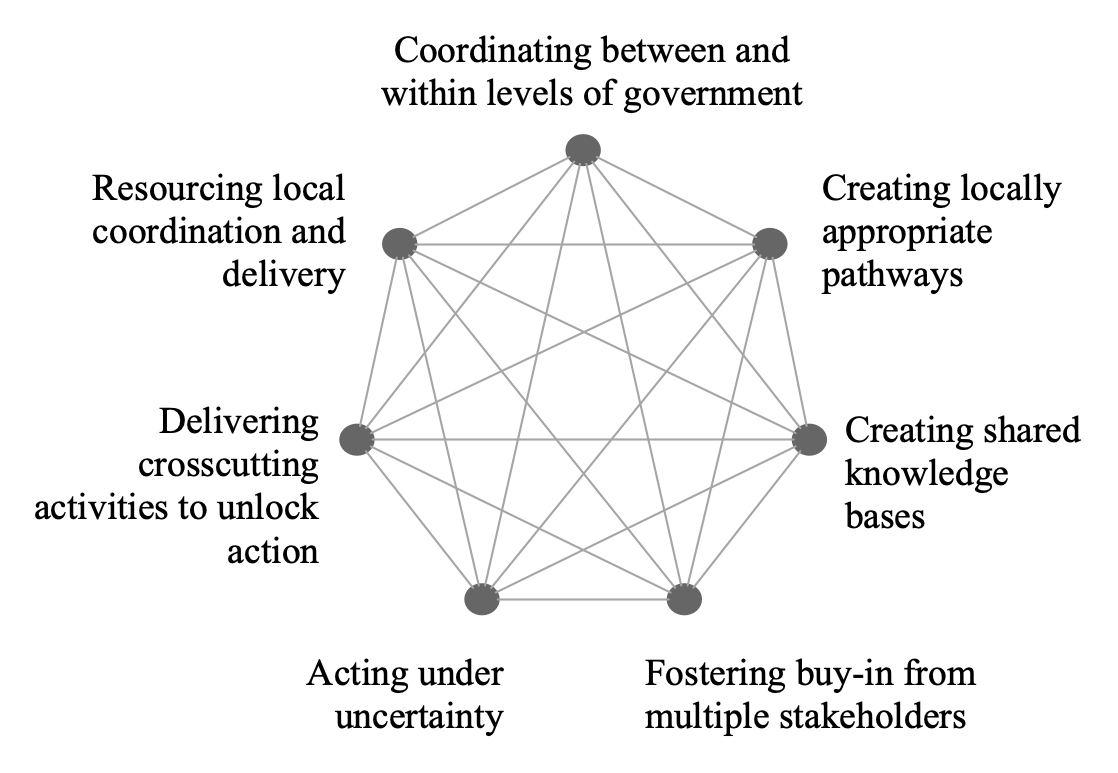
Figure 1
Seven challenges of organising to deliver local, place-based action for NZ (McMillan et al., 2024).
Second, because localities differ in geography, resources, infrastructure, socio-economic conditions and institutional capacity, whilst holding different ambitions, net zero is going to look and feel different depending on where it is enacted. Effective governance must enable locally tailored strategies whilst ensuring consistency with national targets. A core challenge thus becomes creating locally appropriate pathways that balance flexibility and local tailoring with coherence, comparability and fairness across places.
Third, they highlight how effective decision-making often depends on robust, shared evidence. However, emissions data, monitoring systems, and analytical capacity are often uneven and inadequate. Inconsistent reporting practices, limited local expertise, and fragmented data ownership prevent informed, transparent, and replicable decision-making. A subsequent challenge concerns creating shared knowledge bases to support transparent decision-making.
Fourth, it is widely recognised that achieving net zero will require participation from citizens, businesses, landlords, SMEs, community groups, and others. National governments are expected to set clear targets and strategy, whilst local governments are expected to convene and mobilise diverse local and regional actors. However, engagement processes are resource-intensive, what constitutes sufficient participation remains unclear whilst navigating controversies and negotiating trade-offs is increasingly important but relatively neglected (Newell et al., 2022). The challenge therefore concerns fostering broad, durable and equitable commitment from multiple local stakeholders.
Fifth, because net zero requires the transformation of societal systems such as water, energy and mobility, local actors must make decisions despite incomplete information and limited knowledge on systemic consequences. Uncertainties about future infrastructures choices, for example around the role of hydrogen in GB, creates risk of paralysis or costly misalignments and highlights the dependence of local decision-making on national policy decisions. The fifth challenge concerns decision-making under conditions of incomplete knowledge and shifting policy signals.
Sixth, foundational enabling activities, such as planning reform, procurement reform, financial innovation, workforce development, and institutional culture change, cut across sectors and departments and in many instances provide, the basis for organising and delivering change. Nonetheless, responsibility for these activities is often unclear, whilst resource constraints frequently inhibit action. The sixth challenge highlight by McMillian et al (2024) thus concerns undertaking system-wide enabling reforms that make sectoral decarbonisation possible.
Finally, planning for and delivering net zero requires sustained funding, technical expertise and organisational capacity. Current arrangements are piecemeal and inefficient, overly reliant on grant funding (Nolden et al., 2024) reflecting a lack of commitment and understanding of the role of local action from central governments. Set against this context McMillian et al (2024) highlight the state, which operates at national, devolved, regional and local scales, as the only actor with the long-term mandate and position to tackle net zero as a public good. Whilst various public, private or public-private finance combinations exist that offer means to deliver net zero projects, few if any other actors are capable of organising for the delivery of net zero. The final challenge thus concerns securing long-term financial and human resources to support coordination, planning, and implementation in place.
Approach
This paper emerges from an engagement fellowship, which ran between January and June 2026 between the University of Oxford, Oxfordshire County Council (OCC) and NESO. The fellowship aims to share academic expertise and knowledge, build lasting partnerships, and develop future collaborative projects. This paper contributes to these aims by sharing prior academic research on place-based governance for net zero and translating prior insights, through a process of knowledge co-production, into practical insight on regional planning and delivery of clean heat, informed by early discussion between researchers and OCC.
The analysis was iteratively developed, collaboratively. Rather than treating local authority officers as research participants, the analysis was co-developed through a structured workshop and iterative drafting. During the workshop the analytical framework of seven interlinked place-based challenges was introduced and discussed in relation to evolving governance arrangements in Oxfordshire. Notes from this session informed the analysis presented below.
The workshop approached clean heat as an empirical lens through which to examine how governance arrangements are being reconfigured under RESP. Rather than focusing on the technical merits of heat technologies, discussion centred on how the planning and delivery of clean heat expose questions of authority, coordination, and institutional responsibility. Clean heat served as a policy domain through which we might reflect on pathway formation, develop engagement, infrastructure constraints, and the interaction between local political priorities and regional modelling assumptions. In this sense, clean heat was treated as a site where governance arrangements materialise in practice, with the seven-challenge framework structuring discussion.
Regional Energy Strategic Planning and the case of clean heat planning and delivery in Oxfordshire
In the following we introduce the move to regional energy planning in Great Britian and its implementation to date, before introducing Oxfordshire as a specific site in which governance for clean heat planning and delivery is explored.
From reactive management to strategic infrastructure planning
Since the 2019 amendment to the Climate Change Act 2008, which committed the UK to achieving net-zero greenhouse gas emissions by 2050, the energy system has been undergoing structural change at unprecedented speed. The electrification of heat and transport, alongside the rapid deployment of renewable energy generation technologies has placed the electricity transmission networks and electricity distribution networks under significant pressure, creating structural bottlenecks to the UK government’s ambition to decarbonise the electricity system by 2030. The historic reactive ‘first come, first served’ approach to grid connections, has proved inadequate, promoting nationwide reform to the connection queues and a move towards strategic, proactive network planning.
At the same time, the gas transmission and distribution networks are facing uncertainty regarding their long-term role in a decarbonised system. Approximately 74% of households use gas as to heat their homes in England and Wales (ONS, 2021). In Oxfordshire heating is the largest end-use energy demand, the majority of which is met via provision of natural gas, followed by oil with liquified natural gas, biomass and coal making up much smaller contributions (Figure 2). Approximately 80% of household are estimated to be connected to the gas grid.
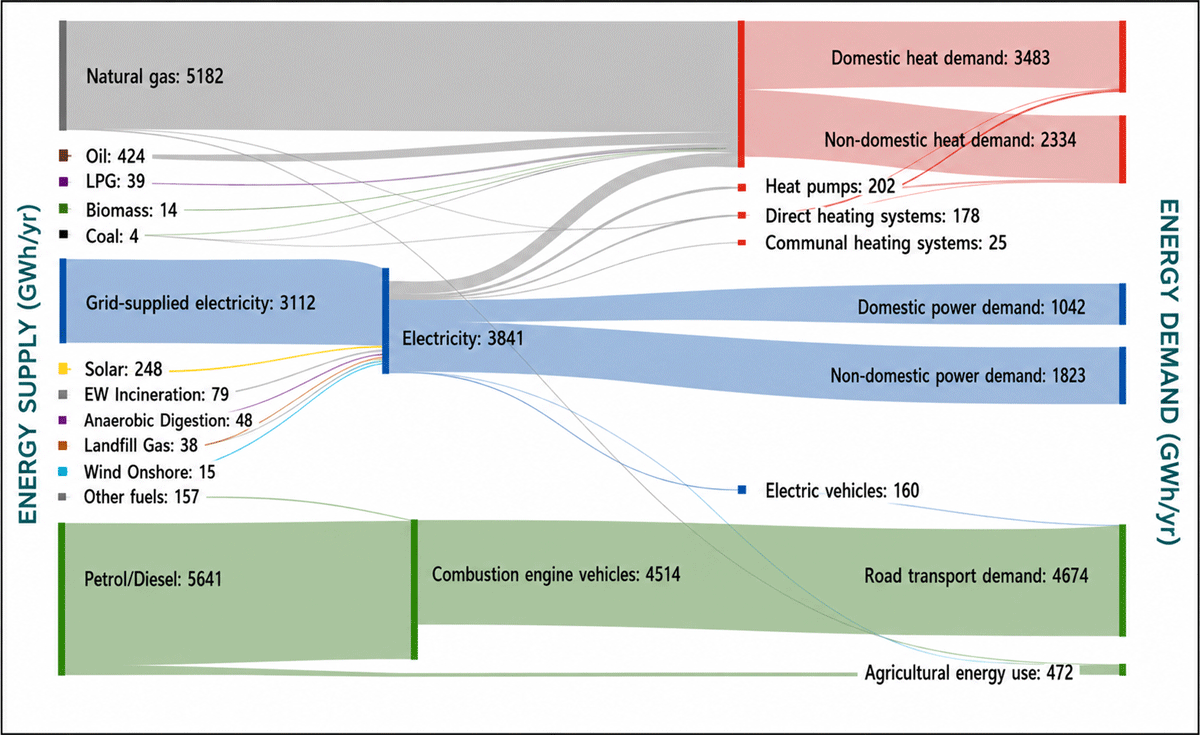
Figure 2
Oxfordshire Baseline Sankey Diagram, GWh/year (ARUP and Oxfordshire Leaders Joint Committee, 2026).
Gas networks are currently regulated and operated in parallel with electricity networks, following regulated five-year investment cycles but the future demand for gas, the extent of hydrogen blending or conversion, and the implications for asset management and investment planning remain unresolved. These whole-system uncertainties further complicate the planning and coordination required across electricity and gas networks, undermining the pace and efficiency of any transition.
In November 2023 the UK, Scottish, and Welsh governments adopted a new long-term, whole-system approach to energy infrastructure planning comprising three elements. The Strategic Spatial Energy Plan will map zonal locations for future electricity and hydrogen generation and storage across GB. The Centralised Strategic Network Plan will set out long-term development of the electricity, gas and hydrogen transmission networks, whilst Regional Energy Strategy Plans (RESPs) will integrate local, place-based priorities into regional whole-system plans that guide distribution-level network investment. Each plan will be developed and overseen by the National Energy System Operator (NESO), an independent, public corporation set up in November 2024.
RESPs will be developed for Scotland, Wales and nine regions in England drawing on local needs while guiding investment ahead of need. Each RESP will consist of five parts: A Nations and Regions Context will set out comprehensive view of local conditions and priorities; Pathways set out short and long-term projections of regional energy supply and demand; Consistent Planning Assumptions (CPAs), provide a single GB-wide set of assumptions to ensure consistent network planning across regions; a Spatial Context that overlays pathway outputs with distribution network capacity data to identify emerging areas of system need; and Strategic Energy Needs (SENs) identifying regional significant, complex areas where targeted network investment would unlock system value.
RESPs and the processes governing their development are being established at pace. 11 nation and regional teams were stood up in NESO’s first year of operation, a consultation on the RESP methodology was undertaken during winter 2025–26 and strategic boards designed to oversee regional processes and sign off plans are due to be stood up in Autumn 2026. In January 2026 “Transitional” RESPs (tRESPs) were delivered to provide short-term investment certainty to Distribution Network Operators (DNOs) through to 2035, reflecting a need to inform their next price-controlled regulatory investment period beginning in 2028 (RIIO ED3). More comprehensive, whole-system, cross vector “enduring” RESPs (eRESPs) are to be developed by the end of 2028 covering the long-term planning horizon to at least 2050, updated every three years.
Clean heat policy across Great Britain
Situated within a mix of devolved and reserved powers, heat decarbonisation is a complex domain of public policy, where little progress has been made despite considerable policy initiatives, plans and institutional innovation across GB (Barnes et al., 2023; Heap, 2025). Whilst powers over energy markets, regulations, and electricity and gas networks are reserved to Westminster, heat is devolved, as is planning and economic development. A degree of divergence in heat policy and practice have resulted (Webb & van der Horst, 2021).
Scotland introduced statutory Local Heat and Energy Efficiency Strategies (LHEES) in 2022, whilst Wales has mandated development of Local Area Energy Plans (LAEPs). In England, only a minority of local authorities have LAEPs, resulting in a two-tier system with some local areas pushing forwards whilst others have barely begun to consider how to decarbonise heat (Britton & Webb, 2024). In Scotland, LHEES provides the foundation for identifying potential heat network zones. In Wales mandatory LAEPs provide the foundation. In England, 28 LAs participated in the Department for Energy Security and Net Zero’s (DESNZ) Heat Network Zoning Pilot Programme, with eight progressing to the Advanced Zoning Programme. In January 2026, the UK Government confirmed that Local authorities will lead coordination and delivery of heat networks in England by establishing zone coordination bodies, supported by a national zoning authority.
Together, these different forms of local planning serve to emphasise that decarbonising heat cannot be delivered from the centre but requires local and regional cooperation and coordination (Lockwood & Devenish, 2024). They emphasise how local authorities are expected to play a critical role in planning despite annual budget cuts, since 2010, restricting capacity development (Wade et al., 2022). The absence of statutory powers alongside local government reform further undermining the capacities in England.
Oxfordshire County Council and clean heat planning and delivery
Oxfordshire is a county in Southeast England characterised by a mix of historic urban centres, market towns, and extensive rural areas. Anchored by the city of Oxford, it is internationally recognised for its university and knowledge-intensive economy and has experienced sustained population and employment growth, driving demand for housing, transport, and energy infrastructure. Alongside this expansion, all six local authorities have adopted net-zero targets, positioning Oxfordshire as an early leader in local climate action, with clean-heat planning and delivery forming an increasingly important part of this agenda.
Oxfordshire’s approach to energy and heat decarbonisation is being developed collaboratively across all six local authorities. The ‘Pathways to a Zero Carbon Oxfordshire’ (Hampton et al., 2021) provides a foundation and evidence base for net zero in the county. The ‘Oxfordshire Net Zero Route Map and Action Plan’ (City Science, 2023) subsequently identified Local Area Energy Planning (LAEP) as a critical mechanism for delivering the county’s net-zero ambitions, leading the Oxfordshire Leaders Joint Committee to commission a countywide LAEP using residual funding from the Housing and Growth Deal amounting to approximately £600,000. The Oxfordshire Local Area Energy Plan (OxLAEP) has therefore been co-produced from the outset by the six councils with shared governance structures, that were purpose built prior to the design and commissioning process. The Executive Steering Board and Energy Planning Working Group bring together senior officers from all councils alongside network operators, NESO, the Low Carbon Hub and the Greater Southeast Net Zero Hub, collectively shaping a countywide programme. More than 200 stakeholders have contributed to date. The programme is organised around two parallel workstreams: the development of the technical plan and the creation of a delivery function to support implementation which considers delivery models, investment approaches, and long-term capability building.
Beyond OxLAEP, the County Council’s role in clean-heat planning and delivery spans a broader set of programmes. This includes retrofit and building-decarbonisation initiatives, heat-network scoping and feasibility work, as part of the Oxford Heat Network Partnership, and engagement with community-led energy initiatives. These activities provide the institutional foundations through which OCC and its partners can translate the strategic insights from OxLAEP into practical delivery routes for clean heat, shaping both near-term project development and the long-term evolution of Oxfordshire’s local energy system.
Results
Below we discuss the implications of a shift to regional energy planning under the NESO-led RESP process in relation to the seven challenges of organising to deliver place-based change as identified by McMillian et al (2024).
Regional energy planning as a foundational activity
Drawing on contemporary policy-practice documents, McMillian et al (2024) draw attention to a diverse range of foundational activities as making sectoral decarbonisation possible (challenge 6). In our experience regional energy planning is emerging as a core foundational activity. The same can be said of local area energy planning.
Our experience suggests planning at each scale is foundational in design, yet emergent and fragile in practice. Both are designed to map local contexts and create baselines, bring together local stakeholders and data and set out clean heat development pathways. Both regional and local energy planning are creating new local and regional structures. Strategic boards have been proposed for each RESP region to “provide oversight, coordination and strategic steer throughout RESP development” and sign off each regional plan (NESO, 2025, 41). Meanwhile OxLAEP is governed through joint boards involving diverse stakeholders. Crucially, energy planning is shifting focus from project delivery to the structures, roles and responsibilities of stakeholders in organising to deliver change. As a process RESP is designed to inform infrastructure investment decisions. Whilst in OxLAEP, this function is clearly expressed within the articulation of two work streams: the first designed to build local plans and evidence base, the second building functional capacity to deliver the plans.
At the same time, energy planning is fragile. Both scales of energy planning have raised expectations and institutional commitments, but their legitimacy and durability depend on effective coordination, transparency, and adequate support. Both run the risk of becoming top-down strategies ‘done to’ rather than ‘with’ local stakeholders if they are not sufficiently engaged in the process. Their ability to unlock action on clean heat dependent on navigating various other challenges discussed below.
What separates regional from local planning is resourcing and statutory footing. NESO has a duty to deliver RESPs in Scotland, Wales and nine regions of England. Its role and responsibilities in the process are backed by UK Government legislation and funded by a levy of electricity and gas consumer bills. By contrast, local government engagement with energy planning in England is discretionary, undermining the ambition of RESP to be reflective of and useful to place.
RESPs as increasing coordination
According to McMillian et al (2024) increasing coordination between and within levels of government is vital for delivering on net zero (challenge 1). In reflecting on Oxfordshire’s experience, we find regional energy planning is creating new meso-level governance structures between national and local strategy and planning and increasing horizontal coordination between regional actors.
Prior to RESP, DNO investment was largely reactive: networks were reinforced mainly in response to individual connections requests under the ‘first come, first served’ regime, and five-year business plans approved by Ofgem offered only limited scope for strategic, forward-looking investment. Local government had little, if any, say in the process.
The introduction of RESP alters these arrangements. First, it reaffirms the role of local government as a provider of local data. While DNOs have long acknowledged the value of local insight, local government input into network planning was previously inconsistent and often incomplete. RESP formalises this expectation by creating structured routes for local data to inform regional modelling. Second, RESP provides local government with a formal presence in regional governance through a 50% share of votes on strategic boards. In principle, this gives local government a role in shaping and signing off the evidence base on which infrastructure plans are developed. In practice, however, the highly technical, network-oriented nature of RESP risks limiting this influence: it requires local authorities to engage in a planning culture, language and set of logics historically developed for and by network operators. The effect is to draw local authorities into the energy-network world rather than creating a genuinely hybrid decision-making space. The designation of English local authorities as heat-network zone coordinators from 2026 further complicates this landscape. It places them in a position analogous to DNOs for heat – yet without comparable resources, statutory duties, or established governance infrastructure – raising wider questions about how the two governance worlds can come together as equitable partners in shaping regional energy futures.
Regional energy planning has further resulted in standardised data sharing and promoted increased local collaboration between Oxfordshire’ local authorities. Until recently each DNO had its own process for accepting local data, resulting in unequal data acquisition and usage across the region. In the last year a single data entry point has been created allowing all three DNOs operating within the central England RESP region, to receive regional and local inputs from a single municipal boundary.
Increased collaboration between Oxfordshire local authorities is most clearly observed within the OxLAEP programme. OxLEAP has provided a structured platform for collaboration, consolidating previously informal or fragmented relationships. It has enabled more coherent data aggregation, shared strategic framing, and a collective interface with network operators and regional planning processes. By contrast, neighbouring authorities without funded LAEP processes appear less able to organise and contribute local data or position themselves effectively within RESP. In this sense, LAEPs serve a dual function: generating local data whilst simultaneously strengthening inter-authority coordination and collective capacity to engage in regional energy planning.
Regional energy planning is also driving gradual governance changes within OCC. In 2025, a second officer was recruited to oversee OxLAEP and engage with NESO. There is now increased recognition of the need for closer collaboration between strategic planning and the climate service. This has improved understanding and coordination across departments whilst building internal energy planning capacity.
In a system previously marked by fragmented roles and reactive decisions, new sites for decision-making are being established. Beyond NESO-led formal governing processes, regional energy planning is strengthening coordination between regional and local actors and building institutional capacity within OCC and district councils. However, uncertainty remains about future governance arrangements, including which local authorities will sit on the regional strategic board and whether local government will take on responsibility for clean heat decisions. ‘Once-in-a-generation’ reforms to local government in England raise further uncertainties about the capacities of local governments to engage with regional energy planning, as well as their role and responsibilities, at least during the transition process to new local government structures.
Reallocating scarce resources
McMillian et al (2024) highlight resourcing coordination and delivery as a core challenge of all place-based governing for net zero. In our experience the shift towards regional energy planning is reallocating scarce local resources, whilst funding arrangements and knowledge infrastructures remain fragile.
Within OCC the shift to regional energy planning has triggered the creation of new energy system planning roles. It is fostering new expertise and encouraging officers to think beyond asset management or project delivery. For OCC then, system planning is becoming a core function of local government. Equivalent roles and capacities are emerging in district councils. Nonetheless, such internal capacity is limited and fragile. If RESPs are renewed every three years, as expected, underpinned by annual data refreshes, this creates a significant ongoing administrative burden. This burden is extended in regarded to local government’s potential convening role vice-a-vis local stakeholder data input. High-quality local data is essential for effective energy planning. Whilst NESO knows which organisations have contributed data, neither NESO nor OCC know if this represents ‘good’ coverage or whether key stakeholders and therefore data, are absent. Whilst less consequential for NESO, for local government, the stakes are high. Housing developments, industry and commercial projects all require grid access, impact local jobs and economic growth. Heat network planning requires evidence of future heat loads. On the current trajectory, responsibility for coordinating stakeholders and ensuring timely data submission may default to local government.
At the same time, local government involvement in regional energy planning remains discretionary in England. Progress within Oxfordshire is underpinned by ring-fenced, time-limited funding. Many other local authorities are not so fortunate. For those without dedicated resources RESP is shifting responsibility to an underfunded local government sector.
Creating shared knowledge bases
For McMillian et al (2024) creating shared knowledge is a foundation from which local problems are collectively understood and potential solutions can be agreed. RESP has been developed following a similar logic, a central aim being to standardise what data informs regional energy infrastructure upgrades and to apply this data in a harmonised manner (NESO, 2025).
Our experience in Oxfordshire suggests RESPs are starting to achieve this aim. The process of collecting and feeding in data to tRESP has meant gathering data from different parts of the council. It has also meant going beyond OCC to other councils and local actors. Efforts to feed into tRESP have supported OxLAEP and vice-a-versa. The shift to energy planning has resulted in a standardised and streamlined data collection processes across the three electricity network operating companies present in the region. Nonetheless, transparency over which organisations are engaging and which are being missed out remains limited. Standardisation with RESP is further highlighting the absence of data standards within LAEP approaches and therefore their comparability.
Overall, we find RESP is creating a significant data infrastructure, which has the potential to increase knowledge about current and future energy needs. Its success, thus far, appears built on a common, shared objective, discussed below. Nonetheless, engagement with RESP is likely to remain partial. Many more local stakeholders are likely to have important information to contribute.
Reducing network capacity constraints is driving local stakeholder engagement
The Oxfordshire case suggests that engagement with regional energy planning is driven by a widely shared problem: distribution network connection requests are facing lengthy delays, in some cases of over 10 years. In our experience the intention behind RESPs, to tackle this issue, creates a foundation for stakeholder buy-in, which is in turn perceived as vital by McMillian et al (2024) because progress will depend on the mobilisation of diverse local actors (challenge 5). Connection delays provide a collective problem to which RESP provides a provisional, long-term answer.
However, in our experience, regional and local engagement in RESP is hampered by the technical language used. Whilst regional plans are intended to “provide key inputs both to the business plans developed by electricity and gas distribution networks, as well as to anyone involved in energy infrastructure planning and development” (NESO, 2025, 5, draft methodology) they are framed in network operator terms, which is inaccessible to many. Technical language requires simplifying if diverse local organisations and communities are to engage. As before, it remains unclear if NESO will lead or whether ensuring diverse representation will fall on local government.
Creating locally appropriate pathways
Recognising differences in starting positions, stakeholders, resources and ambitions, McMillian et al (2024) argue place-based action on net zero requires the creation of local visions and pathways (Challenge 2). Reflecting on our experience, we find OxLAEP rather than RESP is shaping potential clean heat pathways in Oxfordshire. Where these discussions are taking place, they are grounded in individual district council LAEPs, but have yet, to coalesce into decisions about tangible changes on the ground.
For its part, RESP has the potential to rescale and centralise debate on clean heat, the implications of which, are currently unclear. Our experience to date suggests any regional analysis is likely to present a coherent, simplified picture of clean heat, hiding considerable local variation. This could result in a seemingly singular, uniform, regional clean heat pathway, rather than multiple locally contingent clean heat pathways. Questions remain about what datasets are used, for example around housing projections, and whether singular sources of truth can be agreed. Top-down data analysis, as adopted within the development of tRESP, is likely to conflict with bottom-up data analysis adopted in LAEPs.
How RESP will integrate with related clean heat planning frameworks, particularly heat network zoning is also unclear. The UK Government’s decision to empower local authorities as heat ‘zone coordinator bodies’ places local government at the heart of delivering a new “zoning” framework across England. By placing emphasis on an expanded role for local government, this decision reflects that of Scotland and Wales. It affirms heat networks, as sites for clean heat governance, as being local, rather than regional, issues spaces. Despite this, the potential for heat networks outside formal zone designations raises a need for regional pathways analysis.
Overall, how RESP will navigate these issues to create a coherent, singular regional understanding of locally appropriate clean heat pathways is unclear. The introduction of RESP and its potential for regional planning of clean heat subsequently raises more questions than it answers.
Acting under uncertainty
Finally, McMillian et al (2024) highlight how governing for net zero will necessitate local decision-making based on incomplete knowledge set within a dynamic, and potentially conflicting, multi-level system.
Our experience within Oxfordshire and prior to RESP, suggest clean heat decision-making was limited. Beyond discrete retrofit programmes and early heat-network feasibility work, local authorities were neither mandated nor structurally positioned to make significant heat-decarbonisation decisions. Infrastructure alignment was largely governed by reactive network-planning processes and national market signals. Persistent uncertainty over the role of hydrogen in residential heating further constrained action because local government had no institutional levers to influence these choices.
Under RESP clean heat expands as a governance issue. RESPs link heat to regional system planning and long-term infrastructure investment, which is exposing local authorities to questions they did not previously have to answer. For OCC, the process raises significant uncertainty: what exactly is their role, what decisions will they be expected to take, and how will their inputs influence outcomes? Because RESP is formative and described as a first-of-its-kind process, participation itself generates uncertainty while rules and responsibilities are still emerging.
Clean heat decision-making is further complicated by an absence of leadership within local government and currently, no statutory mandate. Secondary legislation on the role of Local government in heat network zoning is expected later in 2026 but is unlikely to resolve local government’s position and role vis-a-vis RESP and clean heat planning and delivery. Meanwhile, the development of multiple policies and approaches to heat planning further complicates matters. Heat Network Zoning, the designation of local authorities as zone coordinators, and regional energy planning are evolving in parallel, with unclear interaction. This creates uncertainty not only about technology pathways but about governance arrangements.
Despite this and while uncertainty remains high, few concrete local decisions are yet required. For electricity infrastructure, tRESP outputs clearly support DNO investment planning. For clean heat, where decision-makers are more numerous and dispersed, the logic and usability of outputs are less settled.
Discussion: effective governance for clean heat?
Drawing together the implications across the seven governance challenges, we identify four interrelated shifts in how clean heat planning is being organised.
First, RESP is driving horizontal coordination between local governments, network operators and other regional and local stakeholders. For local authorities within Oxfordshire, RESP reaffirms the importance and value of local area energy planning as a local tool to build relationships, develop knowledge and assemble data. OxLAEP provides the substantive arena for this; regional energy planning provides a foundational drive. For local governments and network operators, RESP is helping to streamline data sharing and access. RESP is also driving OCC to engage local stakeholders as part of the data entry process.
Second, RESP introduces a new meso-scale of clean heat planning between local retrofit policy and formative heat network zoning and national policy. RESP has the potential to rescale heat planning as a regional rather than local concern. This process sits at odds with heat network zoning and the designation of local authorities as zone coordinating bodies. It creates frictions between arrangements and how they are to interact.
Third, RESP is reconfiguring relationships and institutional capacities more than it is driving clean heat pathways. In part, this reflects the current focus of RESP on electricity and DNO’s. It also reflects how the new governance arrangements are being created in real time. Clean heat as a focus of decision-making is being pulled into regional infrastructure governance, though future roles and responsibilities of diverse stakeholders including local governments, remains uncertain. Set against this backdrop, LAEPs are playing a more formative role guiding locally contingent clean heat pathways.
This points to a fourth and final trend: RESP does not constitute the sole or definitive site for clean heat governance. LAEPs sit outside and below RESPs, as sources of bottom-up data and grounded strategy, but lack a statutory footing in England. Heat network zoning by contrast is being advanced through secondary legislation and assigns explicit responsibilities to local government. How RESP will align these approaches with existing spatial planning duties of local authorities remains unclear. This raises questions about whether RESP will become the central organising framework for clean heat delivery in GB, or operate as one layer within a more fragmented governance landscape.
Taken together, these four shifts suggest the RESP process is reshaping the governance architecture of clean heat more than it is informing paths forward. In relation to McMillan et al.’s seven challenges, its primary effects lie in strengthening horizontal coordination, introducing a regional scale of organising, and reconfiguring institutional capacities across actors. At the same time, tensions remain around roles and responsibilities and alignment with parallel planning processes such as LAEPs and wider heat policy reforms such as Heat Network Zoning.
Regarding the second part of our research question, our case illustrates how effective governance is not solely about good governance practices, though strengthening the accountability of governing bodies to its citizens would help and provide democratic leaders with the tools to navigate complex decisions (British Academy, 2025). Nor is it solely, or even principally, concerned with delivering shovel-ready projects. Current reliance on market uptake of clean heat technologies like heat pumps, combined with small-scale retrofit and heat network projects, have produced modest gains so far (Heap, 2025). Accelerating delivery requires addressing a more fundamental challenge: the fragmentation of organisations in energy system planning.
National and devolved governments, network operators and local authorities all play a part in clean heat transitions, yet they often operate with different plans and timelines. This creates coordination challenges, particularly between electricity and gas network operators and local authorities acting as orchestrators of actors, technologies, and resources in place. As the Oxfordshire case illustrates, roles and responsibilities remain fluid while new expectations are beginning to emerge.
McMillian et al.’s (2024) analytical-diagnostic framework provided a useful lens for assessing whether the introduction of regional energy system planning simplifies or complicates the institutional work required to coordinate clean heat delivery. In particular, the distinction between organising to deliver change and the delivery of projects proved analytically valuable. In the Oxfordshire case, RESP operates primarily within the organising domain, shaping institutional coordination across governance scales and contributing to the gradual development of energy system planning capacity within OCC.
However, our application of the framework also highlights that organising to deliver is neither straightforward nor politically neutral. Instead, it highlights the extent to which localities have the capacity to orchestrate actors and resources through processes of organising to deliver – an aspect often taken for granted – and calls to attention the importance of good, effective governance to address clean heat as a societal challenge. Points of friction between regional energy planning, LAEP processes, and emerging heat network zoning illustrate how institutional alignment requires negotiation and trade-offs. Regional planning therefore functions less as a direct delivery mechanism and more as an evolving governance architecture within which responsibilities, data practices, and coordination arrangements are still being worked out.
Conclusion
This paper set out to examine whether emerging Regional Energy Strategic Planning (RESP) arrangements address key place-based governance challenges for clean heat planning and delivery in Oxfordshire, and what this experience reveals about developing effective governance for heat decarbonisation in Great Britain. Our analysis shows that RESP is beginning to ease some coordination and knowledge challenges by institutionalising regional-scale planning, strengthening horizontal relationships between local authorities and network operators, and standardising data flows. However, it remains operationally immature in relation to clean heat. LAEPs, developed outside of RESP, currently play a more formative role in shaping clean heat pathways. Uncertainty persists around alignment with Heat Network Zoning, and the future role of local government within regional infrastructure governance.
The Oxfordshire case suggests that effective governance for clean heat entails more than selecting technologies or designing delivery programmes. It requires sustained attention to organising: building institutional capacity, clarifying roles across scales, developing shared knowledge bases, and stabilising coordination mechanisms under conditions of uncertainty. RESP represents a significant shift towards structured, regional coordination, but its contribution to delivery will depend on how it aligns with existing planning frameworks and whether it becomes embedded within statutory and resourcing arrangements.
Whilst this research has been analytically evaluative of an emerging process, future research might move beyond single-case analysis to examine how RESP is unfolding across different regions, particularly where local institutional capacity and political commitment vary. Comparative analysis across England, Scotland and Wales would further illuminate how statutory mandates shape organising capacity and potential delivery outcomes. As regional energy planning evolves, the key test will be whether emerging arrangements help actors address the seven governance challenges, rather than reproduce institutional fragmentation. Effective governance for clean heat subsequently depends on convening and aligning multiple actors, building capacity, clarifying roles and coordinating across scales.
Additional File
The additional file for this article can be found as follows:
Clean heat planning and delivery: what might effective (place-based) governance entail?
This presentation examines how local governance can accelerate clean heat delivery through Regional Energy Strategic Planning (RESP), drawing on evidence from Oxfordshire. It explores how new governance arrangements address key coordination, resource and knowledge challenges, arguing that effective governance is essential for translating net zero ambitions into practical, locally delivered decarbonisation outcomes. URI: https://eceeeproceedings.org/articles/62/files/6a5df6d56225e.pdf
Author contributions
Jake Barnes: Conceptualisation, Funding acquisition, Methodology, Investigation, Writing – Original Draft, Writing – Review & Editing. Sarah Kerr: Writing – Original Draft, Investigation, Writing – Review & Editing. Chris Mellard: Investigation, Writing – Review & Editing.
eceee Paper ID
3-190-26