
Introduction
Traditionally, thermal power plants were the backbone of the electricity system, providing not only power to cover the load and its gradients, but also system services such as frequency containment and restoration, voltage containment, grid building capabilities, and redispatch in case of grid congestions. In the decarbonised electricity system of the future, there will only be limited backup capacity of thermal power plants. Instead of these, photovoltaic and wind energy will provide the bulk of power generation in most countries, and their fluctuating nature will increase the need for functions of flexibility, such as those mentioned above.
The question is, then, what is the amount of controllable backup capacities at different points in time, and how much of this should be new power plants? The German government discussed a need of up to 20 GW already by 2030 to predominantly replace outgoing coal power plants, and the European Commission is reported to have agreed to building 10 to 12 GW by 2032, and more under a technology-neutral capacity market.
Indeed, all energy scenario analyses and studies on security of supply known to us assume that, in addition to the targeted development of flexibility options (including electricity storage and load management), new flexible power plants will also be required from 2030/2035 at the latest. This is also the case for the major scenario and security of supply studies evaluated for this paper (BNetzA, 2025a; ENTSO-E, 2024; BNetzA, 2025b; EPICO and Aurora, 2025; Gerken et al., 2025; Sensfuß et al., 2025). However, their results vary greatly regarding the required range of the additional or total capacity of such power plants. Another question we analysed is whether and why flexible power plants should be operated with green hydrogen, i.e., hydrogen produced by electrolysis and electricity from renewable energies – at least after a limited transition period.
For Germany, various studies on the potential of individual or several alternative flexibility options, i.e., all flexibility options except fossil gas or hydrogen power plants, have been published recently (e.g., Agora&FfE, 2023; BNetzA, 2025a; Fiorini et al., 2022; FNB Gas, 2024; Gatzen et al., 2025; Langrock et al., 2015; Mennel&Fischer, 2024; Steinbach et al., 2024; UBA, 2020; VDE, 2022). However, a systematic overview is lacking that compiles and analyses this potential to assess, which purposes of flexibility these alternative options can cover in a future energy system with a high share of fluctuating renewable energies – and what may be the remaining demand for gas or hydrogen power plants to cover either of these purposes. A distinction must be made between (1) load coverage during prolonged periods of high residual load in the winter months, which could last between 6 and 10 days, depending on the size of the residual load that cannot be covered by flexibility options; and (2) security of supply in the event of a failure of an important element of the electricity system, e.g., a large power plant or an important transmission line.
The aim of the study that forms the basis for this paper (Thomas et al., 2026) was therefore to provide a systematic overview, based on existing literature and qualitative assessments, of
which flexibility options could master which flexibility purposes – particularly, reducing or covering the peak residual load and providing the above-mentioned system services – in a future energy system with a high proportion of fluctuating renewable energies,
which purposes remain for controllable backup power plants based on green hydrogen,
and to roughly estimate which capacities (bandwidths) of controllable backup power plants might be necessary to cover the peak residual load occurring during the course of the year and events of high residual loads over several days.
In an energy system with a high share of fluctuating renewable energies, the critical event is no longer the total peak load but the peak of the residual load, i.e., the load minus the generation from renewable energies and the net imports of electricity to a bidding zone.
Important reference years are 2030 and 2035 due to Germany’s policy targets for power from renewable energy sources and the fact that they are reference years for the resource adequacy analysis by the regulator, but an outlook to 2045 – Germany’s target year for greenhouse gas (GHG) neutrality – is also analysed as far as possible.
The space available in this paper mainly allows to report on the findings of our study. The detailed analysis is found in the study (Thomas et al., 2026). In addition, the paper summarises our analysis of the policy mix for enabling the development and flexible operation of each type of alternative flexibility option.
This paper is structured as follows. The next section introduces the methods we used to develop the findings. These are presented in the results section, which is followed by a discussion and conclusions.
Methods
As a first step, we defined the purposes for flexibility in the power system that we considered relevant for the analysis, aiming for a comprehensive coverage of purposes. These are:
coverage of positive residual load, which we distinguished further to capture the different durations, for which the alternative flexibility options are able to cover positive residual loads:
– intraday, i.e., levelling out periods of a few hours of positive residual loads (e.g., during the mornings and evenings) and negative residual loads (e.g., around noon on a sunny day or during a windy night), which is a frequent event
– for around two days, mainly short phases of low wind speed that happen relatively often from autumn to spring
– for up to five days, which happens a few times per year
– for more than five days, which is expected to happen rarely1 but presents the biggest challenge for the alternative flexibility options,
ability to follow load gradients,
frequency containment and restoration,
voltage containment,
grid-building capability,
and redispatch in case of grid congestions.
Note that we refrain from using the term ‘dark doldrum’ in our analysis. The main reason for this is that 1) there is no generally accepted definition for this term, e.g., a maximum threshold for the joint contribution of PV and wind energy to the load, and 2) that this contribution may exceed such a threshold value for some time during longer events of high residual load, which would cut it in two or more ‘dark doldrum’ events of shorter durations, while it still is a prolonged period of high residual load. Therefore, we refer to periods of high positive residual load, whatever may be the cause for them. It is likely that the peak residual load will occur during a prolonged period of low PV and wind power yield during winter (BNetzA, 2025a).
An additional definition is needed for ‘backup power plants’. By this term, we mean power plants that are permanently in the market but only used for a few hours a year (i.e., less than 1,000, and possibly as few as 100 to 200 hours/yr) to cover bottlenecks in the system. Regulation would ensure that they may only be used as a secondary option to the alternative flexibility options. In an electricity system, in which almost 100% of electricity generation is based on renewable energies and alternative flexibility options, power plants based on green hydrogen or, as a transitional measure, fossil gas will only be needed as backup power plants.
The alternative flexibility options that we covered include:
on the demand side,
targeted energy end-use efficiency to reduce the peak residual load,
demand-side response,
batteries (large battery storage systems, battery electric vehicles – BEVs with smart charging or vehicle-to-grid capabilities, and home storage systems),
flexible operation of electrolysers,
flexible operation of decentral heat pumps,
and flexible operation of power-to-heat (PtH) equipment (including large heat pumps) in heat networks,
plus two supply-side options, which are
flexible operation of biogas plants and
flexible operation of geothermal combined heat and power (CHP) plants.
Flexible operation of heat-related options (heat pumps, other PtH, biogas or geothermal CHP plants) will be enabled through heat storage (including in buildings and networks), particularly to enable power demand reduction for heat generation or increased power generation during periods of high residual loads, while flexible use of biogas power plants2 requires biogas storage and increasing the capacity of the power generating equipment compared to baseload operation.
For the qualitative analysis of the research objectives nos. 1 to 3 presented in the introduction, we used the available literature (as documented in detail in Thomas et al., 2026), augmented by limited additional calculations for the potential load reduction through building energy efficiency. For estimating, which capacities (bandwidths) of controllable backup power plants might be necessary to cover the peak residual load occurring during the course of the year and events of high residual loads over several days, we compared the results of the six studies analysing decarbonisation scenarios or the security of supply for 2030, 2035, and beyond, which were mentioned in the introduction section.
Analysis for the policy mix was conducted as follows: For each alternative flexibility option, we collected information on the existing policy framework, identified regulatory or economic gaps, collected and discussed current policy and regulation plans, and derived suggestions for improving the framework, with all steps based on analysis in the literature and own assessments. Comparing the suggestions between the alternative flexibility options and three overarching policy instruments, we derived a combination of policy proposals that address more than one alternative flexibility option and assessed their relevance in comparison for the flexibility options.
Results
Capability of alternative flexibility options to provide services for flexibility in the power system
In a future energy system with a high share of fluctuating renewable energies, alternative flexibility options can, in combination, cover all system services, such as frequency containment and restoration, load gradient reduction/compensation, voltage containment, redispatch and grid-building capability. Figure 1 shows, which flexibility option is suitable for which of these system services. How the alternative flexibility options can be combined and what capacities of each of them are required for this objective will need to be investigated in future.
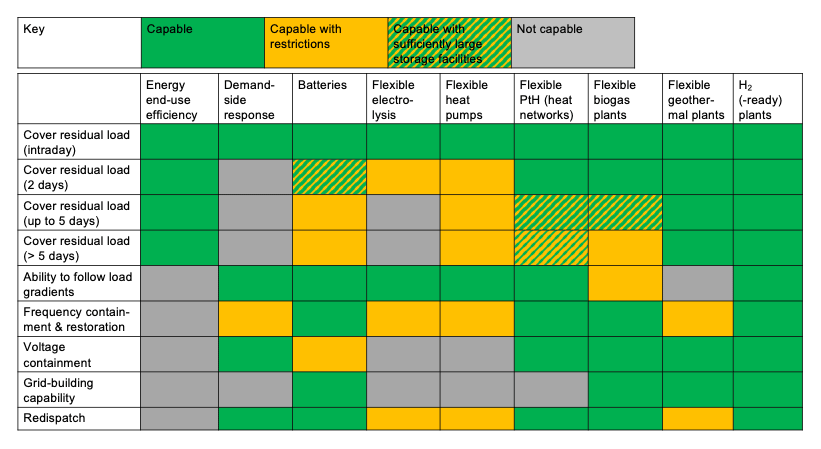
Figure 1
Suitability of flexibility options for different purposes.
Particularly relevant to this study is the flexibility purpose of covering positive residual load. The calculation of the residual load includes biomass plants and hydropower in their current mode of operation in the contribution of renewable energies. In this way, the more flexible operation of biomass plants and hydropower can be analysed as an alternative flexibility option to cover the residual load.
The challenges for the system are primarily determined by the level of residual load and the duration of events of high positive residual load. The duration determines the difficulty of the task and thus the fundamental suitability of the alternative flexibility options. The level of residual load determines the required capacities and is discussed below.
With regard to the duration of the residual load, we consider it useful to distinguish between four cases as introduced above.
The alternative flexibility options are very well suited to the flexibility task of ‘covering positive residual load (intraday)’.
An event lasting two days can still be handled well by many storage options (shown in green in Figure 1) and, with the appropriate design, also by batteries (hatched).
At least for the next 5 to 10 years, even many situations involving high positive residual load over up to five days can be covered without any capacity gap by combining alternative flexibility options and optimising their coordinated interaction with renewable energy plants and existing power plant capacities. The flexibility options suitable for this purpose are also marked in green or green–yellow in the figure for the flexibility task ‘Coverage of positive residual load (up to 5 days)’. The hatching means that it is not a technical but an economic question how much storage capacity can be created in each case to bridge several days.
However, many of these flexibility options reach their limits when, over a period of more than five days, both photovoltaics and wind energy deliver only low output while electricity demand remains high, resulting in a high residual load over a longer period of time. Such situations usually occur in the winter months and are often referred to as ‘cold dark doldrums’.
There are three flexibility options that can make an unrestricted, permanent contribution to closing a residual load coverage gap in the event of high residual loads for more than five days in winter. These are
the targeted increase of energy efficiency in end uses that have a high load during such events,
geothermal power generation (usually in combined heat and power) and
controllable backup power plants.
One of the most suitable electricity end uses for targeted energy efficiency measures is thermal insulation in buildings heated by heat pump heating, which reduces the heat load of the buildings and thus the electricity load for heat generation in the heat pumps. This could reduce the residual load in winter by around 10 GW by 2035 and by around 25 GW in the long term. The long-term estimate is based on a total electricity saving potential of 60 TWh estimated by Mellwig et al. (2025) from thermal insulation of the worst-performing buildings, and applying average relationships between annual energy consumption and peak loads for heating systems, plus a slight reduction of the load reduction estimate to allow for the uncertainty, whether the event of high residual load may happen during less than very cold periods. The potential contribution by 2035 considers the speed of both thermal insulation and conversion to heat pumps in the building stock, according to existing scenario analysis (e.g., BNetzA, 2025a).
A second well-suited electricity end use for targeted energy efficiency improvements is lighting, which is particularly relevant during hours when there is little or no solar feed-in. Policies could particularly target lighting in office buildings, schools, or restaurants, but also in households and industry. Energy efficiency in other end uses in industry, implementing the still high cost-effective potential (Meyer et al., 2025) may also be relevant.
Even in such events of persistently high residual loads, the alternative flexibility options can make a significant contribution to covering the positive residual load when used in combination. In its report on security of supply in 2025, the Federal Network Agency (BNetzA) has determined an economically optimal contribution of demand flexibilities at the time of the annual peak residual load3 of just under 30 GW for the target scenario for 2035, while existing and new gas power plants would contribute a total of around 45 GW. In addition, there are other power plants and electricity imports. The latter, however, were assessed as economically advantageous, but potentially unreliable in individual cases of high residual load, as it is not uncommon for other countries to also experience challenging load situations at the same time and cross-border electricity connections have only limited capacity.
Even during such periods, the intraday balancing described above takes place, as the residual load can then fluctuate by around a third over the course of the day (BNetzA, 2025a, p. 44). This creates a synergistic effect: alternative flexibility options and controllable backup power plants can share the tasks, do not have to be rolled out each to cover the maximum load gap and do not have to be available at full capacity for the entire period. Therefore, a moderate expansion of backup power plants can enable better use of flexibilities and vice versa, which in turn can significantly reduce the need for additional backup power plants.
The ambitious expansion of renewable energies in line with the targets of the Renewable Energy Sources Act (EEG) also directly reduces the residual load during most of the year and even – albeit with a rather small contribution – during a prolonged period of high residual load in winter time.
An ambitious expansion path for renewable energies will also be associated with a greater expansion of alternative flexibility options. In line with the synergy effects described above, making better use of these options can also help to cover the residual load and ensure security of supply during a prolonged period of high residual load. This applies in particular to storage facilities, as these can be charged to a higher level before the residual load event occurs, provided that sufficiently good forecasting tools (for the expected load and feed-in) are available.
Estimates of the future demand for controllable backup power plants
Key findings
The comparison of the six scenario analyses cited above showed that there will be no or only very little demand in Germany (less than 5 GW) for net expansion of controllable backup power plants by 2030.
The recent security of supply report by the Federal Network Agency (BNetzA, 2025a) highlights the two fundamental alternatives for 2035 by comparing its two scenarios (target scenario based on energy transition targets of the previous German government and scenario with delayed energy transition4): We can either invest more heavily in alternative flexibility options and an ambitious expansion of renewable energies, thereby significantly reducing the need for backup power plants, or we must build more controllable backup power plants.
If policymakers pursue the BNetzA’s target scenario, the BNetzA’s report on security of supply suggests that the need for net expansion of controllable capacity could be limited to around 12.5 GW by 2035.
The BNetzA refers to ‘controllable capacities’ because there may be alternatives to controllable gas-based backup power plants (see below). In addition, the potential for targeted energy efficiency (see above) could be exploited more than assumed in the target scenario. However, the long-term need for controllable backup power plants beyond 2035 must also be taken into account (see below).
Findings in detail
In the target scenario, the BNetzA estimated a total capacity requirement for gas power plants of 45.4 GW by 2035. This results in a gross expansion requirement of 22.4 GW (including compensation for decommissioning, see below) or 12.5 GW of net capacity expansion.
In the delayed energy transition scenario, the demand for gas-fired power plants would be higher due to the slower expansion of renewable energies and, in particular, the lower availability of flexibility. The total gas-fired power plant capacity would thus be 58.5 GW in 2035, resulting in a gross additional capacity requirement of 35.5 GW or a net additional capacity requirement of 25.6 GW.
This shows that the gross demand for controllable backup power plants depends not only on the possible uses of flexibility options, but also crucially on the actual or expected level of increase in electricity consumption, the expansion of renewable energies, and the decommissioning or preservation of existing gas-fired power plants for backup or reserve purposes.
With regard to decommissioning, the BNetzA analysis results in primarily decommissioning CHP gas power plants on the grounds that district heating supply should be converted to renewable energies, including via heat pumps and PtH, as well as unavoidable waste heat. However, instead of building new backup power plants to replace CHP plants, the CHP plants could also be converted to backup operation for a transition period, by promoting the construction of large heat storage facilities. These CHP plants would only be allowed to operate for providing backup power during the high residual load periods, but not for regularly supplying heat.
It should also be noted that electrification increases electricity demand, and with it the residual load and the need for system services. However, electric vehicles with bidirectional charging or at least smart charging, heat pumps and PtH systems can directly provide flexibility.
From a technical perspective, the following alternatives could reduce or postpone the construction of new controllable backup power plants:
the targeted increase in energy efficiency on the demand side (see above)
large backup heat storage facilities in heating networks, which are filled with PtH plants before a prolonged event of high residual loads or even during such events, e.g. with hydrogen CHP plants, and can cover the heat demand for several days: this means that district heating does not have to be generated via heat pumps during this period, which reduces the residual load
keeping old gas-fired power plants as backup or in reserve (including CHP plants for backup power only)
the expansion of geothermal power plants for electricity generation; however, most studies estimate a limited economic potential of a few GW
additional biomass development (see above) with large gas storage facilities that can also bridge events of high residual loads lasting up to 10 days
voluntary and remunerated emergency measures to reduce industrial loads in a few events of prolonged and very high residual load that could occur once or twice over the course of several years. This option is conceivable in principle and should also be prepared for more than today (for emergency situations that could arise as a result of sabotage or hostile attacks), but we suggest it should not be firmly planned as a measure to cover high residual loads.
The decision on the best mix of options for an identified demand for controllable capacity and alternative options for secure load coverage is essentially an economic question, including appropriate regulatory measures and incentive systems. The economic analysis should take into account all macroeconomic costs, in particular climate-related costs.
Against this background, the level of controllable backup capacity that needs to be provided, particularly backup power plant capacity, is a political decision. It requires a careful appraisal process to take a decision on the size and nature of capacities needed for a few events of prolonged and very high residual loads that may happen over the course of several years, in addition to alternative flexibilities and controllable capacity designed for average events of prolonged high residual load (less than five days).
With respect to long-term sustainability of this decision, our analysis suggests that flexible biogas plants using existing biogas production and long-term heat storage in PtH installations should be given priority over fossil gas power plants, and any need for capacities exceeding the biogas potential should be directly operated with green hydrogen (which appears possible from ca. 2035 from current perspective) or build hydrogen-ready5 and converted to green hydrogen as soon as possible.
The above discussion focuses on the years 2030 to 2035. However, according to current scenario studies, a significantly higher expansion of new power plant capacities will be necessary in the long term. This also applies in the event that electricity demand may only increase significantly from 2035 onwards due to delayed electrification. For this reason, it is all the more important that the power plant capacities added by 2035 are already hydrogen ready (and that hydrogen infrastructures are established sufficiently early) or provided by flexible biomass plants.
It is also still unclear what contribution flexibility can make in the long term. Technological developments are likely to create new opportunities, while structural changes in industry could open up new options but also result in the loss of current load shifting potential. Potential synergy effects between different types of flexibility that can be exploited in the medium and long term also deserve closer consideration.
Conditions for the design and operation of controllable backup power plants
Key findings
Provided that new backup power plants are 1) hydrogen ready and converted to green hydrogen as quickly as possible, and 2) are only allowed to operate as backup power plants and only receive funding for this purpose, the amount of additional capacity is ultimately not decisive. An increase of a few GW more or less (in addition to an ambitious expansion of renewable energies and the consistent use of alternative flexibility options) will not jeopardise the climate target (in the budget approach); rather, it is a question of political trade-offs between costs and the desired level of security of supply and resilience.
It is important to ensure that these plants remain backup power plants – either through operating time limits or appropriate regulations (e.g. use only allowed subordinate to alternative flexibility options or providing subsidies only for gas turbines or possibly gas engines). The framework conditions must be set up in such a way that there is no economic pressure to generate electricity for the market in competition to the alternative flexibility options.
Findings in detail
New controllable backup power plants, which are initially fuelled by fossil gas, should be built hydrogen-ready and converted to green hydrogen as quickly as possible. This conversion seems realistic from today’s perspective from around 2035 onwards.
The green hydrogen should ideally come from flexible electrolysis, which in turn would create flexibility options.
New power plants should only be built for backup purposes, not for regular operation.
They should therefore be designed as hydrogen-ready gas turbines, i.e. not as combined cycle gas turbine (CCGT) plants; gas engine plants may be an alternative. The high operating costs of such plants automatically have a restrictive effect and prevent high utilisation rates.
New gas turbine backup power plants should also be built using combined heat and power (CHP) technology, provided that this is economically feasible given the specific local conditions. This will further contribute to security of supply on the heating side and ensure that fuel is used as efficiently as possible. They should primarily be integrated into existing heating networks (district heating and industrial parks) with heat storage, but only be allowed to operate as backup power plants.
Even before the switch to green hydrogen, the greenhouse gas emissions of such backup power plants would be low and their impact on the emissions budget would be rather small, because as backup power plants they would only be used for a few hours per year.
By contrast, fossil gas power plants with or without carbon capture, storage or utilisation (CCUS), and hydrogen power plants using ‘blue’ hydrogen from fossil gas with CCUS are not a viable option, because they lock in the use of fossil gas for a long period of time but cannot completely reduce greenhouse gas emissions. This would hinder or even prevent the achievement of climate neutrality by 2045.
Findings and suggestions for the development of the political framework
A targeted mix of policies and measures is needed to enable the necessary investments in alternative flexibility options and the controllable backup power plants that will still be required, and to ensure their use for flexibility purposes. The following is a short summary of the extended analysis in the underlying study (Thomas et al., 2026).
The Energy Efficiency First principle6 is an important basis for assessing the controllable backup power plants and the alternative flexibility options, as well as between these, and thus for optimising the technology mix. As decided by the EU, federal policy must now obligate transmission system operators and the Federal Network Agency (BNetzA) to apply the Energy Efficiency First principle in future grid development planning and in monitoring security of supply. At the same time, the BNetzA should require and promote the application of the principle in grid development and grid operation, in particular by distribution system operators.
It is therefore urgent to accelerate building renovation and other targeted energy efficiency measures in order to limit future electricity load growth and thus grid expansion and flexibility requirements: In particular, it is important to improve the German BEG subsidy programme for building renovation (20% higher subsidy) and to offer practical support through one-stop shops and district energy management, which above all address the non-technical barriers typical of the building sector.
Under EU law, all capacity tenders must also be technology-neutral and non-discriminatory. This certainly applies to the planned capacity market and, in fact, already applies to the 12 GW capacity tenders the German government is currently planning in the short term.
In accordance with the Energy Efficiency First principle, this means allowing all alternative flexibility options in principle, if necessary, through aggregators.
If derating factors are used to assess the availability of capacities in order to make their bids comparable, they must not disadvantage the alternative flexibility options.
As shown above, hydrogen readiness is a prerequisite for the backup power plants to be built, and the switch to green hydrogen should take place as soon as possible. It should be examined whether the bids should specify a fixed date or whether an incentive for the conversion should be created, e.g. by dividing the bids into an investment part and a Contract for Difference for the use of green hydrogen, and a bonus in the evaluation for bids with early conversion. Splitting the financial support in such a way is the plan of the current government. However, the conversion date would be 2040 or 2043, which we consider by far too late.
For reasons of energy efficiency, preference in new developments should be given to CHP plants integrated into existing municipal or industrial heating networks but operating only for backup power production, including in the case of gas turbines, whenever this is economically feasible.
An appropriate regulation for the repayment mechanism for revenues in the wholesale energy market and control reserve market must be developed.
As an alternative to tenders for new capacity, consideration should be given to extending the use of existing gas-fired power plants as backup power plants or, if necessary, as reserve capacity in security of supply standby, followed by direct replacement with alternative flexibility options and hydrogen power plants instead of prematurely building new H2-ready power plants that will be operated with fossil gas for several years.
It is also crucial to further accelerate the rollout of smart meters (EWI and BET, 2025). For consumption points below 100 kW, this is a prerequisite for the use of demand-side flexibility options, i.e. demand response, heat pumps, vehicle batteries and home storage.
Electricity prices and grid fees should generally be dynamic or time-variable. This is particularly important for demand-side flexibility options, but also for PtH plants and flexible electrolysers. For smaller consumers in particular, they should be accompanied by protective mechanisms, such as tariff models with safeguards against extreme price spikes or, even better, best billing clauses.
Streamlining and prioritising grid connection procedures: This can be achieved by, among other things, publishing available grid connection capacities, clear procedures and deadlines for grid compatibility tests, minimum criteria for the planning status and financing of projects, and uniform digitalised grid connection and grid access processes established by the Federal Network Agency (BNetzA) and handled via a central nationwide portal. These instruments are particularly relevant for large batteries, but also for flexible electrolysers, PtH plants, making biogas plants flexible through additional capacity and flexible geothermal plants, as well as for controlling grid expansion.
Improving redispatch: One proposal to promote grid-friendly behaviour of large batteries, flexible electrolysers, PtH plants, but potentially also flexible biogas and geothermal plants is a dynamic, daily redispatch price signal.
The financial support for heat storage in PtH, biogas conversion and geothermal energy, as well as the overall expansion and decarbonisation of district heating by the German BEW programme, should be increased to at least three billion euros per year.
New ways to finance grid expansion at lower cost: In addition to applying the Energy Efficiency First principle, financing costs can be reduced in particular through government acquisition of shares or investment in the equity capital of TSOs and, where applicable, DSOs, as well as citizen funds for acquisition of shares or investment in the equity capital of DSOs.
For the remaining distribution network expansion requirements after applying the Energy Efficiency First principle, and for investments in energy efficiency and digitalisation/smart grids in general, separate financing should also be made possible by law through appropriate recognition of the costs in incentive regulation.
The policies and measures discussed above differ considerably in their relevance for the different alternative flexibility options and backup power plants, as briefly explained above and analysed in more detail in (Thomas et al., 2026). Figure 2 provides an overview.
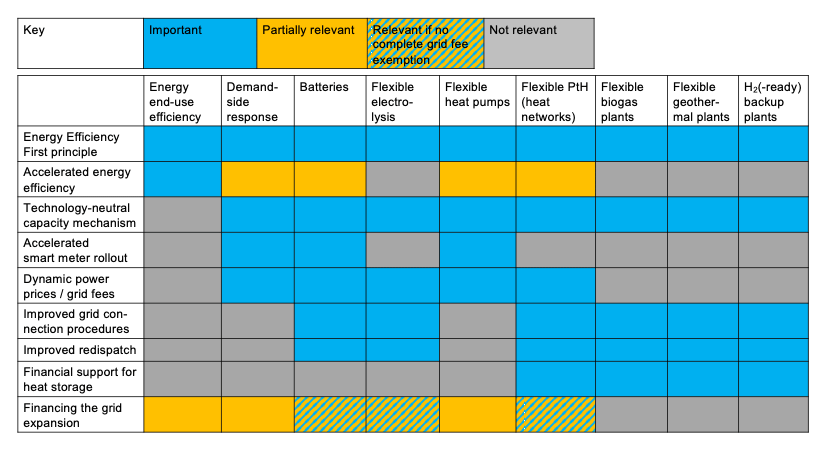
Figure 2
Relevance of policy instruments for the various flexibility options.
Discussion
While this analysis was able to create a qualitative overview of 1) the capability of nine relevant types of alternative flexibility options to provide the most important purposes of flexibility and 2) relevant policy instruments discussed in the literature to support the investment in and flexible operation of these alternative flexibility options, the limited resources available for the study left us with some unresolved questions.
Most importantly, we had no possibility for own technical and economic modelling to assess, what could be an optimal mix of alternative flexibility options and backup power plants for 2030, 2035, 2040, and 2045. Therefore, we had to rely on existing studies that modelled power demand and the power supply system in Germany for either security of supply or climate policy scenarios reaching GHG emissions neutrality by 2045, Germany’s target year. Probably the most comprehensive modelling was performed for the German energy regulator, BNetzA (2025a), for the German report using the methodology of the European Resource Adequacy Assessment. It also includes a scenario in line with meeting the climate target, and we cited some results in our results section above. Yet, even this analysis has been criticised for not being comprehensive, e.g., almost completely excluding utility-scale batteries due to the cost-optimisation model that prefers flexible use of vehicle and home batteries – although large capacities of utility-scale batteries are currently being developed in Germany.
It is important to note that it is not possible to simply add up capacities of alternative flexibility options and backup power plants and compare them with the maximum residual load, but that such integrated modelling, which also follows the Energy Efficiency First principle, is required.
Yet, even the literature on the potential and relative cost of alternative flexibility options and backup power plants is often showing large bandwidths – not the least because their potential and relative cost are often dependent on the policy framework.
We were also not able to fully examine further alternative flexibility options. A lot of innovation is currently on its way, e.g., on new storage technologies using compressed air, sand, iron, high-temperature storage materials, building pumped hydro storage in abandoned lignite pit mines, or even transatlantic power cables between Europe and South America, but most of these may not become fully commercial in the main timeframe of our study, which is the period until 2035.
As for the policy framework, some studies have modelled the impact of some policy instruments on some of the alternative flexibility options, but we are not aware of a study with an integrated modelling of the impact of all elements of the policy mix we suggest in Figure 2 on the speed of development for all the alternative flexibility options and on their flexible operation – and in the integrated system model.
Therefore, this research field presents many opportunities for further study to fill these gaps.
Conclusions
This paper performed a systematic review of the potentials for reducing the peak residual load and providing the most relevant system services, for a set of nine alternative flexibility options in comparison to gas power plants that are at least ready to use hydrogen instead of fossil gas. The most important findings include:
No new gas-fired power plants are needed for regular operation in the market; only backup capacities will be required, if other flexibility options are optimally exploited.
Flexible backup power plants need only come into play after 2030. However, in the interests of climate protection (CO2 emission reduction, efficiency, etc.), they may only operate as a secondary option to other flexibility options.
The available energy system analyses show that a combination of reducing the annual peak residual load and constructing backup power plants with a total capacity of around 12 GW will suffice until 2035, after which demand for this combination will increase.
The required capacity of the backup power plants depends on the extent to which it is possible to systematically reduce the annual peak residual load (in particular through additional targeted energy efficiency and long-term heat storage in heating networks with PtH plants). These measures should be implemented in a targeted and prioritised manner.
The actual medium to long-term demand for backup capacities and alternative flexibility options should be determined in a process that leads to an adaptive, step-by-step and technology-neutral expansion decision, based, i.e., on the Energy Efficiency First principle.
The backup power plants should with priority be provided in the form of flexible biogas power plants. If further backup power plants may be needed to cover prolonged periods of high residual load with a generation gap, they should be hydrogen-ready from the outset. Hydrogen-ready power plants should, in the long term, be operated exclusively with green hydrogen, which seems realistic from today’s perspective from around 2035 onwards.
Incentives for targeted energy efficiency measures and other systematic load reduction measures are currently hardly discussed in public. This gap must be closed, as these measures are important for reducing capacity requirements for load coverage and ensuring security of supply.
The flexibility options examined can also cover other flexibility purposes, such as balancing power and other system services, and redispatch.
Policy-makers and industry need to create the appropriate framework conditions for investment and the operation of alternative flexibility options. This applies to residual load coverage, system services and security of supply in the event of outages.
Backup capacities should immediately be tendered in a fair technology-neutral manner – not only after the closed tendering for gas-fired power plants planned by the German government, and particularly including storage and flexible loads – and with a view to climate neutrality in the future.
However, as the discussion section revealed, there is a lot of further analysis needed to better understand what could be an optimal mix of alternative flexibility options and backup power plants for 2030, 2035, 2040, and 2045, and what could be the optimal policy mix to enable the investment in and flexible operation of these assets for residual load coverage, system services and security of supply in the event of outages.
Additional File
The additional file for this article can be found as follows:
Demand-side energy efficiency and flexibilities – potentials for peak load reduction and system services, and policies to make them reality
Slides for the presentation of this article at the eceee 2026 Summer Study, Lac d’Ailette, France, 4 June 2026. DOI: https://eceeeproceedings.org/articles/70/files/6a59fdff1f4bf.pdf
Notes
[1] In the last 10 years, this happened on average less than once a year in Germany (Kirk, 2026). The frequency of such events in the future will depend, i.a., on the share of variable renewables and the total load.
[2] This means that adding additional engines significantly increases the maximum power generation capacity of a biogas plant, while biogas production and thus the amount of electricity generated per year remains the same. In addition, a larger biogas storage facility is required. The plant can then be used much more flexibly: in times of high residual load, its electricity output is up to two or three times higher than before, while in times of low or negative residual load, it is lower or zero.
[3] According to the analysis for the report, this point in time is in the middle of a period of high residual load in winter time lasting about a week.
[4] In the target scenario, the expansion of renewable energies for electricity generation develops as in the current version of the German Renewable Energy Sources Act. Electricity demand increases as the targets for the electrification of transport, heating and industry, as well as for hydrogen electrolysis, are achieved. This, together with home storage systems for photovoltaic installations, creates corresponding capacities for demand flexibility.In the scenario with a delayed energy transition, it is assumed that both the expansion of renewable energies and electrification will be delayed by two years. In addition, the flexibility of new consumers will be reduced by about half compared to the target scenario.
[5] There is still no specific definition for the term “hydrogen-ready power plant”, but there is an implicit one in the German CHP Act: power plants are described as hydrogen ready if less than 10% of the investment costs are required to convert the plants completely to hydrogen. Further information can be found in literature (e.g., Christidis et al., 2023).
[6] In short, it states that whenever it is more cost-effective to reduce energy consumption through alternative energy efficiency measures on the demand side or in energy supply, or to achieve cost savings through demand-side response and other flexibility solutions, these alternatives should be given priority over expanding energy supply.
Data accessibility statement
No original data were developed. All literature sources for the analysis are accessible in the underlying report (Thomas et al., 2026).
Author contributions
Stefan Thomas coordinated both the underlying study and the writing of this paper. Christine Krüger, Frank Merten and Birte Schnurr analysed the ability of the alternative flexibility options to reduce or cover high residual loads and to provide system services. Felix Suerkemper and Florin Vondung performed the policy analysis. Anike Peters reviewed the results and made significant contributions to the conclusions section.
eceee Paper ID
2-138-26