
Table 1
Analytical Dimensions of Governance-Induced System Inefficiency.
| GOVERNANCE CONDITION | COORDINATION DYNAMIC | OBSERVABLE MARKER | SYSTEM-LEVEL EFFICIENCY CONSEQUENCE |
|---|---|---|---|
| Temporal misalignment in infrastructure planning | Grid reinforcement and capacity allocation lag behind deployment cycles | Curtailment, congestion, delayed connections | Underutilised generation capacity |
| Market–flexibility mismatch | Solar output expands faster than storage, demand response, and grid flexibility | Price volatility, revenue instability, voluntary curtailment | Elevated investment risk and reduced economic utilisation |
| Permitting and spatial misalignment | Uneven regional criteria and weak alignment between land-use planning and grid availability | Extended timelines, project redesign, risk shifting to developers | Increased transaction and coordination costs |
| Institutional layering through reactive adaptation | Compensatory measures introduced to manage unresolved coordination gaps | Storage integration, hybrid configurations, conditional grid connections | Infrastructure redundancy and rising procedural complexity |
Table 2
Overview of interviewed organisations and rationale for their selection.
| INTERVIEW ID | GOVERNANCE LEVEL | RATIONALE FOR SELECTION |
|---|---|---|
| Int. 01 | Civil society | Provides perspective on procedural complexity, legitimacy costs, and transaction burdens associated with solar deployment |
| Int. 02 | Industry association | Offers sector-wide insight into investment conditions, regulatory uncertainty, and coordination costs facing developers |
| Int. 03 | Developer (private sector) | Contributes operational perspective on grid access uncertainty, connection timelines, and project-level transaction costs |
| Int. 04 | Developer (private sector) | Contributes operational perspective on grid access uncertainty, connection timelines, and project-level transaction costs |
| Int. 05 | Regional authority | Provides insight into spatial governance, permitting variation across regions, and institutional misalignment in land-use planning |
| Int. 06 | National agency | Represents top-down coordination; shapes policy frameworks governing grid integration and renewable deployment |
| Int. 07 | National agency | Shapes grid-planning frameworks; provides insight into infrastructure capacity constraints and system-level coordination challenges |
| Int. 08 | Research intermediary | Bridges science, policy, and industry; offers cross-cutting perspective on governance gaps and systemic inefficiencies |
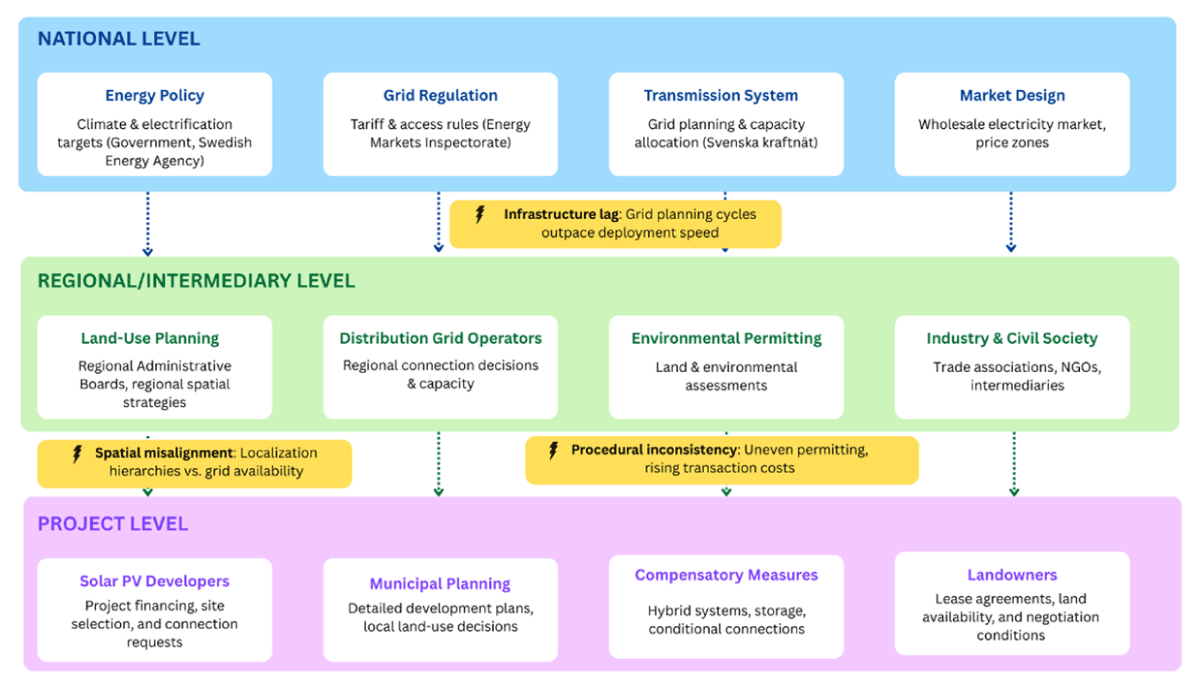
Figure 1
Governance actors and coordination gaps in Swedish solar PV integration.