
Introduction
Energy efficiency is widely recognised as a cornerstone of the transition to a zero-carbon energy system (Dunlop, 2019; Thollander et al., 2019). In policy debates, however, it is often treated as a technical question, concerned primarily with the demand side, improving the performance of individual technologies, components, or processes (Dunlop, 2019). While these measures are essential, they capture only part of the picture. At the scale of entire energy systems, efficiency depends not only on technologies but also on how institutions coordinate infrastructure development, investment incentives, planning procedures, and grid operations (ESIG, 2025). When governance arrangements fail to align with technological change, inefficiencies can emerge even when individual technologies perform well (ESIG, 2025).
This institutional dimension becomes particularly visible in the rapid expansion of renewable electricity (Baker et al., 2021; Marra & Colantonio, 2022; Yang et al., 2022). Across Europe, large-scale solar PV parks have grown from a niche technology into a central pillar of decarbonisation strategies (IEA, 2025c; EPRS, 2022). The speed of this expansion has, in many cases, outpaced adjustments in grid planning, land-use regulation, and market design, producing conditions of congestion, curtailment, and procedural complexity (ACER, 2024; IEA, 2025b). These challenges reflect misalignment in governance and planning frameworks rather than shortcomings in solar PV technology itself (ESIG, 2025).
This paper examines energy efficiency from this broader governance perspective, understood here primarily from the supply and system side rather than the demand side of the concept. Rather than addressing end-use efficiency, such as reductions in consumption or improvements in appliance and building performance, the analysis is concerned with how policy design and institutional coordination influence system-level efficiency outcomes. System efficiency is understood here as the effective alignment between generation capacity, grid infrastructure, spatial planning, and regulatory processes. When this alignment is weak, inefficiencies arise in the form of underutilised capacity, elevated transaction costs, and increased exposure to curtailment. When coordination is strong, renewable expansion can occur with lower system costs and greater reliability (Gorman et al., 2025; Kooij et al., 2025; Schermeyer et al., 2018; Sandin Lompar & Neij, 2025).
Sweden offers a particularly instructive case. Already possessing a largely fossil-free electricity mix, the country has seen rapid growth in utility-scale solar PV, especially in southern regions, without a clearly articulated national strategy for integrating large-scale solar into grid development and land-use planning. Because the grid is already decarbonised, integration challenges cannot be attributed to fossil incumbency or technological immaturity; governance becomes the primary explanatory variable. In this sense, Sweden functions less as a representative case than as an exemplary one: a front-runner context that illustrates where many European energy systems are heading as carbon targets are met and structural integration becomes the central challenge. The Swedish case therefore raises a central question: how do governance arrangements shape the efficiency of renewable expansion when deployment proceeds faster than institutional coordination?
Drawing on qualitative analysis of policy and strategy documents produced by national and international energy agencies, regional governments, the national grid operator, research organisations, industry associations, and civil society actors, alongside interviews with representatives from these institutional domains, the paper investigates how system-level efficiency is constructed, or constrained, in practice. It argues that efficiency in renewable-led transitions is not merely a matter of technological optimisation, but of coordination, between infrastructure investments and policy frameworks, between spatial and energy planning, and between market incentives and regulatory oversight.
Energy Efficiency as a Governance Question
Energy efficiency is most often discussed at the level of devices and technical processes, how much of the energy entering a system is converted into useful output rather than lost. These measures are important, but they tell us little about how efficiently an energy system functions as a whole. A grid populated with high-performing solar installations can still operate inefficiently if generation cannot be absorbed, if infrastructure must be duplicated, or if regulatory uncertainty deters investment (Frew et al., 2021; O’Shaughnessy et al., 2020). In other words, system-level efficiency depends not only on technological performance, but on how effectively the institutions governing energy coordinate their decisions.
This distinction between device-level and system-level efficiency provides the analytical starting point for this paper. The system-level efficiency outcomes examined here are treated as a function of governance efficiency, that is, the effectiveness of institutional arrangements, coordination mechanisms, and procedural relationships, rather than as an intrinsic property of energy technologies themselves. Rather than evaluating the technical performance of solar PV, the analysis examines how governance arrangements shape the conditions under which renewable capacity is built, connected, and utilised. Three theoretical perspectives help clarify why institutional coordination matters for governance and system efficiency.
Coordination costs and institutional friction
Transaction cost economics offers a useful lens for understanding how governance structures influence system performance. When responsibilities are distributed across multiple actors, grid operators, planning authorities, developers, regulators, coordination itself becomes costly (Appelberg, 2025). These costs include negotiating connection agreements, navigating overlapping regulatory requirements, managing uncertainty around infrastructure timelines, and resolving conflicts between actors operating under different mandates and incentives. When such coordination costs are high, investment may be delayed, discouraged, or channelled into configurations that are technically feasible but systemically suboptimal (Palm, 2021; Sandin Lompar & Neij, 2025).
In the context of rapid renewable expansion, this dynamic becomes particularly visible. When deployment accelerates faster than institutional arrangements can adapt, coordination costs tend to increase (O’Shaughnessy et al., 2021). Developers encounter uneven permitting practices and uncertain grid access, while grid operators face connection requests that outpace planning cycles (OECD, 2025; IEA, 2025b). The resulting inefficiencies are not technological failures, but manifestations of institutional friction, inefficiencies rooted in governance structures rather than in the performance of solar technology itself (ESIG, 2025). Conditional connection agreements and hybrid system configurations can be interpreted as responses to this friction, enabling continued deployment under uncertainty, yet often at the cost of added complexity and expense (De Santi et al., 2025; van Druten & van Wieringen, 2025).
System efficiency and observable markers of inefficiency
The grid-integration literature provides a more operational perspective on what system-level inefficiency looks like in practice. Curtailment, the deliberate reduction of renewable output when the grid cannot absorb it, is one of the clearest indicators. When grid infrastructure lags behind generation capacity, curtailment rates increase, reducing the effective utilisation of installed assets and weakening the economic rationale for investment (IEA, 2025b; Jacobsen & Schröder, 2012; Laimon, 2025; Niet et al., 2018; Schermeyer et al., 2018).
Infrastructure redundancy presents a related challenge. When developers must finance compensatory solutions, such as storage installations, alternative connection routes, or locally funded reinforcements, because coordinated planning has not anticipated system needs, overall system costs rise without proportional gains in reliability or capacity (Appelberg, 2025; Svenska kraftnät, 2024a). These additional layers of infrastructure may stabilise individual projects, but they also signal underlying coordination gaps.
Investment risk forms a third dimension of system efficiency. Regulatory uncertainty concerning grid access, permitting timelines, and revenue conditions requires investors to evaluate the anticipated efficiency of the system before committing capital, and this evaluation increases the cost of capital for renewable projects (Alonso-Travesset et al., 2023; IEA, 2025a). Over time, this may influence not only how much capacity is built, but what kind of capacity is prioritised. Shorter-horizon or lower-commitment configurations may be favoured over more integrated, system-optimising solutions. The result can be a system that appears robust in installed capacity but remains institutionally fragile.
Taken together, curtailment, infrastructure redundancy, and elevated investment risk serve as observable markers of system inefficiency. Crucially, these markers are traceable to governance conditions rather than to technological constraints. They provide the empirical reference points for the analysis that follows.
Institutional misalignment and multi-level governance
A third perspective, drawn from research on multi-level governance and institutional fit, helps explain why such inefficiencies arise and persist (Köhler et al., 2019; Markard et al., 2012). Renewable energy systems are governed simultaneously across national, regional, and local levels (Dobravec et al., 2021; Radtke & Wurster, 2023). National energy policy sets broad objectives. Regional authorities oversee land-use and environmental review. Municipalities exercise planning autonomy. Grid operators manage technical integration. Each of these actors operates with distinct planning horizons, procedural logics, and accountability structures (Ansell & Gash, 2008). The regional level is also where broader EU policy principles are meant to be operationalised. The Energy Efficiency First (EE1st) principle, enshrined in the recast Energy Efficiency Directive (EU) 2023/1791, requires that cost-effective demand-side efficiency measures be prioritised over new supply-side investment. Regional authorities have struggled to translate this principle into planning practice, a gap that projects such as REGIO1st have sought to address through dedicated planning frameworks and decision-support tools (Mandel et al., 2024). This illustrates how the regional layer is tasked not only with land-use and environmental review, but with actively reconciling demand-side and supply-side priorities within its own planning decisions.
When these levels fail to align, whether in timelines, incentives, or interpretive practices, institutional misalignment emerges (Glaa & Mignon, 2020; Hermanson, 2018; Kooij et al., 2018; Mamat et al., 2025). This condition does not necessarily reflect poor performance by any single actor (Epstein et al., 2015). Rather, it reflects the structural difficulty of coordinating across governance boundaries in a context where technological change advances more rapidly than institutional reform (Geels et al., 2017). Renewable deployment is often driven by market signals and declining technology costs, while infrastructure planning and regulatory adjustment proceed through slower, politically mediated processes (Radtke, 2025). The gap between these tempos can become a persistent source of system inefficiency (Geels et al., 2017; Köhler et al., 2019).
An analytical framework
Drawing on transaction cost economics, multi-level governance research, and the grid-integration literature, these three perspectives converge on a common conclusion. Efficiency losses in renewable-led energy systems frequently stem from institutional fragmentation rather than from technological limitations. Mechanisms exist to balance variable solar generation against system demand, including electricity demand and its underlying determinants, and storage deployment (Deng et al., 2022). Yet whether these mechanisms are mobilised effectively is itself shaped by the institutional and regulatory conditions examined here, rather than being a purely technical or market-driven outcome. Where coordination costs are high, where infrastructure planning lags behind deployment, and where responsibilities are misaligned across governance levels, inefficiencies emerge that are systemic rather than incidental. Table 1 summarises the governance conditions, coordination dynamics, and observable efficiency consequences that structure the analysis.
Table 1
Analytical Dimensions of Governance-Induced System Inefficiency.
| GOVERNANCE CONDITION | COORDINATION DYNAMIC | OBSERVABLE MARKER | SYSTEM-LEVEL EFFICIENCY CONSEQUENCE |
|---|---|---|---|
| Temporal misalignment in infrastructure planning | Grid reinforcement and capacity allocation lag behind deployment cycles | Curtailment, congestion, delayed connections | Underutilised generation capacity |
| Market–flexibility mismatch | Solar output expands faster than storage, demand response, and grid flexibility | Price volatility, revenue instability, voluntary curtailment | Elevated investment risk and reduced economic utilisation |
| Permitting and spatial misalignment | Uneven regional criteria and weak alignment between land-use planning and grid availability | Extended timelines, project redesign, risk shifting to developers | Increased transaction and coordination costs |
| Institutional layering through reactive adaptation | Compensatory measures introduced to manage unresolved coordination gaps | Storage integration, hybrid configurations, conditional grid connections | Infrastructure redundancy and rising procedural complexity |
This framework guides the empirical analysis of the Swedish case. The study examines how coordination costs, curtailment pressures, investment risk, and institutional misalignment manifest in the governance of large-scale solar PV. In doing so, it seeks to illuminate how governance arrangements shape the efficiency of renewable integration, and what this implies for the broader design of renewable-led energy transitions.
Methodology
This study adopts a qualitative, interpretive research design (Schwartz-Shea & Yanow, 2013). The objective is not to measure technical performance or quantify energy losses, but to understand how actors experience and respond to coordination challenges affecting infrastructure utilisation, investment conditions, and grid integration as large-scale solar PV has expanded rapidly across Sweden, particularly in southern regions where electricity demand and price signals are strongest and where grid pressures have become most visible. Rigour in this design is established through credibility, transferability, dependability, and confirmability (Guba, 1981), rather than through statistical significance or generalisability. These criteria are addressed through purposive sampling across governance levels and institutional roles and through triangulation between interview accounts and an extensive document corpus, rather than through numerical estimation.
Data collection
The empirical material draws on two sources: document analysis and semi-structured interviews. The document analysis covers policy reports, regulatory guidance, grid operator publications, industry position papers, research reports, and regional planning documents produced between 2018 and 2025. These materials originate from national authorities (including the Swedish Energy Agency), international organisations (such as the IEA PVPS programme), regional governments, the national transmission system operator, research institutes, industry trade associations, and civil society organisations. The documents were selected for their direct relevance to grid integration, permitting processes, infrastructure planning, and renewable deployment.
Eight semi-structured interviews were conducted with representatives from national agencies, a regional authority, grid operators, private developers, an industry association, a civil-society organisation, and a research intermediary. Purposive sampling was employed to ensure both vertical coverage across governance levels (local, regional, and national) and horizontal diversity across institutional roles (public authorities, private developers, civil society, and research). Interviews were conducted online, between August and September 2025, lasting 30–40 minutes each, in Swedish. Informed consent was obtained from all participants at the outset, after which interviews were recorded, transcribed verbatim, and anonymised. They focused on participants’ experiences with grid access, permitting procedures, investment decisions, and perceived bottlenecks in solar deployment. Table 2 provides an overview of the interviewed organisations and the rationale for their selection.
Table 2
Overview of interviewed organisations and rationale for their selection.
| INTERVIEW ID | GOVERNANCE LEVEL | RATIONALE FOR SELECTION |
|---|---|---|
| Int. 01 | Civil society | Provides perspective on procedural complexity, legitimacy costs, and transaction burdens associated with solar deployment |
| Int. 02 | Industry association | Offers sector-wide insight into investment conditions, regulatory uncertainty, and coordination costs facing developers |
| Int. 03 | Developer (private sector) | Contributes operational perspective on grid access uncertainty, connection timelines, and project-level transaction costs |
| Int. 04 | Developer (private sector) | Contributes operational perspective on grid access uncertainty, connection timelines, and project-level transaction costs |
| Int. 05 | Regional authority | Provides insight into spatial governance, permitting variation across regions, and institutional misalignment in land-use planning |
| Int. 06 | National agency | Represents top-down coordination; shapes policy frameworks governing grid integration and renewable deployment |
| Int. 07 | National agency | Shapes grid-planning frameworks; provides insight into infrastructure capacity constraints and system-level coordination challenges |
| Int. 08 | Research intermediary | Bridges science, policy, and industry; offers cross-cutting perspective on governance gaps and systemic inefficiencies |
The material draws on a broader research project examining governance conditions in Swedish solar expansion; the present paper focuses specifically on the efficiency-related consequences of those governance arrangements, an analytical dimension not addressed in prior outputs from that project.
Analytical strategy
The analysis proceeded through iterative qualitative coding (Morgan & Nica, 2020) organised around three sensitizing themes derived from the theoretical framework: infrastructure utilisation (including grid congestion, curtailment, and connection constraints); investment conditions (including regulatory uncertainty, risk allocation, and compensatory infrastructure solutions); and procedural coordination (including permitting variation, administrative delays, and transaction costs). These themes were not treated as fixed categories, but as orienting concepts used to trace how institutional arrangements shape observable efficiency outcomes.
Triangulation between documents and interviews was central to the analytical process. Policy texts provided insight into formal rules and planning assumptions, while interviews revealed how those rules are enacted and experienced in practice. Comparing these sources made it possible to distinguish between intended governance design and its operational consequences. This distinction is particularly important when examining how coordination gaps arise not from isolated policy failures, but from the interaction between formal arrangements and the pace of renewable deployment.
Delimitations
The study does not quantify curtailment levels, calculate cost impacts, or evaluate economic efficiency in numerical terms. Instead, it examines how governance arrangements shape the conditions under which efficiency gains or losses occur, prioritising depth of institutional understanding over measurable precision. The findings are most applicable to national contexts that share key features of the Swedish case: mature, liberalised electricity markets, modernised grid infrastructure where the primary challenge is flexibility and integration rather than basic access, and jurisdictions where renewable expansion is outpacing institutional adaptation. Countries at earlier stages of grid development or with less liberalised market structures may face different governance dynamics, and the conclusions should be read with this scope in mind.
Findings and Analysis
This section examines how governance arrangements shape system-level efficiency in the expansion of large-scale solar PV in Sweden. The findings are organised around four dimensions: infrastructure utilisation, market-related underutilisation, compensatory integration measures, and spatial allocation dynamics. Together, these empirical patterns illustrate how coordination gaps and institutional misalignment translate into concrete pressures on grid capacity, investment stability, and resource use.
Infrastructure utilisation and capacity constraints
The rapid expansion of large-scale solar PV in Sweden has exposed a structural tension between deployment speed and grid adaptation. While solar parks can be planned and constructed within relatively short timeframes, grid reinforcement and capacity allocation operate on significantly longer planning cycles. The resulting mismatch has emerged as one of the most visible efficiency challenges in the current phase of renewable expansion.
Sweden’s electricity market is divided into four bidding zones (SE1–SE4), reflecting long-standing structural transmission constraints between the hydro-dominated north (SE1–SE2) and the demand-intensive south (SE3–SE4). These zones institutionalise north–south congestion within the market design itself, meaning that price formation and capacity allocation already reflect geographically embedded grid limitations. National grid operator reports acknowledge a sharp increase in large-scale solar connection requests in recent years, particularly in southern Sweden (SE3 and SE4), where electricity demand and price signals are strongest (Svenska kraftnät, 2021, 2024a). These reports frame the issue primarily as a planning and capacity management challenge: transmission and regional grids must balance increasing production requests with system security requirements and long-term reinforcement timelines. Curtailment is described as a legally available tool to maintain stability when necessary, and new approaches such as improved capacity analysis and dynamic line rating are explored as ways to utilise existing infrastructure more efficiently.
The grid operator representative confirmed this surge in applications and described an intensive period of learning and adaptation within the system operator. Large solar projects, often in the range of 50–100 MW or more, began to appear in significant numbers only in the last few years. From the grid operator’s perspective, this required new routines for capacity reservation and closer coordination with regional network operators. The representative from the national grid operator emphasised the need to balance enabling new production with maintaining operational reliability, particularly during summer periods when line capacity is reduced due to higher ambient temperatures and solar output is at its peak.
From the perspective of developers, however, the same conditions are experienced less as technical optimisation and more as uncertainty. The interviewed project developers described long response times, increased maturity requirements before meaningful grid dialogue can take place, and limited transparency regarding available capacity. Whereas grid reports present congestion as a technically manageable but structurally embedded system constraint, developers interpret it as a risk factor that must be absorbed early in the project cycle.
This divergence in perspective illustrates how capacity constraints translate into efficiency consequences. At the system level, congestion and curtailment represent forms of underutilisation: installed generation cannot always operate at full output, particularly during periods of high solar production. Developers and research actors interviewed in this study referred to increasing occurrences of very low or even negative daytime electricity prices during sunny periods, a pattern sometimes described as a “duck curve,” where supply peaks at times of relatively low demand. Although such price signals are often interpreted as normal market adjustments, they also indicate that available renewable capacity is not fully absorbed by the system.
The interaction between wind and solar further complicates capacity allocation. Grid representatives emphasised that the correlation between these technologies can, in principle, allow more efficient use of existing network capacity if properly managed. In practice, however, allocating capacity based on anticipated correlations requires new analytical tools and revised planning assumptions. According to the grid operator representative, until such approaches are fully institutionalised, the system tends to rely on conservative allocation practices designed to protect reliability, even if this implies lower utilisation of renewable assets.
Taken together, findings from grid operator reports and interviews suggest that infrastructure utilisation challenges are not rooted in the technical performance of solar PV itself. Rather, they arise from institutional arrangements governing connection, capacity reservation, and operational security. Solar parks can be built rapidly, but their effective integration depends on planning processes, allocation rules, and reinforcement investments that evolve more slowly. The efficiency question, therefore, is not whether solar technology functions as intended, but whether the governance structures surrounding it allow installed capacity to be predictably and fully utilised.
Market signals and underutilisation
Beyond physical grid capacity, market dynamics increasingly shape the effective utilisation of large-scale solar PV in Sweden. While solar deployment has expanded rapidly, its integration into wholesale electricity markets has produced new patterns of price volatility that affect both system efficiency and investment stability.
National and international energy reports increasingly document how rising shares of variable renewable generation influence short-term price dynamics, including hourly price variation, congestion effects, and periods of curtailment or negative pricing (Wråke et al., 2022; Energimarknadsinspektionen, 2023a, 2023b, 2023c; IEA, 2025b; Svenska kraftnät, 2023). As solar capacity increases, particularly in southern Sweden, mid-day electricity prices have become more volatile and, in some periods, exceptionally low. From a system perspective, this reflects the merit-order effect: when large volumes of low marginal-cost generation enter the market simultaneously, prices decline. Although this outcome signals successful renewable deployment in economic terms, it also reveals a structural imbalance between generation profiles and demand patterns.
Interviews with developers confirm that mid-day price suppression has become a central concern for project viability. Several developers described a recurring pattern during sunny periods in which electricity is produced precisely when prices are lowest, compressing revenue streams and increasing exposure to market risk. In some cases, interviewees referred to the emergence of pronounced “duck curve” dynamics, where steep price drops occur during high solar production hours. While such price movements are technically consistent with market design, they introduce uncertainty that can deter long-term investment, particularly for projects without long-term power purchase agreements.
From the perspective of public authorities, declining prices during high-production periods are not necessarily interpreted as inefficiencies, but rather as signals that the system requires greater flexibility. Interviews with representatives from national authorities emphasised the need for demand-side response, storage integration, and more dynamic consumption patterns to absorb surplus generation. In this view, low prices are framed as an incentive for adaptation rather than a structural failure. However, the pace of flexibility development appears slower than the pace of solar deployment, reinforcing the temporal mismatch identified in the previous sub-section. This divergence in interpretation has efficiency implications. When solar generation is systematically concentrated in periods of low demand and limited flexibility, installed capacity may remain technically available but economically underutilised.
Market-related underutilisation also interacts with spatial dynamics. Regions with higher solar penetration experience stronger price compression effects, reinforcing geographical clustering patterns and potentially discouraging further development in already congested areas. In this way, price signals do not simply reflect system conditions; they shape subsequent investment decisions and spatial allocation, feeding back into infrastructure planning challenges.
Taken together, document findings and interviews with developers and public authorities suggest that market signals increasingly function as an indirect mechanism of system coordination. However, when flexibility mechanisms, storage capacity, and demand adaptation lag behind renewable expansion, these signals can generate efficiency losses in the form of revenue instability, voluntary curtailment, and uneven spatial development. The issue is therefore not that solar PV produces inefficiently, but that the surrounding market and flexibility structures are still adjusting to its rapid scale-up.
Compensatory integration measures and rising transaction costs
As infrastructure constraints and market volatility intensify, a range of compensatory integration measures has emerged. These measures are often presented as solutions that enable continued deployment under constrained conditions. At the same time, they introduce additional layers of technical, financial, and procedural complexity that reshape the efficiency profile of large-scale solar development.
One prominent response is the growing integration of storage and hybrid configurations. Policy documents and research reports (Energimyndigheten, 2025; Svenska kraftnät, 2023, 2024a, 2024b) increasingly highlight battery storage, co-location with wind, and demand-side flexibility as key mechanisms for improving system balance and reducing price volatility. From a system perspective, such measures promise more efficient use of existing grid infrastructure and smoother production profiles.
Interviews with developers confirm that storage is no longer viewed as optional in many contexts. The interviewed project developers described battery integration as a strategic necessity, particularly in areas with high solar penetration or price volatility. Rather than relying solely on energy sales during peak production hours, projects are increasingly designed to shift output toward higher-value periods or to provide ancillary services. However, developers emphasised that these configurations require substantial additional capital investment and introduce new layers of regulatory and contractual complexity. In this sense, storage functions both as an efficiency-enhancing technology and as a hedge against institutional and market uncertainty.
Grid operator representatives similarly described efforts to optimise existing infrastructure through more advanced analytical tools and allocation strategies. Approaches such as dynamic line rating, correlation-based capacity allocation between wind and solar, and refined reservation practices aim to extract greater utilisation from existing network assets. Yet, according to interviews with grid operator representatives, implementing these measures requires new data systems, revised planning assumptions, and internal procedural adaptation. Efficiency gains at the system level thus depend on institutional learning processes that take time to consolidate.
Beyond technical integration, transaction costs associated with permitting and grid connection have also increased. Developers described longer lead times, higher documentation requirements, and stricter maturity criteria before formal grid assessments are undertaken. In several cases, interviewees noted that substantial expenditures on land agreements, environmental assessments, and project design must be committed before any certainty regarding grid connection is obtained. While these requirements are often justified as necessary to prevent speculative applications and manage capacity scarcity, they effectively shift risk to project developers and increase the upfront cost of participation.
Land-use governance further contributes to this rising complexity. At the project level, these dynamics primarily manifest as procedural burdens and increased transaction costs for individual developers. Regional guidance documents and national reports emphasise careful site selection, particularly with regard to agricultural land classification and environmental considerations (Fyrbodals kommunalförbund, 2024; Naturskyddsföreningen, 2024; Länsstyrelsen Västra Götaland, 2025; Länsstyrelsen Skåne, 2024; Region Stockholm, 2023). Interviews with regional authorities confirm that judicial clarification regarding the permissibility of solar parks on different soil classes has led to more structured but also more demanding assessment procedures. Developers reported that navigating these criteria requires extensive dialogue, site-specific studies, and iterative adjustments. Although such scrutiny may enhance environmental legitimacy, it also lengthens development timelines and increases coordination costs.
Taken together, these compensatory measures illustrate how institutional adaptation generates new forms of systemic complexity. Yet they also raise the threshold for participation, increase transaction costs, and redistribute risk across actors. From an efficiency perspective, the system is not simply constrained by physical limits, but reshaped by layered governance responses that enable deployment while simultaneously increasing its organisational and financial burden.
Spatial governance and allocation efficiency
Beyond infrastructure capacity and market dynamics, the spatial governance of solar development plays a decisive role in shaping system-level efficiency. Whereas the previous section addressed land-use regulation as a source of project-level transaction costs, this section examines spatial governance as a system-level allocation mechanism with broader efficiency implications. Decisions about where solar parks are permitted, prioritised, or contested influence grid distance, connection costs, lead times, and the intensity of local conflict. In this sense, land-use regulation is not only an environmental or planning issue, but also an allocation mechanism with direct efficiency consequences.
Guidance documents from national agencies and regional governments (Naturskyddsföreningen, 2024; Länsstyrelsen Västra Götaland, 2025; Länsstyrelsen Skåne, 2024; Region Stockholm, 2023) emphasise careful localisation of solar parks, particularly with regard to agricultural land classification and competing land-use interests. Some reports (Länsstyrelsen Skåne, 2022; Länsstyrelsen Västra Götaland, 2025) advocate prioritising already impacted environments, such as industrial land, former extraction sites, or infrastructure corridors, before permitting development on productive agricultural soils. This hierarchy is often justified in terms of environmental protection and food security. At the same time, it implicitly shapes the geography of solar expansion by constraining where projects can proceed with lower procedural resistance.
Interviews with representatives from regional authorities confirm that judicial clarification and updated guidance on agricultural land have led to more structured and predictable assessment processes, thereby influencing the spatial distribution of projects and the relative ease with which certain locations can advance. Solar parks proposed on higher-quality agricultural soils face greater scrutiny and require more extensive justification. While this has improved consistency in decision-making, regional officials acknowledged that it has also increased the time and documentation required for project approval.
Developers described the practical consequences of these spatial constraints. The interviewees noted a gradual shift toward forest land or lower-grade soils in order to avoid prolonged permitting disputes. However, such sites may be located further from existing grid infrastructure, increasing connection costs and, in some cases, reinforcing congestion in already pressured regions. Developers emphasised that grid proximity remains a decisive factor in site selection, sometimes outweighing other planning considerations. Where localisation hierarchies and grid availability do not align, projects may be either delayed or redirected to technically feasible but systemically suboptimal locations.
Civil society actors expressed support for clearer localisation principles, arguing that predictable criteria reduce conflict and enhance legitimacy. At the same time, they acknowledged that grid constraints complicate strict adherence to prioritisation hierarchies. If lower-conflict sites lack feasible grid access, pressure may shift back to contested areas. This dynamic illustrates how spatial governance and infrastructure planning operate in partial disconnection from one another.
Regional development strategies further intensify this interaction. In southern Sweden, ambitions to increase regional electricity self-sufficiency have encouraged accelerated renewable deployment. However, when such ambitions are pursued without integrated grid and land-use planning, they risk amplifying congestion and increasing reliance on project-level compensatory solutions. Interviews with research and policy actors suggest that spatial planning and grid planning still operate on different temporal and institutional tracks, limiting the potential for anticipatory coordination.
Taken together, documentary and interview evidence indicates that spatial allocation is a central dimension of system efficiency. Where land-use regulation, grid availability, and market incentives are misaligned, solar development may proceed in ways that increase connection distances, raise transaction costs, or intensify regional congestion. Conversely, where spatial planning anticipates grid conditions and integrates energy considerations into land-use strategies, renewable deployment can occur with lower procedural friction and more efficient infrastructure utilisation.
Spatial governance thus functions as both a constraint and a coordination opportunity. It shapes not only where solar parks are built, but how effectively they can be integrated into the broader energy system. The efficiency challenge, therefore, is not solely one of technology or market design, but of aligning spatial decision-making with infrastructure development and system-wide planning objectives.
Figure 1 maps the governance architecture underlying the four dimensions discussed above. What the diagram makes visible is that the coordination gaps identified throughout this analysis do not stem from isolated failures by individual actors. They emerge from the interaction between institutions operating at different levels, working to different timelines, and accountable to different mandates. The yellow boxes mark where these coordination gaps sit within the architecture, while the lightning symbol identifies the specific friction points where misalignment between levels produces observable efficiency consequences. These correspond directly to the challenges examined in the preceding sections. The lag between national grid planning and the pace of solar deployment, the misalignment between land-use localisation hierarchies and where grid capacity actually exists, inconsistent permitting practices across regions, and the proliferation of compensatory measures at the project level all point to the same underlying condition. Coordination further up the governance chain remains unresolved, and the consequences are absorbed at the project level. The picture that emerges is not one of a system failing in isolated places. It is one of a governance architecture that has not yet caught up with the speed and scale of renewable expansion.
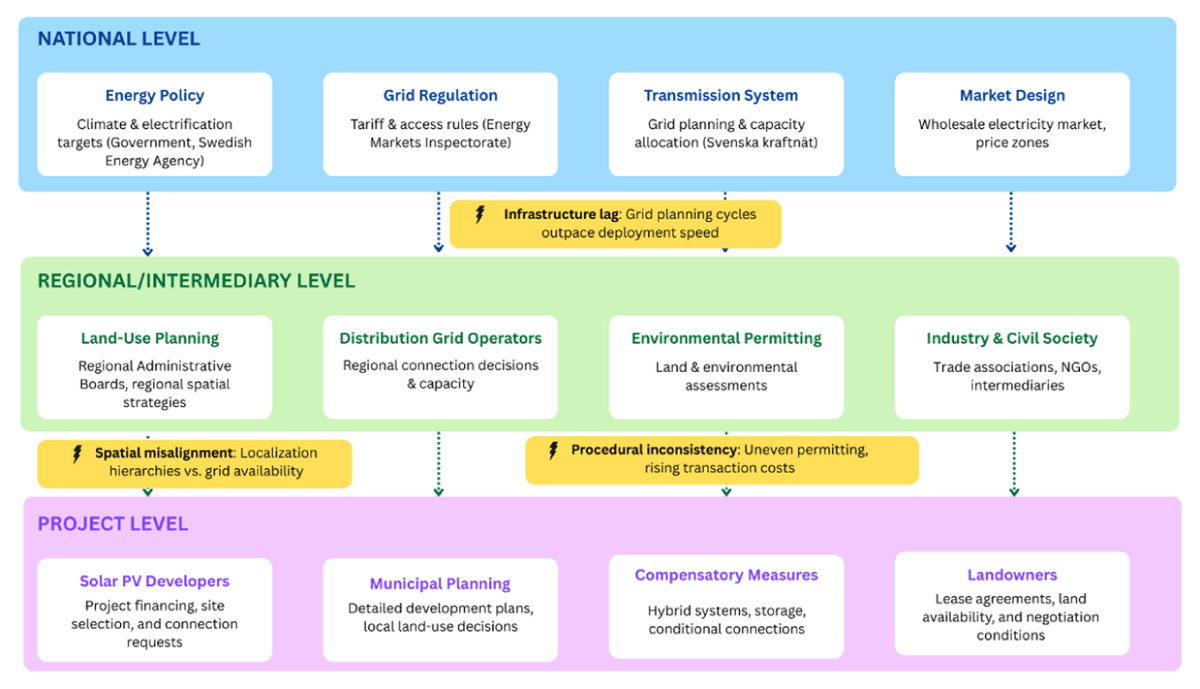
Figure 1
Governance actors and coordination gaps in Swedish solar PV integration.
Discussion
The Swedish case highlights an important insight: system-level efficiency in renewable-led transitions is shaped less by technological performance than by the institutional conditions governing deployment. Across all four empirical dimensions examined, infrastructure utilisation, market dynamics, compensatory integration measures, and spatial allocation, the sources of inefficiency are traceable to coordination gaps rather than to shortcomings in solar PV itself. Efficiency, in this context, emerges as a governance outcome.
The transaction cost perspective provides a useful interpretive lens for understanding these dynamics. Coordination costs are visible throughout the empirical material. Developers commit significant resources before grid feasibility is clarified. Permitting processes vary across regions, contributing to uncertainty and extended timelines. Conditional connection agreements and hybrid configurations often appear not as optimal design choices but as pragmatic responses to unresolved institutional ambiguity. These patterns align with expectations from transaction cost theory when governance responsibilities are fragmented and planning cycles misaligned. At the same time, the Swedish case suggests that such costs are not marginal. They accumulate and reshape participation conditions in renewable expansion, raising entry thresholds and redistributing risk.
The multi-level governance framework is also supported by the findings, yet the empirical material extends it in an important respect. Misalignment in Sweden is not only structural, between sectors or governance levels, but temporal. National grid investment operates on multi-year planning horizons. Regional land-use frameworks evolve more gradually. Solar park development cycles are comparatively short, while market signals shift even faster. When these different temporalities diverge, coordination gaps become embedded rather than episodic. While governance research has extensively examined structural fragmentation and multi-level coordination (Geels et al., 2017; Köhler et al., 2019), the Swedish case suggests that temporal misalignment warrants comparable analytical attention.
The findings further indicate that institutional adaptation may generate new forms of complexity even as it addresses existing gaps. Compensatory measures, including storage integration, hybrid configurations, dynamic line rating, and stricter maturity requirements, are introduced to manage congestion, uncertainty, and volatility. These responses enable continued deployment under constrained conditions. However, they also add procedural layers, increase financial commitments, and shift coordination burdens toward project developers and regional actors. Each successive response, conditional grid connections to manage capacity scarcity, storage requirements to absorb price volatility, stricter maturity criteria to filter speculative applications, sits on top of rather than replacing the underlying coordination gap that produced it. The result is an accumulating institutional architecture in which earlier misalignments remain unresolved while new procedural demands are layered on top.
Rather than signalling institutional failure, the pattern observed in Sweden suggests a process of governance layering. This dynamic complicates frameworks that treat institutional responses as inherently corrective within sustainability transitions (Markard et al., 2012). Adaptation may resolve specific bottlenecks while simultaneously producing new coordination demands.
Market dynamics both reinforce and complicate this interpretation. Mid-day price suppression is, in one sense, an expected outcome of a well-functioning wholesale market: prices fall when renewable supply exceeds demand, and this signal should not automatically be read as evidence of governance failure (Laimon, 2025). At the same time, in the Swedish and wider Nordic context, this dynamic is amplified by cross-border interconnection. Solar deployment in neighbouring markets, particularly Germany, contributes to downward price pressure during periods of coincident sunshine across interconnected European electricity markets (Stiewe et al., 2025). This raises a governance question that extends beyond Sweden’s institutional boundaries: whether grid and storage investment sized to accommodate a small number of peak summer hours is a proportionate response, or whether other instruments, such as extending grid codes beyond conventional power-quality requirements to include supply-side balancing obligations, or a nationally coordinated solar deployment strategy that anticipates the pace and location of capacity additions, would offer a more effective response. The data collected in this study cannot resolve this question directly, but it indicates that responsibility for addressing mid-day oversupply is currently distributed unevenly, and in places ambiguously, across grid operators, market actors, and national policymakers, rather than clearly assigned to a specific governance level or instrument.
Germany’s experience with its ongoing energy transition (Energiewende) offers a useful point of comparison, and one that illustrates a genuinely different governance logic. Grid congestion management cost the German system approximately €2.8 billion in 2024, a level the Federal Network Agency (Bundesnetzagentur) attributes to declining redispatch volumes as transmission grid expansion progresses. At the same time, solar curtailment volumes nearly doubled in 2024 as capacity growth outpaced this same grid expansion (Nuc, 2026). Rather than relying primarily on the project-level compensatory measures observed in the Swedish case, German policymakers have since addressed mid-day oversupply through binding, system-wide regulation.
The Act to Avoid Temporary Generation Surpluses (Solarspitzengesetz), adopted in February 2025, amended the Energy Industry Act (EnWG), Renewable Energy Sources Act (EEG) and Metering Point Operation Act (MsbG) to strengthen the controllability and market responsiveness of distributed generation. Among other measures, the reform introduced stricter requirements for the remote controllability of new PV installations, temporarily limits grid feed-in for certain installations lacking the required control technology, and generally removes EEG support for affected new installations during periods of negative wholesale electricity prices (Bundesrepublik Deutschland, 2025). This represents an ex-ante, nationally uniform alternative to the reactive, negotiated coordination pattern documented in Sweden. Technical and market obligations are imposed on new capacity at the point of connection, rather than emerging through case-by-case compensatory arrangements between developers and grid operators.
Whether this constitutes a more efficient governance response is not self-evident. It shifts cost and complexity onto individual system owners earlier in the process, but it also imposes upfront administrative burdens that could slow deployment, and does not resolve the underlying structural question of who ultimately finances grid expansion under a single bidding zone regime (Nuc, 2026; Zinke, 2023). The German case nonetheless demonstrates that anticipatory, binding regulation is a viable governance alternative to the reactive pattern identified here, and comparative research examining the relative costs and deployment effects of these two governance logics would be a valuable extension of this analysis.
Overall, the findings suggest that efficiency challenges in renewable-led transitions arise from misalignment across governance domains and planning horizons. The Swedish case illustrates how infrastructure constraints, spatial regulation, market incentives, and institutional adaptation interact to shape system performance. Efficiency, therefore, cannot be reduced to technological optimisation. It depends on how effectively governance structures coordinate investment cycles, regulatory frameworks, and spatial planning processes over time. Sweden’s value as an analytical case lies precisely in this visibility. Because the grid is already decarbonised, the efficiency losses documented here cannot be attributed to fossil incumbency or immature technology; they are governance losses. Many European energy systems are moving toward the configuration Sweden already occupies: grids where carbon targets are within reach but structural integration remains unresolved. The coordination challenges identified in this paper are not Sweden’s alone. They are a preview of the institutional work that renewable-led transitions will require more broadly.
Conclusions
This paper has argued that efficiency in renewable-led energy transitions is not primarily a technical issue. It is fundamentally a question of governance. The Swedish experience with rapid solar PV expansion shows how coordination gaps across institutional levels translate into concrete efficiency costs: curtailment, infrastructure duplication, rising transaction costs, and investment instability, even when the technology itself performs as expected. From this case, four broader lessons emerge.
First, coordination cannot remain reactive. When grid planning, spatial regulation, and permitting frameworks trail behind market-driven deployment, the system accumulates misalignments that become progressively harder and more expensive to correct. Compensatory measures may allow projects to proceed in the short term, but they do not resolve the underlying coordination deficit. Countries currently entering earlier phases of large-scale solar expansion face a question of institutional timing: they can establish clearer alignment between infrastructure planning and deployment trajectories before congestion and procedural complexity become embedded features of the system.
Second, spatial planning and grid planning need to move in tandem. In Sweden, these processes operate on different timelines and within different institutional logics. The result is a pattern in which projects are sometimes steered toward sites that satisfy environmental or agricultural criteria but are poorly aligned with existing grid capacity. Bringing energy system considerations into land-use planning, and land-use considerations into grid development, is not a technical adjustment. It is an institutional redesign that requires sustained coordination across governance domains, particularly at the regional level.
Third, compensatory measures deserve careful interpretation. Storage integration, hybrid configurations, and conditional grid connections are increasingly treated as standard elements of solar development. Yet their normalisation risks obscuring what they signal: persistent misalignment higher up the governance chain. The same applies to market-side responses: when developers routinely adjust contractual strategies, incorporate storage, or shorten investment horizons in response to mid-day price suppression and revenue instability, these adaptations signal that flexibility infrastructure and market design have not kept pace with generation capacity. Treating such responses as normal project practice risks normalising a structural imbalance that warrants governance attention. Rather than viewing these measures solely as solutions, it may be more productive to treat them as indicators of unresolved coordination challenges. Framing them this way redirects attention toward the institutional reforms that would reduce the need for such workarounds in the first place.
Fourth, addressing these dynamics requires government to take a more active role in clarifying where responsibility for system balancing actually sits. Mid-day oversupply and price suppression are currently addressed piecemeal, through developer-led compensatory measures and grid-operator-led connection conditions, without a clear national framework assigning responsibility across governance levels. Extending grid codes to encompass supply-side balancing obligations, or developing a government-guided solar deployment strategy that anticipates the pace, location, and system consequences of capacity growth, are two instruments that could help resolve these grey zones of coordination. Absent such intervention, the current pattern is likely to persist: individual actors respond adaptively to system pressures they did not create and cannot resolve alone.
This paper’s qualitative, interpretive design is well suited to identifying the governance mechanisms underlying these dynamics, but it does not quantify their economic magnitude. Future research combining this governance analysis with quantitative approaches, such as survey-based or techno-economic assessments of transaction costs, investment reluctance, and the distribution of costs and benefits among investors, developers, and grid operators, would usefully extend the findings presented here.
The efficiency of a renewable-led energy system depends not only on how much capacity is built, but on whether governance structures enable that capacity to be integrated, utilised, and stabilised over time. Building more solar is necessary. Building the institutional architecture that allows it to function efficiently may be less visible, and considerably more demanding, but it is just as critical.
Ethics and Consent
This study did not require formal ethical approval under the institutional guidelines applicable to this research. All participants were informed of the purpose of the study and provided informed consent prior to participation. Data were anonymised and handled in accordance with applicable data protection regulations.
Acknowledgements
The authors would like to express sincere gratitude to the individuals who generously shared their time and insights during the interviews. Their perspectives were invaluable to the development of this study. The authors also thank Lilly Diamant for her assistance with the administration and coordination of the interviews, and for her contribution to conducting several of them.
Data Accessibility Statement
The data that support the findings of this study are available from the corresponding author upon reasonable request.
Author Contributions
Georgios Pardalis: Conceptualization, Validation, Investigation, Writing-Original Draft, Writing-Review & Editing, Supervision. Jenny Palm: Conceptualization, Investigation, Writing-Original Draft, Writing-Review & Editing, Project administration.