
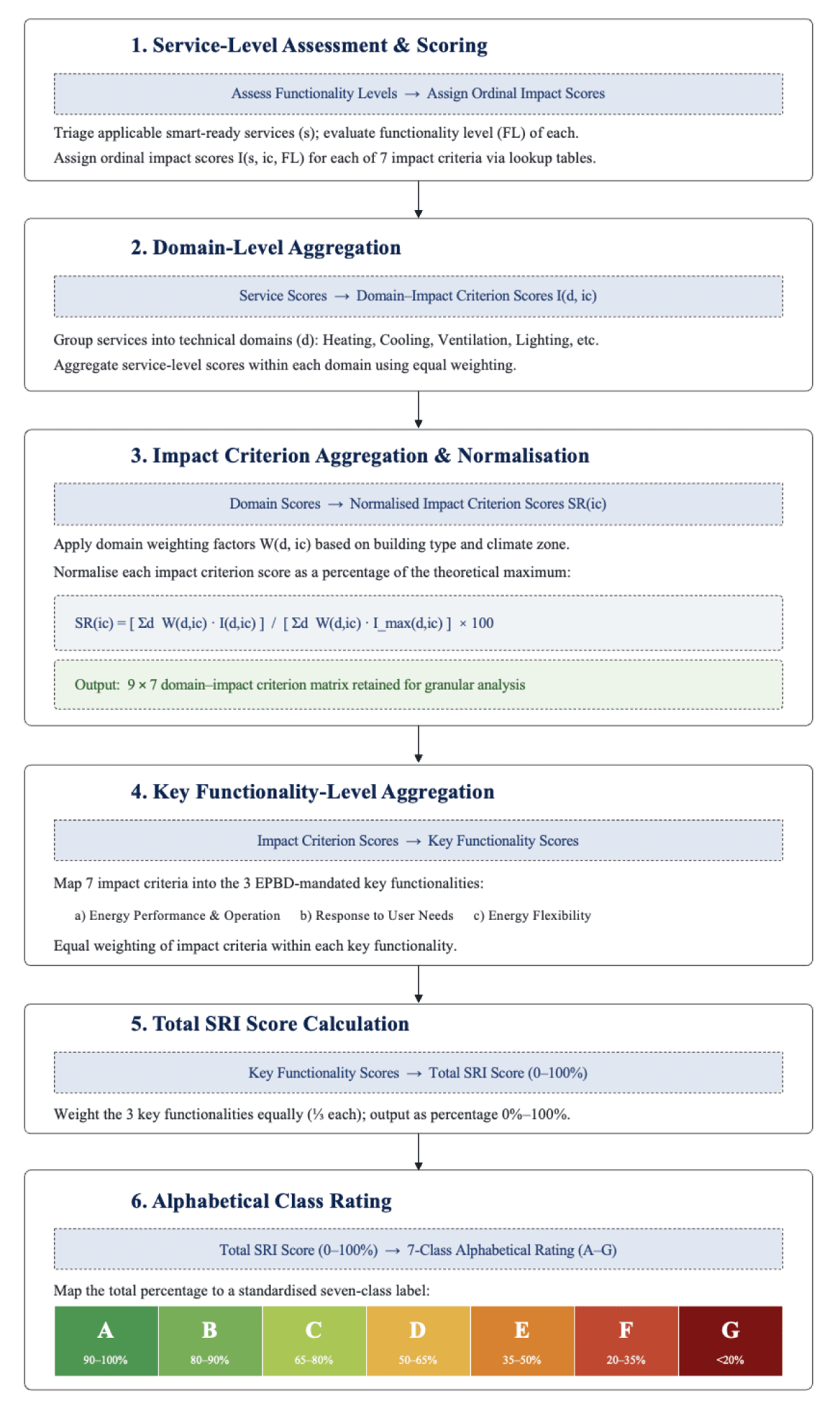
Figure 1
6-step bottom-up aggregation process of SRI score calculation methodology.
Table 1
Nine-dimension comparative framework: SRI v4.5 versus EN ISO 52120-1:2022 (EN ISO 52120-1, 2022; EU, 2020a; Ma et al., 2023; Verbeke et al., 2020).
| S. NO. | DIMENSION | SRI (v4.5) | EN ISO 52120-1:2022 | ANALYTICAL IMPLICATION |
|---|---|---|---|---|
| 1. | Assessment paradigm | Multi-criteria qualitative checklist; ordinal scale (Stevens, 1946) | Single-criterion quantitative factor method; ratio scale (Stevens, 1946) | Outputs inhabit incommensurable mathematical spaces. |
| 2. | Primary output | Score (0–100%) + 7-class rating (A–G) + 9 × 7 diagnostic matrix | BACS class (A–D) + 4 energy factors (fBAC,H; fBAC,C; fBAC,DHW; fBAC,el) | SRI comprehensive information; BACS standard actionable for energy calculations. |
| 3. | Domain coverage | 9 domains, including EV charging, dynamic envelope, and electricity (13 SRI-exclusive services) | 7 disciplines; no EV, dynamic envelope, but electricity elements covered under TBM | Two-way assessment blind spots. |
| 4. | Granularity | 54 services × 2–5 FL × 7 IC = 9 × 7 matrix (approx. 2,646 data points) | 45 functions × 4 classes, collapsed to 2 aggregate factors | Information loss at the BACS standard output stage. |
| 5. | Impact breadth | 7 criteria: energy, maintenance, comfort, convenience, health, information, flexibility | 1 criterion: energy performance (thermal + electrical factors) | 5 of 7 SRI criteria fall outside the BACS standard boundary. |
| 6. | Aggregation logic | Compensatory weighted sum (bottom-up); full substitutability (Munda& Nardo, 2009) | Non-compensatory weakest-link classification (top-down); conjunctive logic | Identical buildings produce structurally different outcomes. |
| 7. | Typology | Method A/B; 5 climate zones; default weights currently uniform across non-residential usage types | Residential/non-residential columns; 10 building categories; differentiated factor values | Both are limited for mixed-use clusters and districts. |
| 8. | Measured performance link | None; Method C proposed but unimplemented (EU, 2020a, 2020b) | Indirect; factors inform EPB calculations but are uncalibrated to measured data | Neither validates operational outcomes. |
| 9. | Translation feasibility (novel to this study, derived from the service-level translation) | Domain Classification: 5 high (H, DHW, C, V, L); 3 medium (DE→blinds only; MC→TBM partial; E→TBM partial); 1 none (EV) | 5 disciplines map to SRI domains; blinds partially map to DE; TBM partially maps to MC and E; no path for EV | Only approx. 60% of SRI services have BACS standard counterparts: translation is inherently asymmetric. |
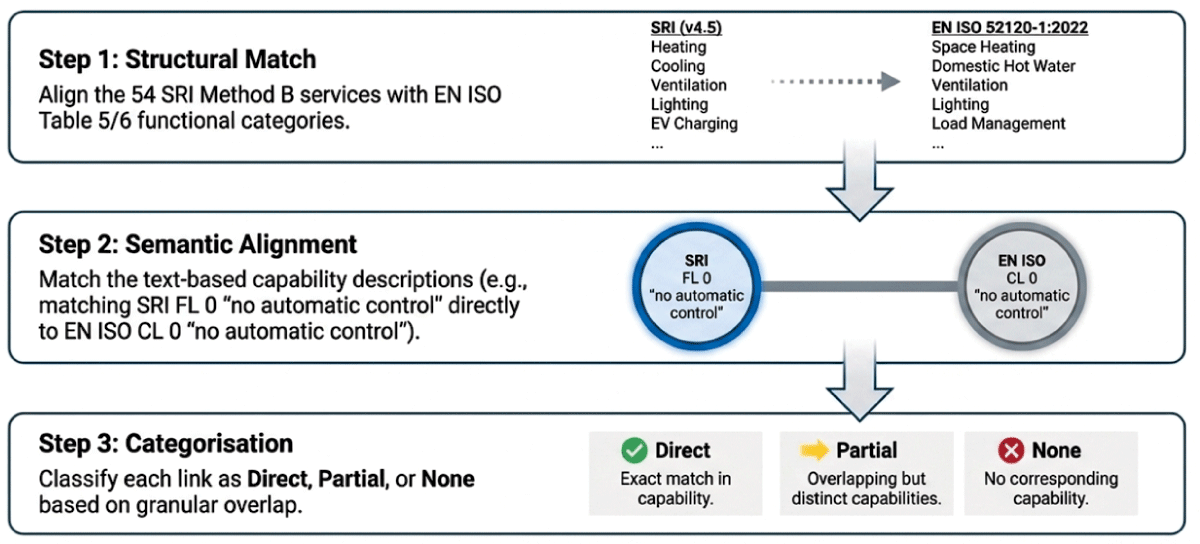
Figure 2
Three-step service-level translational mapping that matches all 54 SRI Method B services to EN ISO 52120-1 functions by aligning their text-based (semantic) capability descriptions.
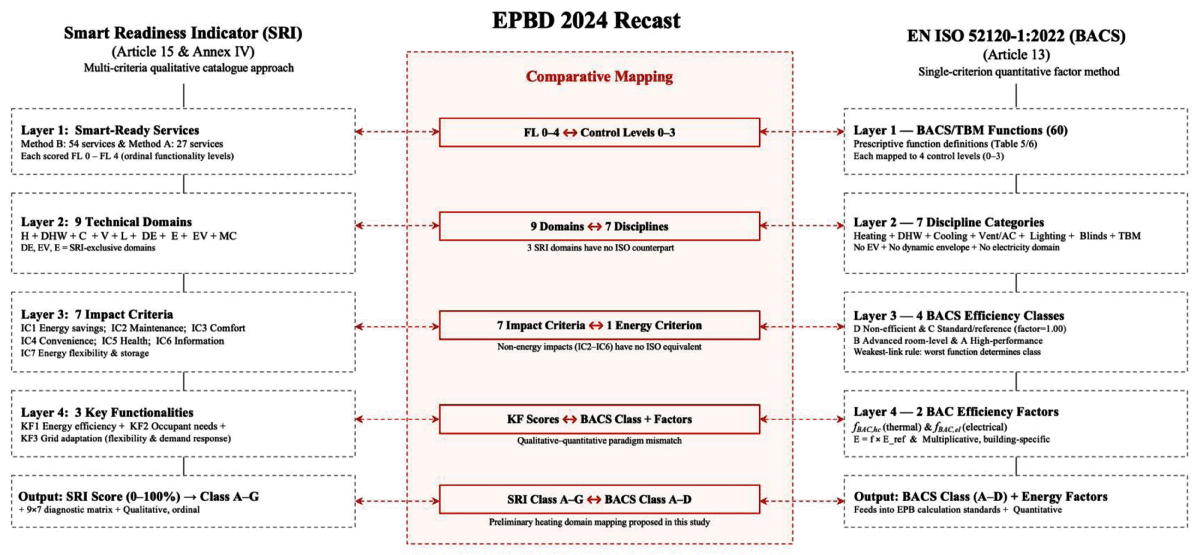
Figure 3
Conceptual comparative analysis mapping translation between SRI and EN ISO 52120-1.
Table 2
Mapping SRI heating services to EN ISO 52120-1 heating functions (EN ISO 52120-1 (Table 5), 2022; Ma et al., 2023).
| SRI CODE | SRI SERVICE | EN ISO 52120-1 FUNCTION | EN ISO 52120-1 TABLE REFERENCE | FL ↔ CL CORRESPONDENCE | MAPPING STATUS |
|---|---|---|---|---|---|
| H-1a | Heat emission control | 1.1 Emission control | Table 5, Function 1.1 | FL 0 ≈ CL 0 (no auto) FL 1 ≈ CL 1 (central auto) FL 2 ≈ CL 2 (individual room) FL 3 ≈ CL 3 (room + BACS communication) FL 4 > CL 3 (exceeds EN ISO scope) | Direct |
| H-1b | Emission control for TABS (heating) | 1.2 Emission control for TABS (heating mode) | Table 5, Function 1.2 | FL 0 ≈ CL 0 (no auto) FL 1 ≈ CL 1 (central auto) FL 2 ≈ CL 2 (advanced central) FL 3 ≈ CL 3 (adv. central + feedback) | Direct |
| H-1c | Control of distribution fluid temperature (supply/return) | 1.3 Control of distribution network temperature (supply or return) | Table 5, Function 1.3 | FL 0 ≈ CL 0 (no auto) FL 1 ≈ CL 1 (outside-temp compensated) FL 2 ≈ CL 2 (demand-based) | Direct |
| H-1d | Control of distribution pumps | 1.4 Control of distribution pumps in networks | Table 5, Function 1.4 | FL 0 ≈ CL 0 (no auto) FL 1 ≈ CL 1 (on/off) FL 2–3 ≈ CL 2 (variable speed, const Δp) FL 4 ≈ CL 3 (variable speed, prop. Δp) | Direct |
| H-1f | Thermal Energy Storage (TES) for heating | 1.10 Control of thermal energy storage (TES) charging | Table 5, Function 1.10 | FL 0–2 ≈ CL 0–2; FL 3 (grid-responsive charging) beyond ISO scope | Partial (ISO covers TES charging only) |
| H-2a | Heat generator control (excl. heat pumps) | 1.6 Heat generator control for combustion and district heating | Table 5, Function 1.6 | FL 0 ≈ CL 0 (constant temp.) FL 1 ≈ CL 1 (variable, outdoor) FL 2 ≈ CL 2 (variable, load) FL 3 ≈ CL 3 (load + return opt.) | Direct |
| H-2b | Heat generator control (heat pumps) | 1.7 Heat generator control (heat pump) | Table 5, Function 1.7 | FL 0 ≈ CL 0 (on/off) FL 1 ≈ CL 1 (compensated) FL 2 ≈ CL 2 (variable speed) FL 3–4 > CL 3 (predictive opt.) | Direct |
| H-2d | Sequencing in case of different heat generators | 1.9 Sequencing of different heat generators | Table 5, Function 1.9 | FL 0–2 ≈ CL 0–2 | Direct |
| H-3 | Report information regarding heating system performance | 7.4 Reporting on energy consumption and indoor conditions (TBM) | Table 5, Function 7.4 | ISO reporting generic; SRI spans 7 impact criteria | Partial (SRI broader) |
| H-4 | Flexibility and grid interaction | 7.7 Smart grid integration (TBM) | Table 5, Function 7.7 | Credited only at management level; no heating efficiency class | Partial (TBM-level only) |
Table 3
Domain-level mapping and feasibility assessment summarised across all SRI domains.
| SRI DOMAIN | CODE | EN ISO 52120-1 DISCIPLINE | SRI Scvs | DIRECTLY MAPPED | FEASIBILITY | KEY CONSTRAINT |
|---|---|---|---|---|---|---|
| Heating | H | Heating | 10 | 7 of 10 | High | Grid-interaction/flexibility (H-4) is SRI-exclusive; AI/predictive optimisation gaps at highest FLs |
| DHW | DHW | DHW | 5 | 3 of 5 | High | Fewer granular DHW controls in EN ISO |
| Cooling | C | Cooling | 10 | 7 of 10 | High | Interlock gaps; AI/predictive optimisation gaps at highest FLs |
| Ventilation | V | Ventilation/AC | 6 | 5 of 6 | High | Strong structural alignment |
| Lighting | L | Lighting | 2 | 2 of 2 | High | Strong occupancy/daylight overlap |
| Dynamic Envelope | DE | Blinds (partial) | 3 | 1 of 3 | Medium | EN ISO covers blinds only; no smart glazing |
| Electricity | E | TBM (partial) | 7 | 1 of 7 | Medium | EN ISO covers local renewables/storage under TBM but lacks explicit individual electricity services |
| EV Charging | EV | – | 3 | 0 of 3 | None | SRI-exclusive domain |
| Monitoring | MC | TBM (partial) | 8 | 4 of 8 | Medium | EN ISO TBM narrower; lacks broader occupant feedback and specific AI analytics |
Table 4
EPBD 2024 asymmetry regulatory timeline for BACS and SRI implementation, derived from Articles 13, 15, 16, and 35 of EPBD 2024 recast (EPBD,2024) as shown in Figure 4.
| DATE | EPBD PROVISION | OBLIGATION | FRAMEWORK INTERACTION |
|---|---|---|---|
| 31st Dec 2024 | Art. 13(9)(a) | BACS mandatory for non-residential >290 kW | BACS compliance required; SRI not yet applicable. No cross-referencing guidance. |
| 29th May 2026 | Art. 35(1) | MS transposition deadline for EPBD provisions | MS must legislate both BACS and SRI implementation before the commission reports on SRI testing. |
| 30th Jun 2026 | Art. 15(2), first para | Commission SRI testing report due to European Parliament and Council | SRI testing results published one month after the MS transposition deadline. |
| 29th May 2026 | Art. 13(10)(d) | BACS must include IEQ monitoring capability | IEQ monitoring required by BACS but not fully captured by either the BACS standard or SRI. |
| 30th Jun 2027 | Art. 15(2), second para | Commission delegated act requiring SRI for non-residential >290 kW | SRI mandatory for the same buildings already required to have BACS. Dual framework compliance begins. |
| 31st Dec 2029 | Art. 13(9)(b) | BACS mandatory for non-residential >70 kW | Extended BACS coverage; SRI application to >70 kW not yet mandated. |
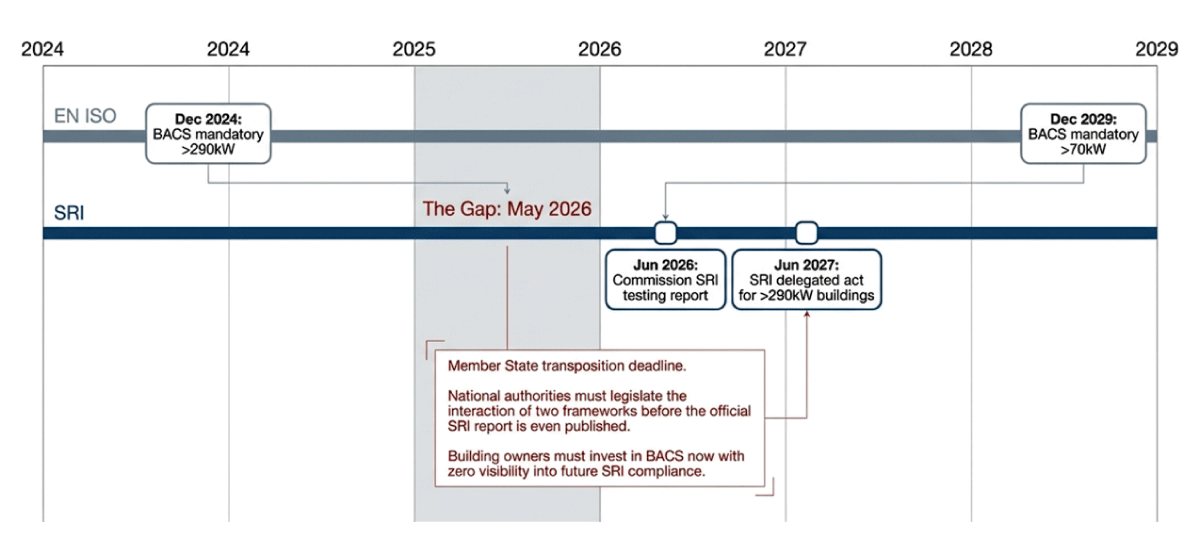
Figure 4
EPBD 2024 timeline for BACS and SRI implementation.