
Introduction
The acceleration of climate objectives and the digitalisation of Europe’s building stock have compelled the European Union to implement two principal regulatory instruments for assessing smart technology deployment in buildings: the Smart Readiness Indicator (SRI), established under Commission Delegated Regulation (EU) 2020/2155 (EU, 2020a), and the building automation and control system (BACS) efficiency classification codified in EN ISO 52120-1:2022 (EN ISO 52120-1, 2022). EN ISO 52120-1:2022 (hereafter ‘BACS standards’ when referring to the assessment methodology, and ‘BACS’ when referring to the physical system). Both now operate under the recast Energy Performance of Buildings Directive (Directive (EU) 2024/1275), which entered into force on the 28th May 2024 (EPBD, 2024).
Despite a shared regulatory context, the frameworks rest on divergent paradigms. The SRI applies a qualitative multi-criteria method evaluating 54 services across nine domains and seven impact areas on a 0–4 functionality scale, aggregated via weighted scores into a 0–100% rating (A–G classes). The BACS standard employs a quantitative approach assessing 45 control functions, with classification (A–D) determined by the weakest function and energy impacts expressed through BAC factors.
The EPBD recast effectively forces convergence between the two frameworks through three mechanisms:
Aligned capacity thresholds, where Article 13 mandates BACS installation in non-residential buildings exceeding 290 kW effective rated output by December 2024;
Equivalent applicability thresholds, as Article 15 targets the same 290 kW threshold for mandatory SRI application through a Commission delegated act by June 2027 (EPBD, 2024); and
Shared digital infrastructure, where Article 16 requires outputs from both frameworks to be integrated within a digital building logbook, alongside methodological cross-referencing under Annex I.
Yet this legal convergence is not accompanied by a technical bridge. There is no published methodology translating SRI functionality levels into BACS efficiency classes; the Directive’s digital building logbook mandates shared data infrastructure without reconciling the underlying scoring frameworks.
This creates a practical barrier for implementation. Building owners investing in BACS upgrades to meet the EPBD Article 13 deadline of 29th May 2026 have no clear means of determining how that investment will translate into a future SRI rating. This uncertainty is compounded by the fact that the SRI framework, expected to become operational following the testing phase report due 30th June 2026 and the subsequent delegated act anticipated by June 2027, evaluates domains that extend beyond BACS. These include electric vehicle charging, dynamic building envelope performance, and advanced electricity management, meaning that compliance with BACS requirements alone cannot guarantee alignment with a future SRI rating.
Furthermore, a regulatory timeline asymmetry compounds the risk: Member States must transpose by 29th May 2026, one month before the SRI testing report (30th June 2026), yet two years before the mandatory SRI delegated act. National authorities must therefore now legislate the interaction of two frameworks whose formal relationship remains undefined.
Aims and objectives
The relationship between the SRI and BACS standard has gained growing scholarly attention, producing several partial comparisons that this paper consolidates and extends. Walczyk & Ożadowicz (2025) provide the most comprehensive narrative review to date but remain descriptive, without dissecting aggregation logic or attempting scoring-framework translation. Ożadowicz (2022) proposes a hybrid BACS-SRI design framework through SWOT analysis, identifying complementarities without service-level mapping. The SRI2MARKET project, an EU Horizon 2020 initiative piloting the Smart Readiness Indicator in real buildings across several Member States, provides some initial comparative insights. Its Deliverable D2.4 (Cleto et al., 2024) offers a service-to-function overlap table identifying approximately 74% topical overlap but addresses domain coverage rather than the structural comparison of scoring methodologies and classification outputs. On the empirical side, Garzia et al. (2024) found no correlation between SRI scores and energy performance across 59 buildings; Person et al. (2025) demonstrated that measured savings deviate significantly from both SRI-predicted efficiencies and EN ISO 52120-1 forecast factors; and Van Thillo, Verbeke, and Audenaert (2022) concluded that the BAC factor method does not reliably estimate achievable energy savings.
The present study is further situated within the rapidly expanding SRI literature. Delavar et al. (2025) provide a comprehensive review of the field, while a growing body of work approaches framework interoperability from the digital building model perspective: Calandri et al. (2025) demonstrate a BIM-based data-exchange framework for automating SRI calculation, illustrating the shared data infrastructure that the EPBD digital building logbook (Article 16) is intended to support. (Martinez et al., 2025) develop and implement a standardised SRI on-site audit procedure, which directly informs the integrated site-visit protocol proposed in this paper. A complementary procedural-integration strand examines how SRI assessment can be combined with statutory building inspections under the recast EPBD (Melero et al., 2026).
This research compares the EU’s two smart building assessment frameworks: the SRI and the EN ISO 52120-1:2022. In the absence of a formal translational mechanism between them within the shared legislative framework of the EPBD recast, measurement theory (Stevens, 1946) and multi-criteria decision analysis are adopted to compare their scoring systems across nine analytical dimensions: assessment paradigm, domain coverage, functional granularity, scoring scale, aggregation logic, classification structure, weighting approach, translation feasibility, and policy applicability, and to develop a translational mapping between the two frameworks.
The novelty lies in formally characterising these differences and translating them into actionable solutions through systematic comparison, service-level translational mapping, and an integrated assessment protocol for the 2026–2027 EPBD implementation period. The study is organised around three core objectives:
To systematically compare the scoring framework of the SRI and EN ISO 52120-1:2022.
To develop a systematic translational mapping of more granular SRI functionality levels to EN ISO 52120-1:2022 efficiency classes.
To assess policy implications and identify pathways for regulatory convergence.
Methodology
This study employs a qualitative comparative analysis of the SRI and BACS standard as described by EN ISO 52120-1:2022, with emphasis on methodological reconciliation and policy implications. The study constitutes a structured framework comparison, extending the approaches used in Cleto et al. (2024) and Walczyk & Ożadowicz (2025), enhanced by translational mapping and normative-to-empirical synthesis. The analysis is not based on empirical study. Instead, it is a secondary, documentary, and comparative analysis that treats the two EU frameworks, SRI (EU, 2020a) and BACS (EN ISO 52120-1, 2022), as the primary analytical sources and develops a novel bridging methodology between them.
The study’s methodological design could be outlined across four phases:
Structural comparison: evaluates the frameworks across nine analytical dimensions. The two systems employ fundamentally different measurement and aggregation logic, creating structural incompatibilities that prevent direct score comparison. The SRI relies on ordinal functionality levels (FL), where services are ranked according to increasing levels of smart capability, but the numerical steps represent ordered categories rather than equal or measurable performance differences. In contrast, the BACS standard uses ratio-scale efficiency factors (fbac) that support proportional comparison and arithmetic operations. This scale mismatch is analysed through Steven’s (1946) theory of measurement, which demonstrates why transformations between ordinal and scale are invalid. The second divergence concerns aggregation logic. The SRI uses a compensatory weighted-sum approach, allowing strong performance in some services to offset weaker performance in others, while the BACS standard applies a non-compensatory weakest-link classification, where the lowest-performing function constrains the overall BACS class. This difference is examined using the framework of Munda & Nardo (2009) on composite indicators and multi-criteria decision analysis, which distinguishes compensatory aggregation methods from non-compensatory rules.
Systematic translational mapping: creates a three-step service-level translational mapping that matches all 54 SRI Method B services to EN ISO functions by aligning their text-based capability descriptions. This involves translating the SRI functionality levels (FL0 to FL4), which rank increasing smart service capability, into the corresponding EN ISO control levels (CL0 to CL3) that describe progressively more advanced building automation and control functionality. Each relationship is then classified as direct, partial, or unmapped. Although the measurement-theoretic analysis (Stevens, 1946) demonstrates that direct numerical conversion between ordinal SRI scores and ratio-scale BAC factors is inadmissible, semantic alignment of the underlying capability descriptions remains valid because both frameworks describe the same physical control functions using text-based definitions that are independent of their respective scoring architectures. The translation therefore operates at the level of technical capability rather than numerical equivalence, bypassing the scale incompatibility that precludes arithmetic transformation.
Empirical calibration: anchors normative BACS efficiency factors against SRI2MARKET pilot benchmarks (Pascual & Boneta, 2024), demonstrating the asymmetric relationship between the frameworks.
Policy synthesis: translates the technical findings into actionable regulatory guidance for the 2026–2027 EPBD transposition window by developing mismatch categories, an integrated site-visit assessment protocol, and convergence recommendations for Member States and the European Commission.
Overview of scoring frameworks
This section describes the scoring structures of the SRI and EN ISO 52120-1:2022 frameworks as the basis for the comparative analysis and the proposed two-way translation between them. Their underlying assessment architectures, i.e.,
multi-criteria qualitative catalogue in the SRI and,
quantitative factor-based method in EN ISO 52120-1,
are outlined below.
Multi-criteria qualitative catalogue in the SRI
The SRI was developed through EU-funded technical support studies (Verbeke et al., 2020) and formalised in Commission Delegated Regulation (EU) 2020/2155 (EU, 2020a) and Implementing Regulation (EU) 2020/2156 (EU, 2020b). SRI was designed as an informative tool to measure a building’s capacity to use information and communication technologies for adapting its operation to occupant needs, grid requirements, and energy efficiency objectives (EU, 2020a). SRI employs a bottom-up multi-criteria framework organised across four hierarchical layers aggregated through a six-step weighted summation.
Structural hierarchy
The base layer defines the catalogue of smart-ready services: 27 services under Method A (simplified assessment for residential and small buildings) or 54 services under Method B (detailed assessment for non-residential and complex buildings) (Ma et al., 2023). Each service is assessed using ordinal functionality levels (FL 0–FL 4), representing a qualitative progression of control capability: FL 0 denotes manual, non-smart operation; FL 1–3 reflect increasing automation from basic scheduling through sensor-based individual room control to integrated communication with a centralised BACS; and FL 4 represents predictive, self-optimising capability (Person et al., 2025). The number of levels varies by service (typically two to five), reflecting differences in technological advancement potential across building systems.
Services are grouped into nine technical domains: heating (H), domestic hot water (DHW), cooling (C), ventilation (V), lighting (L), dynamic building envelope (DE), electricity (E), electric vehicle charging (EV), and monitoring and control (MC). These domains fall into three broad categories: traditional building services (H, DHW, C, V, L) that map directly to BACS discipline categories and share substantial service overlap with the BACS standard (Cleto et al., 2024); grid-interactive extensions (E, EV, DE) that evaluate interaction with smart grids, renewable storage, and dynamic solar mitigation, capabilities absent from the BACS standard; and central integration (MC) evaluating building management systems, platform integration, and automated fault detection.
Each domain is evaluated against seven impact criteria (IC): IC1 energy savings on-site, IC2 maintenance and fault prediction, IC3 comfort, IC4 convenience, IC5 health and well-being, IC6 information to occupants, and IC7 energy flexibility and storage. These are further grouped into three key functionalities: KF1 optimises energy efficiency and in-use performance; KF2 adapts operation to occupant needs; KF3 adapts to signals from the energy grid (Verbeke et al., 2020). The final SRI score weights each key functionality equally at 33.3%.
Calculation methodology and weighting
The SRI score is derived through a six-step bottom-up aggregation (Ma et al., 2023; Verbeke et al., 2020), as shown in Figure 1:
Service-level assessment: applicable services are triaged; each is assigned a functionality level (FL 0–4), yielding ordinal impact scores (Is,ic(FL)) for the seven impact criteria from the lookup table (EU, 2020a; Verbeke et al., 2020).
Domain-level aggregation: services are equally weighted within each technical domain (d) to produce domain impact scores (Id,ic).
Impact criterion normalisation: domain scores are weighted by building-type and climate-zone factors (Wd,ic) and normalised to percentages of theoretical maxima (Equation (1)), generating a 9 × 7 diagnostic matrix.
Key functionality aggregation: the seven criteria are grouped into three EPBD-mandated functionalities (energy performance, occupant needs, and energy flexibility), with equal weighting of relevant criteria within each.
Total score: the three key functionalities are equally weighted (33.3% each) to yield a final percentage (0–100%).
Class mapping: the percentage is converted to an A–G rating (e.g., A: 90–100%; G: <20%).
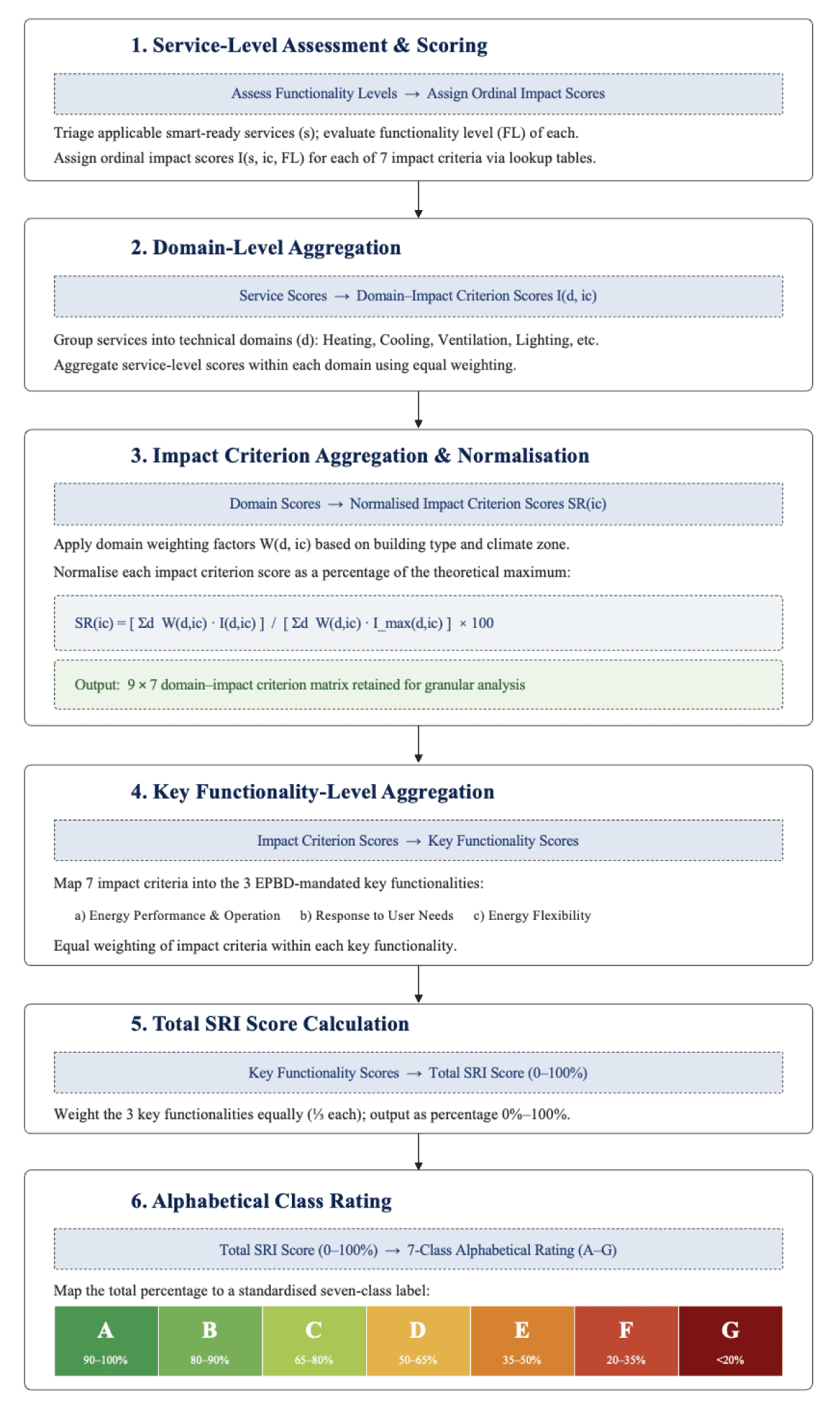
Figure 1
6-step bottom-up aggregation process of SRI score calculation methodology.
Domain weighting factors follow three rules: for energy-related criteria (IC1, IC2, IC7), weights derive from building energy balance profiles across five climate zones, with MC fixed at 20% and DE and EV at 5% each (Ma et al., 2023); for occupant-related criteria (IC3–IC6), equal weights apply across applicable domains; and within key functionalities, weights default to equal but may be nationally adapted. Member State discretion in weights, triage rules, and domain applicability may introduce cross-national fragmentation (Verbeke et al., 2020). While residential and non-residential buildings use different methods and weighting tables, service definitions and functionality levels remain consistent across typologies.
Two operational features of the SRI methodology are central to its national implementation. First, a triage process governs how non-applicable services are handled: assessors identify services that are absent or not relevant to a given building and exclude them prior to normalisation, so that scores reflect only applicable capabilities (Ma et al., 2023; Verbeke et al., 2020). Second, the framework is explicitly adaptable to local conditions, default weighting factors, service catalogues, and triage rules may be modified by Member States and regional authorities through the SRI platform to reflect national building stock, climate, and policy priorities (Ma et al., 2023). This flexibility, together with the guidance issued under the EPBD support package, is intended to promote consistent application, but it also permits cross-national divergence that a formal translation between SRI and BACS would help to contain.
Quantitative factor-based method in EN ISO 52120-1:2022
EN ISO 52120-1 establishes the normative framework for assessing the contribution of building automation, controls, and systems/technical building management (BACS/TBM) to building energy performance. Published by CEN (European Committee for Standardisation) in March 2022 as the European adoption of ISO 52120-1:2021, it replaces EN 15232-1:2017 (EN ISO 52120-1, 2022). The EPBD defines BACS as products, software, and engineering services facilitating energy-efficient, economical, and safe operation of technical building systems through automatic controls and manual management facilitation (EPBD, 2024). Article 13 mandates that non-residential buildings with an effective rated output for heating, air-conditioning, or combined ventilation systems exceeding 290 kW be equipped with BACS possessing specific capabilities (i.e., continuous energy monitoring, efficiency benchmarking, and interoperable communication) by the 31st December 2024, extending to building systems exceeding 70 kW by the 31st December 2029.
Standard identity and EPBD framework position
The standard occupies Module M10 within the ISO 52000 EPB standards framework, covering BACS contributions to heating, cooling, ventilation, DHW, lighting, blinds, and technical building management (EN ISO 52120-1, 2022). A critical design principle that distinguishes it from the SRI is that no energy calculation is performed within Module M10 itself. BAC functions serve as inputs for other EPB calculation standards, such as EN 15316 for heating, EN 16798-9 for cooling, and EN 15193 for lighting, ensuring automation impacts are captured without double-counting (EN ISO 52120-1, 2022). One of the key revisions from EN 15232-1:2017 includes reclassification of Annex B (minimum BAC function requirements) to normative status; new hydronic balancing functions (1.4a, 3.4a); demand-based ventilation using air quality sensors (4.1.3); and scene-based lighting control (5.2.3) (EN ISO 52120-1, 2022), reflecting a shift toward predictive control, dynamic daylighting, and advanced air quality integration (Walczyk & Ożadowicz, 2025).
BACS efficiency classes and classification logic
The standard defines four ascending efficiency classes (EN ISO 52120-1, 2022):
Class D (non-energy-efficient) represents systems that fail to meet the minimum automation requirements for Class C, which includes manual-only operations; existing Class D buildings need to be retrofitted.
Class C (standard) serves as the reference (BAC factor = 1.00), corresponding to standard building automation that meets a specific minimum set of automated control functions.
Class B (advanced) requires room controllers communicating with the building automation system for centralised coordination.
Class A (high energy performance) demands demand-based, occupancy-responsive strategies integrating multidisciplinary functions across heating, cooling, ventilation, lighting, and solar shading (EN ISO 52120-1, 2022).
The classification follows a non-compensatory weakest-link principle: the building’s overall BACS class equals the lowest-performing function group across all applicable disciplines. To achieve Class A, every applicable function must individually meet Class A requirements; a single function at Class B constrains the entire building to Class B. An exception exists for function sections with less than 5% impact or for functions tied to absent equipment (EN ISO 52120-1, 2022). This weakest-link rule contrasts sharply with the SRI’s compensatory weighted averaging, which permits high performance in one domain to offset low performance in another, a distinction with significant practical consequences examined in comparative analysis. The standard provides separate mapping columns for residential and non-residential buildings within the same function tables, reflecting differing expected building complexity levels.
Covered building disciplines
EN ISO 52120-1 (Table 5), (2022) organises approximately 45 control functions across seven discipline categories:
Heating control (functions 1.1–1.10 plus 1.4a), addressing emission, distribution, and generation control.
DHW supply control (functions 2.1–2.4).
Cooling control (functions 3.1–3.9 plus 3.4a), mirroring heating with the addition of a heating/cooling interlock function.
Ventilation and air conditioning control (functions 4.1–4.10), including demand-based air quality control using CO2/volatile organic compound (VOC) measurement.
Lighting control (functions 5.1–5.2).
Blind and shading control (function 6.1).
Technical building management (functions 7.1–7.7), covering fault detection, energy reporting, local energy production, waste heat recovery, and demand-side management.
BAC factor method
Beyond classification, the standard provides two calculation pathways for quantifying the energy impact of BACS. Method 1 (detailed) requires full building energy simulation. Method 2 (factor-based) offers rapid estimation through pre-calculated efficiency factors applied to reference energy consumption:
Four factor types are defined: fBAC,H for space heating, fBAC,C for cooling, fBAC,DHW for domestic hot water (all thermal energy), together with fBAC,el for electrical energy (ventilation, lighting, and auxiliaries), extracted from the transient pre-calculations in Annex A of the standard (EN ISO 52120-1, 2022).
Comparative analysis
The previous section described the SRI and EN ISO 52120-1:2022 frameworks. This section consists of Table 1 that compares the SRI v4.5 framework and EN ISO 52120-1:2022 across nine analytical dimensions, highlighting structural differences in measurement scale, analytical scope, and aggregation logic. Although both frameworks originate from the domain of building automation and control, their assessment architectures differ substantially, which complicates direct equivalence mapping.
Table 1
Nine-dimension comparative framework: SRI v4.5 versus EN ISO 52120-1:2022 (EN ISO 52120-1, 2022; EU, 2020a; Ma et al., 2023; Verbeke et al., 2020).
| S. NO. | DIMENSION | SRI (v4.5) | EN ISO 52120-1:2022 | ANALYTICAL IMPLICATION |
|---|---|---|---|---|
| 1. | Assessment paradigm | Multi-criteria qualitative checklist; ordinal scale (Stevens, 1946) | Single-criterion quantitative factor method; ratio scale (Stevens, 1946) | Outputs inhabit incommensurable mathematical spaces. |
| 2. | Primary output | Score (0–100%) + 7-class rating (A–G) + 9 × 7 diagnostic matrix | BACS class (A–D) + 4 energy factors (fBAC,H; fBAC,C; fBAC,DHW; fBAC,el) | SRI comprehensive information; BACS standard actionable for energy calculations. |
| 3. | Domain coverage | 9 domains, including EV charging, dynamic envelope, and electricity (13 SRI-exclusive services) | 7 disciplines; no EV, dynamic envelope, but electricity elements covered under TBM | Two-way assessment blind spots. |
| 4. | Granularity | 54 services × 2–5 FL × 7 IC = 9 × 7 matrix (approx. 2,646 data points) | 45 functions × 4 classes, collapsed to 2 aggregate factors | Information loss at the BACS standard output stage. |
| 5. | Impact breadth | 7 criteria: energy, maintenance, comfort, convenience, health, information, flexibility | 1 criterion: energy performance (thermal + electrical factors) | 5 of 7 SRI criteria fall outside the BACS standard boundary. |
| 6. | Aggregation logic | Compensatory weighted sum (bottom-up); full substitutability (Munda& Nardo, 2009) | Non-compensatory weakest-link classification (top-down); conjunctive logic | Identical buildings produce structurally different outcomes. |
| 7. | Typology | Method A/B; 5 climate zones; default weights currently uniform across non-residential usage types | Residential/non-residential columns; 10 building categories; differentiated factor values | Both are limited for mixed-use clusters and districts. |
| 8. | Measured performance link | None; Method C proposed but unimplemented (EU, 2020a, 2020b) | Indirect; factors inform EPB calculations but are uncalibrated to measured data | Neither validates operational outcomes. |
| 9. | Translation feasibility (novel to this study, derived from the service-level translation) | Domain Classification: 5 high (H, DHW, C, V, L); 3 medium (DE→blinds only; MC→TBM partial; E→TBM partial); 1 none (EV) | 5 disciplines map to SRI domains; blinds partially map to DE; TBM partially maps to MC and E; no path for EV | Only approx. 60% of SRI services have BACS standard counterparts: translation is inherently asymmetric. |
The frameworks operate in different measurement spaces. Following Stevens (1946), the SRI uses ordinal functionality levels (FL0–FL4) and rating classes (A–G) within a multi-criteria qualitative checklist, whereas the BACS standard applies ratio-scale efficiency factors (fBAC) within a quantitative calculation framework. Because ordinal scales preserve ranking but not magnitude, SRI scores cannot be mathematically transformed into the ratio-scale factors used in ISO-based energy performance calculations.
The frameworks also differ in analytical scope and informational depth. The SRI evaluates 54 services across nine domains and seven impact criteria, producing a diagnostic matrix together with an overall score (0–100%) and rating class. The BACS standard instead evaluates the energy performance impact of building automation functions, producing BACS efficiency classes (A–D) and four energy adjustment factors (fBAC,H, fBAC,C, fBAC,DHW, and fBAC,el). This results in lower informational granularity within the ISO framework and the absence or partial representation of several SRI domains, including EV charging, dynamic envelope systems, and electricity management.
Their aggregation structures also differ. In terms of multi-criteria decision analysis (Munda & Nardo, 2009), the SRI applies a compensatory weighted aggregation, allowing trade-offs across services and impact criteria. The BACS standard instead applies a non-compensatory weakest-link classification, where the lowest-performing control function constrains the overall BACS class.
These structural differences constrain translation between the two frameworks. EN ISO functions can inform elements of an SRI assessment, but SRI scores cannot be reverse-translated into ISO efficiency factors, resulting in an inherently asymmetric relationship between the two rating systems.
Convergence of frameworks
The two frameworks share substantial common ground, reflecting the SRI service catalogue’s foundation derivation from the EN 15232 function lists that preceded EN ISO 52120-1. The SRI2MARKET Deliverable D2.4 (Cleto et al., 2024, Table 5) systematically mapped SRI services against BACS and TBM function categories and identified substantial overlap across heating, cooling, DHW, ventilation, and lighting. Walczyk & Ożadowicz (2025) confirm that six of the SRI’s nine domains are also addressed in the BACS standard. Both frameworks employ functionality or control levels progressing from manual to advanced automated control; both differentiate residential from non-residential buildings; and both are co-referenced under the EPBD 2024 recast (EPBD, 2024). Furthermore, the EU.BAC (2024) compliance verification checklist maps the four BACS capabilities mandated by EPBD Article 13(10) to BACS standard functions, significantly overlapping with the SRI’s monitoring and control domain.
Divergence of frameworks
The SRI and EN ISO 52120-1:2022 differ fundamentally in scope and purpose. The SRI measures smartness as a multi-dimensional capability, evaluating energy, comfort, health, convenience, information, and grid flexibility through seven impact criteria (Verbeke et al., 2020). In contrast, the BACS standard is a single-criterion engineering tool focused solely on energy performance (EN ISO 52120-1, 2022). Five of the SRI’s impact criteria therefore lie completely outside the EN ISO standard’s boundary.
Their methodological paradigms are equally incompatible. The SRI relies on a checklist approach: assessors assign ordinal functionality levels based on installed technology, producing scores independent of actual energy use. Whereas the EN ISO 52120-1:2022 standard applies ratio-scale efficiency factors directly to building-specific calculations. As Stevens (1946) demonstrated, direct numerical mapping between ordinal and ratio scales is mathematically invalid without empirical bridging data.
The frameworks’ contrasting aggregation logics, that is the SRI’s compensatory weighting versus the BACS standard’s weakest-link rule (see the comparative analysis above), create misaligned incentives. The SRI may reward low-cost upgrades, while the ISO standard encourages fixing the weakest element first.
Additionally, there is asymmetry in domain coverage. The SRI contains three standalone domains (electricity, EV charging, and dynamic envelope) with no direct EN ISO equivalent, representing 24% of its Method B services. Conversely, the EN ISO standard covers additional detail in areas such as humidity control.
Therefore, a systematic translation between the two frameworks is urgently required. Pilot evidence from Pascual & Boneta (2024) shows that even perfect BACS Class A compliance yields only moderate SRI ratings, approximately 43% (SRI Class E) across 172 pilot assessments, leaving building owners facing investment uncertainty and double-assessment risks during the 2026–2027 transposition.
Translational mapping
The incompatibilities identified in the comparative analysis show that no direct mathematical equivalence exists between SRI scores and BACS classes. Equivalence is nevertheless established at the service-and-function level by semantically aligning SRI functionality-level descriptions (FL 0–4) with EN ISO control-level descriptions (CL 0–3) within each domain. Implying their semantic alignment because the meaning of the descriptions is identical, even though one is ordinal and the other is a ratio-scale system. This section demonstrates such equivalence.
The matching of descriptive alignment between the two operates in three-steps, as shown in Figure 2:
Each SRI service from the v4.5 catalogue (Ma et al., 2023) is matched to its EN ISO 52120-1 functional counterpart using function definitions described within (Ref: Tables 5 and 6 of (EN ISO 52120-1, 2022)).
The capability descriptions defining each SRI functionality level (FL 0–4) are semantically aligned with the control level descriptions that determine BACS class thresholds (Class D through A) for that function.
Each mapping is classified into one of three categories: (a) direct, where the SRI service and ISO function describe equivalent control capabilities at comparable granularity, meaning both address the same physical system, the functionality-level progression maps onto the control-level hierarchy without substantive scope difference, and the number of gradations is comparable; (b) partial, where scopes overlap but differ in granularity, terminology, or assessment breadth: for example, where the SRI evaluates a capability across multiple impact criteria (e.g., energy, comfort, information) whereas the BACS standard addresses only the energy dimension, or where one framework subdivides a function more finely than the other; (c) no mapping, where one framework covers a capability entirely absent from the other.
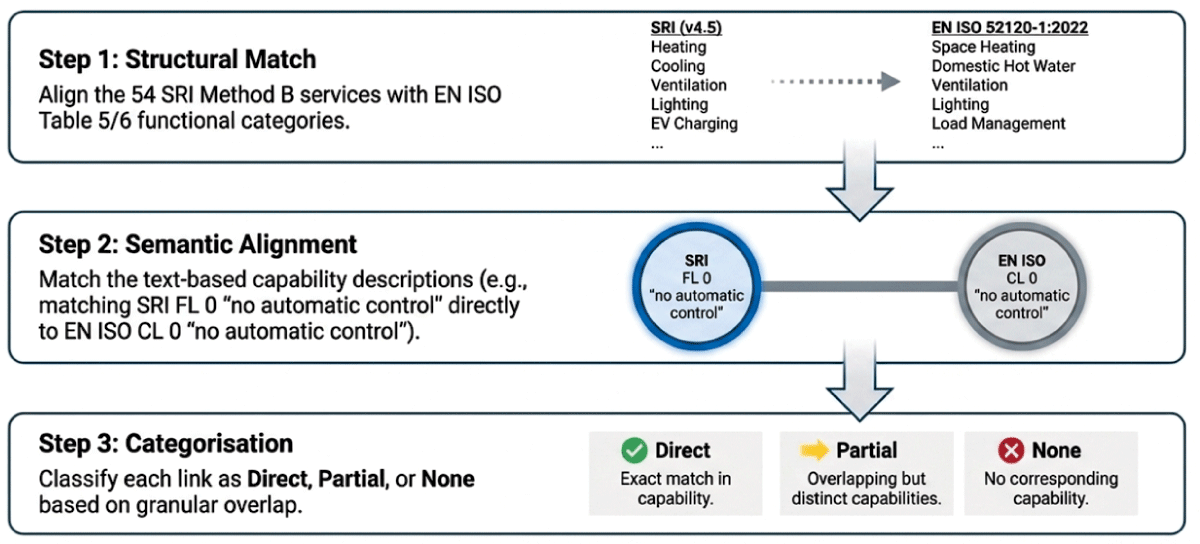
Figure 2
Three-step service-level translational mapping that matches all 54 SRI Method B services to EN ISO 52120-1 functions by aligning their text-based (semantic) capability descriptions.
This semantic matching approach is necessitated by the measurement-theoretic barriers because no empirical bridging function exists to convert ordinal SRI scores into ratio-scale BAC factors. Figure 3 represents a conceptual comparative analysis between the SRI and EN ISO 52120-1, mapping the methodological differences in their scoring structure.
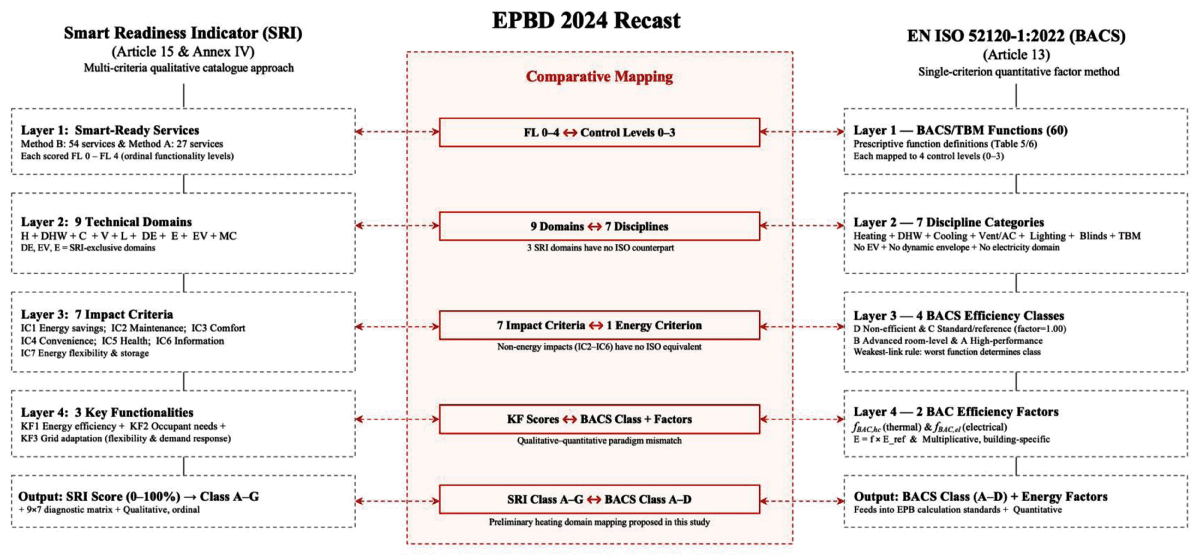
Figure 3
Conceptual comparative analysis mapping translation between SRI and EN ISO 52120-1.
Heating domain mapping
Heating is the main demonstration case. Table 2 shows that it has the highest match between the two frameworks. Seven of the ten heating services in the Method B catalogue map directly to EN ISO 52120-1 heating functions 1.1 to 1.9. Those seven services are H-1a, H-1b, H-1c, H-1d, H-2a, H-2b and H-2d. The other three map only in part. Thermal energy storage (H-1f) maps to function 1.10. The class definitions for 1.10 do not include grid-responsive charging, which is the highest functionality level of H-1f. Performance reporting (H-3) maps to the generic technical building management reporting function 7.4. Flexibility and grid interaction (H-4) maps to smart grid integration function 7.7. Function 7.7 is credited only at management level and has no heating efficiency class. No heating service is therefore entirely without an EN ISO counterpart.
Table 2
Mapping SRI heating services to EN ISO 52120-1 heating functions (EN ISO 52120-1 (Table 5), 2022; Ma et al., 2023).
| SRI CODE | SRI SERVICE | EN ISO 52120-1 FUNCTION | EN ISO 52120-1 TABLE REFERENCE | FL ↔ CL CORRESPONDENCE | MAPPING STATUS |
|---|---|---|---|---|---|
| H-1a | Heat emission control | 1.1 Emission control | Table 5, Function 1.1 | FL 0 ≈ CL 0 (no auto) FL 1 ≈ CL 1 (central auto) FL 2 ≈ CL 2 (individual room) FL 3 ≈ CL 3 (room + BACS communication) FL 4 > CL 3 (exceeds EN ISO scope) | Direct |
| H-1b | Emission control for TABS (heating) | 1.2 Emission control for TABS (heating mode) | Table 5, Function 1.2 | FL 0 ≈ CL 0 (no auto) FL 1 ≈ CL 1 (central auto) FL 2 ≈ CL 2 (advanced central) FL 3 ≈ CL 3 (adv. central + feedback) | Direct |
| H-1c | Control of distribution fluid temperature (supply/return) | 1.3 Control of distribution network temperature (supply or return) | Table 5, Function 1.3 | FL 0 ≈ CL 0 (no auto) FL 1 ≈ CL 1 (outside-temp compensated) FL 2 ≈ CL 2 (demand-based) | Direct |
| H-1d | Control of distribution pumps | 1.4 Control of distribution pumps in networks | Table 5, Function 1.4 | FL 0 ≈ CL 0 (no auto) FL 1 ≈ CL 1 (on/off) FL 2–3 ≈ CL 2 (variable speed, const Δp) FL 4 ≈ CL 3 (variable speed, prop. Δp) | Direct |
| H-1f | Thermal Energy Storage (TES) for heating | 1.10 Control of thermal energy storage (TES) charging | Table 5, Function 1.10 | FL 0–2 ≈ CL 0–2; FL 3 (grid-responsive charging) beyond ISO scope | Partial (ISO covers TES charging only) |
| H-2a | Heat generator control (excl. heat pumps) | 1.6 Heat generator control for combustion and district heating | Table 5, Function 1.6 | FL 0 ≈ CL 0 (constant temp.) FL 1 ≈ CL 1 (variable, outdoor) FL 2 ≈ CL 2 (variable, load) FL 3 ≈ CL 3 (load + return opt.) | Direct |
| H-2b | Heat generator control (heat pumps) | 1.7 Heat generator control (heat pump) | Table 5, Function 1.7 | FL 0 ≈ CL 0 (on/off) FL 1 ≈ CL 1 (compensated) FL 2 ≈ CL 2 (variable speed) FL 3–4 > CL 3 (predictive opt.) | Direct |
| H-2d | Sequencing in case of different heat generators | 1.9 Sequencing of different heat generators | Table 5, Function 1.9 | FL 0–2 ≈ CL 0–2 | Direct |
| H-3 | Report information regarding heating system performance | 7.4 Reporting on energy consumption and indoor conditions (TBM) | Table 5, Function 7.4 | ISO reporting generic; SRI spans 7 impact criteria | Partial (SRI broader) |
| H-4 | Flexibility and grid interaction | 7.7 Smart grid integration (TBM) | Table 5, Function 7.7 | Credited only at management level; no heating efficiency class | Partial (TBM-level only) |
All service-level mappings in this study come from the detailed Method B catalogue in the SRI v4.5 assessment package (Ma et al., 2023). That catalogue has 54 non-residential services. Method A is the simplified 27-service subset of the same catalogue. Every Method A service is also a Method B service, so the mapping has no Method A-only entries. In the heating domain, service H-1c is “Control of distribution fluid temperature (supply or return; a similar function applies to direct electric heating networks)”. It maps directly to EN ISO 52120-1 function 1.3 (Control of distribution network temperature). The two share the same control levels, that is no control, outside-temperature-compensated, and demand-based. Grid-oriented thermal storage and load shifting is placed in two other services. Service H-1f (Thermal Energy Storage for heating) maps its charging control to ISO function 1.10. Its highest functionality level is grid-responsive demand-side management, which goes beyond the standard. Service H-4 (Flexibility and grid interaction) maps only to the management-level smart grid integration function 7.7. It therefore earns no heating efficiency-class credit. Table 3 uses the SRI v4.5 catalogue structure exactly. The domain counts are: heating 10, domestic hot water 5, cooling 10, ventilation 6, lighting 2, dynamic envelope 3, electricity 7, EV charging 3, and monitoring and control 8. That is 54 services in total.
Table 3
Domain-level mapping and feasibility assessment summarised across all SRI domains.
| SRI DOMAIN | CODE | EN ISO 52120-1 DISCIPLINE | SRI Scvs | DIRECTLY MAPPED | FEASIBILITY | KEY CONSTRAINT |
|---|---|---|---|---|---|---|
| Heating | H | Heating | 10 | 7 of 10 | High | Grid-interaction/flexibility (H-4) is SRI-exclusive; AI/predictive optimisation gaps at highest FLs |
| DHW | DHW | DHW | 5 | 3 of 5 | High | Fewer granular DHW controls in EN ISO |
| Cooling | C | Cooling | 10 | 7 of 10 | High | Interlock gaps; AI/predictive optimisation gaps at highest FLs |
| Ventilation | V | Ventilation/AC | 6 | 5 of 6 | High | Strong structural alignment |
| Lighting | L | Lighting | 2 | 2 of 2 | High | Strong occupancy/daylight overlap |
| Dynamic Envelope | DE | Blinds (partial) | 3 | 1 of 3 | Medium | EN ISO covers blinds only; no smart glazing |
| Electricity | E | TBM (partial) | 7 | 1 of 7 | Medium | EN ISO covers local renewables/storage under TBM but lacks explicit individual electricity services |
| EV Charging | EV | – | 3 | 0 of 3 | None | SRI-exclusive domain |
| Monitoring | MC | TBM (partial) | 8 | 4 of 8 | Medium | EN ISO TBM narrower; lacks broader occupant feedback and specific AI analytics |
Directly mapped functions show clear semantic correspondence, with SRI FL 0–3 broadly aligning to BACS Classes D–A. However, the alignment is not mathematically equivalent: SRI evaluates seven impact criteria independently of measured energy use, whereas EN ISO 52120-1 uses precise efficiency multipliers. The highest SRI tier (FL 4) exceeds the EN ISO 52120-1 scope, creating a one-sided translation limit whereby top-tier BACS Class A can reach only approximately SRI FL 3.
Cross-domain mapping
Table 3 summarises the domain-level feasibility of translating SRI Method B services to EN ISO 52120-1 disciplines. Across all domains, 30 of 54 services (56%) map directly, 17 services (31%) map partially, and 7 services (13%) have no corresponding EN ISO function. The domains with high translation feasibility (heating, domestic hot water, cooling, ventilation, and lighting) align closely with conventional building automation functions historically defined in EN 15232 and retained in the BACS standard. In these areas most SRI services correspond directly to existing BACS control functions, reflecting the shared technical foundation of HVAC and lighting automation.
In contrast, weaker alignment occurs in domains associated with newer smart-building and energy-management functions. Partial or absent mappings are concentrated in electricity services (six partially mapped to Technical Building Management, TBM), monitoring and control (six of nine services only partially represented in TBM), and dynamic envelope technologies, where EN ISO covers automated blinds but not broader façade systems such as smart glazing. The EV charging domain has no equivalent representation, making it entirely unmapped within the BACS standard.
These results indicate that translation feasibility is strongly linked to the historical scope of BACS standards. Traditional HVAC and lighting controls show strong structural correspondence, whereas emerging domains related to electrification, advanced monitoring, and adaptive building envelopes fall outside the current ISO functional framework. Consequently, any translational mapping between the two systems remains inherently partial and domain-dependent.
This domain-level asymmetry implies that full BACS compliance (even at Class A) remains necessary but insufficient to achieve high SRI ratings, as several critical SRI domains receive no credit under the BACS framework alone.
Empirical calibration against pilot evidence
To calibrate the normative mapping against field evidence, the results are anchored to the SRI2MARKET pilot benchmarks (Cleto et al., 2024; Pascual & Boneta, 2024). Across 172 assessments in seven EU Member States, buildings certified at the highest BACS efficiency class (Class A) achieved an average SRI score of only approximately 43%, corresponding to SRI Class E. This quantifies the structural asymmetry established qualitatively above: because 44% of SRI services map only partially or not at all to EN ISO 52120-1 functions, and because five of the seven SRI impact criteria fall outside the standard’s energy-only boundary, full BACS Class A compliance is necessary but not sufficient for a high SRI rating. The SRI2MARKET digital assessment tool operationalises this relationship by explicitly linking SRI functionality levels to BACS efficiency classes for the overlapping HVAC and lighting services, providing empirical support for the translational mapping proposed here while confirming that the SRI’s broader, non-energy domains cannot be inferred from BACS classification alone. This calibrated benchmark is carried forward into the policy analysis where it motivates the recommendation to adopt EN ISO 52120-1 Class B as the minimum compliance threshold for overlapping HVAC and lighting services, since even full Class A compliance does not guarantee a high SRI rating.
Policy implications and performance gaps
The findings from previous sections carry direct consequences for EPBD implementation. This section examines three interlinked dimensions: the regulatory timeline asymmetry that creates investment uncertainty, the double assessment burden mitigated by the integrated protocol, and the shared performance measurement gaps that limit both frameworks’ capacity to deliver on the Directive’s decarbonisation objectives.
Regulatory timeline asymmetry
The 2024 EPBD recast introduces an asymmetric regulatory timeline, mandating BACS standards years before the SRI for identical building segments. Under Article 13(9), non-residential buildings exceeding 290 kW must install BACS by December 2024, extending to those over 70 kW by December 2029 (EPBD, 2024). Conversely, Article 15(2) mandates SRI assessments for the 290 kW threshold until June 2027 (EPBD, 2024). This creates a legislative gap, as Member States must transpose these provisions into national law by May 2026, one month before the Commission’s official SRI testing report is even published in June 2026. Table 4 outlines this asymmetrical regulatory timeline.
Table 4
EPBD 2024 asymmetry regulatory timeline for BACS and SRI implementation, derived from Articles 13, 15, 16, and 35 of EPBD 2024 recast (EPBD,2024) as shown in Figure 4.
| DATE | EPBD PROVISION | OBLIGATION | FRAMEWORK INTERACTION |
|---|---|---|---|
| 31st Dec 2024 | Art. 13(9)(a) | BACS mandatory for non-residential >290 kW | BACS compliance required; SRI not yet applicable. No cross-referencing guidance. |
| 29th May 2026 | Art. 35(1) | MS transposition deadline for EPBD provisions | MS must legislate both BACS and SRI implementation before the commission reports on SRI testing. |
| 30th Jun 2026 | Art. 15(2), first para | Commission SRI testing report due to European Parliament and Council | SRI testing results published one month after the MS transposition deadline. |
| 29th May 2026 | Art. 13(10)(d) | BACS must include IEQ monitoring capability | IEQ monitoring required by BACS but not fully captured by either the BACS standard or SRI. |
| 30th Jun 2027 | Art. 15(2), second para | Commission delegated act requiring SRI for non-residential >290 kW | SRI mandatory for the same buildings already required to have BACS. Dual framework compliance begins. |
| 31st Dec 2029 | Art. 13(9)(b) | BACS mandatory for non-residential >70 kW | Extended BACS coverage; SRI application to >70 kW not yet mandated. |
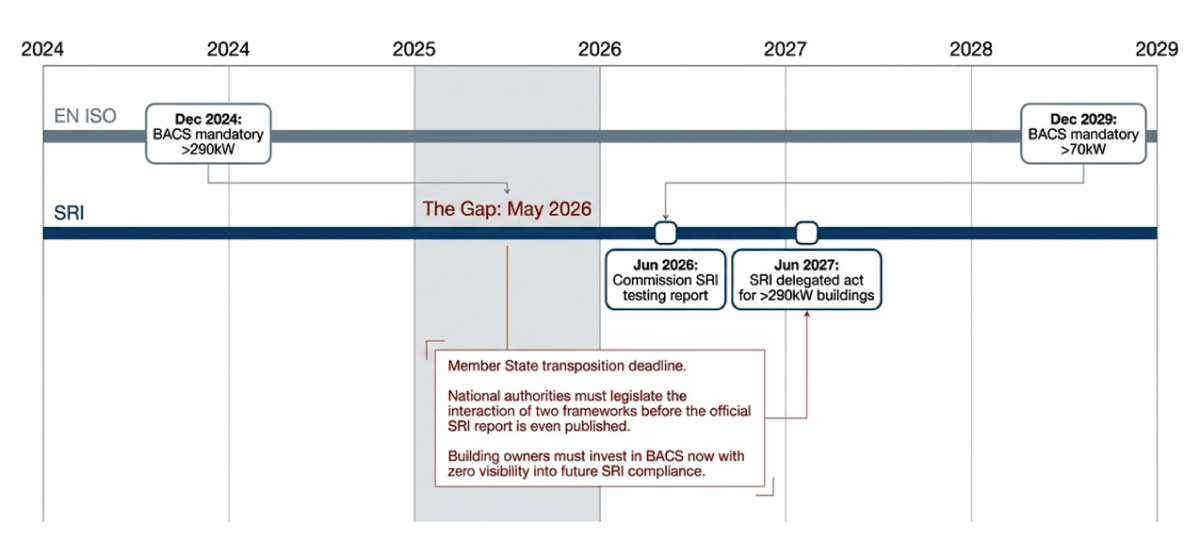
Figure 4
EPBD 2024 timeline for BACS and SRI implementation.
Significant investment risks are created for building owners by this regulatory asymmetry. Capital investments for the December 2024 BACS mandate must be made without future SRI ratings being known. Because a significant portion of SRI services have no or only partial counterparts in the BACS standard, compliance with even top-tier BACS Class A provides no guarantee of high SRI ratings. Through this structural asymmetry, it is demonstrated that critical smart-ready domains are left unaddressed by BACS compliance alone, whereby stranded assets are risked.
Furthermore, significant pressure is placed upon Member States by this disjointed timeline. These regulations are required to be transposed into national law by May 2026, a month before the official SRI testing report is published. Without formal guidance being provided, there is a high risk of fragmented national implementations, by which the EPBD’s standardisation goals are undermined.
Double assessment burden and the integrated protocol
Once the Article 15 delegated act is implemented, dual verification of BACS compliance and SRI assessment will be required for buildings exceeding 290 kW (EPBD, 2024). To unify these currently independent methodologies, an integrated site-visit protocol is proposed, building on standardised SRI on-site audit procedures (Martinez et al., 2025; Melero et al., 2026). This protocol was formulated by comparative mapping, allowing SRI evaluation, BACS class determination, and EPC data collection to be combined into a single workflow.
This proposed protocol is designed across five phases, which are as follows:
Pre-visit preparation including method selection and BACS documentation review.
A building walkthrough where SRI functionality and EN ISO control levels are simultaneously assessed employing translational mapping.
Concurrent scoring facilitated by direct translation mapping for applicable services between SRI FL and EN ISO 52120-1 CL.
EPC integration, where the BACS class determines BAC efficiency factors (fBAC,H; fBAC,C; fBAC,DHW; fBAC,el) for input into EN ISO 52000-1 calculations.
Post-visit reporting, including digital logbook uploads, eliminates duplicated site visits while preserving both assessment outputs, the SRI score (0–100%, Class A–G) and BACS Class (A–D) remain distinct but co-produced from a single evidence base.
To minimise future SRI rating risk (where top BACS Class A may still yield only moderate SRI scores) building owners cannot rely solely on BACS compliance. SRI-exclusive domains (EV charging, smart electricity management, dynamic envelopes) default to baseline without supplementary measures. Targeted supplementary investments in these domains are therefore required to bridge the energy-focused BACS framework and SRI’s broader multi-criteria scope ahead of mandatory 2027 assessments.
Performance measurement gaps
A fundamental limitation is shared by both the SRI and BACS frameworks: neither is sufficiently connected to measured operational performance.
On the SRI side, the indicator evaluates technology presence, not operational effectiveness. Garzia et al. (2024) found no correlation between SRI scores and energy performance class across 59 buildings. Person et al. (2025) conducted the first empirical field validation, finding that EN ISO 52120-1 forecast factors predicted 26% savings for advanced functionality levels, but a district heating system achieved only 16.8%, while a heat pump achieved 51.3%, demonstrating that identically weighted SRI services yield drastically different real-world outcomes.
On the BACS standard side, Van Thillo, Verbeke, and Audenaert (2022) concluded that the BAC factor method does not reliably estimate achievable energy savings, as fixed factors cannot account for building design, occupant behaviour, or climate context. Vandenbogaerde et al. (2023) quantified this variability, finding actual savings ranging from 7 to 37% for heating emission control, ranges far wider than fixed factors represent.
A critical “carbon-blindness” (absence of operational carbon metrics) is exhibited by both systems; operational greenhouse gas emissions are entirely ignored, despite explicit EPBD mandates. Moreover, energy flexibility is contradicted: while grid-interactive performance is comprehensively covered by the SRI, actual flexibility cannot be quantified by its qualitative ordinal scoring system. Meanwhile, there is no scope to evaluate the flexibility in the quantitative EN ISO standard. Therefore, real operational effectiveness remains comprehensively unmeasured by either tool.
Discussion
Through comparative analysis, framework interaction gaps are synthesised and classified into four unique categories, ranked by degree of misalignment.
First, a significant scope imbalance is identified; 25 SRI services remain unaligned with the EN ISO standard. Second, significant methodological paradigm discrepancies emerge, whereby the SRI’s compensatory aggregation conflicts with the ISO standard’s non-compensatory weakest-link criterion, and mathematical conversion between their differing measurement scales is shown to be invalid. Third, deficiencies in performance validation are identified. Neither framework validates actual operational outcomes, and a shared “carbon-blindness” persists despite explicit decarbonisation objectives. Finally, technology-specific gaps of moderate extent are observed, wherein emerging technologies (such as smart glazing and thermal storage) are excluded from evaluation, indicating that the ISO standard requires development.
Recommendations for framework convergence
Five policy recommendations are proposed for the 2026–2027 EPBD transposition window.
Formalisation of translational mapping between SRI and EN ISO 52120-1 as an official technical report proposed under CEN/EN ISO that systematically defines the interaction and translation rules for its implementation to prevent national regulatory fragmentation.
Establishing EN ISO 52120-1 Class B as the minimum compliance threshold for overlapping services, ensuring that building owners are granted investment confidence regarding baseline HVAC and lighting infrastructure.
Mitigation strategies for the double assessment burden by piloting an integrated site-visit protocol, through which SRI evaluation, BACS classification, and EPC data are seamlessly combined into a single operational workflow.
Systematically introducing a dynamic carbon weighting layer into both assessment frameworks, enabling time-varying grid emission factors to be accurately captured. For the SRI, weighting IC1 and IC7 by marginal emissions displaced by demand response; and for the BACS standard, extending the BAC factor method to include carbon-weighted factors (fBAC,CO2) capturing the carbon value of automation beyond energy quantity reduction.
Operationalising measurement-based SRI Method C using real-time metered data calibrated against EN ISO BACS predictions, ensuring that the expected energy and carbon reductions are rigorously empirically validated.
Limitations
The analysis of EN ISO 52120-1:2022 relies on publicly available descriptions and published Annex A factor values rather than an exhaustive clause-by-clause review of the copyrighted standard (EN ISO 52120-1, 2022). The proposed translational mapping remains empirically unvalidated, necessitating further calibration. The study presents no new empirical data, the contribution is methodological, not experimental. Moreover, the findings are bounded by the early 2026 regulatory landscape, which could be altered by impending legislative updates.
Conclusion
This study compares the EU’s two principal smart building assessment frameworks: the Smart Readiness Indicator (SRI) and EN ISO 52120-1:2022. Although both frameworks pursue complementary policy objectives, the analysis shows that they remain structurally incompatible due to differences in measurement scale, aggregation logic, and domain coverage. The SRI operates on ordinal functionality levels within a multi-criteria framework, whereas the BACS standard applies ratio-scale energy factors within a non-compensatory classification structure.
Despite these differences, the study demonstrates that a structured equivalence can be developed through a systematic translational mapping between SRI services and EN ISO 52120-1 control functions. The results reveal clear scoring asymmetry: top-tier BACS Class A typically yields only moderate SRI ratings, as non-energy SRI domains receive no contribution from BACS compliance.
More broadly, both frameworks show limitations in representing operational carbon performance and energy flexibility, indicating that further methodological development is required to support future decarbonisation objectives. In the context of the 2026–2027 EPBD implementation window, the proposed assessment protocol and policy recommendations provide a practical pathway for reducing the double-assessment burden. Procedural convergence between the two systems is therefore achievable without requiring a full merger of their scoring frameworks.
These findings clarify the distinct but complementary roles the two instruments play within the EPBD 2024 recast. EN ISO 52120-1 functions as an engineering input to energy performance calculation by supplying the BAC efficiency factors required under the Article 13 building-automation obligation and feeding the energy performance certificate; whereas the SRI serves as a multi-dimensional readiness assessment under Article 15, evaluating capability across energy, comfort, health, information, and grid flexibility to owners and occupants. Article 16 and Annex I bind both outputs to the digital building logbook. Recognising their difference is essential because the BACS measures the energy impact of automation, while the SRI measures the breadth of smart-ready capability, and neither substitutes for the other.
On this basis, the study advances five policy recommendations for the 2026–2027 transposition window: (i) formalise the SRI-to-EN ISO 52120-1 translational mapping as an official CEN/ISO technical report to prevent national fragmentation; (ii) adopt EN ISO 52120-1 Class B as the minimum threshold for overlapping HVAC and lighting services, giving owners investment certainty; (iii) pilot the integrated site-visit protocol to reduce the double-assessment burden, building on standardised SRI audit procedures (Martinez et al., 2025); (iv) introduce a dynamic carbon-weighting layer into both frameworks to address their shared operational carbon-blindness; and (v) operationalise measurement-based SRI Method C, calibrated against BACS predictions, to close the performance-validation gap. Together these measures enable procedural convergence during the implementation window without requiring a full merger of the two scoring frameworks.
Nomenclature
- Abbreviation
Definition
- BAC
Building Automation and Controls
- BACS
Building Automation and Control System(s)
- CL
Control Level (EN ISO 52120-1)
- DBL
Digital Building Logbook
- EPBD
Energy Performance of Buildings Directive
- EPC
Energy Performance Certificate
- FL
Functionality Level (SRI)
- IC
Impact Criterion (SRI)
- KF
Key Functionality (SRI)
- MCDA
Multi-Criteria Decision Analysis
- SRI
Smart Readiness Indicator
- TABS
Thermo-Active Building Systems
- TBM
Technical Building Management
- TES
Thermal Energy Storage
- f_BAC
BAC efficiency factor (ratio scale)
Author Contributions
All authors contributed equally to this work, including conceptualisation, research methodology, analysis, writing, and review of the manuscript.