
Table 1
Inclusion and exclusion criteria of the systematic literature review and main definitions.
| INCLUSION CRITERIA | EXCLUSION CRITERIA |
|---|---|
| 1. Study assesses sufficiency measure(s) according to definition* | 1. No emphasis on assessing sufficiency measure(s) according to definition* |
| 2. Study focuses on spatial planning or the BE** | 2. Thematical focus deviates from spatial planning or the BE** |
| 3. Study presents a methodology to assess the impact of sufficiency measure(s) | 3. Absence of a clearly stated methodology to assess the impact of sufficiency measure(s) |
| 4. Focus on self-sufficiency with no additional sufficiency aspects assessed |
[i] * Sufficiency measures are defined as: practices that aim for decreased environmental degradation and increased societal well-being by reducing demand for energy, land and/or resources through voluntary or enforced changes in individual or collective behaviour.
** The BE is defined as: residential, non-residential and other spatial areas such as green and infrastructural spaces in rural, peri-urban and urban regions.
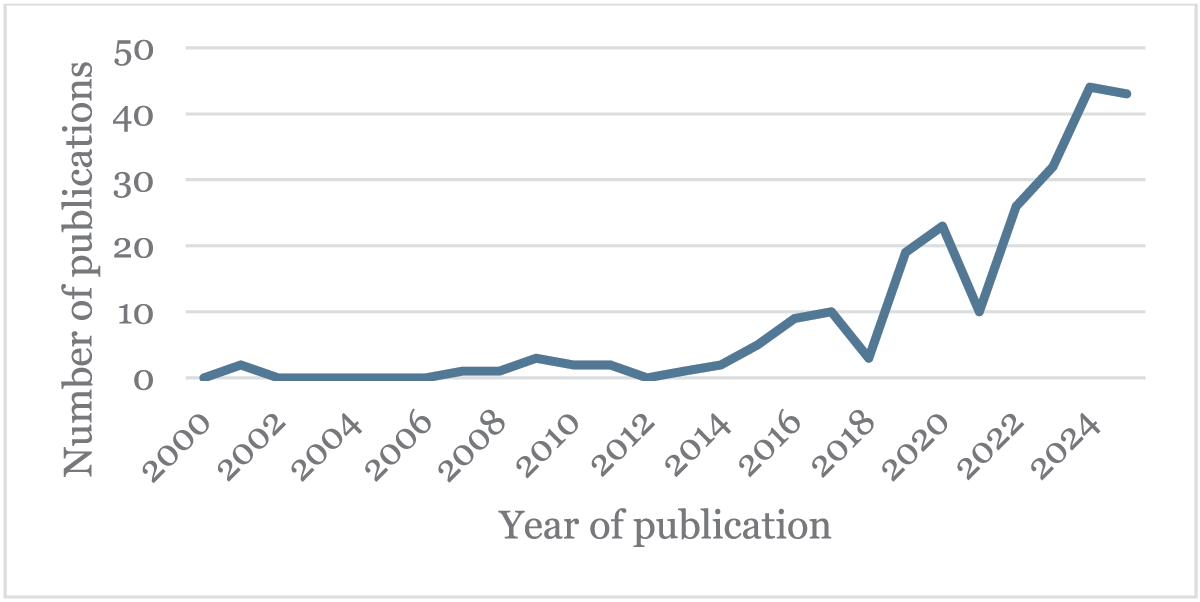
Figure 1
Number of publications per year from search query (initial Scopus and Web of Science exports combined, not excluding duplicates).
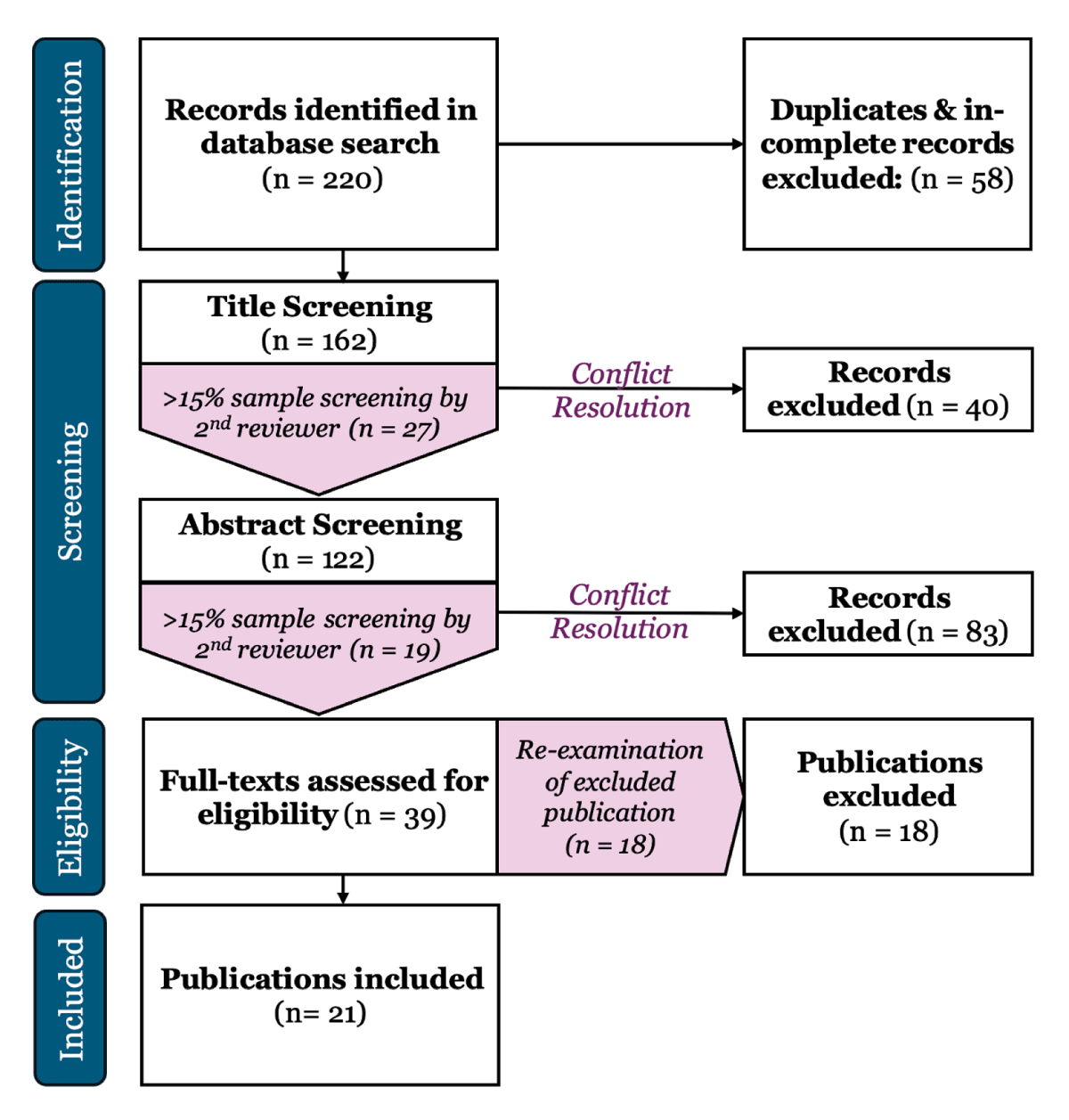
Figure 2
PRISMA Flowchart adapted from Page et al. (2021) showing the main literature review process and (in pink) the application of a rapid review approach by a second reviewer as proposed by Smela et al. (2023) and Garritty et al. (2021).
Table 2
Allocation of reviewed studies to sufficiency strategies (study allocation with possible duplications).
| STUDY ALLOCATION | SUFFICIENCY STRATEGIES | CHARACTERIZATION |
|---|---|---|
| [1], [2], [6], [9], [10], [11], [12], [15], [20] | Space optimization and utilization | Sufficiency operationalized via spatial metrics (e.g. living space/capita, densification, roof/facade space) to reduce energy, material and land demand (Hock 2024; Bierwirth and Thomas 2019; Zimmermann and Firat 2024) |
| [1], [5], [6], [7], [11], [14], [15], [16], [19] | Resource optimization and circularity | Sufficiency framed as extending the useful life of resources, components, and structures by balancing multiple resource flows via spatial optimization or by prioritizing existing buildings over new construction to reduce resource demand (Zimmermann and Firat 2024; Niessen and Bocken 2021; Hock 2024) |
| [4], [13], [17], [18] | Behavioral and lifestyle changes | Sufficiency as attitudes or household practices shaped by/mediating the built environment with a focus on creating social acceptance, decreasing adoption barriers, and nudging behavioral change (Jungell-Michelsson and Heikkurinen 2022; Zimmermann and Firat 2024) |
| [8], [10], [17], [21] | Need satisfaction for infrastructure & green spaces | Sufficiency as satisfying mobility and access needs (transport, green space) with reduced emissions/energy or improved spatial equity, balancing well-being against resource/travel demand (Hock 2024) |
| [3], [19] | Rural regeneration and strengthening of rural-urban linkages | Sufficiency at regional/rural scale achieved through energy/resource self-sufficiency, regeneration of existing settlements, and strengthening of rural–urban linkages rather than new development (Simon 2008; Allen 2003; Iten et al. 2025) |
Table 3
Analysis of included records. Numbers [1–21] refer to the included studies (Figure 3). Bracketed crosses indicate categorizations from contextual information.
| METHODOLOGY | REVIEWED STUDY | TEMPO-RALITY | ASSESSMENT TYPE | SPATIAL AREA | SCOPE | COUNTRY | SUFFICIENCY STRATEGY | IMPACT DOMAIN | VARIABILITY OF SERVICE LEVEL | |||||||||||||
|---|---|---|---|---|---|---|---|---|---|---|---|---|---|---|---|---|---|---|---|---|---|---|
| PROSPECTIVE | RETROSPECTIVE | QUANTITATIVE | SEMI-QUANT. | QUALITATIVE | URBAN | PERI-URBAN | RURAL | RESOURCE | SPACE | MOBILITY | AGRI-FOOD | WATER | EMISSIONS | ENERGY | OTHER | VARIABLE | FIXED | |||||
| Computational systems modelling: optimization & stock modelling | [1] Zheng et al. (2025) | x | x | x | Local | China | Space optimization and utilization/Resource optimization and circularity | x | x | x | x | x | ||||||||||
| [2] Singhvi et al. (2025) | x | x | x | (x) | x | Regional | Switzer-land | Space optimization and utilization | x | x | x | x | ||||||||||
| [9] Lall and Sethi (2024) | x | x | x | National | India | Space optimization and utilization | x | x | x | x | ||||||||||||
| [10] Subin et al. (2024) | x | x | x | National | US | Space optimization and utilization/ Need satisfaction for infrastructure and green spaces | x | x | x | x | x | |||||||||||
| [19] Binder et al. (2016) | x | x | (x) | (x) | (x) | Regional | Austria | Resource optimization and circularity/Rural regeneration and strengthening of rural-urban linkages | x | x | x | x | x | |||||||||
| Geospatial analysis | [5] (Dekolo et al. 2025) | x | x | x | Local | Nigeria | Resource optimization and circularity | x | x | (x) | ||||||||||||
| [6] (Ma et al. 2025) | x | x | x | Local | Multiple | Space optimization and utilization/Resource optimization and circularity | x | x | x | |||||||||||||
| [15] Deng et al. (2021) | x | x | x | National | Austria | Space optimization and utilization/Resource optimization and circularity | x | x | ||||||||||||||
| [21] Agbaje et al. (2024) | x | x | x | x | x | Local | US | Need satisfaction for infrastructure and green spaces | x | x | x | |||||||||||
| Building performance & LCA | [7] Falter et al. (2025) | x | x | x | Local | N.A. | Resource optimization and circularity | x | x | x | x | x | ||||||||||
| [11] Binz and Jäger (2024) | x | x | x | National | Germany | Space optimization and utilization/ Resource optimization and circularity | x | x | x | (x) | ||||||||||||
| [12] Alaux et al. (2024) | x | x | x | x | x | National | Austria | Space optimization and utilization | x | x | x | x | (x) | |||||||||
| [16] Jin et al. (2020) | x | x | x | National | China | Resource optimization and circularity | x | x | x | x | ||||||||||||
| Statistical & econometric analysis | [4] Sula et al. (2025) | x | x | x | x | Regional | Sweden | Behavioural and lifestyle changes | x | x | x | |||||||||||
| [8] Czepkiewicz et al. (2024) | x | x | x | x | Regional | Poland | Need satisfaction for infrastructure and green spaces | x | x | x | x | |||||||||||
| [17] Waygood et al. (2019) | x | x | x | x | x | Regional | Japan | Behavioural and lifestyle changes/ Need satisfaction for infrastructure and green spaces | x | x | x | x | ||||||||||
| Interpretive/ participatory evaluation of sufficiency acceptance | [13] Aagaard and Christensen (2024) | x | x | (x) | (x) | (x) | National | Denmark | Behavioural and lifestyle changes | x | x | x | x | x | ||||||||
| [18] Khalid & Sunikka-Blank (2019) | x | x | x | Local | Pakistan | Behavioural and lifestyle changes | x | x | x | |||||||||||||
| [20] Gröne (2016) | x | x | x | Local | Germany | Space optimization and utilization | x | x | x | |||||||||||||
| Literature/ case-based framework synthesis | [3] Ciampa et al. (2025) | x | x | x | Regional | Multiple | Rural regeneration and strengthening of rural-urban linkages | x | x | x | x | x | x | x | ||||||||
| [14] Fauth & Pieper (2022) | x | x | x | National | Germany | Resource optimization and circularity | x | x | x | x | ||||||||||||
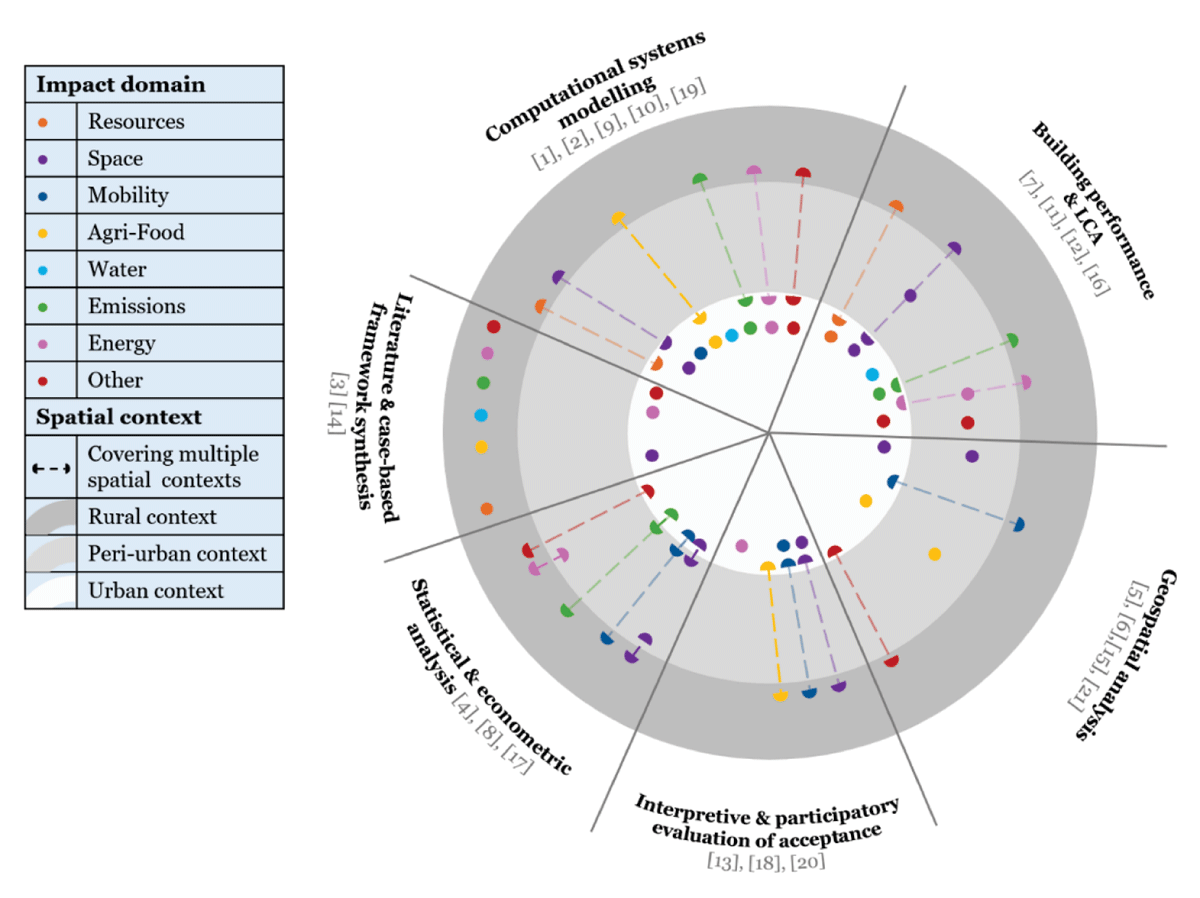
Figure 3
Methodological approaches for assessing sufficiency in relation to impact domain and spatial contexts. Numbers [1–21] refer to the included studies, see Table 3.
Annex 1
Methodological cluster characterization.
| STUDY ALLOCATION | METHODOLOGICAL CLUSTER | CHARACTERIZATION | THEORETICAL GROUNDING |
|---|---|---|---|
| [1], [2], [9], [10], [19] | Computational systems modelling: optimization & stock modelling | Studies that build computational models of a system (building, energy grid, urban stock) to project future states, generate scenarios, or identify optimal solutions among competing objectives. Outputs are model-derived, not directly measured. | Optimization and stock models are related forms of computational systems modelling that represent system components and relationships mathematically, using simulation to explore alternative system states. Optimization models search a defined solution for configurations that maximize or minimize objective functions under constraints (Yang et al. 2012). Stock models, represent individual system components such as residential end-uses or building archetypes and aggregate their characteristics to estimate system-level dynamics (Swan and Ugursal 2009; Kavgic et al. 2010). |
| [7], [11], [12], [16] | Building performance (BPA) & LCA | Studies that quantify environmental (energy, emissions etc.) or economic performance of buildings across their life cycle using existing standardized data or direct field measurement. | Related approaches that systematically quantify building performance and impacts using defined indicators and system boundaries. BPA evaluates building performance to provide feedback for design optimisation (Jin et al. 2019) while LCA assesses environmental impacts across a system’s life cycle (Finnveden et al. 2009; ISO 2006). Life-Cycle Costing (LCC) quantifies significant costs incurred over an asset’s entire life (Woodward 1997). |
| STUDY ALLOCATION | CLUSTER TITLE | CHARACTERIZATION | THEORETICAL GROUNDING |
| [5], [6], [15], [21] | Geospatial analysis | Studies that use spatial data as the primary analytical medium to identify patterns, classify land use, model accessibility, or quantify spatial change. | Subset of analytical techniques and lens through which events, patterns, and processes on or near the Earth’s surface are examined, applicable when data can be referenced on a two-dimensional frame and relate to terrestrial activities (de Smith et al. 2023). |
| [4], [8], [17] | Statistical & econometric analysis | Studies that collect primary or secondary quantitative data and apply inferential statistical techniques to test relationships, predict outcomes, or compare groups. | Empirical quantitative approaches that use primary or secondary numerical data and inferential methods to examine relationships, differences, and outcomes. Both use statistical inference to derive conclusions from observed data; econometrics additionally tends to integrate these methods with theoretically specified models (Samuelson et al. 1954; Guetterman 2019). |
| [13], [18], [20], | Interpretive/ participatory evaluation of sufficiency acceptance | Studies that engage with stakeholders (interviews, focus groups, back casting, practice observation) to assess attitudes, agency, barriers, and enablers. | Qualitative approaches that involve stakeholders in the evaluation of development processes or identification of patterns. Participatory evaluation is characterized by collaboration between evaluators and individuals/groups, with participation intended to enhance the ownership of evaluation findings e.g. to support social change (Cousins and Whitmore 1998). Thematic analysis is a flexible qualitative method for identifying and analysing patterns within similar data (Braun and Clarke 2006). Both are context-sensitive, qualitative approaches that place stakeholders’ perspectives at the centre of understanding development processes. |
| [3], [14] | Literature/ case-based framework synthesis | Studies that synthesize literature or documented case studies into conceptual models or design frameworks that translate sufficiency principles into design strategies for planning guidance. | Systematic method for building a conceptual, design, or operational framework by applying an initial set of categories or dimensions derived from theory, policy, or prior research to literature or case studies (Brunton et al. 2020; Dixon-Woods 2011). The resulting framework is then validated, with rigor and generalizability depending on the evidence base and validation strategy (Venable et al. 2016). |