
Introduction
Projections estimate that at least 75% of the population in Northern America, Europe, Latin America and the Caribbean countries will live in urban areas by 2050 (UNDESA 2019; Kundu et al. 2020). With a rising urban population, the pressure on finding suitable living space is omnipresent in cities worldwide. For expanding the building stock through new construction which is often sought as a solution, energy and resource-intensive processes are required that can run counter to global emission-reduction needs (Lotteau et al. 2015). Building operations contribute to 30% of global final energy consumption and 26% of global energy-related emissions, with 8% stemming from direct emissions within buildings and 18% resulting from indirect emissions linked to the production of electricity and heat used in buildings (IEA 2025). The development of infrastructure systems also plays a crucial role as transport, energy, water, and green networks significantly contribute to greenhouse gas (GHG) emissions and resource consumption (Ai and Yan 2024). Not only urban areas but also peri-urban and rural areas face climate change-related spatial planning challenges such as the equitable use of land, energy, and resources and the integration of climate change adaptation into planning.
Recognizing the significance of sustainable spatial planning across different spatial typologies for addressing the dual challenges of urbanization and climate change, the EU has set the objective of achieving climate neutrality by 2050 as part of the European Green Deal, underscoring the urgency of reducing emissions in the built environment (BE). In addition, the revised Energy Performance of Buildings Directive requires a 55% reduction in GHG emissions by 2030 and stipulates that all new buildings must be zero-emission by 2030, making it essential that planning decisions support these targets (European Commission 2025).
In this context, it becomes increasingly clear that reaching sustainability goals in the BE requires measures not only based on efficiency but also sufficiency (André 2024). Sufficiency policies have considerable potential to address some of these challenges, yet their success depends on supportive local governance to improve social acceptance, provide financial incentives, and regulatory frameworks that enable people to live in ways that adequately meet their needs (Bagheri et al. 2024). Governance action concerns for instance current housing patterns in the EU, where in 2024 about 33% of the population lived in underused homes, highlighting a significant underutilization of housing space and the need for planning strategies that support a sufficient use of existing resources (European Commission 2025).
While efficiency measures have been widely targeted in spatial planning, sufficiency measures remain underutilized, despite their potentially higher GHG-saving impacts and cost-effectiveness (Arceo et al. 2025). A variety of definitions of the sufficiency concept is one reason that hinders its uptake. For the purpose of this study sufficiency is defined as a set of practices which reduce the demand for energy, materials, land, water and other natural resources, while delivering well-being for all within planetary boundaries (FULFILL 2025; IPCC 2024). A lack of robust methodologies to assess the effects of sufficiency measures and integrate social, economic and environmental factors is a second reason limiting the adoption of sufficiency measures in spatial planning. Especially the inclusion of minimum and maximum thresholds in sufficiency discussions often with no clear basis for comparison, makes it is difficult to assess the improvement potentials of sufficiency measures (Binz and Jäger 2024). Sufficiency metrics furthermore can overlap with efficiency metrics, making it difficult to assess their standalone effects. The lack of standardized metrics and the subjective nature of housing needs complicate the measurement process (Arceo et al. 2025).
Assessing the impact of sufficiency measures has been identified as a priority for advancing the role of sufficiency in the BE (Fischer and Arnold 2026). Yet there is no clear methodology for doing so as mentioned earlier. This study therefore aims to address this gap and explore methodologies for assessing the impacts of sufficiency measures. By conducting a systematic literature review, the study examines existing methodologies for assessing sufficiency measures in the BE, investigates their characteristics and provides an evidence base for developing effective methodologies to assess sufficiency measures. The review results provide a foundation for advancing sufficiency-focused spatial planning across urban, peri-urban and rural spatial areas.
Theoretical background
While there have been previous attempts to explore sufficiency, no studies have systematically assessed methodologies to assess their impact, particularly in the BE, encompassing residential, non-residential, and other spatial areas such as green and infrastructural spaces. Three streams of research, however, have laid the foundation for this study: Studies identifying sufficiency measures, spatial planning research and studies on assessment practices for sustainability measures including sufficiency aspects.
For buildings, Zimmermann and Firat (2024) established five sufficiency measures, namely low-tech, mindful user behaviour, adaptability, redevelopment of existing buildings and reduction of per capita living space. Sula et al. (2024) applied a framework to map sufficiency measures such as downsizing, scalability, and optimized resource use and allocate them to various intervention impact domains. Following Sula et al. (2024) this study also uses “impact domains” as the categories of consequences against which sufficiency measures are assessed. Bierwirth and Thomas (2019) also focused on buildings, demonstrate how optimizing space can lower impact domains such as energy demand, resource use and emissions. Hock (2024), identified sufficiency measures to address different impact domains in the BE, focusing on energy, material, and land use and highlight barriers such as an efficiency-focus and lack of equity-focused criteria, as well as sufficiency carriers (Hock 2024). Iten et al. (2025) also identify sufficiency measures beyond buildings in rural municipalities, linking local services, sustainable mobility and densification to lower resource use. In the discourse of sufficiency measures, a distinction is drawn between absolute and relative impact reductions of measures. Sufficiency primarily aims for absolute reductions in energy and resource use by limiting demand to what is necessary within ecological and social boundaries, whereas relative approaches reduce impacts compared to a reference point without necessarily lowering total consumption (Zell-Ziegler et al. 2023). This distinction is linked to rebound effects: efficiency and relative sufficiency may improve performance while overall consumption continues to grow (Sorrell et al. 2020; Zell-Ziegler et al. 2023). In this context, André (2024) argues, that conventional assessment approaches are sometimes poorly suited for sufficiency measures, since assessing them requires methodologies that account for variability in the level of service provided, which differentiates them from efficiency measures.
Spatial planners must balance conflicting land- and resource-allocation objectives, often under cost constraints, limited data, and fragmented methodological tools (Pedro et al. 2019). Urban, peri-urban, and rural areas pose distinct challenges (Sun and Tong 2024). Cities often need densification and integrated infrastructure, peri-urban areas require adaptive governance across fragmented jurisdictions to reconcile land uses and ecological flows and rural regions sometimes need strategies to address depopulation (Simon 2008; Allen 2003). Studies therefore call for integrated metropolitan planning to overcome fragmented governance, stressing the vulnerability and limited resources of peri-urban regions in particular (Allen 2003; Simon 2008). Barriers to sufficiency-oriented planning include costs, regulatory obstacles, and institutional knowledge gaps (Fischer and Arnold 2026). Broader uptake requires coordinated policy, incentives and public awareness. More integrated methodologies are needed to guide sufficiency-based planning as existing tools often lack spatial differentiation, multi-criteria capacity, flexibility or cross-context applicability (Pedro et al. 2019).
Broader sustainability assessment research, such as Ness et al. (2007) and Haapio and Viitaniemi (2008) has developed frameworks for classifying and reviewing environmental assessment tools, though these primarily emphasize resource and energy efficiency. Li et al. (2021) similarly assessed GIS-LCA combinations across environmental sectors. Methodologies that have been used in previous papers to explore sufficiency in the BE according to Sahakian et al. (2024) include interviews, focus groups, surveys and modelling, and combinations of these (Sahakian et al. 2024).
Overall, existing research has advanced the understanding of sufficiency in the BE by clarifying core concepts, identifying measures, distinguishing spatial context conditions, and developing some assessment approaches. However, these strands remain fragmented as conceptual studies rarely address impact assessments, studies on measures and parameters often focus only on efficiency measures and existing assessment tools are not tailored to comprehensively capture the broader impacts of sufficiency measures. It therefore remains unclear which methodologies are available to assess sufficiency in the BE in a comprehensive, spatially differentiated, and decision-relevant way.
Methodology
A systematic literature review was conducted in accordance with the PRISMA guidelines as illustrated in Figure 2 (Page et al. 2021). In line with this approach, an initial identification of records was followed by record screening first titles, then abstracts based on a review protocol with established inclusion and exclusion criteria. Where the title and abstract screening did not exclude a record, the full papers were reviewed in detail and irrelevant studies excluded based on the same set of criteria. Remaining studies were considered included in the review.
Following an iterative approach, the review began with developing a common understanding among reviewers of the research problem and the definition of the research object, namely methodologies to assess the impact of sufficiency measures in the BE, which served as the foundation for establishing keywords for the search query. Before initiating the search query, common definitions among authors on main terms, in particular “sufficiency measures” and “the BE” needed to be established. On this base, a review protocol with inclusion and exclusion criteria was developed as stated in Table 1. The initial review protocol included only the first three exclusion criteria. A fourth exclusion criterion was added after the title screening, namely (4) studies on self-sufficiency which were only to be included if the assessment considered additional sufficiency aspects.
Table 1
Inclusion and exclusion criteria of the systematic literature review and main definitions.
| INCLUSION CRITERIA | EXCLUSION CRITERIA |
|---|---|
| 1. Study assesses sufficiency measure(s) according to definition* | 1. No emphasis on assessing sufficiency measure(s) according to definition* |
| 2. Study focuses on spatial planning or the BE** | 2. Thematical focus deviates from spatial planning or the BE** |
| 3. Study presents a methodology to assess the impact of sufficiency measure(s) | 3. Absence of a clearly stated methodology to assess the impact of sufficiency measure(s) |
| 4. Focus on self-sufficiency with no additional sufficiency aspects assessed |
[i] * Sufficiency measures are defined as: practices that aim for decreased environmental degradation and increased societal well-being by reducing demand for energy, land and/or resources through voluntary or enforced changes in individual or collective behaviour.
** The BE is defined as: residential, non-residential and other spatial areas such as green and infrastructural spaces in rural, peri-urban and urban regions.
Scopus and Web of Science were used for searching publications. The search query was conducted on February 13, 2026, and targeted publications in English containing the following keywords in title, abstract or keywords:
TITLE-ABS-KEY ( sufficiency AND ( “spatial planning” OR “built environment” ) ) AND ( LIMIT-TO ( LANGUAGE, “English” ) )
Alternative keywords (broader spatial and sufficiency-related terms) were trialled but not retained, to avoid a dilution of the intended corpus of literature. The search was instead kept narrow to focus on studies explicitly centred on sufficiency and BE, although this may limit representation of the discourse where synonyms are common.
The body of literature reviewed was limited to peer-reviewed primary research and no temporal restriction was applied to capture the full development of the research field. An initial collection of studies however revealed that a large majority of studies were published within the last ten years as can be taken from Figure 1.
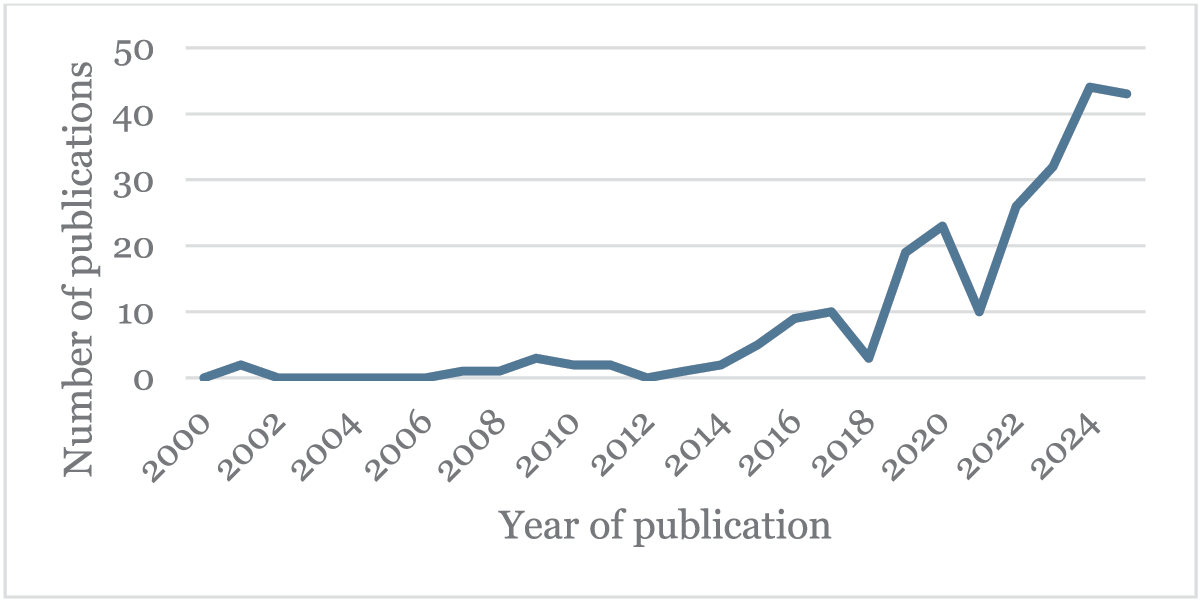
Figure 1
Number of publications per year from search query (initial Scopus and Web of Science exports combined, not excluding duplicates).
Following the identification of the initial set of records, bibliographic data was extracted, merged, and duplicates or records with insufficient information for study identification were removed. The remaining records underwent the screening process, starting with titles and abstracts.
To enhance the reliability of results, the literature review was conducted by two independent reviewers consisting of a main and second reviewer as illustrated in Figure 2 in line with a rapid-review approach as applied by Smela et al. (2023) and Garritty et al. (2021). The main reviewer completed the initial title screening including exclusion decisions, followed by the second reviewer blindly screening a >15% sample of titles again, taking independent exclusion or inclusion decisions. The level of agreement was then assessed, followed by a conflict-resolution discussion to align the application of the review protocol. Based on this improved alignment, the same procedure was applied during abstract screening, with the second reviewer again screening a blinded >15% sample of abstracts previously screened by the first reviewer and comparing exclusion decisions. Although agreement at the title-screening stage was initially only moderate, the abstract-screening stage showed high convergence between the reviewers, indicating that the deviation primarily reflected different levels of caution for excluding studies rather than substantive disagreement about study relevance. In the abstract screening, an observed agreement of 84% and a Cohen’s kappa of 0.62 was achieved, indicating substantial inter-rater reliability according to Landis and Koch (1977). Finally, all studies excluded after full-text screening by the first author were re-examined by the second reviewer.
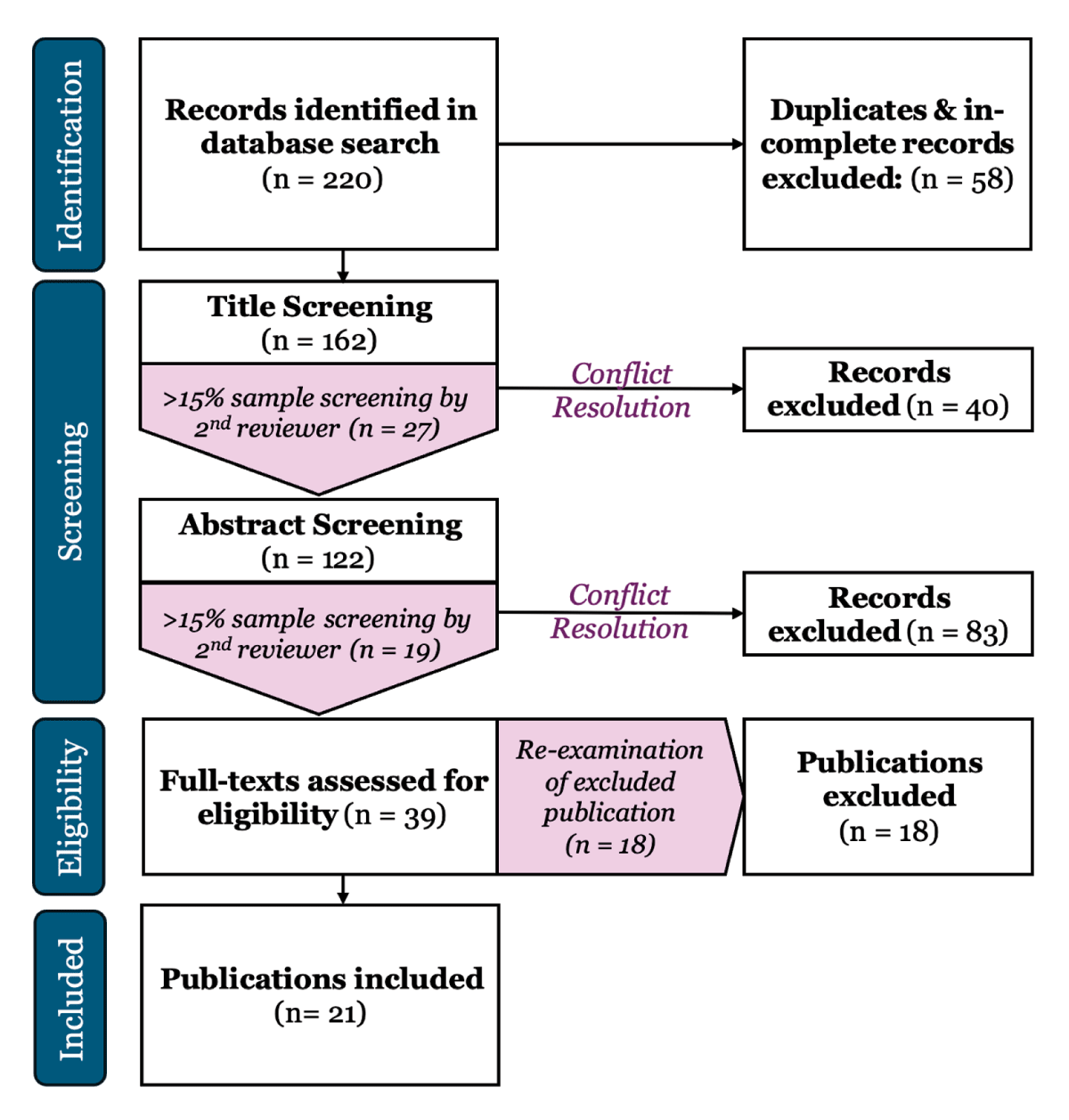
Figure 2
PRISMA Flowchart adapted from Page et al. (2021) showing the main literature review process and (in pink) the application of a rapid review approach by a second reviewer as proposed by Smela et al. (2023) and Garritty et al. (2021).
Studies that were considered included for literature analysis were classified according to nine categories: type of methodology, temporality, assessment type, spatial area, scope, country, sufficiency strategy, impact domain and variability of service level, in line with the research interest and analysed categories of previous studies (Ness et al. 2007; Hock 2024). Among these categories, the methodologies, impact domains and spatial contexts were analysed in-depth, while the remaining categories were used to characterize the studies. The variability of service level was analysed to examine the suitability of the identified methodological clusters for capturing sufficiency as distinct from efficiency measures (André 2024). The study’s indicators were therefore reviewed for their underlying reference value and coded according to whether this allowed the level of service or demand to vary across scenarios.
A total of 220 records were identified through the search query, among which 136 originated from Scopus and 84 from Web of Science. 58 records were excluded due to duplications or data incompleteness. After the title screening, 40 records were excluded as they did not fulfil the inclusion or exclusion criteria applied, followed by abstract screening, which excluded 83 records. Full-text eligibility assessment was conducted for 39 publications, resulting in the exclusion of 18 studies. Ultimately, 21 publications were included in the literature analysis.
Results
This result section is structured to provide an overview of the reviewed studies, including their characteristics, methodological approaches, their sufficiency strategy and the impact domains of assessed sufficiency measures as can be taken from Table 3.
Characteristics of included studies
The included studies span a period of 2016 to 2025, reflecting a recent interest in sufficiency within the BE. Geographically, the studies encompass 12 countries in diverse regions, including Europe (ten), Asia (five), North America (two) and Africa (one). The scale of analysis varies across the reviewed studies, encompassing local (seven), regional (six), and national contexts (eight), with no single scale emerging as predominant. Accounting for 16 studies, a majority was published as journal articles, while conference papers make up five studies. 13 studies focus on either an urban, peri-urban or rural area, while six address multiple spatial areas combined. In total, 15 studies apply quantitative, three qualitative and three a semi-quantitative approaches. The included studies differ in their temporal design, with 12 adopting a prospective approach and nine employing a retrospective design.
Sufficiency strategies
The specific sufficiency measures assessed within the reviewed studies can be clustered into five categories each representing a sufficiency strategy. The characterization of these strategies was applied based on previous studies primarily by Zimmermann and Firat (2024) and Hock (2024) on buildings. Measures beyond buildings still largely lack sufficient conceptual framing. Most of the reviewed studies focused on space or resource optimization as can be taken from Table 2.
Table 2
Allocation of reviewed studies to sufficiency strategies (study allocation with possible duplications).
| STUDY ALLOCATION | SUFFICIENCY STRATEGIES | CHARACTERIZATION |
|---|---|---|
| [1], [2], [6], [9], [10], [11], [12], [15], [20] | Space optimization and utilization | Sufficiency operationalized via spatial metrics (e.g. living space/capita, densification, roof/facade space) to reduce energy, material and land demand (Hock 2024; Bierwirth and Thomas 2019; Zimmermann and Firat 2024) |
| [1], [5], [6], [7], [11], [14], [15], [16], [19] | Resource optimization and circularity | Sufficiency framed as extending the useful life of resources, components, and structures by balancing multiple resource flows via spatial optimization or by prioritizing existing buildings over new construction to reduce resource demand (Zimmermann and Firat 2024; Niessen and Bocken 2021; Hock 2024) |
| [4], [13], [17], [18] | Behavioral and lifestyle changes | Sufficiency as attitudes or household practices shaped by/mediating the built environment with a focus on creating social acceptance, decreasing adoption barriers, and nudging behavioral change (Jungell-Michelsson and Heikkurinen 2022; Zimmermann and Firat 2024) |
| [8], [10], [17], [21] | Need satisfaction for infrastructure & green spaces | Sufficiency as satisfying mobility and access needs (transport, green space) with reduced emissions/energy or improved spatial equity, balancing well-being against resource/travel demand (Hock 2024) |
| [3], [19] | Rural regeneration and strengthening of rural-urban linkages | Sufficiency at regional/rural scale achieved through energy/resource self-sufficiency, regeneration of existing settlements, and strengthening of rural–urban linkages rather than new development (Simon 2008; Allen 2003; Iten et al. 2025) |
Methodological approaches used to assess sufficiency impacts
The reviewed studies employ a range of methodologies to assess the impacts of sufficiency measures. In general, they predominantly anchor assessments in absolute metrics such as carbon budgets or maximum living space per person (Lall and Sethi 2024; Alaux et al. 2024; Singhvi et al. 2025; Waygood et al. 2019), reflecting a deliberate move beyond efficiency and relative sufficiency. Where relative benchmarks appear, they are used to measure the reduction required from a current baseline (Sula et al. 2025). Methodological approaches were categorized in the following six clusters (see Annex 1 for detailed characterization):
Computational systems modelling – optimization and stock modelling (five records): uses computational models to project future system states or identify optimal configurations under defined objectives and constraints. Zheng et al. (2025) employ multi-objective optimization to explore rooftop utilization for food, energy and water provision, while Lall and Sethi (2024) use optimization to identify thresholds for energy use and carbon emissions. Singhvi et al. (2025) apply building stock modelling to assess how sufficiency measures can be differentiated according to socio-spatial conditions. Subin et al. (2024) model housing projections to explore pathways towards low-vehicle-mile neighbourhoods, while Binder et al. (2016) link energy demand, renovation, policy conditions and territorial resource constraints to assess energy sufficiency pathways. Sufficiency is measured through model-derived quantities including floor area, energy demand and supply, emissions, land area and regional resource potentials. The studies operate at different spatial scales, ranging from buildings and neighbourhoods to regional systems, with the spatial context influencing the system components and constraints represented in the models. The strength of this cluster lies in its ability to quantify system-level changes and explore alternative future scenarios. Three of the five studies represented a variable service level, while two treated the service level as fixed, indicating that optimization and stock-modelling approaches can capture changes in service demand, although this is not consistent across the reviewed studies.
Building performance & LCA (four records): evaluates the performance and life-cycle impacts of building alternatives. Binz and Jäger (2024) apply building-level LCA to compare refurbishment with new construction, while Alaux et al. (2024) assess embodied impacts at the national building-stock level. Falter et al. (2025) evaluate adaptive reuse at component level for individual non-residential buildings, and Jin et al. (2020) assess the performance of a net-zero-energy housing design. The studies measure sufficiency-related outcomes through indicators such as floor area, energy demand and environmental impacts, including GWP and, in some cases, additional impact categories such as freshwater use, resource depletion, acidification and eutrophication. Their spatial application ranges from individual building components and buildings to national building stocks, with most studies focusing on specific building types or building interventions. The strength of this cluster is its ability to quantify and compare the environmental, energy and economic consequences of alternative building configurations over defined periods. Two of the four studies represented a variable service level, while two treated it as fixed.
Geospatial analysis (four records): uses spatial data to examine patterns, accessibility, land use and spatial change. Ma et al. (2025) use GIS to quantify rooftop food-production potential in high-density cities, while Agbaje et al. (2024) apply network analysis to assess park accessibility. Dekolo et al. (2025) combine land-change analysis with structural equation modelling to examine how peri-urban expansion affects ecosystem services, and Deng et al. (2021) simulate future residential land consumption. Sufficiency is operationalised through spatial indicators including potential food production, accessibility and distance to green spaces, land conversion and residential land consumption. The studies cover urban, peri-urban and mixed urban–rural contexts, with the spatial configuration of resources, services and land uses forming a central part of the assessment. The strength of these methodologies lies in their ability to make spatial patterns and relationships explicit and to assess sufficiency dimensions that depend on location, proximity and land availability. All four studies represented a variable service level, indicating that the reviewed geospatial applications consistently captured changes in service provision.
Interpretive & participatory assessment of sufficiency acceptance (three records): uses qualitative and participatory approaches to investigate perceptions, needs, barriers and enabling conditions surrounding sufficiency. Aagaard and Christensen (2024) combine focus groups with back casting to explore sufficiency pathways across food, mobility and housing in urban Denmark. Gröne (2016) combines interviews, stakeholder workshops and a multi-level perspective to identify sufficiency-related measures in a shrinking post-industrial district, particularly concerning heating and transport. Khalid and Sunikka-Blank (2019) combines in-depth interviews and practice observation with homeowners to interpret household practices and identify barriers and enablers that mediate sufficiency interventions in space use. Rather than expressing sufficiency through a common quantitative unit, these studies assess dimensions such as perceived needs, acceptance, agency, barriers, enabling conditions and opportunities for reducing resource or floor-space requirements. Their applications range from urban neighbourhoods and districts to specific workplace settings. The strength of this cluster is its ability to capture situated experiences and stakeholder perspectives that are difficult to represent through quantitative approaches. Two of the three studies represented a variable service level, while one treated it as fixed.
Statistical & econometric analysis (three records): uses quantitative empirical data to identify relationships, differences or patterns relevant to sufficiency. Waygood et al. (2019) employ statistical techniques including ANOVA and post-hoc analysis to examine transport sufficiency and its relationship with well-being. Sula et al. (2025) and applies a regression model to survey data, testing the relationship between a willingness-to-adopt outcome and 19 independent variables to identify determinants of sufficiency behaviour. Czepkiewicz et al. (2024) applies a range of inferential statistical techniques to systematically test hypothesized relationships between built environment, socio-demographic, and mobility variables. Sufficiency is therefore measured through empirically observed behavioural, attitudinal or socio-spatial variables rather than through modelled resource quantities. The studies are primarily applied at the individual, household or neighbourhood level, depending on the underlying survey or observational data. The strength of this cluster lies in its ability to derive empirical evidence on behavioural patterns, associations and differences between groups. Two of the three studies represented a variable service level, while one treated it as fixed.
Literature & case-based framework synthesis (two records): draws on existing literature or documented cases to develop conceptual models and design frameworks for applying sufficiency principles. Ciampa et al. (2025) examine rural village regeneration and develop a model integrating social, economic and environmental considerations to avoid additional construction. Fauth and Pieper (2022) developed a case-based framework approach to translate sufficiency principles into a specific built-environment application. Sufficiency is consequently expressed primarily through qualitative criteria and design or planning strategies. The studies focus on specific settlement or project contexts, including rural and context-specific built-environment applications. The strength of this cluster lies in synthesising existing evidence and contextual experience into frameworks that can translate sufficiency principles into planning and design strategies. One of the two studies represented a variable service level.
Impact domains
The reviewed studies highlight a wide range of impact domains relevant to sufficiency in the BE, each of which is operationalized through sufficiency indicators. In line with the definitions introduced above, an impact domain denotes the broad category of consequence being assessed, whereas a sufficiency indicator denotes the specific metric used to quantify that consequence within a given domain. This review differentiates eight impact domains, within which indicators were explored (see Table 3). Space (16), energy (11) and emissions (nine) are the most frequently covered impact domains in the reviewed studies, while water (three) was covered least often. The studies used different metrics to assess these impact domains. Resource use is commonly measured through material input (kg/m2) and recycling rates. Space is often assessed through living space per capita, reused space area, and the share of built-up area relative to total plot size, emphasizing densification. Mobility-related indicators include per capita transport emissions (CO2/passenger-km), trip counts, and distance to services or parks (km). Agri-food and water impacts are captured through indicators such as food self-sufficiency (tons of food), agricultural land per capita (m2), rainwater harvesting efficiency and freshwater consumption (m3/year). Emission reduction is another recurring impact domain, with operational and embodied emissions measured in annual tonnes of CO2-equivalents, as well as annual emission reductions (Mt). Energy-related indicators include energy intensity (kWh/m2) and the share of renewable energy. Broader sustainability goals are reflected in “other” indicators such as economic stability, community well-being, climate comfort, and noise protection.
Table 3
Analysis of included records. Numbers [1–21] refer to the included studies (Figure 3). Bracketed crosses indicate categorizations from contextual information.
| METHODOLOGY | REVIEWED STUDY | TEMPO-RALITY | ASSESSMENT TYPE | SPATIAL AREA | SCOPE | COUNTRY | SUFFICIENCY STRATEGY | IMPACT DOMAIN | VARIABILITY OF SERVICE LEVEL | |||||||||||||
|---|---|---|---|---|---|---|---|---|---|---|---|---|---|---|---|---|---|---|---|---|---|---|
| PROSPECTIVE | RETROSPECTIVE | QUANTITATIVE | SEMI-QUANT. | QUALITATIVE | URBAN | PERI-URBAN | RURAL | RESOURCE | SPACE | MOBILITY | AGRI-FOOD | WATER | EMISSIONS | ENERGY | OTHER | VARIABLE | FIXED | |||||
| Computational systems modelling: optimization & stock modelling | [1] Zheng et al. (2025) | x | x | x | Local | China | Space optimization and utilization/Resource optimization and circularity | x | x | x | x | x | ||||||||||
| [2] Singhvi et al. (2025) | x | x | x | (x) | x | Regional | Switzer-land | Space optimization and utilization | x | x | x | x | ||||||||||
| [9] Lall and Sethi (2024) | x | x | x | National | India | Space optimization and utilization | x | x | x | x | ||||||||||||
| [10] Subin et al. (2024) | x | x | x | National | US | Space optimization and utilization/ Need satisfaction for infrastructure and green spaces | x | x | x | x | x | |||||||||||
| [19] Binder et al. (2016) | x | x | (x) | (x) | (x) | Regional | Austria | Resource optimization and circularity/Rural regeneration and strengthening of rural-urban linkages | x | x | x | x | x | |||||||||
| Geospatial analysis | [5] (Dekolo et al. 2025) | x | x | x | Local | Nigeria | Resource optimization and circularity | x | x | (x) | ||||||||||||
| [6] (Ma et al. 2025) | x | x | x | Local | Multiple | Space optimization and utilization/Resource optimization and circularity | x | x | x | |||||||||||||
| [15] Deng et al. (2021) | x | x | x | National | Austria | Space optimization and utilization/Resource optimization and circularity | x | x | ||||||||||||||
| [21] Agbaje et al. (2024) | x | x | x | x | x | Local | US | Need satisfaction for infrastructure and green spaces | x | x | x | |||||||||||
| Building performance & LCA | [7] Falter et al. (2025) | x | x | x | Local | N.A. | Resource optimization and circularity | x | x | x | x | x | ||||||||||
| [11] Binz and Jäger (2024) | x | x | x | National | Germany | Space optimization and utilization/ Resource optimization and circularity | x | x | x | (x) | ||||||||||||
| [12] Alaux et al. (2024) | x | x | x | x | x | National | Austria | Space optimization and utilization | x | x | x | x | (x) | |||||||||
| [16] Jin et al. (2020) | x | x | x | National | China | Resource optimization and circularity | x | x | x | x | ||||||||||||
| Statistical & econometric analysis | [4] Sula et al. (2025) | x | x | x | x | Regional | Sweden | Behavioural and lifestyle changes | x | x | x | |||||||||||
| [8] Czepkiewicz et al. (2024) | x | x | x | x | Regional | Poland | Need satisfaction for infrastructure and green spaces | x | x | x | x | |||||||||||
| [17] Waygood et al. (2019) | x | x | x | x | x | Regional | Japan | Behavioural and lifestyle changes/ Need satisfaction for infrastructure and green spaces | x | x | x | x | ||||||||||
| Interpretive/ participatory evaluation of sufficiency acceptance | [13] Aagaard and Christensen (2024) | x | x | (x) | (x) | (x) | National | Denmark | Behavioural and lifestyle changes | x | x | x | x | x | ||||||||
| [18] Khalid & Sunikka-Blank (2019) | x | x | x | Local | Pakistan | Behavioural and lifestyle changes | x | x | x | |||||||||||||
| [20] Gröne (2016) | x | x | x | Local | Germany | Space optimization and utilization | x | x | x | |||||||||||||
| Literature/ case-based framework synthesis | [3] Ciampa et al. (2025) | x | x | x | Regional | Multiple | Rural regeneration and strengthening of rural-urban linkages | x | x | x | x | x | x | x | ||||||||
| [14] Fauth & Pieper (2022) | x | x | x | National | Germany | Resource optimization and circularity | x | x | x | x | ||||||||||||
The analysis indicates several relationships between methodologies, impact domains and spatial contexts in which they could be applied. Figure 3 shows three interconnected dimensions of the review. First, it shows the methodological clusters identified in the review. Secondly it illustrates which of the eight impact domains were covered using these methodologies, whereas one study usually has indicators from several impact domains and multiple occurrences of indicators from the same domain are displayed as single counts. Thirdly, it shows whether the methodologies focused on a singular spatial area or operates across two or all spatial areas.
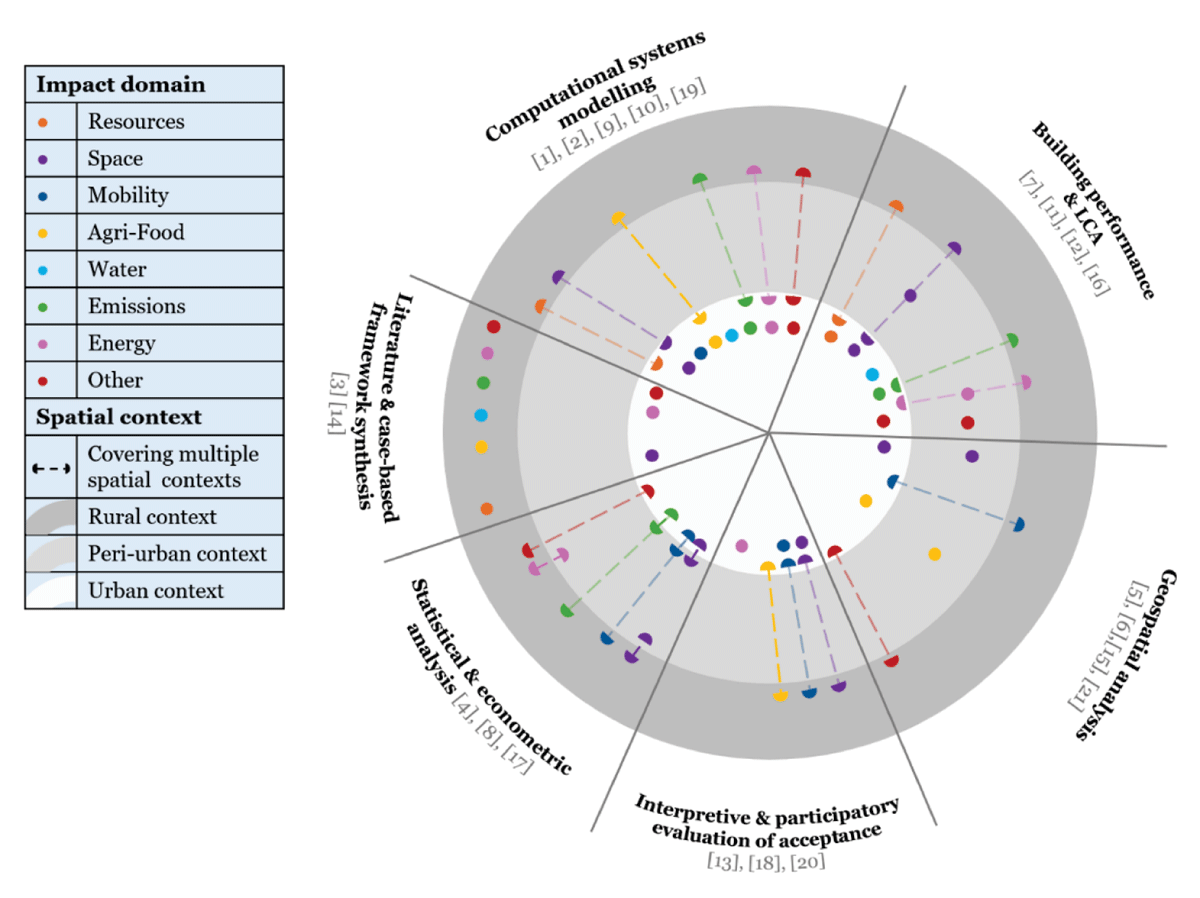
Figure 3
Methodological approaches for assessing sufficiency in relation to impact domain and spatial contexts. Numbers [1–21] refer to the included studies, see Table 3.
The joint evaluation of these dimensions reveals that computational systems modelling seems to cover almost all types of impact domains and crosses all three spatial areas. LCA-based models show potential for assessing several impact domains, such as material inputs, embodied emissions, and resource utilization, as seen in studies like Falter et al. (2025), however, with only four LCA studies included in this review, their demonstrated coverage of spatial areas remains limited. GIS-based spatial analyses demonstrate less versatility as the methodology is applicable to various spatial areas but covering few different impact domains. Statistical and econometric methods appear well suited for analysing various spatial applications, including peri-urban linkages to rural and urban areas. Interpretive and participatory assessments capture a limited number of impact domains. Literature and case-based framework synthesis seem to also cover indicators from many impact domains, however these studies focus only on one spatial area at a time.
Discussion
As methodologies represent the studies’ focus, its discussion focuses on their spatial contexts and impact domains in order to illustrate the breadth and versatility of their application in spatial planning. The discussion first interprets how methodologies are distributed across spatial areas and impact domains, before evaluating their strengths and limitations within the broader dominance of efficiency-oriented spatial planning, and finally points towards practical relevance and potential future development of sufficiency assessment methodologies.
Distribution across spatial areas and impact domains
The distribution of methodologies across spatial areas and impact domains resulting from this analysis seems to reflect the conditions and priorities that currently shape spatial planning practice. The reviewed studies reveal considerable heterogeneity in what is measured, how it is measured, and where it is applied, making comparison across spatial contexts difficult in the absence of harmonized, replicable approaches. Also the urban bias of studies is consistent with observations by Simon (2008) and Allen (2003), who attribute the systematic underrepresentation of peri-urban and rural areas to their limited institutional agency, governance fragmentation, and reduced resources to engage in planning processes driven by urban centres. Notably, studies covering spatial areas beyond the urban context, tend to originate from resource-rich countries (Switzerland, Sweden, Denmark, United States) suggesting that an integrated metropolitan approach as considered preferable by Simon (2008) requires institutional and financial capacities that remain unevenly distributed regionally and globally. Studies from the Global South (Pakistan, Nigeria, India) by contrast, focused on a single spatial area, reflecting these constraints. Regarding impact domains, the dominance of space and energy parameters reflects a planning discourse still largely anchored in building-level concerns and economic drivers, consistent with the efficiency-focused bias that (Hock 2024) identifies as a barrier to integrating sufficiency in assessing sustainability developments in neighbourhood. Broader ecological (water, resources) and especially social (well-being) domains, remain underrepresented despite being foregrounded in sufficiency frameworks. This partly echoes Haapio and Viitaniemi (2008) and Sahakian et al. (2024), who note that sustainability assessment tools in general and sufficiency research in specific tend to neglect the social dimension.
Limitations and strengths of sufficiency assessment methodologies
Spatial planning is still dominated by efficiency measures as highlighted by Arceo et al. (2025) and confirmed by replicating this review’s search query substituting “sufficiency” with “efficiency” which yields 5,362 records on Scopus compared to 136 retrieved for sufficiency. This disparity signals a fundamental paradigmatic asymmetry, and mirrors the findings by Haapio and Viitaniemi (2008). Because efficiency metrics translate environmental goals into quantifiable cost-reduction targets, they become accountable to municipalities, national governance frameworks, and the public, whereas sufficiency demands a more challenging multi-perspective understanding of needs, well-being, and ecological limits, further compounded by inconsistent conceptual framings of sufficiency, as also documented by Jungell-Michelsson and Heikkurinen (2022). Especially well-being dimensions of sufficiency measures require qualitative approaches that sit uneasily within the quantitative paradigm as noted by Sahakian et al. (2024) in their review and empirically confirmed by Hock’s (2024) analysis of neighbourhood sustainability assessments. Sufficiency assessments are challenged by requiring the simultaneous capture of incommensurable outcomes, a difficulty further underscored by Arceo et al. (2025), who identify the absence of standardised metrics and the subjective nature of housing needs as key barriers to measurement. Despite some advantages of efficiency measures, planning practices often overlook the vulnerability of efficiency-only approaches to rebound effects, where absolute sufficiency thresholds, are structurally more robust. According to this review, the majority of studies prioritize absolute caps to ensure that development stays within the environment’s actual carrying capacity (Gröne 2016; Aagaard and Christensen 2024). Moreover, sufficiency measures achieve cost reductions equal to or exceeding those of efficiency measures and frequently generate co-benefits across social and ecological domains as Bierwirth and Thomas (2019) demonstrate in the residential context. Saheb (2021) explicitly frames sufficiency and circularity as overlooked decarbonisation strategies with compounding benefits, an argument that aligns with Bierwirth and Thomas’ (2019) demonstration that space reduction not only lowers energy demand but generates cascading resource and emissions savings. This multi-domain dividend positions sufficiency assessments as a strategic asset for planners navigating competing priorities.
Among the reviewed studies, Ciampa et al. (2025) demonstrate this by making visible e.g. how heritage-focused sufficiency interventions generate economic and social co-benefits (tourism revenue, business creation, community cohesion). However, few reviewed studies yet sufficiently highlight such advantages, requiring more action in making the multiple benefits of assessed sufficiency measures visible to spatial planners.
Suitability of current methodologies for spatial planning practice
To integrate sufficiency into spatial planning, decision-makers need methodologies that provide applicability across different spatial areas and scales, versatility across multiple impact domains and effectiveness in identifying and monitoring improvement potentials. This need is consistent with findings that existing tools often address these requirements only partially, for example by lacking spatial differentiation or multi-criteria decision capacity (Pedro et al. 2019), and with Fischer and Arnold’s (2026) call for improved assessment tools to guide sufficiency-oriented spatial development. On the first criterion, GIS-, LCA-, and statistical methods-based assessments already demonstrate the integrated metropolitan approach that Simon (2008) identify as essential for avoiding the systematic neglect of peri-urban and rural needs. On versatility, the reviewed methodologies collectively cover the full range of sufficiency impact domains, even if no single approach does so simultaneously. This study therefore shows how existing methodologies can address localised needs with assessing sufficiency measures, capture the specific conditions of individual spatial areas and also hold potential for informing integrated approaches when combined. Across clusters, the findings on the reviewed studies’ variability of service level however show that some methodologies are not inherently sufficiency-assessment methodologies but their relevance to sufficiency depends on whether they operationalise the level of service or demand itself. This supports findings by André (2024) and emphasizes the need for indicators in assessing sufficiency measures that allow changes in the amount or form of service provision.
Pathways for methodological advancement and future research
By systematically mapping the methodological landscape, this review advances current knowledge by revealing where assessment capacity exists and which methodologies or combinations hold promise for integrated sufficiency assessments in spatial planning. Future research should pursue several concrete directions. Studies such as Mastrucci et al. (2017) and Alaux et al. (2024) illustrate how methodological combinations may offer an actionable pathway forward. Pairing LCA with building stock models enables spatially explicit, dynamic, and large-scale evaluations. This model could be extendable to other domain combinations identified in this review, and consistent with evidence by Li et al. (2021) that integrating GIS with LCA substantially broadens spatial and thematic scope. Life Cycle Sustainability Assessment or Sufficiency-LCAs as outlined by André (2024) may also represent a potential way forward with standardized frameworks designed to integrate triple-bottom line dimensions within a single approach. Also, greater harmonisation of measurement units, spatial scales, and sufficiency indicators, which is a gap flagged by Arceo et al. (2025) and Binz and Jäger (2024) would enable cross-contextual comparison currently hindered by inconsistent operationalisations.
Direct side-by-side comparisons of efficiency and sufficiency assessment methodologies are moreover largely absent. Understanding how they differ in scope, measurability, and planning effectiveness would provide decision-makers with the evidence base needed to justify sufficiency integration. The effectiveness of existing methodologies in grounding planning decisions and monitoring progress toward defined sufficiency thresholds also remains underexplored. Addressing these challenges may support the development of more targeted, robust tools for decision-makers and could move sufficiency assessment from a fragmented practice toward an integrated, wide-scale agenda that the IPCC (2024) identify as a precondition for measures to reach their full decarbonisation potential.
Research Limitations
Several limitations should be acknowledged when interpreting the findings of this review. First, restricting the search to English publications introduces a linguistic bias, as the discourse is very active in other languages like French and German. Second, relying on the term “sufficiency” and closely related keywords may have excluded relevant studies that address sufficiency-oriented measures without explicitly naming them as such. Applying a specific definition of sufficiency to guide the study selection may have excluded studies that operationalise the concept differently. Finally, while this review distinguished between urban, peri-urban, and rural contexts, other spatial distinctions would have been equally valid, such as differentiating between shrinking and growing urban areas.
Conclusion
Sufficiency is a necessary yet underused strategy for overcoming some of the challenges of the BE. Inconsistent sufficiency definitions and a lack of robust methodologies for decision-makers to assess the impact of sufficiency measures, currently hinder its potential. This study therefore stresses the need to enable the assessment of impacts of sufficiency measures in the BE. By systematically mapping methodologies through a literature review of an initial total of 220 records, it identified methodologies capable of assessing sufficiency measures across various impact domains as well as spatial contexts. Findings emphasize the importance of sufficiency as a complementary strategy to efficiency strategies, focusing for example on reducing resource consumption, optimizing existing spaces, and fostering shared environments that align with planetary boundaries and societal well-being. The mapping further shows that space, energy and emissions are the impact domains which are most often covered by reviewed studies.
Quantitative approaches such as computational systems modelling, GIS and LCA were most frequently applied methodologies to assess sufficiency measures in the BE. Qualitative approaches such as participatory methods are less often applied but show advantages in capturing social drivers. The study shows which methodologies have been applied previously for assessing the impact of sufficiency measures in which impact domains and spatial areas. However, significant methodological gaps and conceptual inconsistencies remain, especially regarding following an integrated approach covering urban, peri-urban and rural areas. Combining methodologies may therefore provide a more comprehensive assessment for example by integrating LCA and computational systems models. To advance sufficiency measures in spatial planning, the study calls for refining methodologies to better capture the interconnected impact domains of sufficiency in the BE which consists not only of buildings but also infrastructure. Assessing the effectiveness of existing methodologies, standardizing sufficiency concepts and metrics and making benefits of sufficiency measures more visible are essential to enable decision-makers in spatial planning to implement effective sufficiency strategies.
Additional File
The additional file for this article can be found as follows:
Literature Screening Records and Study Inclusion or Exclusion Decisions
This supplementary file documents the 162 studies screened with the agreed inclusion and exclusion decisions made by the authors across three stages of the systematic literature review: title screening, abstract screening, and full-text assessment. DOI: https://doi.org/10.66506/ed.44.s1
Appendices
Annex
Annex 1
Methodological cluster characterization.
| STUDY ALLOCATION | METHODOLOGICAL CLUSTER | CHARACTERIZATION | THEORETICAL GROUNDING |
|---|---|---|---|
| [1], [2], [9], [10], [19] | Computational systems modelling: optimization & stock modelling | Studies that build computational models of a system (building, energy grid, urban stock) to project future states, generate scenarios, or identify optimal solutions among competing objectives. Outputs are model-derived, not directly measured. | Optimization and stock models are related forms of computational systems modelling that represent system components and relationships mathematically, using simulation to explore alternative system states. Optimization models search a defined solution for configurations that maximize or minimize objective functions under constraints (Yang et al. 2012). Stock models, represent individual system components such as residential end-uses or building archetypes and aggregate their characteristics to estimate system-level dynamics (Swan and Ugursal 2009; Kavgic et al. 2010). |
| [7], [11], [12], [16] | Building performance (BPA) & LCA | Studies that quantify environmental (energy, emissions etc.) or economic performance of buildings across their life cycle using existing standardized data or direct field measurement. | Related approaches that systematically quantify building performance and impacts using defined indicators and system boundaries. BPA evaluates building performance to provide feedback for design optimisation (Jin et al. 2019) while LCA assesses environmental impacts across a system’s life cycle (Finnveden et al. 2009; ISO 2006). Life-Cycle Costing (LCC) quantifies significant costs incurred over an asset’s entire life (Woodward 1997). |
| STUDY ALLOCATION | CLUSTER TITLE | CHARACTERIZATION | THEORETICAL GROUNDING |
| [5], [6], [15], [21] | Geospatial analysis | Studies that use spatial data as the primary analytical medium to identify patterns, classify land use, model accessibility, or quantify spatial change. | Subset of analytical techniques and lens through which events, patterns, and processes on or near the Earth’s surface are examined, applicable when data can be referenced on a two-dimensional frame and relate to terrestrial activities (de Smith et al. 2023). |
| [4], [8], [17] | Statistical & econometric analysis | Studies that collect primary or secondary quantitative data and apply inferential statistical techniques to test relationships, predict outcomes, or compare groups. | Empirical quantitative approaches that use primary or secondary numerical data and inferential methods to examine relationships, differences, and outcomes. Both use statistical inference to derive conclusions from observed data; econometrics additionally tends to integrate these methods with theoretically specified models (Samuelson et al. 1954; Guetterman 2019). |
| [13], [18], [20], | Interpretive/ participatory evaluation of sufficiency acceptance | Studies that engage with stakeholders (interviews, focus groups, back casting, practice observation) to assess attitudes, agency, barriers, and enablers. | Qualitative approaches that involve stakeholders in the evaluation of development processes or identification of patterns. Participatory evaluation is characterized by collaboration between evaluators and individuals/groups, with participation intended to enhance the ownership of evaluation findings e.g. to support social change (Cousins and Whitmore 1998). Thematic analysis is a flexible qualitative method for identifying and analysing patterns within similar data (Braun and Clarke 2006). Both are context-sensitive, qualitative approaches that place stakeholders’ perspectives at the centre of understanding development processes. |
| [3], [14] | Literature/ case-based framework synthesis | Studies that synthesize literature or documented case studies into conceptual models or design frameworks that translate sufficiency principles into design strategies for planning guidance. | Systematic method for building a conceptual, design, or operational framework by applying an initial set of categories or dimensions derived from theory, policy, or prior research to literature or case studies (Brunton et al. 2020; Dixon-Woods 2011). The resulting framework is then validated, with rigor and generalizability depending on the evidence base and validation strategy (Venable et al. 2016). |
Declaration of generative AI and AI-assisted technologies in the writing process
During the study’s preparation, the authors used ChatGPT (GPT 5.1) and an internal tool to support argument structuring, to improve readability and language. After using these tools, the authors reviewed and edited all content and take full responsibility for the final text.
Author Contributions
Jana Hack: Conceptualisation, methodology, formal analysis, investigation, data curation, validation, visualisation, writing – original draft, writing – review and editing, supervision.
Mahsa Bagheri: Conceptualisation, data validation, writing – original draft, writing – review and editing.
Şirin Alibaş: Conceptualisation, data validation, writing – review and editing.