
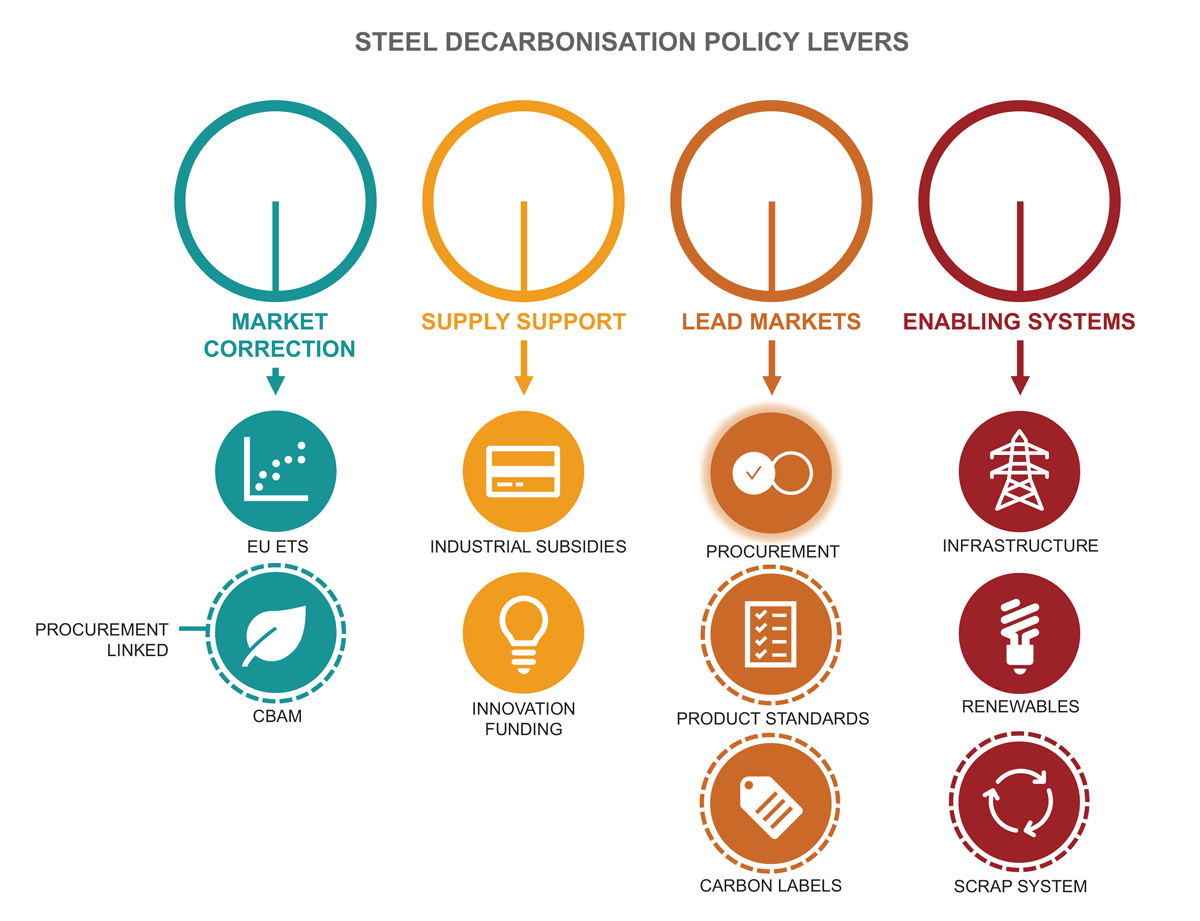
Figure 1
Selected green steel policy levers grouped by category (authors’ own elaboration based on literature review).
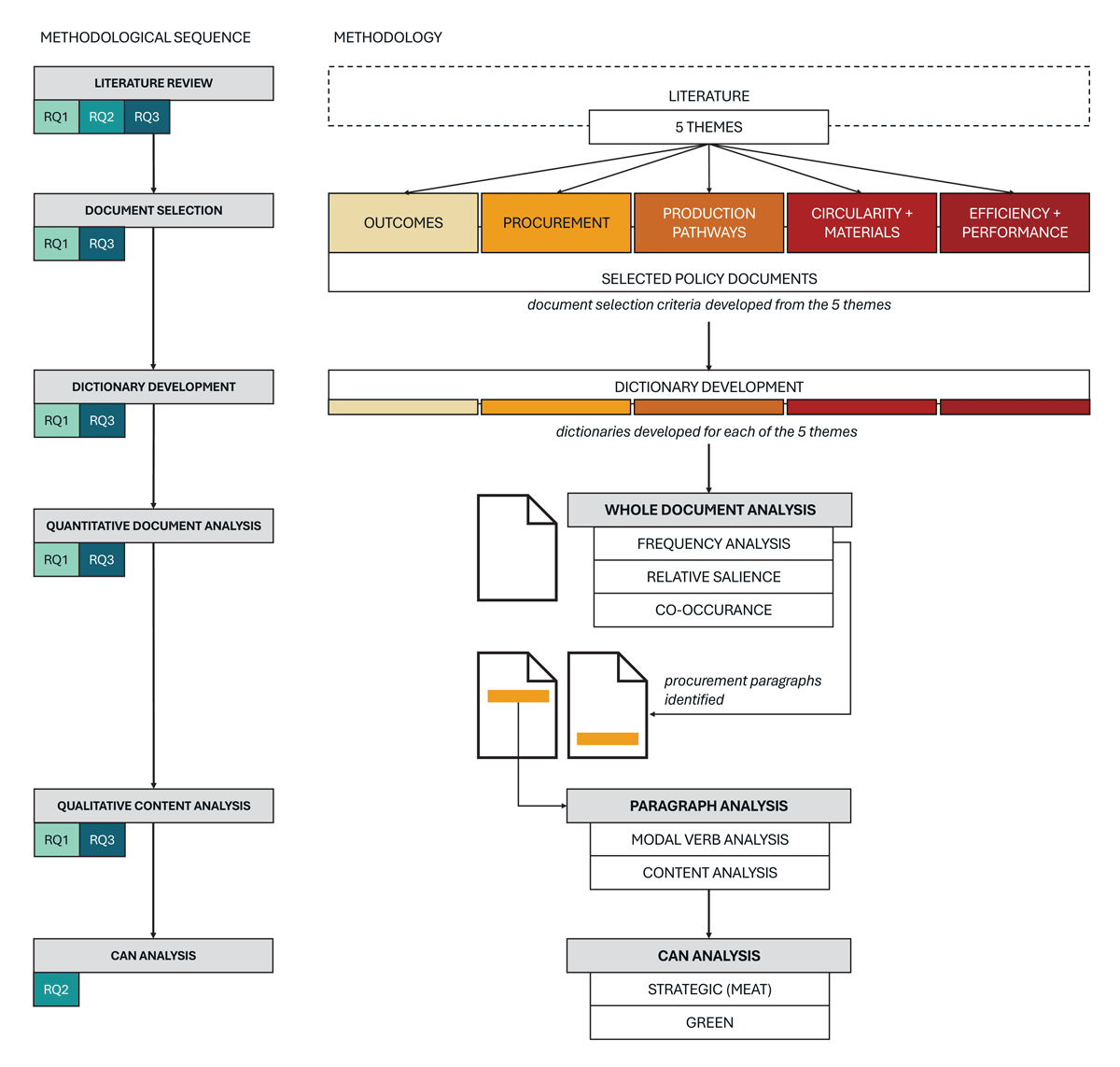
Figure 2
Sequential multi-method research design showing the analytical workflow used to examine procurement governance across EU-level signalling, national policy translation and buyer-level operationalisation (source: authors’ own elaboration).
Table 1
Connecting methodological components with the research questions.
| RESEARCH QUESTION | METHOD(S) | ANALYTICAL CONTRIBUTION |
|---|---|---|
| RQ1: How does the EU frame public procurement as an instrument for steel decarbonisation, and how is this framing translated by Member States into national frameworks? | QDA + QCA | Identifies thematic emphasis, procurement framing, governance narratives and policy translation across EU and national policy documents |
| RQ2: How is public procurement currently being used as a strategic instrument within steel-relevant sectors (transport, buildings, defence) across the EU? | CAN analysis | Examines procurement practices through MEAT usage and environmental criteria in procurement notices |
| RQ3: What governance, policy framing and support mechanisms are needed to enable public procurement to function as an effective demand-side lever for steel decarbonisation? | Integrated synthesis | Integrates findings across governance levels to identify implementation gaps, institutional barriers and governance bottlenecks |
Table 2
EU policy documents included in the analysis and their analytical relevance. A similar table for the national-level document selection and further information can be found in Appendix 1.
| DOCUMENT THEMATIC CATEGORY | INCLUDED DOCUMENTS |
|---|---|
| Industrial decarbonisation and steel transition1 |
|
| Procurement governance and lead markets |
|
| Strategic industrial policy and competitiveness |
|
| Energy systems and production pathways |
|
| Circularity and downstream demand sectors |
|
Table 3
Modal verb dictionaries.
| SIGNAL | TERMS |
|---|---|
| High binding | “shall”, “must”, “require*”, “oblig*”, “mandat*”, “is required to”, “are required to”, “shall ensure”, “must ensure”, “shall establish”, “shall adopt”, “shall not”, “must not”, “may not”, “cannot”, “can’t”, “not allow*” |
| Medium binding | “should”, “recommend*”, “expect*” |
| Low binding | “may”, “can”, “encourage*”, “support*”, “promote*”, “facilitat*” |
| None/unclear | A residual class: procurement paragraphs that do not contain any of the above three modal dictionary matches |
Table 4
Extract of the CAN data used in the analysis. Example 1 = lowest-price procurement (L); Example 2 = use of MEAT criteria (M) including references; Example 3 = use of MEAT criteria with explicit environmental weighting included within the award structure.
| EXAMPLE | ISO_COUNTRY_CODE | CRIT_CODE | CRIT_CRITERIA | CRIT_WEIGHTS |
|---|---|---|---|---|
| 1 | SE | L | – | – |
| 2 | SE | M | Pris|Referenser(Price|References) | 75|25 |
| 3 | SE | M | Pris|Miljö|Personal(Price|Environment|Staff) | 60|15|15 |
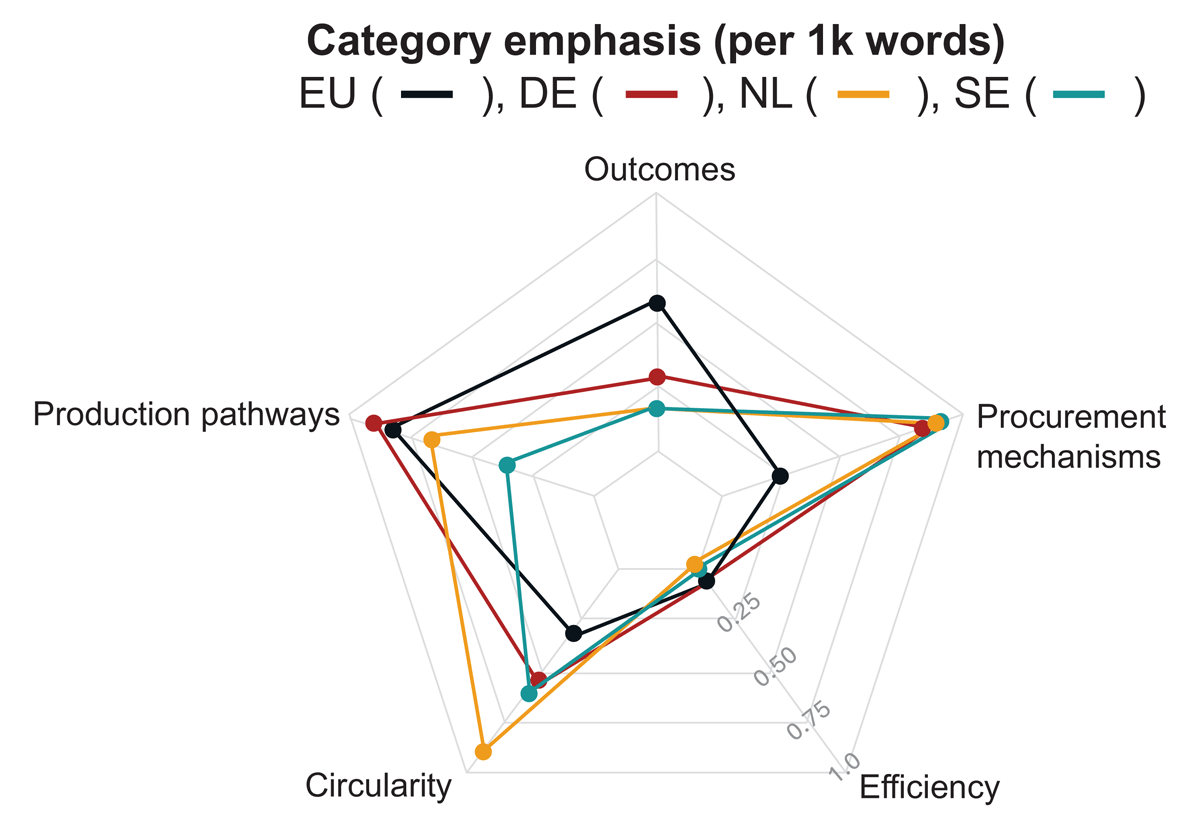
Figure 3
Relative thematic emphasis across analytical categories based on normalised term frequencies (per 1,000 words) (source: authors’ own elaboration).
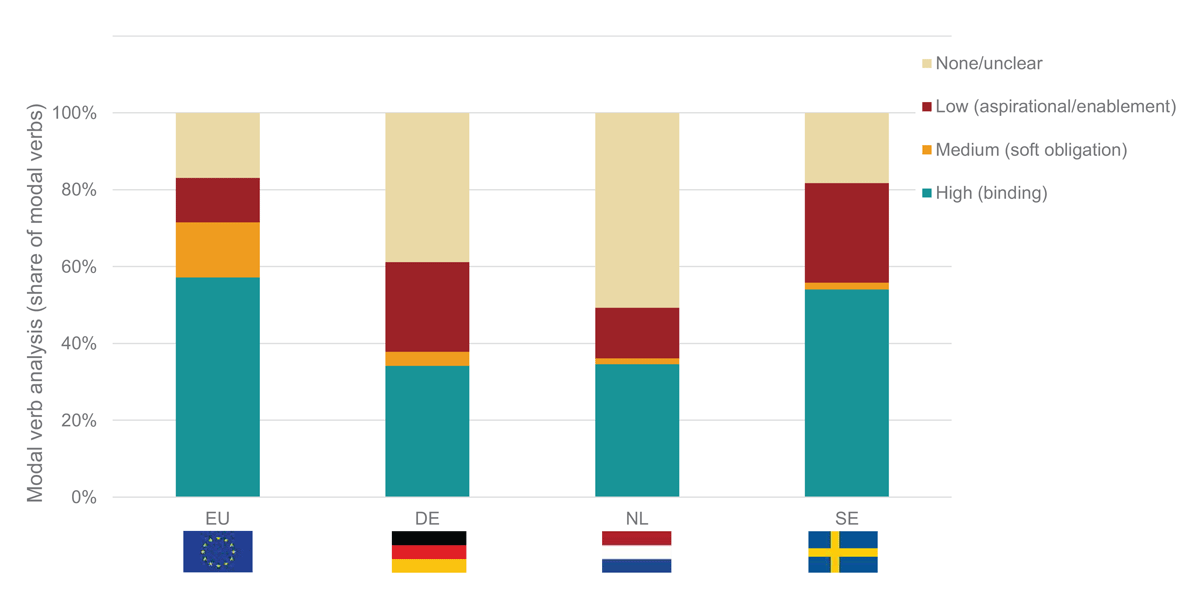
Figure 4
Modal verb comparative analysis across paragraphs containing “public procurement” terms (source: authors’ own elaboration).
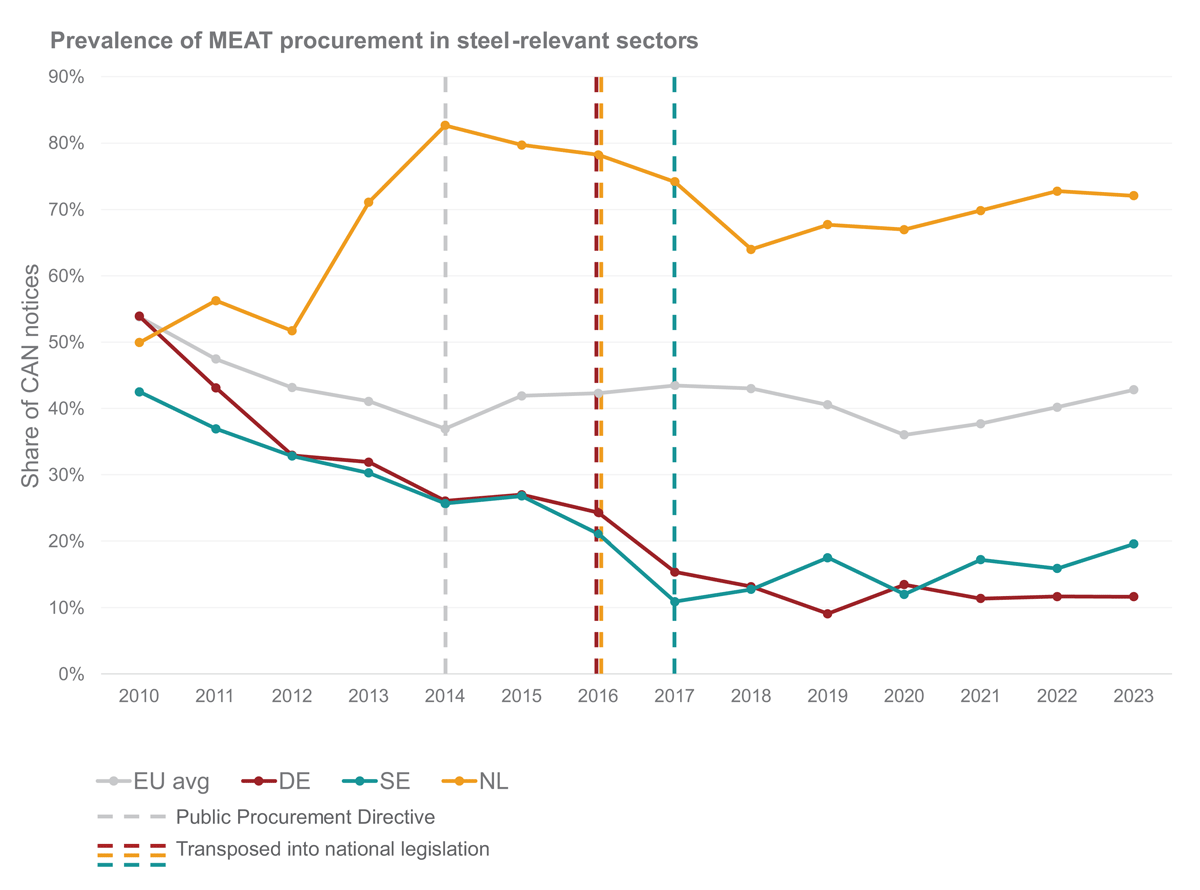
Figure 5
Prevalence of MEAT procurement (average across steel-relevant sectors: buildings, transport and defence) (source: authors’ own elaboration).
Table 5
EU-level and national – German (DE), Dutch (NL) and Swedish (SE) – policy documents included within the analysis.
| GOVERNANCE LEVEL | DOCUMENT | TYPE | YEAR | ANALYTICAL RELEVANCE |
|---|---|---|---|---|
| Signaller (EU) | Carbon Border Adjustment Mechanism (CBAM) | Regulation | 2023 | Industrial decarbonisation |
| Signaller (EU) | Circular Economy Action Plan | Action Plan | 2020 | Circularity; material efficiency |
| Signaller (EU) | Clean Industrial Deal | Communication | 2025 | Strategic industrial policy |
| Signaller (EU) | Construction Products Regulation (CPR) | Regulation | 2024 | Material standards; construction demand |
| Signaller (EU) | EU Innovation Fund | Funding instrument | 2020 | Industrial decarbonisation financing |
| Signaller (EU) | EU Public Procurement Directives | Directive | 2014 | Procurement governance |
| Signaller (EU) | European Hydrogen Strategy | Strategy | 2020 | Steel transition pathways |
| Signaller (EU) | Green Deal Industrial Plan | Strategy | 2023 | Strategic industrial policy |
| Signaller (EU) | Defining low-carbon emissions steel: A comparative analysis of international initiatives and standards | Technical Report | 2025 | Standards; low-emission steel |
| Signaller (EU) | Steel and Metals Action Plan (SMAP) | Action Plan | 2025 | Lead markets; industrial decarbonisation |
| Signaller (EU) | Action Plan for Affordable Energy | Action Plan | 2025 | Energy affordability; industrial competitiveness |
| Signaller (EU) | Automotive Action Plan | Action Plan | 2025 | Transport demand; industrial transition |
| Signaller (EU) | Critical Raw Materials Act | Regulation | 2024 | Strategic autonomy; industrial resilience |
| Signaller (EU) | EU Sustainable and Smart Mobility Strategy | Strategy | 2020 | Transport demand; sustainability transition |
| Signaller (EU) | European Hydrogen Bank | Financing mechanism | 2023 | Industrial decarbonisation financing |
| Signaller (EU) | Industrial Emissions Directive | Directive | 2024 | Industrial decarbonisation; regulation |
| Signaller (EU) | Net-Zero Industry Act | Regulation | 2024 | Industrial decarbonisation |
| Signaller (EU) | Research Fund for Coal and Steel (RFCS) – Programme information package | Programme | 2024 | Innovation support; steel transition |
| Signaller (EU) | Waste Shipment Regulation | Regulation | 2024 | Circularity; material efficiency |
| Signaller (EU) | White Paper on Defence | White Paper | 2025 | Defence/security |
| Signaller (EU) | Draghi Report on EU Competitiveness | Strategic report | 2025 | Competitiveness; industrial policy |
| Signaller (EU) | Directive 2009/33/EC on the promotion of clean and energy-efficient road transport vehicles | Directive | 2024 | Sustainable procurement; transport demand |
| Messenger (DE) | Steel Action Concept | Industrial strategy | 2023 | Industrial decarbonisation; steel transition |
| Messenger (DE) | National Hydrogen Strategy | Strategy | 2023 | Steel transition pathways |
| Messenger (DE) | National Circular Economy Strategy | Strategy | 2024 | Circularity; material efficiency |
| Messenger (DE) | Green Public Procurement Guidelines for Buildings | Guidance | 2021 | Procurement governance; buildings |
| Messenger (DE) | Germany National Energy and Climate Plan 2021–2030 | National strategy | 2024 | National policy translation |
| Messenger (DE) | BMWK Industrial Strategy | Industrial strategy | 2024 | Strategic industrial policy |
| Messenger (DE) | 2030 Federal Transport Infrastructure Plan (FTIP) | Infrastructure plan | 2023 | Transport demand; infrastructure |
| Messenger (DE) | Procurement Regulations for Defense and Security (VSVgV) | Regulation | 2016 | Defence procurement |
| Messenger (DE) | System Development Strategy 2024 | Infrastructure strategy | 2024 | Energy systems; infrastructure |
| Messenger (NL) | Government Strategy on Hydrogen | Strategy | 2020 | Steel transition pathways |
| Messenger (NL) | National Circular Economy Programme 2023–2030 | Programme | 2023 | Circularity; material efficiency |
| Messenger (NL) | Tendering Guidelines 4.0 | Guidance | 2022 | Procurement governance |
| Messenger (NL) | National Impactful Procurement Plan | Strategy | 2022 | Strategic procurement |
| Messenger (NL) | Circular Procurement Guidance | Guidance | 2021 | Circular procurement |
| Messenger (NL) | Procurement with Impact Strategy | Strategy | 2022 | Strategic procurement; sustainability |
| Messenger (NL) | Sustainable Infrastructure Activity Book | Guidance | 2021 | Infrastructure procurement |
| Messenger (NL) | Joint Letter of Intent on Tata Steel Decarbonisation | Joint declaration | 2023 | Steel decarbonisation |
| Messenger (NL) | Netherlands National Energy and Climate Plan 2021–2030 | National strategy | 2024 | National policy translation |
| Messenger (NL) | Mobility Vision 2050 | Strategy | 2021 | Transport transition |
| Messenger (NL) | Vision for a more sustainable basic industry in 2050 | Industrial strategy | 2023 | Industrial decarbonisation |
| Messenger (SE) | Climate Roadmap for a fossil-free and competitive steel industry | Roadmap | 2020 | Steel transition pathways |
| Messenger (SE) | Circular Economy – Strategy for the transition in Sweden | Strategy | 2021 | Circularity; material efficiency |
| Messenger (SE) | Environmental Spend Analysis | Technical report | 2022 | Procurement analysis |
| Messenger (SE) | Swedish Public Procurement Act | Act | 2016 | Procurement governance |
| Messenger (SE) | National Public Procurement Strategy | Strategy | 2017 | Strategic procurement |
| Messenger (SE) | Hydrogen Strategy | Strategy | 2021 | Steel transition pathways |
| Messenger (SE) | Climate Roadmap for a competitive and fossil-free mining and mineral industry in Sweden | Roadmap | 2020 | Industrial decarbonisation |
| Messenger (SE) | Roadmaps Follow-up 2021 | Monitoring report | 2021 | Industrial transition monitoring |
| Messenger (SE) | Sweden National Energy and Climate Plan 2021–2030 | National strategy | 2024 | National policy translation |
| Messenger (SE) | Smart Industry – a strategy for new industrialisation for Sweden | Industrial strategy | 2016 | Strategic industrial policy |
| Messenger (SE) | National Plan for Transport Infrastructure | Infrastructure plan | 2022 | Transport demand; infrastructure |
| Messenger (SE) | Security and Defence Procurement | Guidance | 2023 | Defence procurement |
| LIBRARY | USE |
|---|---|
| ggplot2 | Data visualisation package used to produce all figures (e.g. modality charts, MEAT trends, thematic emphasis plots). Supports layered grammar of graphics and reproducible plotting. |
| ggwordcloud | Used to visualise term prominence and salience across policy document corpora through word clouds and weighted text visualisations. |
| dplyr | Core data manipulation package used for filtering CAN data, grouping by country/sector/year, and calculating shares (e.g. MEAT and green criteria). |
| fmsb | Used for specialised statistical visualisations (e.g. radar/spider charts) to compare thematic emphasis across governance levels. |
| lubridate | Date and time handling package used to standardise and aggregate TED Contract Award Notice (CAN) data by year. |
| pdftools | Used to extract machine-readable text from EU and national policy documents (PDF format) prior to dictionary-based analysis. |
| quanteda | Core text analysis framework used for corpus creation, tokenisation, dictionary matching, and document-feature matrix construction for QDA. |
| quanteda.textstats | Extension of quanteda used for frequency counts, keyness analysis (log-likelihood), and comparative text statistics across document corpora. |
| readr | Used to import structured datasets (e.g. CSV exports of CAN data and modality outputs) efficiently and reproducibly. |
| readtext | Used to batch import and structure multiple policy documents into a unified corpus for analysis within quanteda. |
| stringr | String processing package used for keyword detection, dictionary cleaning, and preprocessing of multilingual text. |
| tidyr | Used for reshaping datasets (e.g. pivoting modality results, term frequencies, and country-level summaries) into analysis-ready formats. |
| viridis | Colour scale package used for perceptually uniform and publication-quality visualisations (e.g. modality and thematic plots). |
| ANALYTICAL CATEGORY | DICTIONARY TERMS |
|---|---|
| Policy outcomes | “decarbon*”, “carbon intens*”, “climate neutral*”, “net zero”, “carbon neutral*”, “emission reduction*”, “greenhouse gas”, “ghg reduction*”, “co2 reduction*”, “climate mitigation”, “climate resilien*”, “strategic autonom*”, “resilien*”, “competitiveness”, “industrial competit*”, “energy security”, “security”, “supply security”, “strategic dependenc*”, “strategic value” |
| Production pathways | “hydrogen”, “green hydrogen”, “renewable hydrogen”, “electrolysis”, “direct reduced iron”, “direct reduction”, “dri”, “h2 dri”, “electric arc furnace”, “eaf”, “renewable electricity”, “renewable energy”, “fossil free steel”, “low carbon steel”, “green steel”, “near zero steel”, “clean steel”, “sustainable steel”, “industrial electrification”, “carbon capture”, “ccs”, “ccu”, “zero-carbon steel” |
| Circularity & material efficiency | “circular*”, “recycl*”, “scrap”, “secondary steel”, “material efficiency”, “resource efficiency”, “life cycle”, “lifecycle”, “life cycle assessment”, “lca”, “embodied carbon”, “embodied emissions”, “product carbon footprint”, “pcf”, “environmental product declaration”, “epd”, “durabil*”, “reuse”, “remanufact*” |
| Efficiency | “energy efficiency”, “energy efficient”, “process efficiency”, “efficiency improvement*”, “energy intensity”, “best available technique*”, “bat” |
| Procurement mechanisms | “public procurement”, “green public procurement”, “gpp”, “strategic procurement”, “sustainable procurement”, “most economically advantageous tender”, “meat”, “award criteria”, “award criterion”, “tender”, “contracting authorit*”, “life cycle costing”, “lcc”, “total cost of ownership”, “tco”, “technical specification*”, “minimum requirement*”, “contract performance clause*”, “environmental criteria”, “lead market*”, “procurement criteria”, “procurement”, ”joint procurement” |
| LANGUAGE | “GREEN FLAG” SEARCH TERMS |
|---|---|
| English | “breeam”, “carbon”, “carbon footprint”, “carbon neutral*”, “circular*”, “climate”, “climate change”, “climate neutral*”, “co2”, “durab*”, “ecological”, “eco”, “electrif*”, “electrification”, “emission*”, “environment”, “environmental”, “environmental impact”, “environmental product declaration”, “epd”, “energy”, “energy efficient”, “energy-efficient”, “energy efficien*”, “energy saving”, “fsc”, “geothermal”, “ghg”, “green”, “greenhouse gas*”, “heat pump*”, “iso 14001”, “iso14001”, “emas”, “lca”, “lcc”, “lead”, “leed”, “life cycle”, “life cycle assessment”, “life cycle costing”, “lifecycle”, “low impact”, “material efficien*”, “net zero”, “net-zero”, “pcf”, “pefc”, “product carbon footprint”, “recycl*”, “recycled”, “recyclable”, “remanufact*”, “renewable*”, “resource efficien*”, “reuse”, “reused”, “sustainab*”, “sustainability”, “sustainable”, “waste”, “waste management”, “waste reduction”, “whole life carbon”, “wlc”, “wind”, “solar”, “bioenergy” |
| German | “abfall*”, “co2”, “emission*”, “energie”, “energieeffizienz*”, “energieeffizient*”, “energiespar*”, “erneuerbar*”, “erneuerbare”, “fsc”, “iso 14001”, “iso14001”, “emas”, “klima*”, “klimawandel”, “klimaneutral*”, “kohlendioxid”, “kreislauf*”, “lebenszyklus*”, “lebenszykluskalkulation*”, “lebenszykluskosten*”, “materialeffizienz*”, “nachhalt*”, “net-zero”, “netto null”, “okobilanz*”, “oekobilanz*”, “pefc”, “pcf”, “produkt carbon footprint”, “recycl*”, “ressourceneffizienz*”, “treibhausgas*”, “umwelt*”, “umweltfreund*”, “umweltproduktdeklaration*”, “wiederverwend*”, “wiederverwertung” |
| Dutch | “afval*”, “broeikasgas*”, “circulair*”, “co2”, “duurzaam*”, “duurzame energie”, “emissie*”, “energie”, “energie efficient”, “energie-efficient*”, “energiebesparing*”, “epd”, “fsc”, “grondstoff*”, “hergebruik*”, “hernieuwbaar*”, “iso 14001”, “iso14001”, “emas”, “klimaat*”, “klimaatneutraal*”, “klimaatverandering”, “koolstof”, “kringloop*”, “lca”, “lcc”, “levenscyclus*”, “levenscycluskosten*”, “materiaal efficient*”, “materiaalefficient*”, “milieu*”, “milieuproductverklaring*”, “milieuvriend*”, “net-zero”, “netto nul”, “pcf”, “pefc”, “product carbon footprint”, “recycl*”, “resource” |
| Swedish | “aterbruk*”, “atervinn*”, “cirkulär*”, “cirkular*”, “co2”, “energi”, “energieffektiv*”, “energisnål*”, “epd”, “fornybar*”, “förnybar*”, “förnybara”, “hallbar*”, “hållbar*”, “hållbarhet”, “koldioxid”, “klimat*”, “klimatpåverkan”, “klimatneutral”, “livscykel*”, “livscykelkostnad*”, “lca”, “materialeffektiv*”, “miljö”, “miljöbyggnad”, “miljöcertifier*”, “miljökrav”, “miljömässig”, “miljövänlig”, “miljovarudeklaration”, “miljo”, “netto noll”, “nordic swan”, “resurseffektiv*”, “svanen”, “utsläpp*” |