
1 Introduction
1.1 Background and policy problem
Steel occupies a uniquely strategic position within the European economy. It is deeply embedded in critical downstream sectors including construction, transport, infrastructure, energy systems and defence, while simultaneously accounting for approximately 5% of total European Union (EU) CO2 emissions (Joint Research Centre, 2022) and around 7% of global energy-related emissions (International Energy Agency, 2020). The decarbonisation of steel is therefore increasingly framed not only as a climate challenge, but also as an industrial and geopolitical challenge linked to competitiveness, industrial resilience and strategic autonomy.
The transition to low-emission steel does not rely on a single universally adopted production pathway. Instead, producers are pursuing a range of decarbonisation strategies, including hydrogen-based direct reduction, greater use of electric arc furnaces and scrap, carbon capture, and process efficiency improvements, reflecting differences in existing production assets, resource availability and national policy contexts (Gailani et al., 2024; Algers et al., 2025). This diversity contributes to a fragmented governance landscape in which standards, investment priorities and procurement requirements continue to evolve. This also complicates the development of common standards and procurement approaches, as public buyers must navigate differing production pathways, emissions accounting methodologies and evolving definitions of low-emission steel. In response, EU climate and industrial policy has increasingly focused on accelerating industrial decarbonisation through a broad mix of regulatory, financial and industrial policy instruments, including the EU Emissions Trading System (EU ETS), the Carbon Border Adjustment Mechanism (CBAM), the Net-Zero Industry Act, the Clean Industrial Deal and the Steel and Metals Action Plan (SMAP). Alongside supply-side innovation support and carbon pricing, increasing attention has also been directed toward demand-side instruments capable of supporting early market formation for low-emission industrial materials (IIGCC, 2025; Lotz et al., 2025).
However, the governance landscape surrounding steel decarbonisation remains highly fragmented and institutionally complex. Industrial transformation is shaped simultaneously by carbon pricing and industrial regulation, infrastructure and energy systems, industrial financing mechanisms, standards and carbon accounting systems, and demand-side policy instruments such as public procurement. Figure 1 situates public procurement within this broader ecosystem of industrial decarbonisation policy levers and illustrates the interdependencies between different governance mechanisms. Public procurement does not operate in isolation but forms part of a broader policy mix for industrial decarbonisation. Figure 1 presents a selection of policy levers relevant to this paper, illustrating how procurement complements carbon pricing, supply-side support and enabling measures.
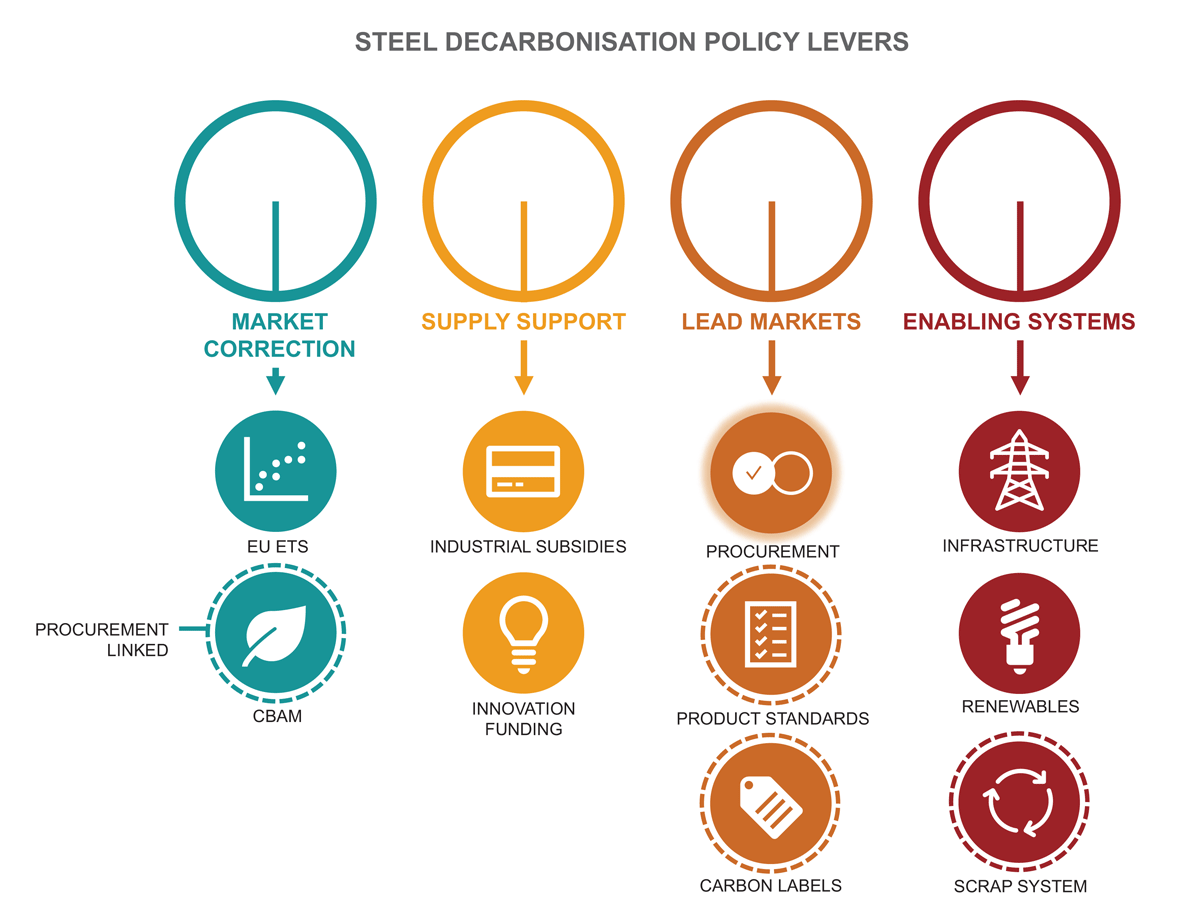
Figure 1
Selected green steel policy levers grouped by category (authors’ own elaboration based on literature review).
The complexity of this policy landscape is reinforced by continuing institutional and market uncertainties. Despite increasing policy attention, a harmonised EU-wide standard defining “low-emission steel” is missing. Several initiatives, including ResponsibleSteel and the Low Emission Steel Standard (LESS), have proposed classification and certification systems for lower-emission steel production pathways (LESS aisbl and ResponsibleSteel, 2025). However, differences in accounting methodologies, system boundaries and emissions definitions continue to complicate procurement design, product labelling and market differentiation (European Commission, 2025).
At the same time, many European low-emission steel projects continue to face delays, uncertainty or postponement despite substantial technological progress and growing policy ambition. High energy prices, infrastructure constraints, international competition and uncertain market conditions continue to undermine investment decisions (Johnson et al., 2025; Vorontsov, 2025). Recent geopolitical developments – including the COVID-19 pandemic, Russia’s invasion of Ukraine, energy price volatility and growing concerns surrounding strategic autonomy and industrial resilience – have further intensified pressure on European industrial policy (Huhta et al., 2025; Pavlenko and Cherp, 2025). As a result, EU industrial governance increasingly combines decarbonisation objectives with concerns surrounding competitiveness, resilience, affordability and security.
Within this context, attention has shifted toward the challenge of creating credible demand signals capable of reducing investment risk and supporting lead market formation for low-emission industrial materials. While earlier industrial decarbonisation policy focused heavily on technological innovation and supply-side support mechanisms, growing attention is now directed toward demand-side governance approaches capable of addressing the additional production costs associated with low-emission steel (Johnson et al., 2025; Lotz et al., 2025). Public procurement is increasingly positioned within this debate as a potential mechanism to create early markets and accelerate industrial transformation. However, procurement systems themselves face growing pressure to simultaneously deliver decarbonisation, competitiveness, innovation, resilience, affordability and supply-chain security objectives.
1.2 Public procurement as strategic industrial policy
Public procurement represents approximately 14% of EU GDP and accounts for a substantial share of demand in steel-intensive sectors such as infrastructure, transport, buildings and defence (European Commission, 2017). Historically, procurement systems in Europe largely prioritised open competition, procedural neutrality and cost minimisation. However, scholarship on mission-oriented innovation policy and sustainability transitions increasingly conceptualises procurement as a strategic demand-side instrument capable of shaping markets, supporting innovation diffusion and accelerating industrial transformation (Edler and Georghiou, 2007; Edquist and Zabala-Iturriagagoitia, 2012; Mazzucato, 2020; Chiappinelli, Giuffrida and Spagnolo, 2025).
In this context, lead markets refer to institutional or market environments in which early demand supports the diffusion and commercialisation of emerging technologies or products (Georghiou et al., 2014). In the case of low-emission steel, procurement may help create early-stage markets capable of supporting industrial learning, economies of scale and investment certainty. Public procurement is therefore increasingly discussed not only as an environmental governance instrument, but also as a mechanism of industrial coordination and strategic economic governance. This shift is increasingly reflected in recent EU industrial policy. The SMAP explicitly positions public and private lead markets as mechanisms for accelerating the adoption of low-emission industrial materials, while the Clean Industrial Deal and Industrial Accelerator Act increasingly frame procurement as part of broader demand-side industrial policy strategies (Huhta et al., 2025; European Commission, 2026). Recent proposals such as the Industrial Accelerator Act suggest that the EU may move toward a more interventionist use of public procurement within industrial policy, including stronger sustainability and resilience requirements in strategically important sectors (European Commission, 2026). However, the proposal had not been formally adopted at the time of analysis, and its final procurement implications remain uncertain. Nevertheless, it signals growing expectations that public procurement will contribute not only to market creation and industrial competitiveness, but also to broader sustainability and resilience objectives.
Procurement systems are increasingly expected to balance multiple and sometimes competing objectives. Public buyers in sectors such as infrastructure and defence face pressure not only to support decarbonisation, but also to consider affordability, industrial competitiveness, resilience, security and supply-chain reliability. Recent work within transformative innovation policy similarly highlights the growing tendency to place increasingly broad expectations on policy instruments to simultaneously address multiple societal and economic objectives (Laatsit, Grillitsch and Fünfschilling, 2025).
Existing studies also identify fragmented standards, institutional complexity, legal uncertainty and uneven buyer capacity as major barriers to strategic procurement implementation (European Court of Auditors, 2023; Bellona, 2024). Moreover, procurement systems across Europe continue to rely heavily on lowest-price approaches rather than lifecycle-oriented or sustainability-oriented evaluation methods such as Most Economically Advantageous Tender (MEAT) approaches, which allow public buyers to incorporate broader criteria including environmental performance, lifecycle costs and quality considerations into procurement decisions (Chiappinelli and Zipperer, 2017; Yang and Morotomi, 2025). This creates important implementation challenges for procurement governance. Although procurement is increasingly expected to support broader industrial and sustainability objectives, existing studies suggest that fragmented standards, uneven buyer capacity and continued reliance on price-oriented procurement approaches continue to constrain operational uptake across Europe.
1.3 Governance challenge and research gap
Although procurement is increasingly positioned within EU industrial policy discourse as a strategic instrument for industrial decarbonisation and lead market creation, considerably less is known about how these ambitions are translated and operationalised across governance levels in practice. Existing research has largely focused either on procurement regulation, green public procurement uptake or industrial decarbonisation pathways separately. Less attention has been given to how strategic industrial policy ambitions travel across governance levels and become operationalised institutionally.
Building on multi-level governance theory (Hooghe and Marks, 2001), this paper develops an analytical framework that distinguishes between three governance functions involved in translating strategic procurement ambitions into practice. The framework conceptualises the governance system across three interconnected levels:
The policy signaller (i.e. the EU) establishes strategic direction by articulating policy objectives and priorities,
Policy messengers (i.e. member states) translate these strategic signals into national legal and policy frameworks, adapting them to domestic institutional contexts, and
Implementers (i.e. public buyers) operationalise these frameworks through procurement decisions and purchasing practices.
Within this framework, policy signalling refers to the communication of strategic direction through both binding instruments (e.g. regulations and directives) and non-binding instruments (e.g. strategies, communications and action plans). The emphasis is therefore not on the legal status of individual instruments, but on how policy ambitions are articulated, translated and ultimately operationalised across governance levels.
The signaller–messenger–implementer framework provides a structured way of analysing how strategic procurement ambitions travel across governance levels and where implementation bottlenecks emerge. Rather than assuming direct linear implementation from EU strategy to procurement practice, the framework emphasises policy translation, institutional mediation and implementation capacity. This multi-level perspective is particularly important because the effectiveness of procurement as a demand-side industrial policy instrument depends not only on strategic policy ambition, but also on the institutional capacity of procurement systems to operationalise complex sustainability and industrial objectives in practice.
1.4 Aim and research questions
Against this background, the overall aim of this paper is to examine how public procurement is framed and operationalised as a demand-side instrument for steel decarbonisation across multiple governance levels within Europe. More specifically, the paper investigates how EU institutions frame procurement within industrial decarbonisation policy, how these signals are translated into national policy frameworks, and to what extent procurement practices in steel-relevant sectors reflect strategic and sustainability-oriented approaches.
The paper addresses the following research questions (RQs):
RQ1: How does the EU (as a policy signaller) frame public procurement as an instrument for steel decarbonisation, and how is this framing translated by Member States (as policy messengers) into national frameworks?
RQ2: How is public procurement currently being used as a strategic instrument within steel-relevant sectors (transport, buildings and defence) across the EU?
RQ3: What governance, policy framing and support mechanisms are needed to enable public procurement to function as an effective demand-side lever for steel decarbonisation?
The national and buyer-level analysis focuses on Sweden, Germany and the Netherlands, which together provide variation in industrial structure, procurement traditions, sustainability governance and approaches to industrial policy while operating within the same overarching EU regulatory framework.
By combining multi-level policy analysis with procurement data from Tenders Electronic Daily (TED) – the EU’s central database for high-value public procurement contracts – the paper contributes to emerging debates surrounding strategic procurement, green industrial policy and industrial decarbonisation governance. Specifically, it examines how demand-side industrial policy ambitions surrounding low-emission steel are translated and operationalised across fragmented multi-level governance systems, and where implementation challenges emerge across the signaller–messenger–implementer chain. Given the scale of the analysis, which spans multiple governance levels, three countries, three major steel-relevant sectors and more than a decade of procurement activity, the study does not attempt to identify individual procurement procedures explicitly targeting low-emission steel. Instead, it examines how sustainability-oriented procurement approaches are operationalised within sectors such as construction, transport and defence, where steel represents a major source of embodied emissions and environmental impact. In these sectors, the inclusion of environmental and lifecycle-oriented procurement criteria is likely to influence material choices and incentivise reductions in the impacts associated with steel alongside other materials and design choices. This broader approach therefore provides insight into the institutional capacity of procurement systems to support demand-side decarbonisation without requiring detailed examination of thousands of individual procurement documents.
2 Methods
2.1 Research design and analytical logic
This paper adopts a multi-level governance approach to examine how public procurement is framed and operationalised as a demand-side instrument for steel decarbonisation across the EU. The analytical premise is that procurement operates through a chain of policy translation spanning multiple governance levels: EU institutions formulate strategic signals and industrial policy narratives, Member States translate these signals into national frameworks, and public buyers operationalise procurement through concrete purchasing practices. The effectiveness of procurement as a lead market instrument therefore depends not only on policy ambition, but also on how these ambitions are translated and implemented institutionally across governance levels (Hooghe and Marks, 2001; Romppanen and Huhta, 2023).
To examine these dynamics, the paper combines three complementary analytical approaches:
Quantitative Document Analysis (QDA),
Qualitative Content Analysis (QCA), and
Contract Award Notice (CAN) analysis.
These methods are deployed sequentially to examine both policy framing and procurement implementation. The QDA identifies broader thematic patterns within policy documents, the QCA examines governance framing and implementation expectations, and the CAN analysis investigates observable procurement practices within steel-relevant sectors. Figure 2 summarises the overall methodological sequence and analytical workflow, while Table 1 illustrates how the different methodological components relate to the research questions.
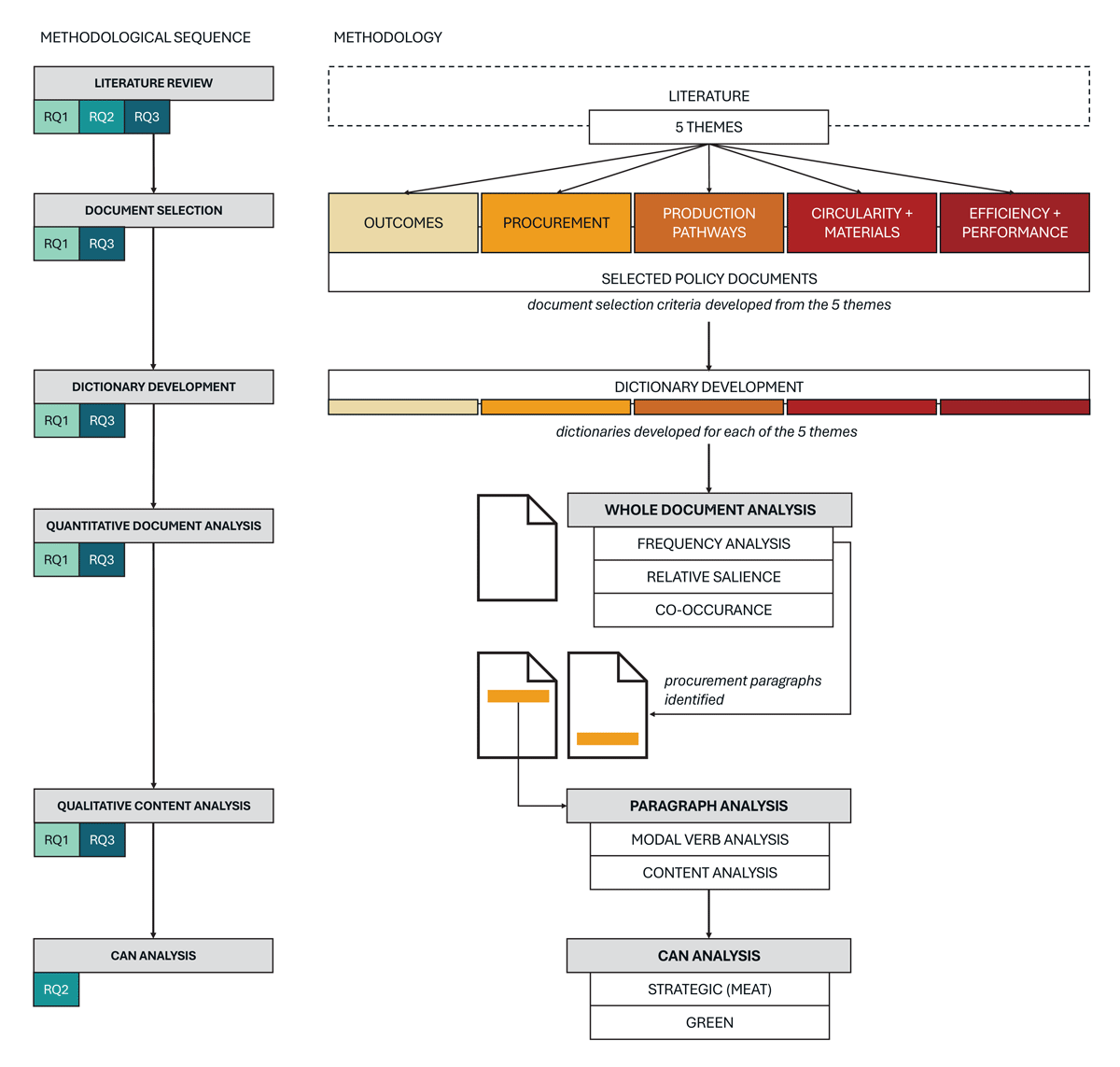
Figure 2
Sequential multi-method research design showing the analytical workflow used to examine procurement governance across EU-level signalling, national policy translation and buyer-level operationalisation (source: authors’ own elaboration).
Table 1
Connecting methodological components with the research questions.
| RESEARCH QUESTION | METHOD(S) | ANALYTICAL CONTRIBUTION |
|---|---|---|
| RQ1: How does the EU frame public procurement as an instrument for steel decarbonisation, and how is this framing translated by Member States into national frameworks? | QDA + QCA | Identifies thematic emphasis, procurement framing, governance narratives and policy translation across EU and national policy documents |
| RQ2: How is public procurement currently being used as a strategic instrument within steel-relevant sectors (transport, buildings, defence) across the EU? | CAN analysis | Examines procurement practices through MEAT usage and environmental criteria in procurement notices |
| RQ3: What governance, policy framing and support mechanisms are needed to enable public procurement to function as an effective demand-side lever for steel decarbonisation? | Integrated synthesis | Integrates findings across governance levels to identify implementation gaps, institutional barriers and governance bottlenecks |
The left-hand panel of Figure 2 illustrates the sequential analytical logic moving from EU-level signalling toward implementation-level procurement analysis, while the right-hand panel summarises the detailed analytical steps undertaken within each methodological stage.
2.2 Policy document selection
At the EU level, the document corpus included strategies, directives, regulations, action plans and technical reports linked to industrial decarbonisation, green industrial policy, procurement governance, low-emission steel, and steel-relevant sectors including construction, transport and defence. Documents were identified primarily through European Commission repositories, EUR-Lex and EU policy databases. The document selection process followed established approaches to purposive and iterative document analysis commonly used within qualitative policy research (Bryman, 2016). Initial document selection focused on major EU regulatory and strategic frameworks directly relevant to public procurement and industrial decarbonisation, including the EU Public Procurement Directives, CBAM, the Net-Zero Industry Act and the SMAP. From this initial corpus, additional documents were identified through iterative review of policy references, thematic connections and institutional linkages across related policy domains.
The literature review also informed document selection by identifying key technological pathways, governance challenges and steel-relevant sectors associated with industrial decarbonisation. For example, literature discussing hydrogen-based steel production pathways informed inclusion of hydrogen-related strategies and financing mechanisms, while discussion of industrial innovation and demonstration projects informed inclusion of the EU Innovation Fund and Research Fund for Coal and Steel. Similarly, literature emphasising the importance of circularity and scrap-based production pathways informed inclusion of the Circular Economy Action Plan and Waste Shipment Regulation, reflecting the importance of material efficiency and secondary steel production within steel decarbonisation pathways (Gailani et al., 2024; Algers et al., 2025). Additional sectoral documents were included for transport, construction and defence because these sectors represent major downstream sources of steel demand and are increasingly identified within both industrial policy and procurement literature as strategically important for lead market formation and demand-side decarbonisation. This resulted in a final EU-level corpus comprising 22 documents (Table 2) published 2014–2025.1
Table 2
EU policy documents included in the analysis and their analytical relevance. A similar table for the national-level document selection and further information can be found in Appendix 1.
| DOCUMENT THEMATIC CATEGORY | INCLUDED DOCUMENTS |
|---|---|
| Industrial decarbonisation and steel transition1 |
|
| Procurement governance and lead markets |
|
| Strategic industrial policy and competitiveness |
|
| Energy systems and production pathways |
|
| Circularity and downstream demand sectors |
|
A parallel process was undertaken for the national-level analysis focusing on Sweden, Germany and the Netherlands. These countries were selected because they provide variation in industrial structure, procurement traditions, sustainability governance, and approaches to industrial policy while operating within the same overarching EU regulatory framework. National policy corpora included industrial strategies, procurement strategies, circular economy plans, hydrogen strategies, climate plans, and sectoral policy documents relevant to steel-intensive sectors. The final national corpus consisted of 9 German documents, 11 Dutch documents and 12 Swedish documents (see Table 5 in Appendix 1 for more detail). The same purposive and iterative document selection criteria used at EU level were applied across the national corpora to ensure analytical comparability across governance levels while retaining sufficient contextual depth to examine policy translation processes.
2.3 Dictionary development
The next methodological step involved the development of structured keyword dictionaries used within the quantitative and qualitative document analyses. Dictionary-based approaches were selected because they enable systematic and replicable comparison across large policy corpora while allowing identification of broader thematic patterns and discursive emphases. Such approaches are increasingly used in policy and discourse analysis because they provide transparent and replicable mechanisms for analysing large text corpora while maintaining analytical consistency (Grimmer and Stewart, 2013).
The dictionary development process was iterative and informed by the literature reviewed for this paper, drawing particularly from scholarship on public procurement, green industrial policy, sustainability transitions, and industrial decarbonisation. Initial keyword lists were developed by identifying recurring concepts and terminology within the literature and policy documents relevant to the research questions. Synonyms, related terminology and alternative formulations were then incorporated through repeated review of both academic and policy sources to improve coverage and reduce the risk of omitting relevant concepts. The dictionaries were subsequently refined through successive testing against the document corpus to improve analytical consistency and reduce false positives. The approach also builds on previous applications of keyword-based analysis in sustainability and procurement policy research (Yang and Morotomi, 2025).
The dictionaries were organised into five analytical categories shown below (see Appendix 2 for the full dictionaries used):
Macro-level policy outcomes (e.g. “decarbon*”, “competitiveness”, “resilien*”, “security”, “strategic autonomy”)
Procurement mechanisms (e.g. “public procurement”, “MEAT”, “award criteria”, “lifecycle costing”)
Production pathways (e.g. “hydrogen”, “electrification”, “direct reduced iron”, “carbon capture”)
Circularity and material efficiency (e.g. “circular*”, “recycl*”, “scrap”, “reuse”)
Efficiency and industrial performance (e.g. “energy efficiency”, “resource efficiency”, “best available techniques”)
The categories were developed iteratively from the literature review and designed to capture the principal governance and industrial transformation themes emerging within debates surrounding steel decarbonisation, strategic procurement and lead market formation. These analytical category dictionaries were applied at whole-document level during the Quantitative Document Analysis (QDA). Term frequencies were calculated across entire documents and subsequently normalised per 1,000 words to account for variation in document length. This enabled systematic comparison of thematic emphasis and policy framing patterns across governance levels and national contexts.
2.4 Quantitative document analysis of policy signalling
The QDA was conducted using R and focused on identifying thematic emphasis and policy framing patterns across governance levels. The analysis aimed primarily to address RQ1 by examining how procurement and industrial decarbonisation are framed within EU and national policy documents. Quantitative text analysis enables systematic identification of thematic emphasis, discursive salience and framing patterns across large policy corpora that would be difficult to identify consistently through manual coding alone (Grimmer and Stewart, 2013).
The QDA proceeded in three stages, all of which was conducted on full documents. First, a frequency analysis was conducted to identify how frequently terms within the analytical categories appeared across documents. Frequencies were calculated both in absolute terms, and normalised per 1,000 words, to reduce distortion caused by varying document lengths.
Second, relative salience analysis was conducted using log-likelihood keyness testing to identify terms and categories that were disproportionately emphasised within particular governance levels or national contexts relative to the broader document corpus. In practical terms, this enabled identification of which themes received comparatively greater political and strategic emphasis within EU-level versus national policy documents. The analysis therefore helped examine how industrial policy priorities and procurement narratives varied across governance levels and national contexts, directly supporting investigation of RQ1.
Third, co-occurrence analysis examined how categories appeared together within the documents. The analysis assessed where themes occurred together in proximity (the same paragraph). This enabled analysis of how procurement was linked discursively to themes such as decarbonisation, competitiveness, resilience, circularity and industrial transformation across governance levels. Together, these analyses provided insight into how procurement was framed strategically within industrial decarbonisation governance and how these framings varied between EU-level signalling and national-level translation. The QDA therefore provides systematic insight into thematic priorities, policy framing, and governance translation dynamics across governance levels. Overall, the QDA was designed to identify how procurement and industrial decarbonisation were framed strategically across governance levels and how these framings varied between EU-level signalling and national-level policy translation.
2.5 Qualitative content analysis of governance translation and implementation expectations
Following the QDA, a Qualitative Content Analysis (QCA) was undertaken to provide deeper interpretive analysis of procurement framing, governance expectations and implementation logics across governance levels. Whereas the QDA identified broader thematic patterns across full policy documents, the QCA focused specifically on procurement-relevant paragraphs identified during the co-occurrence analysis. This enabled more targeted examination of how procurement-related responsibilities, obligations and implementation expectations were framed institutionally and politically within the policy corpus.
The qualitative analysis focused particularly on how procurement was linked to the five broader analytical themes established during the dictionary development process: macro-level policy outcomes, procurement mechanisms, production pathways, circularity and material efficiency, and efficiency and industrial performance. This enabled interpretation not only of whether procurement was discussed, but also how procurement was connected discursively to broader industrial decarbonisation objectives across governance levels.
Additional modal verb dictionaries were developed to assess the degree of policy bindingness associated with procurement-related references. Modal language analysis was included because modal verbs provide insight into how governance obligations, institutional expectations and implementation responsibilities are communicated within policy discourse. Previous studies within climate change, sustainability and governance discourse analysis demonstrate that modal language can reveal differing degrees of institutional commitment, obligation, certainty and policy ambition (Fløttum, 2010; Kapranov, 2023, 2025). In particular, terms such as “shall”, “must” and “require” are commonly associated with stronger binding or obligatory governance language, whereas terms such as “should”, “encourage” and “support” are more frequently associated with enabling, aspirational or non-binding governance approaches (Nowak-Far, 2024; Kapranov, 2025).
The modal dictionaries were applied only at paragraph level rather than across full documents. Procurement-relevant paragraphs were coded according to the degree of implementation expectation signalled through modal language, ranging from strongly binding formulations to weakly binding or enabling language. Table 3 summarises the modal verb dictionaries.
Table 3
Modal verb dictionaries.
| SIGNAL | TERMS |
|---|---|
| High binding | “shall”, “must”, “require*”, “oblig*”, “mandat*”, “is required to”, “are required to”, “shall ensure”, “must ensure”, “shall establish”, “shall adopt”, “shall not”, “must not”, “may not”, “cannot”, “can’t”, “not allow*” |
| Medium binding | “should”, “recommend*”, “expect*” |
| Low binding | “may”, “can”, “encourage*”, “support*”, “promote*”, “facilitat*” |
| None/unclear | A residual class: procurement paragraphs that do not contain any of the above three modal dictionary matches |
Beyond modal coding, the identified procurement paragraphs were manually reviewed and interpreted according to the role assigned to procurement, governance responsibilities, implementation mechanisms, barriers and opportunities, and references to industrial transformation or lead market formation.
The QCA therefore complemented the broader thematic analysis conducted through the QDA by enabling more detailed interpretation of governance narratives, institutional expectations and implementation dynamics across governance levels. More specifically, the qualitative analysis supported investigation of RQ1 and RQ3 by examining how procurement was framed institutionally, how implementation responsibilities were allocated, and how strategic procurement ambitions were translated into governance expectations within the policy corpus.
2.6 Procurement implementation analysis with Contract Award Notices
The final methodological component involved analysis of Contract Award Notices (CANs) from the EU Tenders Electronic Daily (TED) database in order to examine how strategic procurement ambitions are operationalised within Member States by public buyers. While the earlier stages of the analysis focused on policy signalling and governance translation, the CAN analysis investigates observable procurement behaviour at the implementation level. More specifically, this stage addresses RQ2 by examining the extent to which procurement practices within steel-relevant sectors reflect strategic and sustainability-oriented procurement approaches in practice.
TED is the European Union’s central public procurement database for contracts above defined procurement thresholds and provides one of the few standardised large-scale datasets capable of capturing procurement behaviour across EU Member States. CAN data were obtained from the TED Open Data portal and downloaded as CSV datasets covering the period 2010–2023. Previous procurement research has increasingly used TED and CAN data to examine procurement practices, sustainability-oriented procurement uptake and strategic procurement implementation across governance contexts (Chiappinelli and Zipperer, 2017; Yang and Morotomi, 2025). The analysis focused on awarded contracts rather than procurement announcements in order to examine completed procurement practices rather than procurement intentions alone.
The CAN analysis focused on two implementation indicators: (1) use of Most Economically Advantageous Tender (MEAT) approaches, and (2) use of environmental (“green”) procurement criteria. These indicators were selected because they provide insight into the extent to which procurement systems move beyond narrow price-based procurement toward broader strategic and sustainability-oriented procurement approaches.
The first indicator examines whether procurement processes move beyond lowest-price approaches toward broader multi-criteria evaluation models. Most Economically Advantageous Tender (MEAT) approaches function as an umbrella framework for more strategic procurement because they allow public buyers to incorporate a wider range of award criteria beyond price alone, including quality, technical merit, staff expertise, references, lifecycle costs, delivery capacity and environmental performance. Within procurement governance literature, the use of MEAT approaches is therefore frequently associated with more strategically oriented and institutionally mature procurement practices because it reflects greater willingness and capacity to operationalise broader policy objectives within procurement decisions (Chiappinelli and Zipperer, 2017; Bellona, 2024).
The second indicator examines the extent to which procurement systems operationalise environmental considerations specifically through the inclusion of environmental (“green”) procurement criteria. Importantly, while environmental procurement is generally implemented through MEAT-type evaluation approaches, the use of MEAT itself does not necessarily imply sustainability-oriented procurement. Procurement procedures may use MEAT criteria while focusing primarily on quality, delivery capability or technical performance rather than environmental objectives. Environmental procurement therefore represents a more specific subset of broader strategic procurement approaches. Table 4 illustrates this distinction through examples ranging from lowest-price procurement to broader MEAT evaluation structures and explicitly environmental award criteria.
Table 4
Extract of the CAN data used in the analysis. Example 1 = lowest-price procurement (L); Example 2 = use of MEAT criteria (M) including references; Example 3 = use of MEAT criteria with explicit environmental weighting included within the award structure.
| EXAMPLE | ISO_COUNTRY_CODE | CRIT_CODE | CRIT_CRITERIA | CRIT_WEIGHTS |
|---|---|---|---|---|
| 1 | SE | L | – | – |
| 2 | SE | M | Pris|Referenser(Price|References) | 75|25 |
| 3 | SE | M | Pris|Miljö|Personal(Price|Environment|Staff) | 60|15|15 |
The CAN analysis therefore investigates not whether procurement systems explicitly procure low-emission steel itself, but rather whether procurement systems within steel-relevant sectors demonstrate broader institutional willingness and capability to operationalise strategic and sustainability-oriented procurement approaches. This distinction is important because procurement literature repeatedly identifies the initial adoption of sustainability-oriented procurement practices as a major institutional barrier. Once environmental and lifecycle approaches become integrated institutionally within procurement systems, these approaches can subsequently expand over time in terms of both coverage and ambition.
CAN data were collected for the period 2010–2023. This timeframe was selected because 2010 provides a sufficiently long pre-Directive (2014) baseline, while 2023 represents the latest complete year available through TED at the time of analysis. The analysis focused on steel-relevant sectors through Common Procurement Vocabulary (CPV) filters, specifically CPV 45: Construction and infrastructure and CPV 35: Defence and security.
These sectors were selected because they represent both major downstream sources of steel demand and areas where public procurement plays a substantial market-shaping role. Framework agreements and cancelled procurements were excluded from the analysis.
MEAT approaches were identified through procurement award methodology classifications within the CAN database. Environmental procurement criteria were identified using multilingual keyword dictionaries linked to sustainability, lifecycle assessment (LCA), emissions reduction, circularity, environmental management and energy efficiency. The dictionaries were developed iteratively using procurement literature and prior green procurement studies (e.g. Yang and Morotomi, 2025) and applied across English, German, Dutch and Swedish procurement notices (see Appendix 2). Table 4 provides an illustrative extract of the CAN data structure used within the analysis.
An important limitation of the CAN analysis is that the TED database primarily contains procurement notices and structured procurement metadata rather than full procurement documentation. Detailed technical specifications and environmental requirements are therefore not always fully visible within the CAN records themselves. However, the TED questionnaire structure includes explicit reporting fields relating to environmental criteria and sustainability-oriented procurement approaches. Consequently, where environmental criteria are absent from the CAN reporting structure, it is unlikely that substantial environmental evaluation mechanisms were embedded extensively within the underlying procurement process. The CAN analysis therefore provides a useful and reasonably robust indicator of the presence of sustainability-oriented procurement approaches, even where it cannot capture the precise technical ambition or detailed content of those criteria. Future research could build on this analysis through more detailed examination of full procurement documentation in order to investigate how sustainability-oriented procurement criteria are operationalised in practice, including the use of embodied carbon metrics, lifecycle methodologies and material-specific requirements.
Importantly, the analysis does not attempt to identify procurement criteria explicitly targeting low-emission steel specifically. Instead, it examines the broader use of sustainability-oriented procurement criteria within steel-relevant sectors. Given that steel constitutes a major source of embodied carbon within buildings, infrastructure, transport systems and defence equipment, the use of environmental and lifecycle-oriented procurement criteria within these sectors is likely to create incentives for lower-emission material selection, including low-emission steel, recycled steel, or material substitution strategies.
2.7 Limitations and strengths
The methodological approach adopted in this paper has several limitations. First, dictionary-based text analysis inevitably simplifies complex policy language and cannot fully capture implicit political meaning or contextual nuance embedded within policy discourse. Although dictionary approaches enable systematic comparison across large document corpora, they remain dependent on researcher decisions regarding keyword selection and categorisation. Nevertheless, such approaches are increasingly used within policy and discourse analysis because they provide transparent and replicable mechanisms for identifying broader thematic and discursive patterns across extensive document collections (Grimmer and Stewart, 2013; Yang and Morotomi, 2025).
Second, policy documents differ substantially in legal status, institutional function and political purpose. Strategic communications, technical reports, action plans and binding legislation operate differently within governance systems and therefore employ different forms of policy signalling. The qualitative content analysis was therefore included to complement the quantitative document analysis by providing greater interpretive depth regarding governance narratives and implementation expectations that cannot be fully captured through quantitative text analysis alone (Schreier, 2012).
Third, the Contract Award Notice (CAN) analysis captures procurement notices and structured procurement metadata rather than full procurement documentation. The analysis therefore cannot determine precisely how environmental criteria were operationalised within individual procurement procedures or whether procurement explicitly targeted low-emission steel itself. Instead, the CAN analysis functions as an indicator of broader institutional willingness and capacity to operationalise strategic and sustainability-oriented procurement approaches within steel-relevant sectors.
Fourth, procurement systems remain strongly shaped by national institutional traditions, administrative cultures and implementation capacities. Consequently, cross-country differences identified within the analysis should not be interpreted solely as differences in policy ambition, but also as reflecting variation in governance structures and institutional capability.
However, combining quantitative document analysis, qualitative governance analysis and procurement implementation data enables systematic investigation of both policy framing and operational practice across governance levels. Specifically, the integration of policy discourse analysis with procurement implementation data enables the paper to move beyond analysis of policy ambition alone and examine how strategic industrial policy signals are translated and operationalised institutionally. This contributes to a more systemic understanding of how procurement functions – or fails to function – as a strategic demand-side instrument for industrial transformation and lead market creation.
3 Results
The Results section follows the multi-level governance structure introduced in the analytical framework. Section 3.1 examines EU-level policy signalling, Section 3.2 investigates how these signals are translated nationally within Sweden, Germany and the Netherlands, and Section 3.3 examines how these ambitions are operationalised by public buyers through Contract Award Notice (CAN) analysis across steel-relevant sectors.
3.1 EU-level signalling
The EU-level analysis reveals that public procurement is increasingly positioned within a broader strategic industrial policy narrative linked to industrial decarbonisation, competitiveness, resilience and strategic autonomy. Across the analysed EU document corpus, over half of the reviewed documents (52%) contained references to all five analytical categories: macro-level policy outcomes, procurement mechanisms, production pathways, circularity and efficiency. Even highly specialised legal texts, including the Public Procurement Directive, contained terminology spanning multiple categories, indicating a broadly integrated policy discourse surrounding industrial transformation.
The quantitative document analysis indicates that procurement-related terminology appeared most frequently within the Public Procurement Directive, the Clean and Energy-Efficient Road Transport Vehicles Directive, the Net-Zero Industry Act and the Construction Products Regulation when normalised by document length. Across the broader corpus, hydrogen- and circularity-related terminology appeared particularly frequently, indicating strong policy emphasis on technological and material pathways for steel decarbonisation. The co-occurrence analysis further demonstrated that procurement terminology most frequently appeared alongside categories related to competitiveness, decarbonisation, circularity, resilience and industrial transformation. Together, these findings suggest that procurement is increasingly embedded discursively within broader industrial policy narratives rather than framed solely as a narrow environmental governance instrument.
The qualitative analysis reinforces this interpretation. Across much of the EU corpus, procurement is framed primarily as a market-shaping mechanism, a demand-side industrial policy instrument and a coordination tool for industrial transformation. Several documents explicitly connect procurement to lead market formation, industrial scaling, strategic autonomy and investment certainty for low-emission industrial products. The SMAP provides one of the clearest examples of this framing, explicitly identifying public and private lead markets as mechanisms for accelerating the diffusion of low-emission metals. Similarly, the Clean Industrial Deal increasingly situates procurement within broader efforts to strengthen industrial competitiveness and resilience through demand-side coordination.
At the same time, the analysis highlights substantial fragmentation and uneven operationalisation within EU-level signalling. Multiple documents emphasise the importance of decarbonisation, industrial competitiveness and supply-chain resilience simultaneously, often alongside concerns surrounding affordability, energy prices and industrial security. However, these agendas are frequently presented in parallel rather than through clearly integrated implementation frameworks. The analysis also demonstrates considerable policy emphasis on multiple technological pathways – including hydrogen-based production, electrification, circular production routes and industrial innovation support – without a single dominant transition trajectory emerging across the corpus. Procurement is frequently referenced within this broader industrial transformation agenda, yet comparatively few documents provide detailed operational guidance regarding how procurement systems should incorporate lifecycle emissions, carbon intensity, circularity or low-emission material requirements in practice.
This disconnect is particularly visible regarding standards, carbon accounting methodologies and procurement operationalisation. Several documents – particularly the Joint Research Centre technical report – explicitly highlight the absence of harmonised definitions and standards for “low-emission steel”, noting variation in accounting methodologies, system boundaries and production pathways. While voluntary carbon labels, lifecycle metrics and harmonised reporting systems are increasingly discussed, their integration into procurement systems remains comparatively underdeveloped. Similarly, circularity and scrap utilisation are consistently emphasised across the corpus, yet explicit operational links between circular economy objectives and downstream procurement mechanisms remain comparatively limited.
The modal language analysis further suggests that procurement occupies a comparatively strong strategic position within EU policy discourse. Procurement-related paragraphs within the EU corpus contained the highest overall share of strongly binding language (57%), reflecting the EU’s role as a strategic signaller operating through directives, regulations and action plans. However, strongly binding formulations appeared primarily within technical and regulatory documents rather than broader strategic communications, where procurement was more commonly framed through enabling and aspirational language such as “support”, “encourage” and “promote”. While procurement is increasingly positioned as a strategic instrument for industrial decarbonisation, the analysis also suggests that binding green public procurement requirements remain limited. As a result, procurement ambitions are often articulated through strategic direction rather than mandatory implementation obligations, leaving substantial discretion in how Member States and public buyers operationalise these objectives.
3.2 National translation
The comparative national-level analysis examines how EU-level procurement and industrial decarbonisation priorities are translated into national policy frameworks in Sweden, Germany and the Netherlands. The analysis combines quantitative document analysis with keyness testing and qualitative content analysis to compare thematic emphasis and governance framing across the three national policy corpora.
Figure 3 compares thematic emphasis across the five analytical categories developed for the quantitative document analysis. Overall, differences between countries are modest, reflecting a shared commitment to industrial decarbonisation across all three Member States. Nevertheless, distinct patterns emerge. Sweden exhibits the strongest emphasis on procurement mechanisms, Germany places relatively greater emphasis on production pathways, while differences in policy outcomes, circularity and efficiency are comparatively limited.
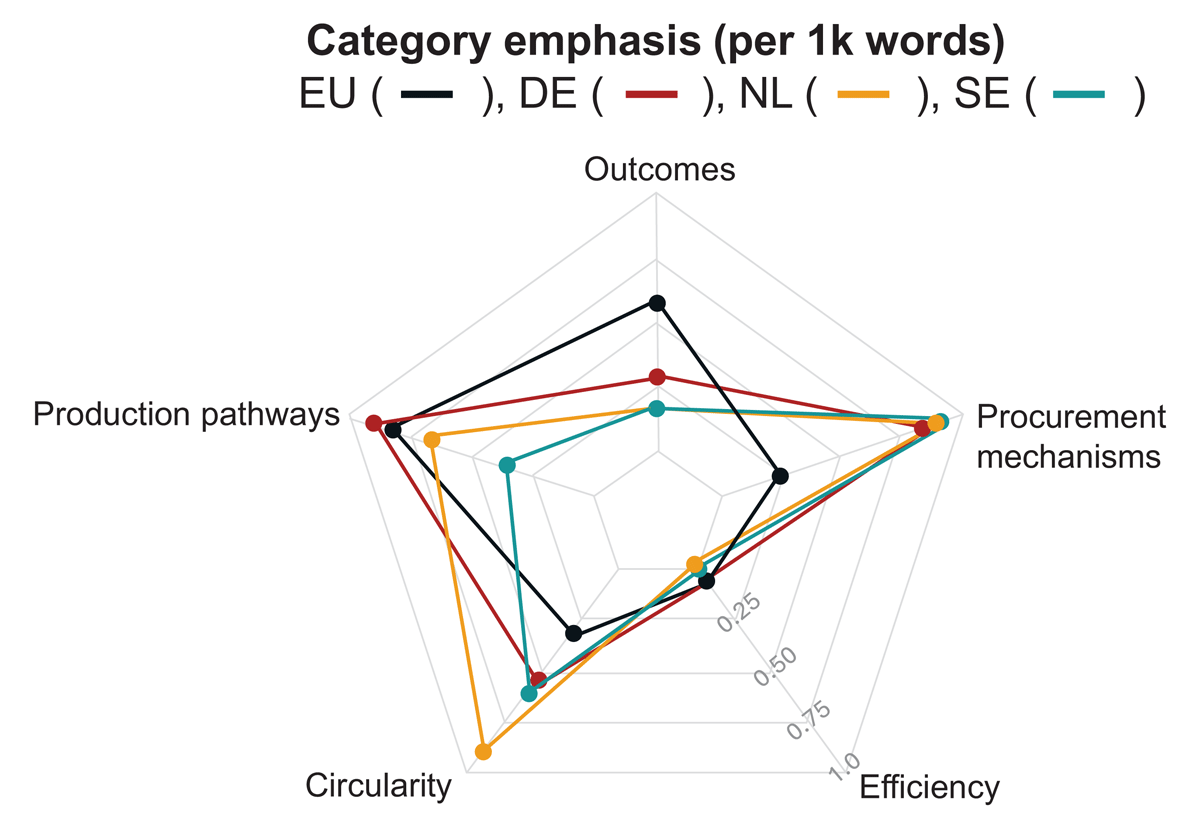
Figure 3
Relative thematic emphasis across analytical categories based on normalised term frequencies (per 1,000 words) (source: authors’ own elaboration).
Beyond these broad thematic patterns, the keyness analysis and qualitative review reveal more pronounced differences in how Member States interpret EU industrial policy priorities. German policy documents place greater emphasis on industrial competitiveness, hydrogen infrastructure and industrial production systems, reflecting a comparatively production-oriented approach to industrial transformation. Procurement receives less emphasis within broader strategic narratives, with greater attention directed towards technological pathways and industrial capability. By contrast, Dutch policy documents link procurement more closely with circular economy objectives, lifecycle approaches and market coordination mechanisms. Rather than emphasising lead markets in abstract terms, the Dutch corpus focuses more frequently on operational procurement tools, circular procurement and implementation guidance. Sweden similarly demonstrates a strong procurement-oriented framing. Procurement is frequently presented as an active governance instrument capable of supporting sustainability transitions, with comparatively greater emphasis on lifecycle approaches, environmental performance and strategic procurement mechanisms.
These differences become more apparent in the modal language analysis. Figure 4 compares the degree of binding procurement language across the national policy corpora and provides insight into how implementation expectations are communicated within each governance context. Swedish policy documents contain the highest proportion of strongly binding procurement language (54%), whereas Dutch and German documents contain lower shares of binding language (35% and 34%, respectively) alongside larger proportions of enabling or descriptive language.
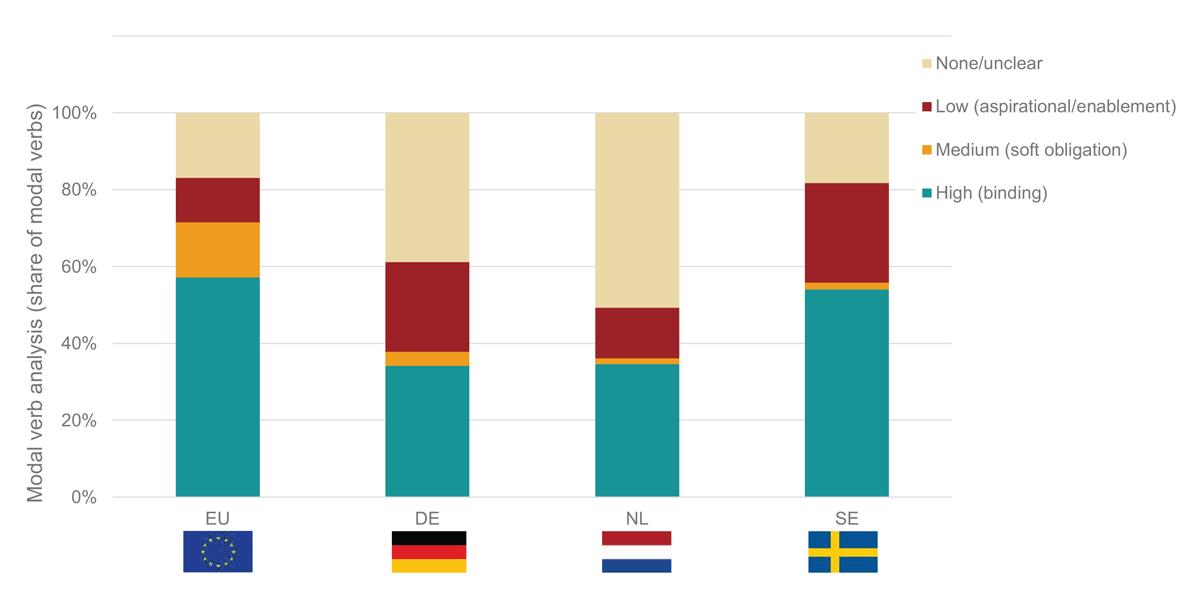
Figure 4
Modal verb comparative analysis across paragraphs containing “public procurement” terms (source: authors’ own elaboration).
These findings suggest that Member States do not simply replicate EU industrial policy narratives, but selectively reinterpret and operationalise EU strategic signals according to differing institutional traditions, industrial structures and governance priorities. The national-level analysis therefore reinforces the conceptualisation of Member States as policy “messengers” that actively mediate and translate EU-level signalling rather than functioning as passive recipients of supranational policy direction.
3.3 Buyer-level operationalisation
The Contract Award Notice (CAN) analysis reveals substantial divergence between strategic procurement ambitions and observable procurement practices across steel-relevant sectors. While EU and national policy documents increasingly frame procurement as a strategic instrument for industrial transformation and lead market creation, the operational implementation of strategic procurement practices remains uneven across Member States.
Figure 5 presents trends in the use of Most Economically Advantageous Tender (MEAT) approaches across steel-relevant sectors including construction, transport and defence procurement. Across the EU as a whole, MEAT usage remained relatively stable between 2010 and 2023, generally fluctuating between approximately 35–45% of procurement notices. The figure illustrates substantial divergence in procurement operationalisation across Member States, particularly between consistently high Dutch MEAT uptake and the comparatively low levels observed in Germany and Sweden following Directive transposition.
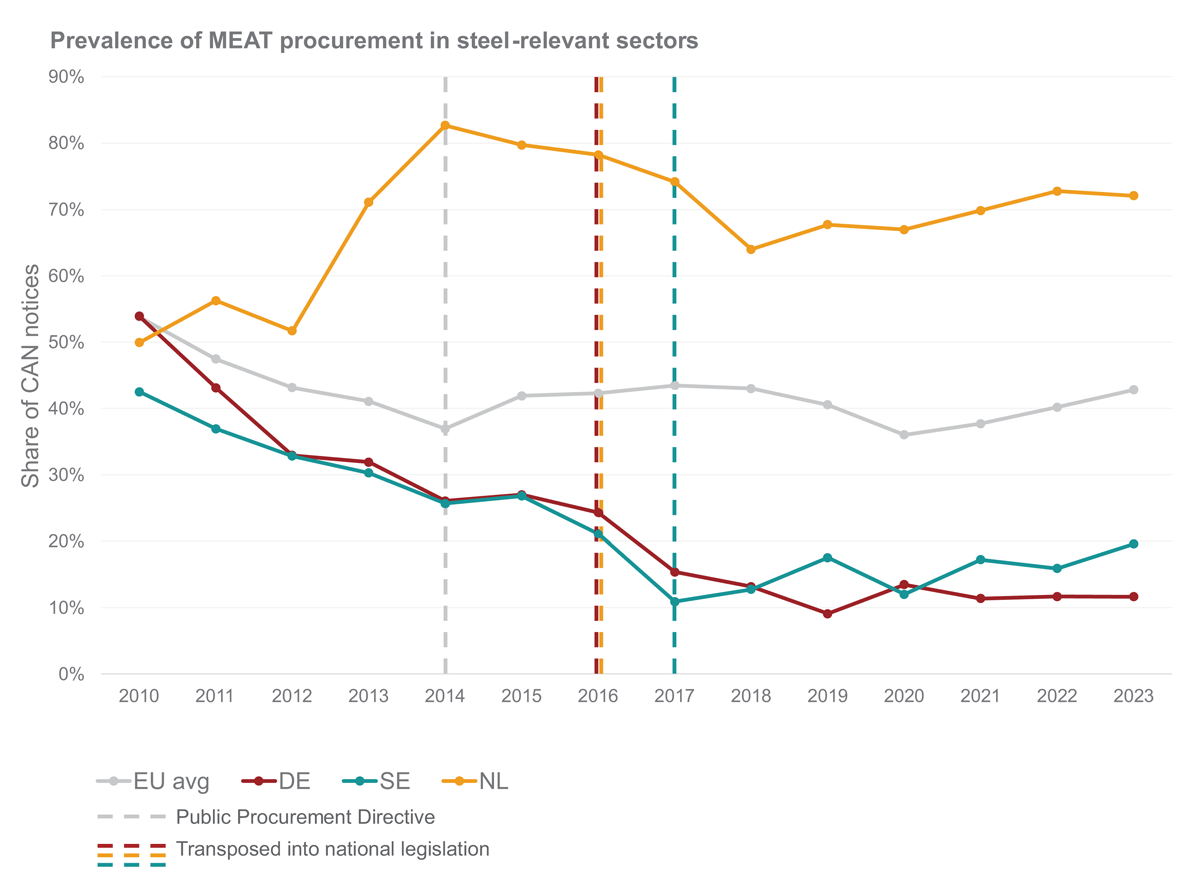
Figure 5
Prevalence of MEAT procurement (average across steel-relevant sectors: buildings, transport and defence) (source: authors’ own elaboration).
The Netherlands consistently demonstrated the highest MEAT uptake across steel-relevant sectors, frequently exceeding 65–80% of notices, particularly within transport and infrastructure procurement. Importantly, Dutch MEAT uptake increased substantially prior to the formal transposition of the 2014 EU Public Procurement Directive, indicating that procurement systems in the Netherlands were already adopting more strategic and lifecycle-oriented procurement approaches before binding implementation requirements emerged. These implementation outcomes did not correspond directly with the strength of procurement language observed within the national policy analysis. Despite comparatively less directive procurement language, Dutch procurement systems demonstrated substantially stronger operational uptake of MEAT and environmental procurement criteria than both Germany and Sweden.
By contrast, Germany exhibited substantially lower MEAT usage overall, with procurement practices becoming increasingly oriented toward lowest-price approaches following the mid-2010s. MEAT usage fell below 15% across most sectors after 2017, suggesting comparatively limited operational uptake of strategic procurement approaches. Sweden displayed a similar post-Directive decline, stabilising at comparatively low levels of approximately 10–20% of procurement notices, although with greater volatility within defence procurement.
These findings suggest that formal regulatory alignment following the 2014 Public Procurement Directive did not produce systematic convergence in procurement behaviour across Member States. Instead, procurement operationalisation appears strongly shaped by national institutional practices, procurement cultures, administrative capability and implementation traditions. The uneven adoption of MEAT approaches also suggests differing levels of institutional readiness to integrate broader lifecycle, circularity and sustainability considerations into procurement processes.
The analysis of environmental (“green”) procurement criteria reveals even stronger implementation limitations than the MEAT analysis. Across most sectors and countries, environmental criteria appeared within only a very small share of procurement notices, typically ranging between 0–3% of notices EU-wide and frequently close to zero within several national contexts. Dutch procurement again represented a partial exception, particularly within transport and infrastructure procurement, where environmental criteria occasionally reached approximately 7–11% of notices. By contrast, environmental procurement criteria remained comparatively limited within building-related procurement despite the importance of embodied carbon within construction materials, while defence procurement displayed greater volatility over time, particularly within Sweden. Overall, however, sustainability-oriented procurement remained far from dominant procurement practice across all sectors and countries.
Importantly, the CAN analysis suggests that operational implementation remains substantially weaker than implied by broader EU-level industrial policy discourse. Although procurement is increasingly framed politically as a market-shaping mechanism and lead market instrument, actual procurement behaviour across much of the EU remains comparatively conservative and frequently dominated by price-oriented evaluation approaches. Given that construction, infrastructure, transport and defence represent major downstream sources of steel demand, the limited uptake of MEAT and environmental procurement criteria suggests comparatively weak operational integration of decarbonisation objectives within procurement systems. The findings therefore reveal a significant implementation gap across the signaller–messenger–implementer chain. Despite increasing strategic attention to procurement within EU industrial policy, procurement practices remain uneven across Member States and sectors, limiting procurement’s ability to generate predictable demand signals for low-emission industrial products, including low-emission steel.
4 Discussion
4.1 Public procurement as strategic industrial policy
The results demonstrate that public procurement is increasingly positioned within EU industrial policy as a strategic demand-side instrument for industrial transformation and low-emission steel market formation. Across the EU-level policy corpus, procurement was repeatedly linked to industrial decarbonisation, competitiveness, resilience, strategic autonomy and industrial scaling objectives. This suggests that procurement is increasingly framed as a broader mechanism of industrial coordination and market shaping rather than solely a sustainability instrument. These findings align with recent scholarship arguing that EU climate and industrial governance are increasingly converging through broader competitiveness and resilience-oriented policy agendas (Romppanen and Huhta, 2023; Huhta et al., 2025).
The findings also support broader literature conceptualising procurement as a market-shaping instrument rather than merely an administrative purchasing function (Edler and Georghiou, 2007; Mazzucato, 2020). In particular, the EU-level discourse surrounding lead markets and low-emission steel reflects wider mission-oriented and transformative innovation policy approaches which emphasise demand creation, market coordination and investment signalling as critical components of industrial transformation (Weber and Rohracher, 2012; Schot and Steinmueller, 2018). The growing prominence of procurement within the Clean Industrial Deal and SMAP further illustrates this shift toward demand-side industrial policy approaches.
The results reveal an important tension between strategic ambition and implementation. Procurement is increasingly expected to simultaneously deliver decarbonisation, competitiveness, resilience, industrial sovereignty and security objectives, reflecting broader trends in transformative innovation policy whereby policy instruments are burdened with multiple overlapping societal expectations (Laatsit, Grillitsch and Fünfschilling, 2025). In this sense, procurement is increasingly subject to what Laatsit et al. describe as “great expectations”: it is expected not only to decarbonise industrial demand, but also to accelerate industrial transformation, reduce investment risk, strengthen European competitiveness and create lead markets for emerging technologies and materials. However, the findings suggest that this expanding strategic role has not been matched by an equivalent strengthening of binding green public procurement requirements or the governance arrangements needed to support implementation, leaving considerable discretion in how these ambitions are translated into practice across Member States.
The results indicate that procurement should be understood less as a standalone policy instrument than as one component of a broader industrial governance ecosystem. Its ability to create and shape lead markets depends on complementary institutions, standards, financing mechanisms and implementation support capable of translating strategic ambition into procurement practice.
4.2 Governance translation failures and implementation gaps
A central finding of this study is that strategic ambition and operational implementation diverge across governance levels. This divergence reflects not only differences in implementation capacity, but also the nature of the policy signal itself. Although procurement is increasingly positioned strategically within EU industrial policy, binding green public procurement requirements remain comparatively limited, leaving substantial discretion in how procurement objectives are interpreted and implemented by Member States and public buyers. This finding contributes to broader multi-level governance literature by highlighting that industrial transformation rarely proceeds through linear top-down policy implementation (Hooghe and Marks, 2001; Romppanen and Huhta, 2023). Instead, strategic policy ambitions are interpreted, adapted and operationalised through governance structures shaped by different institutional traditions, administrative capacities, procurement cultures and sectoral priorities. The results show that EU-level strategic discourse increasingly converges around lead markets, industrial competitiveness, resilience and strategic autonomy. However, these narratives become progressively diluted as governance responsibility moves downward toward implementation.
The national-level analysis indicates that Member States selectively reinterpret EU industrial policy priorities according to differing institutional traditions and governance logics. German policy documents place comparatively greater emphasis on industrial production systems and technological pathways, whereas Dutch and Swedish policy documents exhibit stronger procurement-oriented framing. However, stronger procurement-oriented rhetoric did not necessarily correspond directly with stronger implementation outcomes. While Swedish policy documents displayed comparatively high levels of strongly binding procurement language, operational uptake of MEAT and environmental procurement criteria remained comparatively limited. By contrast, Dutch procurement systems demonstrated substantially stronger operational uptake despite relying less heavily on directive procurement language.
The Dutch case may therefore suggest the importance of clearer strategic directionality within procurement governance. Rather than framing procurement primarily through broad and overlapping industrial policy objectives, Dutch governance frameworks appear more strongly oriented toward operationalising a relatively clear decarbonisation pathway centred on circularity, including lifecycle approaches and embodied carbon assessment. In this sense, the Netherlands does not simply demonstrate stronger rhetorical support for green public procurement, but a more operationally defined governance approach supported by procurement methodologies, implementation tools and intermediary support structures. Previous studies similarly identify the Netherlands as a comparatively advanced case in the operational integration of circular procurement methodologies and sustainability-oriented procurement governance within infrastructure and construction sectors (Bellona, 2024).
The buyer-level findings reinforce this interpretation. Although procurement is increasingly framed politically as a strategic demand-side instrument, operational uptake of sustainability-oriented procurement approaches remains comparatively limited across much of the EU. The low prevalence of environmental procurement criteria – frequently below 5% of notices across steel-relevant sectors – suggests that many procurement systems remain strongly oriented toward procedural compliance, administrative risk minimisation and price-based procurement practices. These findings align closely with earlier empirical procurement research demonstrating similarly limited operational uptake of sustainability-oriented procurement approaches despite growing political attention to strategic procurement. Chiappinelli and Zipperer (2017), for example, found that environmental criteria were used in only 2.4% of German public procurement contracts in 2015, despite growing political attention to green public procurement and sustainability objectives. The persistence of similarly low levels of environmental procurement criteria within the present analysis – typically between 0–3% of notices across steel-relevant sectors – suggests that many of the implementation barriers identified nearly a decade earlier remain only partially resolved.
Importantly, the findings suggest that the governance challenge is twofold. First, although procurement is increasingly positioned strategically within EU industrial policy, binding requirements specifically mandating green public procurement remain comparatively limited. Second, where strategic ambitions are articulated, their translation into procurement practice is constrained by fragmented standards, uneven institutional capacity and limited implementation support. Procurement governance therefore depends on decentralised public buyers operationalising broad strategic objectives within highly variable institutional contexts. The implementation gap identified in this study thus reflects both the character of the policy signal and the challenges associated with its translation across governance levels. These findings suggest that strategic procurement transformation cannot be achieved through policy signalling alone, but requires stronger governance coordination, clearer implementation frameworks and institutional support across governance levels.
4.3 Institutional capacity and lead market formation
The findings demonstrate that institutional capacity plays a critical role in determining whether procurement can function effectively as a lead market instrument for low-emission steel. Across the buyer-level analysis, stronger procurement operationalisation was associated less with rhetorical policy ambition and more with the existence of mature procurement infrastructures, LCA capability, implementation guidance and procurement expertise.
This dynamic is particularly visible in the Dutch case. The rise in Dutch MEAT uptake prior to the formal transposition of the 2014 EU Public Procurement Directive suggests that procurement transformation may depend not only on formal regulatory alignment, but also on anticipatory governance capacity, institutional learning and established procurement cultures.
The Dutch experience also illustrates how intermediary institutions and operational tools can facilitate procurement implementation in practice. Organisations such as PIANOo (the Dutch Public Procurement Expertise Centre) provide guidance, case studies, standardised methodologies and implementation support for public buyers. Previous studies similarly identify the Netherlands as comparatively advanced in the operational integration of lifecycle approaches, circular procurement methodologies and sustainability-oriented procurement governance within infrastructure and construction sectors (Bellona, 2024). Within construction and infrastructure procurement, Dutch authorities – including Rijkswaterstaat – increasingly utilise LCA tools integrated directly into procurement evaluation processes. These include DuboCalc, the National Environmental Database and the CO2 Performance Ladder, all of which help embed lifecycle and environmental considerations into routine procurement procedures (Chiappinelli and Zipperer, 2017). This suggests that procurement operationalisation may depend less on prescriptive policy language alone and more on institutional maturity, procurement capability and the existence of operational procurement tools and implementation infrastructures.
Some of these differences also appeared sector specific. Dutch transport and infrastructure procurement demonstrated comparatively stronger operational uptake of sustainability-oriented procurement approaches than other sectors, potentially reflecting the existence of more mature LCA methodologies, standardised procurement tools and established sustainability governance frameworks within these sectors. By contrast, environmental procurement criteria remained comparatively limited within building-related procurement despite the importance of embodied carbon within construction materials (LETI, 2020; IPCC, 2023). This suggests that procurement operationalisation may depend not only on national governance context, but also on sector-specific institutional capacities, market structures and procurement traditions.
The findings therefore support broader sustainability transition literature emphasising the importance of implementation capacity, policy coordination and cumulative governance infrastructures within industrial transformation processes (Weber and Rohracher, 2012; Laatsit, Grillitsch and Fünfschilling, 2025). Procurement transformation appears to depend not only on strategic signalling, but also on the existence of intermediary institutions, operational methodologies and implementation ecosystems capable of translating strategic objectives into day-to-day procurement practice.
More broadly, the results suggest that procurement’s effectiveness as a lead market instrument depends heavily on wider governance alignment. Procurement alone cannot create low-emission steel markets if standards remain fragmented, carbon accounting methodologies remain unclear, and price differentials remain unsupported. Lead market formation therefore appears to require broader governance ecosystems combining procurement policy, industrial policy, standards development, financing mechanisms and institutional implementation support.
4.4 Implications for EU industrial decarbonisation policy
First, the results suggest that demand-side instruments are becoming an increasingly important component of the EU’s industrial decarbonisation policy mix. While earlier industrial decarbonisation policy relied primarily on carbon pricing, subsidies and supply-side technological support, more recent policy developments increasingly complement these instruments with measures aimed at market creation, procurement governance and lead market formation. This reflects broader transformations in EU industrial governance identified within recent literature on the Clean Industrial Deal, strategic autonomy and mission-oriented industrial policy (Huhta et al., 2025).
However, the findings suggest that the governance infrastructures necessary to operationalise this shift remain underdeveloped. Procurement is increasingly expected to reconcile decarbonisation, competitiveness, resilience, industrial sovereignty and affordability objectives simultaneously. Yet procurement systems frequently lack the institutional coordination mechanisms and operational support structures necessary to operationalise these overlapping objectives consistently. This reinforces broader arguments within transition governance literature that transformative policy instruments frequently encounter practical limits when expected to address multiple complex societal objectives simultaneously (Laatsit, Grillitsch and Fünfschilling, 2025).
The findings therefore suggest that future industrial decarbonisation policy should place greater emphasis on implementation infrastructures. While procurement is increasingly recognised as a strategic demand-side instrument, stronger and more consistent green public procurement requirements could provide clearer market direction, while harmonised standards, lifecycle methodologies, buyer-support systems and implementation guidance would help translate these ambitions into procurement practice. The comparatively stronger operationalisation observed within Dutch procurement systems suggests that intermediary institutions, procurement expertise centres and standardised LCA tools may play a particularly important role in supporting this translation from strategic ambition to procurement practice.
The findings therefore reinforce the importance of policy coherence across the wider industrial decarbonisation policy mix. Public procurement forms one component of a broader governance ecosystem that includes standards, carbon accounting systems, industrial support measures, financing mechanisms and implementation support. Its effectiveness as a lead market instrument depends not only on procurement policy itself, but also on how these complementary measures interact to create credible demand signals and reduce investment uncertainty for low-emission industrial materials.
5 Conclusion
This paper examined how public procurement is framed and operationalised as a demand-side instrument for steel decarbonisation across multiple governance levels within the European Union. While EU industrial policy increasingly positions procurement strategically within broader agendas surrounding decarbonisation, competitiveness and resilience, substantial governance translation gaps emerge across the signaller–messenger–implementer chain.
The findings suggest that the central challenge lies less in the absence of strategic ambition than in uneven operationalisation capacity across governance levels. Although procurement is frequently framed politically as a “sleeping giant” capable of supporting industrial transformation and lead market creation, actual procurement practices across steel-relevant sectors remain comparatively conservative and heavily oriented toward price-based procurement approaches. The operational uptake of sustainability-oriented procurement criteria remains limited across much of the EU, suggesting that procurement’s transformative potential remains only partially realised in practice.
At the same time, the findings demonstrate that stronger implementation outcomes are associated not necessarily with more binding policy language, but with clearer governance directionality, institutional capacity and operational support infrastructures. The Dutch case illustrates how procurement systems become more capable of operationalising sustainability objectives when supported by intermediary institutions, lifecycle methodologies, implementation tools and clearer strategic pathways centred around circularity and embodied carbon reduction.
The paper therefore suggests that future EU industrial decarbonisation policy should place greater emphasis on implementation infrastructures rather than strategic signalling alone. Procurement alone cannot create lead markets for low-emission steel. However, when embedded within broader governance ecosystems involving standards, lifecycle methodologies, institutional support and coordinated industrial policy, procurement may function as an important mechanism for accelerating industrial transformation and reducing investment uncertainty within hard-to-abate sectors.
The persistence of these implementation challenges is particularly notable given that many of the same barriers were already identified nearly a decade earlier. Previous studies highlighted procurement’s strategic potential alongside persistent barriers related to risk aversion, fragmented governance, limited procurement capability and weak implementation support (OECD, 2017), while Chiappinelli and Zipperer (2017) similarly found limited use of environmental criteria in German public procurement. The findings presented here suggest that, although procurement has become increasingly central within EU industrial policy discourse, many of the practical implementation barriers identified previously remain only partially resolved. Beyond its empirical findings, the paper contributes a signaller–messenger–implementer analytical framework for examining how strategic procurement ambitions are translated across governance levels. While developed in the context of low-emission steel, the framework may also provide a useful lens for analysing governance translation in other demand-side industrial policy contexts. Future research could build on these findings through detailed case studies and interviews with public buyers, procurement agencies and intermediary organisations to better understand the practical conditions required to translate strategic procurement ambition into operational implementation. Overall, procurement has an important but contingent role within industrial decarbonisation. Its contribution to lead market formation depends not only on strategic policy ambition, but also on the governance arrangements, institutional capacity and implementation support required to translate ambition into procurement practice.
Appendices
Appendices
Appendix 1: Policy documents included in the analysis
Table 5
EU-level and national – German (DE), Dutch (NL) and Swedish (SE) – policy documents included within the analysis.
| GOVERNANCE LEVEL | DOCUMENT | TYPE | YEAR | ANALYTICAL RELEVANCE |
|---|---|---|---|---|
| Signaller (EU) | Carbon Border Adjustment Mechanism (CBAM) | Regulation | 2023 | Industrial decarbonisation |
| Signaller (EU) | Circular Economy Action Plan | Action Plan | 2020 | Circularity; material efficiency |
| Signaller (EU) | Clean Industrial Deal | Communication | 2025 | Strategic industrial policy |
| Signaller (EU) | Construction Products Regulation (CPR) | Regulation | 2024 | Material standards; construction demand |
| Signaller (EU) | EU Innovation Fund | Funding instrument | 2020 | Industrial decarbonisation financing |
| Signaller (EU) | EU Public Procurement Directives | Directive | 2014 | Procurement governance |
| Signaller (EU) | European Hydrogen Strategy | Strategy | 2020 | Steel transition pathways |
| Signaller (EU) | Green Deal Industrial Plan | Strategy | 2023 | Strategic industrial policy |
| Signaller (EU) | Defining low-carbon emissions steel: A comparative analysis of international initiatives and standards | Technical Report | 2025 | Standards; low-emission steel |
| Signaller (EU) | Steel and Metals Action Plan (SMAP) | Action Plan | 2025 | Lead markets; industrial decarbonisation |
| Signaller (EU) | Action Plan for Affordable Energy | Action Plan | 2025 | Energy affordability; industrial competitiveness |
| Signaller (EU) | Automotive Action Plan | Action Plan | 2025 | Transport demand; industrial transition |
| Signaller (EU) | Critical Raw Materials Act | Regulation | 2024 | Strategic autonomy; industrial resilience |
| Signaller (EU) | EU Sustainable and Smart Mobility Strategy | Strategy | 2020 | Transport demand; sustainability transition |
| Signaller (EU) | European Hydrogen Bank | Financing mechanism | 2023 | Industrial decarbonisation financing |
| Signaller (EU) | Industrial Emissions Directive | Directive | 2024 | Industrial decarbonisation; regulation |
| Signaller (EU) | Net-Zero Industry Act | Regulation | 2024 | Industrial decarbonisation |
| Signaller (EU) | Research Fund for Coal and Steel (RFCS) – Programme information package | Programme | 2024 | Innovation support; steel transition |
| Signaller (EU) | Waste Shipment Regulation | Regulation | 2024 | Circularity; material efficiency |
| Signaller (EU) | White Paper on Defence | White Paper | 2025 | Defence/security |
| Signaller (EU) | Draghi Report on EU Competitiveness | Strategic report | 2025 | Competitiveness; industrial policy |
| Signaller (EU) | Directive 2009/33/EC on the promotion of clean and energy-efficient road transport vehicles | Directive | 2024 | Sustainable procurement; transport demand |
| Messenger (DE) | Steel Action Concept | Industrial strategy | 2023 | Industrial decarbonisation; steel transition |
| Messenger (DE) | National Hydrogen Strategy | Strategy | 2023 | Steel transition pathways |
| Messenger (DE) | National Circular Economy Strategy | Strategy | 2024 | Circularity; material efficiency |
| Messenger (DE) | Green Public Procurement Guidelines for Buildings | Guidance | 2021 | Procurement governance; buildings |
| Messenger (DE) | Germany National Energy and Climate Plan 2021–2030 | National strategy | 2024 | National policy translation |
| Messenger (DE) | BMWK Industrial Strategy | Industrial strategy | 2024 | Strategic industrial policy |
| Messenger (DE) | 2030 Federal Transport Infrastructure Plan (FTIP) | Infrastructure plan | 2023 | Transport demand; infrastructure |
| Messenger (DE) | Procurement Regulations for Defense and Security (VSVgV) | Regulation | 2016 | Defence procurement |
| Messenger (DE) | System Development Strategy 2024 | Infrastructure strategy | 2024 | Energy systems; infrastructure |
| Messenger (NL) | Government Strategy on Hydrogen | Strategy | 2020 | Steel transition pathways |
| Messenger (NL) | National Circular Economy Programme 2023–2030 | Programme | 2023 | Circularity; material efficiency |
| Messenger (NL) | Tendering Guidelines 4.0 | Guidance | 2022 | Procurement governance |
| Messenger (NL) | National Impactful Procurement Plan | Strategy | 2022 | Strategic procurement |
| Messenger (NL) | Circular Procurement Guidance | Guidance | 2021 | Circular procurement |
| Messenger (NL) | Procurement with Impact Strategy | Strategy | 2022 | Strategic procurement; sustainability |
| Messenger (NL) | Sustainable Infrastructure Activity Book | Guidance | 2021 | Infrastructure procurement |
| Messenger (NL) | Joint Letter of Intent on Tata Steel Decarbonisation | Joint declaration | 2023 | Steel decarbonisation |
| Messenger (NL) | Netherlands National Energy and Climate Plan 2021–2030 | National strategy | 2024 | National policy translation |
| Messenger (NL) | Mobility Vision 2050 | Strategy | 2021 | Transport transition |
| Messenger (NL) | Vision for a more sustainable basic industry in 2050 | Industrial strategy | 2023 | Industrial decarbonisation |
| Messenger (SE) | Climate Roadmap for a fossil-free and competitive steel industry | Roadmap | 2020 | Steel transition pathways |
| Messenger (SE) | Circular Economy – Strategy for the transition in Sweden | Strategy | 2021 | Circularity; material efficiency |
| Messenger (SE) | Environmental Spend Analysis | Technical report | 2022 | Procurement analysis |
| Messenger (SE) | Swedish Public Procurement Act | Act | 2016 | Procurement governance |
| Messenger (SE) | National Public Procurement Strategy | Strategy | 2017 | Strategic procurement |
| Messenger (SE) | Hydrogen Strategy | Strategy | 2021 | Steel transition pathways |
| Messenger (SE) | Climate Roadmap for a competitive and fossil-free mining and mineral industry in Sweden | Roadmap | 2020 | Industrial decarbonisation |
| Messenger (SE) | Roadmaps Follow-up 2021 | Monitoring report | 2021 | Industrial transition monitoring |
| Messenger (SE) | Sweden National Energy and Climate Plan 2021–2030 | National strategy | 2024 | National policy translation |
| Messenger (SE) | Smart Industry – a strategy for new industrialisation for Sweden | Industrial strategy | 2016 | Strategic industrial policy |
| Messenger (SE) | National Plan for Transport Infrastructure | Infrastructure plan | 2022 | Transport demand; infrastructure |
| Messenger (SE) | Security and Defence Procurement | Guidance | 2023 | Defence procurement |
Appendix 2: Supplementary methods information
2a) R Libraries used
All quantitative document analysis and visualisation were conducted in R. The selected libraries support reproducible text mining, dictionary-based analysis, and large-scale procurement data processing, ensuring transparency and replicability of the analytical workflow.
| LIBRARY | USE |
|---|---|
| ggplot2 | Data visualisation package used to produce all figures (e.g. modality charts, MEAT trends, thematic emphasis plots). Supports layered grammar of graphics and reproducible plotting. |
| ggwordcloud | Used to visualise term prominence and salience across policy document corpora through word clouds and weighted text visualisations. |
| dplyr | Core data manipulation package used for filtering CAN data, grouping by country/sector/year, and calculating shares (e.g. MEAT and green criteria). |
| fmsb | Used for specialised statistical visualisations (e.g. radar/spider charts) to compare thematic emphasis across governance levels. |
| lubridate | Date and time handling package used to standardise and aggregate TED Contract Award Notice (CAN) data by year. |
| pdftools | Used to extract machine-readable text from EU and national policy documents (PDF format) prior to dictionary-based analysis. |
| quanteda | Core text analysis framework used for corpus creation, tokenisation, dictionary matching, and document-feature matrix construction for QDA. |
| quanteda.textstats | Extension of quanteda used for frequency counts, keyness analysis (log-likelihood), and comparative text statistics across document corpora. |
| readr | Used to import structured datasets (e.g. CSV exports of CAN data and modality outputs) efficiently and reproducibly. |
| readtext | Used to batch import and structure multiple policy documents into a unified corpus for analysis within quanteda. |
| stringr | String processing package used for keyword detection, dictionary cleaning, and preprocessing of multilingual text. |
| tidyr | Used for reshaping datasets (e.g. pivoting modality results, term frequencies, and country-level summaries) into analysis-ready formats. |
| viridis | Colour scale package used for perceptually uniform and publication-quality visualisations (e.g. modality and thematic plots). |
2b) Search term dictionaries
Search terms used for document analysis.
| ANALYTICAL CATEGORY | DICTIONARY TERMS |
|---|---|
| Policy outcomes | “decarbon*”, “carbon intens*”, “climate neutral*”, “net zero”, “carbon neutral*”, “emission reduction*”, “greenhouse gas”, “ghg reduction*”, “co2 reduction*”, “climate mitigation”, “climate resilien*”, “strategic autonom*”, “resilien*”, “competitiveness”, “industrial competit*”, “energy security”, “security”, “supply security”, “strategic dependenc*”, “strategic value” |
| Production pathways | “hydrogen”, “green hydrogen”, “renewable hydrogen”, “electrolysis”, “direct reduced iron”, “direct reduction”, “dri”, “h2 dri”, “electric arc furnace”, “eaf”, “renewable electricity”, “renewable energy”, “fossil free steel”, “low carbon steel”, “green steel”, “near zero steel”, “clean steel”, “sustainable steel”, “industrial electrification”, “carbon capture”, “ccs”, “ccu”, “zero-carbon steel” |
| Circularity & material efficiency | “circular*”, “recycl*”, “scrap”, “secondary steel”, “material efficiency”, “resource efficiency”, “life cycle”, “lifecycle”, “life cycle assessment”, “lca”, “embodied carbon”, “embodied emissions”, “product carbon footprint”, “pcf”, “environmental product declaration”, “epd”, “durabil*”, “reuse”, “remanufact*” |
| Efficiency | “energy efficiency”, “energy efficient”, “process efficiency”, “efficiency improvement*”, “energy intensity”, “best available technique*”, “bat” |
| Procurement mechanisms | “public procurement”, “green public procurement”, “gpp”, “strategic procurement”, “sustainable procurement”, “most economically advantageous tender”, “meat”, “award criteria”, “award criterion”, “tender”, “contracting authorit*”, “life cycle costing”, “lcc”, “total cost of ownership”, “tco”, “technical specification*”, “minimum requirement*”, “contract performance clause*”, “environmental criteria”, “lead market*”, “procurement criteria”, “procurement”, ”joint procurement” |
2c) Green flag dictionaries
Search terms used when developing the “green flag” to filter tender data, elaborated from Yang and Morotomi (2025). Note that English search terms were applied to contracts from DE, NL and SE to reflect that in some instances tender documents are published in English rather than national languages, particularly for mega-projects.
| LANGUAGE | “GREEN FLAG” SEARCH TERMS |
|---|---|
| English | “breeam”, “carbon”, “carbon footprint”, “carbon neutral*”, “circular*”, “climate”, “climate change”, “climate neutral*”, “co2”, “durab*”, “ecological”, “eco”, “electrif*”, “electrification”, “emission*”, “environment”, “environmental”, “environmental impact”, “environmental product declaration”, “epd”, “energy”, “energy efficient”, “energy-efficient”, “energy efficien*”, “energy saving”, “fsc”, “geothermal”, “ghg”, “green”, “greenhouse gas*”, “heat pump*”, “iso 14001”, “iso14001”, “emas”, “lca”, “lcc”, “lead”, “leed”, “life cycle”, “life cycle assessment”, “life cycle costing”, “lifecycle”, “low impact”, “material efficien*”, “net zero”, “net-zero”, “pcf”, “pefc”, “product carbon footprint”, “recycl*”, “recycled”, “recyclable”, “remanufact*”, “renewable*”, “resource efficien*”, “reuse”, “reused”, “sustainab*”, “sustainability”, “sustainable”, “waste”, “waste management”, “waste reduction”, “whole life carbon”, “wlc”, “wind”, “solar”, “bioenergy” |
| German | “abfall*”, “co2”, “emission*”, “energie”, “energieeffizienz*”, “energieeffizient*”, “energiespar*”, “erneuerbar*”, “erneuerbare”, “fsc”, “iso 14001”, “iso14001”, “emas”, “klima*”, “klimawandel”, “klimaneutral*”, “kohlendioxid”, “kreislauf*”, “lebenszyklus*”, “lebenszykluskalkulation*”, “lebenszykluskosten*”, “materialeffizienz*”, “nachhalt*”, “net-zero”, “netto null”, “okobilanz*”, “oekobilanz*”, “pefc”, “pcf”, “produkt carbon footprint”, “recycl*”, “ressourceneffizienz*”, “treibhausgas*”, “umwelt*”, “umweltfreund*”, “umweltproduktdeklaration*”, “wiederverwend*”, “wiederverwertung” |
| Dutch | “afval*”, “broeikasgas*”, “circulair*”, “co2”, “duurzaam*”, “duurzame energie”, “emissie*”, “energie”, “energie efficient”, “energie-efficient*”, “energiebesparing*”, “epd”, “fsc”, “grondstoff*”, “hergebruik*”, “hernieuwbaar*”, “iso 14001”, “iso14001”, “emas”, “klimaat*”, “klimaatneutraal*”, “klimaatverandering”, “koolstof”, “kringloop*”, “lca”, “lcc”, “levenscyclus*”, “levenscycluskosten*”, “materiaal efficient*”, “materiaalefficient*”, “milieu*”, “milieuproductverklaring*”, “milieuvriend*”, “net-zero”, “netto nul”, “pcf”, “pefc”, “product carbon footprint”, “recycl*”, “resource” |
| Swedish | “aterbruk*”, “atervinn*”, “cirkulär*”, “cirkular*”, “co2”, “energi”, “energieffektiv*”, “energisnål*”, “epd”, “fornybar*”, “förnybar*”, “förnybara”, “hallbar*”, “hållbar*”, “hållbarhet”, “koldioxid”, “klimat*”, “klimatpåverkan”, “klimatneutral”, “livscykel*”, “livscykelkostnad*”, “lca”, “materialeffektiv*”, “miljö”, “miljöbyggnad”, “miljöcertifier*”, “miljökrav”, “miljömässig”, “miljövänlig”, “miljovarudeklaration”, “miljo”, “netto noll”, “nordic swan”, “resurseffektiv*”, “svanen”, “utsläpp*” |
Notes
Data Accessibility Statement
All policy documents analysed in this study were obtained from publicly accessible sources, including European Commission repositories, EUR-Lex and national government websites. Procurement data were obtained from the European Union’s Tenders Electronic Daily (TED) Open Data portal. The analytical code and supplementary materials used in this study are publicly available via Zenodo: https://doi.org/10.5281/zenodo.20590948.
Author Contributions
NGF: Conceptualisation, Methodology, Formal analysis, Writing.
CD: Conceptualisation, Writing.