
Introduction
The integration of GenAI in higher education is transforming how knowledge is curated, delivered, and accessed. Across the higher education sector, AI-powered tutoring, adaptive learning, and automated assessment are becoming more visible within institutional strategies and pedagogical experimentation. While these innovations promise flexibility and efficiency, they also introduce a fundamental shift in knowledge control. Traditionally, educators and institutions have served as gatekeepers of curriculum design, knowledge validation, and crucially, assessment standards that regulate student progression. Assessment, in particular, functions as the primary mechanism through which academic thresholds are maintained. However, AI-driven personalisation alters this dynamic, shifting decision-making towards proprietary AI systems and engagement-driven algorithms. In this paper, we use the terms deliberately: AI-generated refers to content produced by generative models; AI-driven to processes substantially shaped by algorithmic outputs; and AI-powered to platforms embedding such systems within institutional infrastructures.
This shift raises concerns about academic autonomy, content consistency, and equity in education. AI-generated learning pathways, while tailored to individual students, risk fragmenting knowledge acquisition, introducing biases, and prioritising engagement metrics over educational value. In the absence of clear governance, AI-driven systems may homogenise knowledge, reinforcing mainstream narratives while limiting epistemic diversity. Drawing on gatekeeping theory, which examines how information is filtered, structured, and disseminated, this study explores how GenAI functions as an educational gatekeeper and the implications for higher education.
By comparing AI-driven knowledge curation to the evolution of algorithmic media gatekeeping, this paper identifies key risks associated with AI-powered personalisation, including: the erosion of academic control over knowledge dissemination; the risk of fragmented and inconsistent learning experiences; and the dominance of corporate AI platforms in shaping curricula.
GenAI is not simply transforming how knowledge is curated, delivered, and assessed; it is redefining the structures of academic authority. Universities are rapidly adopting AI-powered tutoring, adaptive learning, and automated assessment, innovations that promise flexibility and efficiency but also redistribute control from educators to proprietary systems. This paper argues that such a shift is structural, requiring a reconceptualisation of how higher education safeguards academic standards, coherence, and epistemic diversity. By extending gatekeeping theory, we theorise GenAI as an educational gatekeeper and set out a new agenda for research and governance.
Background and literature review
Since the launch of ChatGPT in late 2022, GenAI (AI systems capable of producing new content such as text, images, and code) has rapidly advanced, reshaping human-machine interactions and transforming sectors such as healthcare, customer service, and education (Khan et al., 2024). In higher education, GenAI supports academic services, instructional design, feedback, assessment, and accessibility, enabling personalised learning and expanding content creation (Bektik et al., 2024a; Farrokhnia et al., 2023; Pelletier et al., 2022). Research by Alkaabi et al. (2025) further highlights the cost-effectiveness and time savings associated with these tools, whilst studies by Shahzad et al. (2025) and Acosta-Enriquez et al. (2024) show that Gen Z students hold a positive attitude towards chatbots like ChatGPT, viewing them as tools that can improve self-efficacy and creativity.
GenAI is increasingly viewed as a ‘curriculum partner,’ assisting educators in developing engaging resources (Kukulska-Hulme et al., 2024). By aligning prompts with learning outcomes, teachers can efficiently create interactive course content (Bektik et al., 2024b; Ullmann et al., 2024). The GenAI Content Generation Framework (Dickey & Bejarano, 2024) illustrates how chat-based AI can reduce instructors’ workload while expanding instructional materials. However, as Alimardani (2025) notes, greater reliance on GenAI outputs increases the need for careful human verification, since inaccuracies, omissions, or contextual misalignments may not be immediately visible but can directly affect curriculum quality and assessment alignment.
Recent European work expands the debate on personalisation beyond individual learner experience to the institutional level. The EADTU (2025) report frames personalisation as a systemic design principle that depends on governance structures ensuring both flexibility and shared academic standards. It argues that effective personalisation requires transparent institutional frameworks, including clearly defined accountability mechanisms, human oversight of algorithmic decisions, alignment with assessment policy, and robust data governance safeguards that align adaptive technologies with ethical and pedagogical objectives. This view complements existing research highlighting the risks associated with uneven institutional implementation and the absence of shared standards. Farrokhnia et al. (2023) emphasise the variability in institutional approaches to GenAI, while Cotton et al. (2024) identify significant differences in policy clarity and regulatory maturity across universities. At a systemic level, Tong et al. (2024) warn that without coordinated standards, AI-enabled educational systems risk becoming fragmented, limiting interoperability and coherent governance. In gatekeeping terms, such fragmentation weakens institutional capacity to regulate knowledge validation, assessment standards, and curricular coherence. Taken together, this evidence reinforces the argument that personalisation and standardisation are not opposing forces, but interdependent conditions for maintaining academic authority and epistemic integrity in the age of GenAI.
However, institutional policies lag behind adoption, with implementation often driven by individual departments rather than cohesive strategies. As detailed by Wilson (2025), the development of formal policies on GenAI varies significantly across UK universities. While many research-intensive institutions within the Russell Group (a network of leading UK universities) have developed coordinated policy frameworks, other institutions display more decentralised and heterogeneous approaches. A comparative study by Alqahtani and Wafula (2025) further illustrates that decentralised adoption is common internationally, leading to inconsistencies in assessment and access to AI tools. Their findings highlight the need for coordinated governance to ensure coherence, equity, and accountability in GenAI integration. The challenge of maintaining academic integrity and standardisation is particularly complex, with a systematic review confirming that low faculty AI literacy, the absence of clear institutional policies, and the unreliability of AI detection tools critically compromise this necessary balance (Kangwa et al., 2025). Cotton et al. (2024) highlight that ChatGPT blurs the line between legitimate support and misconduct, underscoring the need for redesigned assessments and clear institutional policies to uphold academic integrity. Efforts remain largely limited to pilot projects, constrained by financial, technical, and organisational barriers, alongside concerns over staff resistance, data privacy, and equitable access (Koçdar et al., 2025; Tessarolo et al., 2024). These challenges are particularly significant as GenAI products are increasingly used in content generation, assessment, and instructional decision-making.
Emerging literature also raises concerns about standardisation, bias, and epistemic coherence. While personalisation allows for tailored learning, it may also fragment curricula, introduce inconsistencies in core concepts, and reinforce biases from training data (Laak & Aru, 2024; Tong et al., 2024). A recent systematic review reinforces these concerns, Hardaker and Glenn (2025) identify a proliferation of tools and strategies with varying degrees of pedagogical alignment and limited institutional coordination, underscoring the need for coherent governance and integration. AI outputs are optimised for efficiency or engagement rather than pedagogical value, potentially narrowing epistemic diversity and weakening critical engagement (Lee et al., 2025; Loos et al., 2023).
Furthermore, the rapid and widespread adoption of GenAI is driven not only by perceived efficiency but also by a socio-emotional factor, as its use can generate positive emotions and directly influence students’ intent to use it (Acosta-Enriquez et al., 2024). This positive perception can lead to an uncritical trust in the tool, resulting in a risk of over-reliance and a phenomenon known as ‘verification drift,’ where users increasingly depend on AI’s accuracy, bypassing critical verification steps (Alimardani, 2025). Consequently, overreliance raises concerns about a potential decline in critical thinking skills and creativity, which students themselves recognise (Acosta-Enriquez et al., 2024). Dabis and Csáki (2024) emphasise the central ethical imperative that student assignments must reflect individual knowledge, with individuals retaining moral and legal responsibility for AI-related wrongdoings. This highlights a critical need for human oversight and transparency.
These developments point to a shift in educational authority, from educators to algorithmic systems, raising questions about who controls what students learn and how knowledge is curated. As AI’s influence grows, concerns about transparency, bias, and the potential loss of academic oversight also increase, as highlighted by Dabis and Csáki (2024).
To conceptualise this shift, the study draws on gatekeeping theory. Originally developed in media and communication studies, gatekeeping examines how information is filtered, structured, and disseminated through institutional and technological processes. Applying this perspective to higher education allows us to analyse how GenAI systems may mediate access to knowledge, influence curricular coherence, and reshape academic authority.
While the integration of GenAI into higher education is driving innovation in learning, assessment, and instructional design, its growing influence also introduces significant concerns. Institutions are increasingly exploring the potential of these technologies to personalise learning and automate academic tasks. However, as GenAI assumes a more prominent role in shaping the delivery, structure, and accessibility of educational content, questions arise regarding the consistency of learning experiences, the safeguarding of academic standards, and the promotion of equity. Addressing these questions requires a theoretical lens capable of analysing how authority over knowledge is mediated and redistributed within AI-supported systems.
Accordingly, this study is guided by three research questions:
How can gatekeeping theory be adapted to analyse the role of Generative AI in shaping access to knowledge and authority in higher education?
In what ways does GenAI’s algorithmic mediation influence pedagogical affordances, standardisation, and the balance between personalisation and coherence in learning?
How can institutional governance frameworks and human–AI collaboration models ensure transparency, equity, and epistemic diversity in AI-mediated education?
The next section provides a more detailed account of the theoretical framework underpinning this study, situating gatekeeping theory within the context of AI-mediated higher education. It examines how this framework helps to analyse AI-driven content selection, processes of standardisation, and evolving forms of academic authority.
Gatekeeping theory: From traditional media to algorithmic mediation
Gatekeeping theory explains how information is filtered, shaped, and disseminated. White (1950) introduced the concept through his study of Mr. Gates, a pseudonym for a newspaper wire editor, illustrating how personal biases shape news selection. Shoemaker and Vos (2009) expanded this theory, highlighting the role of institutional priorities, audience expectations, and socio-economic factors in shaping media narratives. Gatekeeping thus evolved from simple content selection to recognising information as constructed by multiple interconnected actors. In traditional media, gatekeepers such as editors and journalists filter information based on professional norms, institutional priorities, and audience expectations (McCombs, 1994; Shoemaker & Vos, 2009).
With the rise of digital platforms, this process has become increasingly algorithmic. In social media, for example, engagement metrics often determine visibility, amplifying certain narratives while suppressing others (Napoli, 2019; Pariser, 2011). Unlike human gatekeepers, algorithms lack ethical reasoning, leading to concerns about misinformation, bias, and the homogenisation of content (Van Dalen, 2023).
A similar shift is taking place in education. Traditionally, educators have acted as gatekeepers by curating learning materials aligned with pedagogical principles and academic standards. However, AI-driven systems increasingly support content creation and assessment design, including the generation of quizzes, rubrics, and formative feedback (Bektik et al., 2024a), raising broader questions about academic standards and oversight (Farrokhnia et al., 2023). GenAI, in particular, introduces a new form of algorithmic gatekeeping, where personalisation and optimisation often override considerations such as epistemic diversity and critical engagement (Laak & Aru, 2024; Tong et al., 2024). This is exemplified by the phenomenon of ‘verification drift’ (Alimardani, 2025), where the ease of GenAI-generated outputs can lead students to an overreliance on its accuracy, effectively bypassing the human verification step crucial for academic integrity. Consequently, this algorithmic gatekeeping may lead to a potential decline in critical thinking and creativity, issues of concern to students themselves (Acosta-Enriquez et al., 2024). Although adaptive learning systems offer flexibility, their goals may not align with broader educational objectives such as critical thinking and social interaction (Kukulska-Hulme et al., 2024).
This shift raises important questions about academic autonomy and the coherence of learning experiences. Unlike educators, GenAI does not distinguish between different types of knowledge, nor does it contextualise content according to disciplinary conventions. Proprietary algorithms further obscure the logic behind content curation, making it difficult for institutions to ensure pedagogical rigour and consistency. This underscores the need to ensure that responsibility and legal accountability for AI-mediated decisions are clearly attributed to human actors and institutions, rather than displaced onto the system itself (Dabis & Csáki, 2024).
Methodology
This study adopts a Rapid Evidence Assessment (REA) approach (Grant & Booth, 2009) to examine how Generative AI (GenAI) is transforming gatekeeping mechanisms in higher education. The REA applies systematic review principles to synthesise available evidence within a shorter timeframe, providing ‘an assessment of what is already known about a policy or practice issue, by using systematic review methods to search and critically appraise existing research’ (Grant & Booth, 2009, p. 100). Searches were conducted exclusively in the Scopus database, selected for its comprehensive coverage of peer-reviewed research across education, social sciences, and technology. Complementary searches were also carried out in arXiv to capture emerging research and in institutional repositories to include policy reports and documented case studies on AI adoption in higher education.
The review focused on three main areas aligned with the study’s objectives:
AI in Education and Adaptive Learning—exploring how GenAI supports teaching, tutoring, assessment, and accessibility.
Standardisation and Governance—examining institutional responses, policy frameworks, and ethical considerations around AI integration.
Gatekeeping and Knowledge Mediation—identifying how algorithmic systems influence authority, epistemic diversity, and content curation in educational contexts.
The Scopus search combined three conceptual groups of terms:
GenAI-related terms (‘generative AI,’ ‘ChatGPT,’ ‘large language model’);
Educational-context terms (‘higher education,’ ‘university,’ ‘online learning,’ ‘distance education,’ ‘e-learning’); and
Pedagogical and governance terms (‘assessment,’ ‘AI literacy,’ ‘AI governance,’ ‘policy,’ ‘curriculum,’ ‘learning design,’ ‘ethics’).
An exclusion filter removed school-level contexts (‘K-12,’ ‘primary,’ ‘secondary,’ ‘middle school’). Scopus interface filters were then applied to restrict results to the social sciences subject area, journal articles, conference papers, and book chapters, with the keyword ‘Higher Education’ and publication years 2023–2025. Boolean operators and truncation symbols (e.g., educat, standardis, gatekeep) were used to capture variations in word forms. This configuration yielded 1,171 records.
After deduplication and title/abstract screening to confirm the higher-education focus, 384 sources were retained for qualitative analysis. Included records were coded inductively to identify recurrent topics and tensions between personalisation and standardisation, institutional autonomy and platform dependency, and human–AI collaboration and epistemic control. The coding surfaced prominent clusters around assessment and academic integrity, ethics/equity, and policy and governance, alongside feedback/tutoring with Large Language Models (LLMs), AI literacy, curriculum and learning design, and adaptive/personalised learning.
This process followed Braun and Clarke’s (2006) approach to thematic analysis, combining descriptive and interpretive coding to reveal both empirical patterns and conceptual insights. Titles and abstracts were screened by human reviewers using a structured protocol adapted from PRISMA guidelines, ensuring transparency and replicability.
Unlike conventional systematic reviews, this study integrates cross-domain evidence, academic literature, institutional reports, and applied case studies, to develop a comparative framework that reinterprets gatekeeping theory within the context of AI-mediated higher education. This integrative approach enables comparative conceptual analysis across both empirical and policy-oriented sources.
The role of generative AI in higher education: Emerging applications and the gatekeeper challenge
This section synthesises findings derived from the integrative review conducted in this study, focusing on how emerging applications of generative AI operationalise gatekeeping functions within higher education contexts. As universities explore the integration of GenAI into teaching and learning, several institutional use cases and implementation practices highlight both its potential and associated risks. Institutions are leveraging AI to develop personalised learning, enhance tutoring systems, and support student engagement. However, these advancements raise concerns about AI acting as an educational gatekeeper, potentially shaping and filtering knowledge in ways that may limit diversity of thought and constrain standardised learning outcomes. Research suggests that AI-assisted workflows can lead to more uniform outputs, reducing epistemic diversity and critical engagement (Lee et al., 2025).
Several initiatives illustrate the expanding role of GenAI in university education, particularly in the domains of tutoring, student support, adaptive learning, and assessment. Intelligent Tutoring Systems (ITS), such as Brainy (Augmental, 2025), exemplify how GenAI can adapt instructional content to individual learners, offering differentiated instruction and personalised assessments (Nahas et al., 2024). These systems are frequently presented as enhancing accessibility and engagement by tailoring learning pathways to learners’ pace, and in some cases, their ‘learning style,’ as described on the Brainy website (Augmental, 2025). While contemporary adaptive systems typically rely on performance-based modelling rather than formal learning-style theory, the continued invocation of ‘style’ in promotional discourse reflects ongoing conceptual ambiguity surrounding what constitutes pedagogically valid personalisation.
Beyond tutoring, GenAI is increasingly deployed in student support services. Tools such as the Q-Module-Bot (2024) integrate course materials extracted from the Virtual Learning Environment (VLE) into generative chatbot frameworks, enabling students to access institutional knowledge through conversational interfaces (Allen et al., 2024). While these systems promise to improve responsiveness and access, they also raise concerns about the reliability and accuracy of AI-generated responses, highlighting the risks of delegating pedagogical mediation to algorithmic intermediaries.
Adaptive learning represents another area of rapid development. Here, GenAI dynamically adjusts content in response to student performance, generating personalised learning trajectories that promise greater efficiency and responsiveness (Li et al., 2024). Evidence from recent systematic reviews (Kumar et al., 2025) suggests that such systems are reshaping aspects of higher education through automation and personalisation. However, they also foreground questions of governance: who determines the sequencing of knowledge, how are curricular priorities encoded, and to what extent do these systems constrain student autonomy?
Assessment and feedback provide a further site of experimentation. AI-assisted grading and feedback tools, including those generating programming exercises, are being trialled to reduce instructor workload and deliver instant feedback to students (Bauer et al., 2024). At the same time, reliance on algorithmic assessment introduces risks of bias, particularly where training data embed existing inequities. These applications augment teaching practices by automating elements of evaluation and feedback. In parallel, however, institutions are also deploying GenAI detection mechanisms to identify inappropriate student use of AI in assessed work. While serving a different function within the assessment ecosystem—namely academic integrity enforcement—these systems similarly operate as gatekeeping mechanisms. The reliability of such detection tools remains contested, with reported rates of false positives and negatives raising concerns about grading inconsistencies and procedural fairness (Kangwa et al., 2025). Taken together, both augmentation and detection uses of GenAI reshape how judgement, authority, and accountability are distributed within assessment processes, underscoring the continuing importance of human oversight in safeguarding academic standards.
In a broader sense, these applications demonstrate that GenAI is not merely augmenting existing practices but actively reshaping the conditions under which knowledge is produced, mediated, and evaluated in higher education. In terms of production, generative systems increasingly participate in drafting explanations, exercises, and feedback, altering the locus of authorship and intellectual labour. In terms of mediation, conversational interfaces and retrieval-augmented systems filter and prioritise information drawn from institutional repositories, thereby influencing how students encounter and interpret disciplinary knowledge. In terms of evaluation, automated grading tools and AI-detection systems redistribute aspects of academic judgement to algorithmic processes, raising questions about authority, transparency, and accountability. As in the media domain, where algorithmic systems increasingly govern access to information, GenAI in education introduces new forms of gatekeeping. The following section explores this gatekeeping role in greater depth, focusing on four interrelated concerns: control over content generation, the tension between personalisation and standardisation, dependence on proprietary systems, and the reduction of epistemic diversity.
Generative AI as an educational gatekeeper
Beyond the proliferation of tools, these applications reveal that GenAI is reshaping not only what students learn but also how knowledge is selected, structured, and delivered. As in the media domain, where algorithmic systems increasingly mediate access to information, AI in education introduces opaque, engagement-driven curation that reframes educational authority. For example, adaptive systems may prioritise certain topics, explanations, or skills based on interaction patterns, potentially narrowing students’ exposure to the full breadth of a curriculum or encouraging focus on procedural task completion over deeper conceptual understanding. This shift surfaces four interrelated concerns that together characterise GenAI’s gatekeeping role.
First, control over content generation brings risks of bias and error propagation. As Lo (2023) observes, systems such as ChatGPT may produce factually incorrect or fabricated information, including non-existent references, while presenting responses with high linguistic confidence, complicating verification, particularly for students without strong prior knowledge. At the same time, research on algorithmic mediation shows how AI systems shape information visibility and can reinforce dominant patterns embedded in training data (Loos et al., 2023). In this way, GenAI influences not only what knowledge is accessed, but how it is framed as credible and authoritative.
Second, the promise of personalisation sits in tension with pedagogical coherence. In the absence of clear institutional alignment, AI-driven tailoring can produce uneven coverage and inconsistent explanations of core concepts, fragmenting learning experiences and weakening opportunities for deeper engagement (Laak & Aru, 2024; Tong et al., 2024). Recent evidence reinforces this concern by showing that without governance and coordination, personalisation may undermine curricular coherence (Hardaker & Glenn, 2025).
Third, the growing dependence on proprietary platforms redistributes control from educators to corporate infrastructures. As Laak and Aru (2024) argue, the integration of large-scale AI systems into educational environments embeds learning processes within opaque technological architectures shaped by commercial logics. Similarly, Barbosa and Gonsales (2024) highlight how platform dependency reconfigures governance structures, raising concerns about data control, institutional autonomy, and digital sovereignty. In this context, GenAI does not simply support educational practices but reshapes the locus of authority over how knowledge infrastructures are designed and managed.
Fourth, the optimisation logics embedded in recommendation and generative systems shape patterns of visibility and prioritisation. Tong et al. (2024) note that the absence of robust standards in AI-driven educational systems allows algorithmic systems to structure how content is selected and delivered. Similarly, Li et al. (2024) show that generative AI integrated into adaptive environments actively curates learning pathways, while Peiqi (2024) highlights how large-scale training data underpin automated content recommendation. Together, these dynamics indicate that optimisation processes may privilege mainstream, highly represented, or selectively amplified perspectives, with implications for epistemic diversity and balanced curricular exposure.
More fundamentally, these dynamics suggest that GenAI is not merely augmenting existing practices but has the potential to reconfigure the conditions under which knowledge is produced, mediated, and evaluated. In addition to redistributing aspects of authorship and assessment, algorithmic systems may influence which interpretations or explanatory framings are foregrounded within learning environments. The next section develops this argument by examining how these gatekeeping mechanisms materialise within institutional contexts and what forms of governance are required to safeguard standards, autonomy, and epistemic diversity.
The integration of Generative AI in higher education, as explored in the examples above, has led to the proliferation of AI-powered tutoring systems, adaptive learning platforms, and AI-assisted assessment tools. These innovations hold the potential to enhance learning efficiency, improve accessibility, and reduce instructor workload. However, they also introduce significant challenges related to content control, educational standardisation, and academic autonomy.
A critical concern is the role of AI as an educational gatekeeper. Much like traditional media gatekeeping, AI-driven curation influences content generation, structure, and accessibility, raising concerns about bias, reliability of AI-generated materials, and the fragmentation of learning experiences. The reliance on proprietary AI systems further complicates matters, as universities risk losing control over knowledge dissemination, reinforcing platform dependency and limiting epistemic diversity.
The cumulative effect of these four concerns—algorithmic bias, curricular fragmentation, reduced epistemic diversity, and platform dependency—may generate a self-reinforcing dynamic within AI-mediated educational environments. We conceptualise this potential feedback mechanism as the GenAI Algorithmic Gatekeeping Model (see Figure 1). While generative systems offer opportunities for responsiveness, efficiency, and expanded access, this loop illustrates how unregulated or opaque deployment may progressively consolidate algorithmic influence over knowledge mediation and institutional decision-making. The model is therefore intended to identify a governance challenge to be actively managed, rather than to suggest an inevitable trajectory.
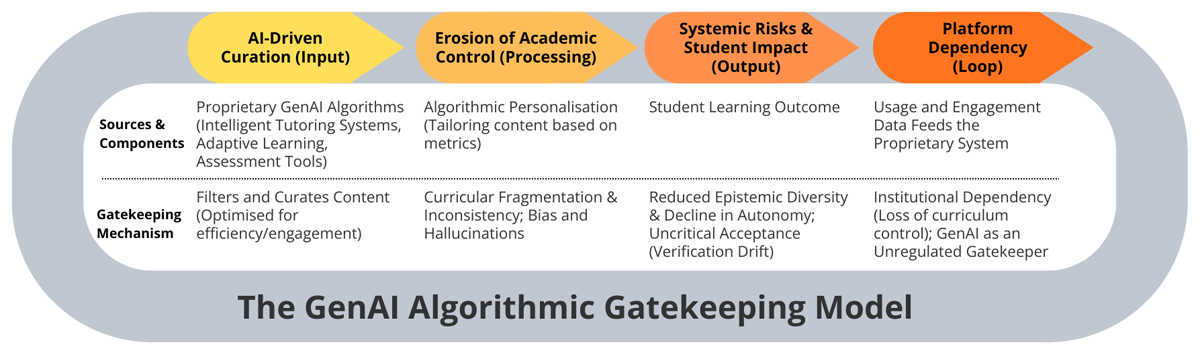
Figure 1
The GenAI Algorithmic Gatekeeping Model.
These challenges necessitate a broader discussion on the implications of GenAI for equity, quality, and consistency in higher education. While AI presents opportunities for personalisation, its unchecked influence may exacerbate disparities in learning experiences and compromise academic standards. Thus, the following section critically examines how universities can balance AI-driven innovation with pedagogical oversight, ensuring that AI serves as a facilitator of education rather than an unregulated gatekeeper of knowledge.
Discussion
The integration of GenAI in higher education presents both opportunities and challenges, particularly regarding content control, standardisation, and academic autonomy. AI-powered tools enhance personalisation, automated assessment, and student support, but also shape knowledge in ways that may impact diversity of thought and educational coherence. This section explores how GenAI’s gatekeeping role impacts epistemic diversity, pedagogical integrity, and institutional autonomy, highlighting the need for governance frameworks.
Conceptually, the synthesis presented in this study positions generative AI not merely as a technological tool but as a structuring force within higher education. By integrating cross-domain evidence, the analysis demonstrates how AI-mediated systems can reconfigure established dynamics of educational governance, influencing authority, access to knowledge, and epistemic diversity. These dynamics become particularly visible when examining how generative AI is operationalised in institutional contexts. The following sections therefore analyse how the gatekeeping function materialises in practice, shaping both opportunities for personalisation and risks of fragmentation or excessive standardisation.
AI as an educational gatekeeper
AI-driven platforms now influence how content is prioritised, structured, and presented, similar to media gatekeeping, where control shifted from human editors to algorithmic recommendations (Shoemaker & Vos, 2009). This raises concerns about bias and misinformation, as AI-generated content reflects training data that may reinforce dominant narratives while marginalising alternative perspectives (Lo, 2023). The issue of AI hallucinations, where models generate misleading or false information, further challenges academic integrity (Loos et al., 2023). Another challenge is AI decision-making opacity. Educators and institutions often lack insight into how AI-generated materials are selected and refined, raising concerns about pedagogical oversight and accountability. Alqahtani and Wafula (2025) emphasise that the absence of institutional frameworks leaves decisions about AI use to individual actors, resulting in fragmented practices and a lack of systemic guidance. Universities therefore need to ensure AI-driven content aligns with academic standards.
Personalisation vs. pedagogical coherence
While GenAI enables highly personalised learning, it also fragments educational experiences. Adaptive learning platforms adjust content dynamically based on individual performance (Li et al., 2024), but this flexibility can undermine curricular coherence by creating disparate learning pathways (Tong et al., 2024).
Standardised curricula ensure that students receive a common knowledge base, facilitating collaborative learning and disciplinary coherence. In contrast, unregulated AI personalisation may lead to inconsistent explanations of fundamental concepts, reinforcing learning gaps (Laak & Aru, 2024). As Sullivan et al. (2023) observe, in the absence of coherent institutional policies, staff and students interpret the role of GenAI inconsistently. This results in fragmented learning practices, with some employing AI tools for surface-level task completion and others using them to support conceptual understanding, thereby producing uneven academic experiences. A hybrid approach, where AI personalisation is complemented by educator oversight, can balance adaptability with curricular coherence.
The challenges surrounding personalisation and coherence echo broader European reflections on institutional preparedness. The EADTU (2025) report underscores that effective personalisation relies on coordinated governance rather than isolated technological adoption. It emphasises that personalised learning must operate within shared academic frameworks that preserve coherence, inclusivity, and transparency. This aligns with the Human–AI Gatekeeping Model proposed in this paper, where institutional oversight ensures that adaptive systems serve pedagogical integrity rather than algorithmic optimisation. By embedding personalisation within systemic governance, institutions can prevent the drift towards fragmented learning experiences and sustain both innovation and standardisation in AI-mediated education.
Institutional dependency and academic autonomy
The increasing reliance on corporate AI tools raises concerns not only about academic autonomy and digital sovereignty, but also about the redistribution of gatekeeping authority within higher education. When universities integrate proprietary AI systems, they may cede aspects of control over content generation, assessment design, and feedback processes to external platforms (Laak & Aru, 2024). These systems often operate as closed ecosystems, where algorithmic decision-making structures curriculum pathways, evaluative criteria, and pedagogical mediation (Barbosa & Gonsales, 2024). In such contexts, gatekeeping functions—traditionally exercised by academic staff and institutional governance structures—risk becoming partially embedded within opaque, vendor-controlled infrastructures. This dependency can constrain universities’ capacity to customise AI-mediated learning environments and heighten concerns related to data governance, privacy, and institutional oversight.
If GenAI systems increasingly participate in knowledge curation and evaluative processes, safeguarding academic autonomy requires that institutions retain meaningful supervisory authority over these gatekeeping mechanisms. Universities should therefore prioritise AI models that allow educator oversight, transparency, and modification. Investment in open-source or customisable solutions, alongside robust compliance with data protection regulations, can help mitigate corporate dependency while preserving institutional control over how knowledge is generated, filtered, and assessed.
Governing GenAI as an educational gatekeeper: Balancing innovation and integrity
If GenAI functions as an emergent gatekeeper within higher education, institutional governance must determine how this gatekeeping role is structured, supervised, and constrained. The challenge is not to halt innovation, but to ensure that algorithmic mediation of knowledge remains aligned with academic standards, institutional autonomy, and epistemic diversity. The following strategies aim to recalibrate and distribute gatekeeping authority between algorithmic systems and human actors.
Human-AI collaboration—Educators should review AI-generated content for accuracy and bias (Dickey & Bejarano, 2024). This collaboration is best implemented through hybrid (Human–AI) assessment models, which combine algorithmic detection with essential faculty monitoring and professional judgement to improve the accuracy of assessment outcomes and refine academic standards (Kangwa et al., 2025). Furthermore, incorporating AI as a supplementary tool for specific tasks, such as assisting with code debugging, has been shown to improve problem-solving and quality of work (Arum et al., 2025). Leveraging GenAI for these efficiency gains enables educators to concentrate their time and effort on direct student interaction and qualitative review, thus enhancing the overall quality of instruction.
Transparency and accountability—Institutions must develop clear policies on AI deployment, bias audits, explainability, and ethical AI usage (Tessarolo et al., 2024). A key step in this process involves establishing interdisciplinary GenAI Ethics Committees to ensure comprehensive and adaptable governance models that align with integrity standards and rapid technological change (Kangwa et al., 2025). Furthermore, institutional policies must evolve from initial prohibition towards a consensus on ‘responsible use’, moving away from vague or reactive measures (Erhardt et al., 2025; Wilson, 2025). Structured governance models have demonstrated higher faculty engagement and better monitoring of GenAI-assisted learning, underscoring the necessity for policies that are transparent, adaptable, and responsive to discipline-specific needs (Kangwa et al., 2025).
AI Literacy for students and educators—Students must be trained to critically evaluate AI-generated content, fostering independent analytical skills (Abdelghani et al., 2023). This capacity building is critical. Specifically, training in prompt engineering skills has been shown to lead to significantly better learning outcomes by equipping students to effectively query the LLM for relevant and accurate information (Wang et al., 2024). Students should also be encouraged to actively critique, refine, or question algorithmic outputs in assignments, which promotes self-regulation and intellectual accountability over passive acceptance (Kangwa et al., 2025). Moreover, LLMs have the potential to act as an ‘equaliser’, offering bespoke assistance to simplify complex language and improve writing clarity for students, particularly non-native speakers (Liu et al., 2024).
Investment in Open AI systems—Universities should explore customisable, open-source AI tools that prioritise pedagogical transparency and institutional autonomy (Van Dalen, 2023). This is essential to mitigate the risks associated with opaque, proprietary systems. Institutions should actively seek AI solutions that are transparent and allow for educator supervision and modification (Barbosa & Gonsales, 2024). To achieve this goal, fostering collaboration between developers and educators is necessary to ensure that AI tools are designed with functionalities that meet specific academic and pedagogical standards, rather than merely being optimised for efficiency or engagement (Kangwa et al., 2025).
The integration of these four strategies—collaboration, literacy, transparency, and institutional investment—constitutes a governance framework designed to supervise and recalibrate algorithmic gatekeeping within higher education. Whereas Figure 1 illustrates the potential for a self-reinforcing algorithmic gatekeeping loop under conditions of opacity and dependency, Figure 2 presents the Human–AI Gatekeeping Model as a structured institutional response to that risk dynamic. By redistributing authority between algorithmic systems and human actors, this model seeks to mitigate the consolidation of opaque control while preserving the pedagogical opportunities afforded by GenAI (see Figure 2).
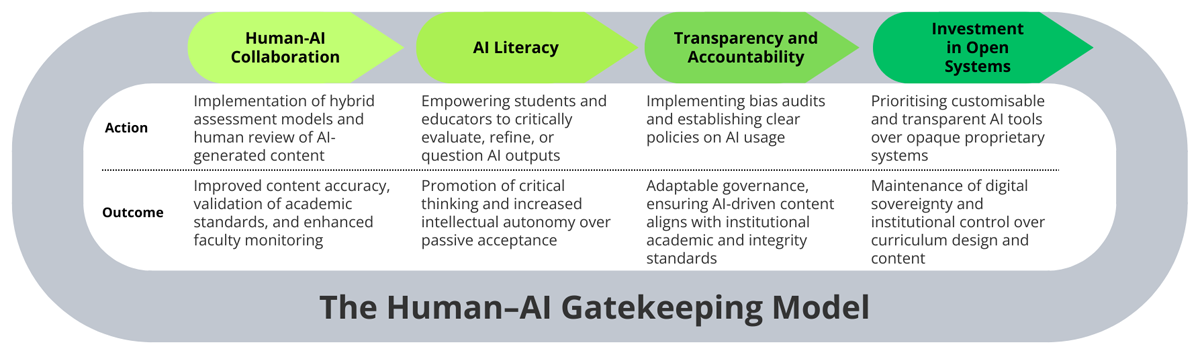
Figure 2
The Human–AI Gatekeeping Model.
Conclusion and future directions
This paper has critically examined the rapid emergence of generative AI (GenAI) in higher education, highlighting its pedagogical affordances, institutional challenges, epistemic risks, and implications for educational authority. By applying gatekeeping theory, we have argued that GenAI functions not only as a tool for efficiency but also as an algorithmic gatekeeper that shapes access to knowledge, reconfigures authority, and raises pressing questions about transparency, accountability, and epistemic diversity.
The first research question examined how gatekeeping theory can be adapted to analyse the role of Generative AI in shaping access to knowledge and authority in higher education. The analysis shows that gatekeeping can no longer be understood solely as human editorial selection but must also account for algorithmic mediation embedded within pedagogical and institutional processes. By influencing what knowledge becomes visible, how it is sequenced, and which interpretations are prioritised, GenAI functions as a structural educational gatekeeper that redistributes elements of academic authority across educators, institutions, and proprietary systems. In this way, gatekeeping theory provides a conceptual lens for understanding how AI-mediated systems reshape knowledge governance in contemporary higher education.
The second research question examined how GenAI’s algorithmic mediation influences pedagogical affordances, standardisation, and the balance between personalisation and coherence in higher education. The analysis indicates that while AI-driven systems expand adaptive feedback, content generation, and learning pathways, they also restructure how knowledge is sequenced and prioritised, potentially fragmenting curricula and weakening shared academic reference points. Personalisation, when driven primarily by optimisation logics, may produce uneven conceptual coverage and divergent learning trajectories. Maintaining coherence therefore requires deliberate institutional alignment and human oversight, ensuring that adaptive affordances operate within collectively defined academic standards and pedagogical frameworks.
Finally, the third research question examined how institutional governance frameworks and human–AI collaboration models can ensure transparency, equity, and epistemic diversity in AI-mediated education. The analysis suggests that as GenAI assumes co-gatekeeping functions within content generation, assessment, and feedback, institutional actors must retain supervisory authority over algorithmic mediation. Governance mechanisms grounded in transparency, policy alignment, bias auditing, and shared accountability are essential to prevent the consolidation of opaque algorithmic control. The Human–AI Gatekeeping Model proposed in this study positions educators and institutions as supervisory co-gatekeepers, ensuring that algorithmic systems operate within ethical, pedagogical, and equity-oriented parameters rather than purely optimisation-driven logics.
Taken together, these findings highlight the need for coherent theoretical and governance frameworks to guide the responsible integration of GenAI in higher education. Institutional responses remain uneven, with policy development lagging behind practice and ethical mechanisms for accountability still emerging. Building on these insights, we propose a forward-looking research agenda that addresses critical gaps in the literature. Future studies should:
Investigate how GenAI reshapes pedagogy and student agency, particularly in relation to creativity, authorship, and critical thinking.
Examine institutional governance models across diverse contexts to identify effective strategies for balancing innovation with integrity.
Explore the epistemic consequences of GenAI adoption, including its impact on disciplinary diversity, bias, and coherence.
Analyse the reconfiguration of educational authority as algorithmic systems increasingly act as co-gatekeepers of knowledge.
Develop ethical and legal frameworks that clarify human responsibility in AI-mediated assessment and authorship.
Assess the socio-emotional drivers of GenAI adoption and their implications for long-term learning behaviours.
Address global equity concerns by comparing adoption patterns across resource-rich and resource-constrained higher education systems.
By articulating these research questions and propositions, this paper contributes to an emerging scholarly conversation that moves beyond descriptive accounts of GenAI adoption toward a more critical, theory-driven understanding of its implications. In doing so, it provides a foundation for future empirical and conceptual work that can guide higher education institutions in navigating the opportunities and risks of AI-mediated learning.