
Table 1
Exemplary operationalization from competence field definition to learning outcomes and action scenarios.
| Competence Field: Activity and Implementation Competence (Ehlers et al., 2024b, p. 28) | |
| Learning Outcome (Level: Knowledge & Understanding): The learner can explain fundamental concepts of artificial intelligence (AI), including key terms, technologies, and ethical issues, and clearly convey their relevance for both professional and personal contexts. The learner recognizes the need for continuous personal development in the field of AI in order to meet growing future demands. | |
| Action Scenario nr. 1 | Action Scenario nr. 2 |
| Imagine you are sitting with friends who are discussing AI. One person turns to you and asks, ‘What exactly is AI, where do we encounter it in everyday life, and why is it important to understand the basics?’ How confident do you feel in naming and explaining basic AI concepts (e.g., machine learning, speech recognition) in your own words? | In a team meeting discussing how AI can be more strongly integrated into your work processes, a colleague turns to you and asks, ‘Which fundamental concepts—such as machine learning and natural language processing—should we understand in order to use AI effectively?’ Later in the discussion, someone adds: ‘How can we systematically expand our knowledge to meet future requirements?’ How confident do you feel in actively contributing to this discussion and sharing your ideas? |
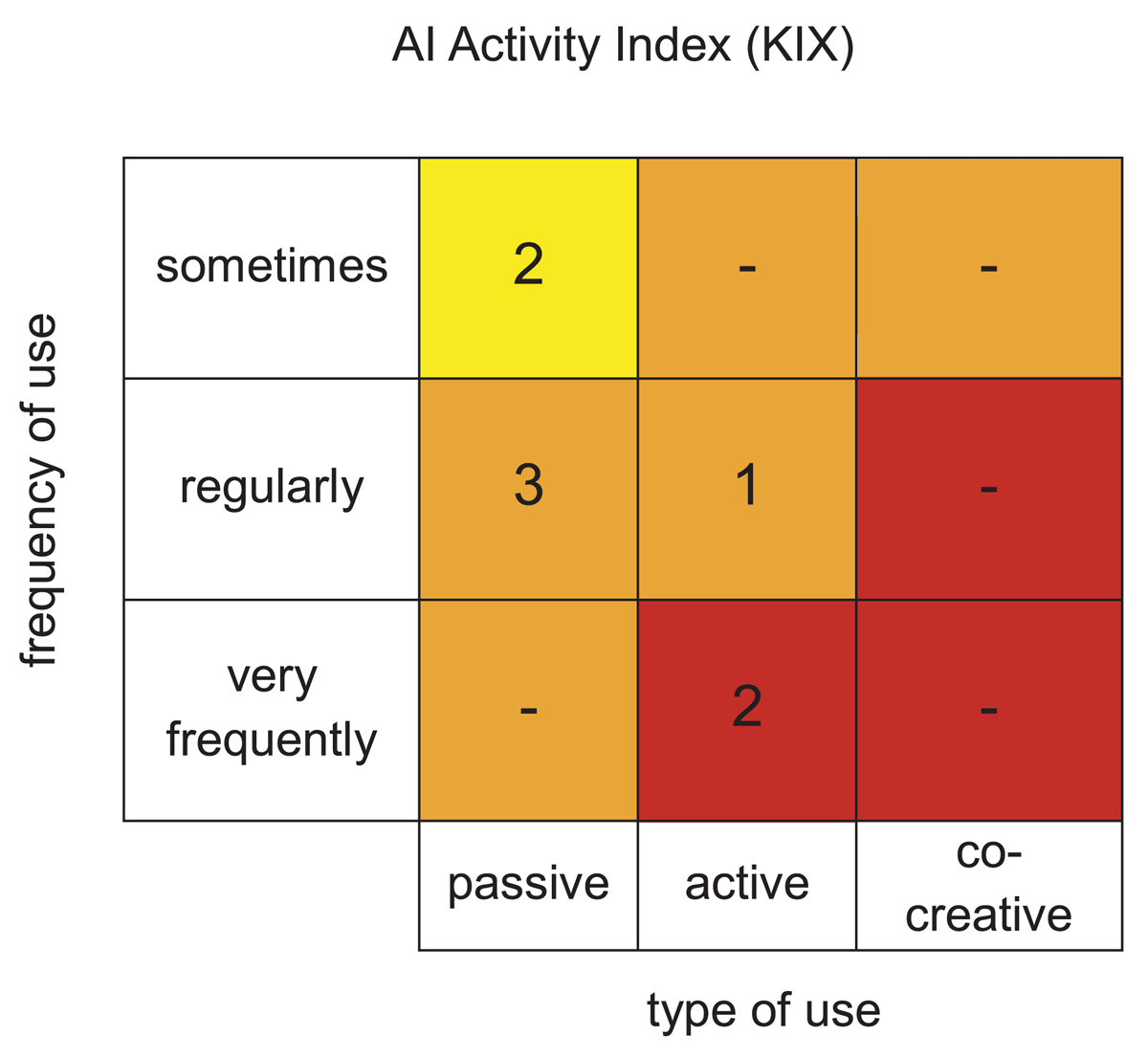
Figure 1
AI Activity Index (KIX): Classification of usage types and frequencies (n = 8). The matrix displays the number of participants across combinations of AI usage frequency (sometimes, regularly, very frequently) and type of use (passive, active, co-creative). The KIX combines these dimensions to approximate practical experience with AI.
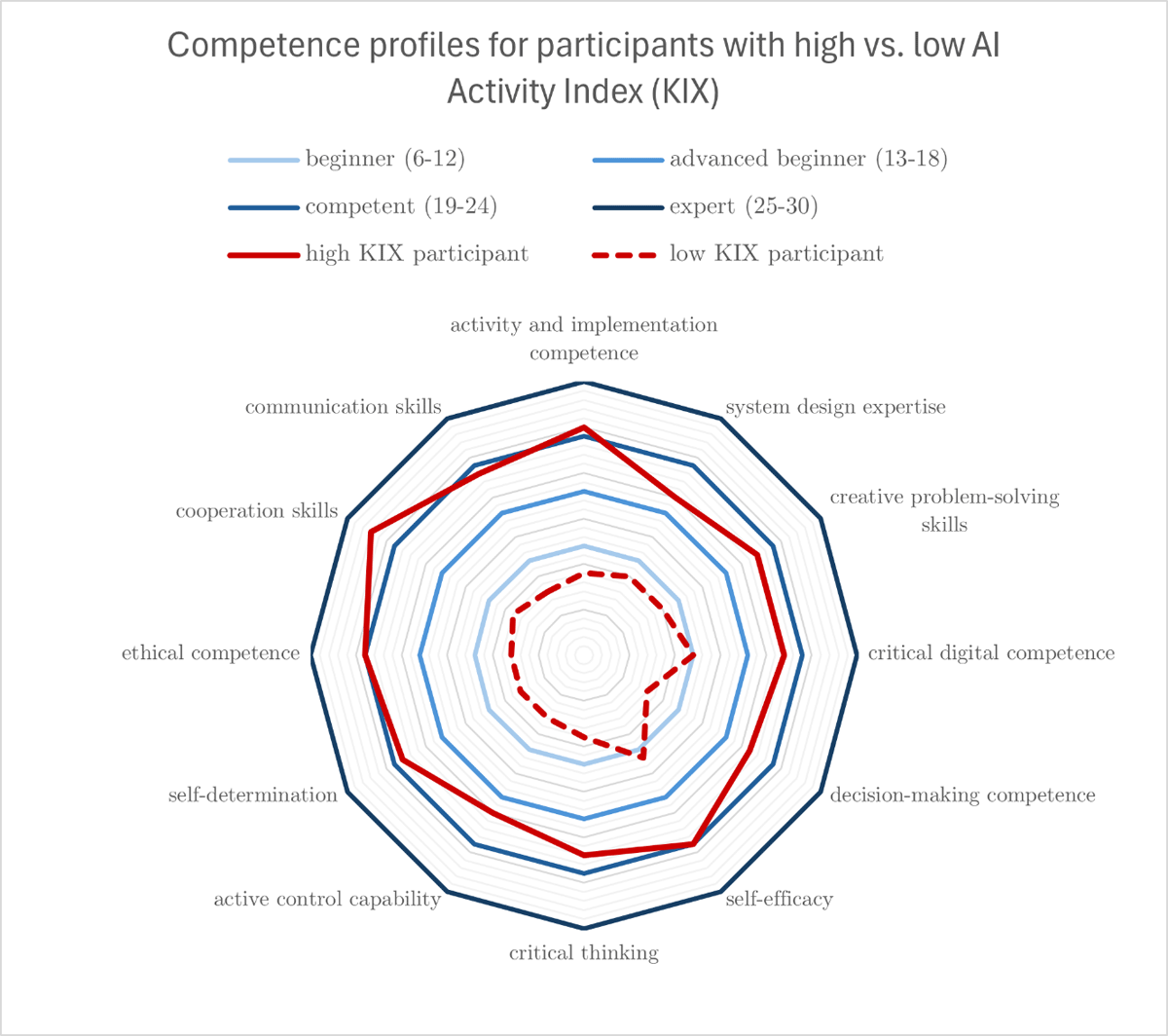
Figure 2
Competence profiles of participants with high vs. low AI Activity Index (KIX). The radar chart displays competence scores across twelve AIComp fields based on scenario-based self-assessment (range: 6–30 points, AICompAss). The solid red line represents a participant with a high KIX, while the dashed red line represents a participant with a low KIX. Reference lines indicate proficiency levels: Beginner (6–12), Advanced Beginner (13–18), Competent (19–24), and Expert (25–30).
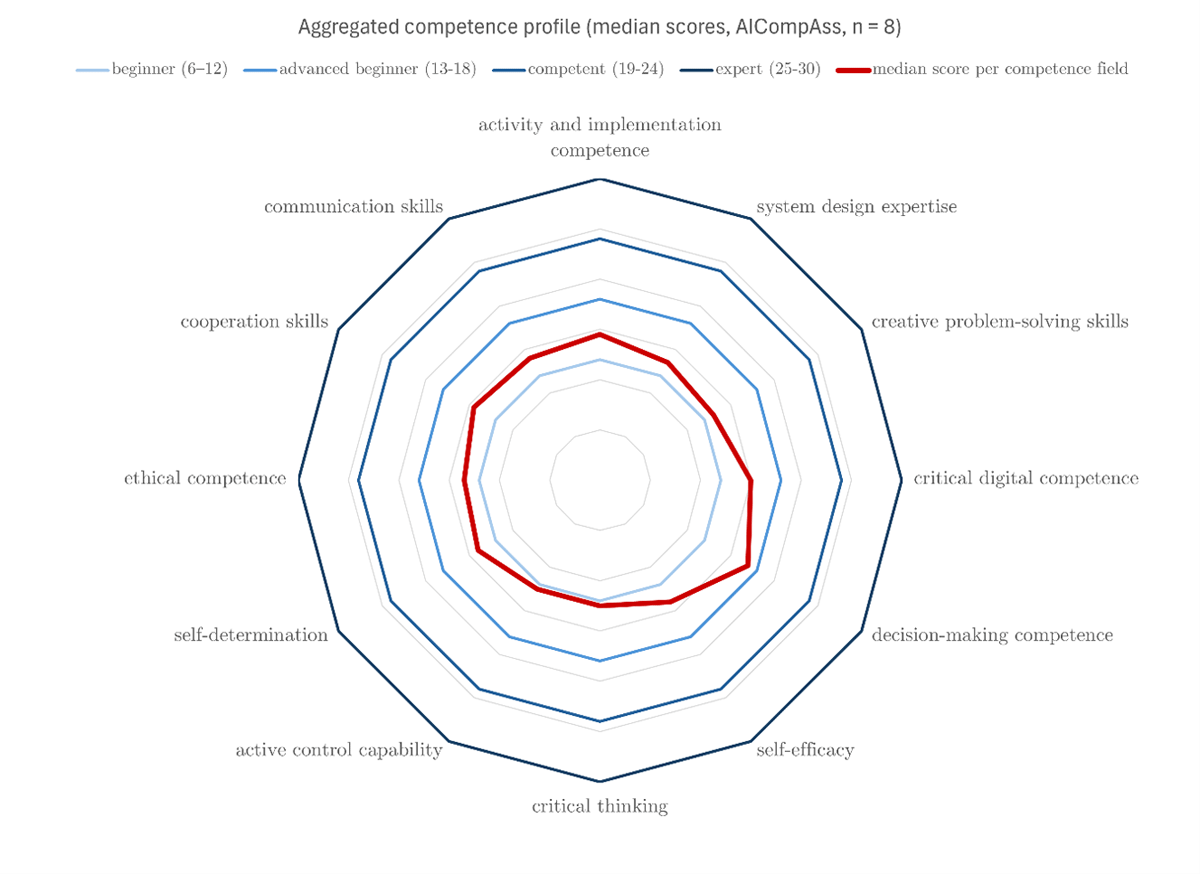
Figure 3
Aggregated competence profile (median scores, AICompAss, n = 8). The radar chart displays median scores per competence field based on scenario-based self-assessment (range: 6–30 points). Reference lines indicate proficiency levels: Beginner (6–12), Advanced Beginner (13–18), Competent (19–24), and Expert (25–30). The red line represents the median score across all participants.
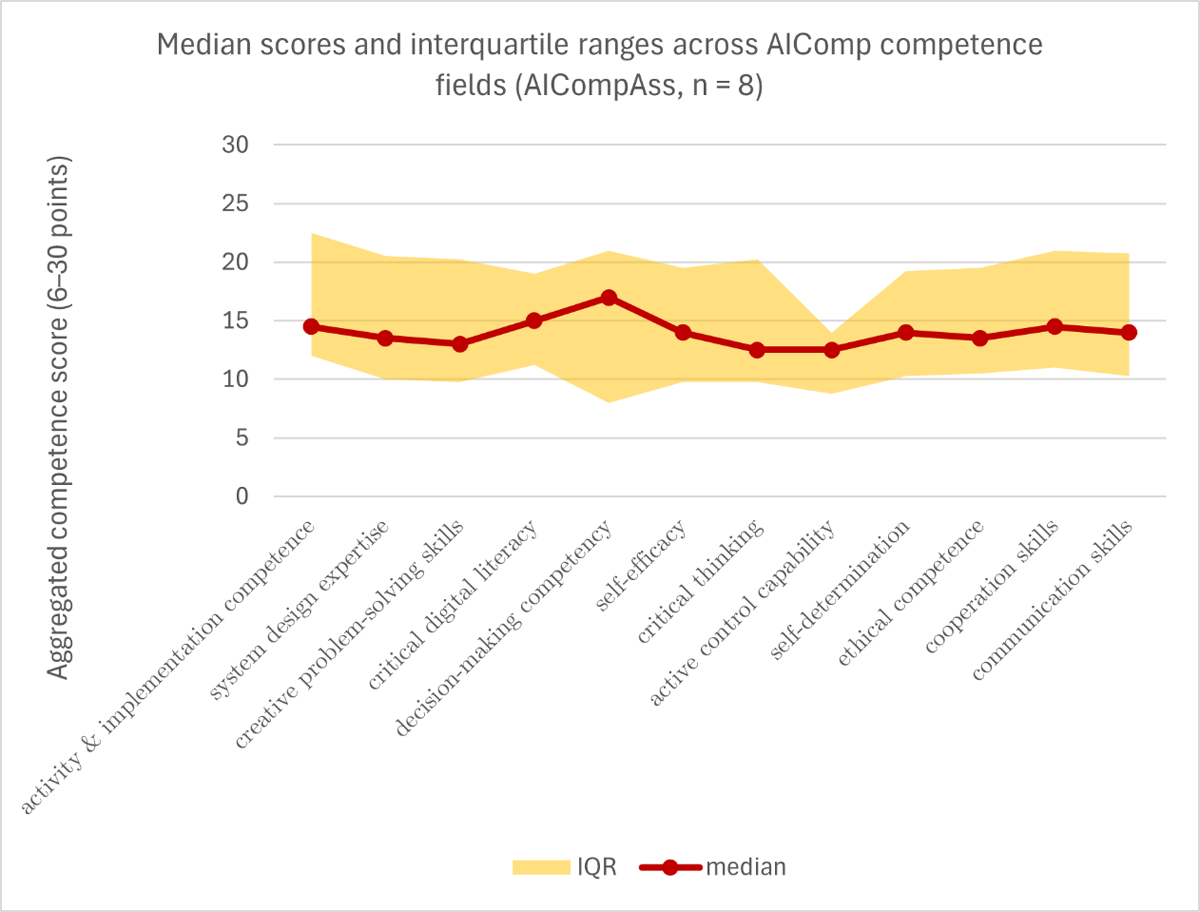
Figure 4
Median scores and interquartile ranges across AIComp competence fields (AICompAss, n = 8). The line chart displays median scores per competence field based on scenario-based self-assessment (range: 6–30 points). The shaded area represents the interquartile range (IQR), indicating the dispersion of scores within the sample.
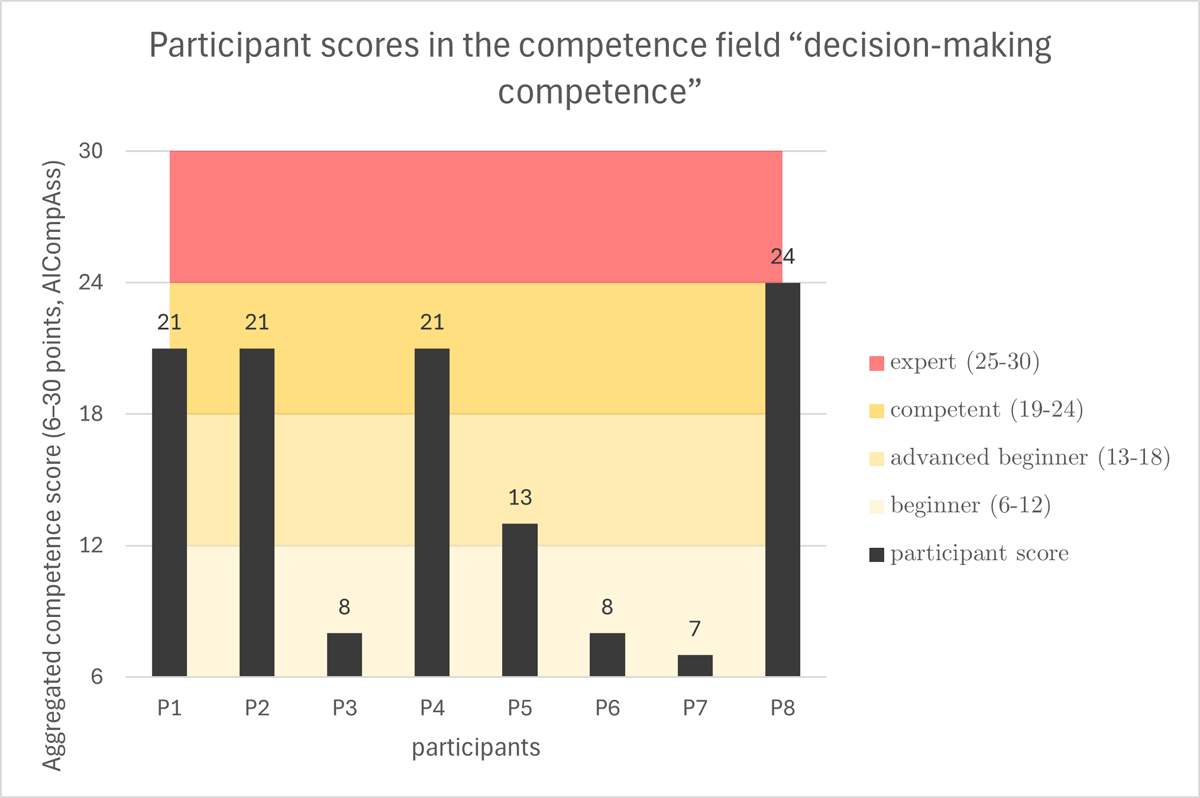
Figure 5
Participant scores in the competence field ‘decision-making competence’ (n = 8). The bar chart displays aggregated scores per participant based on six scenario-based items (range: 6–30 points, AICompAss). Colored background areas represent proficiency levels: Beginner (6–12), Advanced Beginner (13–18), Competent (19–24), and Expert (25–30). Each bar corresponds to the total score of one participant.