
Introduction
Flipped Learning (FL) has emerged as a prominent pedagogical strategy in higher education, especially within STEM fields (Eppard & Rouchdi 2017; ElGamal 2022). By shifting content delivery outside the classroom and utilizing class time for active engagement, FL promotes deeper learning through technology integration (Bergmann & Sams 2012). Its growing relevance is evident in Open, Distance, and Digital Education (ODDE) research, as emphasized in a recent meta-review (Zawacki-Richter et al. 2024). The COVID-19 pandemic further accelerated the adoption of FL and digital teaching practices (AlJermawi et al. 2024).
Simultaneously, research into generative artificial intelligence (GenAI) in education is expanding, with a growing interest in how GenAI-powered tools enhance blended learning environments (Park & Do 2024). While early studies explore the role of GenAI in FL contexts (Zhen & Yahya 2024), substantial gaps remain—particularly a lack of holistic research that bridges FL and GenAI (AlKadi & Ali 2024; Liu 2019). This conceptual paper addresses that gap by applying the 3M framework—micro, meso, and macro—as a lens to understand and implement educational innovation across multiple levels (Zawacki-Richter 2009).
An umbrella review of systematic reviews on FL (ElGamal & Zawacki-Richter 2025) found a pronounced theoretical deficiency: only seven of 23 reviews employed any theoretical framework, and most relied on traditional models. Contemporary frameworks like connectivism, despite their relevance for digital learning, were rarely used. Connectivism, though debated as a full theory (Kop & Hill 2008; Turner 2014), emphasizes knowledge construction through networks, making it especially suited to understanding learning in connected, digital environments. This highlights the need for a stronger theoretical grounding in FL research and practice.
Existing FL research often centers on pre- and post-class activities while underemphasizing in-class dynamics. Integrating AI into classroom instruction could bridge the online-offline divide, enhancing continuity and engagement (Park & Doo 2024). To this end, this paper proposes the use of applied GenAI tools within classroom settings and recommends connectivism (Siemens 2005) as a guiding framework for conceptualizing flipped classrooms (Eppard & Rouchdi 2017; ElGamal 2022).
Building on this foundation, the paper offers a focused discussion on the opportunities and limitations of GenAI tools in FL. It targets educators and researchers seeking to integrate GenAI into flipped learning environments and introduces a novel framework to guide this integration. Specifically, it explores (1) the transformative role of GenAI chatbots in flipped education, (2) a tri-level model (micro, meso, macro) for optimizing FL, and (3) a roadmap for systemic, data-informed implementation of FL through GenAI. Before presenting the framework, the paper reviews the conceptual foundations, benefits, and persistent challenges of FL in higher education. It also examines how GenAI technologies can address these challenges and open new possibilities for reimagining the flipped classroom (FC).
Overview of Related Literature
Birgili et al. (2021) state that FL surpasses traditional teaching methods, marking a significant shift toward digital learning as the primary educational approach. As a subset of the broader field of ODDE, FL effectively integrates digital instructional tools, multimedia, and interpersonal communication to create immersive learning experiences.
Bergmann and Sams (2012) initially conceived the FC as an unconventional methodology. The FC redefines traditional educational frameworks by reversing the roles of in-class and at-home learning activities. The Flipped Learning Network (FLN) highlights four foundational pillars—F (Flexible), L (Learning Culture), I (Intentional Content), and P (Professional Educators)—which collectively form the FLIP acronym (2014).
Many researchers agree that the flipped classroom model (FCM) improves student performance and enhances the overall academic experience (Bergmann & Sams 2012; Lage et al. 2000; Ettien & Touré 2023). However, the overlapping use of terms such as ‘flipped learning,’ ‘flipped’ and ‘inverted’ classrooms, ‘flipped teaching,’ and ‘blended learning’ raises important questions about the pedagogical differences and methodological implementations associated with each approach (ElGamal 2022). Some FL definitions emphasize the use of online lectures as a pre-class preparation. In contrast, others suggest that it is a variation of the traditional blended learning model, which combines in-person and online educational modalities. Additionally, various studies (e.g., Lo 2022; Tse et al. 2017) have highlighted the effectiveness of video lectures, noting their benefits in terms of repeatability, accessibility, and customization for students.
Flipped classroom as a mode of blended learning
Alqarni (2018) classified blended learning models into three categories: low-impact (integrating online activities into traditional teaching), medium-impact (restructuring a course by substituting some face-to-face approaches with online features), and high-impact (developing blended learning materials aligned with the curriculum). The high-impact category facilitates the seamless integration of online and face-to-face learning, allowing instructors to maximize the benefits of blended teaching and effectively cater to students’ needs. On the other hand, Alqarni (2018) classified the FC method into two categories: traditional and holistic flipped classrooms. In the conventional type, students learn by watching lecture videos, having interactive sessions, and exploring challenging topics comprehensively (Asiksoy & Ozdamli 2016). The instructor then develops activities based on the material and provides face-to-face support.
To establish the flipped classroom as a significant type of blended learning, it is crucial to study the design of the learning process and environment. The design plays a vital role in evaluating instructional effectiveness, including the FC approach, while emphasizing the theoretical and practical underpinnings of student-centered and active learning (Ng & Lam 2022). The holistic flipped classroom approach considers every learning activity a classroom affair, supported and monitored by the instructor (Asiksoy & Ozdamli 2016).
Therefore, optimizing the impact of the blended learning approach or its subsets, such as FL, involves revisiting the entire learning process—from curriculum structure to learning design—rather than merely outsourcing part of the teaching through videos. In Figure 1, the traditional flipped classroom practice norm remains in the medium-impact blended learning category, involving decisions about which parts of the course to flip and which not to flip. In contrast, the holistic flipped classroom emphasizes a high-impact category of blended learning, and advocating for this approach remains one of the aims of this paper.
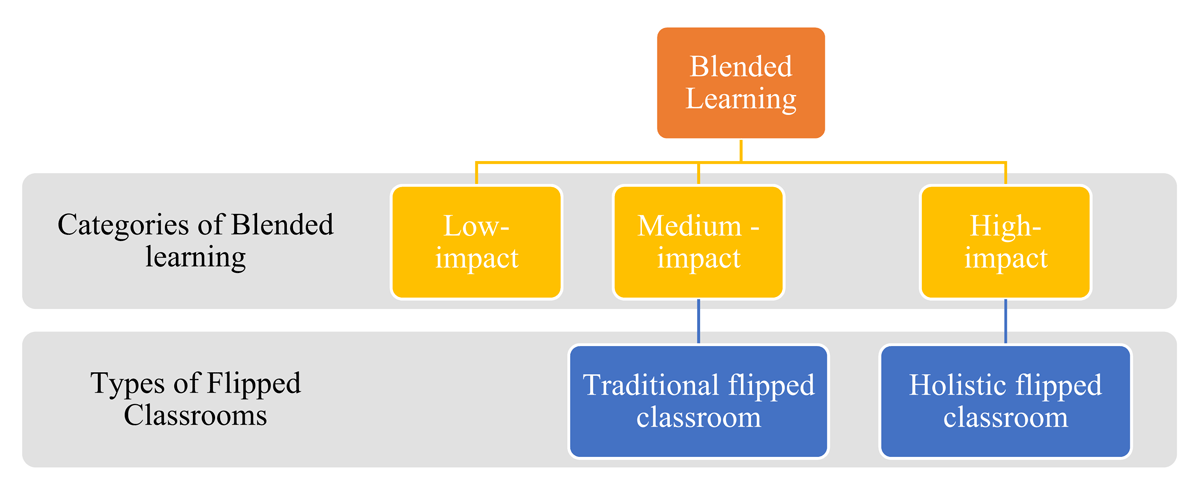
Figure 1
Flipped Classroom as a blended learning mode.
The benefits of the flipped approach
The FCM enhances learning by focusing on student-driven activities and personalized support (Bergmann & Sams 2012). As enrollment in higher education rises, reforming traditional teaching methods becomes essential. This model fosters higher-order thinking, communication, and self-directed learning (Bishop & Verleger 2013; Bergmann & Sams 2012). Effective implementation requires students to collaborate and actively build knowledge, leading to deeper insights. The FC is now a vital teaching approach that has a positive impact on educational experiences (Bishop & Verleger 2013). In a qualitative discussion with expert professors using the FC method in their classes over multiple years, an account of the most important benefits have been compiled (See Table 1; ElGamal, 2024).
Table 1
The Benefits of the flipped approach (adopted from ElGamal 2024).
| BENEFITS AND ADVANTAGES | |
|---|---|
| IN LEARNING | IN TEACHING |
|
|
The opportunities of GenAI for flipped learning
AI has the potential to transform education, making the role of educators and institutions essential in guiding its responsible development. Systematic reviews, such as the one by Zawacki-Richter et al. (2019), identify key AI applications in education, which include personalized learning, automated assessment, predictive analytics, and intelligent tutoring. These applications align with the Framework for Learning Models (FLM) by promoting personalized and engaging learning experiences.
Xu and Ouyang (2022) further highlight AI’s diverse roles: it can serve as a subject of study, a direct learning tool, and an assistant for both students and educators. This multifaceted approach enhances interaction between students and teachers, facilitates peer collaboration, and empowers self-directed learning. In doing so, it effectively addresses key challenges faced in blended learning environments.
GenAI is a subset of AI that creates content in various modalities and media and has the potential to revolutionize education. Models like Generative Adversarial Networks (GANs), Variational Autoencoders (VAEs), and Transformers, including Generative Pre-trained Transformers (GPT) and Gemini, power this advancement (Alshahrani 2023). The integration of transformer-based models, including Generative Pre-trained Transformers (GPT) and submissions from Gemini, has contributed significantly to the current enthusiasm surrounding GenAI. These models use machine learning to respond to queries and generate images, text, and videos. Moreover, the combination of machine learning, natural language processing, and chatbot technologies has the potential to significantly enhance various aspects of education, including content delivery, assessment, and feedback (Alshahrani 2023). These models enable personalized learning, automated content generation, and data-driven insights. By tailoring assignments to individual needs, analyzing student performance, and automating tasks, GenAI enhances both teaching and learning experiences (Sengar et al. 2024).
The increasing interest in research on GenAI in education has led to several systematic literature reviews. Notable analyses by Sengar et al. (2024) and Ipek et al. (2023) have highlighted the perceptions of AI-powered chatbots among educators and learners in educational settings, particularly in blended learning environments. A consistent trend has emerged: learners are enthusiastic about using these tools, while educators tend to be more cautious and skeptical.
Recent investigations (Lin & Mubarok 2021; Al-Kaisi et al. 2021) into the use of GenAI within FL frameworks have provided policymakers and educational professionals with valuable insights. These insights focus on benefits such as resource optimization and enhanced educational accessibility in blended learning settings. Current research is shifting from merely assessing the effectiveness of FL compared to traditional teaching methods (ElGamal 2022) to exploring innovative strategies and technologies that enhance foreign language learning. This shift opens up new and impactful research opportunities.
GenAI can potentially enhance FL by providing personalized support, automating tasks, and fostering student-educator interactions. It can integrate intelligent tutoring, data analysis, content recommendations, and virtual assistance, thereby transforming student engagement and creating inclusivity (Chiu 2024; Alshahrani 2023). Tools like ChatGPT improve personalized learning and motivation in larger classes, offering tailored solutions and instant responses that address low student interest and feedback delays (Li 2023; Lee et al. 2022).
A study by López-Villanueva et al. (2024) demonstrated that incorporating GenAI into flipped learning enhances student engagement, requiring instructors to adapt and acquire new skills. Ilieva et al. (2023) proposed a five-stage framework for integrating GenAI-driven chatbots in blended learning, tackling learner engagement and workload issues. Research by López-Villanueva and colleagues (2024) showed GenAI’s effectiveness in flipped learning by providing tailored resources and ongoing student support (Sengar et al. 2024). Alshahrani (2023) identified strategies for implementing GenAI that enhance accessibility and educational equity, emphasizing the importance of careful integration and teacher training. Sánchez-Ruiz et al. (2023) highlighted ChatGPT’s role as a supplementary tool in engineering education.
Finally, Park and Doo (2024) called for research to consider emotional responses and motivation alongside learning outcomes. In summary, GenAI has the potential to enhance social interaction, support learning, and foster emotional aspects in blended and flipped learning environments.
Conceptual Research Methodology
This essay adopts a conceptual research design, consistent with best contemporary practices in non-empirical scholarship that emphasize theoretical integration, methodological transparency, and clarity of contribution (Jaakkola 2020; Gilson & Goldberg 2015). Conceptual articles play a critical role in advancing educational research by synthesizing existing insights, reframing challenges, and developing new theoretical frameworks.
Research questions
How can the strategic integration of GenAI tools optimize the implementation and effectiveness of FL at the meso (institutional support) and micro (individual learning) levels in higher education?
How can a connectivist-informed framework integrating GenAI optimize in-class activities within flipped learning pedagogy to foster deeper learning and collaborative knowledge construction in higher education?
Conceptual research design
Following Jaakkola’s (2020) typology, this study adopts the model approach, which seeks to build a conceptual framework that clarifies relationships between constructs and develops propositions for future exploration. The conceptual framework that will be introduced in the coming section is thus not merely descriptive but explanatory, positioning FL as a multi-level ecosystem reshaped by GenAI.
Literature identification and synthesis
The framework is grounded in an umbrella review of FL in higher education (ElGamal & Zawacki-Richter, 2025), which categorizes barriers into student-related, faculty-related, and operational domains guided by Betihavas et al. (2016). The systematic reviews included in this umbrella review were published between 2018 and 2022 and sourced from three major international databases—Web of Science, Education Source, and Scopus. Each review was a peer-reviewed scholarly journal article, published in English, with FL as its primary focus, and within the defined time span, which constituted the unit of analysis. This foundation was further enriched with additional literature selected specifically for its conceptual and theoretical relevance, in line with best practices for conceptual research (Gilson & Goldberg 2015).
Model-building process
The analysis proceeded in three iterative stages (Jaakkola, 2020):
Deconstruction – identifying key constructs and themes from umbrella and complementary studies.
Integration – organizing these constructs through the dual lens of connectivist theory and GenAI affordances at the micro, meso, and macro levels.
Framework Construction – synthesizing the findings into a systemic conceptual framework or model that illustrates the dynamic interplay of learners, faculty, institutions, and theoretical paradigms in a GenAI-augmented flipped learning environment.
The GenAI-Enabled FL Ecosystem: A Holistic Framework to Inherent Challenges
The widespread adoption of FL necessitates attention to the obstacles that impede its effectiveness. These challenges broadly fall into three interconnected categories (Betihavas et al. 2016). This essay will first dissect these key challenges before advocating for a holistic, systemic approach to flipped learning. It will then introduce a GenAI-enabled FL conceptual framework as an innovative, holistic model that harnesses the power of GenAI tools to address these inherent difficulties and unlock the full transformative potential of the flipped learning ecosystem.
The FL challenges
An umbrella review of the literature underscores these complexities, categorizing them into student-related, faculty-related, and operational challenges that demand careful consideration and strategic solutions (ElGamal & Zawacki-Richter 2025, Forthcoming).
Student-related barriers
The flipped classroom model often places greater responsibility on students for their learning outside of formal instruction. This shift can manifest in several key challenges. Firstly, students frequently report an increased workload and a greater demand for preparation time compared to traditional lecture-based courses (Gerber & Eybers 2021; Baltacı 2022; Divjak et al. 2022). Secondly, the self-directed nature of pre-class learning can be particularly challenging for students who lack strong self-regulation skills or who are accustomed to more passive learning environments (Cevikbas & Kaiser 2022). This can lead to resistance towards engaging with at-home materials (Gerber & Eybers 2021) and a significant concern for educators: the failure to complete pre-class assignments. Finally, the need to dedicate specific time slots for out-of-class work can be a significant barrier for students juggling multiple commitments (Baltacı 2022), and the initial transition to this novel pedagogical approach can lead to a sense of disorientation.
Faculty-related burdens
The implementation of flipped learning also presents a unique set of demands on educators. Perhaps the most significant is the increased workload associated with designing and developing effective flipped learning experiences (Lo & Hew 2022). This includes the time-intensive process of lesson planning and the creation or adaptation of engaging pre-class materials such as videos, readings, and interactive exercises (Cevikbas & Kaiser 2022). The multifaceted nature of this preparation, encompassing the design of both asynchronous and synchronous activities, the curation of diverse resources, and the anticipated increase in student inquiries, represents a considerable time investment (Divjak et al. 2022). Furthermore, the perceived lack of direct control over students’ initial learning and the substantial need for ongoing resource development can add to the pressures faced by faculty (Baltacı 2022). A critical factor for successful implementation is faculty competence and preparedness for this pedagogical shift. Even experienced instructors may lack the necessary instructional or technical skills required to produce effective video lectures and manage online learning environments (Gerber & Eybers 2021), and insufficient training can lead to frustrating technical difficulties (Ekici 2021). Finally, some educators may experience resistance to the fundamental role change required in flipped learning, moving from the traditional ‘sage on the stage’ to a facilitator of learning (Koh 2019).
Operational and infrastructural limitations
Beyond the challenges faced by individuals, the successful adoption of flipped learning is also contingent upon the operational and infrastructural support within educational institutions. Technical and infrastructural limitations can pose significant barriers (Baltacı 2022). Inadequate resources, limited internet access, and insufficient technical support can impede both teachers’ ability to deliver online materials and students’ ability to access them (Lo & Hew 2022; Arslan 2020). The digital divide—characterized by disparities in students’ technological access and skills—exacerbates these issues, highlighting the critical need for equitable access to technology and support. Moreover, a lack of institutional support for enhancing the technical competencies of both educators and learners can hinder widespread and practical implementation (ElGamal 2024). While the inherent flexibility of blended learning approaches like the FC is a strength, establishing a sustainable and effective system often requires a significant adjustment period and dedicated institutional commitment.
The proposed conceptual framework
Given the intricate challenges in implementing FL, a comprehensive, systemic approach is essential (Wang et al. 2015). This conceptual framework introduces the GenAI-Enabled Flipped Framework (GEFF), which extends existing theoretical models by integrating the transformative capabilities of GenAI. GenAI-Enabled Flipped Framework positions FL not as an isolated pedagogical method but as an integral component of a dynamic learning ecosystem—a complex network of learners, educators, content, and technology that co-evolves to maximize educational impact (Dillenbourg & Jermann 2010; Giannakos et al. 2016; Siemens 2005).
This framework defines a learning ecosystem as a diverse, collaborative, and dynamic network of stakeholders that provides greater access to a range of learning opportunities and supports learners in achieving positive academic and wellbeing outcomes (Dillenbourg & Jermann 2010). This systemic view is the foundation for GEFF, which is grounded in three key theoretical perspectives:
Learning Ecosystem Concept. The framework adopts a holistic view of education, recognizing that FL is not an isolated technique but part of a larger system of interactions and dependencies (Dillenbourg & Jermann 2010; Giannakos et al. 2016; Siemens 2005). GenAI-Enabled Flipped Framework (GEFF) builds upon Wang et al.’s (2015) Complex Adaptive Blended Learning Systems (CABLS) framework by explicitly including GenAI as a key component. Six interconnected subsystems are identified by CABLS: learner, teacher, institution, content, learning support, and technology. The dynamic and non-linear relationships among these elements, which are now influenced by GenAI, are recognized by GEFF.
Holistic Learning Drivers. GenAI-Enabled Flipped Framework (GEFF) aligns with the ‘Classroom 4.0’ vision, which is driven by engaging pedagogies like FCs and e-learning (Koul & Nayar 2020). It operationalizes this vision by embedding GenAI-driven personalization and adaptability into flipped practices. Existing frameworks lack explicit consideration of GenAI’s potential in optimizing FL (Park & Doo 2024), a gap that GEFF fills.
The Complex Adaptive Blended Learning Systems (CABLS) framework. Wang and colleagues’ (2015) Framework CABLS provided a pivotal contribution to our systemic understanding of blended learning. Its examination of six interconnected dimensions (learner, teacher, institution, content, learning support, and technology) effectively illuminated the dynamic and non-linear interactions within these environments. Nevertheless, despite its robust analysis of blended learning’s complexities, CABLS did not explicitly account for the transformative potential of emerging technologies, most notably GenAI, in optimizing flipped learning outcomes. Recognizing this gap, the framework presented in this paper builds upon the foundational work of CABLS, extending it a decade later to integrate the crucial role of GenAI.
Integration of learning theories
To ensure a robust theoretical grounding, GEFF draws on both established and contemporary learning theories, proposing a nuanced integration of two key theories: constructivism and connectivism.
(GenAI-Enabled Flipped Framework) GEFF is grounded in robust theoretical underpinnings to address the long-standing critique that research in ODDE has often been descriptive and lacking theoretical foundations (Perraton 2000; Zawacki-Richter & Bozkurt 2023). By integrating both established and contemporary learning theories, GEFF provides a holistic and future-oriented foundation for flipped learning.
At its core, GEFF draws on constructivism, emphasizing active, learner-centered engagement where knowledge is co-constructed through scaffolding, guidance, and social interaction (Vygotsky 1978; Bishop & Verleger 2013). Within flipped learning, the Zone of Proximal Development (ZPD) becomes central, highlighting the role of adaptive scaffolding, peer collaboration, and the presence of more knowledgeable others in supporting learners’ progression.
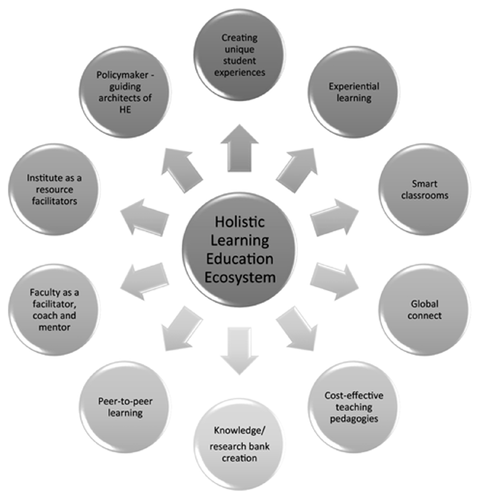
Figure 2
The Holistic Learning Educational Ecosystem Drivers from Koul & Nayar (2020, p. 102).
Complementing this, GEFF incorporates connectivism, a network-based theory that recognizes the transformative role of digital technologies in fostering diversity, autonomy, and interactivity (Siemens 2005; Downes 2010; Bates 2015). Connectivism views learning as a process of creating and navigating networks, with knowledge emerging from interactions, collaboration, and the exchange of perspectives within digital ecosystems (Kop & Hill 2008; Chien et al. 2019). It underscores the potential of technology and GenAI tools to expand opportunities for inclusive, adaptive, and interactive learning environments.
Rather than a linear transition between these theories, GEFF envisions a dynamic integration of constructivism and connectivism. While connectivist principles often inform the pre-class phase of flipped learning through self-directed exploration and digital interaction, constructivist approaches underpin the in-class phase, where collaboration and knowledge reconstruction occur (Chien et al. 2019). When mediated by GenAI, these phases converge, enabling a fluid interplay between individual exploration and collective knowledge-building.
This integration addresses key limitations of traditional FL, such as (and not limited to) students’ tendency toward isolated engagement (Lo 2022). By embedding scaffolding strategies and leveraging GenAI to foster collaboration, GEFF proposes a model that values diversity, autonomy, interactivity, and openness (Downes 2010), thereby offering a comprehensive theoretical grounding for flipped learning in the digital age.
The GEFF: Multi-level operation
GenAI-Enabled Flipped Framework (GEFF) is a modified and extended version of CABLS, structured around a 3M model (macro, meso, micro levels). The effectiveness of GEFF stems from its strategic integration of GenAI across three interconnected, dynamic levels (see Figure 3).
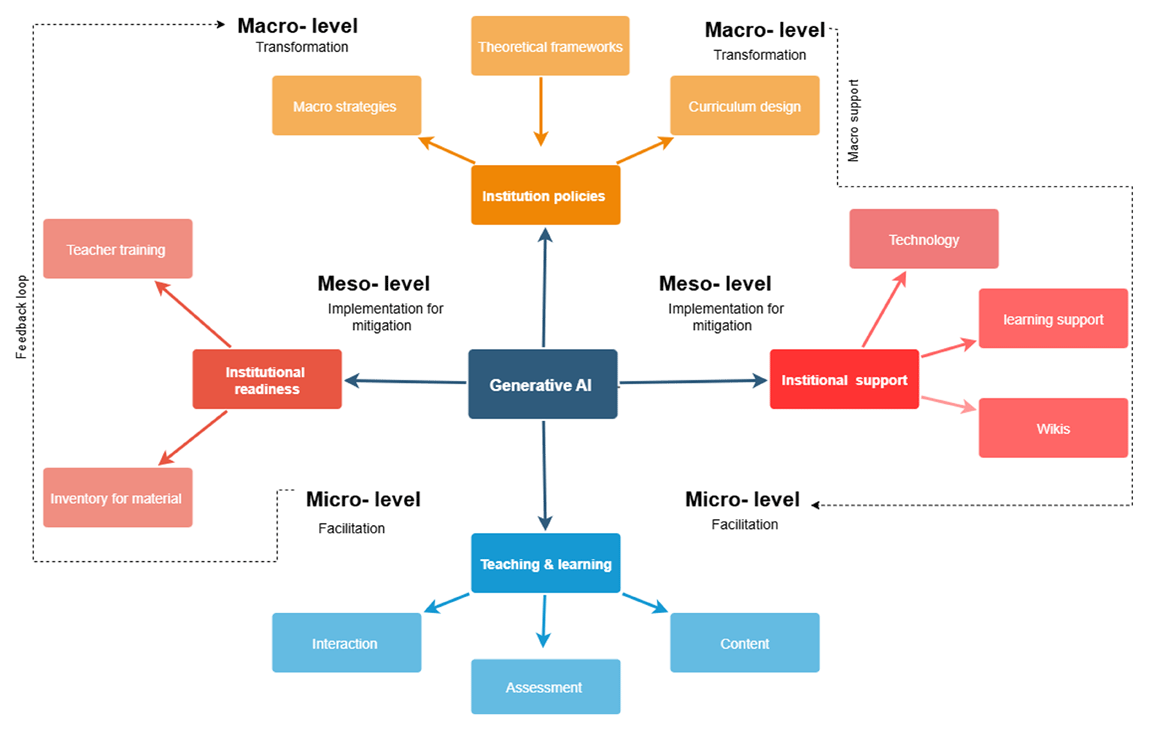
Figure 3
Visualizing the GEFF.
Specifically, the framework illustrates:
GenAI as a Mediator: GenAI mediates the relationship between the teacher and content by automating content generation and personalizing it for the learner.
Feedback Loops: The framework emphasizes continuous feedback loops, where GenAI provides dynamic, personalized feedback to the learner, which in turn informs the teacher and the institution.
Holistic System: The framework posits that changes to one component—particularly the introduction of GenAI—will have a cascading effect on the entire ecosystem, requiring a systemic approach to implementation.
This multi-level approach (see Figure 3) not only addresses the inherent challenges of the flipped learning model but also predicts the potential impacts at each level. For researchers, GEFF offers a comprehensive framework for examining the multifaceted dimensions of flipped learning, uncovering critical connections and pathways for investigation.
The GEFF: Interrelation and dynamics
The GEFF is not a static model but a complex, adaptive, and dynamic ecosystem where changes in one component ripple across the entire system. It operates across three interconnected levels:
Macro Level (Theoretical Advancement): The GEFF redefines FL within the broader context of learning ecosystems and GenAI-enabled knowledge networks.
Meso Level (Institutional Integration): The framework guides policy, faculty development, and infrastructure planning for the sustainable adoption of FL.
Micro Level (Classroom Practice): The GEFF enhances pre-class, in-class, and post-class phases through GenAI-driven personalization, collaboration, and adaptive feedback.
For researchers, GEFF provides a comprehensive framework for investigating the evolving complexities of FL. For practitioners, it offers a practical toolkit to address systemic challenges by strategically embedding GenAI to enhance engagement, optimize learning, and expand inclusivity.
Discussion and Implications
The conceptualization of GEFF directly addresses critical knowledge gaps in FL literature by clarifying the intricate linkages, drivers, and potential thresholds influencing its effectiveness (Kapur et al. 2022). This perspective bridges the divide between theoretical understanding and practical application, illuminating the model’s true impact and significance within specific contexts. Acknowledging the necessity for sustainable change, GEFF advocates for incremental yet strategic integration, aligning with Bozkurt’s (2022) call for adaptive and resilient educational strategies. Consequently, GEFF offers targeted ‘shelf remedies’ leveraging GenAI enablers to specifically alleviate the inherent challenges of flipped learning, rather than attempting a systemic overhaul of higher education. Ultimately, this focused framework enables institutions to implement meaningful, supportive changes within their flipped learning initiatives, making previously intractable challenges more manageable and paving the way for enhanced learning experiences. From the perspective of this paper, GEFF’s core components interact progressively and dynamically across the three levels. Together, the research questions frame the discussion across three levels:
Macro (theoretical/systemic) – advancing disciplinary understanding of flipped learning by situating it within connectivism and GenAI-enabled digital education
Meso (institutional) – addressing faculty support, infrastructure, and organizational adoption.
Micro (learning and teaching) – examining personalization, self-regulation, and scaffolding.
GEFF: Gen-AI enabled macro-level
At the macro level, the framework articulates the overarching theoretical principles that anchor the approach, drawing primarily on social constructivist and connectivist perspectives. These paradigms shape the institutional vision and inform the design of strategies and pedagogical models at the meso and micro levels, fostering a coherent, learner-centered, and digitally integrated educational ecosystem. However, the integration of GenAI at this level warrants both optimism and caution. GenAI presents a clear opportunity for large-scale curriculum redesign through the rapid creation and adaptation of learning materials tailored to diverse learner profiles, including those with accessibility and neurodiversity considerations (Qian 2025), but its transformative potential depends on the institution’s capacity to address ethical, epistemological, and quality-assurance concerns.
Similarly, the promise of leveraging AI-driven analytics to identify educational trends, forecast skill demands, and inform policy (Qian 2025) is tempered by the risks of over-reliance on algorithmic outputs, potential bias in training data, and the erosion of academic autonomy (Cefa et al. 2025). Furthermore, while strategic GenAI adoption can strengthen the alignment between institutional goals and pedagogical practice, fostering a sustained cultural transformation (Cefa et al. 2025), such an outcome (as claimed in GEFF) would require deliberate governance, robust faculty development, and a clear framework for responsible use. Without these safeguards, the macro-level adoption of GenAI risks amplifying inequities rather than promoting inclusive, future-ready higher education.
GEFF: Gen-AI enabled meso-level
At the meso level, institutions aiming to scale FL must go beyond isolated classroom innovations and focus on systemic integration. Here, implementation for mitigation becomes the strategic goal—specifically, reducing workload, time pressures, resource gaps, and instructional inefficiencies that hinder widespread FL adoption (see Table 2). This is made possible through three interdependent pillars within the GEFF framework: centralized support systems, inventory development, and training—each enhanced by GenAI tools.
Table 2
Overview of the FL Challenges compiled from (ElGamal & Zawacki-Richter 2025, Forthcoming).
| CHALLENGE | SUBCATEGORY |
|---|---|
| Student-related | Not completing pre-class tasks |
| Disorientation | |
| Resistance and lack of motivation | |
| Time consumption and workload | |
| Faculty-related | Effort and workload |
| Teacher’s preparation | |
| Resistance to role change | |
| Operational | Lack of institutional support Technical problems |
| Requiring adjustment time |
Also at the meso level, the framework focuses on the institutional and organizational capacities that bridge the macro-level pedagogical vision with micro-level learner engagement. This intermediary layer is critical for translating theoretical constructs into sustainable, scalable practices, particularly in the context of FL, where institutional support, strategic planning, and educator preparedness have been identified as recurrent implementation challenges (Akçayır & Akçayır 2018; Lo & Hew 2022; Article III). By systematically addressing these challenges through coordinated measures at the meso level, such as strengthening technology infrastructure, enhancing academic and technical support, maintaining dynamic institutional knowledge bases, and delivering targeted professional development, institutions can mitigate factors that typically hinder FL adoption. Such hindering factors at the meso level often include insufficient access to up-to-date learning technologies, lack of centralized resource management, inconsistent technical support, fragmented professional development provision, and absence of coordinated instructional planning. In GEFF, GenAI tools play an enabling role in both institutional support and institutional readiness, ensuring that meso-level functions are adaptive, data-informed, and aligned with the pedagogical goals of flipped learning.
The institutional support comprises the technological infrastructure, academic assistance systems, and curated knowledge resources that underpin effective FL implementation. In a GenAI-enabled framework, these components are integrated into a cohesive support ecosystem.
Technology Infrastructure. Robust digital and physical learning environments (including high-speed connectivity), secure LMS access, and device compatibility form the base. GenAI enhances these through intelligent tagging, automated indexing, and predictive analytics, enabling efficient resource allocation and personalized access.
Learning Support. GenAI-powered tutoring agents offer just-in-time, subject-specific guidance, formative feedback, and adaptive remediation. GenAI-driven help desks provide instant technical troubleshooting and platform navigation assistance, minimizing downtime. Wikis also act as collaborative, living repositories of institutional knowledge. GenAI keeps them current via automated summarization, outdated content detection, and integration of best FL practices, ensuring both faculty and students have an evolving and accessible knowledge base.
Open Educational Resources (OERs). GenAI curates and generates OERs, adapts them to local curricula, and translates them for multilingual access. Linked with institutional wikis, these resources enhance accessibility and pedagogical richness.
On the other hand, institutional readiness focuses on the strategic and human-capital aspects necessary for implementing and sustaining FL at scale. Through intelligent planning, data-informed decision-making, and adaptive professional development, GenAI optimizes readiness.
Teacher Training – Generative AI-personalized pathways, adaptive microlearning, and real-time mentoring simulations enhance professional development. Generative AI analyzes teaching practices to deliver targeted feedback on flipped techniques, digital pedagogy, and assessment design.
Adaptive Planning – Generative AI generates predictive models for resource allocation, scheduling, and workload distribution, and simulates FL rollout scenarios to optimize strategies.Implementation for Mitigation Example: Poor planning overburdens staff and wastes technology; AI-driven modelling enables efficient implementation.
GEFF: Gen-AI enabled micro-level
Finally, at the micro-level, the framework addresses the immediate teaching-learning interface, where pedagogical vision is enacted in real time. Here, the teacher shifts from being a primary knowledge transmitter to a facilitator—guiding inquiry, moderating collaboration, and nurturing learner autonomy—while students actively engage as co-constructors of knowledge. In the FL context, this facilitation is strengthened by GenAI’s ability to personalize experiences, scaffold interaction, and streamline assessment, making learning more adaptive, interactive, and student-driven. Generative AI tools support this by reducing cognitive load through summarization, content retrieval, and real-time feedback, enabling more time for higher-order tasks like problem-solving, simulations, and peer instruction (Zhen & Yahya 2024).
For example, in a STEM-based module, students might engage with a GenAI-powered simulation during the in-class phase to model real-world scenarios. The GenAI tool dynamically generates visual or data-driven outcomes based on student inputs, allowing learners to experiment with variables, test hypotheses, and receive immediate, adaptive feedback. This form of micro-level facilitation reduces the cognitive load associated with abstract concepts and grounds learning in an interactive, experiential environment. This level constitutes the following elements:
Personal Learning Environment (PLE). Generative AI personalizes learning through adaptive pathways, content recommendations, and intelligent resource discovery. Artificial intelligence dashboards integrate OERs, institutional materials, and peer contributions, enabling learners to curate their own study spaces and build self-regulation.
Content. Generative AI generates adaptive case studies, problem scenarios, and multimedia aligned with pedagogical goals, adjusting complexity to learner progress.
Interaction. Using connectivist principles, GenAI moderates discussions, matches peers, and summarizes dialogues, highlighting themes for deeper inquiry.
Assessment. Generative AI delivers instant, personalized feedback, adapts future assessments, and tracks growth across learning outcomes.
At the heart of this holistic learning ecosystem is the GenAI-enhanced micro-level instructional design, aligned with connectivism’s focus on networked, adaptive learning. Using Kultawanich et al.’s (2015) four-stage model—aggregating, remixing, repurposing, and feed-forwarding—students engage in interactive cycles of inquiry, creation, and peer feedback. This micro-level facilitation transforms the in-class experience into a space for dynamic knowledge construction. GenAI tools do not replace pedagogical intent but enhance it, enabling precision, personalization, and engagement at the activity level. The result is a more coherent, emotionally connected, and cognitively supported learning experience for both traditional and digital classrooms.
Table 3
GenAI tools optimizing teaching and learning inside the flipped classroom.
| MACRO-LEVEL: CONNECTIVISM- AND CONSTRUCTIVISM-GROUNDED CURRICULUM DESIGN | ||||||
|---|---|---|---|---|---|---|
| MICRO ASPECT :(GENAI-ENABLED IN-CLASSROOM) | ||||||
| AGGREGATING | REMIXING | REPURPOSING | FEEDING-FORWARD | |||
| In-class | Reinforce | Learning | Summarizing topics and creating interesting connections with GenAI tools (e.g., Gemini’s multimodal capabilities). | Students apply existing knowledge to pick relevant data and develop a well-structured outline for their presentation using GenAI. | Learners utilize GenAI content creation tools to analyze data, generate new insights, and assess their work. | Students utilize GenAI to publish their work and leverage social networks to gain additional insights. |
| Students utilize GenAI tools to explore diverse perspectives and construct arguments with their peers from multiple angles. | Students share information with classmates using GenAI collaboration tools. | GenAI tools help enhance thinking, writing, sharing ideas in pairs, and discussing prompts. | Advanced students can tutor beginners with GenAI tools, while experienced ones strengthen their mastery, helping to alleviate feelings of loss among all students. | |||
| Engage | Teaching | GenAI enables teachers to create personalized materials and assessments, leading to improved student outcomes. | GenAI can assist teachers in collecting habits, learning preferences, cognitive abilities, and grouping each student according to their specific situations and needs using ChatGPT. | GenAI helps teachers create engaging content and motivate scientific investigation by simulating scenarios and laboratories in different subjects (e.g. STEM). | GenAI assistance delivers personalized information through audio and video discussions with peers and guest speakers, increasing student engagement and interaction. | |
The Limitations and Recommendations
Specifically, the absence of empirical or pilot testing of GEFF may limit the usage of this conceptual framework, yet it is recommended that researchers extend the knowledge by testing such conceptual frameworks.
Generally, integrating GenAI into education requires a critical understanding of both its potential and limitations. Bozkurt (2024) highlights the ‘organic vs. synthetic’ dilemma—whether GenAI fosters academic co-creation or facilitates cheating. A manifesto by Bozkurt et al. (2024) explores its disruptive potential and rapid rise since late 2022, calling for a balanced view that considers both benefits and challenges. The authors identify twenty risks, including bias, academic integrity issues, and the digital divide. GenAI is not ideologically neutral; it acts as a content-generating agent that reflects embedded worldviews, requiring critical interpretation. While GenAI offers educational benefits, ethical concerns have made educators cautious (Bozkurt 2024).
In FCs, opinions on GenAI are mixed. While some see its adaptive learning support as valuable, others worry it may disrupt traditional pedagogy (Zhen & Yahaya 2024). Perceptions of GenAI—whether as a tool or a goal—shape its educational role. Stakeholders must critically evaluate current practices to avoid overreliance on technology driven by external interests (Tlili et al. 2023).
A key risk is that GenAI may replace genuine interpersonal engagement, weakening flipped classroom effectiveness. Overuse can diminish interaction and active learning (Bozkurt et al. 2024). Since GenAI draws on existing knowledge rather than generating original insights, educators’ input remains vital.
This paper’s conceptual framework, GEFF, focuses on tools like ChatGPT and Gemini, cautioning against generalizations based on one system. Future studies should examine multiple tools for accurate analysis (Bozkurt 2024). Educators must verify AI-generated content, teach students to assess accuracy, and embrace their evolving role alongside AI, even if this adds to their workload (López-Villanueva et al. 2024).
Concluding Remarks
This paper has examined the transformative potential of GenAI in reshaping flipped learning, positioning the GEFF as a three-layered model (micro, meso, macro) that bridges theory and practice. Theoretically, GEFF contributes by integrating constructivism and connectivism into a coherent model that explains how scaffolding, collaboration, and networked knowledge can be enhanced through GenAI. In doing so, it addresses the well-documented theoretical gap in ODDE research and offers a structured lens through which flipped learning can be reimagined.
Practically, GEFF provides a roadmap for adoption:
At the micro level, educators can leverage GenAI tools such as ChatGPT or Gemini to support adaptive scaffolding, provide instant feedback, and personalize learning pathways.
At the meso level, institutions can integrate GenAI into learning management systems, promote faculty development, and design policies that ensure ethical and effective use.
At the macro level, policymakers can align systemic structures to support equitable access, scalability, and long-term sustainability of GenAI-enhanced flipped models.
Finally, while GEFF outlines a conceptual pathway, sustained empirical research is essential to validate its effectiveness. Future studies should examine long-term learning outcomes, cost-efficiency, and equity across diverse contexts to ensure GenAI enhances—not replaces—teacher guidance, and fosters inclusive, engaging, and meaningful learning.
Competing Interests
The author has no competing interests to declare.