
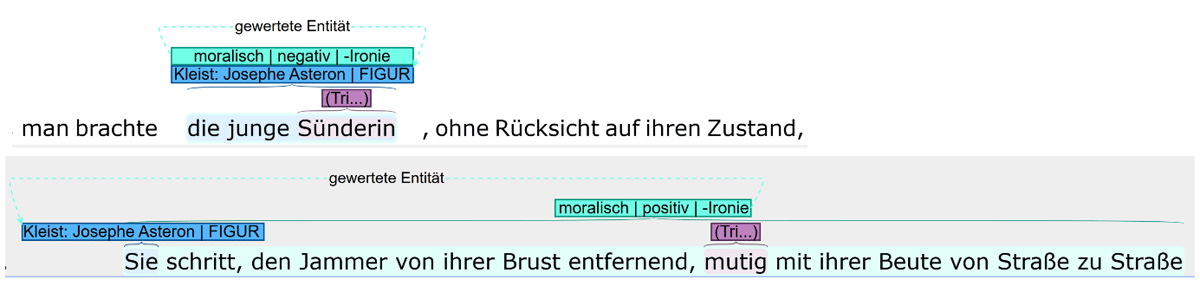
Figure 1
NP- and clause-evaluation from Kleist‘s “The Earthquake in Chili”, INCEpTION text-annotation environment. My transl: 1) “The young sinner was brought, regardless of her condition”; 2) “She walked bravely from street to street with her booty, removing the misery from her chest.” (The irony tag is by default “-“ [false] and can be used to mark ironic evaluations or encodings.)
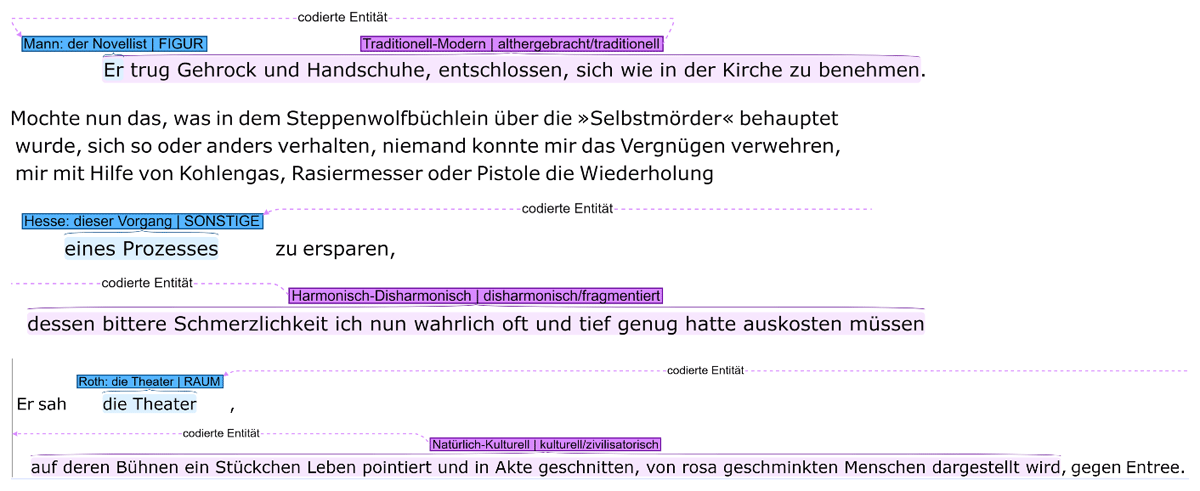
Figure 2
Literary encodings from Thomas Mann’s “With the Prophet”, Hermann Hesse’s “Steppenwolf” and Joseph Roth’s “The Silent Prophet”, INCEpTION text-annotation environment. My transl: 1) “He wore a frock coat and gloves, determined to behave as if he were in church.” Might that which is claimed about the “suicides” in the Steppenwolf book be this way or another, no one could deny me the pleasure to spare myself, with the help of carbon gas, razorblade or pistol, the repetition of a process the bitter pain of which I have truly had to suffer frequently and deeply.” 2) “He saw the theaters, on whose stages a piece of life is portrayed pointedly and cut into acts by people in pink make-up, against Entree.”
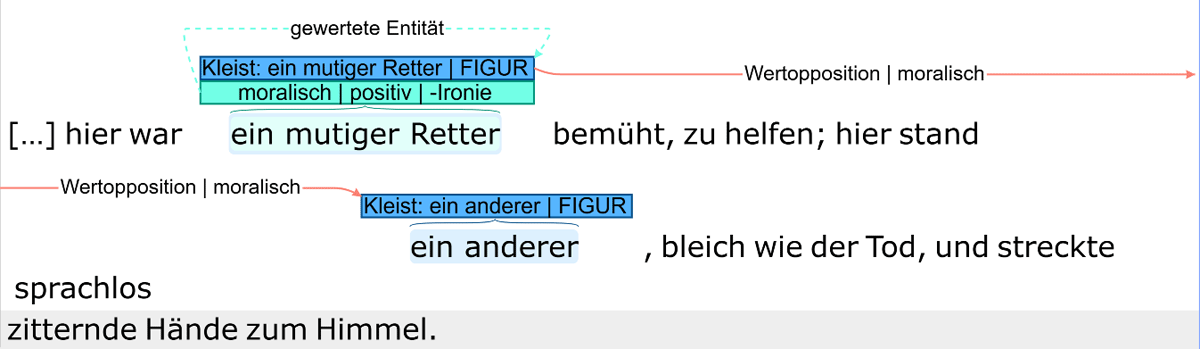
Figure 3
Example of a value opposition from Kleist’s “The Earthquake in Chili”, INCEpTION text-annotation environment. My transl.: “here was a courageous savior trying to help; here stood another, pale as death, stretching speechless, trembling hands to the sky.”
Table 1
Descriptive statistics of annotation corpus.
| n | TOKENS | |
|---|---|---|
| Texts | 35 | 77068 |
| Literary evaluations | 2249 | 25309 |
| Literary encodings | 555 | 10906 |
| Oppositions | 287 | 917 |
Table 2
Inter-annotator agreement based on 35 (for evaluations) respectively 32 texts (for encodings).
| γ | |
|---|---|
| Literary evaluations | 0.53 |
| Literary encodings | 0.22 |
Table 3
Inter-annotator agreement, Krippendorff’s alpha for ordinal scales.
| Assertive Force How sure are you that the text conveys an implicit message? (0 – very uncertain; 10 – very certain) | 0.45 |
| Assertive Clarity How sure are you exactly what the implicit message of the text is? (0 – very uncertain; 10 – very certain) | 0.50 |
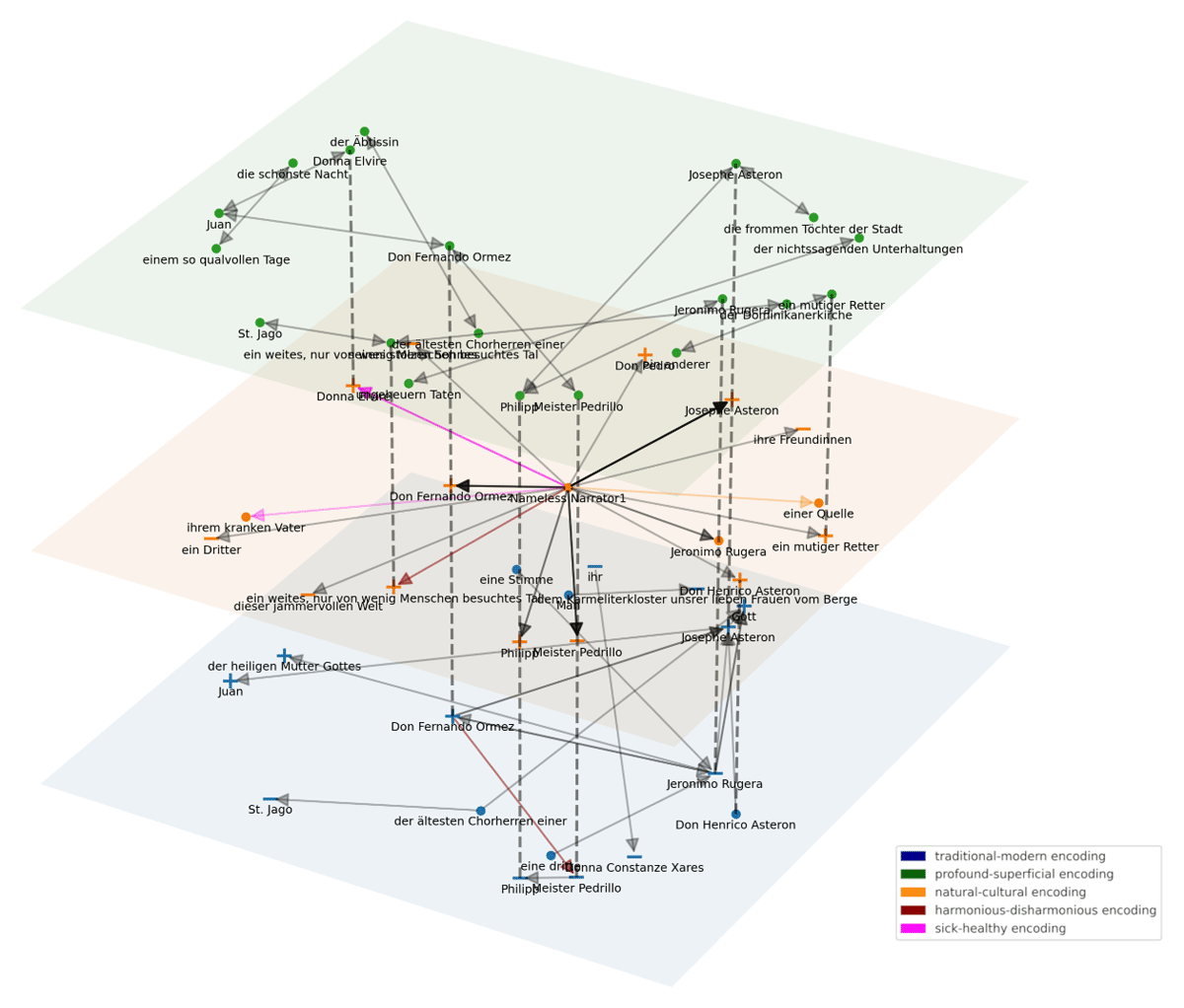
Figure 4
Evaluative text structure in relation to characters in Kleist’s “Das Erdbeben in Chili” (“The Earthquake in Chili); character level (blue), narrator level (orange), text organization level (green); evaluations represented by simple arrows in grey, encodings by simple arrows in color, and oppositions by double-sided arrows in grey.
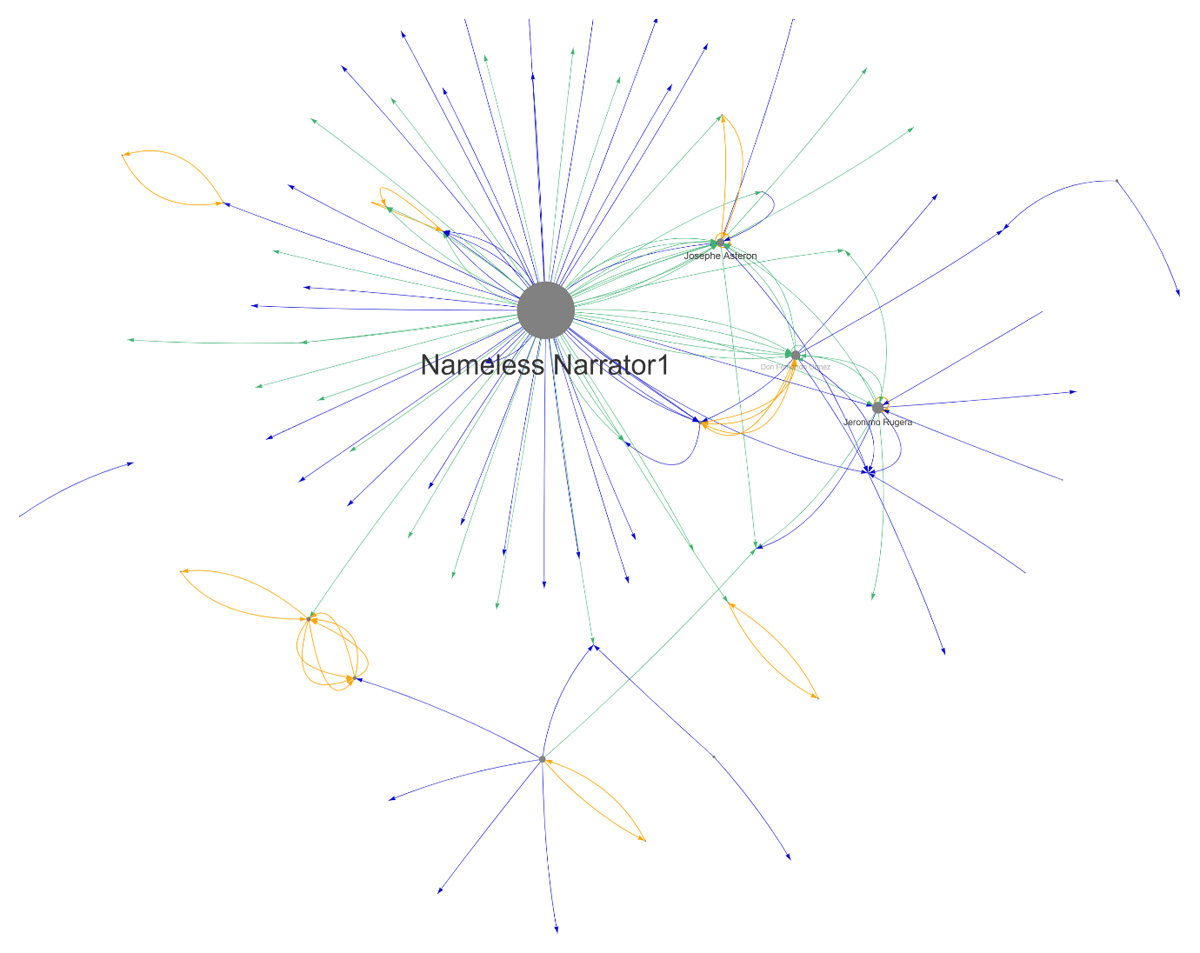
Figure 5
Directed Single-layer Network of Kleist’s “Das Erdbeben in Chili” (“The Earthquake in Chili”). Blue – negative evaluation, Green – positive evaluation, Orange – opposition.
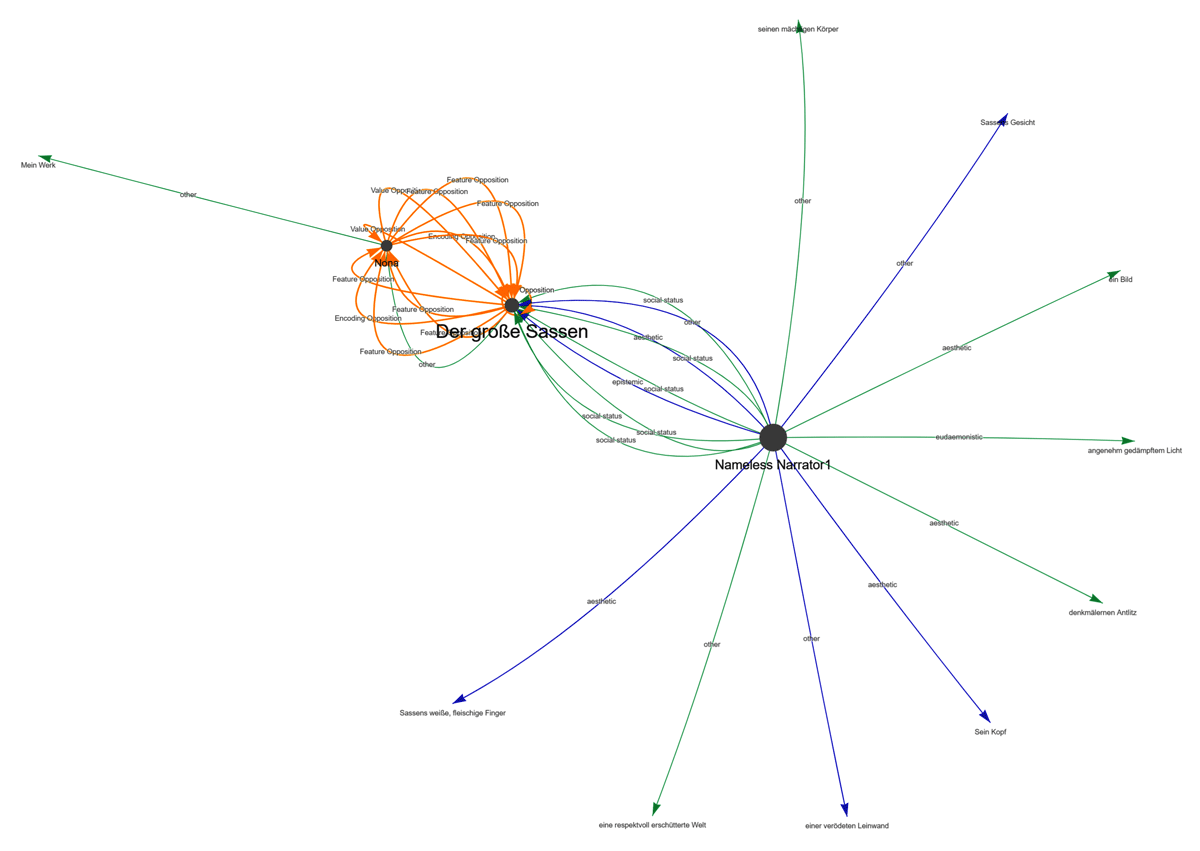
Figure 6
Evaluative structure of Thea Dorn’s “Vorsicht Steinschlag” (“Danger Falling Stones”). Blue – negative evaluation, Green – positive evaluation, Orange – opposition.
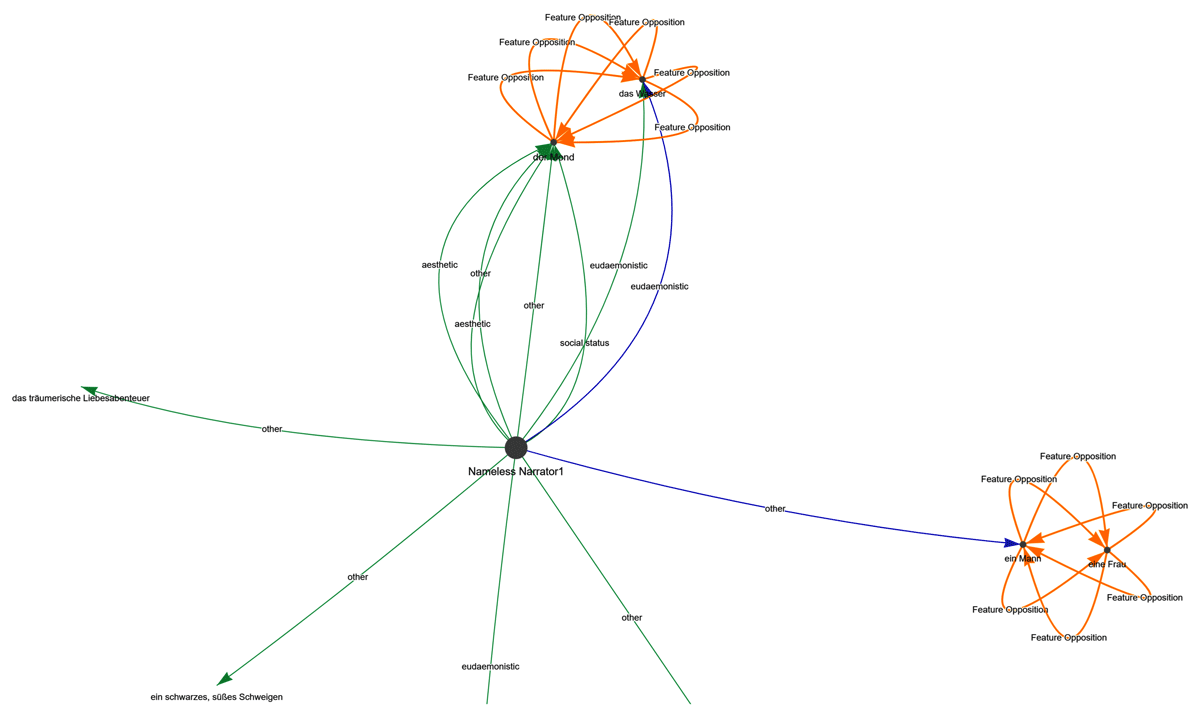
Figure 7
Evaluative structure of Robert Walser’s “Der Nachen” (“The Bark”). Blue – negative evaluation, Green – positive evaluation, Orange – opposition.
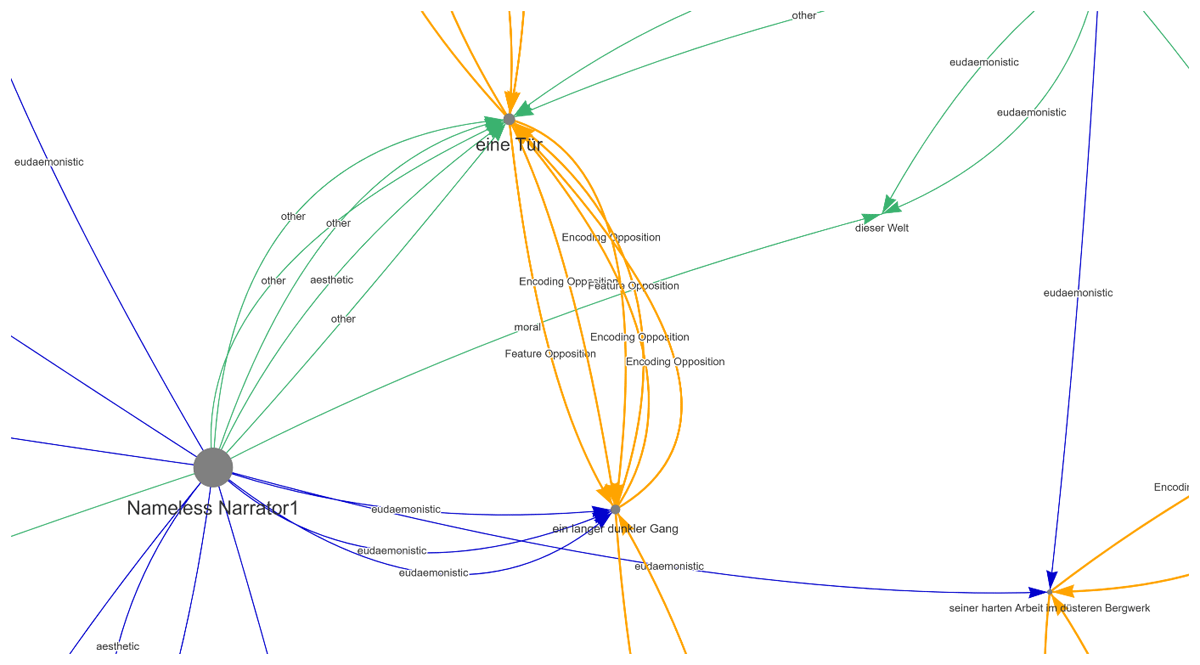
Figure 8
Evaluative structure of Hollenstein’s “Gelb wie eine Zitrone” (“Yellow Like a Lemon”) (excerpt). Blue – negative evaluation, Green – positive evaluation, Orange – opposition.
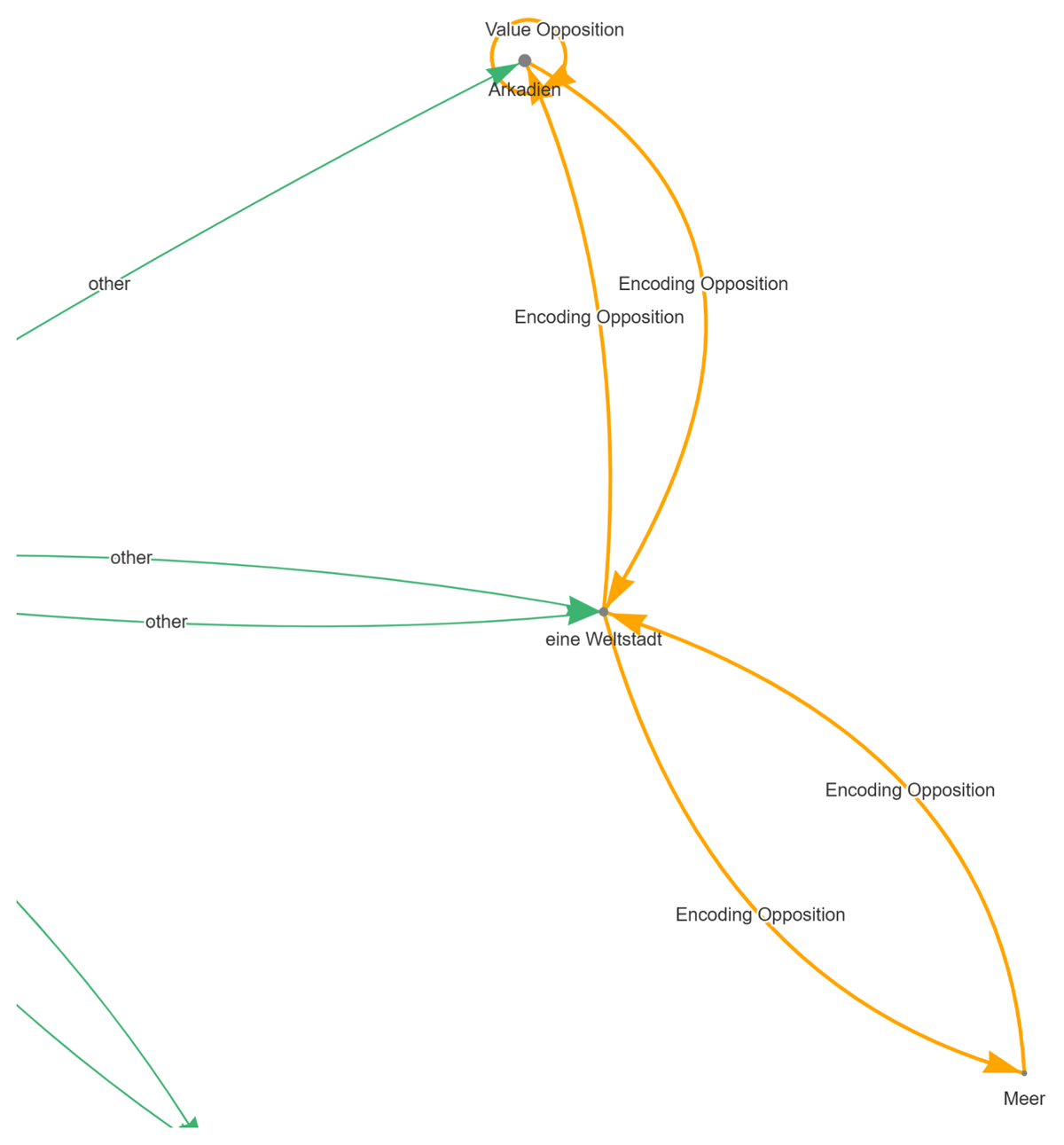
Figure 9
Evaluative structure of Bachmann’s “Auch ich habe in Arkadien gelebt” (“I Too Have Lived in Arcadia”) (excerpt). Blue – negative evaluation, Green – positive evaluation, Orange – opposition.
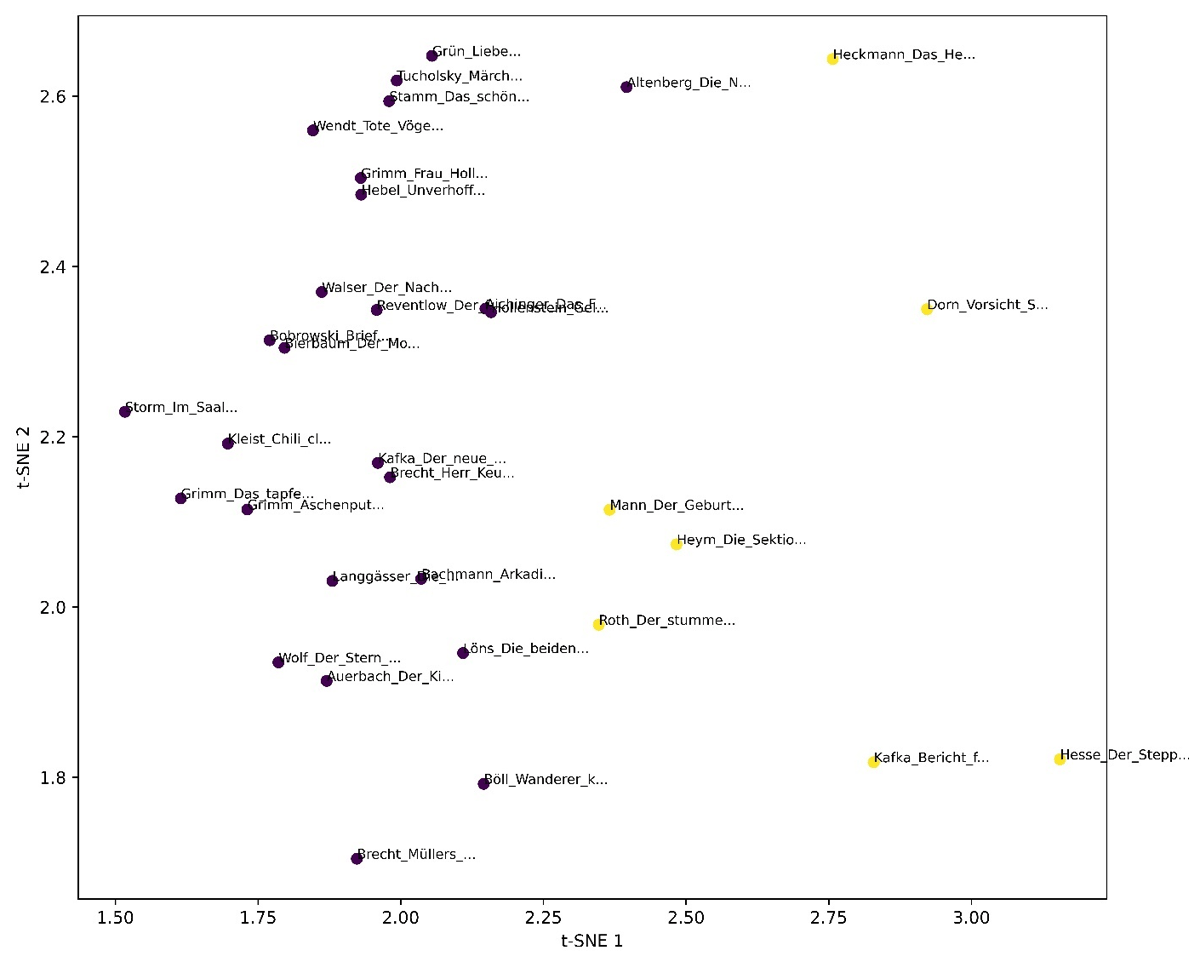
Figure 10
t-SNE of Network Clusters Based on Portrait Divergence.
Table 4
Classification results for assertive clarity (LOW vs. HIGH). P – Precision (how many predicted positives are actually correct), R – Recall (How many actual positives were correctly found), F1 – F1-Score (balance between precision and recall (their harmonic mean).
| P | R | F1 | SUPPORT | |
|---|---|---|---|---|
| LOW | 0.86 | 0.38 | 0.52 | 16 |
| HIGH | 0.62 | 0.94 | 0.74 | 17 |
| accuracy | 0.67 | 0.67 | 0.67 | 0.67 |
| macro avg | 0.74 | 0.66 | 0.63 | 33 |
| weighted avg | 0.73 | 0.67 | 0.64 | 33 |
Table 5
Classification results for assertive force (LOW vs. HIGH). P – Precision, R – Recall, F1 – F1-Score.
| P | R | F1 | SUPPORT | |
|---|---|---|---|---|
| LOW | 0.00 | 0.00 | 0.00 | 10 |
| HIGH | 0.70 | 1.00 | 0.82 | 23 |
| accuracy | 0.70 | 0.70 | 0.70 | 0.70 |
| macro avg | 0.35 | 0.50 | 0.41 | 33 |
| weighted avg | 0.49 | 0.70 | 0.57 | 33 |
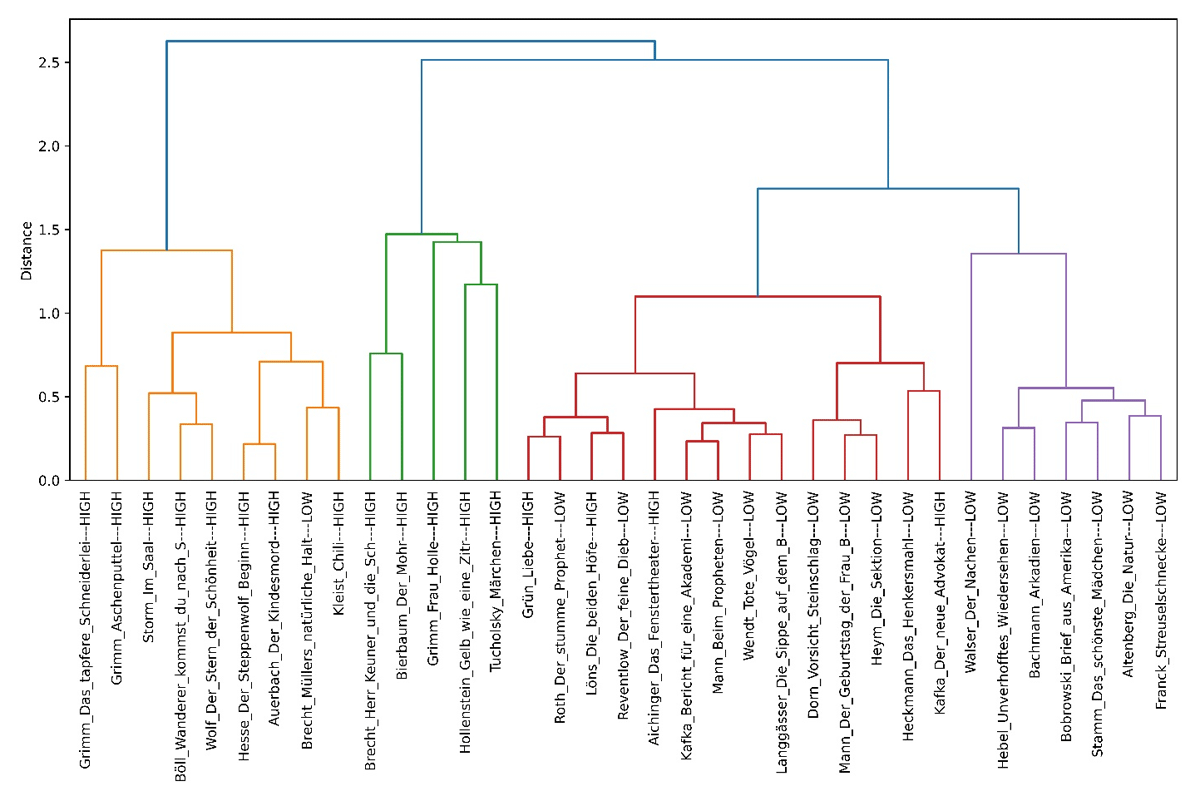
Figure 11
Hierarchical Clustering based on Annotation Based and Global Network Features, “LOW” and “HIGH” refer to assertive clarity.
Table 6
Evaluation of Hierarchical Clustering based on Annotation Based and Global Network Features, “LOW” and “HIGH” refer to assertive clarity. ). P – Precision, R – Recall, F1 – F1-Score.
| P | R | F1 | SUPPORT | |
|---|---|---|---|---|
| LOW | 0.81 | 0.94 | 0.87 | 18 |
| HIGH | 0.93 | 0.76 | 0.84 | 17 |
| accuracy | 0.86 | 0.86 | 0.86 | 0.86 |
| macro avg | 0.87 | 0.85 | 0.86 | 35 |
| weighted avg | 0.87 | 0.86 | 0.86 | 35 |
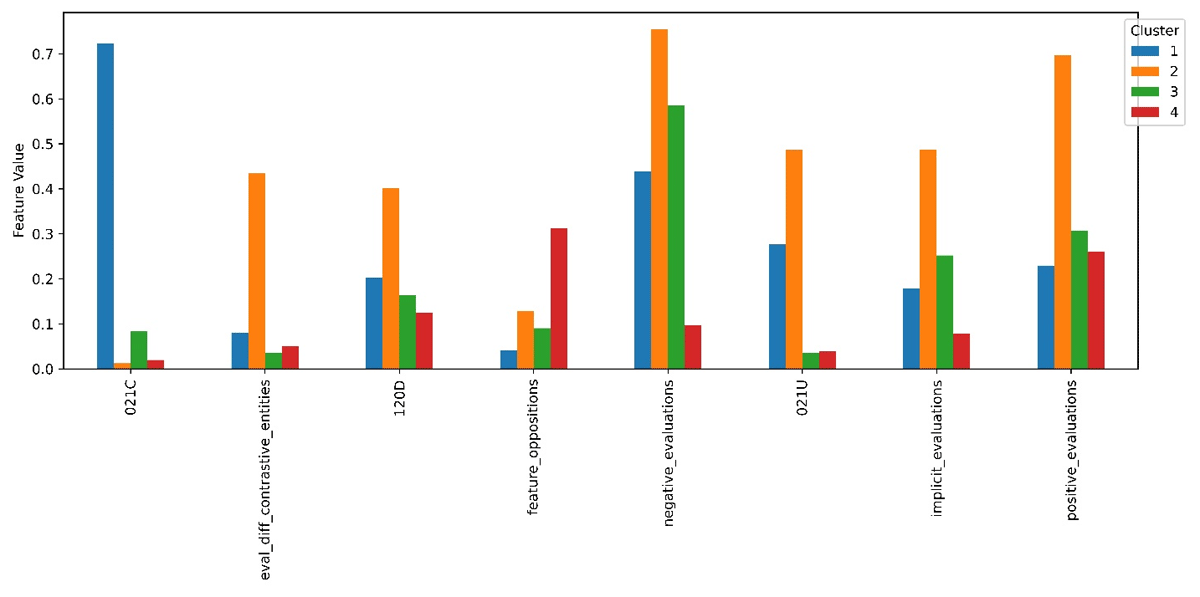
Figure 12
Average Feature Values for Hierarchical Clustering, assertive clarity.
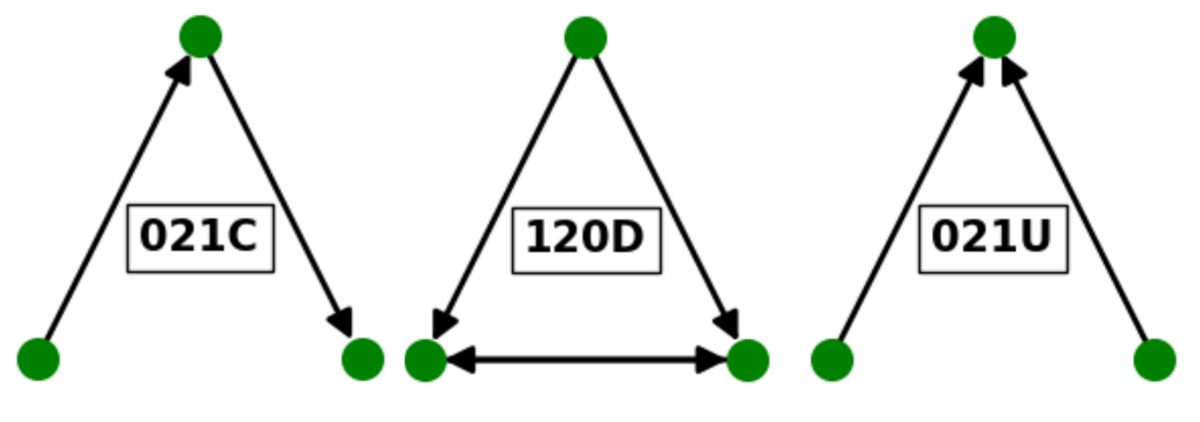
Figure 13
Triad types 021C, 120D and 021U, among most prominent features in Hierarchical Clustering.13
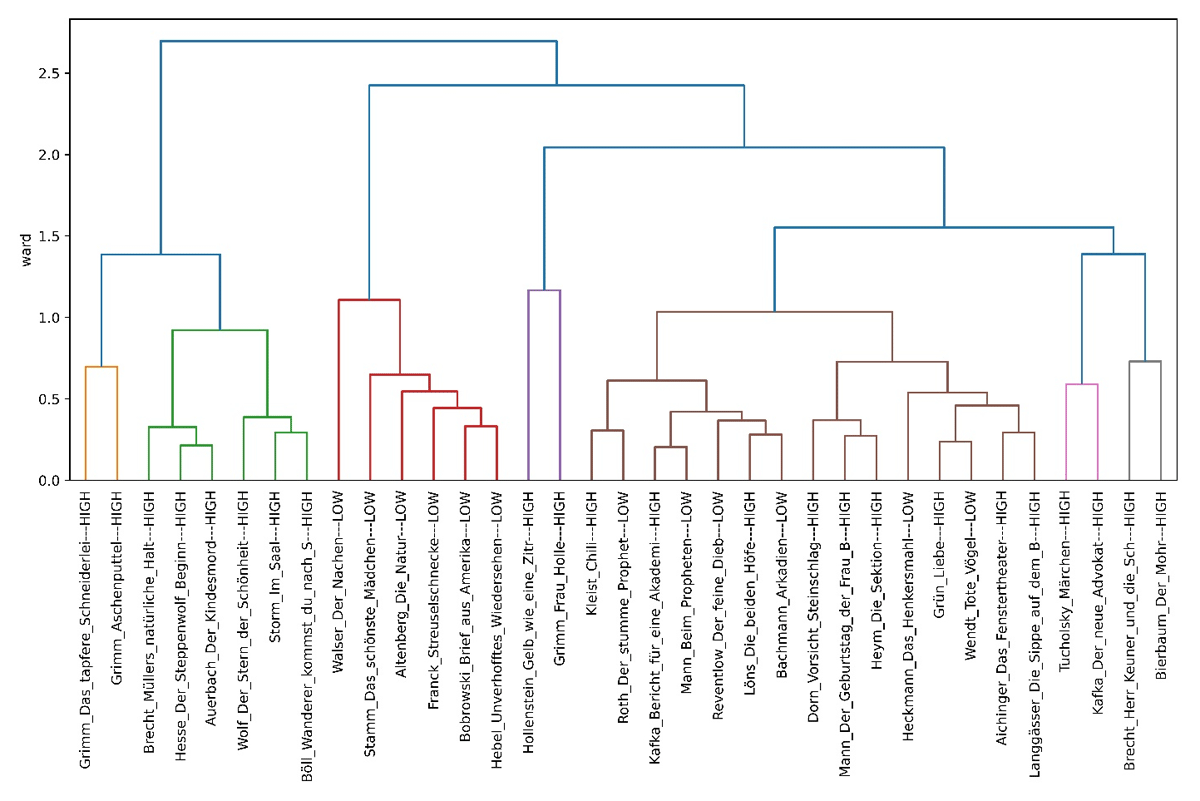
Figure 14
Hierarchical Clustering based on Annotation Based and Global Network Features, “LOW” and “HIGH” refer to assertive force.
Table 7
Evaluation of Hierarchical Clustering based on Annotation Based and Global Network Features, “LOW” and “HIGH” refer to assertive force. P – Precision, R – Recall, F1 – F1-Score.
| P | R | F1 | SUPPORT | |
|---|---|---|---|---|
| LOW | 1.00 | 0.50 | 0.67 | 12 |
| HIGH | 0.79 | 1.00 | 0.88 | 23 |
| accuracy | 0.83 | 0.83 | 0.83 | 0.83 |
| macro avg | 0.90 | 0.75 | 0.78 | 35 |
| weighted avg | 0.86 | 0.83 | 0.81 | 35 |
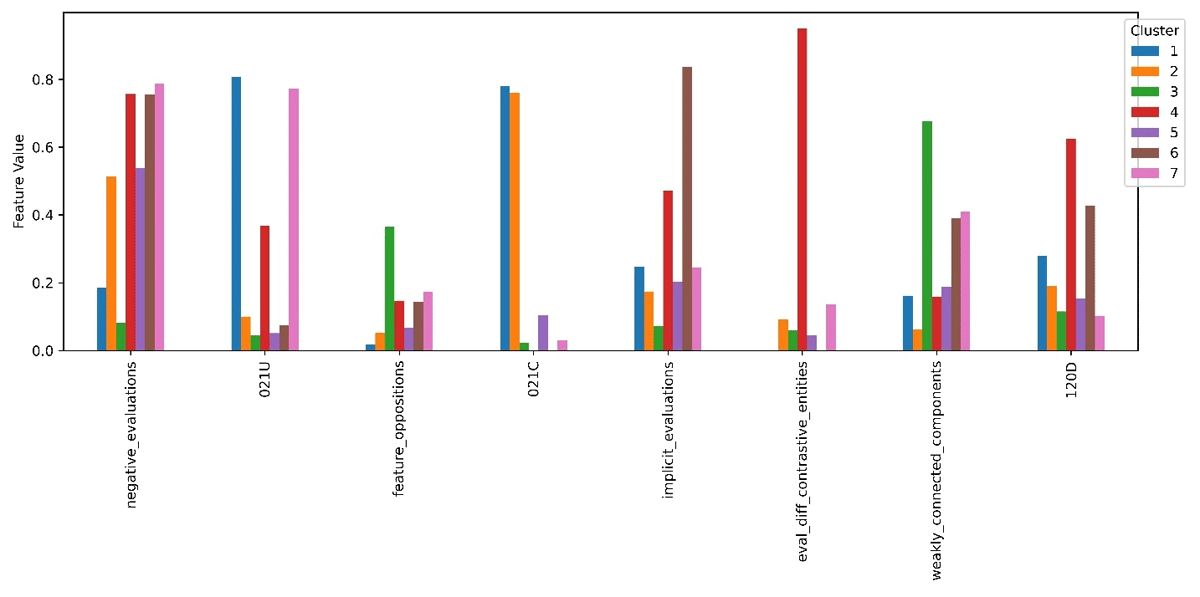
Figure 15
Average Feature Values for Hierarchical Clustering, assertive force
A1
Narratological Text Types.
| DOCUMENT TITLE | TYPE |
|---|---|
| Aichinger_Das_Fenstertheater.txt | feature contrast & value contrast |
| Altenberg_Die_Natur.txt | – |
| Auerbach_Der_Kindesmord.txt | disposition-outcome |
| Bachmann_Arkadien.txt | feature contrast & value contrast; subverted contrast |
| Bierbaum_Der_Mohr.txt | feature contrast; satirical |
| Bobrowski_Brief_aus_Amerika.txt | feature contrast |
| Böll_Wanderer_kommst_du_nach_Spa.txt | disposition-outcome |
| Brecht_Herr_Keuner_und_die_Schauspielerin.txt | feature contrast & value contrast |
| Brecht_Müllers_natürliche_Haltung.txt | – |
| Dorn_Vorsicht_Steinschlag.txt | feature contrast |
| Franck_Streuselschnecke.txt | – |
| Grimm_Aschenputtel.txt | disposition-outcome; feature contrast & value contrast |
| Grimm_Das_tapfere_Schneiderlein.txt | disposition-outcome |
| Grimm_Frau_Holle.txt | disposition-outcome; feature contrast & value contrast |
| Grün_Liebe.txt | feature contrast & value contrast |
| Hebel_Unverhofftes_Wiedersehen.txt | – |
| Heckmann_Das_Henkersmahl.txt | subverted contrast |
| Hesse_Der_Steppenwolf_Beginn.txt | feature contrast & value contrast |
| Heym_Die_Sektion.txt | feature contrast & value contrast |
| Hollenstein_Gelb_wie_eine_Zitrone.txt | feature contrast & value contrast |
| Kafka_Bericht_für_eine_Akademie.txt | feature contrast & value contrast; subverted contrast |
| Kafka_Der_neue_Advokat.txt | feature contrast & value contrast |
| Kleist_Chili.txt | feature contrast & value contrast |
| Langgässer_Die_Sippe_auf_dem_Berg_und_im_Tal.txt | feature contrast & value contrast |
| Löns_Die_beiden_Höfe.txt | feature contrast; disposition-outcome |
| Mann_Beim_Propheten.txt | satirical |
| Mann_Der_Geburtstag_der_Frau_Baronin.txt | feature contrast; satirical |
| Reventlow_Der_feine_Dieb.txt | – |
| Roth_Der_stumme_Prophet_Fragment.txt | – |
| Stamm_Das_schönste_Mädchen.txt | feature contrast |
| Storm_Im_Saal.txt | feature contrast & value contrast |
| Tucholsky_Märchen.txt | satirical |
| Walser_Der_Nachen.txt | feature contrast |
| Wendt_Tote_Vögel.txt | – |
| Wolf_Der_Stern_der_Schönheit.txt | feature contrast & value contrast |
A2
List of Features used in Lasso Regression.
| ANNOTATION BASED FEATURES | NETWORK FEATURES |
|---|---|
|
|