
The ubiquity of the phrase spoiler alert and related warnings and admonitions on social media and in other sources suggests a strong bias toward the consumption of stories and other information without having been exposed to crucial information giving away plot points, endings, and other information that might otherwise potentially ruin the experience. Despite this, there is evidence that, in some circumstances, spoiled stories are enjoyed more than unspoiled ones (Leavitt & Christenfeld, 2011; 2013). However, this pattern has not been independently replicated. Instead, complementary findings, that spoiled stories are enjoyed no more or even less than unspoiled stories, have emerged several times (e.g., Daniel & Katz, 2019; Ellithorpe et al., 2023; Johnson & Rosenbaum, 2015; 2018; Johnson et al., 2020; Levine et al., 2016; Yan & Tsang, 2016). In the research reported here, we explored whether the experience of (written) stories might be altered for better or worse by different types of possible spoilers. We examined two kinds of spoilers: full spoilers, those that give away plot-points, including the ending; and thematic spoilers, which provide a possible thematic interpretation. We also considered how individual differences among readers might moderate any influence of these kinds of spoilers. Before providing a rationale for these choices, we briefly review some of the literature detailing the effect of spoilers on the experience of stories.
Extant spoilers research
Leavitt and Christenfeld (2011) found that spoilers increased enjoyment of ironic-twist, mystery, and literary short stories when the spoilers were presented as the first part of a story (i.e., not separated from the story). This effect was replicated by Leavitt and Christenfeld (2013), but the enjoyment-increasing effect of spoilers was limited to stories for which the complexity of the spoiler matched the complexity of the story, determined by the grade-level of anthologies where the stories were found. The only other study to report an increase in enjoyment that was associated with spoilers was reported by Ellithorpe and Brookes (2018), who found that spoilers were associated with increased enjoyment of the finale of a long-running TV sitcom; however, in this research, spoiler exposure was not manipulated, making causality difficult to establish. Notably, some research has shown the spoiler selection before engagement with media may have a variety of beneficial effects or functions (e.g., Brookes et al., 2024; Johnson et al., 2020; Kryston et al., 2022). For instance, Kryston et al. found that spoiler selection (i.e., reading a review that is labeled with “Spoiler Alert!”) was related to the perceived cognitive challenge associated with media before consumption (see also Ellithorpe & Brookes, 2018). By contrast, those seeking out affectively-challenging media tend to try to avoid spoilers (Johnson et al., 2020), whereas those who are concerned that the content of media may be disturbing may seek out spoilers (Brookes et al., 2024). Research on spoiler effects and spoiler-seeking is evolving, but there is little extant evidence of a reliable positive effect of spoilers specifically on enjoyment.
In contrast with the limited findings of a beneficial effect of spoilers on enjoyment, others have reported experimental findings that spoilers do not change enjoyment much or that they reduce enjoyment (Daniel & Katz, 2019; Ellithorpe et al., 2023; Johnson & Rosenbaum, 2015; 2018; Johnson et al., 2020; Levine et al., 2016; Yan & Tsang, 2016). Johnson and Rosenbaum (2015) measured the enjoyment of spoiled short stories and found that spoilers significantly decreased enjoyment; furthermore, unspoiled stories were experienced as more moving and suspenseful. Levine et al. also found that spoilers significantly reduced enjoyment of short stories, whereas Daniel and Katz found that spoilers had no significant impact on the enjoyment of short stories and reduced the enjoyment of full-length, standalone episodes of a TV show (i.e., The Twilight Zone). Johnson and Rosenbaum (2018) found that spoiled television and film clips from several genres were enjoyed non-significantly less than unspoiled clips. Ellithorpe et al. found that spoiling the finale of a long-running TV sitcom (i.e., How I Met Your Mother) had no discernable effect on enjoyment. Yan and Tsang found that what they called process spoilers, which revealed details that led to a short, suspenseful film’s outcome, reduced enjoyment relative to an unspoiled control condition. They further found that spoilers that simply revealed the outcome, but not the process that led to that outcome, had no significant effect on enjoyment. In sum, the small, extant literature is mixed about what spoilers do to enjoyment of both written and other fictions.
Types of Spoilers
The existing literature on the effect of spoilers on enjoyment is at best unclear. We argue here that one possible contributing factor to the inconsistent influence of spoilers on story enjoyment is the type of spoiler (i.e., its content). Our goal in this research was not to definitively test whether this factor explained the disparate findings in the literature. Instead, we sought to first draw attention to the variety of types of spoilers that have been used to investigate of the effect of spoilers on enjoyment, and second to investigate two types of spoilers. The possibility that spoiler-type is an influential factor is suggested when comparing and contrasting the spoilers used in prior research. Leavitt and Christenfeld (2011) used spoilers that were written to match the style of the associated story and to provide information about the outcome in a way that seemed inherent to the story, allowing the spoiler to be incorporated as the opening lines of the story. Here is an example spoiler for Ambrose Bierce’s “An Occurrence at Owl Creek Bridge” (J. Leavitt, personal communication, May 13, 2014):
The experience of time is one of life’s mysteries. Years may pass in a rush, or a moment stretch interminably. A whole lifetime may flash through the mind in the moment before death. But in the case of Peyton Farquhar, the man to be hanged on the bridge, it is not a rush of memories that comes to the fore. Instead, new experiences – vivid fantasies of escape – inhabit his last moments, calling into question whether it is real time or the experience of time that truly matters.
This spoiler reveals the general structure of the story, in which the protagonist experiences an extended escape fantasy in the moments between having a noose placed around his neck and his death. But it reveals the ending only obliquely. The first two sentences and the last sentence are both abstract and arguably more about the theme of the story than its content. This focus on thematic information in the spoiler was one of the antecedents of our own use of thematic spoilers.
In contrast with this, the spoilers used by Johnson and Rosenbaum (2015), Levine et al. (2016), and Daniel and Katz (2019) were written to give away the endings of stories. Here is an example spoiler for Hugh B. Cave’s “Two Were Left” from Johnson and Rosenbaum’s research (B. K. Johnson, personal communication, April 17, 2015):
Eskimo boy Noni and his faithful dog Nimuk are stuck on an ice floe for two days. Noni is extremely hungry, and realizes that to survive, he must kill and eat his companion. He takes out his knife, ready to strike; but Nimuk appears ready to eat him instead. Neither can go through with it, and they reconcile. They are rescued a few hours later.
This spoiler summarizes the plot, conflict, and the resolution of the latter. The spoilers used by Levine et al. were even more focused on the resolution, as seen in this reveal of the conceit and ending of “An Occurrence at Owl Creek Bridge”:
The protagonist, Peyton, fantasizes of escaping right before he is executed.
The spoilers used by Daniel and Katz were similarly blunt, including both a brief summary of the plot and additionally an explanation of the ironic twist that was explicitly labeled as a spoiler, such as the following for “An Occurrence at Owl Creek Bridge”:
In the middle of the American Civil War, one plantation owner is being prepared for execution by hanging from a bridge. Just as his executioners carry out the sentence, the plantation owner’s noose breaks, and he falls into the river below, making an escape. Though he is tired and in pain, he travels back to his home so that he can once more see his wife. Spoiler: Before he can embrace his wife, this hallucination ends, and the plantation owner is killed by hanging - the story being a flash before his eyes on the way to his death.
Considering the divergent results from research on spoilers, it seemed worthwhile to manipulate and examine, within one study, the possible effects of different spoiler-types.
Some researchers (Johnson et al., 2020; Yan & Tsang, 2016) have already examined some spoiler-types experimentally. Johnson et al. presented participants with what they called minor spoilers or major spoilers before presenting horror film scenes. Minor spoilers were those that disclosed upcoming scares, whereas major spoilers were those that revealed outcomes and twists. Generally, spoilers had little influence on the experience of the participants. As noted previously, Yan and Tsang examined two types of spoilers, outcome spoilers and process spoilers. Outcome spoilers revealed the ending of a story, and process spoilers revealed details that led to the outcome. Process spoilers led to a reduction in enjoyment relative to a control condition, but no reliable difference in enjoyment emerged between the outcome spoiler and the control condition. The former result replicates the pattern observed by Johnson and Rosenbaum (2015), using similar types of spoilers, suggesting that spoilers that contain information about plot points reduce enjoyment. However, Yan and Tsang’s process spoilers did not reveal the outcome of stories, whereas Johnson and Rosenbaum’s did. Moreover, the outcome spoilers used by Yan and Tsang did not significantly reduce enjoyment, whereas the outcome-revealing spoilers used by Johnson and Rosenbaum (2015), Levine et al. (2016), and Daniel and Katz (2019) reduced enjoyment. The influence on enjoyment of different information types in spoilers remains an open question.
The type of spoiler might matter for the experience of a short story because different information in the spoiler could direct a reader’s attention to different features of a story. For example, being provided plot points might allow a reader to focus more on features of the writing. By contrast, an outcome spoiler might deprive a reader of some suspense or problem-solving activity (but see Cohen et al., 2023). One type of spoiler we used, which we call full spoilers, were written to reveal both plot information and the ending. In light of the argument above, we hypothesized (H1) that such spoilers make some of the experience of stories better, such as whether they are thought-provoking, and other aspects of that experience worse, such as whether they are suspenseful. Given the mixed results in the literature, our first research question was about how full spoilers influence other aspects of the experience of stories.
H1: Full spoilers will lead to stories being perceived as (a) more moving but as (b) less suspenseful than the same stories when unspoiled.
RQ1: What is the effect of full spoilers on other aspects of the experience of stories, including enjoyment, how much fun they are to read, whether they leave a lasting impression, and how transporting they are?
In addition to full spoilers, we also examined the effects of what we call thematic spoilers. One reason to investigate whether thematic spoilers have a positive effect on readers is that Leavitt and Christenfeld’s (2011) spoilers appear to have been written in part to include thematic information. Because their results have not been independently replicated, the possibility that the thematic information in spoilers is crucial to the beneficial effect of spoilers is important to examine. Further, and more generally, another rationale for using thematic spoilers is that is that one of the activities readers often engage in is understanding the theme of a story (e.g., Hunt & Vipond, 1986; Lee, 2011). Thus, providing a cue to a story’s potential theme may ease interpretation and lead to a more-positive experience, helping to fulfill readers’ eudaimonic motivations (Oliver & Raney, 2011). Evidence that a focus on thematic information leads to a richer reading experience was provided by McCarthy and Goldman (2015), who found that college-age readers produced more interpretive inferences during reading when instructed after reading to write an essay that either discussed the theme of a short story or to respond to a particular argument about the theme, relative to instructions to focus on plot. Based on this, providing thematic information before reading should lead to a similarly more-sophisticated and enriched interpretation of a story. To implement this, we wrote spoilers that provided a hint about a story’s potential message with respect to the human condition, not specifically tied to the events of the story (cf. Burkett & Goldman, 2016; Vipond & Hunt, 1984), written with an eye toward mythology and archetypes (Green et al., 2019). For example, one of the stories we used was Kurt Vonnegut’s “Harrison Bergeron”, about a dystopian society in which equality is maintained by the government by handicapping those more advantaged. The protagonist, a brilliant, attractive, athletic teenager named Harrison Bergeron appears on television, intending to overthrow the government. He removes his handicaps and those of a beautiful ballerina, and they proceed to dance on live television. For this story, we wrote the following thematic spoiler:
In dire circumstances, there is a distinct hope that a great hero will rise above the chaos, coming forth from the shadows to deliver not only salvation but disavow those evil doers of power. As he transverses his quest, the modern hero faces contemporary monsters of ignorance, oppression, and subjugation. Nevertheless, it is a much more poignant statement about the potency or entrenched nature of power when that hero fails to liberate the people indefinitely.
This spoiler is abstract and has little information about the plot or outcome, except for an allusion to its perhaps predictably pessimistic ending; calling it a spoiler at all is debatable. But it does provide information about a potential theme for the story. We hypothesized (H2) that this information might increase the extent to which the story left a lasting impression or allowed participants to be more transported (Green & Brock, 2000), and investigated how thematic spoilers influences other story-reading outcomes (RQ2).
H2: Thematic spoilers will lead to stories (a) having a greater lasting impression and being (b) more transporting than the same stories when unspoiled.
RQ2: What is the effect of thematic spoilers on other aspects of the experience of stories, including enjoyment, how suspenseful they are, how much fun they are to read, and how moving they are?
The Possible Role of Individual Differences
In addition to examining the effect of spoiler-types on the experience of stories, we examined how individual differences among readers might moderate any effects of spoilers. We measured three characteristics that arguably should be related to the experience of reading: need for cognition (Cacioppo & Petty, 1982); print exposure (Stanovich & West, 1989); and need for cognitive closure (Webster & Kruglanski, 1994).
Need for Cognition
One individual difference we considered was need for cognition, which is a willingness to engage in and enjoy effortful cognitive activity (Cacioppo & Petty, 1982). Need for cognition is positively related to complexity of reading material choice (Tolentino et al., 1990) and to enjoyment of reading short fiction of the sort we used in this research (Levine et al., 2016). With respect to how it might interact with the presence of a spoiler, one of the ways that need for cognition was originally validated by Cacioppo and Petty was by demonstrating that high need for cognition individuals preferred a complex cognitive task (i.e., number searching), whereas low need for cognition individuals preferred a simple version of the same task. Despite findings like this, a need for cognition by spoiler interaction has not been demonstrated in studies where both factors were modeled (Johnson & Rosenbaum, 2018; Levine et al., 2016; Rosenbaum & Johnson, 2016). Nevertheless, for participants who enjoy a challenge (i.e., those higher in need for cognition), such as reading a literary short story, we expected full spoilers to remove some of the challenge of reading and thereby reduce enjoyment and related outcomes (H3a). By contrast, for those low in need for cognition, spoilers could lighten the cognitive load associated with reading a complex text and increase enjoyment and its correlates. More generally, we expected need for cognition to be positively related to enjoyment and related outcomes (H3b), a finding that has emerged in several studies (e.g., Levine et al., 2016; Rosenbaum & Johnson, 2016).
H3a: Full spoilers will have a detrimental effect on enjoyment and related outcomes (e.g., suspense, transportation) for those high in need for cognition, relative to the experience of unspoiled stories, but will have a beneficial effect on enjoyment and related outcomes for those low in need for cognition.
H3b: Need for cognition will be positively related to enjoyment and related outcomes.
With respect to thematic spoilers, which were expected to lead to a greater lasting impression and increased transportation, we examined whether need for cognition would moderate the effects of these spoilers. Need for cognition is positively related to the experience of being transported, a relationship that may be especially pronounced when there is a match between task difficulty and skill (Green et al., 2008). If thematic spoilers reduce the difficulty of extracting thematic information from a story, this would be detrimental especially to those high in need for cognition and would emerge most strongly for measures such as how much of a lasting impression a story has and how moving it is (H3c).
H3c: Relative to the experience of unspoiled stories, thematic spoilers will have a detrimental effect on how much of a lasting impression a story has and how moving it is for those high in need for cognition, whereas these effects will be reduced for those lower in need for cognition.
Print Exposure
Another individual difference that we considered was print exposure, measured using a shortened version of an author recognition test (ART; Stanovich & West, 1989). The ART presents participants with a list of names, and the participants are asked to indicate which names they recognize as authors. Half of the names are authors and half are foils, with scores calculated by subtracting endorsed foils from endorsed authors. Scores on the ART are positively correlated with many aspects of language processing, such as reading for pleasure, vocabulary level (Stanovich & Cunningham, 1992; Vermeiren et al., 2023), and the efficiency of basic word recognition (Gordon et al., 2020). This suggests that print exposure should be positively related to positive aspects of reading short stories (H4). Further, given that greater print exposure reflects not only experience with reading but also some aspects of reading skill, we anticipated that print exposure would interact with the presence of spoilers such that full spoilers, by giving away plot points and the ending, will create an atypical reading experience especially for frequent, skilled readers, damaging their experience in greater magnitude relative to the same effects for those lower in print exposure (H5). Given the exploratory nature of the use of thematic spoilers, we examined whether these spoilers would interact with print exposure in predicting enjoyment and other outcomes such as transportation, but we did not have specific hypotheses.
H4: Print exposure will be positively related to positive aspects of reading short stories.
H5: Relative to the experience of reading unspoiled stories, full spoilers will have a detrimental effect on enjoyment and related outcomes for those with high print exposure, but will have a beneficial effect on enjoyment and related outcomes for those with lower print exposure.
Need for (Cognitive) Closure
One other individual difference that we considered was the need for (cognitive) closure (Webster & Kruglanski, 1994). Individuals high in this trait prefer predictability and are uncomfortable with ambiguity, among other characteristics. Because spoilers increase predictability and reduce ambiguity, we expected that spoilers, full spoilers in particular, would improve the experience of short stories for those high in this trait. Similarly, for those low in this trait, that is, those who prefer unpredictability and ambiguity, full spoilers should be especially ruinous.
H6: Full spoilers will have a beneficial effect on enjoyment and related outcomes for those high in need for closure, but will have a detrimental impact on these outcomes for those low in need for closure, relative to the experience of unspoiled stories.
We also examined whether need for closure moderated any effects of thematic spoilers, but did not have any specific hypotheses.
Fluency
One explanation suggested by Leavitt and Christenfeld (2011; 2013) for the beneficial effect of spoilers is that it is due to the increased processing fluency (Reber et al., 2004) spoilers provide. Easier processing of a stimulus, like a story, a painting (Belke et al., 2010), or music (Szpunar et al., 2004), such as that which arises due to repeated exposure, is typically experienced as pleasurable and frequently attributed to the stimulus as greater enjoyment. Leavitt and Christenfeld (2013) found support for this fluency hypothesis. Participants rated the ease of reading (i.e., self-reported fluency) spoiled and unspoiled stories. Spoiled stories were enjoyed more, an effect statistically mediated by fluency. Similarly, Ellithorpe and Brookes (2018) found that their beneficial spoiler effect (on the finale of a TV series) was mediated by the events in the finale making more sense, arguably a form of fluency. However, other researchers have found little or even contradictory evidence for a positive relationship between fluency and enjoyment. Johnson and Rosenbaum (2015) found no evidence that self-reported fluency played a mediating role in the spoiler-enjoyment relationship. Both Levine et al. (2016) and Daniel and Katz (2019) reported a negative relationship between reading time – arguably an objective measure of fluency – and enjoyment. Ellithorpe et al. (2023) found no clear effect of spoilers on fluency nor a clear role for fluency in the spoiler-enjoyment relationship, concluding “it is difficult to generate generalizable statements about the interaction between spoilers, fluency, and (un)expected endings” (p. 8).
Given the lack of clarity about the role of fluency in enjoyment, especially in complex stimuli like short stories, it was a secondary focus of this study. However, rather than measuring fluency, we instead used an experimental manipulation that has been argued to influence fluency (Topolinski, 2014) to examine if this might moderate the effect of spoilers. Specifically, a 2-minute filled delay was imposed between exposure to spoilers and story-reading for half of our participants. In one study, Topoliniski showed that pre-exposure to the crucial concept underlying the punchline of a somewhat lengthy (i.e., 12–62 words) narrative joke increased reported funniness when there was a delay of as short as 1 minute between spoiler and joke; by contrast, a no-delay condition between spoiler and joke decreased enjoyment. The logic of this manipulation and explanation of this finding is that with a delay between pre-exposure to the punchline and the joke, the enhanced fluency experienced during the joke would be more likely to be attributed to the joke than to the punchline, an effect that would not be as probable if they were presented contiguously. This is similar to, for example, mistaken attributions of fame that arise, after a delay, from single exposure to unknown names (Jacoby et al., 1989). Analogously, we manipulated the delay between the presentation of spoiler information and reading, with the longer delay expected to allow any fluency boost to be attributed to the story. If this manipulation affects fluency and if fluency is a mechanism by which spoilers influence the experience of stories, any effects they have will be increased with a delay experienced between spoiler and story. We used reading time as an index of this fluency, in a manner similar to Sanchez and Jaeger (2015; see also Daniel & Katz, 2019; Levine et al., 2016). If we had measured fluency via self-report (cf. Leavitt & Christenfeld, 2013) after participants provided measures of enjoyment, it would likely have been difficult for them to separate attributions of experienced fluency from their experience of enjoyment.
RQ3: Does fluency, via a manipulation of the delay between spoiler exposure and reading, moderate the effect of full or thematic spoilers on the enjoyment, suspense, transportation, and other aspects of the experience of stories, relative to when the same stories are read without being spoiled?
Summary of the Current Study
In the study we conducted, participants read fictional short stories that were unspoiled or preceded by different types of spoilers. Each participant read three stories, one of which was preceded by no spoiler (i.e., only the title was presented), one of which was preceded by a thematic spoiler, and one of which was preceded by a full spoiler. There was either a short, filled delay of 2 minutes between reading a spoiler and reading a story or no delay. After each story, measures of the experience of the story were taken, including enjoyment; suspense; fun; whether the story left a lasting impression; whether the story was moving; and how transporting the story was. We also measured need for cognition, print exposure, and need for closure.
Method
Participants
Volunteer participants (n = 326) were recruited from General Psychology courses at the University of Arkansas. Our target sample size was preregistered to be n = 300. Details of the rationale for this sample size are available in the preregistration in an online supplement. Recruitment materials indicated that the experiment involved reading short stories. Ranging in age upwards from 18, the sample was limited to native-English speakers. Participants were compensated for their time with class credit toward a research requirement.
Materials & Measures
The experiment was conducted using Qualtrics (2018, https://www.qualtrics.com/; Provo, Utah, USA). We selected six short stories (see Table 1) with abstract themes and twist endings. For each story, a thematic spoiler and a full spoiler were written. One story’s spoilers appear in Table 2; the remainder appear in an online supplement. Because they contained information about the plot and ending, the full spoilers (M = 82.2 words; SD = 8.6) were significantly longer than thematic spoilers (M = 69.1 words; SD = 8.5), which contained only abstract information about a possible thematic interpretation, t(5) = 2.93, p = .03.
Table 1
Titles, authors, and word counts for stories.
| TITLE | AUTHOR | WORD COUNT |
|---|---|---|
| An Occurrence at Owl Creek Bridge | Ambrose Bierce | 3763 |
| All Summer in a Day | Ray Bradbury | 1939 |
| The Pedestrian | Ray Bradbury | 1444 |
| The Eyes Have It | Philip K. Dick | 1100 |
| Harrison Bergeron | Kurt Vonnegut | 2184 |
| 2BR02B | Kurt Vonnegut | 2527 |
Table 2
Spoiler examples (for “An Occurrence at Owl Creek Bridge”).
| Thematic spoiler A hanged man is brought to the edges of his psyche, dwelling in the interim between death and life. Ultimately a symbol of the power of surrender, the hanged man sacrifices his reality as he moves forward in time to face the inevitable. The hanged man is not only judged by his actions, but judged by his own psyche as he faces a choice between acceptance and resistance to meet his end. |
| Full spoiler A man and his executioners stand on a bridge in Alabama during the Civil War. As the man awaits his hanging, he fantasizes about escaping. At the moment of his hanging, he frees himself, swims to safety, and reaches his home. But as he is about to embrace his wife, he feels a blow against his neck. He has died, his neck broken, hanging from the bridge; he never escaped. |
Story Experience Measures
Measures of story enjoyment and experience were administered after each story. The first assessment, of enjoyment, consisted of one item, On a scale from 1 to 10 where 1 indicates the lowest enjoyment and 10 the highest enjoyment, how much did you enjoy this story? This method of measuring enjoyment has been used by Leavitt and Christenfeld (2011) and Levine et al. (2016). The other measures that we used assessed particular features of the experience of each story, including the following four statements (selected and adapted from Oliver & Bartsch, 2010): This story was suspenseful; it was fun for me to read this story; this story left me with a lasting impression; and I was moved by this story. Each of these statements was presented along with a 1-to-7 agreement (1 = strongly disagree; 4 = neither agree nor disagree; 7 = strongly agree) scale. Rather than using the full scale that Oliver and Bartsch developed, we selected face-valid items from each subscale to sample various aspects of enjoyment while still keeping the length of the experiment as short as possible.
Additionally, transportation during reading was assessed using a short form of Green and Brock’s (2000) transportation scale (Appel et al., 2015). The measure included items such as Imagining was easy for me while reading this story and I could picture myself in the scenes of the events described in the story. There were six items, accompanied by the same 7-point agreement scale as above asking to what extent a statement was true of the participant’s experience of the story. Cronbach’s α was calculated separately for each story and ranged from .75 to .91, comparable to the values reported by Appel et al. A mean transportation score was calculated for each participant for the six items for each story.
Individual Difference Measures
Participants’ cognitive tendencies were assessed with the brief version of the need for cognition scale (Cacioppo et al., 1984). This includes items such as I would prefer complex to simple problems and I like tasks that require little thought once I’ve learned them. There were 19 items with responses about whether each item describes the participant on a Likert-type scale from –4 (very strong disagreement) to 4 (very strong agreement). The scale demonstrated good reliability (Cronbach’s α = .89). A mean score was calculated for each participant.
A subset (n = 234) of participants completed the short need for closure scale (Roets & van Hiel, 2011) to measure the degree to which they were comfortable with and sought out uncertainty or avoided it. The scale was administered separately via a voluntary online prescreening available to all General Psychology students, but completion of this measure was not a requirement for participation due to a programming error. This measure includes items such as I don’t like situations that are uncertain and I enjoy having a clear and structured mode of life. The measure consists of 15 items, each accompanied by a scale from 1 (strongly disagree) to 6 (strongly agree) indicating whether each item describes the participant. The need for closure scale demonstrated reasonable reliability (Cronbach’s α = .78). A mean score was calculated for each participant.
Participants’ print exposure was measured using a shortened version of the ART (Stanovich & West, 1989) that we created. The assessment asked participants to identify the names of authors that they recognized. It included 40 names (see the online supplement), half of which were well-known authors and half of which were foils. Instructions indicated that there was a penalty for guessing. The ART demonstrated moderate reliability (Cronbach’s α = .73), on the low end of the range reported in a meta-analysis by Mol and Bus (2011), likely due to the use of a shorter version of the ART than is typical.
Procedure & Design
Each participant completed the experiment alone on a computer in a lab. After providing informed consent (University of Arkansas IRB Protocol #1711083325), participants were instructed to read at a comfortable pace and to especially pay attention to their enjoyment of the stories. Additionally, instructions provided an overview of the study and the tasks involved.
After finishing the instructions, participants read three stories, randomly chosen so that each participant read one of the two shortest, one of the two longest, and one of the two remaining stories. Each participant experienced all spoiler conditions: one story was presented with a full spoiler, one with a thematic spoiler, and one was preceded by only its title (i.e., it was not spoiled). The timing between the presentation of the spoiler and the reading of the story was manipulated between two conditions: delay and no-delay. If the participant was in the delay condition, the delay occurred between the spoiler and the story. The delay consisted of a 2-minute distractor task, namely, working on a word search. If the participant was in the no-delay condition, the story followed immediately after the spoiler. Those in the no-delay condition worked on the word search after each story rather than after spoilers, equating the number of tasks completed by all participants and roughly equating the total length of the experiment. Across all participants, randomization was constrained so that each story was seen approximately equally often and appeared approximately equally often in each spoiler condition and each ordinal presentation position.
Spoilers were presented on their own, separate from stories, labeled as “information about the next story”. Stories were split into pages that were short enough that there was no need for participants to scroll while reading; the number of pages per story varied with its length. Participants advanced through reading by clicking a NEXT button. A BACK button was also available to allow rereading. Immediately after reading each story, participants were asked to rate their enjoyment, followed by measures of suspense, fun, lasting impression, how moving the story was, as well as how transported they were; except for the enjoyment item, which was always presented first, these were presented in random order. After this, participants were asked whether they had ever read the story before. After participants read three stories and provided information about their experience of each, the study concluded with the need for cognition scale and the ART, presented in random order. At the end of the experiment, participants were debriefed. All participants finished the experiment in 40–60 minutes.
The design of the experiment was a 2 (delay: none; 2 minutes) × 3 (spoiler-type: thematic; full; control) mixed-factor design. Each participant experienced only one of two levels of the delay condition. Participants were exposed to all levels of the spoilers.
Results
Data Screening & General Analytic Information
Each of the 326 participants provided three observations of the story outcome measures, for a total of 978. All observations associated with stories read previously were excluded from all analyses (n = 81; 8.3%). Additionally, all observations for stories that corresponded to per-word reading times that were outliers based on Tukey’s (1977) criterion, calculated separately for each story, were excluded (n = 20; 2%). The analyses below are based on the remaining 877 observations. In instances where an observation was missing for a particular measure (e.g., due to a skipped question), that case was excluded from the analysis; at most, this resulted in the loss of six additional observations. Full and thematic spoilers took a mean of 27.0 seconds (SD = 13.0) to read, with 95% of the reading times taking at least 10 seconds, suggesting that participants attended to the information in the spoilers.
We used R (R Core Team, 2020) to analyze the data using the slate of tidyverse (Wickham et al., 2019) functions. Mixed linear models were fit using the lme4 package (Bates et al., 2015) with denominator df estimated to produce p-values for fixed effects using the lmerTest (Kuznetsova et al., 2017) package. The effects (Fox & Weisberg, 2018) and ggeffects (Lüdecke, 2018) packages were used to generate parameter estimates, standard errors, and confidence intervals for plots. We set α = .05 for tests of significance. For each outcome, one model was fit with the experimental factors (i.e., spoiler and delay) and their interaction. For each outcome and for each individual-difference variable, an additional model was fit with the experimental factors, the individual difference variable (grand-mean-centered, except for need for cognition), and their interactions. See Table 3 for an overview of the linear mixed models that are reported. Random intercepts for participants and for stories were included in all models. Models with random slopes for spoiler (within stories) generally failed to converge.
Table 3
Linear mixed models fit in the analyses of each outcome.
| Step 1: modeling outcomes with experimental factors and their interactions |
| DV ~ spoiler type × delay + (1 | story) + (1 | participant) |
| Step 2: adding in an individual-difference variable and its interactions with the experimental factors |
| DV ~ spoiler type × delay × individual difference + (1 | story) + (1 | participant) |
[i] Note: In these models, spoiler type, delay, and individual differences were treated as fixed-effect predictors, whereas stories and participants were treated as random-effects predictors (i.e., intercepts). DV represents each outcome measure.
Overview of Results
Descriptive statistics for individual-difference measures appear in Table 4. Mean reading time per word at the level of each individual story-reading was 233 ms (SD = 68). A linear mixed model of reading time (see Table 5 for estimated condition means) with the experimental factors (i.e., delay and spoiler-type) and their interaction as predictors showed no significant effects, indicating that the delay manipulation had no observable impact on our measure of fluency. Additional models of reading time were fit separately for each individual-difference variable along with its interactions with the experimental factors. The only significant effect to emerge from these models was a negative relationship between print exposure and reading time, typical of that found in prior research (e.g., Gordon et al., 2020). Thus, we are unable to draw strong conclusions about any role of fluency as a moderator of any spoiler effects.
Table 4
Individual-difference descriptive statistics and correlations.
| VARIABLE (POSSIBLE RANGE) | M (SD) | α | max | min | 1 | 2 |
|---|---|---|---|---|---|---|
| 1. Need for cognition (–4 to +4) | 0.57 (1.04) | .89 | 3.28 | –2.67 | ||
| 2. Author recognition test (–20 to + 20) | 3.61 (2.19) | .73 | 15 | –4 | .19*** | |
| 3. Need for (cognitive) closure (1 to 6) | 3.55 (0.51) | .78 | 4.8 | 1 | –.14* | –.003 |
[i] Note. For need for cognition and the ART, n = 326. For the need for closure, n = 234. *p < .05, ***p < .001.
Table 5
Estimated per-word reading times in msec (and 95% CIs) as a function of spoiler-type and delay.
| DELAY | SPOILER TYPE | |||
|---|---|---|---|---|
| CONTROL | FULL | THEMATIC | ||
| long | 230 (218, 242) | 233 (221, 245) | 231 (219, 243) | 231 (221, 242) |
| short | 234 (222, 246) | 232 (220, 244) | 233 (221, 245) | 233 (223, 244) |
Spoiler-condition estimated means for the outcome measures appear in Figure 1. Spoiler condition-by-individual difference moderator analyses appear in Table 6. In general, spoilers had little effect on the outcome measures. Enjoyment was generally above the midpoint of the 1-to-10 scale, as were the other outcomes, except for how moving the stories were rated. For some outcomes, individual differences moderated spoiler effects slightly, but few interactions were statistically significant. Need for cognition was strongly and positively related to several outcomes, and need for closure was strongly and positively related to suspense. Delay had no significant main effects and did not interact significantly with any variable, with one exception, discussed below.
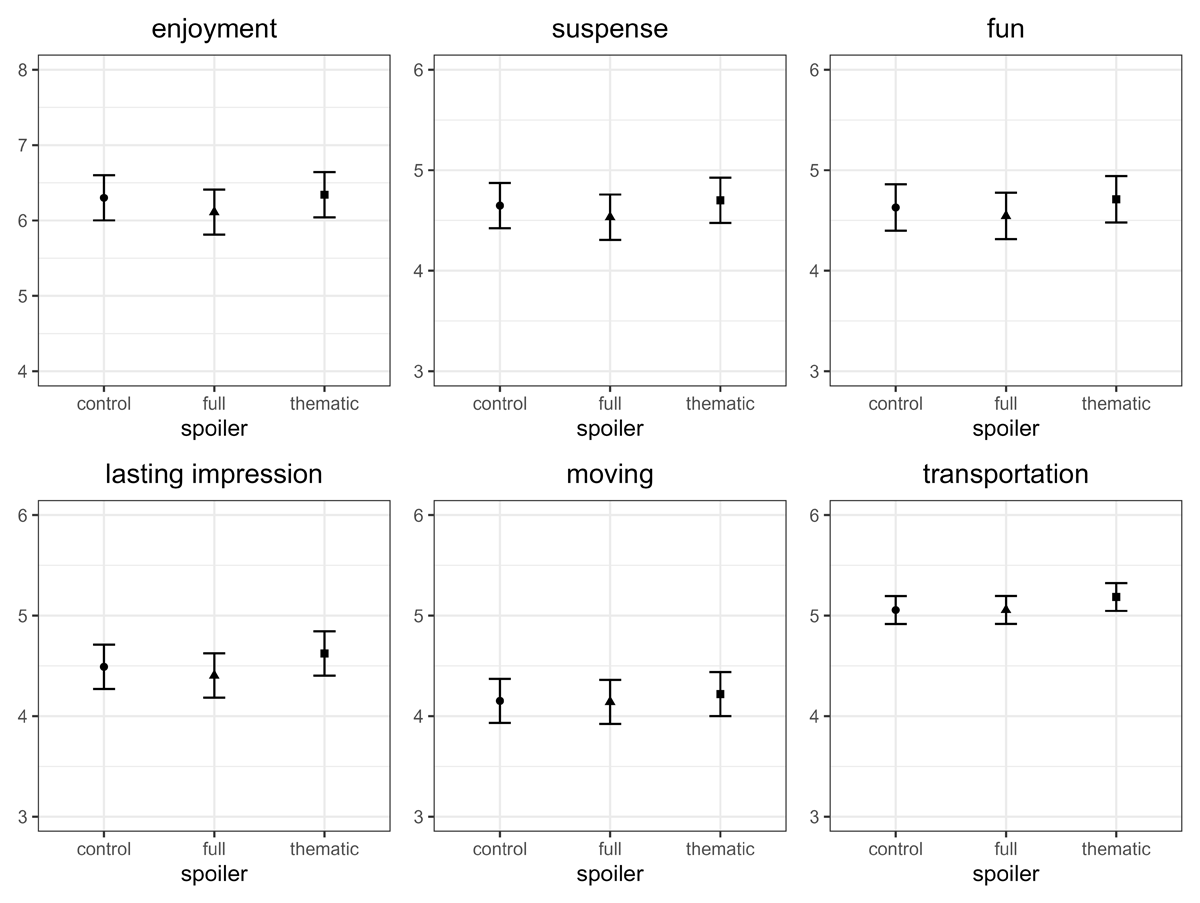
Figure 1
Model-estimated means for all outcomes as a function of spoiler condition. Error bars represent 95% repeated-measures confidence intervals (Jarmasz & Hollands, 2009). The vertical scale of the outcome measures has been expanded to allow closer inspection of the pattern of results.
Table 6
Moderation analyses: Slopes (and 95% CIs) for individual differences variables predicting outcomes, overall and by spoiler condition.
| MODERATOR | OUTCOME | ||
|---|---|---|---|
| ENJOYMENT | SUSPENSE | FUN | |
| need for cognition | 0.39 (0.22, 0.56) | 0.19 (0.08, 0.31) | 0.33 (0.22, 0.44) |
| control slope | 0.38 (0.13, 0.62) | 0.17 (–0.01, 0.34) | 0.29 (0.12, 0.47) |
| full-spoiler slope | 0.57 (0.33, 0.80) | 0.14 (–0.03, 0.31) | 0.45 (0.28, 0.62) |
| theme-spoiler slope | 0.23 (–0.02, 0.47) | 0.27 (0.09, 0.45) | 0.24 (0.06, 0.42) |
| interaction F | F = 2.52 | F < 1 | F = 1.82 |
| print exposure (ART) | 0.09 (0.01, 0.17) | –0.01 (–0.06, 0.05) | 0.08 (0.03, 0.14) |
| control slope | 0.10 (–0.01, 0.21) | 0.04 (–0.04, 0.12) | 0.08 (0.00, 0.17) |
| full-spoiler slope | 0.10 (–0.01, 0.22) | –0.04 (–0.13, 0.04) | 0.07 (–0.02, 0.15) |
| theme-spoiler slope | 0.07 (–0.05, 0.19) | –0.03 (–0.11, 0.06) | 0.10 (0.02, 0.19) |
| interaction F | F < 1 | F = 1.37 | F < 1 |
| need for closure | 0.30 (–0.12, 0.71) | 0.45 (0.18, 0.73) | 0.13 (–0.16, 0.42) |
| control slope | 0.21 (–0.38, 0.80) | 0.42 (0.00, 0.84) | –0.09 (–0.52, 0.34) |
| full-spoiler slope | 0.52 (–0.07, 1.11) | 0.42 (0.00, 0.84) | 0.39 (–0.04, 0.82) |
| theme-spoiler slope | 0.16 (–0.44, 0.76) | 0.51 (0.08, 0.93) | 0.09 (–0.35, 0.53) |
| interaction F | F < 1 | F < 1 | F = 1.47 |
| MODERATOR | LASTING IMPRESSION | MOVING | TRANSPORTATION |
| need for cognition | 0.29 (0.16, 0.41) | 0.28 (0.16, 0.40) | 0.30 (0.22, 0.38) |
| control slope | 0.29 (0.11, 0.47) | 0.24 (0.06, 0.42) | 0.29 (0.18, 0.41) |
| full-spoiler slope | 0.43 (0.26, 0.60) | 0.41 (0.24, 0.58) | 0.34 (0.23, 0.45) |
| theme-spoiler slope | 0.14 (–0.04, 0.32) | 0.19 (0.01, 0.37) | 0.27 (0.15, 0.38) |
| interaction F | F = 3.43* | F = 2.09 | F = 0.59 |
| print exposure (ART) | 0.04 (–0.02, 0.10) | 0.01 (–0.05, 0.07) | 0.04 (0.00, 0.08) |
| control slope | 0.08 (–0.01, 0.16) | 0.02 (–0.07, 0.10) | 0.03 (–0.02, 0.09) |
| full-spoiler slope | –0.01 (–0.09, 0.08) | 0.02 (–0.07, 0.10) | 0.02 (–0.03, 0.08) |
| theme-spoiler slope | 0.04 (–0.05, 0.13) | 0.00 (–0.09, 0.08) | 0.06 (0.00, 0.12) |
| interaction F | F = 1.24 | F = 0.10 | F = 0.72 |
| need for closure | 0.41 (0.10, 0.71) | 0.45 (0.16, 0.75) | 0.21 (0.00, 0.43) |
| control slope | 0.37 (–0.07, 0.80) | 0.36 (–0.06, 0.78) | 0.29 (0.00, 0.58) |
| full-spoiler slope | 0.50 (0.06, 0.93) | 0.58 (0.16, 1.00) | 0.33 (0.04, 0.62) |
| theme-spoiler slope | 0.36 (–0.09, 0.80) | 0.42 (–0.01, 0.85) | 0.02 (–0.27, 0.32) |
| interaction F | F = 0.16 | F = 0.36 | F = 1.78 |
[i] Note. Boldfaced slopes are significantly different from 0 (α = .05). Slopes are unstandardized. *p < .05.
Enjoyment
Enjoyment did not differ significantly across spoiler conditions, F(2, 579.5) = 1.25, p = .29. Delay did not have a significant effect on enjoyment, nor did it interact significantly with spoiler-type. Need for cognition was positively and significantly related to enjoyment, t(324.4) = 4.61, p < .001; a model with an additional quadratic NFC term (cf. Knobloch-Westerwick & Keplinger, 2008) showed no evidence of a curvilinear relationship between NFC and enjoyment. The interaction between need for cognition and spoiler-type was not significant. Need for cognition did not interact significantly with delay (F < 1). Print exposure (i.e., ART scores) was positively and significantly related to enjoyment, t(326.8) = 2.21, p = .03; this relationship did not vary significantly across spoiler-types or delays. Need for closure was not significantly related to enjoyment, t(222.8) = 1.41, p = .16; this relationship did not vary significantly across spoiler-types or delays.
Suspense
Suspense did not differ significantly across spoiler conditions, F = 1.05. Delay did not have a significant effect on suspense, nor did it interact significantly with spoiler-type. Need for cognition was positively and significantly related to suspense, t(305.3) = 3.30, p = .001, but did not interact significantly with spoiler or delay (Fs < 1). Print exposure was not significantly related to suspense, t(311.3) = –0.36, p = .72, and it did not interact significantly with spoiler-type or delay. Need for closure was positively and significantly related to suspense, t(213.3) = 3.21, p = .002, but did not interact significantly with spoiler or delay.
Fun
Fun did not differ significantly across spoiler conditions, F < 1. Delay did not have a significant effect on suspense, nor did it interact significantly with spoiler-type. Need for cognition was positively and significantly related to fun, t(316.5) = 5.77, p < .001, but it did not interact significantly with spoiler-type or delay. Print exposure was positively and significantly related to fun, t(321.1) = 2.99, p = .003; this effect did not vary significantly across spoiler-types or delays. Need for closure was not significantly related to fun, t(216.4) = 0.89, p = .37, nor did it interact significantly with spoiler-type or delay.
Lasting impression
The lasting impression a story had did not differ significantly across spoiler conditions, F(2, 581.4) = 1.81, p = .16. Delay did not have a significant effect on this outcome, nor did it interact significantly with spoiler-type. Need for cognition was positively and significantly related to the lasting impression a story made, t(323.4) = 4.59, p < .001. Moreover, need for cognition interacted significantly with spoiler-type, F(2, 582.2) = 3.43, p = .03. As with enjoyment, the relationship between need for cognition and a story’s lasting impression was significantly stronger for fully-spoiled stories than for thematically-spoiled stories, t(579.4) = 2.62, p = .009. Need for cognition did not interact significantly with delay. Print exposure was not significantly related to lasting impression, t(331.5) = 1.17, p = .24, and it did not interact significantly with spoiler-type or delay. Need for closure was positively and significantly related to lasting impression, t(222.7) = 2.58, p = .01, but did not interact significantly with spoiler or delay.
Moving
The extent to which a story was moving did not differ significantly across spoiler conditions, F(2, 575.3) = 0.26, p = .77. Delay did not have a significant effect on this outcome, nor did it interact significantly with spoiler-type. Need for cognition was positively and significantly related to how moving a story was, t(317.2) = 4.57, p < .001, but it did not interact significantly with spoiler-type, F(2, 577.7) = 2.09, p = .12, or delay (F < 1). Print exposure was not significantly related to how moving a story was, t(321.4) = 0.35, p = .72, and it did not interact significantly with spoiler-type or delay. Need for closure was positively and significantly related to how moving a story was, t(213.4) = 3.01, p = .003, but did not interact significantly with spoiler or delay.
Transportation
Transportation did not vary significantly across spoiler-types, F(2, 576.5) = 2.10, p = .12. Delay did not have a significant effect on this outcome, nor did it interact significantly with spoiler-type. Need for cognition was positively and significantly related to how transporting a story was, t(323.9) = 7.23, p < .001, but it did not interact significantly with spoiler-type or delay. Print exposure was not significantly related to how moving a story was, t(327.1) = 1.84, p = .07, and it did not interact significantly with spoiler-type or delay separately. However, the three-way interaction between spoiler-type, delay, and print exposure was significant, F(2, 580.1) = 6.04, p = .003; although print exposure was generally – though not significantly – positively related to transportation, this relationship was strongest for thematically-spoiled stories at a short delay and unspoiled stories at a long delay (see Figure 2). Need for closure was positively but non-significantly related to transportation, t(222.6) = 1.94, p = .054, and it did not interact significantly with spoiler or delay.
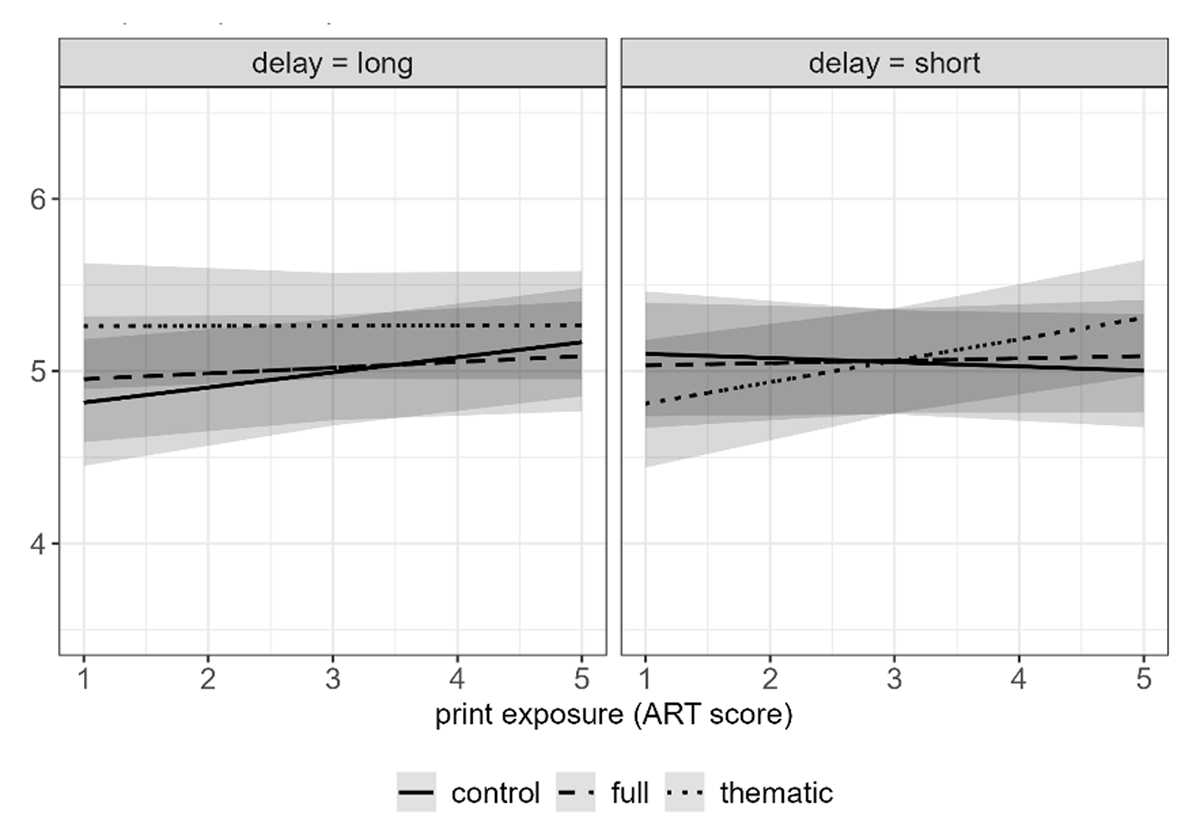
Figure 2
Model-estimated transportation as a function of spoiler condition, delay condition, and print exposure. Bands represent 95% confidence intervals.
Summary of Results: Hypotheses and Research Questions
There was no evidence that full spoilers led to stories being experienced as more thought-provoking or less suspenseful (H1). Full spoilers also had no significant effects on other aspects of the experience of short stories (RQ1). Thematic spoilers did not significantly affect any aspects of the experience of reading short stories (H2 & RQ2). Although need for cognition had a significant positive relationship with most of the outcome measures (H3b), it did not interact significantly with either full or thematic spoilers (H3a, H3c). In contrast with need for cognition, print exposure was only significantly positively related to enjoyment and how much fun stories were, providing partial support for H4, but it did not interact significantly with type of spoiler (H5). Although need for closure was positively related to suspense, the lasting impression a story was perceived to have, and to how moving a story was, this individual-difference variable did not interact significantly with the presence of a spoiler (H6). Finally, our attempt to manipulate fluency by imposing a delay between spoiler and story did not significantly influence reading time, suggesting that fluency was not effectively manipulated, and this delay manipulation did not have a significant effect on any story-reading outcome, nor did it interact with type of spoiler (RQ3).
Discussion
Effects of spoilers on enjoyment
In this study, we presented participants spoilers of two different types before they read short stories with abstract themes and twist endings; after reading, participants provided information about their reading experience and about themselves. One type of spoiler – a full spoiler – provided plot details and the outcome. The other type of spoiler – a thematic spoiler – provided an abstract thematic interpretation, with virtually no information about plot or outcome. Compared to unspoiled stories, neither of these spoiler-types had much discernable impact on enjoyment and other measures of the experience of stories. A manipulation of the delay between the presentation of a spoiler and the reading of a story also had little impact on these outcomes, a finding discussed in more depth below. Despite the non-significant effects of the spoiler and delay manipulations, several outcomes were sensibly and significantly related to individual difference variables, suggesting that these outcome measures have variability across individuals that is related to theoretically-pertinent characteristics of readers. But the influence of spoilers was minimal.
The negligible impact of spoilers on the experience of short stories leaves us unable to draw strong theoretical conclusions based on only our results. However, when these results are considered as part of the literature on the effect of spoilers on short media, we can attempt to draw some conclusions. The pattern of results due to the manipulation of spoilers in this study does not match the beneficial effects of spoilers seen in only a few studies (Leavitt & Christenfeld, 2011; 2013), nor the detrimental effects of spoilers seen in others (Johnson & Rosenbaum, 2015; 2018; Levine et al., 2016; Yan & Tsang, 2016). The present non-significant effects of spoilers on the enjoyment of short stories join those of Daniel and Katz (2019) and Rosenbaum and Johnson (2016). Leavitt and Christenfeld’s findings are outliers in the published literature on the spoiler effects. There is a feature of their methodology and results that might be crucial to understanding their findings: They found that spoilers increased enjoyment only when the spoilers were incorporated into stories as the first paragraph, written in a manner that closely mimicked the style of the story. From the point of view of their readers, these may not have been spoilers so much as a feature of the story’s structure, that is, prolepsis (Bridgeman, 2005). There is evidence that the presentation of information separate from a story, if viewed as a spoiler, leads to an anticipated reduction in enjoyment (Johnson & Rosenbaum, 2015; Yan & Tsang, 2016). Ohtsuka and Brewer (1992) found that stories with flashforwards led to poor comprehension relative to a canonically-order story, but what Leavitt and Christenfeld did was not simply reorder information. When text signals (e.g., overviews) are presented before (expository) text, it often leads to easier comprehension and improved memory, especially for the signaled information (Lorch, 1989). Similarly, Berliner (2020) argues that information planted early in a narrative may contribute positively to aesthetic experience in several ways, one of which is fluency. Given this reasoning, then, it might be best to not label Leavitt and Christenfeld’s spoilers as spoilers, but instead as foreshadowing, plants, or some other form of prolepsis. If this is the case, then careful consideration of not only the information in a spoiler but also how it is presented and whether it is incorporated into a story will be crucial to understanding the variability in findings across different studies.
Fluency
Despite that we were interested in a possible moderating role for fluency, we did not measure fluency directly. Instead, we measured and modeled reading time as an indicator of fluency. We chose not to measure fluency directly because in much of the research demonstrating that fluency influences enjoyment, fluency has been manipulated experimentally (e.g., Galak & Nelson, 2011) to establish that it has a causal relationship with enjoyment and other aesthetic outcomes. If we had measured fluency via self-report (cf. Leavitt & Christenfeld, 2013) after participants provided measures of enjoyment and other aspects of their experience with the story, it would likely have been difficult for them to separate attributions of experienced fluency from their experience of enjoyment. As a result of the manipulation of delay having no evident impact on reading time, as well as the lack of reliable effects of spoilers, we are unable to draw strong conclusions about the role of fluency as a moderator of any spoiler effects.
Individual differences
The individual differences that we measured were related to the experience of stories in a sensible way. Need for cognition, in particular, was positively related to every outcome we measured. Those who enjoy being cognitively challenged had a better experience reading these stories more than those who enjoy such challenges less, mostly irrespective of whether the stories were spoiled, validating once again the need for cognition construct (Cacioppo et al., 1996).
Need for cognitive closure was positively related to self-reported suspense, the lasting impression a story was expected to have, and how moving a story was, across types of spoilers. The relationship especially with suspense is sensible: those who have a greater need for cognitive closure are less comfortable with confusion and ambiguity (Webster & Kruglanski, 1994), so it follows that these individuals would generally experience greater suspense; our results validate this. However, we had expected that those who measured high in this construct might find full spoilers beneficial in suspense reduction, but no such interaction was found. The materials we used were moderately suspenseful and generally brief. Possibly by using more-suspenseful stories and by measuring suspense during rather than after reading, evidence for an interaction like this might emerge.
Print exposure measured via the ART was positively but weakly related to enjoyment and fun. The weak relationship is surprising in light of a strong relationship between ART scores and self-reported general enjoyment of reading reported by Acheson et al. (2008), although these researchers also found that ART scores were only weakly related to the self-reported complexity of what respondents read. Our use a shortened version of the ART, combined with it being presented at the end of a lengthy experiment in which participants read stories that were not self-selected, might have contributed to its relatively low predictive usefulness.
Limitations & caveats
We treated stories as a random-effects variable, consistent with the statistical and theoretical claim that these results will generalize beyond the stories used. But they were not randomly selected, and we used only six stories. Despite this, it is likely that these stories are representative of some larger corpus of texts, but characterizing that corpus is difficult, and making generalizations from a small sample is always fraught with difficulty. Another limitation on the kinds of conclusions we can draw here comes from the nature of the sample and the way it was recruited. The sample was self-selected from a college-student population into a study that was advertised as involving reading stories. We did not collect any demographic data about our participants, so we are unable to directly address any limitations to generalizability based on the sample’s relative homogeneity or lack thereof. However, the sample was obtained from general psychology classes at a large, public university in the southern United States, and as such is not notably diverse in age, ethnicity, or race, nor reading skill. Finally, we used only a subset of the items from Oliver and Bartsch’s (2010) scale. This was done to reduce the number of items participants had to respond to, but this comes at a cost of at least increased measurement error and reduced comparability with other uses of this measurement instrument.
Conclusion
Including the findings of this study, a growing number of studies have demonstrated that spoilers do not change a lot about the experience of stories. The findings of Leavitt and Christenfeld (2011) that sparked this growing research endeavor have not been independently replicated and appear to be an outlier. Continued research on this topic will probably benefit from continued integration with the larger literature on media enjoyment (e.g., Busselle & Bilandzic, 2009; Vorderer et al., 2004) rather than spoilers being considered as a topic unto themselves.
Data Accessibility Statement
The full set of materials used in this research – except for those protected by copyright – is publicly available, along with wrangled data and analysis code, at https://osf.io/54zdq/?view_only=7368d8854ab24f58923bd79087e76e02. The project was preregistered at https://osf.io/cbw5d/?view_only=f1571de5528c4b03b18e775cccf3f7b8.
Acknowledgements
Sydni Ayers, Olivia Chambers, Emily Educate, Dahee Han, Micah Holdman, Kolby Knight, Jessie Merriman, Bailey Parsons, and Victoria Radke assisted with data collection.
Competing Interests
The authors have no competing interests to declare.
Author Contributions
WHL and SKR both conceptualized this research. WHL was responsible for data curation, formal analysis and visualization, and supervised SKR’s written honors thesis. Parts of the latter were adapted in this manuscript, which was otherwise written and edited by WHL.