
Table 1
Questions to measure Storyworld Possible Selves.
| TEMPORAL DIMENSION OF THE SELF | QUESTION |
|---|---|
| Present Self SPS | I recognized several aspects of myself in one of the characters in the story. |
| Past self SPS | One of the characters in the story reminded me of who I was some time ago. |
| Desired Possible Self SPS | One of the characters in the story got me thinking about the person that I would like to become. |
| Feared Possible Self SPS | While reading the story, I found myself worried that one day I could become like one of the characters. |
Table 2
Coding scheme for mixed-methods content analysis.
| CODE | EXAMPLE QUOTE | κ |
|---|---|---|
| Direction of Transformative effects | ||
| Present self: This code was assigned when the reading experience impacted the self of the reader as it was perceived at the time of reading. For example, it made the participant view their present life/opinions in a different light, or it prompted feelings of self-recognition with aspects of the storyworld that are similar to their own. | “It really got me into the story and made me think about how fortunate I am to live where and when I do.” (Book reader) | .59 |
| Past self: This code was assigned when the reading experience impacted the readers’ perception of who they were in the past. For example, it activated self-related memories in the participant, often leading to cathartic feelings. | “Through the game’s main character, I was able to relive the past in a safe, controlled environment, but this time with support. Through the game, I was able to vicariously confront my experiences.” (Digital Fiction reader) | .69 |
| Desired Possible Self: This code was assigned when the reading experience prompted the image of a future-oriented self in the reader, with a positive connotation. For example, it made the participant realize who they wanted to become or what they wanted to do. | “This book is basically a small nudge in the right direction, and that’s what I needed to begin to put my life back together. […] Turgenev’s vision of a life lacking purpose other than greed is beautiful and heartbreaking enough to shake me out of my stupor.” (Book reader) | .61 |
| Feared Possible Self: This code was assigned when the reading experience prompted the image of a future-oriented self in the reader, with a negative connotation. For example, it made the participant visualize the possibility of becoming something they fear, or of living in difficult times. | “My favorite character turned from a brutally relatable person to someone whose absolutely disgusting actions I simply couldn’t condone and it hurt. […] but it made sense, and there was no other way he, after those experiences, could have turned out. Watching someone you could relate to end up like that really makes you think if you’d turn out the same.” (Digital Fiction Reader) | .67 |
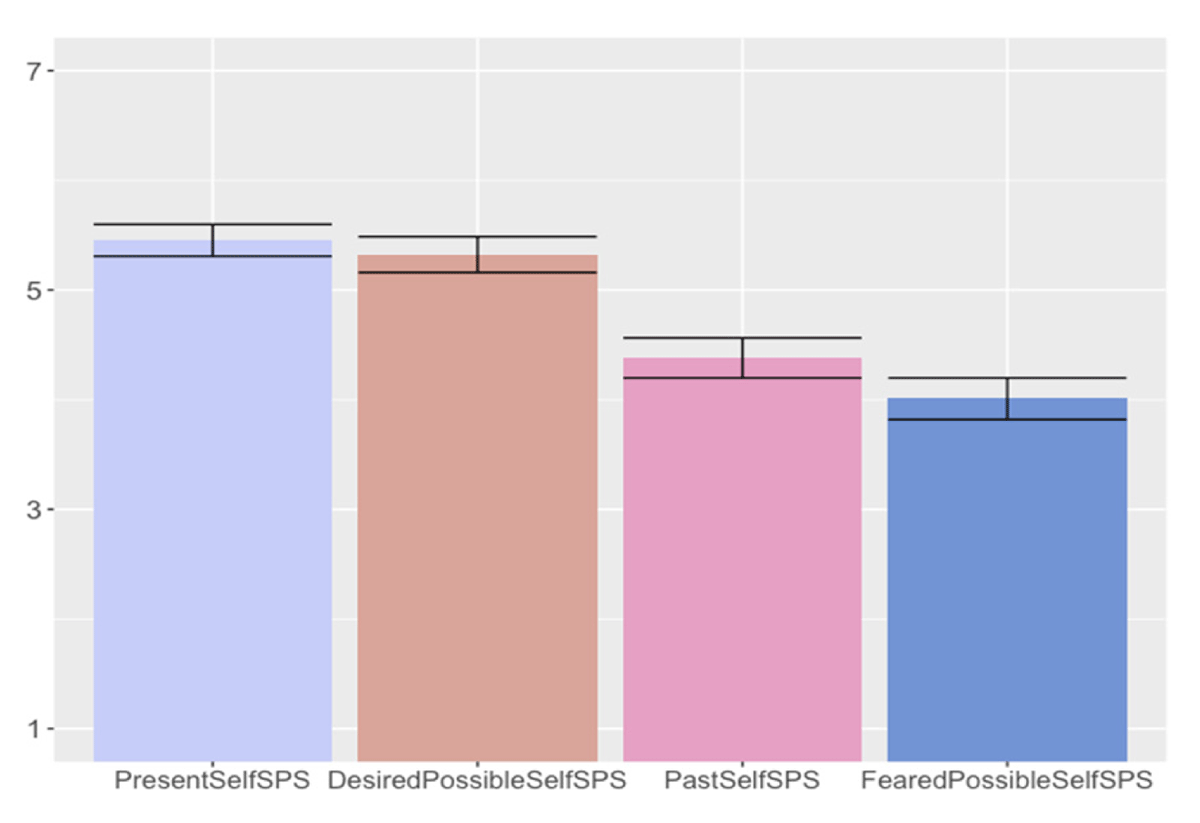
Figure 1
Mean scores on storyworld possible selves questions.
Table 3
Multiple regression analysis with the SWAS dimensions as predicting variable and each of the SPSs questions as outcome variables.
| B | 95% CI FOR B | SE B | β | R2 | P | ||
|---|---|---|---|---|---|---|---|
| LL | UL | ||||||
| Present Self SPS | |||||||
| .28 | <.001 | ||||||
| Intercept | 1.39 | 0.36 | 2.44 | 0.53 | <.001 | ||
| Emotional Engagement | 0.55 | 0.39 | 0.71 | 0.08 | 0.34 | <.001 | |
| Transportation | 0.48 | 0.36 | 0.61 | 0.06 | 0.41 | <.001 | |
| Mental Imagery | –0.12 | –0.26 | 0.02 | 0.07 | –0.08 | .09 | |
| Attention | –0.18 | –0.35 | –0.03 | 0.08 | –0.12 | .02 | |
| Age | 0.01 | –0.01 | 0.02 | 0.01 | 0.04 | .31 | |
| Desired Possible Self SPS | |||||||
| .21 | <.001 | ||||||
| Intercept | 1.93 | 0.72 | 3.15 | 0.62 | <.002 | ||
| Emotional Engagement | 0.52 | 0.34 | 0.71 | 0.09 | 0.29 | <.001 | |
| Transportation | 0.23 | 0.08 | 0.38 | 0.08 | 0.18 | .002 | |
| Mental Imagery | –0.05 | –0.22 | 0.11 | 0.08 | –0.03 | .52 | |
| Attention | 0.06 | –0.13 | 0.26 | 0.10 | 0.04 | .50 | |
| Age | –0.04 | –0.05 | –0.02 | 0.01 | –0.17 | <.001 | |
| Past Self SPS | |||||||
| .23 | <.001 | ||||||
| Intercept | 0.85 | –0.56 | 1.80 | 0.68 | .21 | ||
| Emotional Engagement | 0.44 | 0.24 | 0.64 | 0.10 | 0.22 | <.001 | |
| Transportation | 0.66 | 0.50 | 0.83 | 0.08 | 0.45 | <.001 | |
| Mental Imagery | –0.05 | –0.23 | 0.13 | 0.09 | –0.03 | .56 | |
| Attention | –0.32 | –0.53 | –0.11 | 0.10 | –0.16 | .003 | |
| Age | –0.01 | –0.03 | 0.01 | 0.01 | –0.03 | .48 | |
| Feared Possible Self SPS | |||||||
| .18 | <.001 | ||||||
| Intercept | 1.68 | –0.40 | 2.16 | 0.73 | .02 | ||
| Emotional Engagement | 0.16 | –0.06 | 0.38 | 0.11 | 0.08 | .16 | |
| Transportation | 0.64 | 0.47 | 0.82 | 0.09 | 0.42 | <.001 | |
| Mental Imagery | –0.02 | –0.21 | 0.18 | 0.10 | –0.01 | .77 | |
| Attention | –0.16 | –0.39 | 0.06 | 0.11 | –0.08 | .16 | |
| Age | –0.02 | –0.04 | –0.003 | 0.01 | –0.1 | .02 | |
[i] Note: N = 468. CI = confidence interval; LL = lower limit; UL = upper limit.
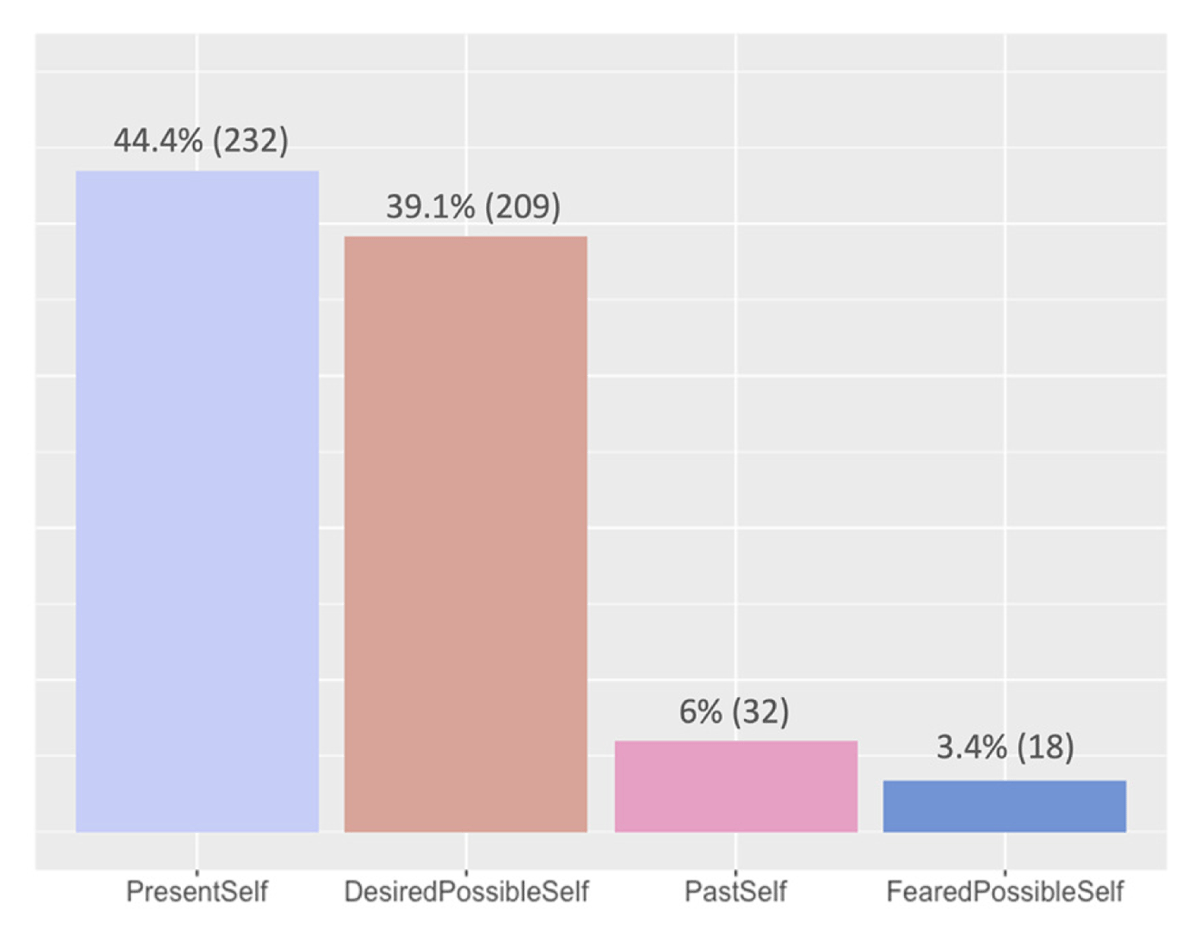
Figure 2
Transformed dimensions of the self concept: relative frequencies.
Note: The percentages represent relative frequencies in the overall set of responses. The exact counts of responses that were coded at least once with the corresponding dimension of the self are reported in brackets.
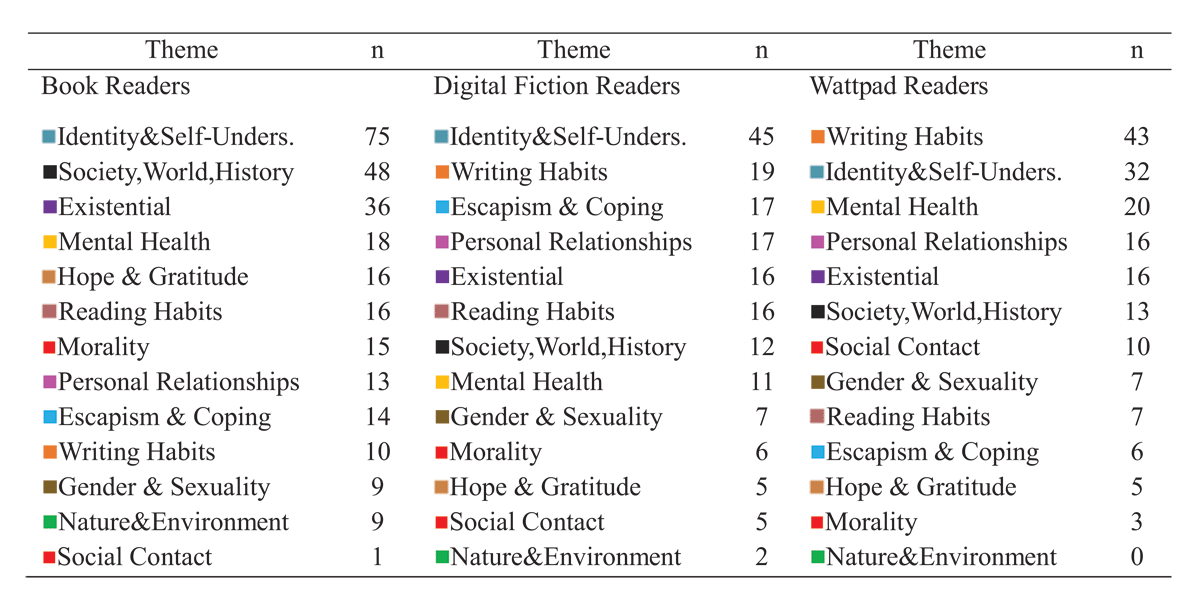
Table 4
Frequencies of life themes across groups.
Note: Sample sizes: Books (N= 227); Digital Fiction (N= 149); Wattpad (N= 167).