
1. Introduction
One of the powers ascribed to reading fiction is that it helps readers to learn about themselves, expanding and shaping their senses of self. Indicative of this conviction is not only the anecdotal evidence that can be found in the many personal testimonies of readers (Mermelstein & Feyer, 2020) but the empirical evidence gathered by numerous studies that showed how engaging with fictional texts can elicit self-modifying feelings (Fialho, 2012; Kuiken et al., 2004), transformative effects (Fialho, 2019; Tangerås, 2020) and self-altering experiences (Kuiken & Sopčák, 2021). Other studies contributed more specifically to the question of how reading fiction impacts the self-concept, by addressing the role of self-relevance in experiencing narratives (see review in Kuzmičová & Bálint, 2019), by showing how readers can temporarily assimilate a fictional character’s personality traits into their self-concept (Sestir & Green, 2010), and by arguing that identification with fictional characters provides a safe venue for trying on alternative identities and exploring various possible selves (Alber, 2020; Johnson et al., 2016; Shedlosky-Shoemaker et al., 2014; Slater et al., 2014).
This study investigated how reading fiction activates and transforms different dimensions of the self-concept. For this purpose, following Martínez (2014, 2018), we adopted Markus and Nurius’ (1986) self-concept as a dynamic network of temporal dimensions, that is, the present, or actual, self (enclosing several self-schemata), past selves, and both desired and feared future possible selves. We expand on the existing research about the impact of reading on self-concept, by distinguishing between the activation and the transformation of these different temporal dimensions of the self-concept, as we assume that such an approach may provide a more fine-grained picture of the impact of reading. We acknowledge that the concept of “transformation” of the self as a result of reading fiction is a broad and fuzzy one, as it can encompass a large range of experiences, from life-changing encounters with a text (Tangerås, 2020) to comparably less strong (but not less important) effects such as broadening readers’ insights about themselves and others (Fialho, 2019), or about topics of general social interest (e.g., activism against climate change, Schneider-Mayerson et al., 2020). In a broader sense, transformative reading experiences can be simply defined as “significant” or “meaningful.” In the context of this study, we adopted an exploratory approach, considering as “transformative” every reading experience that readers themselves perceive as having left a significant impact on them (i.e., perceived transformation, Loi et al., in press). Furthermore, while previous research reviewed above tended to focus only on one type of fiction reading (i.e., books – may they be novels, short stories, or poems), we investigated self-reported transformative reading experiences within a more comprehensive range of contemporary reading practices: books (print and eBooks), digital fiction (e.g., hypertext, interactive fiction, visual novels), and Wattpad (i.e., the most popular digital storytelling platform) to capture and explore the broad diversity of transformative experiences with fiction.
2. Theoretical framework
2.1. Temporal dimensions of the self-concept
In simple terms, the self-concept is a collection of beliefs in various domains that individuals hold about themselves. Such beliefs, for example “I am a caring friend” or “I am independent,” are called self-schemata, that isi.e., “cognitive generalizations about the self, derived from past experience, that organize and guide the processing of self-related information contained in an individual’s social experience” (Markus, 1977, p. 63). Self-schemata represent a multidimensional view of who we are in the present (the present or actual self), as they are active in several different domains (Bracken, 1996), from the physical (how we perceive our appearance), academic (how we perceive our general abilities in knowledge fields, e.g., math, science), and emotional (how we perceive our emotional states) selves, to the social or interpersonal self (which is a transversal dimension that highlights how the self is deeply grounded in the ecology of its interactions with both significant and general others, Frazier & Hooker, 2006).
Moreover, and most importantly, the self is not only multidimensional but also dynamically distributed in time: past and future selves shape the self-concept and influence present behavior (Markus & Nurius, 1986). Past selves refer to our perception of who we were in the past, they are constructed from autobiographical memory (Strahan & Wilson, 2006), and, regardless of how malleable such memories might be, are key to the personal narrative that sustains the self (Bruner, 2004; Sedikides & Skowronski, 1995). But how do we relate past selves to the present self? There is evidence that we project our current beliefs on the past, either to establish a sense of continuity into the present or to distance ourselves from a previous identity or behavior that we no longer endorse (Osborn et al., 2022; Ross & Wilson, 2002). We also often venture into the past (a) to reinterpret past experiences in a new light, for example by acknowledging or confronting trauma (Pennebaker & Beall, 1986); or (b) to imagine how an alternative course of events might have led to different outcomes in the present (a cognitive process known as counterfactual thought, which can lead to affective responses that range from regret to self-appraisal, Roese & Olson, 2014).
The future-oriented component of the self has been extensively studied through the notion of possible selves, established by Markus and Nurius (1986; see also Dunkel & Kerperman, 2006; Oyserman & James, 2012). Possible selves are mental representations of who we might become in the near or distant future, and they can differ in valence between who we would like to become (desired possible selves) and who we are afraid of becoming (feared possible selves). An example of a desired and a feared possible self might be, respectively, “the successful self” and “the depressed self.” However, the content of possible selves varies highly across individuals, depending on personal goals, hopes, fears, social context, and the expectations of others (Dunkel & Kerperman, 2006). Moreover, past experiences incorporated in the present self naturally have a role in the creation of possible selves, and Markus and Nurius (1986) argue that past selves can even become possible selves when an individual feels like a former self (e.g., the good student self, the heartbroken self) could become salient again in their future (e.g., by studying more in the future, by the end of another relationship).
In sum, possible selves are essentially future projections, but they are generated in the present, where they can serve one of their primary functions, i.e., “to provide a context in which to evaluate the current or real self” (Knox, 2006, p. 62). Confronting possible versions of ourselves can elicit a variety of affective and behavioral reactions. For example, Higgins (1987) investigated specific types of possible selves and showed that perceiving a discrepancy between who we are (actual self) and who we would like to be (ideal self) or who we should be (ought self) leads to feelings of sadness and anxiety, respectively; however, when we perceive possible selves as situated in a realistic and tangible future, they can impact us deeply and positively, as they are a source of motivation, functioning as roadmaps to attain future goals or avoid dreaded outcomes (Oyserman et al., 2004). This is the reason why possible selves – as powerful drivers for developmental change and personal transformation – have been applied in experimental and clinical contexts, often in the form of interventions, and across a wide range of target groups, such as clinical populations (Aardema et al., 2018), adolescents (Oyserman & Fryberg, 2006), divorced women (King & Raspin, 2004), elderly adults (Ryff, 1991), young fathers in prison (Meek, 2007), and several marginalized groups (Burke & Park Taylor, 2022; Peterson, 2011).
2.2. Storyworld possible selves
One of the reasons why Markus and Nurius’ (1986) formulations were so innovative is that they essentially “found a way to measure the role of fantasy within the self-concept” (Segal, 2006, p. 84), thus paving the way for investigations of how the self-concept is impacted when we engage with the quintessential realm of possibilities, that is, fictional worlds. As readers, we enter a storyworld carrying our actual world experience, our memories, and our possible selves. Here we meet characters that have their view of the textual actual world, onto which they project their wishes and fears (Ryan, 1991), which might just as well be called a character’s possible selves. Through this encounter, we can even identify with characters that are radically different from us. Experiencing the (fictional) world as if we were in their shoes can temporarily expand the boundaries of our self by suspending the limitations of our personal identity, thus allowing for an exploration of our unrealized (and often unrealizable) potentials (Slater et al., 2014). Other times – as pointed out by studies that focus on the role of self-reflection as a driver for character engagement (Bortolussi et al., 2018) – we might bond with characters because they hold a certain degree of personal relevance to us (Kuzmičová & Bálint, 2019). For example, they resemble our actual selves, trigger episodic memories of our past, or feed our imagination about who we might become in the future. While there is evidence that reading about characters that represent either one’s actual present self or one’s ideal self increases cognitive overlap and perceived self-expansion respectively (Shedlosky-Shoemaker et al., 2014), there are no systematic empirical investigations of the impact of reading fiction on the self-concept through a comprehensive approach that includes all its temporal dimensions. Hakemulder’s (2015) unpublished study is an exception in this respect. It investigated what “company readers seek” when selecting narrative texts for rereading. Participants were asked to think of a narrative they liked but were not planning to reread, and then to think of a narrative they liked and reread once, or more than once. Next, they were asked to what extent the characters in those two stories resembled their present self, past selves, hoped-for possible selves, feared possible selves, ideal selves, or not-me selves. It was found that characters in the texts that were reread inspired significantly higher scores on present, hoped-for, and ideal selves. The measures that were used in Hakemulder’s study have a natural affinity with a theoretical concept that lends itself quite well for operationalization, namely storyworld possible selves.
Martínez (2014, 2018) introduced storyworld possible selves (SPSs) as a means to explain the underlying mechanisms of narrative engagement and readers’ emotional responses. SPSs are “mental models of the self projected into storyworlds” (Martínez, 2018, p. 119), activated through a conceptual blend between two mental constructs: (a) the reader’s mental representation of a perspectivizing entity in the fictional world (a focalizer or narrator) and (b) the reader’s self-concept, that is, a network of self-schemas and possible selves. She proposes five types of SPSs, four of which echo Markus and Nurius’ (1986) conceptualizations of the self-concept (self-schema SPS, desired possible self SPS, undesired possible self SPS, past possible self SPS). The fifth type of SPS is the past SPS which differs conceptually from the other four and is defined as “past projections of the self in storyworlds [that] intervene in immersive processes of three types: genre echoes, emotional response predictions, and intertextual resonance” (Martínez, 2018, p. 132). Martínez argues that the emergence of SPSs is anchored in a series of linguistic expressions in the text (e.g., doubly-deictic you, multiply-deictic one, indefinite pronouns) that create SPS nodes, or “grammatical slots which one might feel tempted to occupy, and the abstract entity which allows the conceptualization of this metaleptic move is an SPS” (Martínez, 2018, p. 60). This linguistic anchoring is at the center of previous investigations of the theory of storyworld possible selves. Indeed, previous studies (Martínez, 2021; Martínez & Sánchez-Pardo, 2019) typically focus on close readings of literary texts by speculating about readers’ possible elaborations on primary SPSs because they can be predicted from socio-cultural knowledge and shared values, such as the adventurer desired SPS in Melville’s (1851) Moby Dick (Martínez, 2018). However, Martínez acknowledges that some SPSs, which she calls slipnets, are highly dependent on personal experience and thus cannot be predicted.
Overall, her theory is well-elaborated, convincing, and overarching in all facets of narrative engagement. This comprehensive nature, however, inevitably requires caution and a certain amount of simplification when attempting to investigate it empirically. If one were to test all its networked components at once and on both levels of text and reader, accounting for the high variability across different readers, they may easily fail to generalize any result beyond the one tested text stimulus. Indeed, the only empirical investigation carried out with an SPS framework so far is a small-scale qualitative study that investigated readers’ SPSs within their interpretation of a text-less, one-page graphic narrative (Martínez & Herman, 2020).
Since we aim to investigate how reading fiction activates and transforms the temporal dimensions of the self-concept on the level of general trends, we believe that a necessary first step is to temporarily disentangle the framework of storyworld possible selves from its linguistic anchoring to look at the experience of actual readers with a wide range of texts. In his take on SPSs theory, Alber’s (2020) formulations already move in a similar direction. Intending to lay the ground for quantitative investigations into Martínez’s theory, he refers to SPSs as a blend of readers’ self-concept and fictional characters, rather than the broader range of focalizers and narrators. He also looks at how readers’ individual differences in states and traits might influence their creation of SPSs, hypothesizing, for example, that “readers who like to reminisce about the past, experience the highest degree of identification when they create past self SPSs” (Alber, 2020, p. 29).
In our contribution to operationalizing SPSs theory, we propose a way to investigate the reader’s self-reported perception of storyworld possible selves. Following Alber, we focus on fictional characters, and we exclude the intertextual type of past SPSs from our revised typology, reported below:
– Present Self SPS: The reader recognizes a general resemblance between a fictional character and their perception of who they are in the present. Following Markus’ (1977) terminology, Martìnez (2018) correspondingly refers to this type of SPS as self-schema SPS. In our conceptualization, we prefer to simplify the terminology by employing the term “present,” which stresses the temporal dimension that interests us. Often it is not only one self-schema (e.g., “the parent self”) that is involved in this form of mirroring, but rather multiple self-schemata at once (or what Martìnez calls parallel SPS blending, e.g., “the parent self” + “the stressed self” + “the caring self”).
– Past Self SPS: The reader encounters a character that resonates with one of their past selves, typically because the character’s experiences or attitudes in the present remind them about going through a similar experience or possessing certain attitudes (may they be positive or negative) that no longer describe their present self-concept. Martínez referred to this SPS as past possible self SPS, but we decided to modify this terminology slightly to highlight that past selves are not necessarily possible selves; they rather can be possible selves only “to the extent that they may define an individual again in the future” (Markus & Nurius, 1986, p. 955).
– Desired Possible Self SPS: The reader encounters a character that makes them envision a future version of themselves that they wish to attain, i.e., they would like to resemble certain aspects of that character in the future (e.g., traits, personal or professional goals). In a formulation that echoes the TEBOTS model (Slater et al., 2014), Alber stresses that, through desired SPSs, the reader “assumes the identity of someone whose bodily appearance or psychological set-up is radically different from her or his own” (Alber, 2020, p. 25); while this can be indeed one function of desired SPSs, in this study we do not put the focus on differences that are necessarily radical, as we are more interested in desired SPSs that the reader projects onto a character because it embodies characteristics that he or she can realistically imagine to possess in their future.
– Feared Possible Self SPS: The reader encounters a character that makes them envision a future version of themselves that they are afraid of becoming, for example because the character embodies the long-term consequences of a negative trait that the reader displays in their present, or because the character is going through an experience that the reader feels like, under certain circumstances, one day might happen to them as well. In our view, characters that activate feared possible self-SPSs do not only “display features we dread” (Alber, 2020, p. 26) - a formulation that leads to Alber’s inclusion of Lolita’s Humbert Humbert among representative examples – but rather features we feel might describe us in the future. Thus, more pertinent examples could be characters experiencing the devastating effects of the environmental crisis, grief, depression, or unemployment.
Overall, assessing storyworld possible selves can reveal which dimensions of the self-concept are activated by a reading experience, but such activations do not guarantee that the self-concept subsequently underwent change or transformation. Yet, SPSs blends with fictional characters certainly hold at least the potential to prompt lasting changes in the self-concept. Martínez argues that SPSs can generate effects on the reader’s self-concept and identity in terms of what Eder et al. (2010) describe as a “spillover from fictional to actual” (p. 413). She implies that the potential for transformation is one of the drives for the activation of SPSs by specifying that “it is not the whole of the reader’s self-concept that is projected inside the storyworld, but the part of it activated on criteria of relevance and to meaning-construction and self-transformation” (Martínez, 2018, p. 58). This transformative potential remains to be investigated and cannot be inferred from the activation of an SPS alone. While our formulation does not solve this gap completely, we tied our view of SPSs to the concept of psychological proximity (Ross & Wilson, 2002; Bashir et al., 2014) by conceptualizing the future-oriented dimensions of desired and feared possible selves in the form of projections that are perceived as realistic possibilities for the reader’s future. Strahan and Wilson (2006) demonstrated that possible selves regarded as close in time or subjectively accomplishable have more impact on present identity and behavioral motivation than possible selves that are perceived as temporally or psychologically distant. In other words, they have more transformative potential. Still, if a reader activates an SPS while reading about a fictional character, there is no guarantee that this activation will lead to a change in their self-concept, nor that its effects will last in time, leaving marks beyond the here-and-now of the reading experience. We have tried to mitigate this limitation in designing our study, as described below.
2.3. Present study
We aim to investigate which of the four temporal dimensions of the self-concept, as described above, are activated and transformed by reading fiction. If we were to focus on one text, testing how it activates and transforms the self-concept in a group of readers, the results would inevitably be bound to the story characters and themes found in that particular text. Instead, to let a possible general trend emerge – and acknowledging that not every text has the potential to resonate with a reader’s self-concept – we decided to focus on a wide range of self-selected reading experiences that readers themselves retrospectively identify as transformative. Moreover, since contemporary reading practices spread beyond the traditional fiction books in print (and even beyond eBooks, Rebora et al., 2021), we carried out this study with three different groups: readers of (1) books (both in print and eBooks), (2) digital fiction (e.g., hypertext, interactive fiction, visual novels) and (3) Wattpad, the most popular digital storytelling platform. The purpose of investigating these three reading practices is not just to broaden the scope of previous research on transformation through reading, but also to explore whether we can observe general patterns of how reading fiction activates and transforms the self-concept. However, we can imagine that the three reading practices, through their own peculiarities, may also activate different temporal dimensions of the self-concept.
Digital fiction and digital storytelling platforms display a few structural peculiarities that make them differ from “regular” books as well as each other; thus, there is a chance that these differences can lead to divergent tendencies when it comes to which temporal dimensions of the self-concept are more and less frequently impacted by engaging with each reading practice. Digital fiction includes a broad range of narrative phenomena read on digital screens, and conceptually it is at the crossroads between literature and video games; non-exhaustive examples are interactive fiction, hypertext, literary games, visual novels, and network writing. They are highly interactive text-based narratives that often include audio-visual elements, and what connects such diverse works is that “each reading […] is different, either because the reader takes a different pathway through the text or because the text offers a different version of itself” (Bell et al., 2014, p. 5). The active interaction of the reader, who moves through the story in the shoes of a character, has the potential to deepen some facets of the “trying on another identity” experience, may it be to relive familiar situations and play around with plausible outcomes, or to explore unknown territories in the realm of identity.
Digital storytelling platforms, on the other hand, are online communities of user-generated stories (e.g., Wattpad, ArchiveofOurOwn, fanfiction.net). We chose to focus specifically on Wattpad not only because it is the most popular among such platforms (90 million monthly active users, Wattpad, 2022) but also because it displays comparably higher levels of socially interactive features, since readers can comment on story chapters up to each line, providing feedback to peer-authors, expressing their emotional reactions to the text, and creating social bonds (Kraxenberger & Lauer, 2022; Pianzola et al., 2020). Both the social aspect of reading on Wattpad, as well as the fact that it is a platform that is typically used by young adult readers who enjoy reading romance stories predominantly (Loi et al., in press), could lead to comparably more activation of desired possible selves (younger individuals tend to generate more possible selves, Cross & Markus, 1991).
The first step of our study was to assess which dimensions of the self-concept were activated by reading fiction. This “activation” is defined as the emergence of a storyworld possible self, that is, a blend between the reader and a character in the story that involves aspects of the reader’s present self, past self, or a (desired or feared) possible self. Drawing from Martínez’s (2014, 2018) and Alber’s (2020) conceptualization of SPSs, we developed four questions to retrospectively measure the activation of storyworld possible selves, thus constructing a simple instrument to answer our first research question:
RQ1: Which storyworld possible selves are more frequently activated during reading?
We are also interested in how some aspects of the reading experience may affect the generation of SPSs. Bálint and Tan (2019) observed that readers spontaneously and frequently mentioned similarities and desired similarities with fictional characters when they described their highly absorbed narrative experiences. Thus, we believe that some dimensions of state Story World Absorption (Kuijpers et al., 2014) may relate to the activation of storyworld possible selves. In Kuijpers et al.’s (2014) formulation, story world absorption refers to the reader’s sense of psychological relocation into the fictional story world, and its four main components are Attention (deep concentration); Emotional Engagement (feelings towards characters); Mental Imagery (being able to imagine the fictional world); and Transportation (traveling from the actual world to the storyworld). While a link between SPSs and emotional engagement seems particularly likely due to the shared focus on characters in these concepts, we also believe that transportation might play a crucial role in facilitating the emergence of SPS blends. Indeed, as transportation refers to experiencing the storyworld from within (Green et al., 2008), it embodies the concept of ontological crossing or deictic shift, a key prerequisite for momentarily setting aside the current limitations of our identity (Slater et al., 2014). Not only is there evidence that transportation favors cognitive overlap and assimilation effects between readers and story characters (Sestir & Green, 2010), but crucially it was also found to predict self-expansion (Shedlosky-Shoemaker et al., 2014), leading Forster (2021) to hypothesize that narrative consumers “experience self-expansion most not by assuming someone else’s identity within the narrative but by bringing their own self-concept into the fictional world” and by blending a part of their self-concept with a fictional character (p. 267). We can now summarize our second research question as follows:
RQ2: Does story world absorption relate to the activation of storyworld possible selves?
The second main aim of our study is to measure which dimensions of the self-concept are transformed by reading fiction. We consider transformation to occur when readers themselves feel that the text left a lasting impact on them (perceived transformation, Loi et al., in press). These reported effects come in varying degrees, ranging from the expansion or reinforcement of active self-schemas (e.g., readers say they gained a fresh outlook on their present self), to the more tangible change of generating new possible selves or cathartically reframing past selves. We have recognized that SPS questions alone can only tell us whether different dimensions of the self-concept were activated, not if they were transformed as a result of the reading experience. Moreover, as SPSs are tied to fictional characters, focusing on this construct alone, we risk missing out on other fiction-elicited effects. There are no grounds to exclude the possibility that formal aspects (e.g., literary style) or the general content of a story can elicit long-lasting effects on readers’ self-concepts. Thus, we will look at these transformative effects regardless of whether they were prompted by a fictional character or other textual features. Our third research question reads:
RQ3: Which temporal dimensions of the self-concept are transformed by reading fiction?
For this purpose, we will focus on readers’ descriptions of how a certain reading experience had an impact on their lives, adopting a deductive mixed-methods approach (Schreier, 2012) to identify which dimensions of the self-concept were transformed as a result. Locating these perceived transformative effects on the self when they are spontaneously reported by readers – by assigning designated qualitative codes – allows us to spot if there is a general trend across all three reading practices (e.g., if perceived transformative effects on the present self are more commonly coded than effects on the past self, and if this hypothetical tendency holds for all three groups of readers). We will then compare the relative frequencies of these codes with the mean scores on SPS questions in the first section, in order to see whether they display a similar trend. Furthermore, while it is important to stress that these two measures are conceptually distinct (in our study, SPSs deal with fictional characters only, while coded transformative effects could be elicited also by other textual features), we are still interested in investigating whether they spontaneously overlap, that is, whether reporting a transformative effect on a particular temporal dimension of the self-concept coincides with a higher score on the SPS question about the same dimension.
The last step of this study dives deeper into the content of these perceived transformative effects on the self-concept. We will investigate which life themes (i.e., areas of readers’ lives) are affected by reading. Previous studies on possible selves (e.g., Frazier & Hooker, 2006) often make use of a coding scheme developed by Cross and Markus (1991) that assigns participants’ responses to a wide range of theme-categories, such as “abilities and education,” “relationships,” “health.” As we not only took into account possible selves but also perceived transformative effects on all temporal dimensions of the self-concept, we let similar categories emerge inductively from the readers’ descriptions. Thus, our final research question is:
RQ4: Which life themes are transformed by reading fiction across the three reading practices under investigation?
By answering this question, we hoped to identify further differences between readers of books, digital fiction, and Wattpad. For example, since there is previous research indicating that Wattpad readers often also write stories themselves and that they predominantly use the platform to form cooperative social bonds with other users (Kraxenberger & Lauer, 2022), we might expect that perceived transformative effects ascribable to writing habits or finding online friendships will be particularly common for Wattpad readers. Overall, our aim for this last section is to provide an explorative outlook on how fiction impacts our lives, hoping to encourage future research endeavors on the transformative effects of reading that will take into account the various nuances of different contemporary reading practices. To this end, we provide under this link (https://osf.io/rjucy/) our dataset on transformative reading experiences reported by readers of books, digital fiction, and Wattpad, complete with the measures that we will now describe.
3. Methods
3.1. Procedure
We distributed an online Qualtrics survey in three versions: for readers of books (i.e., in print and e-books), digital fiction (i.e., hypertext, interactive fiction, e-poetry, etc.), and Wattpad (i.e., the most popular digital storytelling platform). Targeting these three distinct groups of readers, we took care to distribute the survey link on online communities that revolved around the three reading practices by identifying dedicated groups or threads on social media (i.e., Facebook, Twitter), forums, and other online communities (i.e., Reddit, Wattpad, Goodreads, Discord). The versions were analogous in content but custom-targeted to the three readerships through slight phrasing adjustments. For further details, the three survey versions and the recruitment messages used to advertise them are available under this link: https://osf.io/rjucy/. This survey collected data for a larger research project that included three distinct sections: (a) a section on reading habits and motivations, measuring participants’ reading frequency with all three reading practices, their genre preferences (adapted Reading Habits Questionnaire, Kuijpers, Douglas & Kuiken, 2020) and their motivations for reading (adapted version of the Motivations for Entertainment Consumption scale, Oliver & Raney, 2011); (b) a section on transformative reading experiences, in which we asked participants whether, within the last two years, they had a reading experience (with a book, a work of digital fiction, or a Wattpad story, respectively) that had a significant impact on them. If they responded with a yes to this question, they were asked to describe this experience, and then to complete two retrospective questionnaires on storyworld absorption and storyworld possible selves with their chosen text in mind; and (c) a quasi-experimental section in which participants were asked to read two randomized short excerpts from a novel, write down their immediate reactions to them and complete questionnaires on two personality traits (i.e., Maximization and Regret, Schwartz et al., 2002) as measures of individual differences. Finally, we collected demographics such as age, gender, whether they were native English speakers, and in which language they usually read fiction. Completing the entire survey took participants on average 38 minutes for readers of books, 49 minutes for readers of digital fiction, and 44 minutes for readers of Wattpad.
Sections 1 and 3 were not considered in the analyses central to this paper but are discussed elsewhere (for section 1, dedicated to investigating which genre preferences and motivations for reading seem to favor the occurrence of transformative reading experiences, see Loi et al., in press). For the present contribution, we deemed only participants who reported a transformative reading experience to be eligible, and they were therefore invited to complete the relevant measures of the survey in section 2. As an incentive for participation, participants were given the possibility to take part in a raffle for a total of 30 gift cards worth 25€ each (i.e., gift cards for Netflix, Steam, Amazon, Apple Store, or Google Play). Data collection ran from May to September 2021. The survey protocol was approved by the Ethics Committee at the University of Basel.
3.2. Participants
Out of a total of 814 participants, 66.7% reported having had a transformative reading experience, completing section 2. Thus, the final sample for this study consists of 543 participants, divided across three groups: readers of books (N = 227), digital fiction (N = 149), and Wattpad (N = 167). 323 participants were female, 171 were male, 25 were non-binary, and 24 did not specify their gender. In terms of age, a Kruskal-Wallis test showed a significant difference (H(2) = 111.36, p =< .001) between readers of books (M = 30.1, SD = 9.5), digital fiction (M = 25.9, SD= 8.5) and Wattpad (M = 22, SD = 6.3). Most participants (n = 328, 60% of the total sample) were English native speakers. Participants in all three groups read predominantly in English (Books = 78%; digital fiction = 95%; Wattpad = 86%). More detailed information on reading languages per group is reported in the supplementary materials.
For the quantitative analyses on storyworld possible selves and story world absorption, 75 participants were excluded because they failed to follow instructions, reporting more than one transformative reading experience. Thus, the sample size for answering RQ1 and RQ2 amounted to 468 participants among readers of books (N = 206), digital fiction (N = 128), and Wattpad (N = 134). Detailed demographics per group for the reduced sample size are in supplementary materials.
3.3. Measures
3.3.1. Eligibility criterion: a transformative reading experience
The question that screened which participants had recently had a transformative reading experience, and thus were eligible for this study, was presented as follows: “In the past couple of years, have you read a book/Wattpad story/work of digital fiction that had a significant impact on you? For example, it made you realize something about yourself or others, it inspired you to do something, or it somehow changed your plans. This is not a complete list: you can interpret impact in any way you wish.” The underlined word-clues were designed to facilitate associations with typical markers of self-transformation (i.e., feeling changed, gaining different insights or perspectives) and they were meant to indirectly evoke memories of reading experiences that led to the expansion of the domain of possibilities perceived by the self.
3.3.2. Storyworld Possible Selves
We developed 4 Storyworld possible selves questions (SPS), one for each dimension of the self-concept: present self, past self, desired possible self, and feared possible self. In developing these questions, we referred to Martínez’s (2014) theoretical conceptualization, although – as explained in the theoretical framework – we operationalized storyworld possible selves as being strictly connected to story characters (Alber, 2020). The phrasing of the questions (reported in Table 1) also draws from a previous instrument developed and administered in a study on motivations for rereading (Hakemulder, 2015). In our survey, the newly developed SPS questions were randomized with the Story World Absorption Scale (described below) and rated on a 7-point Likert scale ranging from “completely disagree” to “completely agree”.
Table 1
Questions to measure Storyworld Possible Selves.
| TEMPORAL DIMENSION OF THE SELF | QUESTION |
|---|---|
| Present Self SPS | I recognized several aspects of myself in one of the characters in the story. |
| Past self SPS | One of the characters in the story reminded me of who I was some time ago. |
| Desired Possible Self SPS | One of the characters in the story got me thinking about the person that I would like to become. |
| Feared Possible Self SPS | While reading the story, I found myself worried that one day I could become like one of the characters. |
3.3.3. Story World Absorption
We used the Story World Absorption Scale (Kuijpers et al., 2014) to measure absorption retrospectively, which contains 18 items rated on a 7-point bipolar scale ranging from “completely disagree” to “completely agree.” Sample items from the four subscales of the SWAS included (a) Attention: “I was reading in such a concentrated manner that I had forgotten the world around me”; (b) Emotional Engagement: “I felt how the main character was feeling”; (c) Mental Imagery: “I could imagine what the world in which the story took place looked like”; and (d) Transportation: “When I was reading the story it sometimes seemed as if I were in the story world too.” The overall SWAS showed good internal consistency (α = .81).
3.3.4. Mixed-methods content analysis: self-concept dimensions
To analyze the open responses provided by participants describing their transformative reading experience, we ran a mixed-methods content analysis (Schreier, 2012) using the software MAXQDA. Two annotators (the first author and a trained student assistant) independently assigned a series of codes to each response, following a newly developed coding scheme aimed primarily at identifying the direction of perceived transformative effects, that is, which temporal dimensions of the self-concept were transformed by the reading experience. More than one effect could be coded within each response since participants may report, for example, an impact on the present self and on a possible self as a result of the same reading experience. In Table 2, we report the codes that are relevant for this study. The complete coding scheme is reported in the supplementary materials, along with results on several other dimensions that were included in it, such as perceived transformative effects directed towards other people rather than the self, what prompted these effects (characters, form, or general content), and the type of these effects (cognitive, emotional/bodily, behavioral). Furthermore, each reported reading experience was also coded for the genre of the text (e.g., classics, romance, fantasy), resulting in a frequency list of the “most transformative genres” as observed across the three groups in this study. These results are also available in supplementary materials.
Table 2
Coding scheme for mixed-methods content analysis.
| CODE | EXAMPLE QUOTE | κ |
|---|---|---|
| Direction of Transformative effects | ||
| Present self: This code was assigned when the reading experience impacted the self of the reader as it was perceived at the time of reading. For example, it made the participant view their present life/opinions in a different light, or it prompted feelings of self-recognition with aspects of the storyworld that are similar to their own. | “It really got me into the story and made me think about how fortunate I am to live where and when I do.” (Book reader) | .59 |
| Past self: This code was assigned when the reading experience impacted the readers’ perception of who they were in the past. For example, it activated self-related memories in the participant, often leading to cathartic feelings. | “Through the game’s main character, I was able to relive the past in a safe, controlled environment, but this time with support. Through the game, I was able to vicariously confront my experiences.” (Digital Fiction reader) | .69 |
| Desired Possible Self: This code was assigned when the reading experience prompted the image of a future-oriented self in the reader, with a positive connotation. For example, it made the participant realize who they wanted to become or what they wanted to do. | “This book is basically a small nudge in the right direction, and that’s what I needed to begin to put my life back together. […] Turgenev’s vision of a life lacking purpose other than greed is beautiful and heartbreaking enough to shake me out of my stupor.” (Book reader) | .61 |
| Feared Possible Self: This code was assigned when the reading experience prompted the image of a future-oriented self in the reader, with a negative connotation. For example, it made the participant visualize the possibility of becoming something they fear, or of living in difficult times. | “My favorite character turned from a brutally relatable person to someone whose absolutely disgusting actions I simply couldn’t condone and it hurt. […] but it made sense, and there was no other way he, after those experiences, could have turned out. Watching someone you could relate to end up like that really makes you think if you’d turn out the same.” (Digital Fiction Reader) | .67 |
To calculate inter-rater reliability, both annotators coded 30% of the data independently. The values of Cohen’s kappa were calculated separately for each code, as they function as distinct variables in the study design. These values are reported in Table 2, and they show very good reliability. Building on this inter-annotator agreement, one annotator (the first author) proceeded to code the remaining 70% of the data.
3.3.5. Mixed-methods content analysis: life themes
As part of the content analysis procedure, every time that a response was coded with at least one transformative effect, we specified the themes (or areas of life) that were impacted by the reading experience. The number of themes was not predetermined nor theory-driven, but it emerged inductively from the data. In a grounded theory approach (Charmaz, 2006), the first coder read 50% of the responses before starting the mixed-methods content analysis and made notes on the themes that were present in the data, which resulted in a preliminary list of categories. Both coders independently adjusted the list during the process of performing content analysis on the first 20% of the data; afterward, the coders agreed on retaining 13 life themes, which were used consistently throughout the analysis. Multiple themes could be assigned to the same chunk of text (in this case, the overall response). The possibility to assign life themes as if they were tags was aimed at capturing a nuanced and contextualized overview of perceived transformative effects, as many responses were so multilayered that categorizing them into one area of life would have been reductive of their complexity. The retained life themes – further described with examples in the discussion section and the supplementary materials – are the following: Identity & Self-Understanding; Society, World & History; Personal Relationships; Mental Health; Existential; Morality; Hope & Gratitude; Reading Habits; Writing Habits; Escapism & Coping; Gender & Sexuality; Social Contact; Nature & Environment.
4. Results
4.1. Storyworld Possible Selves
To answer RQ1 (Which storyworld possible selves are more frequently activated during reading?), we calculated mean scores for all four SPS questions, first in the overall sample and then for each of the three groups of readers separately. Figure 1 visualizes mean scores on SPS questions in the overall sample, presenting them in decreasing order: scores are the highest for the Present Self SPS question (M = 5.5, SD = 1.6), shortly followed by Desired Possible Self SPS (M = 5.3, SD = 1.6) and then – one point lower on the scale, and with higher standard deviations – by the Past Self (M = 4.4, SD = 2) and Feared Possible Self (M = 4, SD = 2.1) SPS questions.
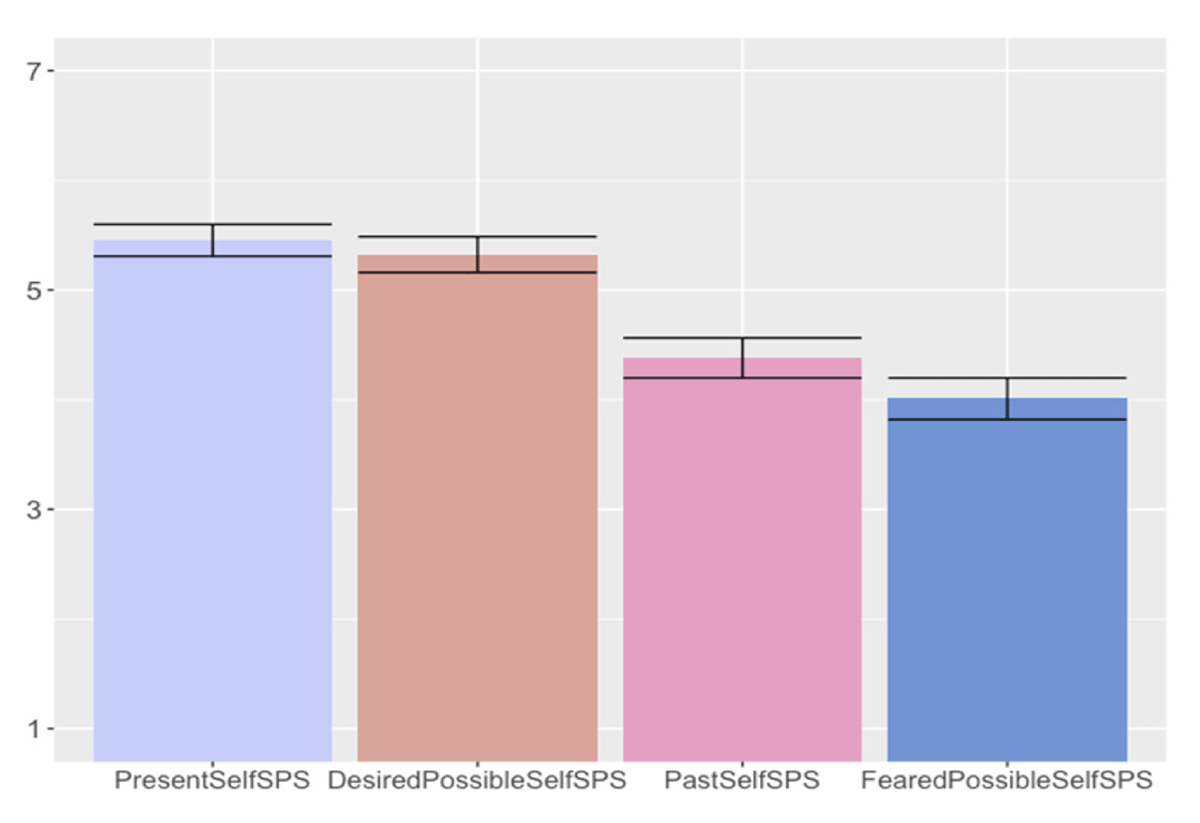
Figure 1
Mean scores on storyworld possible selves questions.
This general trend remains stable across the groups, except for Wattpad: for participants in this group, the order of the first two items is reversed: the Desired Possible Self SPS (M = 5.6, SD = 1.7) question is slightly more prominent than the Present Self SPS (M = 5.4, SD = 1.6). Since the Wattpad group consisted of younger participants and previous studies indicated that adolescents and young adults generated a higher number of desired possible selves, a simple regression was used to investigate whether age had a role in the activation of a desired possible self SPS in our overall sample. The result shows that age did explain a significant amount of the variance in scores on the desired possible self SPS, F(1, 466) = 26.83, p =<. 001, R2 = .054: the older the participant, the lower the score on the desired possible self SPS question.
4.2. Storyworld Possible Selves and Absorption
To answer RQ2 (Does story world absorption relate to the activation of storyworld possible selves?), we conducted four multiple regression analyses with each of the SPSs questions as an outcome variable and Attention, Emotional Engagement, Mental Imagery, and Transportation as predictor variables, while controlling for age as a covariate. Results, reported in Table 3, show that out of the 4 subscales of the SWAS, only Emotional Engagement and Transportation significantly predict higher scores on the Storyworld Possible Selves questions. More specifically, Emotional Engagement is the strongest positive predictor of the “Present Self SPS” and “Desired Possible Self SPS” questions, whereas Transportation is the strongest positive predictor of the “Past Self SPS” and “Feared Possible Self SPS” questions (for the latter, it is also the only predictor, as Emotional Engagement does not reach significance). On the other hand, Attention seems to trend in the opposite direction, being a significant negative predictor of the “Present Self SPS” and the “Past Self SPS”.
Table 3
Multiple regression analysis with the SWAS dimensions as predicting variable and each of the SPSs questions as outcome variables.
| B | 95% CI FOR B | SE B | β | R2 | P | ||
|---|---|---|---|---|---|---|---|
| LL | UL | ||||||
| Present Self SPS | |||||||
| .28 | <.001 | ||||||
| Intercept | 1.39 | 0.36 | 2.44 | 0.53 | <.001 | ||
| Emotional Engagement | 0.55 | 0.39 | 0.71 | 0.08 | 0.34 | <.001 | |
| Transportation | 0.48 | 0.36 | 0.61 | 0.06 | 0.41 | <.001 | |
| Mental Imagery | –0.12 | –0.26 | 0.02 | 0.07 | –0.08 | .09 | |
| Attention | –0.18 | –0.35 | –0.03 | 0.08 | –0.12 | .02 | |
| Age | 0.01 | –0.01 | 0.02 | 0.01 | 0.04 | .31 | |
| Desired Possible Self SPS | |||||||
| .21 | <.001 | ||||||
| Intercept | 1.93 | 0.72 | 3.15 | 0.62 | <.002 | ||
| Emotional Engagement | 0.52 | 0.34 | 0.71 | 0.09 | 0.29 | <.001 | |
| Transportation | 0.23 | 0.08 | 0.38 | 0.08 | 0.18 | .002 | |
| Mental Imagery | –0.05 | –0.22 | 0.11 | 0.08 | –0.03 | .52 | |
| Attention | 0.06 | –0.13 | 0.26 | 0.10 | 0.04 | .50 | |
| Age | –0.04 | –0.05 | –0.02 | 0.01 | –0.17 | <.001 | |
| Past Self SPS | |||||||
| .23 | <.001 | ||||||
| Intercept | 0.85 | –0.56 | 1.80 | 0.68 | .21 | ||
| Emotional Engagement | 0.44 | 0.24 | 0.64 | 0.10 | 0.22 | <.001 | |
| Transportation | 0.66 | 0.50 | 0.83 | 0.08 | 0.45 | <.001 | |
| Mental Imagery | –0.05 | –0.23 | 0.13 | 0.09 | –0.03 | .56 | |
| Attention | –0.32 | –0.53 | –0.11 | 0.10 | –0.16 | .003 | |
| Age | –0.01 | –0.03 | 0.01 | 0.01 | –0.03 | .48 | |
| Feared Possible Self SPS | |||||||
| .18 | <.001 | ||||||
| Intercept | 1.68 | –0.40 | 2.16 | 0.73 | .02 | ||
| Emotional Engagement | 0.16 | –0.06 | 0.38 | 0.11 | 0.08 | .16 | |
| Transportation | 0.64 | 0.47 | 0.82 | 0.09 | 0.42 | <.001 | |
| Mental Imagery | –0.02 | –0.21 | 0.18 | 0.10 | –0.01 | .77 | |
| Attention | –0.16 | –0.39 | 0.06 | 0.11 | –0.08 | .16 | |
| Age | –0.02 | –0.04 | –0.003 | 0.01 | –0.1 | .02 | |
[i] Note: N = 468. CI = confidence interval; LL = lower limit; UL = upper limit.
4.3. Mixed-methods content analysis: Self-Concept
To answer RQ3 (Which temporal dimensions of the self-concept are transformed by reading fiction?), we calculated relative frequencies for each dimension of the self as coded in our mixed methods content analysis, first in the overall sample and then for each of the three groups of readers separately. In our overall sample, the mixed methods content analysis showed the same general trend found with the four SPSs questions: present selves (n = 275) were the most frequently reported, closely followed by desired possible selves (n = 248) and – with a sharper divide – by past selves (n = 33) and feared possible selves (n = 19). To enable statistical analyses, these counts were converted to Boolean variables measuring whether each code was assigned at least once to a response. While maintaining the observed descending order, this procedure slightly changed the counts, which are reported in Figure 2 with their corresponding percentage within the whole set of responses (n = 543).
Exactly as with the results on SPS questions, the Wattpad group is the exception in an otherwise stable trend: The order of the first two items is reversed, with desired possible selves (n = 71 out of 164 responses, 43%) being more common than present selves (n = 56 out of 164 responses, 34%). Thus, we ran a logistic regression to see whether, as observed with the scores on the desired possible self SPSs questions, age again played a role in whether a reader spontaneously reported fiction-elicited desired possible selves in their open response. The model was statistically significant (χ2(1) = 12.94, p < .001), with an effect size of .11 (Nagelkerke R2), showing that the older the participant, the lower the number of mentions of desired possible selves.
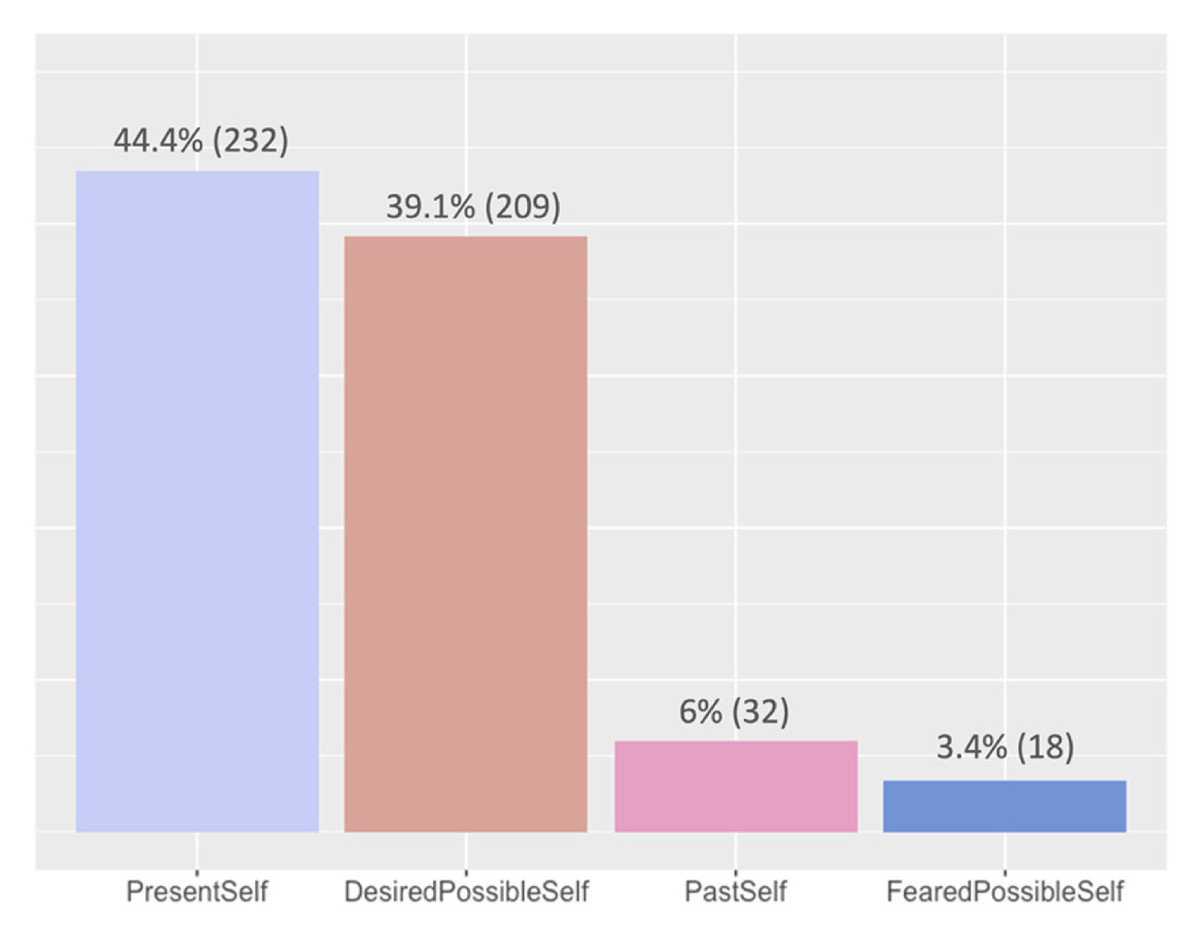
Figure 2
Transformed dimensions of the self concept: relative frequencies.
Note: The percentages represent relative frequencies in the overall set of responses. The exact counts of responses that were coded at least once with the corresponding dimension of the self are reported in brackets.
Additionally, as these measures were used for the first time, we investigated the convergence between the measures of activation (SPSs) and of transformation (coded transformative effects) for each of the self-concept dimensions. These results are detailedly reported in supplementary materials, and they showed significant relationships to the corresponding SPSs for both the desired possible selves and past selves dimensions (approaching statistical significance in the other two cases).
4.4. Differences across groups: life themes
To compare across groups the life themes that describe the types of transformation elicited by the reading experiences (RQ4), we looked at simple count frequencies for each life theme, as displayed in decreasing order in Table 4. Specifically, this analysis highlights which areas of readers’ lives were more often transformed, and how such tendencies compare across the three reading practices (books, digital fiction, Wattpad). The predominant role of transformative effects directed towards “Identity and Self-Understanding” emerges across all three groups. On the other hand, some of the most apparent differences are (a) the number of cases where transformative effects had to do with being inspired to write (“Writing Habits”) within both digital fiction and (especially) Wattpad, and (b) book readers reported transformative effects on the topic of “Society, World, & History” consistently more than Wattpad or digital fiction readers. A more detailed discussion, with exemplifying cases for the different life themes, appears in the Discussion section titled “Giving the floor to actual readers: transformed life themes across groups.”
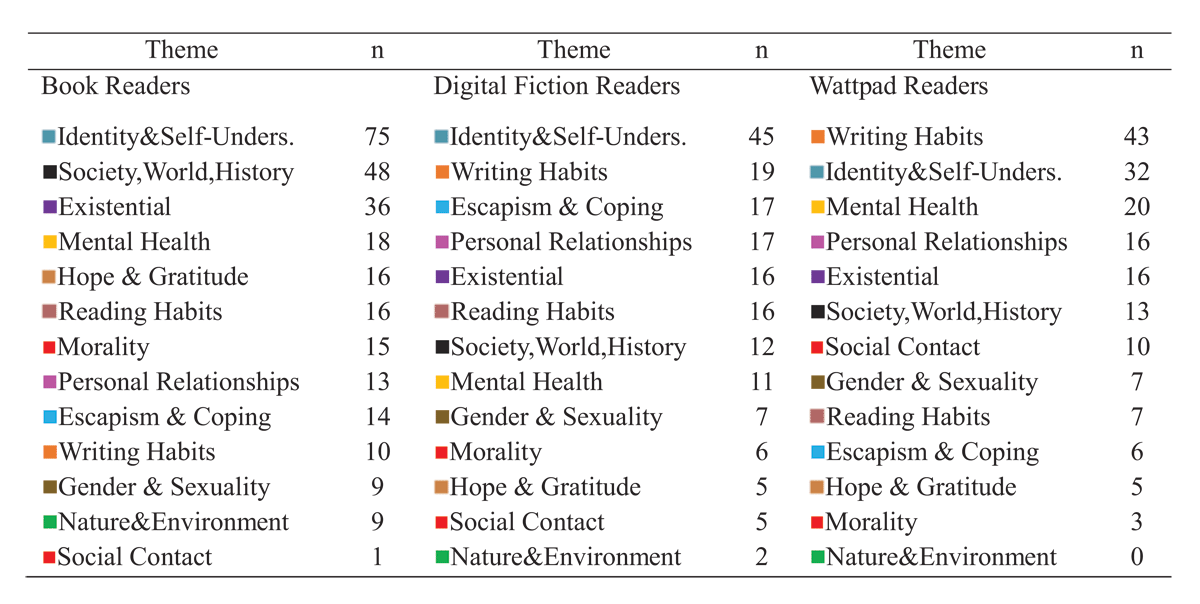
Table 4
Frequencies of life themes across groups.
Note: Sample sizes: Books (N= 227); Digital Fiction (N= 149); Wattpad (N= 167).
5. Discussion and conclusions
As we used a mixed-methods approach, this discussion section introduces, analyzes, and interprets our qualitative data and also overviews the quantitative results presented above. We structure the discussion around the four research questions central to this paper. Accordingly, the first two sections summarize and interpret the quantitative results of RQ1 and RQ2, which are dedicated to storyworld possible selves (activation of the temporal dimensions of the self-concept) and their relationship with absorption, respectively. The final two sections summarize the quantitative results and present and interpret the qualitative results of RQ3, on the transformation of the temporal dimensions of the self-concept, and RQ4, on the differences between transformed life themes across reading practices. The common thread of these final two sections is to give the floor to actual readers, reporting selected examples from the qualitative data that were used for these analyses to illustrate the mechanisms that this study investigated, and as cases that we consider particularly representative of the peculiarities of each reading practice. We believe that the self-reported experiences of actual readers are the best testimony to how deeply and variedly reading fiction can impact us.
5.1. Storyworld possible selves quantified: a general trend
Our study showed a clear trend regarding which temporal dimensions of the self-concept are more commonly both activated (measured by SPSs questions) and transformed (measured by coded transformative effects) as a result of reading fiction. As the mean scores on all four SPS questions were above the midpoint of the scale (ranging from “completely not agree” to “completely agree”), this seems to indicate that the activation of storyworld possible selves is quite common. Specifically, readers of fiction in general activated present self SPSs and desired possible self SPSs most often (RQ1). This finding is in line with previous research indicating that readers in previous studies have related to narratives primarily by referring to their self-schemas (Kuzmičová & Bálint, 2019) and that they have been particularly drawn to characters that embody their own traits, experiences, and opinions (perceived similarity, de Graaf, 2014; Hoeken et al., 2016), as well as to characters that present personal characteristics that the readers themselves desire to possess (wishful identification, Hoffner & Buchanan, 2005).
On the other hand, our study suggests that blending our self-concept with characters that remind us of who we were in the past (past self-SPSs), or that display features that we fear might come to describe us in the future (feared possible self-SPSs), seems to be slightly less common, particularly in the latter case, as the feared possible self SPS item gained the lowest scores among the four dimensions. Compared to the other two temporal dimensions of the self-concept, past selves and feared possible selves appear to be less “accessible” when engaging with fictional characters, and we believe that this might be due to an issue of negative valence. While the negative valence of feared storyworld possible selves as defined in our conceptualization is self-explanatory, we also believe that a fair share of past self SPSs could be negatively charged, as it has been shown that we tend to detach ourselves from our past, judging our past selves more negatively than the current version of ourselves (Osborn et al., 2022; Ross & Wilson, 2002). According to the distancing-embracing model of enjoyment of negative emotions (Menninghaus et al., 2017), we appreciate fiction-elicited negative emotions precisely because the triggering narrative contents are fictional, which allows us to keep a safe distance. Therefore, this emotion up-regulation mechanism might be the reason why readers are more reluctant to blend with characters who present negative features that are (were, or could be) directly ascribable to themselves. For the same reason, it might also be the case that readers are more reluctant to report the activation of feared possible selves, preferring to keep this aspect of their self-concept private (Martìnez & Herman, 2020).
As postulated in Martínez’s theory (2014, 2018), we also acknowledge that which SPSs are more likely to be generated by readers depends on the content of each specific text. For example, reading about fictional characters in dramatic or tragic situations will probably elicit more feared possible self SPSs than desired possible selves SPSs. Moreover, readers’ individual differences also play an important role in determining whether they will activate an SPS, depending on their personal experience with the story topic as well as on their personality traits, since it has been shown that individuals differ in how easily they tend to project their life experiences during reading (Charlton et al., 2004). Future research will benefit from an experimental investigation of which SPSs are more often generated when reading different kinds of texts, accounting for the variability of readers’ individual differences, as defined by their personality and/or by their genre preferences.
Nonetheless, we believe that the trend that emerged from our study on transformative reading experiences is indicative of a general tendency across reading practices and genres. Predominantly, our participants tended to activate present self SPSs, shortly followed by desired possible self SPSs and then by past self SPSs and feared possible self SPSs. This frequency order remained relatively stable across the three reading practices considered in this study, with a minor oscillation for Wattpad as, in this case, readers reported more desired possible self SPSs than present self SPSs, but participants in this group were significantly younger than in the other two groups, and our results on the role of age endorsed that younger individuals tended to generate more desired possible selves (Cross & Markus, 1991). Moreover, the trend emerged in our results had already been observed in the two studies that previously measured SPSs in different contexts, that is, in Martinez and Herman’s (2020) qualitative study that identified the activation of SPSs after 15 readers provided their own interpretation of a graphic narrative, and in Hakemulder’s (2015) study on motivation for rereading, which, although without using the storyworld possible selves terminology, employed the original formulation of the quantitative questions that we re-elaborated.
5.2. Storyworld Possible Selves and absorption
Our study also supported our hypothesis on which dimensions of story world absorption could be connected to the activation of SPSs (RQ2), namely emotional engagement and transportation. Interestingly, emotional engagement was a stronger predictor than transportation for the activation of present self SPSs and desired possible self SPSs, signaling that feelings of empathy, perspective-taking, and identification towards characters (the concepts measured in emotional engagement, Kuijpers et al., 2014) are crucial factors for activating these self-concept dimensions. On the other hand, transportation was the strongest predictor for activating past self SPSs and particularly feared possible self SPSs, as for this SPS item emotional engagement did not reach significance. If these two dimensions of the self-concept are indeed less accessible (i.e., readers are less prone to activate them when engaging with fictional narratives), then it seems plausible that a higher degree of transportation would facilitate their activation. Deictic projection, meaning “the ability to shift one’s origo from its anchorage in the ‘I’, ‘here’ and ‘now’ to an alternative position” (Whiteley, 2011, p. 25), is the basic prerequisite for transportation. Thus, the more we are transported into a story world, the less we are aware of our main deictic anchoring in the actual world, and this can guarantee a certain degree of protective distance when experiencing those dimensions of our self-concept that tend to be negatively charged.
The other two facets of absorption, mental imagery and attention, did not predict higher scores on any of the SPS questions. The retrospective design of our study, which was based on asking readers to recall a transformative reading experience within the last two years, grants a high ecological validity, but it also entails the disadvantage of memory concerns. The sensory impact of the narrative (mental imagery) and the concentration-related focus during reading (attention) could be particularly difficult to recall after a longer period. However, there might be other underlying mechanisms at play, particularly for attention, as it significantly negatively predicted scores on present self-SPSs and past self-SPSs. Attention refers to a sustained concentration that implicates text comprehension and, most importantly, resisting distraction by personal concerns such as autobiographical diversions (Kuijpers, Douglas & Bálint, 2021, p. 285). Given that storyworld possible selves imply a certain degree of self-referencing by definition, and that “too much self-referencing can overtax the reader’s attention and divert it from features of the text” (Kuzmičová & Bálint, 2019, p. 436), this could explain why the higher participants in our study scored on SPSs, the lower they scored on Attention.
5.3. Giving the floor to actual readers: shades of transformation
The second main aim of our study required us to look more closely at readers’ descriptions of their transformative reading experiences, investigating which temporal dimensions of the self-concept are transformed by reading fiction (RQ3). The trend that emerged mirrored the one observed with the activation of these temporal dimensions (as measured via the four SPSs questions), although with a sharper divide between the more frequently activated dimensions (present self and desired possible selves) and the less common ones (past selves and feared possible selves). This can be because, when asked to describe how the text had an impact on their lives, readers might have been primed to think about more positive aspects; they could also have felt less comfortable sharing aspects of their past or their fears for the future.
It is important to remember that the two measurements used in this study are related but distinct, as when we coded for each dimension of the self-concept in the readers’ descriptions, we did it regardless of which textual feature prompted the transformative effect. While the activation of storyworld possible selves is tied to characters, the fiction-elicited transformative effects could also be prompted by other text elements. For example, sometimes it was the plot or the style of the text that led readers to a new desired possible self, as in these cases: “The style of writing, especially the build-up, is superb and it left me questioning reality. This story inspired me to write a few thrillers of my own” (style, Wattpad reader); “I picked up the Foundation Trilogy, in which a whole new branch of science is born. It blew my mind. I had not been reading much at that time and it got me back into reading […]. I am a huge science fiction fan now, I especially like books that deal with the vastness of time and space, it makes me see the world through different eyes and deal with the stress of daily life” (plot, Book reader). Nonetheless, we found a certain overlap between SPSs and the coded transformative effects on the self-concept dimensions. Although it was not requested, many participants in our sample spontaneously reported transformative effects on the self-concept that were clearly prompted by fictional characters. This tendency amounts to 30% of all coded transformative effects (see supplementary materials for analysis). Below we report an example, which incidentally also shows how networked the temporal dimensions of the self-concept are, as different dimensions were often transformed by the same reading experience:
About 5 months ago I read George Eliot’s Middlemarch. The characters that affected me the most were Dorothea and Casaubon. Reading about Casaubon declining and suffering so much in middle age due to his insecurity and self-absorption felt like a warning. He died lonely, unfulfilled, self-conscious, and feeling like a failure because he was afraid to take risks, look foolish, put himself out there, or learn from others. Seeing that as a potential future for myself was frankly very scary [feared poss. s.]. I think about him nearly every day since I read the book; when I am acting (or failing to act) based on my insecurity, I think of Casaubon and pretty much try to do the opposite of what he would do. I also related a lot to Dorothea, and now when I catch myself acting or thinking like Casaubon, I try to act more like Dorothea instead: generous, compassionate, loving, mastering her emotions so that she can support others, working to serve those in need, but still making choices to make herself happy, even if she needs to make sacrifices to do so [desired poss. s.]. – Book reader (our italics)
As a representative example of many similar cases, what this reader describes is the activation of storyworld possible selves that lead to long-lasting transformative effects. Observing this tendency in our data suggests that SPSs do indeed have a consistent transformative potential (Martínez, 2018).
At the beginning of this paper, we stated that our approach to transformative reading experiences was exploratory, based on the assumption that reading experiences that readers perceive as significantly impactful for them can be considered transformative (perceived transformation, Loi et al., in press). Indeed, the transformative effects reported by participants differed widely in terms of the “degree” of transformation, ranging from the consolidation of the reader’s self-concept (“I loved it because it supported my increasing distaste for cities and my life for isolation from people”) to life-changing effects (“I personally separate my life to pre-Subahibi and post-Subahibi periods, as reading it has completely changed how I view the world”). Furthermore, the mixed-methods approach that we adopted allowed us to notice that certain degrees of transformation tended to go along with the specific temporal dimensions of the self-concept. Transformative effects coded as “present self” showed slightly weaker degrees of transformation, usually based on a feeling of recognition (Kuzmičová & Bálint, 2019), such as (a) self-consolidation (exemplified above, but only reported in a minority of cases), which is based on the reinforcement of active self-schemas, or what Martìnez (2018) calls “mirror blending”; and (b) self-modification (Kuiken et al., 2004), by far the most common effect within the present self. In the case of self-expansion, readers reported gaining fresh insights, thus expanding – rather than simply reinforcing – their self-concept, as in the following cases: “The book made me more contemplative of how much my personality, wants, and needs were influenced by those around me”; “Since I’m questioning my sexuality ever since I became an adult, that part of the character resonated with me a lot too, perhaps even made it a bit easier to accept some things. […] it was like unlocking something in my own personhood.” Transformative effects coded as “past self” were also mostly based on recognition, in the form of memories (“It reminded me of how much my own father was present in my life, even if the circumstances are not the same […] my father was effectively the parent who took care of me, spent time with me, and was actually there both physically and emotionally”), sometimes enhancing the readers’ understanding of their own past (“[the story] led me to think about how I can now watch back to my teenager years, that are so near and yet so far, and about how my choices were influenced by emotions of different intensity”), or even prompting therapeutic and cathartic experiences (it was like reading my own history when it comes to a mentally abusive relationship that you grow out of. […] I started remembering details and gaining fresh views on something I’ve long left behind. […] Gaining that perspective means I have a better-rounded vision of what went wrong, and can offer better advice to those who are stuck in such situations”).
Undoubtedly, the higher intensity of transformative effects pertained to the future-oriented dimensions of the self-concept, which by definition entails that an individual is generating “blueprints for personal change and growth” (Cross & Markus, 1991, p. 232). Indeed, in the case of responses coded for “desired possible selves,” many readers reported concrete behavioral effects caused by reading experiences, such as: “I put down the book and devoted myself to building strong relationships and living life to the fullest”; I was able to have better results in therapy by sharing my true feelings”; “the book restored a bit of my hope and brought me back to social activism”; “I sent in the [job] application the day I finished the book”; “I found myself reflecting on the ideas raised for weeks afterward and noticed myself being kinder and more self-reflective in my workplace and personal relationships.” To sum up, a closer look at the experiences of our readers corroborates how broad and variable the concept of transformation can be. However, we consider this variability in transformative effects as a fruitful finding and one that encourages future research that may analyze individually different types of transformative effects in more depth. In the context of our study – where the readers’ perception of texts that made a “significant impact on them” was prioritized over top-down definitions of what constitutes a transformative reading experience – we preferred to consider this variability as a testimony of different shades of transformation, rather than proposing a value-charged taxonomy.
5.4. Giving the floor to actual readers: transformed life themes across groups
Overall, our study looked at three contemporary reading practices (books, digital fiction, and Wattpad). The fact that these three groups showed almost identical frequency patterns for the activation of the temporal dimensions of the self-concept strengthened our finding that there is a general trend regarding which dimensions of our self-concept are activated and transformed by reading fiction. However, the last section of our study succeeded in highlighting more nuanced similarities and differences between the three reading practices by revealing which areas of readers’ lives were more often transformed (RQ4). First of all, the predominant role of the “Identity & Self-understanding” theme across the three groups indicates that a crucial effect of reading fiction is providing a new outlook on ourselves (self-modification, Kuiken et al., 2004), as this code was assigned when the reading experience led a participant to gain new insights on their own life and identity.
Compared to readers of books, readers of both digital fiction and Wattpad reported more often transformative effects ascribable to “Writing Habits,” meaning that they decided to start writing themselves as a result of their transformative reading experience, particularly in the case of Wattpad, as this effect was even more common than “Identity & Self-understanding.” Indeed, works of digital fiction are posted on “democratic” online communities, where users share information on open-source interactive writing tools, and peer feedback and crowdfunding are commonplace. As for Wattpad, this component is even stronger because the “everyone can be a writer” motto is the foundation of this online storytelling platform (see the homepage on Wattpad.com), and most often Wattpad users engage in both reading and writing stories (Kraxenberger & Lauer, 2022). For a representative example from one of our participants, see below:
In 2018, I got sick and had to stay home nearly every day. I passed much of my time reading […]. When I found Wattpad, the first stories I ever read were the Affliction Trilogy by user @CrystalJJohnson. The series combined zombies with sweet romance and new adult characters, something I personally hadn’t seen before. I realized that there was extremely good original fiction to be found online. After reading those three books, I mustered enough courage to try writing and sharing on Wattpad myself. (Wattpad reader, transformed dimension: desired possible self, life theme: Writing Habits)
If we only look at readers of digital fiction instead, one theme that was frequently observed is “Escapism & Coping,” which was coded whenever readers reported strong feelings of absorption into the storyworld, functioning as a healing gateway from reality, particularly in periods of stress due to the Covid 19 pandemic or personal circumstances. The interactive nature of digital fiction can foster a deeply immersive reading experience (Bell et al., 2018; van der Bom et al., 2021), and this could be the reason why, in our study, readers of digital fiction reported more often experiencing beneficial escapism that effectively relieved them from stress and suffering, as in the following example:
I think Mystic Messenger from Cheritz impacted me the most. Each character was an embodiment of a different kind of character flaw, in need of some kind of development to move past trauma. You deal with self-confidence issues, listlessness, overworking, not understanding the human experience, and not being able to open up about your traumatic past. It has so many things that hit deep for me. It is also extra impactful because of the structure of the storytelling; it is told in real-time, so to get one storyline you need to dedicate yourself for 10 days straight, which works to get me invested. Alongside that, I also started playing in it in April of last year, to help me cope with the pandemic. It was something I could control and something that had a set schedule that I could follow when everything else in the world was going crazy […]. (Digital Fiction reader, transformed dimension: present self; life theme: Escapism & Coping)
On the other hand, one theme that was only prominent for readers of books but quite marginal for the other two reading practices is “Society, World, & History,” which was coded when the transformative effects experienced by readers revolved around topics of general interest on the world’s socio-political current issues as well as historical events. A representative case is reported below:
Inversions by Ian M. Banks […] In this particular book, Banks explores individual choices and impact, and not the decision of a whole civilization. We follow two main characters from an ultra-developed alien civilization living on a planet where the society resembles that of medieval Europe. One of the characters thinks that they should help the people of this world and acts as a doctor, even though because of gender and class prejudices she is in constant danger. She also witnesses a lot of violence and struggles which affects her emotionally but she continues to help people to the best of her ability. […]Due to certain events that had happened in my life before reading the book I was not in a good place mentally while reading it, I was feeling jaded and disillusioned with the situation in the world. But the book restored a bit of my hope and brought me back to social activism. Now I just pretend that I am also an alien on a mission here, which makes it easier to process the reality and to put efforts towards improving it. (Book reader, transformed dimension: desired possible self, life theme: Society, World & History)
Lastly, some of the differences between the three reading practices may be connected to the genres that are predominantly read within each of them. For example, readers of books had the majority of their transformative reading experiences with genres such as Drama (texts with a focus on characters’ inner lives and psychological insight) and Classics (for a frequency list of all genres across groups, see supplementary materials). The introspective and reflective themes typical of these genres might explain why some transformed life themes were more often observed in this group, such as “Society, World & History” and “Existential” (which was coded whenever the transformative effects experienced by readers revolved around existential matters such as the meaning or the finitude of life). On the other hand, many readers of both digital fiction and especially Wattpad had their transformative reading experience with a text that falls under the romance genre, and this might be a reason why, compared to readers of books, these groups more often experienced transformative effects that were coded under the “Personal Relationships” life theme, which indicates that the reading experience affected how participants perceived their relationships with others such as friends, family, and love interests. While these reflections on the role of genres remain observational in this study, it has already been shown that the genre preferences that can predict a higher chance of experiencing transformative effects do differ across readers of books, digital fiction, and Wattpad (Loi et al, in press), future research might benefit from a systematic experimental comparison of the type of transformative effects that different genres tend to elicit in readers.
5.5. Limitations
The most apparent limitation of our study is that its design is correlational, thus, while it can determine the association between our variables of interest, it cannot predict causal relationships. An experimental design would be necessary to determine if high levels of Transportation and Emotional Engagement can cause the activation of SPSs, or if it is rather the other way around, namely that activating an SPS leads to experiencing higher levels of Transportation and Emotional Engagement. Secondly, the measurement that was used for SPSs employed only one item for each temporal dimension of the self. While single-item measurements are not necessarily inferior to multi-item measures (Allen et al., 2022) as long as they refer to a construct that is unidimensional and clearly defined (Fuchs & Diamantopoulos, 2009), we still recognize that further studies might be needed to ensure the validity of the SPS measurement, perhaps including more items for comparison. Lastly, since a consistent part of this study was intended to empirically test the theoretical concept of Storyworld Possible Selves (Martìnez, 2014, 2018), further research might benefit from taking some steps forward in this direction, testing some of the other mechanisms that Martìnez theorized, from a comparison between mirror (identificatory) and double scope (non-identificatory) SPS blending, to the role of SPS markers and nodes, that is, linguistic features that are believed to facilitate the activation of SPSs, whilst taking into account the essential role of individual differences. For example, an upcoming study will investigate the relationship between the presence of SPS linguistic markers and the activation of SPSs, accounting for readers’ level of similarity to the portrayed fictional character (Loi et al., in preparation). Moreover, do specific texts (or specific genres altogether) tend to activate and transform certain temporal dimensions of the self-concept over others? We hope that future research will tackle these questions through experimental designs, as further empirical tests of Storyworld Possible Selves might hold crucial potential for unveiling the underlying mechanisms of the impact of fiction on readers.
Data Accessibility Statement
The complete dataset, analysis script, and supplementary materials (including additional results and the complete coding scheme) are available in the Open Science Framework repository under this link: https://doi.org/10.17605/OSF.IO/RJUCY.
Acknowledgements
We thank Sara Rasic for annotating data in the mixed-methods content analysis. We also wish to thank the reviewers for their constructive feedback and insightful comments.
Funding Information
This research was funded by the EU Marie Curie ITN No 860516.
Competing Interests
The authors have no competing interests to declare.
Author Contributions
C.L. designed the study, with support from F.H. and M.K.
C.L. collected the data and performed the quantitative analyses. C.L. and F.H. developed the mixed-methods coding scheme for the qualitative data. C.L., M.K., F.H., and G.L. contributed to the interpretation of results. C.L. wrote the manuscript with input from all authors. All authors provided critical feedback and helped shape the research, analysis, and manuscript.