
1.0 Introduction
Boiling liquid expanding vapor explosion (BLEVE) is a physical explosion that can occur when a tank containing a liquefied gas ruptures catastrophically. This high-consequence/low-probability phenomenon can be triggered by a variety of causes, including external heating, mechanical damage, or failure of safety devices. Despite being commonly associated with flammable substances, BLEVE can also involve non-flammable chemicals, such as water or nitrogen.
Traditionally, BLEVE is characterized by the rapid phase transition of a liquid to vapor following depressurization, leading to the release of significant mechanical energy. However, some researchers (Laboureur et al., 2015; Ustolin et al., 2020) have expanded the definition to include supercritical scenarios, i.e., when the fluid inside the tank is above its critical temperature and pressure prior to rupture. Such conditions may arise if safety devices (e.g., pressure relief valves) fail or when substances with low critical points, such as hydrogen (critical point: approx. 33 K, 1.3 MPa), are involved (McAllister et al., 2011). The consequences of a BLEVE typically include a blast wave, projectiles generated by tank fragmentation, and, if the released substance is flammable and an ignition source is present, a fireball.
Multiple models have been proposed to estimate the blast wave effects of BLEVE, particularly focusing on overpressure (Ustolin et al., 2020). These models vary in the assumptions used to calculate the released energy. For instance, some consider ideal gas expansion after tank rupture (Brode, 1959), while others treat the vapor as an ideal gas (Casal and Salla, 2006; Genova et al., 2008; van den Bosch and Weterings, 2005). Moreover, while some approaches consider the liquid in the calculation of the mechanical energy released by the explosion (Casal and Salla, 2006; Genova et al., 2008; van den Bosch and Weterings, 2005), others only account for the vapor contribution. The first approach is regarded as more accurate, particularly in cases where either liquid or vapor may dominate depending on system conditions (e.g., tanks full of liquid or supercritical BLEVEs) (Ustolin et al., 2020).
A critical limitation shared by these traditional approaches lies in the neglection of the chemical energy contribution to the total released energy. In fact, while these models give satisfactory performance when used for hydrocarbons, they consistently underestimate the blast wave overpressure observed in liquid hydrogen BLEVEs (Ustolin et al., 2020). Compared to other hydrocarbon-based fuels, hydrogen’s rapid diffusion and wide flammability range may facilitate partial combustion shortly after tank rupture. Molkov and Kashkarov (2015) suggested that approximately 5.2% of hydrogen’s chemical energy contributes to the blast wave generated by the rupture of high-pressure vessels containing gaseous hydrogen. This claim was later supported through analytical modeling (Ustolin et al., 2022) and CFD simulations (Cirrone et al., 2023) for LH2 BLEVEs. These findings support the classification of LH2 BLEVEs as ‘hybrid’ events, involving both physical and partial chemical explosion mechanisms.
In addition to blast wave effects, the thermal consequences of LH2 BLEVEs, particularly the fireball, are also critical. Several empirical correlations exist for predicting fireball diameter and duration. The approach by Hord (1972), which relates fireball parameters directly to the fuel mass, is one of the most widely used. Most available methods simplify the inherently dynamic phenomenon by adopting a steady-state assumption, and the fireball shape is generally approximated as a sphere, although some studies have proposed hemispherical corrections to better capture early development (Makarov et al., 2021). Similar to overpressure correlations, the majority of these models were originally developed and validated for hydrocarbon fuels. More recently, Giannini et al. (2023) adapted these correlations specifically for liquid hydrogen BLEVEs, providing a more accurate representation of fireball characteristics in cryogenic scenarios.
This study introduces BLEXCOM (BLEVE consequences model), a new engineering tool designed to predict the blast wave and fireball effects of BLEVE events. In this paper, the tool is presented with a specific focus on supercritical LH2 scenarios. The model integrates multiple sub-models and has been validated against experimental data from the Norwegian project SH2IFT, where a supercritical LH2 BLEVE was recorded (Ødegård et al., 2022). Results indicate that BLEXCOM can accurately predict blast wave overpressure and impulse, though discrepancies remain in fireball predictions, potentially due to uncertainties in initial conditions (e.g., hydrogen mass and temperature recorded during the tests). While further validation is needed, BLEXCOM shows promise as a reliable tool for assessing LH2 BLEVE consequences, particularly in safety-critical applications such as hydrogen infrastructure development.
2.0 Methodology
BLEXCOM is an independent engineering tool that can be used to assess the BLEVE consequences of different substances, including hydrogen. This is possible thanks to the implementation of the CoolProp package (Bell et al., 2014) to retrieve the thermodynamic properties of the substance. The peculiarity of the proposed tool is that it considers part of the chemical energy contained in the fuel contributing to the blast wave consequences. Moreover, BLEXCOM can assess supercritical BLEVEs. These two aspects are particularly important for LH2 BLEVEs.
The methodology adopted to develop the BLEXCOM tool, capable of assessing both blast wave and fireball effects, is described in this section. The different steps of the methodology are shown in Figure 1. The blue boxes in the flow diagram indicate the inputs needed by the model, including the information retrieved from databases, such as the thermodynamic properties. The white boxes represent the steps in which the model takes a decision or performs a calculation (see Sections 2.1 and 2.2). Finally, the green boxes indicate the outcomes provided by BLEXCOM.
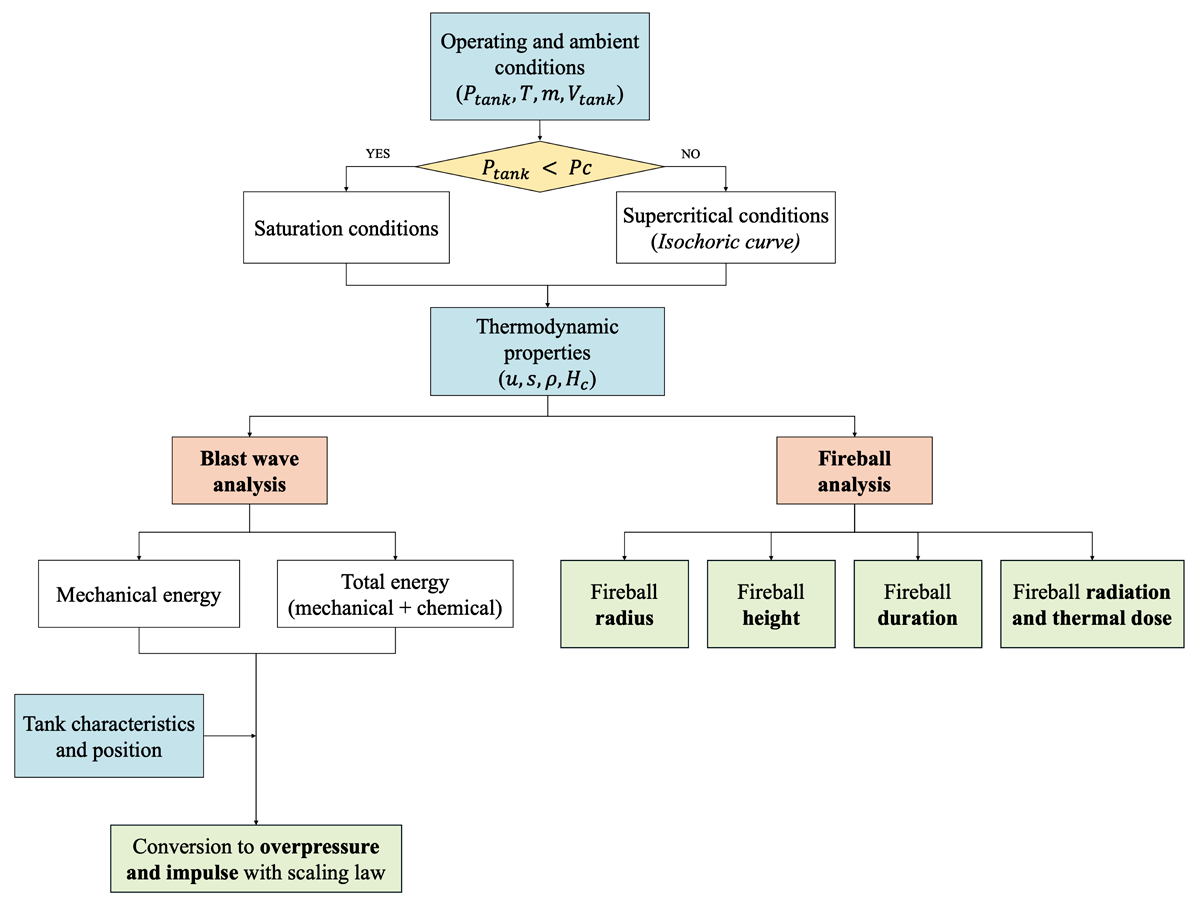
Figure 1
Flow diagram of the methodology employed in BLEXCOM to assess blast wave and fireball effects from BLEVEs (abbreviations: T: temperature before the explosion, m: fuel mass before the explosion, Pc: critical pressure, Ptank: tank internal pressure before the explosion, u: internal energy, s: entropy, ρ: density, Hc: heat of combustion).
2.1 BLEXCOM—Blast effects
The model treats the estimation of total energy (both mechanical and chemical energy) differently, depending on the internal tank pressure relative (Ptank) to the critical value (Pc) at the moment of rupture and explosion. There are two options:
Ptank < Pc (subcritical conditions): both gaseous and liquid phases are present in the tank.
Ptank > Pc (supercritical conditions): only one supercritical phase is present in the tank.
The total hydrogen mass initially stored inside the tank and the tank volume are required as input for the calculation together with the internal tank pressure. For subcritical conditions, the internal temperature is obtained assuming saturation conditions. For supercritical conditions, the isochoric curve is followed to determine the temperature. Alternatively, if the temperature is known, the mass can be derived.
After retrieving the thermodynamic properties (density, internal energy, entropy) using the CoolProp wrapper implemented in Matlab, the total energy is estimated by calculating first the mechanical and then the chemical energy. The mechanical energy is estimated with Eq. (1) by following the real gas behavior and isentropic expansion (RISE) approach (van den Bosch and Weterings, 2005):
where the subscripts g and l indicate the gaseous and liquid phases, respectively, 1 and 2, are the conditions before and after the explosion considering an isentropic expansion, respectively, m is the mass of fuel in kg, and u the internal energy in J/kg. The internal energy after isentropic expansion can be estimated with Eq. (2) for the gaseous phase and with Eq. (3) for the liquid one:
where the subscript 2 indicates that the internal energy is at atmospheric pressure and normal boiling point (20.3 K for hydrogen (McAllister et al., 2011)), and Xg and Xl are the flashing fractions for the gaseous and liquid phases and are estimated with Eqs. (4) and (5), respectively:
where s is the entropy in J/kg K. Finally, the masses can be directly provided as input in the model, or estimated based on the volume and filling degree of the tank, i.e., amount of liquid, gaseous, and liquid densities before the explosion as shown in Eqs. (6) and (7):
where Vt is the tank volume in m3, ρ is the density in kg/m3, and fd is the filling degree in %. This method to determine the mechanical energy contained in the tank prior to the explosion was already adopted for hydrogen by Ustolin et al. (2020). In the case of supercritical BLEVE, there is no liquid phase. Therefore, only the gaseous phase is considered, assuming its mass is equal to the total amount contained in the tank. As suggested by Laboureur et al. (2015) for supercritical propane BLEVE, the gas inside a tank exposed to a fire follows the isochoric curve once the pressure exceeds the critical value. Therefore, the temperature and related thermodynamic properties can be determined by knowing the initial mass of the tank content, and assuming that venting or other types of releases or leakages occurred during the test (or incident).
The chemical energy contributing to the blast wave effects is determined following the method suggested for vapor cloud explosions by van den Bosch and Weterings (2005) and described by Eq. (8):
where St is the stoichiometric concentration, i.e., the ratio between the fuel moles and the moles of fuel and air (e.g., 1/3.38 for hydrogen), and Hc is the heat of combustion of the fuel (e.g., approx. 120 MJ/kg for hydrogen (McAllister et al., 2011)). It is assumed that only the combustion of the gaseous phase contributes to the BLEVE blast wave. It is suggested to estimate the chemical energy only for LH2 BLEVE since it was demonstrated that this does not contribute to the BLEVE for other types of fuels (e.g., propane) most likely due to the slow burning velocity compared to hydrogen. Finally, the total energy can be estimated with Eq. (9):
It can be noticed that the total energy contributing to the explosion is multiplied by a factor of 2 to account for reflection on the ground (van den Bosch and Weterings, 2005). Moreover, only part of the chemical energy is added to the total amount. Molkov and Kashkarov (2015) suggested using β = 0.052 for explosions of high-pressure hydrogen vessels. The same coefficient is used in BLEXCOM for supercritical BLEVEs. If BLEVE is estimated for substances other than hydrogen, the chemical energy is neglected, thus β = 0.
The total energy is then converted into overpressure and impulse with the scaling law, and the non-dimensional overpressure and impulse curves developed by Baker et al. (1977) are used. The correct curve must be selected by following the procedure described by van den Bosch and Weterings (2005) for pressure gas vessels, i.e., calculating the hemispherical vessel’s radius (Eq. (10)) and the initial scaled distance (Eq. (11)):
where Vt is the tank volume in m3, and p0 is the atmospheric pressure (101.3 kPa). The initial peak overpressure () can be read from the chart developed by Baker et al. (1977), knowing the ratio of speed of sound in the gas (ag) and in air (a0), and the ratio between tank and atmospheric pressure. Alternatively, it can be calculated by solving iteratively Eq. (12):
where γ0 and γg are the specific heat ratios of the air and the gas in the vessel. The scaled overpressure () and impulse () can be read from the chart. Eventually, it can be multiplied by factors accounting for the tank elevation from the ground and its cylindrical shape. Specifically, when , an elevation factor of 1.1 can be used and when (i.e., far field) a shape factor of 1.4 can be adopted; both factors can be used at the same time for elevated cylindrical tanks. Finally, the overpressure (ps) and impulse (is) can be estimated with Eqs. (13) and (14):
2.2 BLEXCOM—Fireball effects
Following the release of cryogenic hydrogen, a fireball is likely to form, especially in hot BLEVE scenarios where an external fire can ignite the vapor–aerosol mixture. The fireball evolves through rapid fuel–air mixing, full-volume combustion, and eventual lift and extinction due to buoyancy, typically lasting less than 30 s. Given its short duration, fireball diameter, height, and radiation are calculated considering the steady-state combustion phase (i.e., full-volume combustion).
Empirical equations were appositely developed to determine diameter (Dfb, see Eq. (15)), height (Hfb, see Eq. (16)) and duration (tfb, see Eq. (17)) of hydrogen fireballs by Giannini et al. (2023):
where mf is the mass of fuel involved in the fireball, in kg. The solid flame model (Planas and Casal, 2016) is implemented in BLEXCOM to estimate the fireball radiation and thermal dose. The radiation received by a target from the fireball (qfb) is calculated with Eq. (18), assuming the fireball is a homogeneous sphere and adopting the surface emitter model approach:
where F is the view factor (see Eq. (19)), SEP is the surface-emitted power of the fireball in W/m2, (see Eq. (20)), and τa is the atmospheric transmissivity. The view factor for a vertical surface (e.g., a standing target) is:
where x is the horizontal distance between the target and the center of the explosion, in m. The SEP depends on the type of fuel as per Eq. (20):
where η is the fraction of total heat radiated from the fireball and depends on the internal tank pressure before the explosion as suggested by Planas and Casal (2016) and shown in Eq. (21):
where Ptank is the tank burst pressure, in Pa. The atmospheric transmissivity depends on the distance of the target from the fireball and the relative humidity of the air as demonstrated by Planas and Casal (2016). The approach of these authors was implemented in BLEXCOM. Finally, the thermal dose (T.d.) is estimated with Eq. (22):
A threshold value of 80 (kW/m2)4/3 s is assumed to define the no-harm distance. Overall, the model requires the fuel mass involved in the fireball and the tank pressure at the moment of rupture as input parameters.
2.3 Case study
The experimental data used in this work to validate the BLEXCOM tool are retrieved from the fire test performed on an LH2 tank during the Norwegian research project SH2IFT (Ødegård et al., 2022) ending with the catastrophic rupture of the tank. The critical aspects to be considered in this work to analyze the rupture are as follows:
Internal volume of the LH2 tank was 1 m3.
Burst pressure of the LH2 tank was 4.85 MPa, and temperature of hydrogen was between 53 K (–220°C) and 153 K (–120°C). Therefore, it is assumed that the content was under supercritical conditions.
Initial filling degree was between 35 and 40%, i.e., the LH2 mass was 25–30 kg considering the density at the normal boiling point.
Part of the hydrogen was vented before the tank rupture; the mass of vented hydrogen is unknown and cannot be reliably estimated.
Maximum blast wave overpressure measured at 22.5 and 26.4 m from the explosion center was 13.3 and 9.9 kPa, respectively.
Fireball diameter and duration were 25.8 m and 5 s, respectively.
Maximum radiation emitted by the fireball was 2,122 and 1,242 W/m2 at 70 and 90 m from the tank center, respectively.
The LH2 tank data are summarized in Table 1, while the consequences of blast wave and fireball needed for model validation purposes are collected in Table 2. The main uncertainties found in the tests results are the hydrogen mass in the tank at the beginning of the test and before the explosion and the temperature gradient of hydrogen during the test (it was measured in only two points).
3.0 Results and Discussion
The mass of hydrogen in the tank during the SH2IFT fire test of LH2 tank analyzed in this study was estimated by considering a tank filling degree of 35%, tank internal pressure at the beginning of the test of 0.37 MPa, and assuming saturation conditions. Therefore, at 0.37 MPa and 25.6 K, the densities of liquid and gaseous hydrogen are 63.6 and 4.5 kg/m3, respectively. This gives a total hydrogen mass of approximately 25.2 kg. From the total mass, the average density in the tank is 25.2 kg/m3. This is critical to obtain the average temperature of hydrogen prior to the explosion and retrieve the correct thermodynamic properties. Following the isochoric curve, the correspondent temperature at 4.85 MPa is 57 K. This is an acceptable value, between the measured ones (53–153 K). Figure 2 displays the measurements of temperature and pressure inside the LH2 tank during the SH2IFT fire test until the tank explosion, and the temperature of the tank system is estimated by assuming isochoric compression of the gas. It can be noticed that this hypothesis fits very well the experimental recordings.
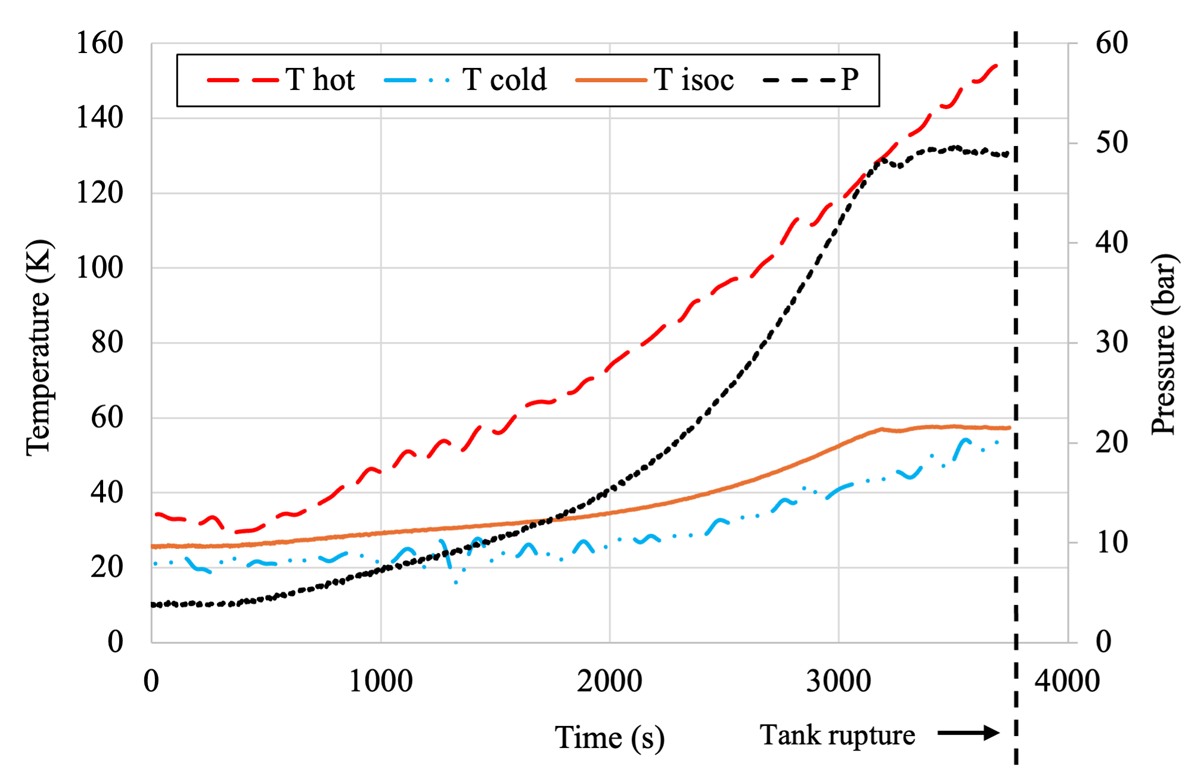
Figure 2
Temperature and pressure measurements during the SH2IFT fire test until the tank explosion compared with the temperature estimated, assuming isochoric compression of the gas.
3.1 Blast wave effects
Overpressure and impulse of the blast wave generated by the catastrophic rupture of the LH2 tank during the SH2IFT fire test were estimated with the BLEXCOM model by considering part of the hydrogen chemical energy contributing to the blast wave effects. Therefore, it was assumed that part of the hydrogen combustion with air is as fast as the expansion of the gas and it is superimposed to the physical explosion. As a comparison, the blast wave effects were assessed without considering the chemical energy as well, thus considering the BLEVE solely as a physical explosion. A sensitivity analysis was conducted to identify the total hydrogen mass that best reproduces the experimental measurements of overpressure and impulse. For clarity, only the results corresponding to the hydrogen mass (25.2 kg) providing the best agreement with the experimental data are presented in this study. The BLEXCOM results for the blast wave overpressure are compared with the experimental measurements in Figure 3.
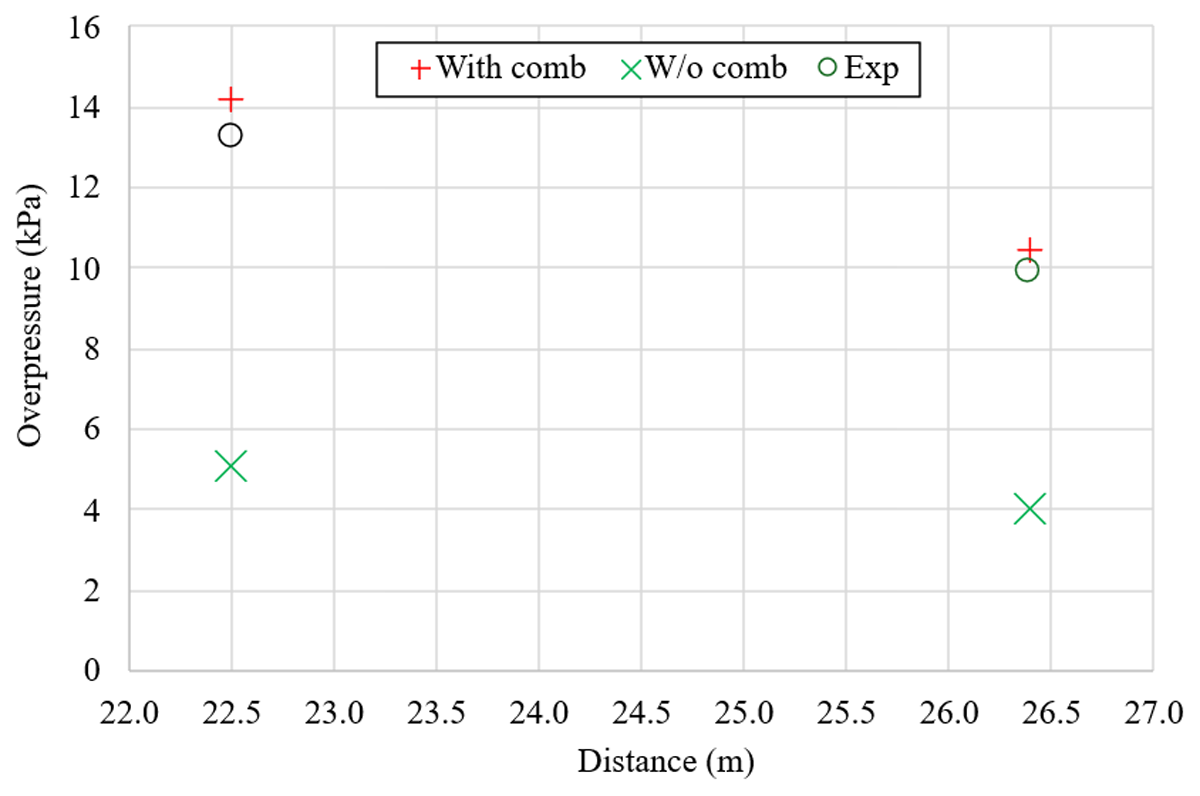
Figure 3
Blast wave overpressure generated by the supercritical LH2 BLEVE measured during the SH2IFT fire test and compared with the values assessed by the BLEXCOM tool with and without considering the combustion contribution.
The blast wave overpressure values were also collected in Table 3 together with the errors in relation to the experimental data. A very small error is obtained when the combustion process is accounted for by the BLEXCOM tool (+6.7 and +5.4% at 22.5 and 26.4 m, respectively), while a large underestimation (approx. 60%) is attained when neglecting the chemical energy.
Table 3
Blast wave overpressure simulated with BLEXCOM and compared with the SH2IFT experimental results.
| DISTANCE (m) | OVERPRESSURE | ERRORS | |||
|---|---|---|---|---|---|
| EXPERIMENTS (KPa) | BLEXCOM WITH COMB (KPa) | BLEXCOM W/O COMB (KPa) | BLEXCOM WITH COMB (%) | BLEXCOM W/O COMB (%) | |
| 22.5 | 13.3 | 14.2 | 5.1 | +6.7 | –61.9 |
| 26.4 | 9.9 | 10.4 | 4.1 | +5.4 | –59.1 |
Finally, the impulse of the blast wave was determined by both considering and neglecting the combustion process. The impulse from the experiments was estimated considering the following:
Distance from the explosion center 22.5 m, maximum overpressure 13.3 kPa, positive overpressure phase duration 12.5 ms.
Distance from the explosion center 26.4 m, maximum overpressure 9.9 kPa, positive overpressure phase duration 14.0 ms.
The impulse was calculated in BLEXCOM by converting the total energy involved in the explosion. All the values are collected in Table 4. Again, a very good estimation of the impulse is obtained by the model when considering a fraction of the chemical energy, while neglecting this effect leads to a larger underestimation.
3.2 Fireball effects
Results of the fireball effects are found in Table 5. While the fireball duration estimated by BLEXCOM agrees with the experimental results, the fireball diameter is overestimated (+25%). This can derive from the conservative assumption about the total mass of hydrogen involved in the fireball. As previously mentioned, a precise estimate of the vented mass is not experimentally available nor calculable. To account for this uncertainty, the calculation of the fireball diameter was based on the entire hydrogen mass present in the tank. The overestimation suggests the importance of accurately defining this parameter.
Table 5
Fireball diameter and duration simulated with BLEXCOM and compared with the experimental results.
| FIREBALL PARAMETER | EXPERIMENTS | BLEXCOM | ERROR (%) |
|---|---|---|---|
| Diameter (m) | 25.8 | 32.2 | +24.8 |
| Duration (s) | 5 | 5.58 | +11.6 |
Table 6 shows the comparison between the fireball radiation measurements and model results. An overestimation is obtained by BLEXCOM. There are multiple reasons for this. First, the uncertainty about the hydrogen mass and fireball diameter that influences the outcomes of the radiation assessment. Second, the parameter η has never been validated for hydrogen.
Finally, the thermal dose was estimated (Table 7). It was concluded that both distances from the explosion center (70 and 90 m) can be defined as no harm since the thermal dose values are below the threshold of 80 (kW/m2)4/3 s. However, this means that a target standing at those distances will not be harmed by the fireball, but it could get injured due to the blast wave effects. Therefore, both 70 and 90 m cannot be defined as safety distances from the supercritical LH2 BLEVE.
4.0 Discussion
The results obtained with BLEXCOM highlight both strengths and areas requiring further refinement, particularly in the context of modeling LH2 BLEVE events. One of the main challenges encountered in the validation process was the presence of uncertainties in the experimental data, particularly initial test conditions such as the mass of hydrogen and its exact temperature prior to tank rupture. These parameters critically influence the thermodynamic state of the fluid and, consequently, the BLEVE consequences, including both the blast wave and fireball behavior. For instance, the sensitivity analysis identified a total hydrogen mass that best reproduces the measured overpressure and impulse, and only this best-fitting case was reported in Section 3.1. However, significant uncertainty remains because an unknown fraction of hydrogen was vented during the fire test prior to the tank explosion. This limitation underscores the need for additional experiments to better constrain the relationships among pressure, temperature, and the masses of gaseous and liquid hydrogen, and to further validate the model.
The inclusion of chemical energy is essential when modeling LH2 BLEVEs. As demonstrated in previous studies, a fraction of hydrogen’s chemical energy contributes to the blast wave overpressure. This study confirms that neglecting this contribution leads to significant underestimation of the blast effect. However, the empirical coefficient used to account for the partial combustion of hydrogen in the blast wave, estimated equal to 5.2% of the chemical energy, should be further validated with additional experimental data. Current results support its effectiveness, but a broader dataset would strengthen confidence in its application across different BLEVE scenarios, especially for subcritical BLEVEs.
Fireball prediction results revealed an overestimation of fireball diameter, which is likely tied to uncertainties in the hydrogen mass involved in the SH2IFT experiments. Since the size and intensity of a fireball are closely related to the available fuel mass, any discrepancy in this parameter can significantly affect model accuracy. The radiation predictions showed good agreement with observed data if compared with results obtained in a previous study where a blind prediction was carried out (Ustolin and Paltrinieri, 2020). This suggests that the general approach to radiative heat estimation is sound, and some residual errors may still be attributed to the same uncertainty in the initial hydrogen mass.
Another factor influencing radiative predictions is the fraction of total heat radiated from the fireball (η) used to determine the surface emissive power. The current model uses an approach suggested for hydrocarbon fireballs; its applicability to hydrogen fireballs, especially those resulting from BLEVEs, should be verified. Hydrogen fireballs tend to emit less thermal radiation than those from hydrocarbon fuels yet are more visible than hydrogen jet fires. This intermediate behavior should be better captured by refining the emissive power coefficient.
Lastly, it is evident that a more accurate representation of fireball dynamics, i.e., variation of emitted radiation in time, would enhance the model’s predictive capability. BLEXCOM currently employs simplified assumptions in this regard, and future work should focus on incorporating transient fireball behavior to improve radiation estimates.
5.0 Conclusion
The consequences of a supercritical LH2 BLEVE, including both blast wave and fireball effects, were assessed using the BLEXCOM tool. The study demonstrated that a fraction of the chemical energy released during partial combustion must be considered to accurately predict blast wave overpressure and impulse for hydrogen BLEVEs. BLEXCOM showed very good agreement with experimental data, particularly in modeling the blast wave effects. While the tool represents a significant step forward in BLEVE consequence prediction, especially for hydrogen applications, further improvements are needed, particularly in fireball modeling. Continued development and validation of BLEXCOM will require additional experimental data to reduce uncertainties and enhance predictive accuracy.
Author Contributions
Conceptualization: F.U., D.F., A.S., V.C.; Investigation: F.U., D.F., A.S.; Methodology: F.U., D.F., A.S.; Validation: F.U., D.F.; Supervision: F.U., V.C.; Visualization: F.U., D.F., A.S.; Writing—original draft: F.U., D.F.; Writing—review and editing: F.U., A.S.