
1. Introduction
The current energy policy framework of the European Union (EU) has the objective of transitioning to a cleaner and more sustainable energy market. Hydrogen produced from low-carbon energy sources can play an important role in that transition as chemical feedstock and energy carrier, having the potential to decarbonise hard-to-abate sectors, such as heavy industry and heavy-duty transport. Hydrogen can also act as an energy storage medium to reduce volatility from renewable energy. The ambitions in relation to hydrogen are set out in various EU policy documents, including the Hydrogen Strategy for a Climate-Neutral Europe (European Commission, 2020), the REPowerEU Plan (European Commission, 2022) and the EU Hydrogen and Gas Decarbonisation Package (European Commission, 2024). The EU Hydrogen and Gas Decarbonisation package, adopted in May 2024, introduces a new regulatory framework for dedicated hydrogen infrastructure and creates the conditions for the repurposing of existing gas infrastructure. A European Network of Network Operators for Hydrogen (ENNOH) has been established to facilitate the creation of dedicated hydrogen infrastructure in the EU and to ensure the efficient transport of hydrogen across EU borders, with the aim of identifying the infrastructure needs at the European level (European Commission, 2025a). The European Grids Package and Energy Highways initiative (European Commission, 2025b), published in December 2025, provides a fast track for most urgent hydrogen infrastructure needs. This includes the Southwest hydrogen corridor from Portugal to Germany through Spain and France and the SouthH2 corridor from Tunisia to Germany through Italy and Austria.
In addition to the construction of new hydrogen pipelines, Europe’s existing natural gas grid is seen as a promising asset to repurpose for the transport of hydrogen, thus accelerating the establishment of a hydrogen transmission network in the EU. The EU’s natural gas infrastructure is a vast and complex network that plays a crucial role in ensuring energy security and meeting energy demands, and it is an essential element for the energy supply and economic stability of the EU countries. The network includes approximately 200,000 km of high-pressure (>16 bar) gas transmission pipelines, with an additional 2,000,000 km of distribution pipelines (ENTSOG, 2022), numerous storage facilities, liquefied natural gas (LNG) terminals, and interconnectors that link the EU countries’ gas systems. The EU’s natural gas infrastructure has been developed over many decades, with a significant expansion in recent years to integrate new EU countries and secure alternative supply routes, such as the Southern Gas Corridor.
By repurposing some of the natural gas transmission grid for hydrogen transport, the European Union could potentially lower the cost and accelerate the establishment of a hydrogen transmission network. The European Hydrogen Backbone (EHB) initiative envisions a hydrogen transmission network spanning over 53,000 km by 2040, with 60% consisting of repurposed pipelines (van Rossum et al., 2022). The repurposing of existing natural gas pipelines for hydrogen transport could reduce cost by around 80% as compared to the construction of new dedicated hydrogen pipelines. In order to advance the deployment of hydrogen pipelines and other technologies, the EU has put in place funding mechanisms such as Important Projects of Common European Interest (IPCEI), Projects of Common Interest (PCI) and Projects of Mutual Interest (PMI). The Hy2Infra IPCEI project supports the deployment of approximately 2,700 km of new and repurposed hydrogen transmission and distribution pipelines between 2027 and 2029. Six extended hydrogen infrastructure projects, envisioned in the European Hydrogen Backbone by 2040, are listed as PCIs or PMIs and, as such, are eligible for funding from the Connecting Europe Facility (CEF) for Energy and may benefit from faster planning and permit approvals.
For a successful repurposing, the compatibility of the assets and operations needs to be assured. It includes the long-term integrity and safety aspects of pipeline operation. Integrity management covers the prevention and monitoring of material degradation, leaks, and other factors that could compromise the pipeline performance or lifespan. Safety, on the other hand, encompasses the safety of people and external objects during the operation of the pipeline. As most safety concerns related to pipelines are connected to their loss of integrity, these two aspects are closely intertwined (JRC, 2025).
2. Integrity Challenges for Hydrogen Pipelines
The effect of hydrogen on steel pipeline materials has been extensively studied. The interaction of hydrogen with steel involves adsorption, dissociation, and absorption of hydrogen atoms into the steel and can lead to hydrogen embrittlement (Barrera et al., 2018).
Hydrogen embrittlement is governed by three factors: environmental loads (e.g., partial pressure, impurities), mechanical loads (e.g., stress, defects), and material properties (e.g., strength, microstructure). It therefore depends not only on the material susceptibility but also on the specific operating conditions of the hydrogen pipelines.
From small-scale laboratory tests, it is observed that gaseous hydrogen leads to a reduction in ductility and fracture toughness of steel pipeline materials and an increase in Fatigue Crack Growth Rates (FCGR) (Laureys et al., 2022).
Ductility, i.e., the material’s plastic ability to deform under mechanical loading, can be measured as elongation to failure or reduction in area. Small-scale laboratory tests show a reduction in ductility more pronounced in notched tensile specimens compared to smooth ones. Overall, ductility shows a decrease in the range of 20–80% in gaseous hydrogen depending on the steel grade (Andrews et al., 2020). Variation is, however, found between smooth and notched tensile specimens and between reduction in area and elongation to failure methods.
Fracture toughness, i.e., the material’s ability to resist unstable crack propagation, is reduced in gaseous hydrogen by around 35–70% (Andrews et al., 2020). This reduction is seen also at amounts of hydrogen as low as 25% in a blend, although it scales nonlinearly with hydrogen fugacity. Higher-strength steels may exhibit larger reductions in fracture toughness, but these reductions are based on their initially higher values. It has been suggested that fracture toughness in hydrogen is similar for many pipeline steel grades, irrespective of fracture toughness in air (Ronevitch et al., 2022). Fracture toughness measurements of 58 different pipeline base metals and welds revealed that fracture toughness in hydrogen was in the range of around 80–160 MPa.m1/2 for all tested samples (Steiner, Marewski and Silcher, 2023). A default threshold for time-dependent growth, as referenced in ASME B31.12 Option B, is 55 MPa.m1/2 (ASME, 2023). However, it has been hypothesised that fracture toughness reported from small-scale laboratory tests is not necessarily representative of pipeline service (Andrews et al., 2020). This is because the hydrogen needs to concentrate at the crack tip first in order to have an effect. Hence, fracture toughness is time-dependent. Depending on the type of threat to the pipeline, e.g., internal pressure or third-party damage, the strain rate and, therefore, the crack propagation speed will be different. This could result in small-scale laboratory results being either overconservative or underconservative.
Fatigue, i.e., the deterioration of materials that happens due to fluctuating stresses well below the ultimate strength of the material, results in crack growth. Fatigue crack growth is a critical aspect of pipeline integrity, and hydrogen can enhance FCGR by a factor of 10–100, with larger increases for higher stress intensity factor ranges (Laureys et al., 2022). Stress intensity factor range is a function of defect severity, maximum stress, and stress range. The increase was found to be relatively independent from material strength and microstructure. FCGR is more pronounced for higher load ratios, which is also where pipelines typically operate. It is also dependent on hydrogen fugacity, at least at lower stress intensity factor ranges (Ronevich, Agnani and San Marchi, 2024). It was observed that there is no clear relationship between yield strength and FCGR (Laureys et al., 2022). There is an ongoing interest for FCGR at lower stress intensity factor ranges (and for threshold stress intensity factor range), considering that it is under these circumstances that most fatigue life is spent. Models have also been developed to simulate hydrogen-assisted fatigue crack growth of pipeline steel (Amaro et al., 2018).
Gas impurities, such as oxygen or carbon monoxide, potentially reduce hydrogen embrittlement by obstructing hydrogen adsorption sites onto the steel surface (Andrews et al., 2020). However, the long-term effects of these inhibitors are not well understood, and further research is necessary to clarify their impact on fracture toughness and FCGR under operating conditions (Laureys et al., 2022). The consumption of oxygen due to adsorption onto pipeline surfaces may also lead to an effectiveness that varies along the pipeline length, a factor not yet investigated over extended distances or for large scales.
In summary, a significant amount of research has been conducted in the field of material compatibility with hydrogen. However, this knowledge needs also to be interpreted in terms of pipeline integrity and safety, and effective mitigation strategies for the transport of hydrogen in steel pipelines need to be developed.
To understand how gaseous hydrogen will affect the integrity and safety of the pipelines, it is important to look at the different possible failure causes of a gas pipeline. The ASME B31.12 code lists root failure causes for hydrogen pipelines. This list corresponds well with the list provided in the ASME B31.8S code, which refers to natural gas pipelines. This indicates that the types of possible root causes are anticipated to be similar, but the frequency or severity of each failure type may change. Typical integrity-threatening defects from these failure types include cracks, dents, gauges and metal loss.
Crack-like defects are a key challenge for hydrogen pipelines and are the type of defects that have received the most attention so far. The severity of a crack depends on its size, location and orientation (Kappes and Perez, 2023). The reduction in fracture toughness and increase in fatigue crack growth rates in gaseous hydrogen can lead to the growth of existing cracks, potentially compromising the integrity of the pipeline. Failure Assessment Diagrams (FADs) are typically used to assess crack-like defects, and the introduction of hydrogen can lead to a lower failure pressure for brittle fractures (Kappes and Perez, 2023). Fatigue is an important consideration for hydrogen pipelines, as it can lead to the growth of existing cracks. However, most studies on fatigue crack growth are performed at low load ratios and constant (high) amplitude, which may not be representative of real-life operating conditions (Kethamukkala, Potts and Liu, 2024). For a reliable prediction of fatigue life, the material characteristics as well as the operating conditions need to be carefully defined. The operating conditions of interest are particularly the pipeline pressure and variations thereof. The definition and use of pressure variation data in fatigue life estimations are considered a knowledge gap.
Dents and gouges are another integrity threat to pipelines and can be caused by external interference, such as excavation equipment making contact with the pipeline. The criticality of a dent depends on factors such as its geometry and the strains induced by the deformation. Dents are often found in combination with other defects, which lead to even more severe challenges for pipeline integrity (Naib et al., 2024). Dents can be more severe in hydrogen service due to the reduced ductility (elongation at failure) observed for pipeline steels in hydrogen gas. Dents can also cause stress concentrations, leading to crack formation with issues associated with crack growth described above.
Corrosion is a form of metal-loss damage that may lead to either sudden rupture failure or leakage failure. However, the introduction of hydrogen may not significantly affect corrosion-related failure, as most corrosion-related failure models assume plastic failure (Andrews, Gallon and Huising, 2022). Ground movement is another source of pipeline failure and can result in local displacement of the pipeline, leading to stress in excess of the steel’s ultimate tensile strength. The reduction in ductility from hydrogen exposure may increase the risk of failure due to ground movement.
In summary, there have been numerous studies, mainly numerical and small-scale laboratory experiments, investigating the effects of hydrogen on pipeline steels with defined defects such as cracks. There is, however, a prevailing belief that small-scale laboratory tests may not accurately represent the behaviour of full-scale pipelines, leading to inaccurate predictions. This has highlighted the need for further research on the effect of gaseous hydrogen on full- or large-scale pipeline sections with realistic defects (Andrews, Gallon and Huising, 2022) to fully understand the integrity threats to hydrogen pipelines. Inspection and monitoring of pipelines are crucial to detect possible time-dependent flaws before they become critical. As such, pipeline inspection and integrity management practices may need to be revised.
3. Safety Challenges for Hydrogen Pipelines
The safety concerns related to hydrogen pipelines are primarily focused on the possibility of accidental release of flammable gas from the pipeline, which can lead to jet flames, deflagration or even detonation. Hydrogen and natural gas are both flammable gases that can exhibit similar behaviours upon leakage, rising due to buoyant forces. Hydrogen, however, has some characteristics that can contribute to more severe consequences, such as a low ignition energy and high laminar velocity (Kotchourko, 2022).
Hydrogen pipelines are mainly located underground (reported values range from a depth of a minimum of 0.7–0.9 m to a maximum of 5 m). The soil type and pipeline pressure, therefore, affect the release behaviour of hydrogen gas from a buried pipeline. Small releases underground may diffuse up through the soil (Bonnaud et al., 2018), while larger releases can create craters uplifting the soil (Houssin-Agbomson et al., 2018). The different flow properties of hydrogen and natural gas can affect how and when craters are formed during accidental releases, requiring existing models for natural gas to be adapted and revalidated for hydrogen.
Hydrogen flames emit radiation, but less in the visible spectrum compared to carbon-based fuels like methane (the main component of natural gas). The thermal radiation from hydrogen jet flames can cause harm to humans and structures, but most experimental studies are limited to smaller fires and situations different from those expected for a pipeline (Ewan, Moodie and Hawksworth, 2022). Some full-scale experiments have been conducted, such as in the European project NATURALHY, which found that hydrogen-methane blends did not produce significantly different amounts of radiated heat compared to pure methane. In the same project, overpressures from explosions involving hydrogen and methane were compared. It was found that hydrogen explosions produce significantly higher overpressures. When hydrogen and methane were mixed with hydrogen content kept below 25%, the overpressures were similar compared to pure methane (Shirvill et al., 2019).
The distinctive properties of hydrogen in comparison to natural gas may require the revision of the safety protocols, emergency response plans, and risk assessment methodologies that were initially developed for natural gas. The risk assessment approaches for hydrogen pipelines typically involve quantitative risk assessments (QRAs) or pre-determined safety distances. The QRA methodology applied in the UK for natural gas pipelines is described in IGEM/TD/2, but there is currently no equivalent for hydrogen (Rowell, 2024). The Netherlands has a QRA methodology for gas pipelines, which has been adapted for hydrogen pipelines (RIVM, 2021). Several studies have conducted QRAs for hydrogen transmission pipelines. The results indicate that the level of risk can be higher close to the pipeline for hydrogen transport compared to methane, but lower at greater distances (Froeling et al., 2021). The higher risk level close to the pipeline is often attributed to the assumed high probability of direct ignition and, therefore, jet fire. The risk to the public from hydrogen pipelines is also influenced by the end use of hydrogen, with studies such as the HyDelta 2 and H21 projects finding that the risk from explosion can be greater for hydrogen, but the overall risk can be lower compared to natural gas. A large contributor to risks from natural gas in residential settings is from carbon monoxide poisoning, a risk that is not present with hydrogen. As with most risk assessments, large variations in results exist between different assessments, mainly due to differences in underlying assumptions that stem from uncertainties.
4. Incident History of Gas Pipelines
The previous sections have shown that hydrogen can affect the pipeline material properties and may lead to integrity and safety challenges. Ultimately, threats to integrity and safety are leading to incidents. In that regard, knowledge of past gas pipeline incidents is of interest to better understand the future behaviour of the hydrogen gas grid.
Both Europe and the United States have pipelines transporting gaseous hydrogen. However, they serve the needs of few industrial customers, have smaller diameters and shorter lengths. According to H2TOOLS data from 2016 (H2TOOLS, 2016), there are more than 4,500 km of hydrogen pipelines in operation. Those are mainly operated by hydrogen producers. The largest share of pipelines is operated in the USA for a total of 2,600 km, concentrated in Texas and Louisiana, followed by Belgium and Germany with a European length of around 1,600 km. Although some of these pipelines are operated at pressures up to almost 10 MPa, most of them are characterised by lower pressures up to five MPa, with small diameters up to 0.25 m.
There is therefore no field experience related to the operation of large-scale hydrogen transmission pipelines. Nevertheless, important experiences exist in large-scale transmission of natural gas, as well as small-scale transmission of gaseous hydrogen, that should both be leveraged. Therefore, this paper has compiled and reviewed the few publicly available incidents from hydrogen pipelines worldwide, with an attempt to compare them with the much broader return of experience from incidents from the natural gas transmission grid and to gain insights on the threats to pipeline integrity and safety.
4.1 Natural gas pipelines
The transportation of natural gas via pipelines has a long tradition in Europe. Although operations are generally safe with only a limited number of incidents, they do happen. The European Gas Pipeline Incident Data Group (EGIG) collects incident data from several gas transmission grid operators in Europe (EGIG, 2023). Looking at the trend over the years, it is clear that incidents are becoming less frequent, as demonstrated by an average of 15 incidents per year for the 2018–2022 period as compared to an average of 25 incidents per year for the period 1983–2022. Figure 1 presents the distribution of incidents by cause and leak size for natural gas transmission pipelines between 2013 and 2022, as given in the EGIG database.
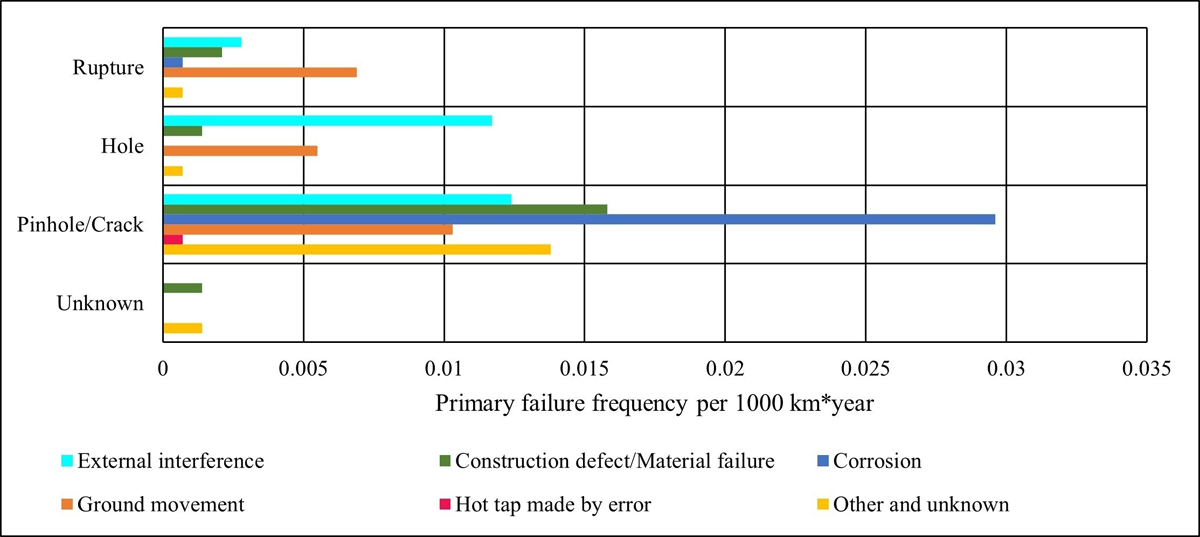
Figure 1
Primary failure frequency by cause and size of leak for natural gas transmission pipelines in the EGIG database, years 2013–2022, based on 171 incidents (EGIG, 2023).
As with industrial incidents in general, smaller incidents, such as pinholes and cracks, are significantly more frequent compared to larger incidents. In general, corrosion leads to smaller leaks (pinholes), whereas ground movement and external interference lead to larger releases (ruptures and holes, respectively) (EGIG, 2023).
Similar conclusions emerge from the analysis of the incidents affecting US natural gas pipelines. A recent summary of the findings from the database of the US Pipeline and Hazardous Materials Safety Administration (PHMSA) is available (Ruiz-Tagle and Groth, 2024). When analysing all reported incidents, material failure (welds) and corrosion causes contribute to more than half of the total. The cause distribution is different when focusing on serious incidents only: excavation damages and incorrect operations account for almost 45% of the total.
From a public safety perspective, the larger leaks, i.e., following ground movement, external interference, and to some extent construction defects/material failure, are more of a concern since these incidents have a bigger potential to harm third parties.
4.2 Hydrogen pipelines
For a future safe large-scale hydrogen transmission grid, it is important to assess the impact of hydrogen in relation to the same loss of confinement identified above for the natural gas grid. However, because of their different physical and chemical characteristics, hydrogen pipelines will respond differently to loss of confinement than natural gas ones. This means that the incident history of natural gas pipelines is not directly applicable to hydrogen pipelines. Nonetheless, it provides a general frame for the identification of the integrity challenges affecting gas transmission pipelines.
The collection of experiences from hydrogen pipeline incidents is not as systematic as it is for the natural gas transmission pipeline sector. An analysis of the research gaps affecting quantitative risk assessment of hydrogen transmission pipelines is provided in (Yang et al., 2024). One of the gaps is a lack of knowledge about failure causes and frequencies. To this purpose, the world’s largest publicly available repository of hydrogen-related incidents, the Hydrogen Incidents and Accidents Database (HIAD) (JRC, 2026; Wen et al., 2022), managed by the Joint Research Centre of the European Commission, was consulted. Its latest release (1 January 2026) contains most of the pipeline incident reports made available in the public domain. This analysis only includes incidents involving pipelines with pure hydrogen and environmental and operational conditions relevant to long-distance gas transport pipelines. The terminology used by incident reports is often unclear due to the use of common language for very different technologies, components and processes. The term ‘pipeline’ can be used to indicate long-distance gas or liquid transmission technology or for pipes carrying process gases and liquids from one process unit to another on the same site of a chemical or petrochemical plant. However, these have very different operational and environmental characteristics than the pipelines used to transport gas over long distances, which is the topic of this paper. Pipes in an industrial setting often operate at high temperatures, different pressures and flows, carry mixtures of gases or multi-phase mixtures and are installed in industrial, congested structures, which induce different and complex behaviours of the released substances. The mechanisms that lead to their loss of confinement vary and are caused by different factors. Therefore, in this analysis, care was taken to select only HIAD incidents relevant to the pipeline transmission technology. Only 12 were identified. This low number is, on one hand, due to the much lower coverage of hydrogen pipelines with respect to the natural gas and liquid hydrocarbon pipelines, both in the US and in the EU. On the other side, they have a private character and are not classified and regulated as the natural gas transmission lines and therefore do not have a legal commitment to report mishaps. For example, none of the reports of the European Gas Pipeline Incident Data Group (EGIG) on annual gas pipeline incidents contain any reference to hydrogen transmission pipelines. The incidents are summarised in Table 1. The sources of these incidents do not specify if these pipelines were built specifically for hydrogen transport or reconverted from natural gas pipelines. Nevertheless, the first case can be reasonably assumed for their majority.
Table 1
Relevant incidents involving hydrogen pipelines extracted from HIAD 2.2, version released on 1 January 2026 (JRC, 2026).
| HIAD EVENT ID DATE COUNTRY ORIGINAL SOURCE | SHORT EVENT DESCRIPTION |
|---|---|
| #154 2006-10-20 UNITED STATES PHMSA (PHMSA, 2026) | A release of hydrogen during the installation process of a new pipeline. Due to human error, hydrogen was released and ignited, injuring one operator. |
| #191 2002-12-03 UNITED STATES PHMSA (PHMSA, 2026) | Circumferential rupture of a hydrogen pipeline at a place where a previous leak had been repaired. A plausible cause of the failure was the heat applied during the weld repair. |
| #478 2019-05-06 BELGIUM News – Sud Info (Sud Info, 2019) | An abnormal noise was reported from a hydrogen pipeline. The pipeline was depressurised, emptied and repaired. No impact was reported. |
| #759 2007-10-12 NETHERLANDS VROM (VROM, 2009) | A leak occurred at an underground steel pipeline of six inches in diameter transporting pressurised hydrogen at 75 bar. The leakage occurred at a so-called ‘CP coupling’. The released hydrogen was ignited by nearby welding activities, resulting in a small fire. It is unclear how long the leak persisted before the ignition. |
| #891 2019-03-21 BELGIUM ARIA (ARIA, 2026) | Excavation work was performed nearby a buried pipeline of gaseous hydrogen. The excavation machine hit the pipeline, causing a jet fire. No injured person was reported. The excavation machine was burnt during the accident. |
| #933 2013-04-18 FRANCE ARIA (ARIA, 2026) | A worker detected a small leak from a pipeline for hydrogen transport (OD = 80 mm, p = 75 bar). The pipeline was emptied and repaired successfully. |
| #1027 2021-03-21 BELGIUM ARIA (ARIA, 2026) | During agricultural drainage work carried out by a farmer, an explosion occurred on a hydrogen pipeline located in a field. Flames several meters high were visible, and two houses were evacuated. A safety perimeter was set up. The pipeline operator applied the emergency procedures in place to ensure the safety of the local residents and of the pipeline. |
| #1056 2021-02-15 UNITED STATES PHMSA (PHMSA, 2026) | A hydrogen release and subsequent fire occurred at a meter station on a pipeline transporting hydrogen to a refinery. For various reasons, the hydrogen pipeline was operated at a larger than normal flow rate. The incident investigation identified that there was erosion of the flow tubes in the gas meter. The initial event led to subsequent failures of the skid, including the gas meter housing, meter flange, an eight-inch manufactured elbow, and an eight-inch bypass line. |
| #1057 2022-02-05 UNITED STATES PHMSA (PHMSA, 2026) | A release from a hydrogen transmission pipeline occurred following welding on the pipeline. The pipeline was isolated. |
| #1058 2019-05-05 UNITED STATES PHMSA (PHMSA, 2026) | A third party heard a leak in a hydrogen pipeline. The pipeline was isolated, stopping the leak. The source of the leak could not be identified due to some parts being inaccessible. Parts of the pipeline were replaced by a new segment with a new route, and the pipeline was later put back into service. |
| #1059 2018-11-12 UNITED STATES PHMSA (PHMSA, 2026) | A potential hydrogen pipeline leak was observed due to bubbling water. The pipeline was depressurised, stopping the leak. Due to its small size, the leak was not identified by the automated control system. |
| #1060 2015-04-28 UNITED STATES PHMSA (PHMSA, 2026) | An in-line inspection of the hydrogen pipeline was being conducted, and prior to the last run of the in-line inspection tool (magnetic flux leakage), hydrogen gas was released and ignited from a blind flange connection failure on a temporary separator filter installed at the receiver site. The fire was immediately identified by on-site personnel. There were no injured personnel. |
Figure 2 presents some statistics from the identified incidents involving hydrogen pipelines.
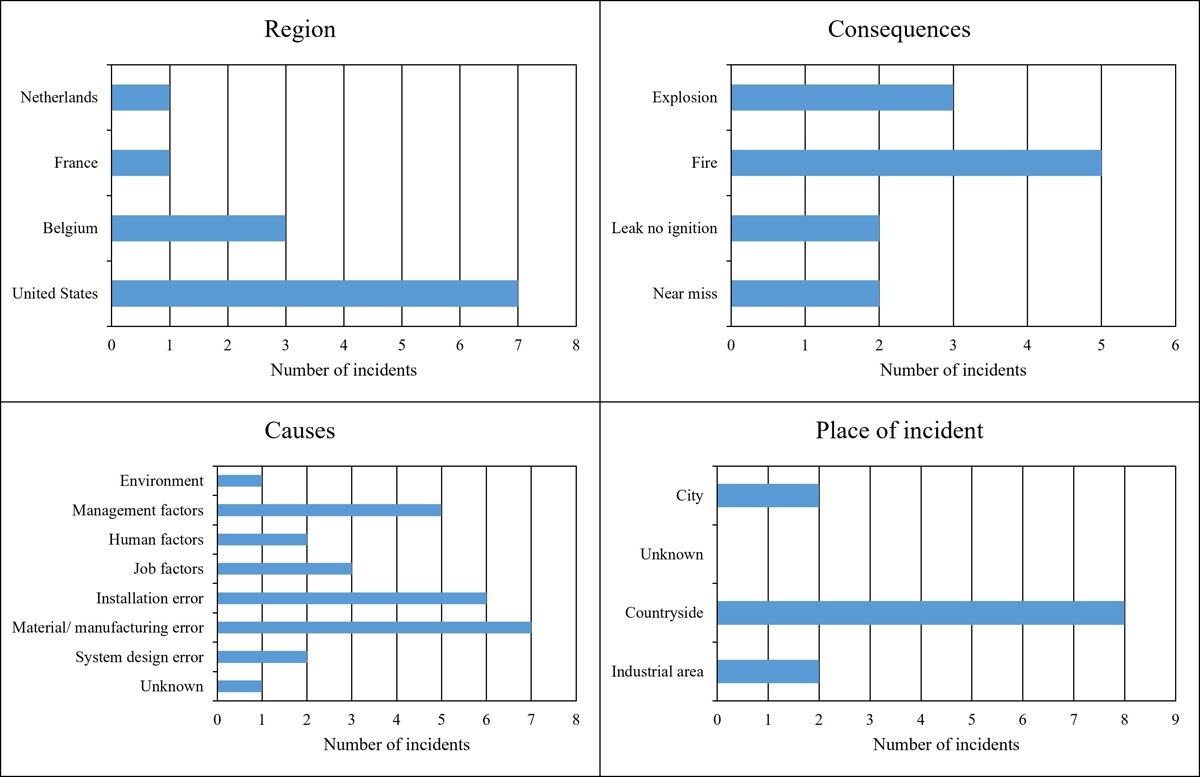
Figure 2
Countries where the incidents occurred, including consequence, cause, and place of incident for the 12 identified incidents involving hydrogen pipelines from the HIAD 2.2 database (incidents may have more than one cause).
Seven of these incidents occurred in the United States, five in Europe. The higher proportion and quality of incidents in the United States is due to the obligation for pipeline operators to report incidents to the Pipelines and Hazardous Materials Safety Administration (PHMSA) of the US Department of Transportation. These reports are filed in a database that can be consulted through the HAZMAT Incident Report search tool (US Department of Transportation, 2026), but only for the period after 2010, when hydrogen transporting transmission pipelines received a unique labelling in the database. Most incidents, eight of them, led to either fire or explosion. One incident (#154) led to the injury of one worker. Two-thirds of the incidents occurred during normal operation, and one-third during abnormal operation, such as maintenance work. Most incidents, eight of them, occurred in the countryside, which is where transmission pipelines are typically located. The PHMSA database provides in a few cases the released quantities, which range from hundredths of kg to a few tons.
Several of the releases were recognised locally, for example, due to the hissing sound of the leaking gas and, in one case, due to the production of bubbles in a water-filled ditch. The control room of the pipeline operator can detect larger leaks that may result in a loss of pressure. The first operational mitigating measure undertaken is the isolation of the affected pipeline section, followed, if necessary, by its controlled depressurisation and purging.
However, the limited number of incidents prevent any statistical conclusions from being drawn from the analysis of those incidents. Moreover, incidents from hydrogen and natural gas pipelines should be carefully compared to study differences in trends and behaviour. This is currently not feasible due to scarce data availability and differences in incident reporting.
5. Discussion
Defects in the pipeline infrastructure pose threats to its integrity. Crack-like defects require particular attention due to the enhanced risk of propagation in the presence of hydrogen. Small-scale laboratory experimental results and numerical results suggest that existing cracks exhibit accelerated growth in a hydrogen environment and that cracks can grow faster and become critical under certain operating conditions. Pressure variation data need to be carefully selected and defined for accurate predictions, something that currently can be considered a knowledge gap, at least in the scientific literature. Other integrity threats, such as dents, gouges, and corrosion, also need to be reconsidered in the light of the hydrogen effect on the steel pipeline materials.
Most research on hydrogen embrittlement in pipeline steel has been performed using small-scale laboratory experiments. There is, therefore, a need to validate these findings at near full-scale and, for realistic defects, to verify that the findings on small-scale specimens can be accurately extrapolated to real-world pipeline conditions, especially since the experimental conditions may be different in small-scale laboratory experiments and in real-world operating conditions. Here, testing facilities having the capabilities to test large-scale pipeline sections in a hydrogen environment have an important role to play. The High-Pressure Gas Testing Facility (GasTeF) of the European Commission’s Joint Research Centre (JRC) in Petten, the Netherlands, is one of them. The facility has been used for a long time for the testing of gaseous hydrogen storage tanks for automotive applications and has contributed to various research projects, including the European project MATHRYCE, which investigated the hydrogen-enhanced crack growth on the fatigue life of metallic pressure vessels for hydrogen storage (de Miguel et al., 2017). In this project, the accelerating effect of hydrogen on the wall crack propagation was determined by comparing results of fatigue pressure cycles in full-scale vessels using both hydraulic media and gaseous hydrogen. The full-scale tests resulted in faster crack growth rates in comparison to small-scale laboratory tests and fracture mechanics approaches. Based on the operational experiences from the MATHRYCE project, the JRC assessed that, after some modifications, the GasTeF facility could serve to study the effect of hydrogen in large-scale pipeline sections, especially from repurposed vintage infrastructure.
Pipelines typically operate under cyclic stresses due to variations in pressure in the pipeline, leading to fatigue. The fatigue life of the pipeline as a function of the operating conditions is therefore an important aspect to study. Pressure cycling tests are used as a way to carry out accelerated fatigue testing of a pipeline over its expected lifetime and beyond. In order to perform fatigue testing of real-size pipeline sections transporting 100% hydrogen, the setup of the GasTeF facility and the sample shape were both modified. A mock-up was manufactured to demonstrate the feasibility of testing pipeline sections in a similar way as for on-board storage tanks. The GasTeF facility was also modified to allow cycling tests within a pressure range relevant to hydrogen pipeline operation, i.e., approx. 20–100 bar. Strain gauges are used to monitor crack growth during the pressure cycles. Fatigue testing campaigns are expected to last approx. 2–3 months under relevant hydrogen pipeline conditions with the current experimental setup. Abnormal conditions, such as transients or high-pressure excursions, can also be studied using the modified GasTeF setup. Pipeline sections currently used in the natural gas transmission network, which may be considered for repurposing for hydrogen transport and that present defects typically found in the grid, will be tested in the modified GasTeF facility. The findings will contribute to the development of informed integrity and safety management practices for repurposed natural gas pipelines for hydrogen transport and will be shared with relevant European and international standardisation bodies, such as CEN JTC6 on hydrogen in energy systems and ISO TC197 on hydrogen technologies.
Due to the changes in the properties of pipeline steel in the presence of hydrogen, the transition from natural gas to hydrogen may necessitate a re-examination of pipeline inspection and integrity management practices. For example, faster crack growth rates may require more frequent inspections and the implementation of new crack growth models. The existing ASME B31.12 code as well as other national codes and standards address some of these issues already. Safety protocols, emergency response plans, and risk assessment methodologies may also need to be updated to account for the distinct properties of hydrogen in comparison to natural gas. Some risk assessment methodologies have already been proposed, but they need to be continuously updated as new empirical and theoretical evidence is unveiled.
An integrated approach is needed to address knowledge gaps. This includes research and development efforts to better understand the interaction of hydrogen with pipeline materials and operational implications. European and international codes and standards need to be updated to include specific requirements on adaptation measures, such as safety aspects, choice of material, and assessment criteria, to make the infrastructure fit for hydrogen purposes and ensure its safety. There are already several of these regulations and guidelines in place, such as the ASME B31.12 code and the EIGA IGC Doc 121/14 ‘Hydrogen Pipeline Systems’ guidance document. Nonetheless, these need to be continuously improved as more empirical evidence is gathered.
The incident history of gas pipelines offers useful information about the potential risks associated with hydrogen transmission pipelines. While the number of incidents involving hydrogen pipelines is limited, the data suggests that ‘soft’ factors, such as management, human, and job factors, are important incident causes. Material and manufacturing errors are the most common causes of incidents, highlighting the need for rigorous quality control and integrity management procedures. An important disclaimer is nevertheless required when presenting statistics on overall causes. On top of the fact that incidents are almost never the results of one single cause, it must also be considered that cause classification and identification are affected by uncertainties and biases. It is therefore important to be able to access and scrutinise the details of the incidents before drawing general conclusions. In this paper, a careful selection of the incidents was performed to guarantee a coherent analysis. However, due to the limited amount of data, it is not possible to conclude important accidental aspects. For example, the common assumption that hydrogen released from a pipeline ‘always ignites’ is not confirmed by the dataset studied in this paper, which reports at least two cases of leaks without ignition. The difference in behaviour may be related to the mass flow values caused by the leak and the specific environment surrounding the pipelines. The lack of statistical reliability does not allow either to rank various technologies belonging to the hydrogen supply chains in terms of safety.
6. Conclusion
The integrity and safety challenges of transporting hydrogen by pipelines have been reviewed with a focus on the repurposing of existing natural gas pipelines for hydrogen transport. Hydrogen embrittlement of pipeline steels reduces the ductility, fracture toughness, and fatigue crack growth resistance of the material in the presence of hydrogen. These alterations are important to assess with regard to the long-term structural integrity of steel pipelines in hydrogen service. The behaviour of typical defects found in natural gas pipelines, such as cracks, dents and corrosion, has been previously investigated under the influence of gaseous hydrogen in small-scale laboratory experiments. The small-scale laboratory experiments may, however, not be representative of the conditions and behaviours expected for full- or large-scale pipeline sections. Testing facilities capable of testing full- or large-scale pipeline sections play a crucial role in ensuring informed integrity and safety management practices.
The findings suggest that, while hydrogen embrittlement presents an important challenge for pipeline steel material, it can be managed with thorough material compatibility, integrity, and safety assessments, as well as adapted inspection, maintenance, and risk mitigation practices. Revised safety and risk assessment procedures may also be necessary due to the different safety-related characteristics of hydrogen compared to natural gas.
Knowledge of past gas pipeline incidents is of interest to better understand the future behaviour of the hydrogen gas grid. The incident history from the natural gas transmission sector and its analysis provide valuable insight on the main threats to pipeline integrity and safety, thus presenting great opportunities to leverage the existing knowledge. Unfortunately, the same cannot be said for the operation of the existing hydrogen pipelines. The lessons learned are not publicly available to the same extent despite the critical role they could play for the scientific community and governmental and local administrations for the development of credible accident scenarios, extraction of reliable failure frequencies and designing of effective permitting procedures.
Disclaimer
The views expressed are purely those of the authors and may not in any circumstances be regarded as stating an official position of the European Commission.
Author Contributions
Aurelien Pitois–conception and design, data analysis, drafting, Erik Smedberg–data acquisition, data analysis, drafting, Remi Kleine–data acquisition, critical review, Pietro Moretto–conception and design, critical review, Beatriz Acosta Iborra–conception and design, critical review.