
1. Introduction
The International Maritime Organization (IMO) Strategy for reducing greenhouse gas (GHG) emissions from ships aims to achieve net-zero GHG emissions by 2050 (The International Maritime Organization, 2023). Ship design, production sustainability, and fuel availability are essential considerations (Mazloomi and Gomes, 2012). Hydrogen is, therefore, considered a very promising green energy carrier or fuel, as it can be produced through various methods and resources, such as the steam reforming of natural gas or through electrolysis of water (Ustolin, Campari and Taccani, 2022). However, several safety concerns are associated with hydrogen, including its low minimum ignition energy and wide explosive limits.
Inert gas safety systems are widely used on ships and tankers to mitigate explosions and fires. The International Convention for the Safety of Life at Sea (SOLAS) regulates and sets minimum safety standards for merchant ships, which also include the use of inert gas systems in tankers (Akyuz, 2015). Inert gas safety systems mitigate fires and explosions by diluting and replacing the oxygen in the room. Although this can be an effective method for reducing explosions and fires, accidental release still has the potential to be fatal. Several deaths have been reported due to the unintentional initiation of inert gas safety systems (Akyuz, 2015).
Inergen is an inert gas that consists of 52% nitrogen, 40% argon, and 8% carbon dioxide, which is used for fire and explosion mitigation. However, it is typically used in an inert gas system that only reduces the oxygen concentration in the room to around 12% (Riley, 1992). This is enough oxygen for humans to avoid fainting or suffocation. Although hydrogen has a wide explosive range and can burn at very low oxygen concentrations, such an inert system could reduce the probability of ignition and the consequences of an explosion.
The objective in this study is to examine the effectiveness of Inergen in hydrogen-air mixtures by experimentally measuring the explosion pressure, rate of pressure rise, and explosive limit at various concentrations of air and inert gas in the mixture. Additionally, a simple numerical model predicting the explosion limits of hydrogen, air, and inert mixtures is compared to experimentally determined explosion limits. The explosion characteristics of hydrogen mixed with different parts of air and Inergen were measured in a 20-liter explosion sphere at 300 Kelvin and 100 kPa (absolute).
2. Methods and Materials
Figure 1 shows a schematic illustration of the 20-liter explosion sphere. A detailed description of the experimental setup and procedure has been previously published (Henriksen et al., 2020, 2019). The internal volume of the explosion sphere is 20.4 liters. A temperature-controlled heating jacket surrounding the vessel regulates the temperature of the gas inside the vessel. While two pressure sensors recorded the explosion pressure, a separate pressure sensor was used to record the ambient pressure in the sphere during filling. Moreover, the separated fuel, inert, and air inlets reduced uncertainties in fuel-air concentrations. The wire/fusing coil ignition system was used, which causes a metal wire to melt and evaporate, igniting the mixture in the process. The ignition energy is approximately 10 J, according to the supplier. The target temperature and pressure for all experiments were 300 Kelvin and 100 kPa (absolute), respectively.
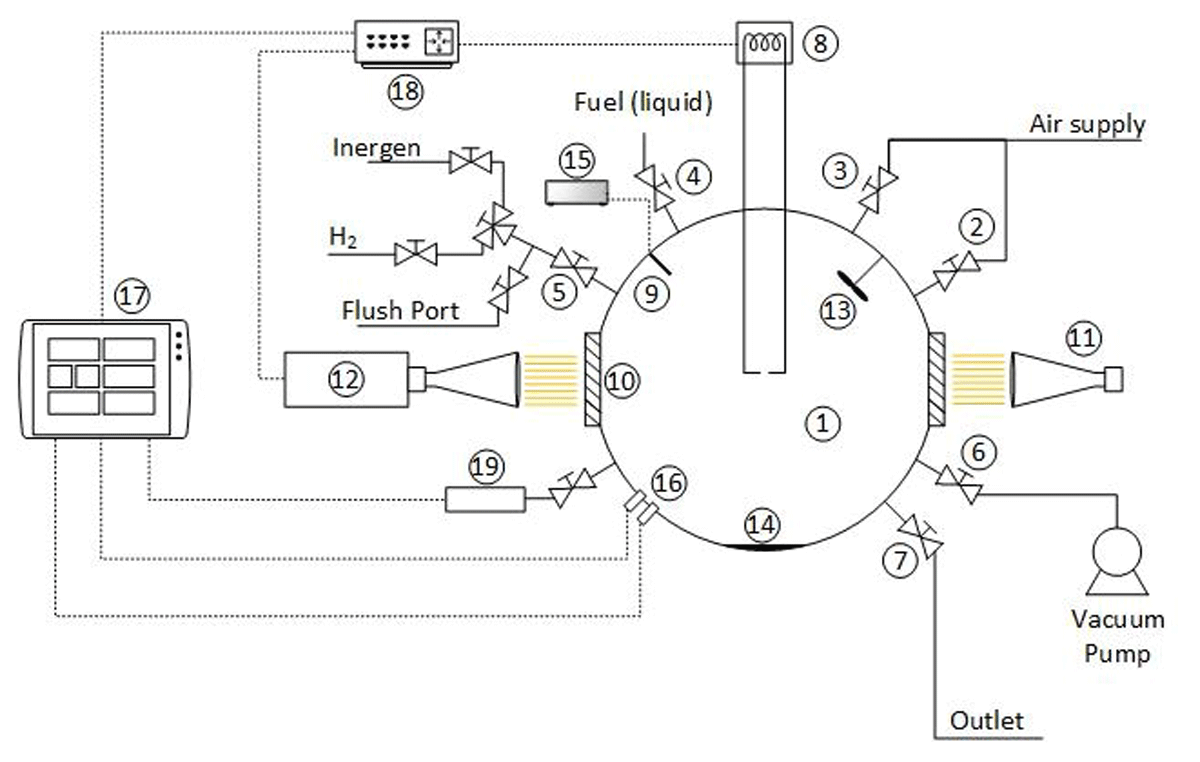
Figure 1
Schematic of the experimental setup (Henriksen, 2021; Henriksen et al., 2021). 1: explosion chamber; 2: oxidizer inlet; 3: flush inlet; 4: fuel (liquid) injection port; 5: inlet for fuel and inert (gas); 6: vacuum port; 7: gas outlet; 8: ignition system; 9: thermocouple; 10: glass windows (100 mm); 11: LED light source; 12: high-speed camera; 13: stirrer; 14: heating plate; 15: ambient temperature display; 16: dual explosion pressure sensors; 17: data acquisition system; 18: control/trigger unit and; 19: ambient pressure sensor.
The explosion sphere was purged with compressed and oil-free air for a minimum of five minutes, and the total volume in the sphere was exchanged approximately 40 times before each experiment. The explosion sphere was evacuated to an absolute pressure of 10 kPa or less, after purging. Fuel was filled to the desired partial pressure, and then the sphere was filled with air to 100 kPa (±0.5 kPa). Air and fuel were actively mixed for three and a half minutes to ensure a homogenous mixture. After mixing, the temperature was recorded. The temperature difference between experiments was within ±1 Kelvin. The ignition was delayed for one and a half minutes after mixing to ensure that the mixture was quiescent. For the explosive limit results, two duplicate experiments were conducted for most of the experiments.
During the post-processing of the pressure data, the experiments were categorized into two groups based on a pressure threshold of 100 kPa. For experiments with a maximum explosion pressure exceeding this threshold, the unfiltered maximum explosion pressure was recorded, and the maximum rate of pressure rise during the explosion was determined using filtered pressure data. A Savitzky-Golay (Savitzky and Golay, 1964) least-square filter was applied with a filter size of 2% of the data. For experiments below 100 kPa (gauge), the maximum explosion pressure was determined based on the filtered data, as the noise-to-signal ratio in the raw data was higher. If the filtered pressure was below 5 kPa (gauge), the experiment was categorized as no combustion. The threshold of 5 kPa (gauge) was based on the guidelines from the European Standard EN 1839, Determination of Explosion Limits of Gases and Vapors (European Standard, 2012).
To numerically estimate the explosive limit with the addition of an inert gas, a simple model or algorithm using the adiabatic flame temperature as a threshold was employed (Mashuga and Crowl, 1999). The algorithm first determined the adiabatic flame temperature at the lower and upper explosive limits of hydrogen in air, which were 4% and 77%, respectively (Cheikhravat et al., 2012). These temperatures were then used as criteria to determine the respective lower and upper explosive limits as the inert concentration was increased. For hydrogen, the adiabatic flame temperature differs between the lower and upper explosive limits. Therefore, as the inert concentration increases, the numerical explosive limit will not reach a singularity at the minimum inert concentration (MIC). Instead, the point of the MIC is determined where the extrapolated upper explosive limit line intersects with the lower explosive limit line. Cantera (version 2.3) (Goodwin, Moffat and Speth, 2017) and the equilibrate solver were used to determine the adiabatic flame temperature and the closed-volume explosion pressure at constant enthalpy and internal energy, respectively. The reaction mechanism used was GRI-MECH 3.0 (Smith et al., 1999, p. 4).
As mentioned in the introduction, the intended purpose of using Inergen as an explosion and fire mitigation system is to reduce the oxygen concentration to approximately 12%. At this oxygen concentration, while humans do not faint or suffocate, it is still low enough to mitigate the explosion hazard. To reduce the oxygen concentration in a room, a precalculated amount of inert gas can be injected into the room, displacing a certain fraction of the air. Therefore, in this study, the results are also presented as a function of the inert-to-air relation (α) as given by the equation below, where an α of 0.5 is an equal volume fraction of air and inert in the total gas mixture.
where α – inert to air relation [–], Xi – mole/volume fraction of species i, [–].
At the time of submission, a total of 47 experiments had been conducted, comprising 35 with ignition and 12 without ignition. Four different values of inert-to-air relations (α) were studied: 0, 0.25, 0.50, and 0.75. The purity of the Inergen and hydrogen was 99.95% and 99.995%, respectively.
3. Results and Discussion
Figure 2 shows the preliminary experimental and numerical explosion pressure as a function of fuel-air equivalence ratio (Φ) at the four different values of α. As expected, the explosion pressure decreases as the inert-to-air relation (α) increases. However, the decrease in pressure is relatively low compared to the amount of inert added. Even with an equal amount of inert and air in the mixture, the explosion pressure is only reduced by approximately 200 kPa compared to a gas mixture without inert at Φ equal to 1. At Φ equal to 1.0 and α equal to 0.5, the oxygen concentration in the mixture is 8.6% and the maximum explosion pressure is 505 kPa.
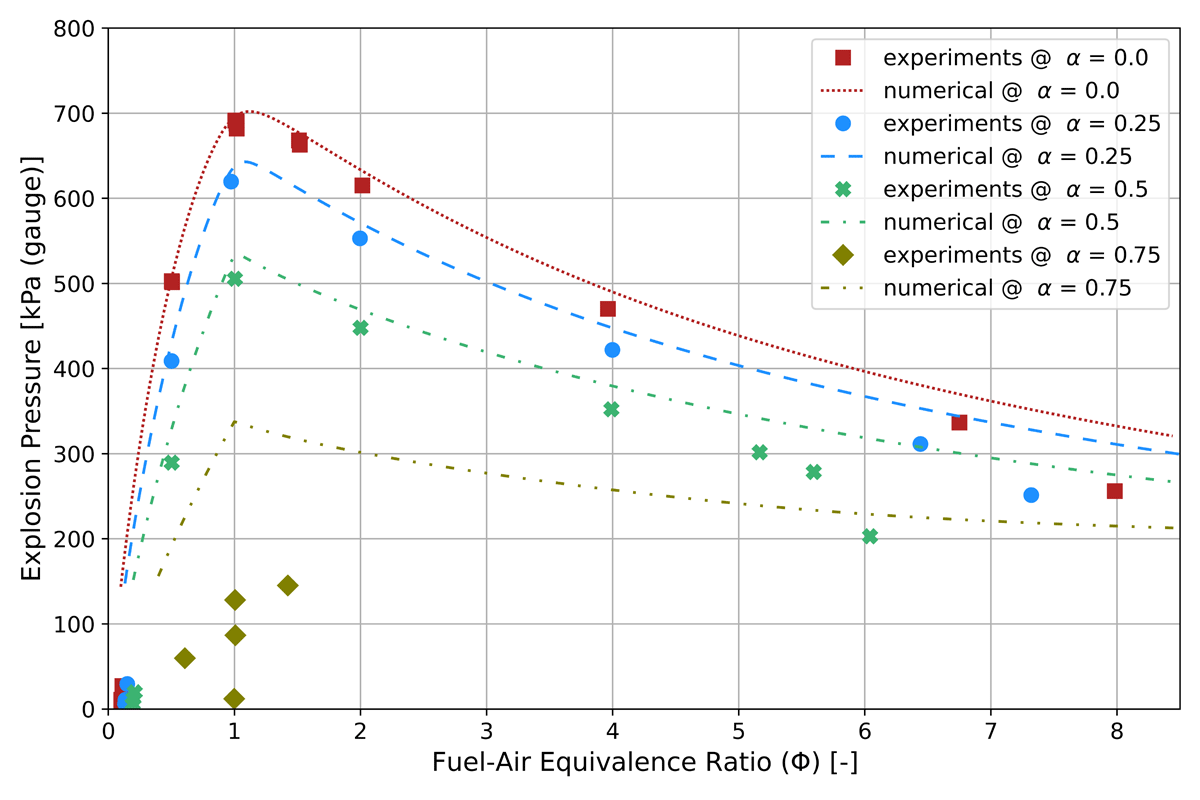
Figure 2
Experimental and numerical explosion pressure as a function of fuel-air equivalence ratios for inert-to-air relations (α) of 0, 0.25, 0.50, and 0.75.
When α is increased to 0.75, the maximum explosion pressure drops significantly, varying from 12 kPa to 128 kPa. The differences in explosion pressure at Φ equal to 1.0 appear to be caused by a slight variation in the hydrogen concentration, on the order of 0.015%. This abrupt change in explosion pressure from only a slight change in the hydrogen concentration indicates that an α value of 0.75 is close to the MIC. At Φ equal to 1.0 and α equal to 0.75, the oxygen concentration in the mixture is 4.8%. These preliminary results, shown in Figure 2, indicate that hydrogen-air-inert mixtures with an oxygen concentration below the proposed limit of 12% still yield reasonably high explosion pressures.
The numerical and experimental results in Figure 2 agree well for Φ around 1.0 and an α value of 0.5 and lower. As either Φ or α increases, the discrepancy increases. This deviation is especially pronounced for the curve at α = 0.75. These discrepancies at the concentration near the explosive limit are caused by an increase in radiative heat loss and heat loss to the vessel walls. In contrast, the numerical explosion pressures are calculated with adiabatic conditions.
Figure 3 shows the experimental results for the maximum rate of pressure rise during the explosion. In contrast to the explosion pressure results shown in Figure 2, the addition of Inergen has a more significant impact on the rate of explosion pressure rise. At an α of 0.5, the maximum rate of explosion pressure rise is reduced by an order of magnitude. By contrast, at Φ and α equal to 1 and 0.5 respectively, the deflagration index (KG) is very similar to that of stoichiometric propane-air of 85 bar∙m/s (Razus et al., 2011). When the α is increased to 0.75, the rate of explosion pressure rise is reduced to that near the explosive limit of hydrogen-air.
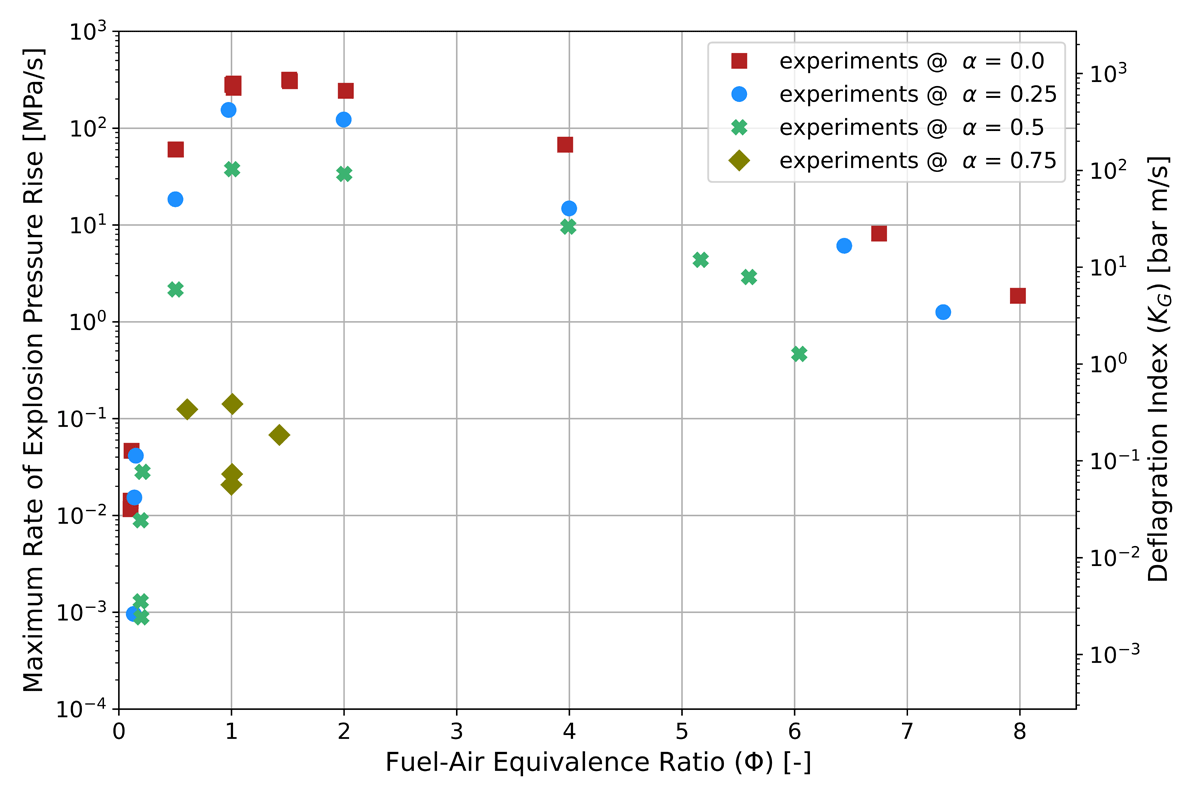
Figure 3
Experimental maximum rate of explosion pressure rise as a function of fuel-air equivalence ratios for inert-to-air relations (α) of 0, 0.25, 0.50, and 0.75.
In Figure 4a, the experimental and numerical explosive limits of hydrogen-air-inert mixtures are shown as a function of α. Without the addition of an inert gas, the explosive limits of hydrogen-air are determined to be 4% and 77% hydrogen in air. The lower explosive limit is within ±0.5% of the values reported by other studies (Cheikhravat et al., 2012; Liu and Zhang, 2014; Schroder and Molnarne, 2005). The upper explosive limit at 77% is 2–3% higher than that mentioned in some other studies. However, Schröder and Molnarne (2005) reported the same upper explosive limit when using a similar setup based on the same standard (European Standard, 2012). The difference in these results is most likely due to the use of different ignition sources, which result in varying ignition energies.
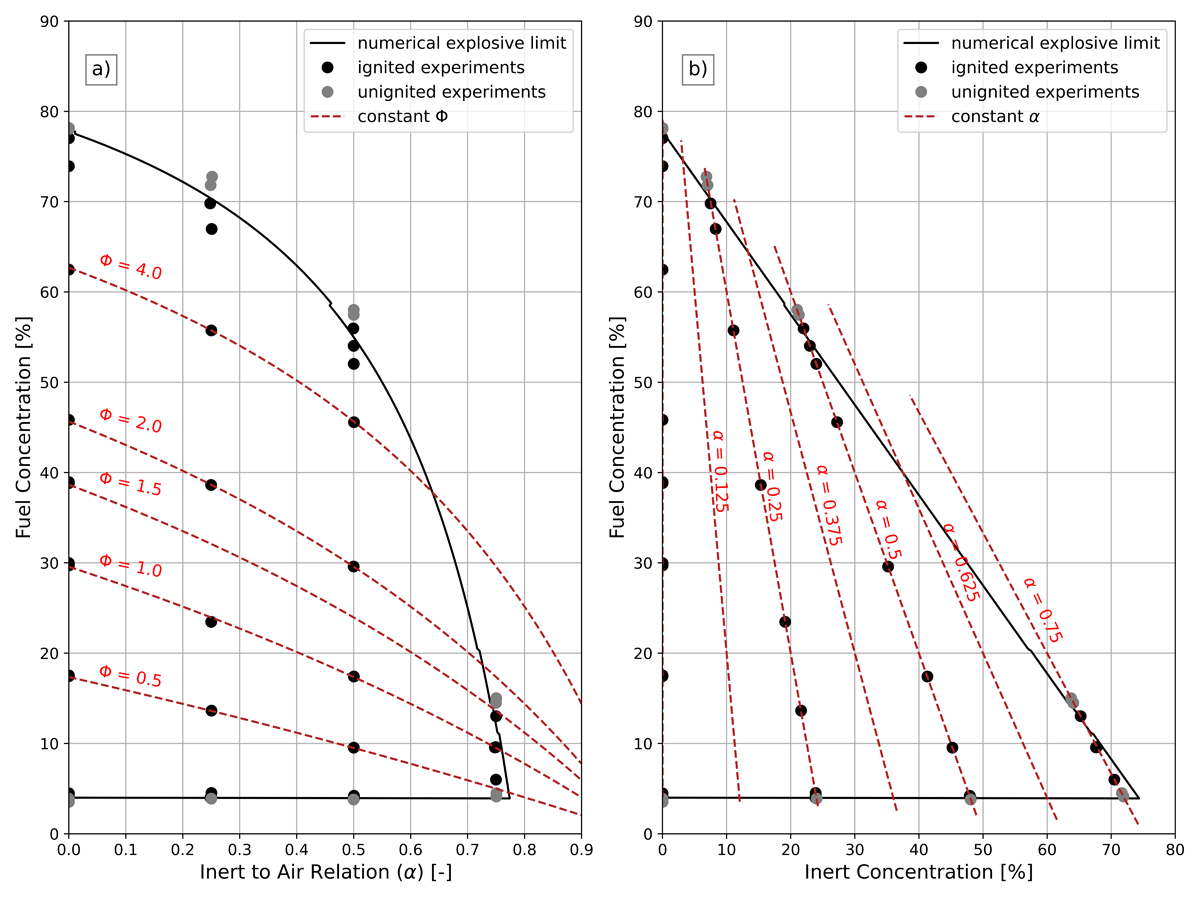
Figure 4
Experimental and numerical explosive limit of hydrogen-air-Inergen. a) Explosive limit of hydrogen as a function of inert-to-air relation (α); b) Explosive limit of hydrogen as a function of the concentration of Inergen.
Focusing on the lower explosive limit in Figure 4 shows that adding Inergen to the hydrogen-air mixtures does not change the explosive limit until it is close to the limit of MIC. This is because oxygen is not the limiting species at the lower explosive limit; it’s the fuel. Similar results were also reported by Van den Schoor et al. (2009) in their study on the lower explosive limit of syngas diluted with nitrogen.
Along the upper explosive limit, the hydrogen concentration decreases as the concentration of Inergen and α increase. This is as expected, since oxygen is the limiting species at the upper explosive limit. A similar trend was observed by Van den Schoor et al. (2009) in their study.
The MIC of Inergen found in this study was around 72%. For a more precise value of MIC, several more experiments are needed, but are considered outside the scope of this proceeding. At the MIC of 72% Inergen, the oxygen concentration is 5.9% if no hydrogen is in the gas mixture. The addition of hydrogen will, of course, further decrease the oxygen level. This indicates that to eliminate the possibility of an explosion hazard for a hydrogen release, the oxygen concentration must be within the same range, which poses an immediate risk to human health.
The numerical model in Figure 4 utilized the measured explosive limits of 4% and 77% hydrogen in air to determine the adiabatic flame temperatures at the lower and upper explosive limits, respectively. Examining Figure 4, the model prediction qualitatively aligns reasonably well with the experimental results. There is a slight deviation between the experimental and numerical results, which becomes apparent as the mixture approaches the MIC point. Towards the MIC point, the model overpredicts the explosive limit. For the lower explosive limit, the experimental results indicate that the hydrogen concentration increases slightly towards the MIC point. This increase in the hydrogen concentration is not predicted by the numerical model, since there is no change in adiabatic temperature.
Figure 5a shows the explosive limit of hydrogen as a function of oxygen concentration and the inert-to-air ratio (α). As mentioned, the proposed oxygen concentration for a partially inert system, such as Inergen, is approximately 12%.
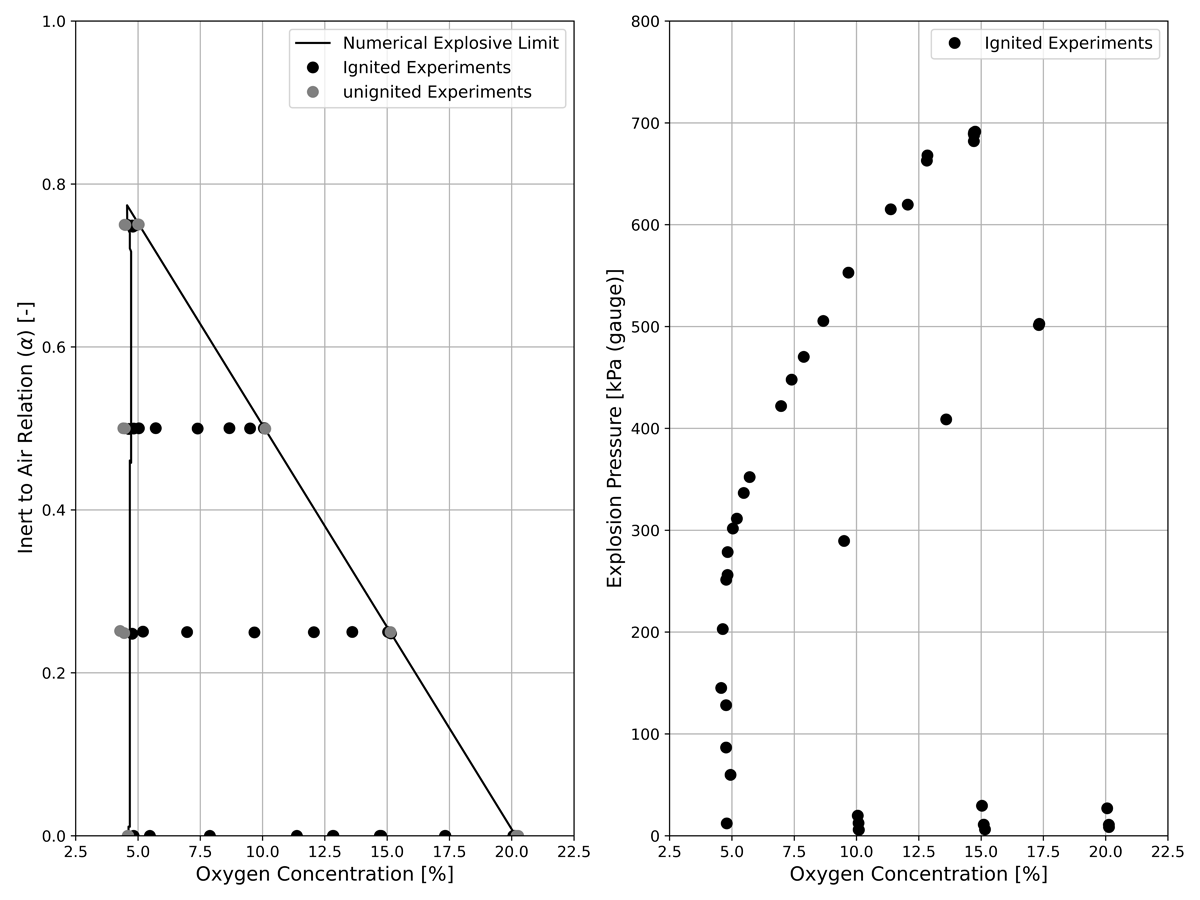
Figure 5
Experimental and numerical explosive limit as a function of oxygen concentration and inert-to-air relation (α).
At this oxygen concentration, it poses no immediate risk to humans. However, the explosive range of hydrogen, as shown in Figure 5a, reveals that a relatively large explosive limit range exists even at oxygen concentrations below 10%. Furthermore, Figure 5b shows that even with a low oxygen concentration of 5%, the explosion pressure can reach 300 kPa (gauge). At an oxygen concentration of 10%, the explosion pressure is 550 kPa (gauge) and the deflagration index is 355 bar·m/s.
Finally, based on the experimental results presented, it is evident that partially removing oxygen is not a feasible solution for mitigating explosions involving hydrogen. Even at very low oxygen concentrations around 5–6%, explosion pressures around 300 kPa (gauge) could be achieved.
4. Conclusion
In this experimental and numerical study, the explosion characteristics of hydrogen are investigated using a 20-liter explosion sphere and the chemical kinetics thermodynamic solver, Cantera. The lower and upper explosive limits (LEL and UEL), the rate of explosion pressure rise, the maximum explosion pressure for hydrogen-air mixtures, as well as those with the addition of an inert gas, were determined at varying concentrations. Furthermore, a simple numerical model was developed to determine the explosive limit with the addition of Inergen, using the adiabatic flame temperature as a criterion for ignition determination. The measured explosive limits without Inergen were used to estimate the adiabatic temperature threshold.
The estimated explosive limit of the hydrogen-air Inergen mixture, as determined using a simple numerical model, produced promising results. For inert-to-air relations (α) below 0.5, deviations were within ±2% of the hydrogen concentration. As the Inergen concentration increased towards the point of the MIC, the model’s weakness of using a fixed temperature threshold for ignition became more apparent. The MIC was experimentally determined to be approximately 72% of Inergen, while numerically estimated to be slightly higher at 75% concentration of Inergen.
Based on the experimental results of explosion pressure, the maximum rate of explosion pressure rise, and the explosive limits, there is relatively little effectiveness in using partially inert explosion mitigation systems, such as Inergen. Although reducing the oxygen concentration by a factor of two (α equal to 0.5) reduces the explosion pressure, the rate of explosion pressure rise, and the explosive limits, the rate of explosion pressure rise remains in the same range as propane, and the explosive limit remains wide, at an α equal to 0.5. To sufficiently suppress the explosion characteristics of hydrogen, the oxygen level must be significantly lower than the limit considered barely breathable for humans.
Acknowledgements
This work was partially performed within MoZEES, a Norwegian Center for Environmentally Friendly Energy Research (FME), co-sponsored by the Research Council of Norway (project number 257653) along with 40 partners from research, industry, and the public sector.
Competing Interests
The authors have no competing interests to declare.