
1 Introduction
The US government launched an $8 billion H2Hubs initiative as part of the 2021 Bipartisan Infrastructure Law to develop regional hydrogen hubs throughout the United States that will accelerate the adoption of hydrogen technologies and aid in decarbonizing the energy sector to meet the nation’s ambitious 2050 clean energy goals (US National Clean Hydrogen Strategy and Roadmap, 2023). This national investment presents the opportunity for hydrogen to become a mainstream energy carrier while challenging the hydrogen industry to scale up production and demand. To meet this new demand, new systems and components will be designed, developed, and tested to ensure they meet performance and safety requirements. University of Maryland’s Center for Risk and Reliability (CRR) is working with industry to identify reliability concerns and research needs to promote risk and reliability best practices and develop solutions for hydrogen technologies.
This paper, based on the workshop proceedings report (Groth et al., 2024b), documents the proceedings from the Hydrogen Systems Risk and Reliability Workshop hosted by the University of Maryland (UMD) in College Park, Maryland, on September 12 and 13, 2024. The workshop was attended by more than 90 participants from around the world representing government, national laboratories, industry, and academia to address and prioritize testing, risk, and reliability needs across the growing hydrogen and fuel cell industry. The workshop also launched a formal platform for identifying key priorities and sharing technical solutions ahead of the rollout of regional hydrogen hubs and to advance the broader deployment of hydrogen and fuel cell technologies. UMD will establish partnerships with stakeholders to develop research dedicated to pioneering transformative solutions for hydrogen systems safety, risk, and reliability engineering and move toward a more expansive, long-term trajectory that builds upon previously successful academia–industry collaborative research activities.
A workshop organized by the International Association for Hydrogen Safety ‘HySafe’ has since been held to define research priorities in hydrogen safety (International Association for Hydrogen Safety ‘HySafe’, 2025). Both this paper and the HySafe report demonstrate a pressing need for research advancing both hydrogen safety and reliability and highlight the importance of interdisciplinary collaboration and perspectives in advancing this field.
2 Organizers and Presenters
The workshop was organized and hosted by the UMD’s CRR. Presenters from government included representatives from the US Department of Energy (DOE) Hydrogen and Fuel Cell Technologies Office (HFTO), Japan’s New Energy and Industrial Technology Development Organization (NEDO), and DOE’s Office of Clean Energy Demonstrations (OCED). A speaker from the National Renewable Energy Laboratory (NREL) provided national laboratory perspectives. From industry, presenters included Fuel Cell and Hydrogen Energy Association (FCHEA), Plug Power, Electric Power Research Institute (EPRI), AcuTech Consulting Group, and National Aeronautics and Space Administration (NASA). From academia, UMD speakers included leadership from the A. James Clark School of Engineering and representatives from Mechanical Engineering, Materials Science and Engineering, Aerospace Engineering, Civil and Environmental Engineering, and Fire Protection Engineering. A compilation of poster presentations from faculty and students illustrated ongoing hydrogen research activities across UMD.
3 Workshop Program
The objectives of the workshop were to identify hydrogen systems reliability gaps and delineate the role of industry, government, national laboratories, and academic institutions in enabling hydrogen technologies to transition to clean energy solutions and solving emerging challenges. A consortium model was established by UMD to address the need for coordinating precompetitive research and development activities for advancing a sustainable and reliable hydrogen infrastructure.
The workshop began with a general overview that outlined the role of hydrogen as a solution to meet the US national clean energy goals and emission reduction targets. The second day was dedicated to sharing and exchanging industry knowledge through presentations and panel discussions focused on hydrogen production, pipeline development, hydrogen fueling stations, and risk and reliability management.
The hydrogen risk and reliability priorities identified by industry and government include:
Creating databases and mechanisms to share operational data for risk and reliability analyses;
Reducing the impact of high maintenance costs and low spare parts availability on facility downtime;
Building more hydrogen equipment testing capabilities at the component and system levels;
Developing safety codes and standards and test requirements for hydrogen systems;
Educating, training, and developing the hydrogen industry engineering workforce.
4 Session Findings
4.1 Government and national laboratory perspectives
Japan was the first nation to establish a hydrogen strategy in 2017 (Hara, 2024). Today, NEDO is the largest government-funded agency in Japan. In 2023, NEDO revised its hydrogen strategy plan to focus on expanding the supply of hydrogen to create demand and on optimizing hydrogen safety regulations based on relevant existing regulations. Activities funded through NEDO include Megawatt (MW) scale electrolysis, test supply sites for heavy-duty vehicles, hydrogen-firing gas turbines, a hydrogen tanker named Suiso, and the world’s first demonstration base HyTouch Kobe. NEDO also has 16 demonstration projects in North America, including a project to decarbonize the port of Los Angeles.
The US DOE provided an update on the federal activities funded by the Hydrogen and Fuel Cell Technologies Office (Rustagi, 2024). The DOE also shared the status of the Bipartisan Infrastructure Law-mandated investment of $8 billion to launch a network of hydrogen production hubs known as H2Hubs. The DOE is currently negotiating the final awards for the development of seven hydrogen production hubs throughout key regions of the United States. The DOE published the US National Clean Hydrogen Strategy and Roadmap (US National Clean Hydrogen Strategy and Roadmap, 2023) with an overarching clean energy goal of net zero greenhouse gas (GHG) emissions by 2050. The roadmap lays out three key strategies: (1) targeting strategic, high-impact uses of clean hydrogen; (2) reducing the cost of clean hydrogen; and (3) focusing on regional networks. These will help realize the large-scale development and rollout of hydrogen technologies. While significant progress has been achieved in reducing the cost of hydrogen and fuel cell systems, there is a compelling need to fund essential technological developments. The DOE announced an additional $750M for electrolyzer manufacturing, which supports 52 electrolysis projects with the aim of reducing the cost of scale-up. Another area that is critical for the rollout of hydrogen infrastructure is the permitting of fueling stations and the development of safety codes and standards. This includes the need for research to develop technical standards, safety technology, and resources for the public.
The DOE’s OCED was established in December 2021 to oversee over $25 billion in Bipartisan Infrastructure Law funding for clean energy demonstrations, which include the scale-up of emerging technologies and the development and deployment of regional hydrogen hubs (Baker, 2024). OCED is responsible for awarding the national clean energy hubs and works in partnership with industry, non-profits, public entities, the DOE, and other government agencies, connecting producers and consumers. The impact of the hubs includes creating hundreds of thousands of new jobs and reducing GHG emissions by 25 million metric tons per year. The office prioritizes community benefits, investment in the American workforce, organized labor, and community engagement. Some of this work includes benefits flow to disadvantaged communities and an emphasis on community feedback during the development phase of the hydrogen infrastructure. OCED, in alignment with the US National Clean Hydrogen Strategy and Roadmap, is working on Inflation Reduction Act (IRA) tax incentives, task forces, the hydrogen hubs, commercial liftoff reports, and ensuring their work can be quickly adapted and adopted in a commercial system.
NREL discussed the many teams working on production, storage, distribution, and end use applications of hydrogen (Buttner, 2024). The focus of the presentation was on NREL’s hydrogen component reliability program, with the goal of better understanding and improving the safety and reliability of hydrogen components. NREL is working with UMD on the Hydrogen Component Reliability Database (HyCReD) (Groth et al., 2024a) project to provide hydrogen fueling station component reliability data, inform safety codes and standards, and identify components that require further reliability development. NREL indicated that the well-known problem of significant station downtime was due to unreliable components. Downtime is known to lead to loss of profits and an overall unreliable hydrogen fueling infrastructure (Buttner, 2024). Thus, reaffirming that the work on hydrogen component reliability is crucial to ensuring the commercial success of hydrogen infrastructure. In addition to working with academia, NREL collaborates with hydrogen technology stakeholders, developers, and end users to create a scientific basis for risk and reliability analysis of hydrogen systems. Projects include component testing, developing test protocols, leak rate quantification, and other related activities.
4.2 Insights from industry
Presentations from experts representing a wide sector of the hydrogen industry, including hydrogen suppliers, equipment manufacturers, safety and reliability experts, and end-users, underscored a persuasive view on hydrogen infrastructure concerns and gaps in systems performance, risk, and reliability.
FCHEA discussed the key role of risk and reliability in the expansion of hydrogen technologies (Dolan, 2024). FCHEA stated that ‘electricity alone is not enough to get us to our decarbonization goals.’ As the market transitions to hydrogen, consumers require low-risk and highly reliable systems to secure investments that will ensure the future success of green hydrogen systems. Supporting the expansion from light-duty vehicle consumers to a large heavy-duty vehicle fleet requires reliable station uptime. This is directly impacted by the limited component supply chain around the world. Components are expensive, prone to frequent failure, and available from only a limited number of suppliers.
Plug Power’s presentation covered a list of ongoing developments and the challenges currently facing the industry (Smith, 2024). They described the broad Plug Power hydrogen ecosystem encompassing everything from the power source needed to produce hydrogen to its end uses. The Plug Power speaker noted that the key to continuous hydrogen supply is to ensure operational uptime of hydrogen production facilities. The key to accomplishing this goal is to implement reliability best practices throughout the life cycle of hydrogen technologies. Some of these practices include using reliability requirements, establishing proper training and workforce development, utilizing reliability analysis and testing, tracking failure data for analysis, and improving the overall reliability using the results from the testing and data analysis. Specifically, there is a need to increase the reliability of components and improve operational uptime by establishing design guidance and standards, utilizing operational data to establish component use profiles, developing physics-of-failure models and accelerated life testing methods. The other key to improving facility uptime involves both corrective and preventative maintenance. Plug Power believes that a skilled diagnostics and repair crew, effective component stocking levels onsite, and accessible offsite stocking locations will enable the facility to meet the hydrogen demands of its consumers.
AcuTech Consulting Group presented on the need for risk and reliability data in the hydrogen industry (Moore, 2024). This presentation included a discussion about the role and importance of risk and reliability data in the industry, providing example applications and including objectives and recommendations for further work. The presentation began by emphasizing that risk and reliability are essential to every aspect of the hydrogen value chain and have a direct impact on public perception. The goal for hydrogen systems is to have a low-incident rate and highly reliable operations. A key challenge facing the industry is the lack of risk and reliability data, especially for novel designs and during periods of rapid scale-up. Often, when incidents occur, people are unwilling to share specific details and data. However, it is necessary to share this type of data to continually learn from incidents so improvements can be made to the next generation of the technology.
Another challenge AcuTech mentioned in the presentation was the unfamiliarity with hydrogen from new developers (Moore, 2024). Developers need guidance on how to develop hydrogen systems from the beginning and due to a lack of hydrogen risk management standardization, developers are often unfamiliar with risk management processes. Another aspect of this challenge is, first, making companies aware of the available risk and reliability data, and second, educating them on how to organize and effectively utilize the data once they have it. Currently, there is work being done on hydrogen risk and reliability, but many people are unaware of it. Going forward, it is important to make this information better known to those who need to use and apply it. The Center for Hydrogen Safety (CHS) disseminates safety practices and lessons learned and recognizes the need for failure rate data and the lack of reporting. CHS is looking to have an up-to-date, reliable, well-known, easily accessible database that shares all relevant information. The hydrogen industry is looking to other industries for their successful tools as well as current hydrogen tools including HyRAM (Ehrhart et al., 2025), H2Tools (Pacific Northwest National Laboratory and US Department of Energy, n.d.), which encourages the sharing of incidents for learning purposes, and the Hydrogen Incident and Accident Database (HIAD) (Wen et al., 2022). While the current tools are informative, they are not yet detailed enough to be applied in a Quantitative Risk Assessment (QRA). AcuTech acknowledged UMD and NREL’s HyCReD (Groth et al., 2024a) as the most mature project tackling this problem.
NASA discussed how hydrogen technologies are currently used by NASA and how they began using hydrogen in turbines before transitioning to hydrogen rocket technologies (Jakupca, 2024). To enable the transition to rocket technology, NASA also needed to develop hydrogen infrastructure to support the delivery, storage, and transfer of hydrogen, along with training personnel to be able to handle hydrogen safely. The presentation included images of three hydrogen accidents that NASA experienced, showing that NASA has learned, first-hand, how hydrogen systems fail. As a result, NASA has adopted a more rigorous approach to hydrogen safety. NASA uses a layered approach to handle hydrogen safely. The use of codes and standards is vital to this approach, as well as ensuring all personnel involved are properly trained and adhere to approved procedures. It was also stated that risk management is an iterative process that should be present throughout the project lifecycle. NASA has developed a Hydrogen Hazard Assessment Protocol (HHAP), a major component of their best practices coupled with expert review. The key theme of the HHAP is to understand the problem before you can address it and consult an expert for their input when unsure about the problem or solution. NASA’s key to handling hydrogen safely is not to take shortcuts and understand that a ‘cookbook’ approach does not work due to the uniqueness of each project.
EPRI presented the safety and environmental lessons learned from their hydrogen-natural gas cofiring demonstrations (Gupta, 2024). During the cofiring demonstrations, there were many lessons learned from a safety aspect, including the prudent need to identify the necessary codes to ensure a broad understanding of how they are applicable, and recognize that codes provide the minimum requirements. EPRI stated that, ‘we only get one chance to do this right.’ During the planning phase, the key lesson learned was the importance of engaging local authorities that have jurisdiction over the areas where these demonstrations were being held. Overall, this led to a successful demonstration with no leaks, safety issues, or damage to the equipment. The existing emissions controls also proved to be sufficient in maintaining emissions at permissible levels.
4.3 Academic perspectives and capabilities
Providing an academic perspective, presenters from UMD included leadership and representatives from the Department of Mechanical Engineering, Materials Engineering, Aerospace Engineering, Civil Engineering, and Fire Protection Engineering. UMD presentations highlighted the university’s wide range of hydrogen risk and reliability capabilities, including reliability prediction and testing, probabilistic risk assessment, physics of failure and accelerated testing, human reliability analysis, artificial intelligence (AI), and machine learning for modeling, monitoring, and prognostics (Groth, 2024a; Modarres, 2024a). Highlighted testing capabilities include hydrogen fire testing with diagnostics including pyrometry, advanced imaging, and gas chromatography (Sunderland, 2024); solid oxide electrolysis fuel cell development and testing (Wachsman, 2024); energy efficiency and heat pump testing (Radermacher, 2024); and hydrogen-powered eVTOL research (Flatau, 2024).
The CRR performs research on complex systems, including nuclear power plants, hydrogen production and fueling, pipelines, aviation and space systems, defense, civil infrastructure, transportation, chemical processes, manufacturing, consumer products, and information systems. The center contains six cutting-edge research laboratories with a range of capabilities including reliability prediction and testing, probabilistic risk assessment, physics-of-failure and accelerated testing, human reliability analysis, and AI and machine learning for modeling, monitoring, and prognostics (Groth, 2024a; Modarres, 2024a).
A representative from the CRR explained the need for risk and reliability in complex engineering systems, explaining that the US economy, security, and quality of life depend on the safety and operation of these systems (Groth, 2024a). Risk and reliability engineering is needed, even after a product is delivered, to mitigate, recover from, and prevent system failures (Groth, 2024a). The reliability engineering curriculum at UMD was designed to educate engineers about the spectrum of methods, data, and models to address reliability comprehensively.
The CRR formed a consortium with the goal of providing a platform for collaboration in reliability, safety, and integrity of engineering systems and structures. This consortium seeks to engage members from diverse sectors, including energy, transportation, defense, regulatory, and research organizations (Modarres, 2024b) and aims to tackle reliability concerns throughout the hydrogen supply chain and to inform early design modifications and test requirements of critical hydrogen components to advance a safe and sustainable hydrogen economy (Groth, 2024b).
4.4 Panel discussions
The first panel discussed risk and reliability research opportunities for hydrogen production. Panelists included representatives from Plug Power, EPRI, Nel Hydrogen, NREL, CGA, and the DOE Hydrogen and Fuel Cell Technology Office.
Panelists were asked a series of questions about their perspectives on the current state and projected growth of hydrogen production technologies. The key themes that emerged from the discussion include the need to support industry’s growth as electrolysis and other hydrogen technologies advance; to place more emphasis on the electrolyzer’s balance of plant in risk analyses; to ensure reliable uptime on the MW scale; and to better understand dynamic system integration between hydrogen production facilities and renewable energy sources.
Supporting industry growth was a common topic of discussion during the panel. Specifically, the discussion emphasized the need to maintain performance and reliability while making technological changes, the demand for more designated hydrogen testing capabilities, and highlight the importance of writing standards for new technologies before and as they emerge, especially for the purpose of safety and risk mitigation. A discussion took place surrounding the importance of safety and risk mitigation, which is crucial not only for the people working with the technology but also for the public image and support of the technology. It was noted that a single incident or accident involving hydrogen could greatly impact the public support of the technology, making safety and standards even more crucial. Electrolyzer balance of plant refers to a focus on reliability of each part of the plant system. A key need is the necessity to increase individual component reliability in hydrogen systems. One failure with low probability can lead to an entire system shutdown, making the focus on improving individual components crucial.
The identified challenges facing hydrogen production technology were cost of clean electricity, cost of hydrogen, uncertainty regarding tax credits and incentives, equivocal policy and regulatory environment, and lack of a hydrogen-ready workforce. The panel argued the importance of reducing the cost of clean electricity to meet the goal of clean hydrogen production cost. The panel also discussed specific opportunities for future work in hydrogen production, such as improving deionized water system supply reliability, improving localized energy systems, and evaluating existing work on alternative technologies such as methane pyrolysis. Other opportunities considered included performing accelerated stress tests for materials and equipment, improving hydrogen storage, as well as assessing the reliability of heavy-duty refueling components, backup power systems, including fuel cells, and improving risk mitigation through safety standards development, training and education, standardized testing, design protocols, and standardized regulatory policy. The final key takeaway from this panel was reiterated by the CGA representative, stating that we must remember the effects of climate change and remain committed to going forward toward clean energy despite the cost and challenges.
The second panel discussed the risk and reliability research opportunities in the field of hydrogen pipeline and fueling for transportation applications. Panelists included representatives from Plug Power, CGA, Nikola, and NREL, with insights from the moderator, a representative from Savannah River National Laboratory. The key challenges discussed by the panel included the need for standardized component testing in a hydrogen environment to ensure reliability, a need for proper data collection techniques to output usable hydrogen data in risk analyses, and a need for a continued dialogue between industry and government.
One key topic the panelists discussed was the subject of fueling requirements and fueling times. Through engaging with heavy-duty truck customers and station operators, developers found that a 10-minute fill time for heavy-duty trucks is not a conclusive customer requirement; customers acknowledged satisfaction with a 30-minute fill time because it also allows truck drivers to take needed breaks. Stakeholders are mainly unsatisfied with station downtime that keeps their drivers waiting for multiple hours to fuel. The fueling industry feels that it is more important to prioritize component reliability and station uptime rather than a 10-minute fill time. Another key topic discussed by the panelists was the high impact of station downtime, high maintenance costs, and low spare component availability. Industry representatives discussed how the current maintenance strategy is not a sustainable business model in the long term. To keep a station online, one company employed 10 on-call technicians 24 hours a day to address system failures. However, even when a failure is identified, the lack of availability of replacement components results in the station experiencing longer downtime.
The hydrogen pipeline discussion emphasized the need to be clear and explicit about the end uses for generating specific technical requirements. This includes making clear distinctions when the community is discussing hydrogen blending versus full hydrogen pipelines. The industry agrees that pipelines will play a key role in the transition to hydrogen energy. However, multiple industry partners expressed that, at present, there are more gaps in our knowledge than answers in terms of hydrogen pipeline technology.
The panelists provided general insight into specialized and engineering workforce development, system testing, and standards development. A discussion highlighted the need for hydrogen education at universities. Universities can help establish and promote undergraduate and graduate engineering programs with a focus on hydrogen and clean energy technologies. Establishing more programs that incorporate hydrogen testing and analysis at university campuses will help produce more experienced entry-level engineers to address the industry workforce demand. More hydrogen testing capabilities are needed, specifically equipment testing in a hydrogen environment. The panelists also discussed how the lack of hydrogen testing capabilities is hindering the development of hydrogen components and the promulgation of technically sound codes and standards. The industry is currently leading the development of these standards; however, there is more research and data needed for specific hydrogen applications. The panelists concluded that writing these standards will also require risk, reliability, and hazard analysis specific to hydrogen systems.
4.5 Results: key priorities identified by participants
To conclude the workshop, a group activity was conducted to catalog participants’ perspectives and input on the key challenges relating to reliability in the hydrogen industry. Approximately 90 participants submitted individual responses to the questions, resulting in the word clouds in Figures 1, 2, and 3, where larger words mean a larger number of participants submitted that response. Of the 90 participants shown in Figure 4, approximately 15% represented government, 30% industry, 31% professors, and 24% students. Government participants spanned six US government offices or laboratories and one international agency. From industry, 19 companies participated. Academic participants represented five different universities. Responses were aggregated across all participant types and institutions. Responses during the group activity directly reflect the key challenges discussed throughout the workshop.
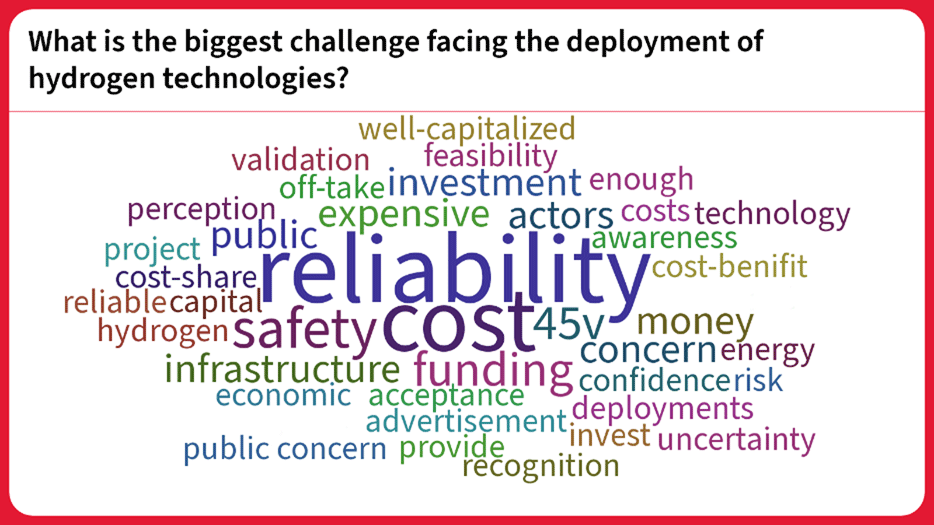
Figure 1
Group activity word cloud: biggest challenges facing the deployment of hydrogen technologies.
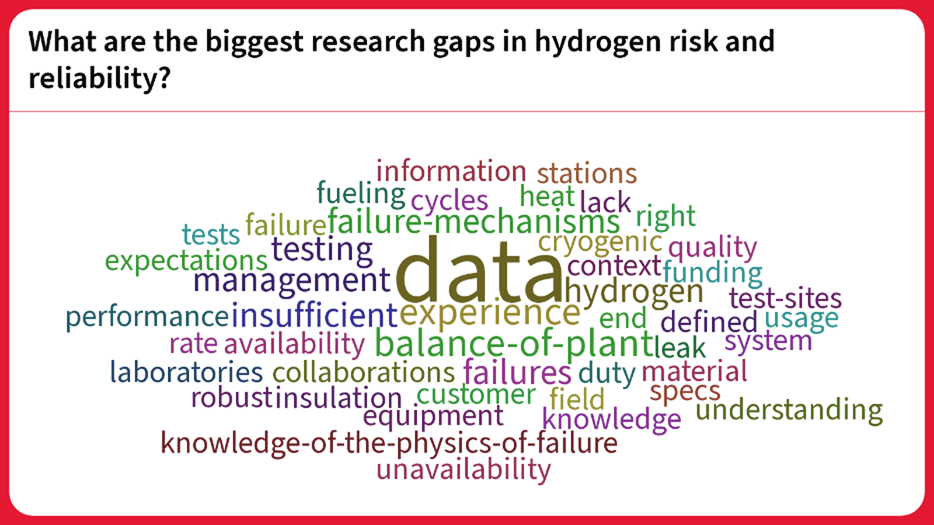
Figure 2
Group activity word cloud: biggest research gaps in hydrogen risk and reliability.
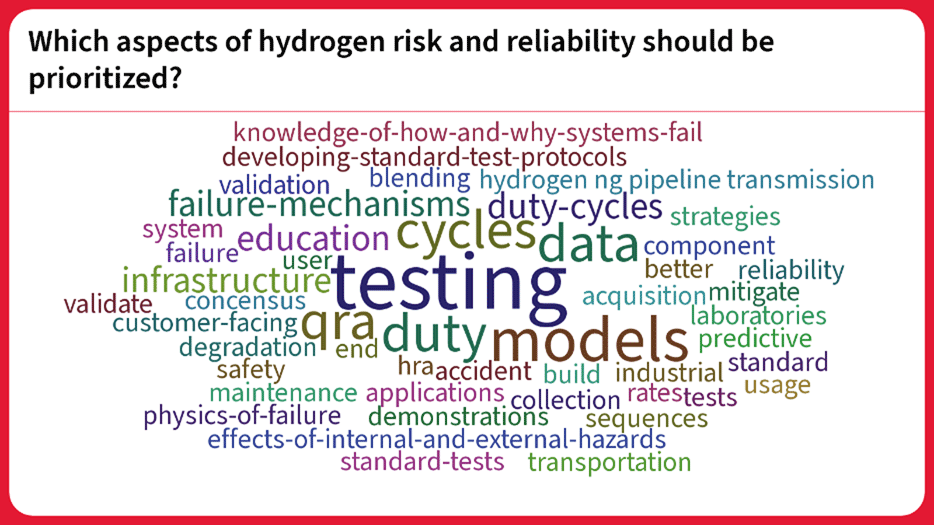
Figure 3
Group activity word cloud: hydrogen risk and reliability priorities.
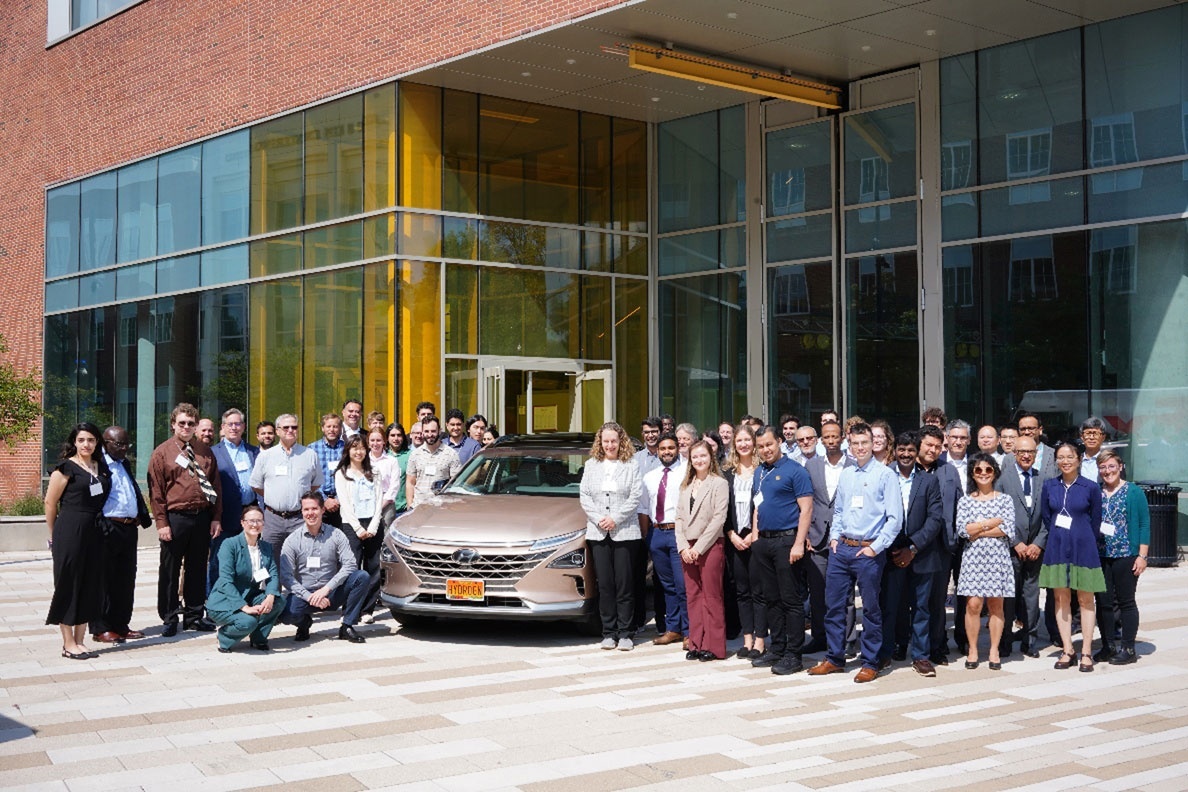
Figure 4
Hydrogen Systems Risk and Reliability Workshop attendees with hydrogen fuel cell-powered car.
5 Discussion and Conclusion
UMD hosted a Hydrogen Systems Risk and Reliability Workshop to bring together experts from government, national laboratories, industry, and academia to address and prioritize testing, risk, and reliability needs across the growing hydrogen and fuel cell industry. The workshop established a formal platform for identifying key priorities and sharing technical solutions ahead of the rollout of regional hydrogen hubs and to advance the broader deployment of hydrogen and fuel cell technologies.
The key hydrogen risk and reliability priorities identified by government and stakeholders are:
Creating databases and mechanisms to share operational data for risk and reliability analyses. Representatives from industry spoke uniformly about the importance of collecting and sharing operational data to characterize the performance and reliability of key components, including cryogenic pumps, compressors, and valves.
Reducing the impact of high maintenance costs and low spare parts availability on facility downtime. Reducing the overall cost of hydrogen and ensuring facility operational availability is a function of maintenance and system reliability. Reducing the cost of maintenance requires improving system reliability and maintainability and increasing the availability of spare components.
Building more hydrogen equipment testing capabilities at the component and system levels. At present, component testing in a hydrogen environment is predominantly conducted in operation because suppliers do not have the capabilities to test these components with hydrogen. Thus, failure of components during operation becomes valuable data to characterize their reliability. However, this data comes at the expense of costly downtime to stations that are trying to meet consumer demands.
Developing safety codes and standards and test requirements for hydrogen systems. As the industry grows and large-scale production and distribution become imminent, codes and standards play a key role in defining safety requirements that allow for new stakeholders and companies to safely enter the hydrogen ecosystem. Representatives from government and industry agreed that incorporating risk and reliability concepts into the standardization of hydrogen technologies is crucial to mitigate risk and establish credibility and trust with engineers and the general public.
Educating, training, and developing the hydrogen industry engineering workforce. As the hydrogen economy continues to evolve, industry representatives spoke of the need for more entry-level engineers already familiar with hydrogen. It was discussed that the best way to provide young engineers with this exposure is by establishing hydrogen-relevant laboratories and infrastructure on college campuses. It is also essential to support strong reliability engineering coursework to develop core knowledge needed in industry.
A safe and sustainable transition to expanded hydrogen usage requires that the risks and reliability issues associated with it be proactively and rigorously investigated, quantified, and mitigated. Reliability engineering and risk analysis play a key role at the design and early deployment stages, when it is most cost-effective and easiest to engineer-in these features. The field of reliability engineering includes physics of failure, reliability analysis, probabilistic and quantitative risk analysis, prognostics and health management (PHM) techniques, data collection, cybersecurity, and more. It is necessary and urgent to develop engineering knowledge and a highly skilled workforce prepared to develop, deploy, operate, and maintain safe and reliable hydrogen systems.
Competing Interests
The authors have no competing interests to declare.