
1.0 Introduction
During severe accidents (SAs) with core degradation in water-cooled nuclear power plants (NPPs), a large amount of hydrogen (H2) can be produced. The H2 can migrate into the containment buildings, mix with air and form combustible mixtures. H2 combustion presents a challenge to containment integrity, which could potentially break the last safety barrier for release of radiative material to the environment. Since the Three Mile Island Unit 2 (TMI-2) accident in 1979 (IAEA, 2001), there has been a great deal of interest concerning H2 combustion in post-accident nuclear containments. Since the 1980s, comprehensive research and development (R&D) programs have been developed to address H2 safety issues by the nuclear community. The evolution of the nuclear H2 safety research and areas of focus in the past 40 years are summarized in Figure 1. The R&D program is divided into four stages.
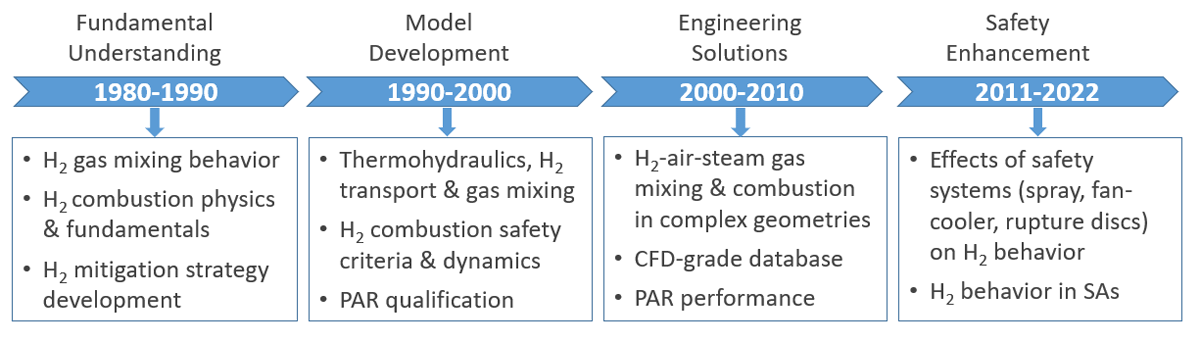
Figure 1
Evolution of H2 safety research in nuclear community.
In the 1980s and 1990s, the R&D aimed to establish the fundamental understanding of H2 combustion behavior. A great number of H2 combustion tests were performed by the international nuclear community to study combustion characteristics (Berlad, Subulkin and Yang, 1983; Koroll, Kumar and Bowles, 1993; Kumar, Dewit and Greig, 1989; Marshall, 1986; Ratzel, 1985; Studer and Petit, 1997), diffusion flame (Shepherd, 1987), deflagration-to-detonation transition and detonation (Klein et al., 1999; Chan and Greig, 1989; Dorofeev et al., 1996; Eder, Gerlach and Mayinger, 1999; Gelfand and Breitung, 1994; Sherman, Tieszen and Benedick, 1989). Various large-scale facilities were constructed in these experimental programs to address scaling issues. The early studies established a foundation for the development of H2 safety criteria and analysis tools. Most importantly, these studies contributed to the development of H2 mitigation measures and strategies (Nuclear Energy Agency (NEA), 1997).
Most of the studies conducted before 2000 were focused on capturing global H2 behavior and the experimental conditions were not always relevant to specific accident scenarios. The measurement data were obsolete and lacked spatial details. The application of three-dimensional and computational fluid dynamic (CFD) simulations for reactor safety analysis inspired further experimental studies on H2 behavior in the 2000s. Various international collaborative projects were initiated by the Organization for Economic Co-operation and Development (OECD) NEA, and European Commission (EC), such as THAI (NEA, 2010), SETH (Paladino et al., 2012a), SARNET (Meyer et al., 2005) and ERCOSAM (Paladino et al., 2012b). Combining multi-national efforts allowed conducting a more comprehensive program and a more complete data analysis. These experiments were well instrumented with advanced measurement techniques (known as ‘CFD-grade’). Most experimental data have been used for code validations and benchmark exercises (NEA, 2007, NEA, 2012).
The occurrence of the Fukushima Daiichi accident in 2011 triggered further analyses and assessments to support H2 safety enhancements for the protection of nuclear containment and reactor buildings (NEA, 2014). Although R&D efforts to date have already significantly enhanced the understanding of the phenomena governing the distribution of H2 gas mixtures and their potential for combustion, effort continued to close knowledge gaps, enhance computer codes prediction capabilities, and reduce their uncertainty. In addition, it was recognized that significant improvements are needed for national and international communications on nuclear safety, as well as information exchange amongst national nuclear regulatory organizations. Further, H2 risk assessment methodology has been implemented in safety analysis by combining the use of CFD tools and empirical correlations to simulate the dispersion of H2, assess the flammability and flame acceleration propensity of the resulting gas mixtures, and evaluate the potential pressure and temperature impacts induced by combustion.
In addition to H2, carbon monoxide (CO) can also be produced due to molten core–concrete interaction in the late phase of SAs. The H2 and CO combustion behavior and performance of PARs have been studied in the EC AMHYCO project (Jiménez et al., 2023) and OECD/NEA THEMIS (Gupta, Freitag and Poss, 2021) project. The purpose of these projects was to generate experimental data for model development, enhance model predictive capabilities and accident management guidelines.
The experience and knowledge gained from the nuclear community on H2 safety is valuable and many aspects are applicable for other industries. This paper will provide an overview of the state of knowledge obtained on H2 gas mixing and combustion behavior, and mitigation measures, describe selected experimental programs and facilities, as well as summarize the computer codes and their capabilities used for safety analysis. The intention of this paper is to increase the awareness of the existence of the database of knowledge on H2 safety developed by the nuclear community.
2.0 Hydrogen Distribution
2.1 Overview
H2 generated from the reactor core can be released into containment or reactor buildings through engineered pathways and breaks of reactor cooling system. Nuclear containments are confined and generally of large size (several thousand cubic meters) with internal obstacles, although most containments or reactor buildings have a large free volume in the upper dome. H2 transport and mixing behavior in large, closed enclosures is one of the important phenomena investigated by the nuclear industry to determine the potential H2 risks. Detailed knowledge of containment thermal-hydraulics and gas distribution behavior is essential to assess the effectiveness of H2 mitigation measures employed in the containments, such as ignitors, PARs, coolers, spray, and venting system. The experiments conducted by nuclear industry are primarily focused on investigating the following aspects:
Effects of turbulence, buoyancy, and steam condensation on homogenously mixed or stratified H2-air-steam atmosphere in single- and multi-compartment geometries
Break-up of stratified light gas cloud due to natural or forced convection (such as, momentum dominated jets)
Interaction between containment gas atmosphere (well-mixed or stratified) and operation of H2 mitigation systems (e.g., PARs, containment coolers, spray, and venting system)
In general, the mixing of H2 with surrounding air in containment can be influenced by the volume Richardson number RiV, introduced by (Cleaver, Marshal and Linden, 1994) as:
where V is the enclosure volume, U0 is the injection velocity, ρ0 is the injection gas density, and ρa is the surrounding gas density. The volume Richardson number compares the inertia of the discharge to the natural convection in the volume. The critical volume Richardson number is determined by:
where C is a constant equal to 25 for vertical upward release, R1 is the release radius and H is the height of the enclosure.
If the Richardson number is less than the critical value, the inertia of the release can mix the gas in the entire volume, leading to a homogeneous atmosphere above the release location. Otherwise, the gas mixture is stratified with a large amount of H2 accumulated at the upper region, which can significantly slow down the mixing process at the containment scale. The spatial extension and persistence of flammable atmosphere must be eliminated for such cases.
Since the TMI event, a great number of experiments and benchmark exercises have been carried out to understand the gas mixing and transport phenomena. Most gas mixing experiments were conducted using helium as a surrogate gas for H2 due to safety concerns. The experimental study conducted in the OECD/NEA THAI project (NEA, 2010) confirmed the transferability of helium as a replacement for H2. Details of the experimental facilities and computers codes referred in the following sections can be found in S1 and S2 (supplementary material), respectively.
2.2 Experimental programs and benchmark exercises
In the 1980s and 1990s, the experimental programs were focused on measuring the global gas composition in large-scale volumes (i.e., several tens of cubic meters), providing data for validation of lumped parameter (LP) codes. Most tests were conducted with limited instrumentation. A major breakthrough occurred in the OECD/NEA ISP-29 benchmark exercise for the HDR E11.2 H2 distribution test (NEA, 1993). The HDR vessel and the comparison of gas concentrations in the experimental measurements and simulation results are shown in Figure 2. In this test, a mixture of H2 and He was injected at an intermediate level without global homogenization. A great modeling effort was required to capture the gas mixing process using the LP codes (i.e., CONTAIN, GOTHIC and MELCOR).
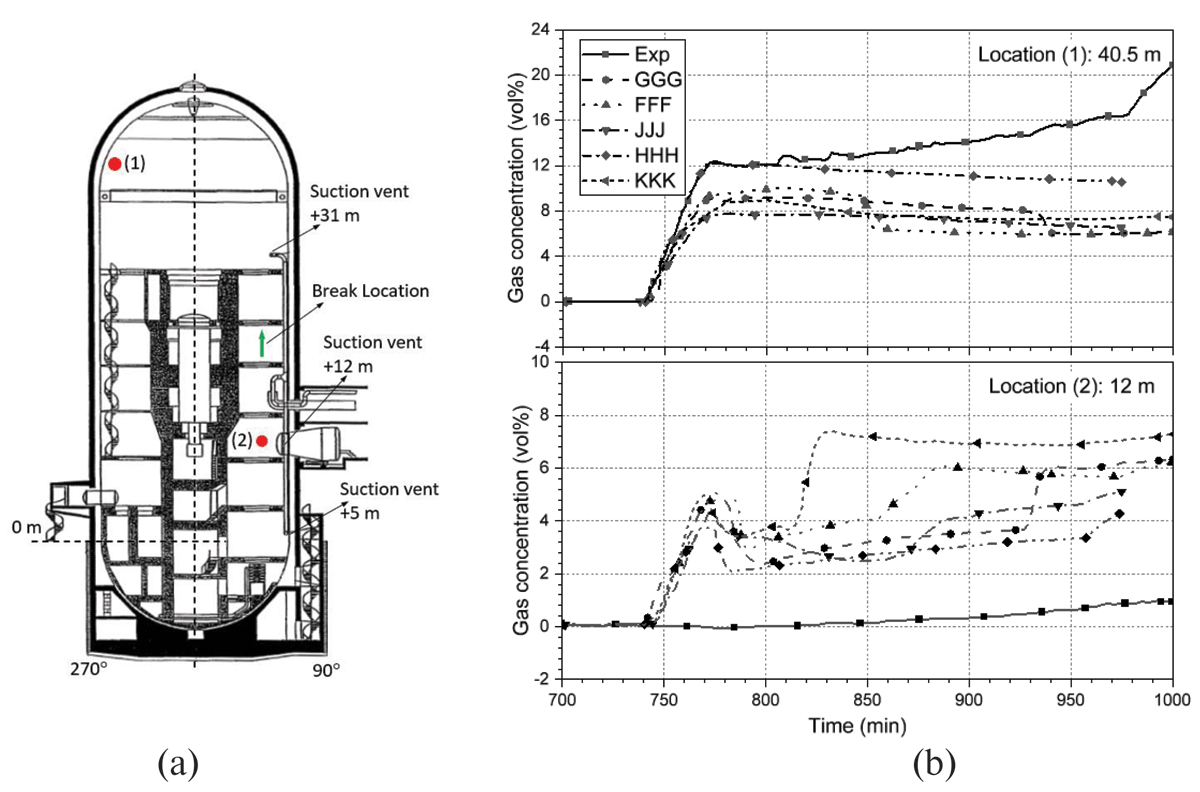
Figure 2
ISP 29 benchmark exercise: (a) HDR facility, (b) comparison of gas concentrations predicted by LP codes with experimental data (NEA, 1993).
Since the early 2000s, 3D codes started to be used to provide complementary analysis for H2 mixing, although LP codes remain essential for the calculation of many accidental scenarios for probabilistic safety assessments. In the OECD/NEA ISP47 benchmark exercise (NEA, 2007), 3D/CFD codes demonstrated their strength for capturing local details. Figure 3 shows the THAI vessel and the comparison of the experimental measurements with the predictions of CFX, GASFLOW and GOTHIC.
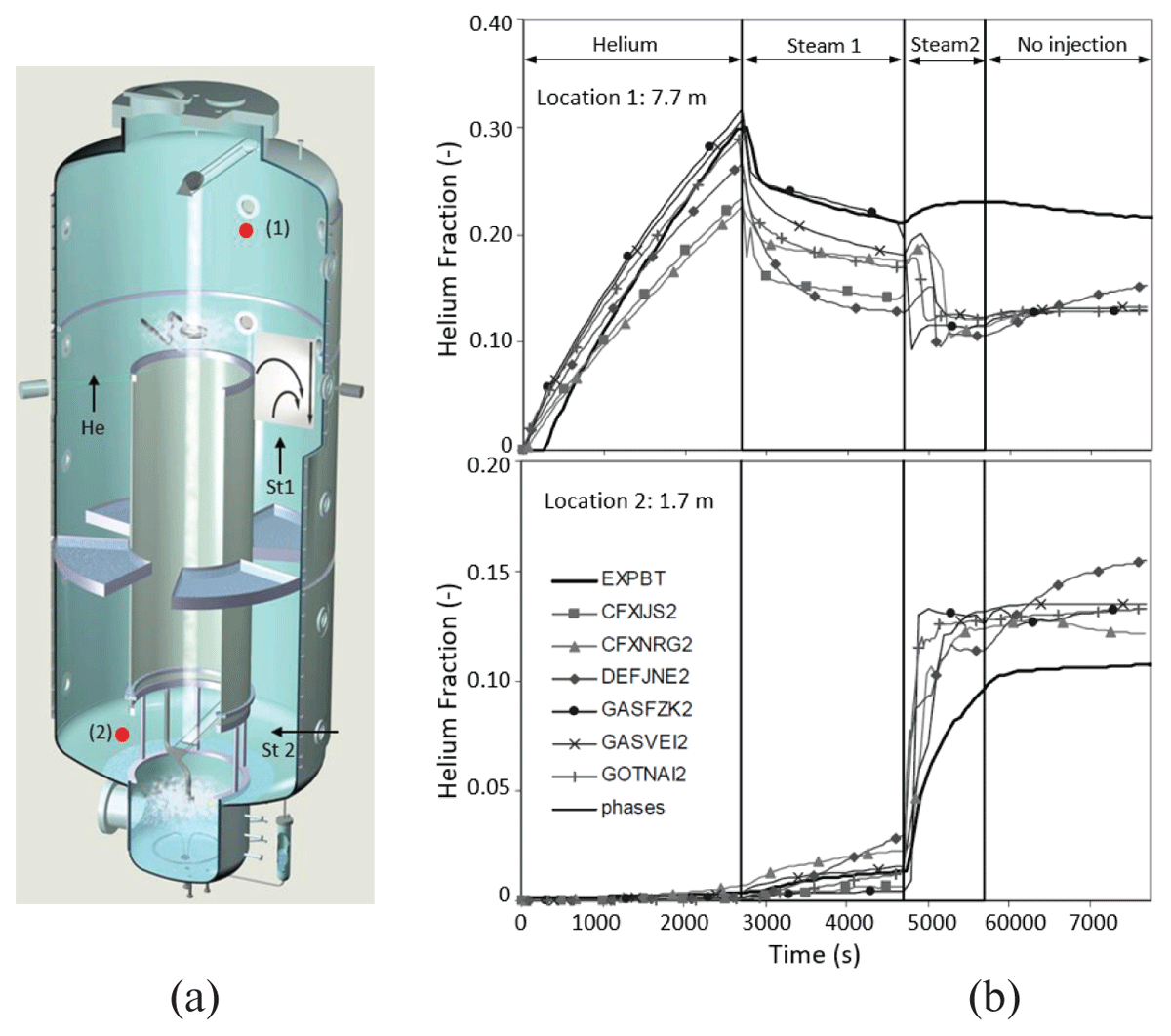
Figure 3
ISP47 THAI benchmark exercise: (a) THAI facility, (b) comparison of helium concentrations predicted by 3D/CFD codes with experimental data (NEA, 2007).
Since the 2000s, experiments started to be equipped with ‘3D-grade’ instruments and optical techniques, such as Particle Image Velocimetry to obtain the velocity field. Figure 4 shows an example of a test conducted in the PANDA facility for the OECD/NEA SETH project (Paladino et al., 2010). Figure 5 shows an example of the MISTRA test and benchmark exercise conducted in the OECD/NEA HYMERES project using CFX, GOTHIC, OpenFOAM and FLUENT (Studer et al., 2018). The experiments examined the erosion of thermal and gas stratification and impingement of jets on structures.
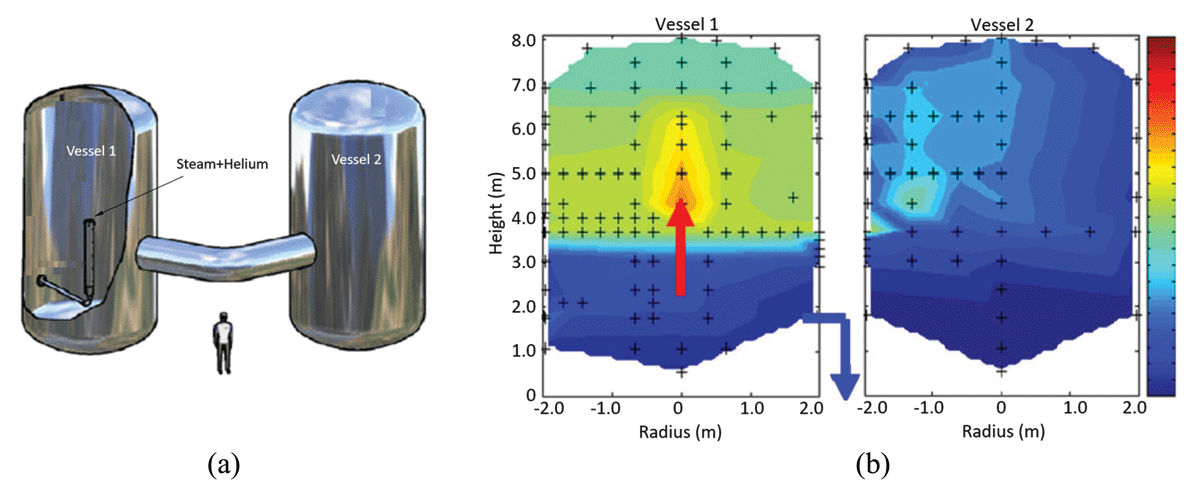
Figure 4
SETH–PANDA test 25: (a) PANDA facility, (b) experimental measurements of temperature fields (Paladino et al., 2010).
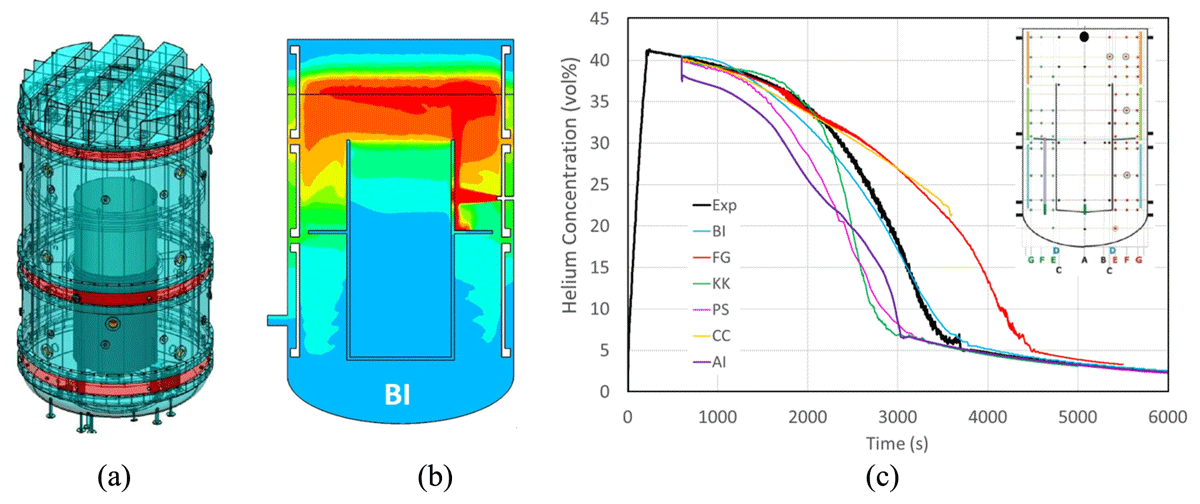
Figure 5
HYMERES–MISTRA HM1-1 benchmark exercise: (a) MISTRA facility, (b) gas temperature field predicted by CFD-ACE+ at 2100 s, (c) comparison of helium concentrations at the ceiling predicted by various codes with experimental data (Studer et al., 2018).
A recent benchmark demonstrated that taking into account the radiative heat transfer in a participating medium (water vapor) allows a more accurate interpretation of the experimental results, even with small temperature differences (Yu Glotov et al., 2019). Figure 6 shows the comparison of experimental data with the predictions conducted with or without thermal radiation heat transfer.
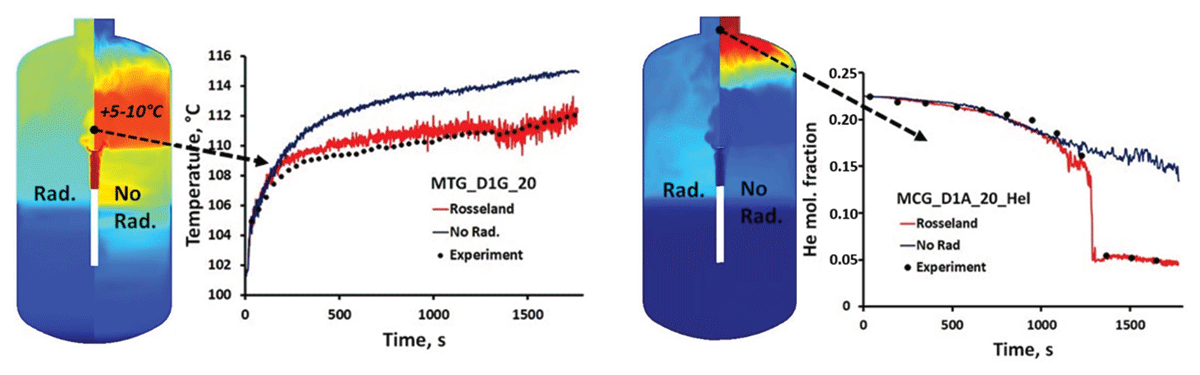
Figure 6
HYMERES–PANDA HP1_8 benchmark exercise: (a) gas temperature in the stratified layer, (b) helium erosion at the top of Vessel 1 with and without radiation model, modified from (Yu Glotov et al., 2019).
Finally, the effects of operation of mitigation measures (spray, cooler, PAR, and venting system) on H2 mixing has been the subject of extensive research in recent years. While spray can provide an efficient mixing for a larger region, the gas mixing induced by PARs, coolers or venting is generally limited to the region close to these devices.
2.3 Open questions and future investigations
There are a few issues that need to be further investigated. First, H2 mixing and transport are primarily driven by buoyancy and turbulence; however, none of the Reynolds-Averaged Navier-Stokes (RANS) turbulence closure models have shown superiority. A hybrid of RANS and large eddy simulation approaches and extension of validation cases can be considered. Second, scaling effect remains an open issue. The height of experimental facilities present in operation is generally 8 to 10 m, whereas it is an order of magnitude larger for nuclear containments. Therefore, natural convection could be enhanced, and boundary layer thickness could be reduced in containment, which will be more difficult to capture in computer models. Third, propagation of uncertainties in the models needs to be considered for future analyses. Finally, for experiments, in addition to the ever-important need for separate-effects tests, it is desirable to have more advanced parametric studies, including integral tests.
3.0 Hydrogen Combustion
3.1 Overview
Since the 1980s, the research effort of nuclear reactor safety in the combustion community has been focused on the understanding of the risk of explosion of H2-air mixtures through specific studies related to flame acceleration (Dorofeev et al., 2001; Kuznetsov et al., 2002; Lamoureux et al., 2005) and transition to detonation (Guirao et al., 1982; Knystautas et al., 1986; Lee, Knystautas and Chan, 1985). Recently, through the French national program MITHYGENE (Bentaib, Meynet and Bleyer, 2015), the effect of steam dilution and initial temperature on flame acceleration in a closed tube laden with obstacles (ENACCEF-2) have been addressed.
Indeed, in the evaluation of an explosion hazard with pressure effects that can threaten the containment and the safety equipment, the identification beforehand of the combustion regime is mandatory in the assessment of the different scenarios stemming from the H2 distribution analyses. When a combustible mixture is formed and a flame is initiated, three different combustion regimes can be identified: (i) slow flame with a limited pressure increase, characterized by a flame speed on the order of meter per second, (ii) fast flames with high pressure loads, characterized by flame speeds higher than the speed of sound in the unburnt gases and above half the speed of sound in the burned gases, (iii) detonation with extremely high pressure loads and a velocity on the order of thousand meters per second. If the gas distribution analyses show that a steady detonation is highly unlikely to occur, the limit between slow and fast flames must be addressed thoroughly.
The understanding of flame acceleration phenomena relies on the following parameters identified in the literature (Klein et al., 1999):
Laminar flame velocity and flame thickness that are intrinsic to the combustion itself.
Turbulent flame velocity that is characterized by the integral length scale and intensity of turbulence.
Flame instabilities, characterized by the Lewis number, Le = χ/D, where χ is the mixture thermal diffusivity and D is the mixture mass diffusivity.
Thermodynamic and kinetic properties, characterized by the expansion ratio σ = ρu/ρb, where r is gas density, and the Zeldovich number, β = Ea(Tb – Tu)/RTb2, Ea is the global activation energy, and T is the temperature. The subscripts u and b represent the unburnt and the burned gas.
Speed of sound for reactant and product.
The more recent work (Grosseuvres et al., 2019) illustrates the importance of the flame-stretch interaction in the subsonic stage of the flame acceleration through the proper characterization of the burned gas Markstein number and may act in the turbulent burning rate in addition to the classical variables of the Borghi diagram. Turbulent flow may be characterized by integral scales; this is generally applied to stationary turbulent flow. When considering premixed flame propagation, the involved processes are too complicated to define those scales. For example, the integral length scale, LT, depends not only on the characteristic geometric size (e.g., tube diameter, obstacle shape and size), but also on the gas flow dynamics. Based on numerous experimental tests of flame propagation in tubes with different obstacles, Kuznetsov et al. (2002) proposed a global expression of LT according to the obstacle geometry, where the turbulent length scale is normalized with the laminar flame thickness.
Ciccarelli and Dorofeev (2008) have pointed out that although the basic phenomena involved in flame acceleration and deflagration to detonation transition are identified, there are still deficiencies that the scientific community has to address in order to reduce the uncertainty margins within the evaluation of the potential hazard in a given scenario. These deficiencies can be attributed to remaining uncertainties in the determination of the critical conditions, including critical values of the mixture expansion ratio in the detonation cell size data, the laminar burning velocity, and the laminar flame thickness.
3.2 Experimental programs and benchmark exercises
Since the 1980s, extensive experimental research has been carried out to study pre-mixed H2 combustion behavior. The objective was twofold: 1) characterize the transition between slow and fast regimes, and between deflagration and detonation; and 2) produce a database to validate computer codes. The OECD report (NEA, 2000) provides a description of the major experiments conducted for flame acceleration and detonation. These experimental programs aimed to address the postulated typical reactor conditions (e.g., geometry, turbulence effects), the gas composition, and the venting on flame propagation.
The complexity of the facilities geometry and the limited instrumentation have made it difficult to validate advanced combustion models using the earlier data. Since 2000, new experimental programs were conducted on well-instrumented facilities with the objective to provide complementary data for the validation of both CFD and LP codes. In the OECD/NEA ISP49 benchmark exercise (NEA, 2012), LP and CFD codes demonstrated their ability to predict flame speed and rate of pressure increase. Figure 7 shows the THAI vessel and the comparison of the experimental measurements with the predictions of CFX and COM3D codes. The ISP49 also highlighted the need of further investigations to increase the knowledge regarding turbulence effect on flame propagation, especially in stratified mixtures.
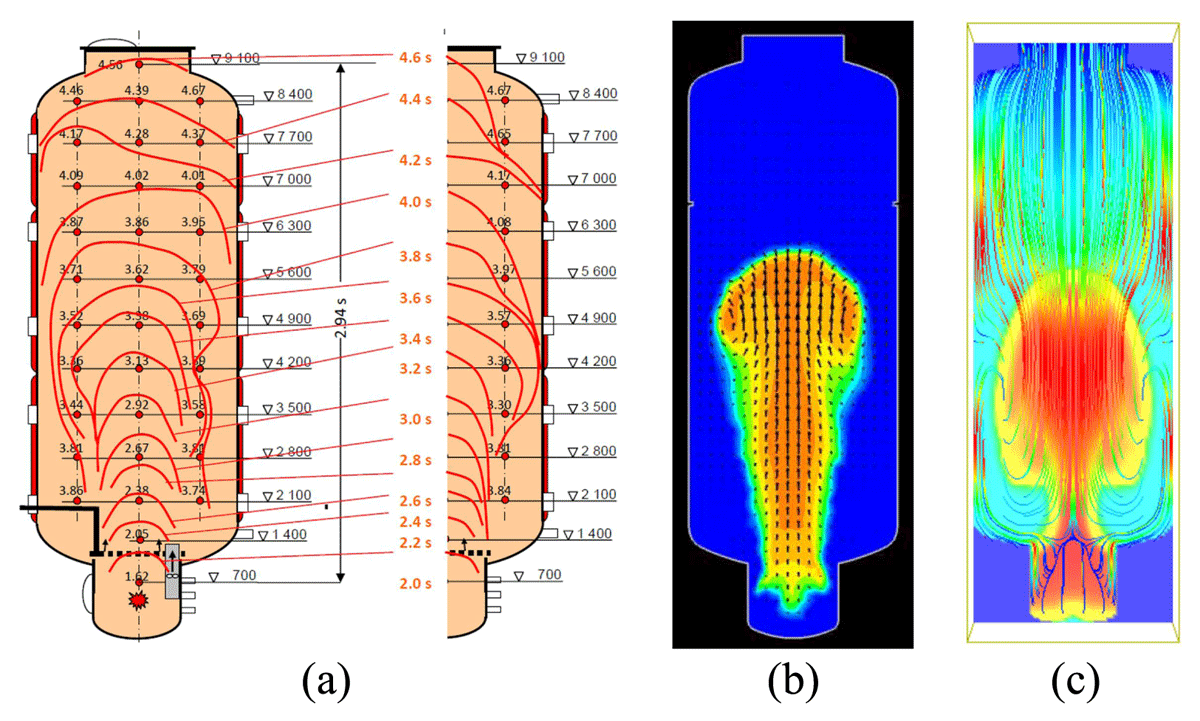
Figure 7
ISP49 THAI flame front: (a) experiment, (b) CFX, (c) COM3D (NEA, 2012).
More recently, benchmarks were conducted to simulate the experiments performed in the ENACCEF2 facility, where H2-air and H2-air-steam mixtures were considered (Bentaib et al., 2022). As shown in Figure 8, most of the LP and CFD codes were able to qualitatively predict the pressure evolution inside the vessel. Nevertheless, the maximum flame speed was generally over predicted. This indicates that there are still limitations and weaknesses in the combustion models used in the different codes. These limitations are related to the chemistry and turbulent combustion models, and the coupling between the two models.
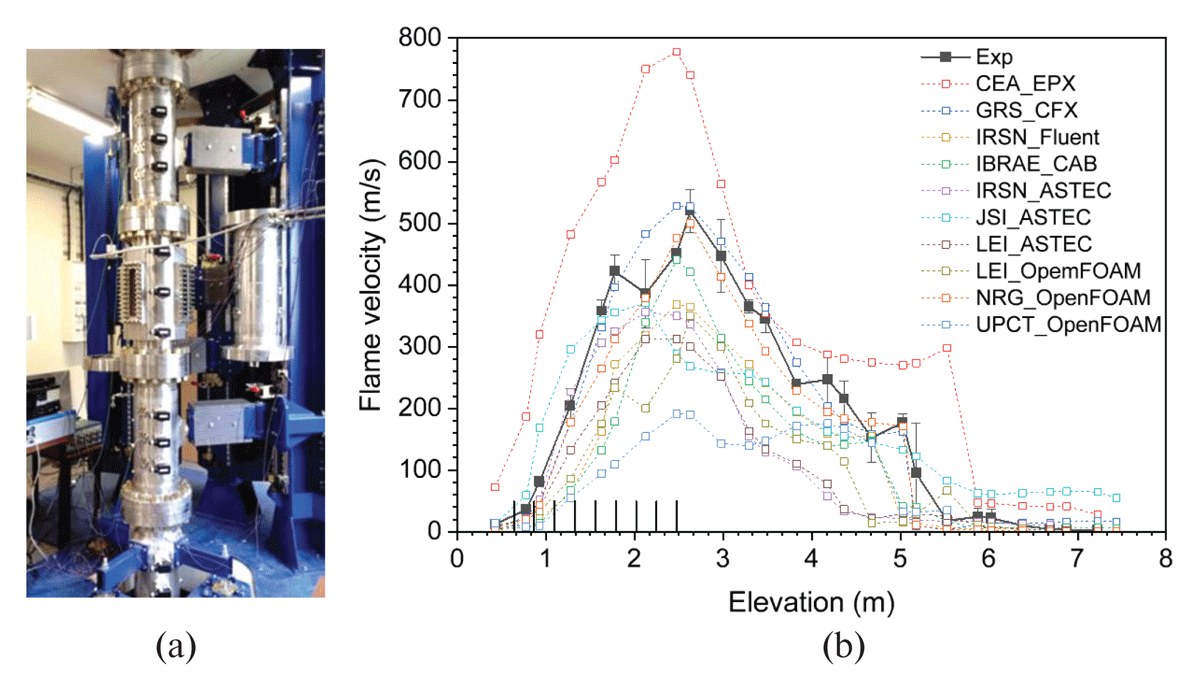
Figure 8
ETSON-SAMHYCO-NET benchmark of fast flames: (a) ENACCEF2 facility, (b) comparison of simulation results with experimental data (Bentaib et al., 2022).
3.3 Open questions and future investigations
Despite the extensive effort spent on addressing the fundamentals of the H2 explosion hazard evaluation, there are still numerous questions raised concerning: (i) the combustion regimes in oxygen (O2) starvation conditions, resulting in H2-rich mixtures that are less studied in the literature, (ii) the limit between slow and fast flame seems to be too high and should be revised. Indeed there are conditions for which combustion regimes are identified as ‘slow,’ but the flame is fast enough to induce pressure peaks higher than the theoretical combustion pressure for an adiabatic, isochoric complete combustion, (iii) the mitigation measures relying on dilution (inert gases) and/or water sprays are not fully understood and need further investigations, and (iv) the effect of non-homogeneous mixtures either in terms of H2 distribution or temperature gradients on the combustion regime classification needs to be assessed and their effect on the flame acceleration criteria are not well understood nor quantified. Questions were also raised regarding the effects of vented combustion in multi-connected rooms (e.g., studies by Liang (2017)), interaction of spray and flame and combustion in venting systems.
In the near future, it is mandatory to extend the current studies to the late phase SAs, where not only H2 and steam are involved, but also CO, CO2 and other minor gases. These new mixtures are also obtained under O2 starvation, which have been addressed by the European AMHYCO (Jiménez et al., 2023) and OECD/NEA THEMIS projects (Gupta, Freitag and Poss, 2021). Indeed, the presence of carbonated species modifies several features in the combustion regimes, such as the completeness of the reaction in case of O2 starvation, the radiative heat losses responsible for a modification of the heat release, the flame dynamics, and the influence of the thermo-diffusive instabilities, which in turn affect the acceleration process and the interaction of the flame with the environment.
4.0 Hydrogen Mitigation
4.1 Overview
Since the TMI-2 accident, worldwide R&D programs have focused on developing mitigation strategies to prevent fast H2 combustion in case of SAs. Further actions have been taken to address issues raised after the Fukushima Daiichi accident. The H2 mitigation measures commonly applied by NPPs (IAEA, 2001) are:
Pre-inerting of containment by replacement of O2 with an inert gas during normal operation
Post-accident inerting of containment by local injection of inert gas during an accident
Dilution of the atmosphere to prevent the formation of flammable mixtures by natural convection or engineered systems (e.g., fan-cooler, spray)
Consumption and recombination of H2 by PARs
Deliberate ignition of the gas mixture as soon as the lower flammability limit is reached
The principle of the above measures is to preclude flammable mixtures either by control of the O2 concentration through inerting of the containment atmosphere or by control of the H2 concentration through dilution or recombination (i.e., PARs). The strategy to control the H2 concentration follows three steps: (1) reduce the possibility of H2 accumulating to flammable concentrations, (2) minimize the volume of gas at flammable concentrations if such conditions cannot be precluded, and (3) prevent the H2 concentration increasing from flammable to detonable levels. To allow monitoring the performance of mitigation measures and to provide relevant information for operators supporting decision making during the progression of an accident, gas composition monitoring systems have also been implemented in many reactors.
The choice of mitigation strategy depends on specific containment designs (NEA, 2014). After the Fukushima accidents, PARs have become a primary choice for large containments in long-term accidents, while inerting remains commonly used for smaller containments, such as boiling water reactors. The location and size of each mitigation measure are generally determined based on plant-specific numerical simulations and dedicated assessments (NEA, 2014). However, due to significant differences in regulatory requirements, safety criteria and plant conditions, the specific approach and strategy vary in different countries or reactor designs.
4.2 Passive catalytic recombiners
Catalytic recombiners use noble metal catalysts to recombine H2 and O2 (from air) to form water vapor. The catalyst elements are commonly arranged in a rectangular open-ended stainless-steel housing to promote the buoyancy driven chimney effect. The PAR units are situated inside the containment building and use the heat of the oxidation reaction to produce flow through the unit by natural convection. As a consequence of their passive self-start and self-generated flows, they do not require outside power or operation actions. In contrast to combustion, the catalyst enables the oxidation of H2 outside conventional flammability limits at room temperature and even under saturated conditions.
PARs are in line with the general trend toward passive safety features in NPPs. However, the H2 recombination rate of PARs is ultimately subject to mass transfer limitations. PARs may not be capable of removing H2 at a rate required for fast-developing conditions. In addition, the catalysts can become a source of ignition at high H2 concentrations (i.e., 6–9 vol.%). Further, the PAR catalysts can be temporarily poisoned due to environment contaminants.
4.3 PAR Qualification and testing
Extensive testing of PAR performance took place in the 1980s and 1990s in different experimental facilities, including BMC (Kanzleiter, 1997), KALI (Braillard et al., 1997) and H2PAR (Studer and Rongier, 1996), and LSVCTF (Gardner and Marcinkowska, 2011), to investigate the initial performance of the PAR designs and qualify the PARs for installation in NPPs. To provide an example of the extent, Table 1 summarizes the qualifications of the PAR developed by AECL/CNL (Gardner and Marcinkowska, 2011).
Table 1
Summary of Qualifications for AECL/CNL PAR.
| QUALIFICATION ASPECT | OPERABILITY |
|---|---|
| Pressure | 1–4 bar(abs) |
| Temperature | 13–108°C (ambient), up to 750°C (catalyst) |
| H2 concentration | >0.5 vol.% |
| Relative humidity | Up to 100% |
| Radiation | 2000 kGy gamma |
| Post-accident H2 transient | Yes (24 h post-LOCA H2 transient in CANDU reactor) |
| Seismic acceleration | Up to 9.5 g (horizontal) and 6.3 g (vertical) |
| Thermal aging | 40 years at 50°C |
| H2 combustion | Yes |
| Cable/kerosene fires | Yes |
| Sprays (before and after H2 release): | |
| Water; NaOH; Na3PO4; B(OH)3, borax, KOH; Na3PO4, LiOH | Yes |
| Low O2 concentration | Yes (1–2 vol.%) |
| Post-accident chemicals (I2, CH3I, H2 N4, Cl2, HCl) | Yes |
| Long-term exposures to plant operating conditions | Yes (up to 42 months) |
After the initial qualifications were performed by the manufacturers, several institutions started more scientific experimental programs in order to further consolidate and understand the operational behavior under specific accident-related boundary conditions. In the framework of the OECD/NEA THAI project (NEA, 2010), PAR units provided by three manufacturers (Framatome (formerly AREVA), CNL (formerly AECL), NIS) were tested under accident-relevant boundary conditions. These tests provided fundamental information on the PAR start-up behavior, H2 recombination rate and gas-phase ignition to enable further development and validation of numerical PAR models (Freitag et al., 2022). In more advanced experiments, specific accident conditions such as the release of aerosols, atmospheres with extremely low O2 concentrations, occurrence of local counter flows, and the presence of carbon monoxide were investigated. In parallel with the THAI project, PARs have also been tested in national programs, including FZJ (Germany) and CNL (Canada) to understand the PAR operation in more detail and to develop advanced numerical PAR models beyond the existing correlation models. Experiments conducted in the REKO facilities at FZJ enabled the development of FZJ’s REKO-DIREKT code, which is a geometry-independent PAR model (Reinecke et al., 2010), and IRSN’s SPARK code (Meynet and Bentaib, 2012), which is a detailed PAR model involving full surface and gas-phase chemistry.
Experiments carried out at CNL facilitated the understanding of PAR behavior and explore the use of PARs for the H2 economy. Some examples of CNL’s research on PARs include investigating the gas-phase ignition (Gardner et al., 2021), behavior in the presence of carbon monoxide (Liang, Gardner and Clouthier, 2020), improving the catalyst to resist carbon monoxide poisoning (Gardner et al., 2023), and PAR behavior with continuous H2 release. Figure 9 provides an example of a test performed in CNL’s 60 m3 large-scale vented combustion test facility. In this test, H2 was continuously released at approximately 5 g/min from the side wall at the 1.5 m height, which was above the PAR inlet (1.3 m height). Under quiescent conditions, the H2 accumulated in the upper portion of the facility. The PAR didn’t begin to function until the PAR inlet H2 concentration reached 0.5% (at approximately 36 min). Once operational, the PAR reduced the overall H2 concentration in the facility and mixed the gases within minutes. The H2 concentration was maintained at the non-flammable level afterward.
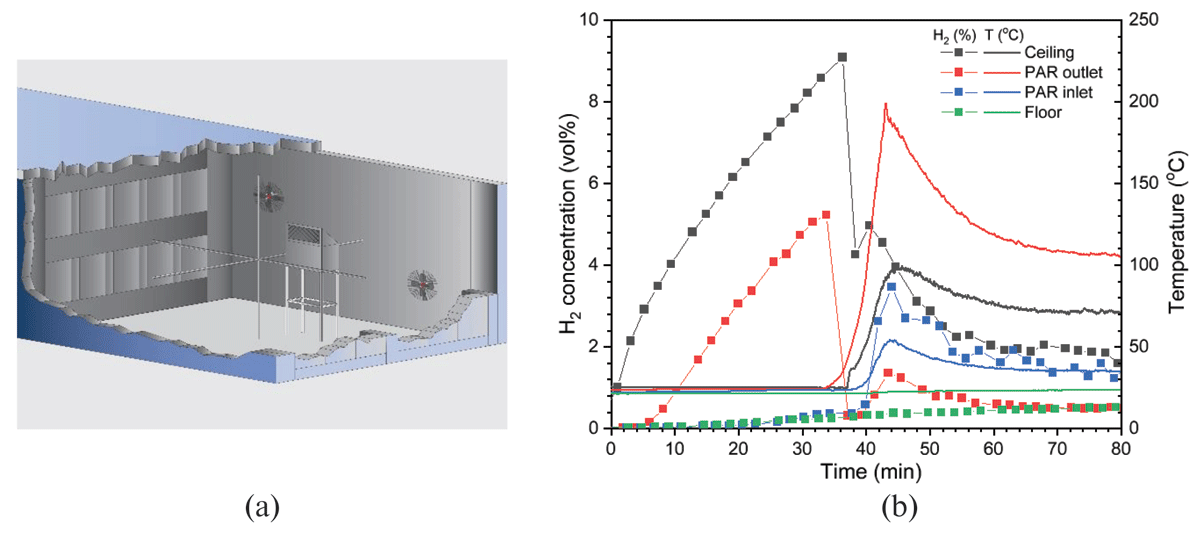
Figure 9
PAR performance during continuous H2 release: (a) CNL’s large-scale vented combustion test facility and a standard PAR with 31 catalytic plates, (b) evolution of H2 concentrations and gas temperatures.
At present, research projects are focusing on the late phase of SAs, when the gas mixture contains H2 and CO. Predicting the effect of CO on H2 mitigation has proven to challenge the capabilities of existing simulation tools. The open issues being studied include the combustion properties of the resulting H2/CO mixtures, as well as the effect on H2 recombination. The identification of the boundary conditions resulting in the deactivation of the PAR (i.e., catalyst poisoning) has been focused in the AMHYCO and THEMIS projects (Jiménez et al., 2023, Gupta, Freitag and Poss, 2021).
5.0 Summary and Implication for Other Industries
There is a fundamental difference in the safety design philosophy between nuclear and H2 facilities. The safety regulations and mitigation measures implemented for NPPs are aimed to limit the consequences of an accident, such as combustion loads and possible fission product releases. In contrast, the mitigation strategy for H2 facilities is to prevent the accumulation of flammable gas by allowing ventilation and dilution, thus avoiding confinement and congestion. Further, the H2 release pressure in a nuclear accident is much lower than a non-nuclear accident, but opposite for the release temperature. Despite the above difference, H2 risk assessments in both nuclear and H2 facilities presuppose the use of validated computer codes to predict H2 dispersion and evaluate the explosion-induced pressure and temperature loads, and the use of empirical correlations to identify flammable clouds and assess the possibility of flame acceleration and detonation.
A large amount of data for hydrogen safety has been produced by both the nuclear and non-nuclear industries. Continuous validation of computer codes along with the experimental progress is ongoing in many organizations. Some of the above-mentioned experimental results and computer codes have been applied to strengthen the capabilities of modeling H2 gas mixing and combustion behavior in both nuclear and non-nuclear industries. It is important to maintain this strong link to progress toward safer systems. As mentioned above, a number of projects have been carried out by the nuclear community at national and international level to develop and validate advanced LP and CFD simulation tools taking into account a wide range of conditions. These tools and the associated safety assessment methods have been successfully used in the licensing process (such as EPR-Flamanville in France). As a result, the knowledge and experience gained in nuclear applications can be easily used to assess the risk of H2 explosion in industrial installations.
In the future, the realization of nuclear reactor technologies, such as the molten salt reactor and high temperature gas cooled reactor, and the coupling or co-locating of a nuclear reactor with H2 production installations will drive further development and research on hydrogen toward safety, risk assessment, demonstration, and licensing.
Additional File
The additional file for this article can be found as follows:
Competing Interests
ZL and ES are members of the Editorial Board for Hydrogen Safety, but had no involvement in any editorial processes related to the handling of this submission. All other authors have no competing interests.