
Table
Multidimensional Comparative Framework for the Differential Diagnosis of Dissociative Disorders, Reactive Psychosis, and Schizophrenia
| Dimension | Dissociative Disorders | Reactive Psychosis | Schizophrenia |
|---|---|---|---|
| Trigger and Onset | Sudden onset after trauma | Abrupt onset after existential crisis | Insidious, no clear trigger |
| Narrative Continuity | Fragmented but trauma-linked | Symbolic, metaphorical content | Bizarre, non-relational delusions |
| Voice-Hearing Phenomenology | Dialogic, emotionally charged voices | Symbolically meaningful voices | Commanding, impersonal voices |
| Affect and Regulation | Affective storms and mutism | Emotional overwhelm, then recovery | Flat or incongruent affect; catatonic outbursts of agitation |
| Identity and Self | Identity fragmentation, alternating states | Transient destabilization of identity | Erosion of self-other boundaries |
| Course and Outcome | Tends to resolve with support | Acute and often self-limiting | Chronic or relapsing course |
| Insight and Meaning-Making | Partial or delayed insight | Partial insight, reflective potential | Limited or encapsulated insight |
| Somatic and Sensorimotor Features | Analgesia, altered ownership | Somatic metaphors | Disorganized/catatonic features |
| Response to Treatment | Responsive to trauma-informed care | Responsive to containment, supportive care | Requires antipsychotic treatment |
| Prognosis and Functioning | Often return to high functioning | Generally favorable with integration | Often long-term impairment |
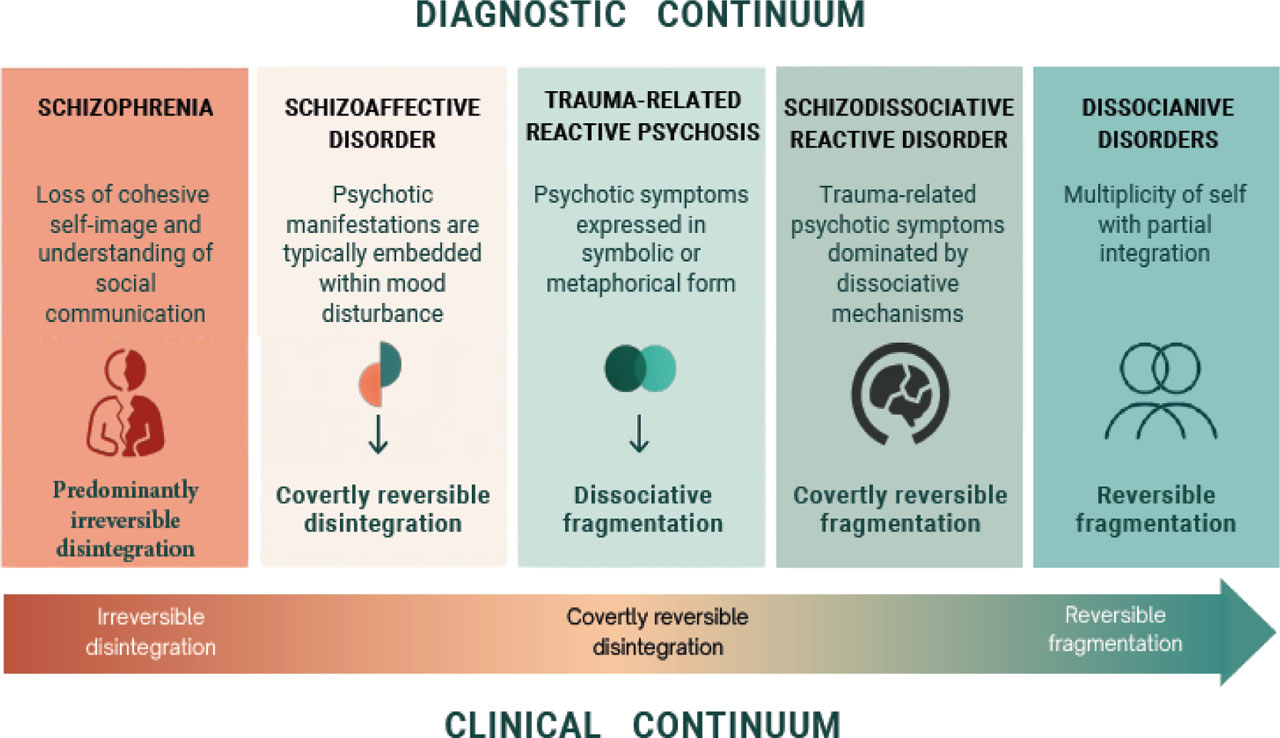
Diagnostic and clinical continuum from irreversible disintegration to reversible fragmentation across psychotic and dissociative spectra.
Legend:
The figure illustrates a multidimensional continuum ranging from schizophrenia, characterized by irreversible disintegration of the cohesive self, to dissociative disorders, where self-integrity is preserved and fragmentation remains reversible. Intermediate positions include schizoaffective disorder, trauma-related reactive psychosis, and schizodissociative reactive disorder, representing transitional forms with distinct modes of fragmentation and clinical trajectories.
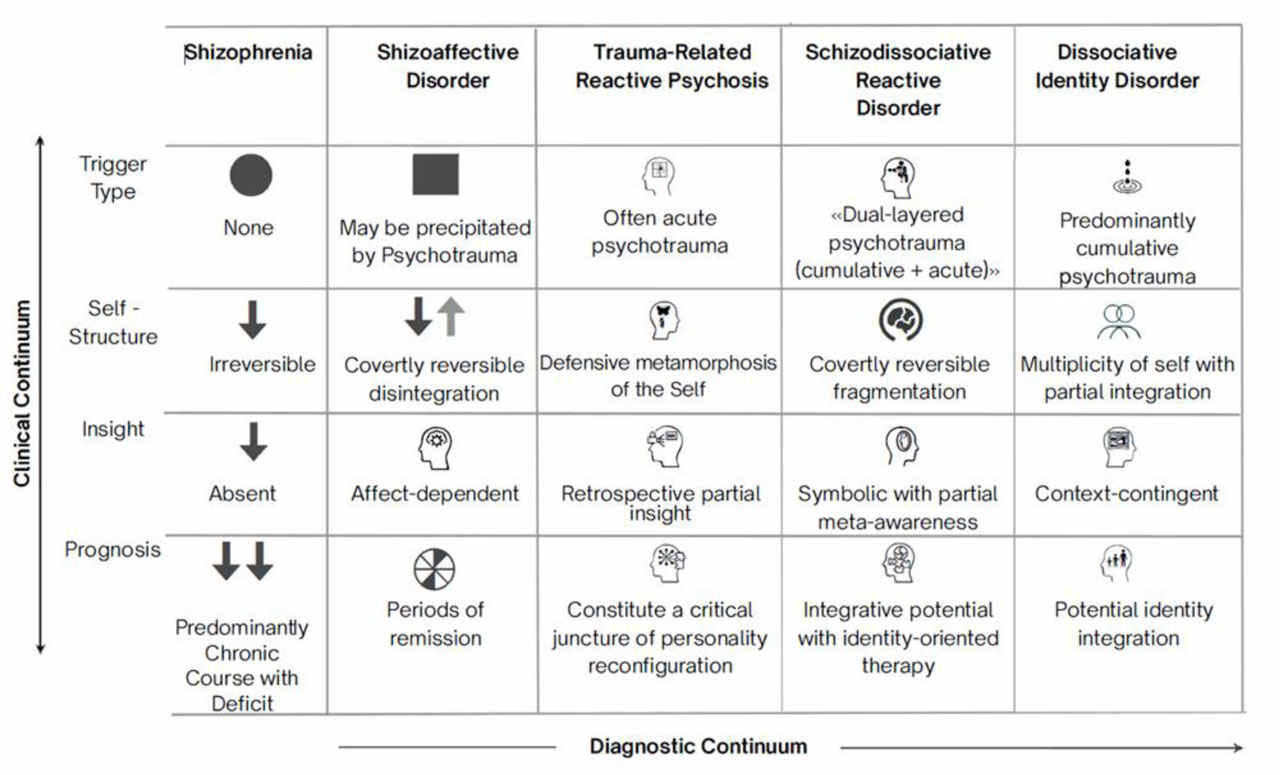
Multidimensional diagnostic continuum from schizophrenia to dissociative identity disorder with clinically relevant differentiation vectors.
Legend:
The figure presents a structured diagnostic continuum spanning schizophrenia to dissociative identity disorder, organized across key clinical dimensions, including trigger type, self-structure, insight, and prognosis. The model highlights clinically meaningful vectors that facilitate differential diagnosis across psychotic and dissociative spectra, with particular emphasis on transitional forms such as trauma-related reactive psychosis and schizodissociative reactive disorder.