
Introduction
During the full-scale war in Ukraine, stress-associated mental disorders have markedly increased. This trend underscores the importance of distinguishing endogenous conditions for accurate diagnosis and effective treatment. According to the World Health Organization (WHO, 2022), up to 10 million Ukrainians (approximately 25% of the population) are at risk of developing mental health disorders due to the war. Of particular concern are psychotic conditions, including reactive psychoses, which may be precipitated or exacerbated by chronic war-related stress, while their epidemiology remains insufficiently characterized.
The issue of the structure and nosological boundaries of stress-associated disorders is actively debated in contemporary psychiatry, particularly in the context of dissociative and reactive conditions under war-related stress. In Ukraine, these challenges have been addressed within professional discourse at international scientific and practical conferences, including “Stress-Associated Mental Disorders During War (Therapy, Prevention, Organization of Care)” (May 23–24, 2024) and “Challenges of Psychiatry in Wartime: Prolonged Grief Reaction and Depressive Disorder” (June 11–14, 2025), where particular attention was paid to existing gaps in the differential diagnosis of these conditions. Contemporary investigations additionally highlight the psychodynamic transformations associated with direct exposure to warfare and the profound effects of traumatic stress on personality organization and self-system functioning among military personnel (Pustovoyt, 2025).
Psychotic and dissociative disorders impose a substantial burden on mental health systems, being associated with significant functional impairment and high socioeconomic costs. At the same time, dissociative disorders, particularly those related to trauma, are frequently underdiagnosed or misclassified. Contemporary research increasingly conceptualizes dissociation, identity fragmentation, and voice-hearing as transdiagnostic phenomena that may manifest across both dissociative and psychotic spectra, thereby challenging the rigid categorical boundaries of traditional diagnostic systems. Studies on schizophrenia spectrum disorders additionally demonstrate that social dysfunction, reduced quality of life, and impaired psychosocial adaptation remain central dimensions of severe mental illness and may overlap phenomenologically with trauma-related psychopathology (Romash, 2023; Romash et al., 2022).
A paradigmatic example of such nosological ambiguity is Ganser syndrome, which has historically been interpreted as a reactive, dissociative, or psychotic condition. In 1898, S.J. Ganser described prisoners who displayed “Vorbeireden” (approximate answers), clouding of consciousness, auditory and visual “hallucinations”, and amnesia. Ganser syndrome has been observed frequently in conjunction with a marked psychosocial or physical stressor (e.g., head injury, serious illness). Subsequently, several psychiatrists reported similar symptoms in soldiers exposed to extreme stress. According to Mayer-Gross and Bleuler (1926), Ganser syndrome occurs mainly in epileptic or schizophrenic patients. According to Stern and Whiles (1942), Ganser syndrome is a fundamentally psychotic illness. As evidence, they describe the case of a woman with recurrent mania and a head injury before being submitted to treatment, and the report of a man with schizophrenia who suffered from alcoholism and had recently been in prison. Although S.J. Ganser (1898/1965) described the symptoms in prisoners, the condition has also been reported in the civilian population. It is thought to occur in individuals facing stressful, intolerable situations. Those who, for various reasons, are poorly prepared to cope with stress are thought to be the most likely to develop the symptoms.
In DSM-II (1968), it was classified as an adjustment reaction; in DSM-IV (1994), as dissociative disorder not otherwise specified (DDNOS); whereas in DSM-5 (2013), it is not recognized as a distinct diagnostic entity. In ICD-10 and ICD-11, it is subsumed under other specified dissociative disorders. Despite more than a century of investigation, its nosological status remains controversial, particularly in relation to other dissociative disorders. Notably, this persistent uncertainty regarding nosological boundaries has gained renewed clinical and theoretical relevance in contemporary psychiatry under conditions of large-scale collective trauma, particularly armed conflict, where extreme and chronic stressors expose the limitations of rigid categorical systems and re-activate longstanding debates on the differentiation between reactive, dissociative, and psychotic psychopathology.
The concept of reactive psychoses has a long and heterogeneous tradition in psychiatry. Its theoretical foundations were largely established by Karl Jaspers in Allgemeine Psychopathologie (Jaspers, 1913), in which he emphasized the relationship between severe psychotraumatic events and the emergence of acute psychotic states. Jaspers distinguished psychogenic reactions from endogenous psychoses on the basis of their meaningful causal relationship to traumatic events, affective congruence, and the potential reversibility of symptoms.
Throughout the twentieth century, the Scandinavian psychiatric school further elaborated this concept through the notions of “reactive psychosis,” “psychogenic psychosis,” and later “brief reactive psychosis,” describing acute polymorphic states precipitated by overwhelming stress and frequently accompanied by dissociative, affective, and psychotic symptoms. Scandinavian authors, particularly representatives of Swedish and Norwegian psychiatry, conceptualized these conditions as occupying an intermediate position between neurotic and schizophrenic disorders, thereby emphasizing their transitional and heterogeneous nature (Strömgren, 1987). During the twentieth century, the terminology and diagnostic criteria associated with reactive psychoses varied considerably across psychiatric traditions, including the French (bouffée délirante), German (cycloid psychosis), and Scandinavian (reactive/psychogenic psychosis) approaches (Nugent et al., 2011).
With the development of standardized diagnostic classification systems, increasing attention was directed toward issues of diagnostic reliability, limited longitudinal stability, and difficulties in differentiating reactive psychoses from schizophrenia spectrum and affective disorders. Consequently, driven by efforts to improve diagnostic consistency and international standardization, reactive psychoses gradually lost their status as an independent nosological category (Coelho, 2024). Beginning with ICD-8 and ICD-9, reactive psychosis was incorporated into the category of “other non-organic psychoses.” In ICD-10 and ICD-11, related clinical presentations were subsumed under acute and transient psychotic disorders and dissociative disorders, whereas DSM-5 redistributed such conditions across brief psychotic disorder, trauma- and stressor-related disorders, and dissociative disorders (Castagnini et al., 2022).
Thus, the historical evolution of the concept of reactive psychosis—from Jaspers through the Scandinavian school to contemporary diagnostic systems—reflects a gradual shift from phenomenological and biographically oriented models toward more formalized and descriptive diagnostic criteria. This transformation ultimately resulted in the loss of the autonomous status of reactive psychosis as a distinct nosological entity and its incorporation into broader categories of short-lived psychotic disorders within ICD-10/11 and DSM-5 (Coelho, 2024). Moreover, the subsumption of reactive psychoses under Chapters F.20 (ICD-10) and 06A20 (ICD-11) means that they are subject to guidelines that, while helpful for schizophrenic psychoses, are not appropriate for reactive psychoses—thereby entailing the risk of inadequate treatment attempts. This problem becomes particularly important in the context of increasing war-related psychopathology and the growing prevalence of stress-induced psychiatric decompensation in vulnerable populations (Matiashova et al., 2022).
The historical conceptualization of reactive psychoses as psychologically understandable and trauma-associated conditions also provides a rationale for considering psychotherapy not merely as an adjunctive intervention, but as a potential alternative to treatment as usual in selected patients. Given the central role of dissociation, affective disintegration, and psychotrauma in the pathogenesis of these conditions, psychotherapeutic interventions may facilitate not only symptom reduction, but also the integration of traumatic experiences and the restoration of psychological coherence (Reid et al., 2024; Hellen et al., 2025; Niemeyer et al., 2025).
Recent advances in trauma research and neurophenomenology have further blurred the boundaries between psychotic and dissociative disorders, demonstrating that trauma-related phenomena may present with psychosis-like symptoms in the absence of an endogenous pathological process (Longden et al., 2020). Within dimensional frameworks, particularly the Research Domain Criteria, such conditions are conceptualized as sharing neurobiological mechanisms (Insel et al., 2020; Guloksuz & van Os, 2021), supported by evidence implicating disruptions in predictive processing and experiential integration (Lanius et al., 2021). Neurobiological studies additionally indicate that traumatic events may induce substantial alterations in neurotransmitter systems, hormonal regulation, and metalloenzyme activity, potentially contributing to the emergence of trauma-associated psychopathology and psychotic-like states (Romash et al., 2023).
The overlap between reactive psychoses, dissociative disorders, and trauma-associated psychotic states remains insufficiently delineated, contributing to diagnostic uncertainty and the risk of inappropriate treatment (Reinders et al., 2020; Resnick et al., 2023). In this context, the development of novel conceptual models capable of more accurately capturing such “borderline” or hybrid conditions becomes critically important.
Purpose
The aim of this article is to delineate existing diagnostic gaps in the field of dissociative and reactive disorders, as well as the limitations of their differential diagnosis. Particular attention is paid to the insufficient elaboration of phenomenological features and psychopathological patterns underlying the development of these conditions, which complicates their clear delineation in clinical practice.
Drawing on clinical experience, the authors undertake a conceptual reappraisal of these disorders and propose a novel systematization to refine their psychopathological boundaries and developmental trajectories. Within this framework, a new hypothetical diagnostic category - schizo-dissociative reactive disorder- is introduced and conceptualized as a distinct clinical entity emerging at the intersection of dissociative, reactive, and psychotic-disorganization processes. In addition, phenomenologically oriented diagnostic criteria are proposed to more accurately capture its psychopathological structure and dynamic course.
Methodology
Study Design
A comprehensive and methodologically rigorous literature search (last updated January 2025) was conducted to support this narrative review. Searches were performed across major biomedical databases, including PubMed, Scopus, Web of Science, and Google Scholar. Search terms were systematically developed and combined using Boolean operators to capture key thematic domains related to trauma-associated psychopathology, dissociation, and psychotic disorders. Specifically, keywords included reactive psychosis, dissociation, trauma, schizophrenia, and schizo-dissociative reactive disorder.
Priority was given to peer-reviewed original research articles, systematic reviews, meta-analyses, clinical guidelines, and expert consensus statements, predominantly published within the past decade to ensure relevance and contemporaneity. Earlier studies were included selectively based on their conceptual or foundational significance. Additionally, manual screening of the reference lists of relevant publications was conducted to identify additional pertinent sources.
Inclusion criteria comprised thematic relevance, methodological rigor, and contribution to the understanding of trauma-related psychopathology, the relationship between dissociation and psychosis, and contemporary theoretical models, including neurophenomenological approaches and predictive processing frameworks. Exclusion criteria included studies with insufficient methodological quality, research conducted exclusively on animal models without clear translational relevance, and publications not aligned with the study objectives.
Selected sources were systematically organized, synthesized, and critically analyzed to construct a coherent and clinically relevant narrative. Study selection and screening were conducted independently by two authors, with discrepancies resolved through discussion. This approach ensured the development of an up-to-date, evidence-informed synthesis of the pathogenesis, clinical manifestations, and theoretical models of psychotic–dissociative disorders, with implications for both research and clinical practic.
Clinical Case Analysis
The study includes an in-depth analysis of a single clinical case selected for its illustrative value in demonstrating the overlap between dissociative and psychotic phenomena. The analysis was conducted retrospectively using phenomenological and psychodynamic approaches, with a focus on symptom structure, narrative coherence, identity processes, and trauma-related mechanisms.
Clinical material was obtained through psychiatric interviews, longitudinal clinical observation, and reconstruction of the patient’s life history and psychosocial context. The analysis aimed to identify diagnostically relevant patterns and to evaluate the applicability of the proposed theoretical framework.
Analytical Strategy
Data analysis was conducted using a qualitative interpretative approach. Phenomenological analysis was employed to describe subjective experience and clinical manifestations, while psychodynamic interpretation was used to explore intrapsychic processes and defense mechanisms.
Comparative clinical analysis was applied to differentiate dissociative disorders, reactive psychosis, and primary psychotic conditions across several parameters, including onset, narrative structure, affect regulation, identity organization, and treatment response.
Ethical considerations
The presented clinical case was adapted in accordance with ethical standards for the publication of clinical materials. All identifying information was modified or removed to ensure patient confidentiality. The description preserves clinical and phenomenological integrity without enabling identification of the individual.
The study was conducted in accordance with the principles of Good Clinical Practice (GCP, 1996) and adhered to established ethical standards for medical research involving human subjects, including the Declaration of Helsinki of the World Medical Association (2000 revision) and the Convention on Human Rights and Biomedicine of the Council of Europe (1997). Ethical approval was obtained from the Bioethics Committee of Ivano-Frankivsk National Medical University (Protocol No. 153/25, September 17, 2025).
Declaration of Generative AI and AI-Assisted Technologies in the Writing Process
During the preparation of this work, the author used «Grammarly» in order to proofread and edit. After using this tool/service, the author reviewed and edited the content as needed and takes full responsibility for the publication’s content.
Results
Review of Recent Research and Theoretical Framework
The classical conceptual distinction between reactive psychoses and schizophrenia has historically been rooted in a dualistic framework that positioned schizophreniform disorders and dissociation-related disorders at opposing ends of a presumed structural divide. This model, however, has proven insufficient for capturing the complexity of trauma-related clinical presentations, which often display features of both categories (Ross, C. A., 2021). Building on previously published reflections (Pustovoyt et al., 2012), the present article advances a dimensional perspective on the reactive–dissociative continuum, wherein trauma operates as a transversal axis influencing both core dissociative symptomatology and phenomena traditionally attributed to schizophreniform psychotic manifestations.
The framework is grounded in three core assumptions:
Trauma as a dynamic catalyst: Traumatic events, especially those occurring in early development or involving interpersonal violence, can overwhelm integrative mental functions. Depending on premorbid structure, ego resilience, and contextual containment, this may result in either compartmentalization (dissociation) or symbolic dramatization (reactive psychosis).
Dissociation and reactive psychosis as overlapping yet distinguishable defensive formations: In this view, dissociation represents an intrapsychic segregation of affect and experience - a splitting-off that preserves psychic survival by rendering intolerable elements inaccessible to conscious integration. Reactive psychosis, by contrast, entails a symbolic reconstitution of meaning in the face of existential disaster and the wrecking of psychological defenses - an attempt to forge a mutational defense where the usual protective structures have been shattered. They share a common origin in fragmentation but diverge in their psychopathological form and communicative intent. Nevertheless, they may alternate, each replacing the other as the mind struggles to restore psychic equilibrium.
Phenomenology over nosology: Echoing the work of Jaspers (1913) and contemporary trauma theorists (van der Kolk, 2014), the model emphasizes subjective experience over rigid criteria. The goal is not to replace diagnoses, but to situate them within a broader understanding of existential and neurobiological disruption.
This integrative framework also draws on contemporary theories of predictive coding and free energy (Friston et al., 2023), which conceptualize psychosis and dissociation as differing strategies for dealing with violated expectations, unbearable affect, and epistemic unpredictability. Dissociative states may reflect a withdrawal of precision-weighting from interoceptive signals, while reactive psychoses may involve maladaptive overinterpretation of exteroceptive cues in an effort to restore coherence (Sterzer et al., 2021; Seth et al., 2018).
In short, the theoretical framework proposed here invites a shift from diagnostic exclusivity toward layered, trauma-informed mapping of psychopathology.
Clinical Differentiation
Differentiating between trauma-related dissociative states, reactive psychosis, and primary psychotic disorders is a major clinical challenge. Traditional diagnostic frameworks often fail to account for the complex phenomenology of trauma responses, especially when symptoms such as hallucinations, voice-hearing, affective dysregulation, or altered states of consciousness overlap across nozological boundaries.
To facilitate the differential diagnostic process, Appendix A presents a multidimensional comparative framework summarizing the key clinical and phenomenological parameters required for the differential diagnosis of dissociative disorders, reactive psychosis, and schizophrenia. Each dimension represents an important component of the differential diagnostic algorithm.
This section adopts a comparative perspective, beginning with Ross (2021) and Kluft’s key contributions (2005), followed by the author’s earlier work (Pustovoyt et al., 2012). The framework is further refined with contemporary clinical insights and structured across ten dimensions (Appendix A).
Trigger and Onset: Dissociative and reactive conditions typically follow identifiable psychological trauma or existential shock. In contrast, primary psychotic disorders often have a more insidious onset with no clear precipitant.
Narrative Continuity: Dissociative experiences are often fragmented but embedded in a trauma narrative. Reactive psychosis exhibits symbolic or metaphorical content, often distorted but emotionally linked to lived experience. Schizophrenic delusions and hallucinations tend to be non-relational, bizarre, or self-referential.
Voice-Hearing Phenomenology: In DID and trauma-related psychosis, voices are typically experienced as dialogic, affect-laden, and interpersonally charged. In schizophrenia, voices may be more impersonal, commanding, or enigmatic.
Affect and Regulation: Dissociative and reactive forms often show intense affective storms followed by shutdown or mutism. Schizophrenia may involve affective flattening or incongruity.
Identity and Self: Dissociative disorders involve identity fragmentation with alternating ego-states. Reactive psychosis may temporarily destabilize identity without full structural division. Schizophrenia often features erosion of boundaries between self and other.
Course and Outcome: Dissociative and reactive states tend to resolve with appropriate containment and therapeutic support. Schizophrenic syndromes generally follow a chronic or relapsing course.
Insight and Meaning-Making: Patients with trauma-related states often retain partial insight or can retrospectively make sense of their experience. In schizophrenia, insight is frequently absent or rigidly encapsulated.
Somatic and Sensorimotor Features: Dissociative presentations may include analgesia, paralyses, or altered bodily ownership. Reactive psychoses often involve somatic metaphors. Schizophrenia may show disorganized or catatonic motor features.
Response to Treatment: Trauma-informed therapy, narrative integration, and supportive pharmacotherapy are typically effective in dissociative/reactive conditions. Antipsychotics alone may be insufficient. In schizophrenia, antipsychotics are the primary treatment.
Prognosis and Functioning: With stabilization and integration, dissociative/reactive patients often return to high functioning. Schizophrenia is more likely to entail long-term functional impairment.
Appendix A provides a side-by-side comparison of these dimensions across diagnoses. This clinically grounded matrix serves as a diagnostic guide and a foundation for tailored intervention.
Neurobiological Findings
Emerging research in affective neuroscience and neuroimaging has significantly enhanced our understanding of trauma-related psychotic and dissociative states. Neurobiological data increasingly support the differentiation between trauma-induced alterations in consciousness and primary psychotic disorders.
Functional Neuroimaging and Dissociation: Studies using functional magnetic resonance imaging (fMRI) and positron emission tomography (PET) have demonstrated that dissociative states are characterized by hypoactivation in brain areas associated with bodily self-awareness (e.g., the anterior insula and anterior cingulate cortex) and hyperactivation in medial prefrontal regions involved in self-monitoring and internal narrative suppression (Lanius et al., 2021). This pattern is consistent with the clinical experience of emotional numbing, depersonalization, and compartmentalization of trauma.
Neurobiology of Reactive Psychosis: While data are more limited, reactive psychosis has been associated with acute dysregulation in cortico-limbic circuits, particularly involving the amygdala, hippocampus, and ventral striatum. These changes may reflect the brain’s maladaptive attempt to re-establish meaning and coherence in the face of overwhelming stress. The symbolic and metaphorical nature of symptoms often corresponds with hyperactivity in associative temporal and parietal cortices, which are implicated in narrative construction and metaphoric representation (Lee et al., 2023).
Predictive Coding and Free Energy Theory: Friston’s model of hierarchical Bayesian inference provides a compelling framework for understanding these states. In dissociation, the brain may reduce the precision weighting of interoceptive signals, resulting in experiential disconnection. In reactive psychosis, the system may generate over-weighted priors in an effort to minimize surprise, leading to perceptual distortions or delusional ideation (Heinz et al., 2019).
Comparisons with Schizophrenia: In contrast, primary psychotic disorders such as schizophrenia demonstrate widespread dysconnectivity across frontotemporal networks, with reductions in gray matter volume, impaired synaptic plasticity, and alterations in dopamine and glutamate transmission (Li & Kéri, 2020). These findings support the distinctiveness of trauma-related psychotic states at the neurobiological level, despite superficial phenomenological overlap.
Together, these data support the reconceptualization of trauma-related dissociative and psychotic phenomena as neurobiologically grounded conditions with identifiable mechanisms. They call for diagnostic frameworks that incorporate these neurophenomenological insights rather than relying solely on symptom-based categorization.
To further elucidate the neurophenomenological mechanisms and differential diagnostic aspects discussed above, a detailed illustrative clinical case is provided in Appendix B.
Case Analysis clinical considerations.
From a clinical and phenomenological perspective, the patient’s life history presents a highly illustrative trajectory of dissociative predisposition. Early sexual trauma, attachment disruptions, and a longstanding pattern of identity fragmentation are evident well before the emergence of overt psychotic symptoms. Dissociative phenomena - ranging from amnesia and depersonalization to trance states - are present across her developmental arc.
However, clinicians must also consider the presence of endogenous affective fluctuations and the seemingly spontaneous onset of psychotic features. For instance, the triggering event - trip to a friend’s wedding - may not meet conventional thresholds of traumatic stress. Yet when interpreted through the lens of re-enactment, it becomes plausible that the patient unconsciously re-entered a scenario mirroring earlier trauma, resulting in a dissociative amnesia and shame-driven psychotic breakthrough. The lack of memory for the night’s events, the perception of social judgment, and her subsequent belief in being “cursed” suggest a collapse of symbolic integration.
The differential diagnostic challenge centers on whether this was a reactive psychosis or the inaugural manifestation of an endogenous psychotic process. Given the affective lability, transient psychotic symptoms, and identity instability, one must differentiate between schizoaffective disorder and dissociative identity disorder (DID) with comorbid borderline personality disorder. This debate mirrors ongoing clinical discourse regarding phase-like dynamics in personality disorders.
Some schools (e.g., Anglo-American psychiatry and the ICD/DSM framework) accept affective episodes as features of borderline pathology. In contrast, Eastern European traditions argue that phase dynamics can also reflect latent psychotic diathesis - particularly within schizotypal or mixed schizoid-cycloid character structures. These cases may resemble transient endoform psychoses triggered by psychosocial stress.
Within this framework, one could reasonably exclude the “non-dissociative schizophrenia” pole of Ross’s dissociative-psychotic continuum. The remaining diagnostic dilemma thus lies between dissociative-type schizophrenia and a “schizodissociative reactive disorder” - a concept emphasizing the interplay between trauma, identity diffusion, and symbolic elaboration.
The patient’s preserved affective capacity, lack of core negative symptoms, and poor response to antipsychotic treatment weigh against a primary schizophrenic diagnosis. Rather, her condition aligns more closely with a trauma-linked, structurally complex reaction - where dissociation serves both defensive and expressive functions.
Understanding why the friend’s wedding became the fulcrum for psychological collapse - shifting the case from “minor psychiatry" to “major psychiatry” - requires psychodynamic formulation. This analysis, presented in the next section, will explore how latent meanings, symbolic enactments, and dissociative processing coalesced into an existential crisis that was simultaneously a breakdown and a cryptic call for reconstitution.
Psychodynamic Analysis and Diagnostic Integration. From a psychodynamic perspective, it is important to immediately note the excessive role of sexuality in the life story narrated by the patient. Such a subjective coloring of experiences may indicate the absence of developmental boundaries in the child–parent relationship - boundaries that protect the child’s maturation - which inevitably leads to a premature activation of the child’s sexual needs. All significant figures in the patient’s life, from her maternal grandmother to her parents and brother, appear in her account as objects incapable of adequately performing the holding function (in D. Winnicott’s sense: they fail to provide a sense of safety and stability, and are unable to receive and contain the child’s negative experiences, thereby failing to soothe her. Consequently, the patient’s earliest memories express the feelings of insecurity and confusion of a small child in the tangled and dangerous world of adults. One may assume that under such relational conditions, the girl developed an insecure attachment, likely of the disorganized type (combining features of avoidance and ambivalence), as evidenced by her later relational patterns.
In the patient’s subjective world, her mother appears emotionally detached, indifferent, unpredictable, and unreliable; this “emotional absence” is processed by the patient in a depressive mode, forming a persistent sense of guilt toward the mother. The only seemingly interested figure - the father - proves even more dangerous than the absent mother: he is intrusively seductive, ultimately cementing the patient’s guilt toward her mother and a depressive sense of her own badness. In this polarity of the mother’s “emotional absence” and the father’s inadequately seductive involvement, one can recognize Bion’s description of the typical transformation “from the absence of a good object to the presence of a bad object” (Bion, W. R., 1962). This inner constellation complicates the course of subsequent development, particularly the oedipal stage, crystallizing into an unconscious conviction that emotionally intense relationships are potentially painful and dangerous, as well as into a characteristic behavioral pattern: persistent attempts to elicit a positive emotional response from emotionally distant figures and the disregard of the feelings of those who are emotionally attached.
The development of this mode of transformation - “the absence of a good object into the presence of a bad object” - can also be observed in the patient’s dreams, in which she sees her father killing her mother. These dreams can be interpreted as the destruction of the “bad internal object” by the “good internal object” within the patient’s psychic world. In her episode of sleepwalking, triggered by sharing a room with her brother, we see a “mirror” defensive strategy: an attempt to protect the “internal good object” (in this situation, herself) from a potential attack by the “bad object” (in this situation, her brother).
This “confrontation” in the patient’s inner world forms the main leitmotif of her life and constitutes a closed “pathogenetic” circle of retraumatization and repetitive compulsions. On the phenomenological level, this “confrontation” manifests itself in alternating states of consciousness and associated behavioral patterns: at times she is strikingly gentle, kind, and vulnerable, in contrast to her consciously chosen strategy of being a rather sharp, uncompromising, and sometimes even cruel woman who has sacrificed her “good name” for emotional freedom (these states being separated by an amnestic barrier); when the absence of emotional connection with her own son contrasts with her preoccupation with his fate; and in the current enactment of her unconscious conflict with her mother - when the mother tries to protect the “good child” (the patient’s son) from the harmful influence of his “bad mother.”
On the psychodynamic level, we observe a defense tactic specific to such cases: the protection of the “internal good object” from a potential attack by the “bad object” through the preventive conversion of an unconsciously anticipated aggressive attack into emotional attachment, followed by the justification of her own aggression as a defense against inappropriate sexual advances from partners.
In other words, the patient demonstrates a typical histrionic coping strategy - preemptively converting any experience into an erotic–sexual context - which, on the manifest level, gives her behavior a strong oedipal/sexually provocative tone, making it possible to interpret the entire case through the lens of an oedipal conflict alone. Indeed, the patient had no opportunity either to safely live through the oedipal situation in a “triangular” relationship with her mother and father, or to resolve it constructively for herself.
However, this combination - on the one hand obvious, on the other paradoxical - of oedipal and pre-oedipal dynamics creates the greatest diagnostic challenges: it misleads the clinician with opposite compulsive impulses - at one moment, to diagnose a corresponding personality disorder (based on her overtly demonstrative, provocative behavior), and at another, to diagnose schizophrenia (based on clear psychotic features). In most cases, this ultimately inclines clinicians toward the latter, out of reluctance to engage with this “contrasting confusion.”
This entire defensive strategy serves the patient’s desperate attempt to protect herself from the depressive experience that she herself is the “bad object” who destroyed her own internal “good object,” leaving her alone in a world of unpredictable, seductive, and boundary-violating “bad objects” - objects just as “bad” as she perceives herself to be.
The situation that precipitated the psychotic breakdown is highly illustrative: the patient simultaneously found herself in a very good and safe place - the marital bed of newlyweds - and attacked this place, identifying with her own bad internal object (bad because it violates others’ private boundaries). In other words, she both found and destroyed what she had been searching for so long - a place imbued with love, where everything happens by mutual consent, without anyone’s boundaries being violated; a loving parental couple that she never had in her life.
Thus, her expulsion from this bed, waking up in the morning next to an unfamiliar man, and reading disapproval in the eyes of those around her mercilessly assailed the painful experiences she had been so desperately defending herself against - namely, that she herself is the “bad object” who brings only harm. An echo of precisely this experience can be found in the psychotic sense that she, like a witch, attracts all sorts of misfortune and negative energy; and also in her experience of feeling ugly and dirty - down to a physical sensation of dirtiness - after a night at a disco in Prague with her lover.
Her anxiety subsides when she feels the presence of a “friend,” an “angel guardian,” nearby, and intensifies again when things at home do not work out, when she feels alienation from her son. Her psychosis begins when splitting and dissociation are no longer able to keep the “good” and “bad” self-representations in separate compartments, due to the inability to differentiate images of the external and internal worlds (a universal mechanism for the reactive triggering of psychoses) - with the result that depersonalization experiences dominate the clinical picture.
When dissociation can no longer contain this affective overload, more primitive defenses become activated: projective identification (drawing others into her inner conflict), intensified dissociation (the presence of the “guardian angel” alter), splitting (extreme mood shifts), denial, and regressive fantasies of universal love and protection. These mechanisms offer momentary relief but only fragmentary reality testing, culminating in a structurally rich, affectively charged psychotic reaction embedded within a traumatic context.
The diagnostic challenge lies in disentangling psychosis born of trauma from primary psychotic disorders. While schizoaffective disorder might explain her affective lability and psychotic episodes, her emotional vitality, narrative insight, and resistance to antipsychotic medication suggest otherwise. A dissociative subtype of schizophrenia could be considered, yet the prominence of dissociative symptoms, trauma history, and symbolic content supports the construct of a “schizodissociative reactive disorder” - a hybrid presentation not formalized in current nosologies.
The patient’s case underscores the necessity of trauma-informed diagnostic frameworks that integrate both phenomenological nuance and psychodynamic data. Her narrative exemplifies a dissociative-reactive crisis: not merely a symptom of decompensation, but an existential threshold crossing - a psychic event that restructures the trajectory of identity. As such, it demands an equally integrative response: one that hears not just the psychosis, but the pain, protest, and paradox it contains.
Discussion
This case is an example of the clinical and theoretical actuality of re-visiting of psychiatric conceptualization, diagnosis, and treatment of trauma-related psychotic phenomena. Rather than viewing acute psychotic breakdowns exclusively through the lens of neurobiological disease models (e.g. schizophrenia or bipolar disorder), this patient’s trajectory proposes a more nuanced, trauma-attuned perspective - one that accounts for dissociative structures, symbolic meanings, and narrative discontinuities. Drawing on the legacy of Astrup and Retterstøl (1959), and integrating contemporary findings in PTSD, dissociative disorders, and predictive neurocognition, we argue that current taxonomic boundaries between psychosis and trauma have to be redrawn. Psychosis in the context of trauma-particularly in case of domination of dissociative mechanisms - requires a distinct clinical framework that acknowledges its adaptive, symbolic, and reversible nature.
The proposed concept of Schizodissociative Reactive Disorder aims to formalize this intermediate territory. It addresses the clinical population that manifests with identity fragmentation, symbolic psychosis, and emotional permeability, without the characteristic deterioration of schizophrenia or the discrete episodic rigidity of bipolar disorder. The delineation of schizodissociative reactive disorder from both reactive psychoses and dissociative identity disorder must remain provisional. Nevertheless, the construct serves to demarcate this entity from the broader spectrum of reactive conditions on the one hand, and from the highly specific manifestation of dissociation represented by DID on the other. What most centrally defines this category is the conjunction of two processes: first, the symbolic reconstitution of meaning in the face of existential disaster, involving the collapse of established defenses and the attempt to forge a mutational substitute; and second, the splitting-off that safeguard psychic survival by rendering intolerable elements inaccessible to conscious integration. These dynamics may alternate, interweave, or crystallize into hybrid constellations, giving rise to novel clinical configurations at the intersection of psychosis and dissociation. Recognizing such conditions has not only diagnostical value - it is ethically imperative. Misdiagnosis can lead to overtreatment, chronicity, and neglect of the core trauma that fuels the symptoms.
This case underscores the necessity of a paradigm shift in psychiatry - moving beyond binary categorizations of “endogenous” versus “reactive” illness toward a dimensional, phenomenologically informed, and trauma-responsive approach. In doing so, we may not only refine our diagnostic accuracy but also restore therapeutic meaning for those whose minds speak in the fractured language of unintegrated suffering.
Diagnostic Integration
Key Clinical Conclusions:
Embedded Dissociative Predisposition: The patient’s presentation reveals a latent dissociative vulnerability shaped by cumulative early trauma (emotionally absent caregiving and sexual boundary violations in childhood).
Alternating Ego States: The presence of alternating ego states, amnestic gaps, symbolic enactments of shame/guilt, and identity confusion suggests a dissociative structure far more intricate than a typical mood disorder or primary psychotic disorder.
Lack of Antipsychotic Response: Antipsychotic treatment produced no significant improvement, reinforcing the hypothesis that dissociation - rather than neurotransmitter dysregulation - is the principal mechanism driving the patient’s condition.
Preserved Help-Seeking and Affect: The patient’s consistent help-seeking behavior, emotional expressiveness, and partial narrative insight (between episodes) argue against schizophrenia, despite the transient psychotic-like symptoms
Theoretical Synthesis: Legacy of Astrup & Retterstøl and Modern Trauma Science
The case lends empirical allegiance to the legacy of Astrup and Retterstøl, who conceptualized reactive (psychogenic) psychosis as an affective and psychogenic derailment rather than a fixed degenerative disease. Their model emphasized the meaning, reversibility, and symbolic content of such conditions - a perspective that has been revalidated by contemporary trauma research and neurophysiology in psychosis. Modern studies of trauma - from van der Kolk’s (2014) work on body-memory to the neuroimaging research of Lanius et al. (2021) - demonstrate that dissociative fragmentation is not only a psychological defense but also a measurable neurobiological event involving functional disconnections across the default-mode, salience, and interoceptive networks. Disruptions in predictive coding, as proposed by Friston and colleagues (2023), help explain the ways trauma can disable the mind’s ability to accurately “guess” the present, leading to distorted perceptions (e.g. persecutory interpretations, magical beliefs) and symbolically exaggerated experiences.
Proposed Diagnostic Concept: “Schizodissociative Reactive Disorder”
We propose Schizodissociative Reactive Disorder as a formal diagnostic category to capture trauma-related psychoses dominated by dissociative mechanisms. This formulation is characterized by the following proposed criteria:
A. Core Features (all required):
- Causal connection with Trauma: History of identifiable psychological trauma (acute or cumulative, relational or catastrophic in nature).
- Dissociative phenomena: Evidence of dissociative symptoms across at least two domains (e.g. amnesia, depersonalization/derealization, identity confusion, trance-like episodes).
- Psychotic symptoms: Hallucinations, delusional ideas, or perceptual distortions that are transient, polymorphic, and clearly contextual (often metaphorically related to trauma themes).
- Absence of negative symptoms: No enduring negative symptoms (e.g. flattening of affect, alogia, avolition) and no primary formal thought disorder as present in schizophrenia.
- Paradoxical medication response: Relative resistance to standard antipsychotic medications (or paradoxical worsening), with partial or full improvement when treated with trauma-focused, integrative psychotherapeutic approaches.
B. Supportive Features (at least 2 of the following):
- Marked fluctuations in mood and affect that do not conform to classical bipolar patterns.
- Episodes of altered consciousness (e.g., fugue states, regressions) are consistently linked to interpersonal or attachment-related triggers.
- Preserved narrative insight between psychotic episodes (the patient can reflect on and partially understand their experience when stabilized).
- Symbolic or metaphorical elaboration of psychotic content (e.g., adopting the persona of a “witch” symbolizing persecutory guilt, hearing a “guardian angel” during distress, experiencing a “split self” voice that echoes trauma narratives).
C. Exclusion Criteria:
- No established diagnosis of schizophrenia, schizoaffective disorder, or bipolar I disorder (per DSM/ICD criteria).
- Symptoms are not better accounted for by a neurological condition or substance-induced psychosis.
This formulation recognizes that certain psychotic phenomena emerge not from a neurodegenerative or primary psychotic process, but as symbolic responses to unresolved trauma and fragmented identity. It reframes trauma-related psychosis as a dynamic psychological process - an extreme but potentially adaptive expression of mental suffering - rather than as a static pathology of thought.
Differentiating Schizoaffective vs. Schizodissociative Trajectories
The above-mentioned criteria outline the core phenomenology according to which trauma-related psychotic phenomena may predominantly manifest as disturbances in self-awareness and disruptions in identity continuity. Within this spectrum of clinical presentations, two clinically significant trajectories within the transitional psychosis spectrum can be identified. A detailed graphical representation of these conceptual models, including the continuum from irreversible disintegration to reversible fragmentation, as well as multidimensional diagnostic vectors facilitating the differentiation between psychotic and dissociative disorders, is provided in Appendices C and D.
Figure in Appendix C presents a diagnostic continuum ranging from irreversible disintegration to reversible fragmentation. At one pole lies schizophrenia, marked by a collapse of the cohesive self-structure and an essentially irreversible loss of identity. At the opposite pole stand the dissociative disorders, in which basic self-integrity is preserved, and fragmentation remains fundamentally reversible. Between these poles stretches a transitional zone that can be differentiated into two modes of fragmentation: an affect-driven mode (represented by schizoaffective disorder) and a self-structure-driven mode (schizodissociative reactive disorder). This framework highlights two distinct clinical trajectories within the transitional psychosis spectrum: a schizoaffective trajectory and a schizodissociative trajectory.
Figure in Appendix D presents the diagnostic continuum from schizophrenia to dissociative identity disorder; based on our clinical experience, we propose a set of clinically significant vectors that may serve as guiding landmarks for differential diagnosis.
In the schizoaffective trajectory, the destabilizing impact of trauma is channeled primarily into affective dysregulation. Psychotic symptoms in this trajectory are typically embedded within mood disturbances. The structure of the self is disrupted not through an immediate shattering by trauma, but secondarily - under the influence of pathologically altered mood and affect. Phenomenologically, the axis of disorder runs through the emotional sphere: fluctuations in self-experience occur, but they are congruent with the prevailing affective state. Importantly, once the mood is stabilized, the person often experiences partial or full restoration of a coherent sense of self.
According to the schizodissociative trajectory - exemplified by the case detailed in this study - trauma targets self-awareness and the continuity of identity directly. Here, fragmentation is not confined to an affective content of experience; it penetrates the very structure of subjectivity. The patient’s psychotic content is rich with metaphor and symbolism, effectively enacting unresolved autobiographical material. Consequently, fundamental orientations of time, space, and personal identity become disrupted or “ruptured.” The core disturbance centers around fluctuations in self-awareness and self-coherence, independent of mood. The psychotic phenomena (voices, visions, delusional narratives) often bear an allegorical relation to the trauma, representing dissociated aspects of the person’s life story demanding integration.
This phenomenological distinction aligns with emerging concepts of Complex PTSD, wherein diagnostic criteria explicitly include both affect-regulation disturbances and changes in self-perception (Cloitre et al., 2013). The patterns observed in this case—when integrated with the earlier differential framework for dissociative disorders (Pustovoyt et al., 2012) and the continuum models illustrated above - fit coherently within a spectrum: from irreversible disintegration (schizophrenia) on one end to reversible fragmentation (dissociative disorders) on the other, with a transitional zone comprising affect-driven and self-structure-driven forms of fragmentation.
Clinically, this differentiation has more than theoretical value. Schizoaffective forms of psychosis require treatment strategies that combine trauma processing with mood stabilization. In contrast, schizodissociative forms demand an identity-focused, narrative-restorative approach that prioritizes rebuilding a coherent self-narrative. Correctly identifying the trajectory in a trauma-related psychotic presentation prevents both the underestimation of the role of trauma in symptom genesis and the overreliance on pharmacological suppression—an approach that risks perpetuating the very fragmentation it aims to resolve.
Strengths & Limitations. Future Directions
Despite the conceptual significance of the proposed model, this study has several important limitations. First, the empirical component is based on a retrospective, in-depth analysis of a single clinical case. Although this case provides substantial illustrative value in demonstrating the overlap between dissociative and psychotic phenomena, it does not permit broad statistical generalization to the wider population of patients with trauma-related psychopathology.
Second, the proposed diagnostic construct—schizo-dissociative reactive disorder—remains, at this stage, a hypothetical category that has not been formally recognized in current international diagnostic classifications (ICD-11 or DSM-5). Consequently, its direct implementation in routine clinical practice requires further empirical validation.
Third, the study methodology is grounded in a qualitative, interpretative approach that incorporates phenomenological and psychodynamic analyses. While this framework enables an in-depth exploration of the patient’s subjective experience, it inevitably involves a degree of researcher subjectivity that differs from quantitative assessment methods. Furthermore, the neurobiological evidence discussed in the review represents a synthesis of the existing literature rather than findings derived from original experimental investigations conducted within the present study.
Theoretical and Practical Value
Clinically, this differentiation has more than theoretical value. Schizoaffective forms of psychosis require treatment strategies that combine trauma processing with mood stabilization. In contrast, schizodissociative forms demand an identity-focused, narrative-restorative approach that prioritizes rebuilding a coherent self-narrative. Correctly identifying the trajectory in a trauma-related psychotic presentation prevents both the underestimation of the role of trauma in symptom genesis and the overreliance on pharmacological suppression—an approach that risks perpetuating the very fragmentation it aims to resolve.
Clinical Implications and Recommendations:
Adopt a trauma-informed lens at each phase of assessment and treatment. The patient’s symbolic language, emotional inconsistencies, and dissociative coping strategies should be decoded - not dismissed as “bizarre” symptoms.
Favor narrative and psychodynamic case formulations over simplistic checklist-based diagnostics. A rich narrative understanding is especially crucial in case psychotic features might be trauma-expressive rather than idiopathic.
Psychopathological and psychodynamic findings should be integrated into clinical training and case conceptualization. Clinicians should recognize the central role of disturbances in self-experience and trauma-related modes of perception, which may manifest as bodily symptoms, affective intrusions, or distorted threat awareness.
Reform diagnostic taxonomies to accommodate transitional and interface states between PTSD, dissociative disorders, and psychosis. Diagnostic systems should include criteria or specifiers for trauma-induced psychotic states, ensuring such cases are not prematurely labeled as schizophrenia or personality disorders.
Develop phased treatment protocols that balance safety and integration. Early stages should focus on stabilization and grounding (to manage dissociation and ensure basic safety), while later stages emphasize meaning-making, trauma processing, and narrative reconstruction—rather than relying solely on long-term pharmacological sedation.
These practical recommendations underscore the importance of a trauma-centered, dimensional approach to psychosis. Embracing such a framework not only improves diagnostic precision and treatment effectiveness but also restores a sense of human meaning and hope for individuals whose minds speak in the fragmented language of unintegrated suffering.
Conclusions
In summary, this study’s findings suggest that balancing connection and separation are key resources that enable MHPs to navigate the delicate balance between showing compassion to their patients while maintaining compassion for themselves, within the context of caring for those who use opioids. Participants highlighted that the need for boundaries was not a sign of detachment or burnout, but rather reflected wisdom grounded in self-awareness for keeping themselves well so they could continue to engage in demanding work. Further, participants described the use of mindfulness not to escape from the stress of interactions with patients, but as a path to fuller presence with them. In this way, compassionate care is not only about giving to those who struggle with the impact of opioids, but also about caring for oneself as a caregiver, so that they can continue to serve those who struggle.
Acknowledgements
The authors acknowledge Ivano-Frankivsk National Medical University, particularly the staff of the Department of Psychiatry, Narcology and Medical Psychology, for institutional support provided within the framework of the research project “Research into mental disorders among civilians, military personnel, and other population groups caused by the impact of hostilities in Ukraine” (State registration No. 0126U002072).
Notes
[1] Financial disclosure Funding Statement
The work is a fragment of the research project “Research into mental disorders among civilians, military personnel, and other population groups caused by the impact of hostilities in Ukraine” (№ state registration 0126U002072) on the Department of Psychiatry, Narcology and Medical Psychology, Ivano Frankivsk National Medical University.
[2] Conflicts of interest Conflict of Interest
The authors declare that they have no conflicts of interest.
[3] Contributed by Authors’ Contributions
Mykhaylo Pustovoyt: Conceptualization; study design; methodological framework; writing – original draft; data curation; Supervision; Organization of clinical materials; documentation of case material.
Ivan Romash: Clinical investigation; case-based data acquisition; supervision of clinical interpretation; writing – review & editing; Validation; Final approval.
Yuliia Medynska: Formal analysis; literature synthesis; theoretical integration of phenomenological models.
Roman Kechur: Validation of diagnostic framework; critical review of psychopathological conceptualization.
Oxana Shevchuk: Clinical investigation; observational and interview-based data collection, Data visualization.
Iryna Romash: Data curation; literature review; writing – review & editing. Final approval.
Vasyl Neyko: Supervision; methodological oversight; critical revision of intellectual content.
Volodymyr Paliichuk: Coordination of research process, critical intellectual revision.
Liubov Lutska: Literature review; bibliographic support;
Olexandr Myronenko: validation; critical intellectual revision.
Berger Hartmut: Critical revision of intellectual content. Final approval.
[4] Accountability Statement:
All authors attest that they meet the academic criteria for authorship. All authors have read, critically revised, and approved the final manuscript, and agree to be accountable for all aspects of the work in ensuring that questions related to the accuracy or integrity of any part of the work are appropriately investigated and resolved.
Appendices
Appendix A.
Table
Multidimensional Comparative Framework for the Differential Diagnosis of Dissociative Disorders, Reactive Psychosis, and Schizophrenia
| Dimension | Dissociative Disorders | Reactive Psychosis | Schizophrenia |
|---|---|---|---|
| Trigger and Onset | Sudden onset after trauma | Abrupt onset after existential crisis | Insidious, no clear trigger |
| Narrative Continuity | Fragmented but trauma-linked | Symbolic, metaphorical content | Bizarre, non-relational delusions |
| Voice-Hearing Phenomenology | Dialogic, emotionally charged voices | Symbolically meaningful voices | Commanding, impersonal voices |
| Affect and Regulation | Affective storms and mutism | Emotional overwhelm, then recovery | Flat or incongruent affect; catatonic outbursts of agitation |
| Identity and Self | Identity fragmentation, alternating states | Transient destabilization of identity | Erosion of self-other boundaries |
| Course and Outcome | Tends to resolve with support | Acute and often self-limiting | Chronic or relapsing course |
| Insight and Meaning-Making | Partial or delayed insight | Partial insight, reflective potential | Limited or encapsulated insight |
| Somatic and Sensorimotor Features | Analgesia, altered ownership | Somatic metaphors | Disorganized/catatonic features |
| Response to Treatment | Responsive to trauma-informed care | Responsive to containment, supportive care | Requires antipsychotic treatment |
| Prognosis and Functioning | Often return to high functioning | Generally favorable with integration | Often long-term impairment |
Appendix B.
Illustrative Clinical Case:
This case report has been adapted in accordance with ethical standards. All personal data has been anonymized or altered to preserve confidentiality without compromising the clinical narrative integrity.
Developmental and Family History: The patient, a young woman, was born as the second child from an uncomplicated pregnancy and delivery. Her early development was unremarkable. She was named after her mother, Alina, with a similarly sounding but slightly altered name, Alisa, which, at the time, was quite unusual. Consequently, people often addressed her by her mother’s name, which may have contributed to identity-related confusion.
She recalls herself from around the age of five. Her memories of childhood are fragmented, consisting primarily of emotionally saturated episodes. One of the earliest and most vivid memories involves an incident in kindergarten where three boys attempted to insert a toy cone into her genitals, leaving blood stains on her underwear. Her mother confronted the staff, but the child was left fearful and unwilling to attend kindergarten. She imagined a witch living in an abandoned house nearby who kidnapped little girls—a projection reflecting early internalization of fear and vulnerability.
She also recalls overhearing women speaking about a man (now understood as a rapist) and being warned to be cautious. She developed chronic fears of solitude and described herself in childhood as highly anxious and abnormally attached to her mother. At the age of six, a neighborhood boy led her to an attic, exposed himself, and forced her to do the same. She reported the incident to her mother, whose minimal reaction (“just don’t do it again”) left the girl feeling unprotected and ashamed.
During this period, her father became the subject of a criminal investigation. The child recalls her mother picking her up from kindergarten in a distressed, trembling state, speaking incoherently and crying uncontrollably. Following this, she was left in her grandmother’s care while her mother disappeared temporarily and later returned “quiet, sad, as if something inside her had broken.” The patient remembers feeling guilty, a theme that persisted throughout her life, especially during intensifying parental conflict. Her mother became increasingly irritable and critical, while her father was protective—deepening the child’s ambivalence.
Upon learning about the mechanics of sexual intercourse in elementary school, she was overwhelmed with shame and guilt in relation to her mother. Academically, she performed well and favored the humanities. At home, family tensions escalated. Her mother began taking frequent work trips. During this time, her father demonstrated exaggerated tenderness toward the girl and scorn toward her brother, inciting jealousy and hostility from the latter.
Between the ages of 11 and 12, the patient frequently dreamt of her father killing her mother. She would wake up in terror and rush to verify her mother’s safety. These episodes intensified her sense of guilt. Around age 13, following a family relocation, she was forced to share a room with her brother. This coincided with the onset of sleepwalking episodes, for which she had complete amnesia. Her brother mocked her, calling her “crazy,” while her mother took her to various folk healers. The sleepwalking decreased after several months and ceased within a year. The sibling relationship continued to deteriorate thereafter.
In adolescence, the patient began engaging in mutual masturbation and deep petting with peers—some of whom were distant relatives. These encounters, which resulted in orgasm, were followed by intense guilt. On one occasion, a cousin attempted to have sex with her while she was asleep. She disclosed the incident to her mother, who responded with an unemotional reprimand to the cousin regarding incest taboos. The harassment ceased, but the lack of maternal protection reinforced her internalized helplessness.
Months later, the patient was hospitalized in an ENT ward due to recurrent episodes of choking and sudden aphonia. Medical staff noted signs of neglect (dirty clothing, general unkemptness) and communicated this to her parents. The experience left her feeling humiliated and inferior. According to the medical recommendations for convalescent therapy, her father took her on a seaside vacation. This trip became a treasured memory - her father treated her as a princess, fulfilled her wishes, bought clothes, and took her to museums and restaurants.
She graduated from eighth grade with honors. During her final school year, she became increasingly confident, assertive, and popular. She experimented with smoking, alcohol, and socializing at parties and dances. She was quick to stand up for herself, including engaging in physical fights when provoked. She displayed particular sensitivity to perceived condescension.
After finishing school, she obtained vocational secondary education in a small town far from her parental home. She was easily admitted and quickly gained the respect of both peers and instructors. Though nominated for a student leadership position, she declined, citing discomfort with authority. Nevertheless, she was generous in supporting others, especially with advice on clothing and makeup.
During her studies, she rented a room from a woman who abused alcohol. Gradually, the patient began drinking daily with the landlady or friends. While under the influence of alcohol, she felt liberated and cheerful, engaging in superficial relationships with men. After a year of this lifestyle, she began experiencing fatigue, frequent headaches, and academic decline. A heartfelt conversation with a peer inspired her to regain control. She soon ceased drinking almost entirely.
Further Psychosocial Development and Symptom Emergence: During a college dance party, the patient met a cadet from a military academy whom she retrospectively described as the greatest love of her life. He embodied both sociable charm and reliability. Despite deep mutual affection, their relationship was punctuated by frequent arguments followed by reconciliation. Before his departure for further studies, a serious conflict arose. Shortly after, the patient entered a new relationship with a mild, marriage-oriented man. Although she credited this man with awakening her femininity, she harbored ambivalent feelings toward him - oscillating between affection and contempt, often mocking or belittling him. She left him without regret when her former lover reappeared.
The relationship resumed but became colder and ultimately ended due to his infidelity. The betrayal devastated the patient. She vowed never to love again but to “punish” men. She began playing a psychological game of seduction and abandonment, pursuing several men simultaneously and abruptly ending relationships. At a family wedding, she clashed with her father, who disapproved of her uninhibited behavior. After a dramatic confrontation, including public humiliation and later apologies from him, her feelings of shame deepened.
After graduation, she worked in a state institution and was initially satisfied. However, under pressure from her mother and brother, she returned home, where family dynamics were severely strained: her father was drinking heavily and becoming increasingly aggressive. She often defended her mother - sometimes physically - and was accused by her father of promiscuity. He also attempted drunken “confessions” with her.
She found employment at a military sanatorium and demonstrated clinical competence. Nonetheless, she perceived envy from female colleagues. Her relational pattern with men - of seduction and withdrawal - persisted. Eventually, she agreed to marry a man who persistently pursued her, influenced partly by maternal pressure. Her father strongly opposed the marriage. The newlyweds began living with the husband’s parents who were also unhappy, frequently interfering with the couple’s life.
Six months into the marriage, she became pregnant. Despite her mother-in-law’s opposition, she chose to keep the baby. The pregnancy was complicated by severe nausea, and she received little support. The child suffered a birth injury and required intensive care. Her mother-in-law ominously suggested the child might die. After discharge, the patient resolved to radically change her life. She organized the move to a new apartment, got her husband transferred to a new job, and took the child to her parents. Her husband remained passive, and she suspected infidelity.
Meanwhile, her psychosomatic symptoms began to manifest: throat spasms, a sensation of choking, palpitations, and health-related fears. She required emergency care and a month-long inpatient stay in a neurology department. Symptoms later subsided, but her husband’s emotional unavailability disappointed her. Six months later, she filed for divorce, which he did not contest.
Post-divorce, she attempted to reclaim autonomy. Her mother and grandmother criticized her for selfishness and neglecting her child. She lived with them for three years, working and attempting (unsuccessfully) to establish relationships. Eventually, she moved abroad to work in physically demanding jobs. Living in a dormitory, she continued the relational pattern of emotional distancing and manipulation. She began smoking heavily and using alcohol to suppress mounting anxiety.
She began a serious relationship with a local man, but he learned of her intention to bring her mother and child to live with him and broke off the engagement. She then resumed multiple concurrent relationships, which she terminated upon sensing emotional involvement. She experienced episodes (in the absence of substances) of uncharacteristic generosity and warmth - giving away possessions, only to later have no memory of doing so.
She spent approximately three years in this country, periodically visiting home. At one point, she attended a wedding in a neighboring European country, where she compared herself favorably to the bride and garnered much male attention. After excessive drinking, she accidentally fell asleep in the bridal suite, later waking next to an unfamiliar man. This was perceived as public shaming. Despite reassurances, she felt deeply embarrassed and sensed judgment. Flooding delayed her return, and she began to believe she attracted misfortune “like a witch.” Her friend later tearfully apologized, without clarification.
On the way back, she experienced logistical difficulties and prolonged stress. Upon arrival, she was exhausted, disoriented, and hypersensitive. An incident at a dance party where her lover’s friend brought a sex worker triggered feelings of deep shame. She returned home, obsessively showered, and experienced a bodily sense of contamination.
The next day, she wandered the city, boarded random buses, and ended up in the outskirts. Walking back on foot late at night, she experienced a surreal shift in consciousness: she perceived the presence of a warm, friendly spirit - “a guardian angel” or alternate self. During the long walk, her mood oscillated between despair and euphoria. Suicidal thoughts alternated with feelings of optimism and strength, which she attributed to her “invisible companion.”
Back in the dormitory, she embraced friends, and then withdrew for several days - sleeping, reading, and reflecting. Concerned roommates contacted her family. She did not resist returning home but felt intense sorrow, believing she was leaving behind something vital. She fantasized that the entire city was bidding her farewell, that nature itself was lovingly urging her to stay. She even perceived warning voices.
On the train home, she formulated new life plans: to become a devoted mother and rebuild her domestic life.
Return Home and Psychiatric Encounters: Upon returning home, the patient experienced a deep sense of disillusionment. Her mother and brother were emotionally distant, and her young son reacted to her with fear and estrangement. She felt caught between the urge to rebuild and a mounting sense of helplessness. Internally, she reported a division of consciousness: part of her remained grounded in the present, yet another part was mentally transported to her adolescent years. She perceived her son as a stranger, despite recognizing him cognitively, and experienced her mother more as a peer than a parent. She described herself as feeling alien to her current body and circumstances, “as if I am not myself.”
She spent most of her days at home, attempting to re-establish a bond with her son and manage the household. However, she quickly became fatigued, emotionally volatile, and overwhelmed by minor frustrations. Her mother, alarmed by her instability, arranged for involuntary psychiatric hospitalization under the diagnosis of “reactive paranoid psychosis.” The patient resisted admission and perceived the experience as traumatic.
During inpatient observation, she spent long hours reading and reflecting on her life. She was candid with clinicians, sharing her experiences in search of understanding and support. However, neuroleptic treatment left her sedated and emotionally blunted. She derived no significant benefit from the intervention and was eventually discharged for violating ward protocols.
Shortly after discharge, she resumed work. Initially functional, she soon relapsed into unstable interpersonal patterns: impulsive romantic entanglements and escalating workplace conflicts. At home, her relationship with her mother and son deteriorated. She believed that her mother and stepfather were manipulating her son against her and calling her “crazy.”
Following a violent altercation with her mother, another involuntary admission was arranged. Her brother deceitfully brought her to the hospital, where she was diagnosed with “paranoid schizophrenia.” The patient was devastated - both by the betrayal and the diagnosis. She expressed guilt for her “reckless” relationships, describing herself as “dirty.” Once again, she openly shared her experiences with clinicians, including persistent feelings of self-division and dual awareness. These admissions only reinforced the treating team’s belief in their diagnostic assessment.
Neuroleptic therapy again produced sedation but no meaningful clinical improvement.
Mental Status Observations: Within the inpatient setting, the patient stood out for her neatly maintained appearance, emotional reactivity, and openness to therapeutic engagement. She appeared somewhat disoriented and desperate to understand herself. She readily agreed to structured interviews and psychotherapy.
She spoke candidly and in detail about her internal experiences - sometimes exaggerating their unnatural quality, giving the impression of emotional detachment or dissociation. She compartmentalized her life into sharply delineated periods, often anchored to major personal events. Her autobiographical memory was fragmented; she had no recall of several years and described childhood mainly in negative terms. Accounts of traumatic events were sometimes recited in a monotone, detached voice - “as if speaking of someone else.”
In contrast, narratives about her education, marriage, and divorce were richer in affect, though still punctuated by amnestic gaps. When recounting especially charged episodes, she would enter a trance-like state: becoming motionless, staring into space, and speaking with a flat tone. She responded slowly or not at all to questions during these episodes, which typically lasted until the emotional content had been expressed.
When interrupted (e.g., by the therapist’s voice), she emerged confused, disoriented, and often tearful or inappropriately laughing. Her gaze conveyed fear. Gradually, she would return to her baseline state - engaging more playfully, sometimes flirtatiously. Several of these dissociative episodes could occur in a single 45-minute session. In later sessions, these states became less frequent.
Appendix C.
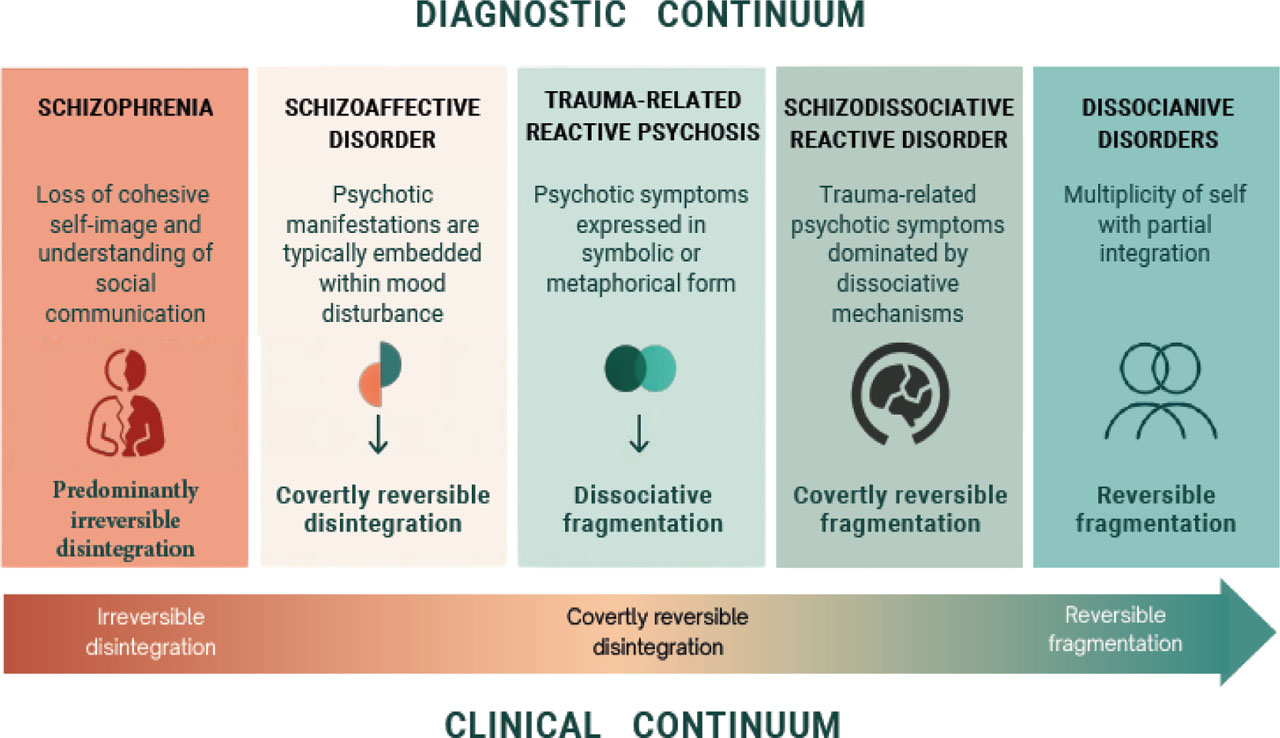
Diagnostic and clinical continuum from irreversible disintegration to reversible fragmentation across psychotic and dissociative spectra.
Legend:
The figure illustrates a multidimensional continuum ranging from schizophrenia, characterized by irreversible disintegration of the cohesive self, to dissociative disorders, where self-integrity is preserved and fragmentation remains reversible. Intermediate positions include schizoaffective disorder, trauma-related reactive psychosis, and schizodissociative reactive disorder, representing transitional forms with distinct modes of fragmentation and clinical trajectories.
Appendix D.
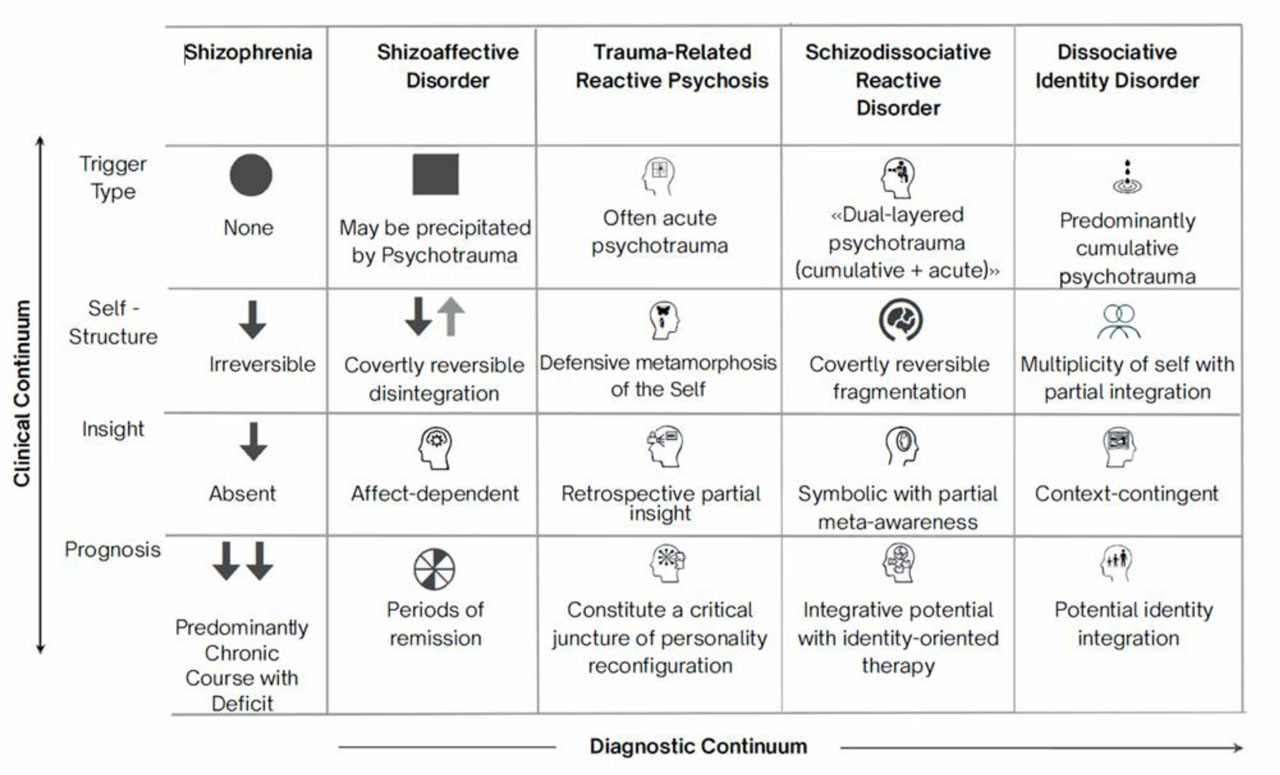
Multidimensional diagnostic continuum from schizophrenia to dissociative identity disorder with clinically relevant differentiation vectors.
Legend:
The figure presents a structured diagnostic continuum spanning schizophrenia to dissociative identity disorder, organized across key clinical dimensions, including trigger type, self-structure, insight, and prognosis. The model highlights clinically meaningful vectors that facilitate differential diagnosis across psychotic and dissociative spectra, with particular emphasis on transitional forms such as trauma-related reactive psychosis and schizodissociative reactive disorder.