
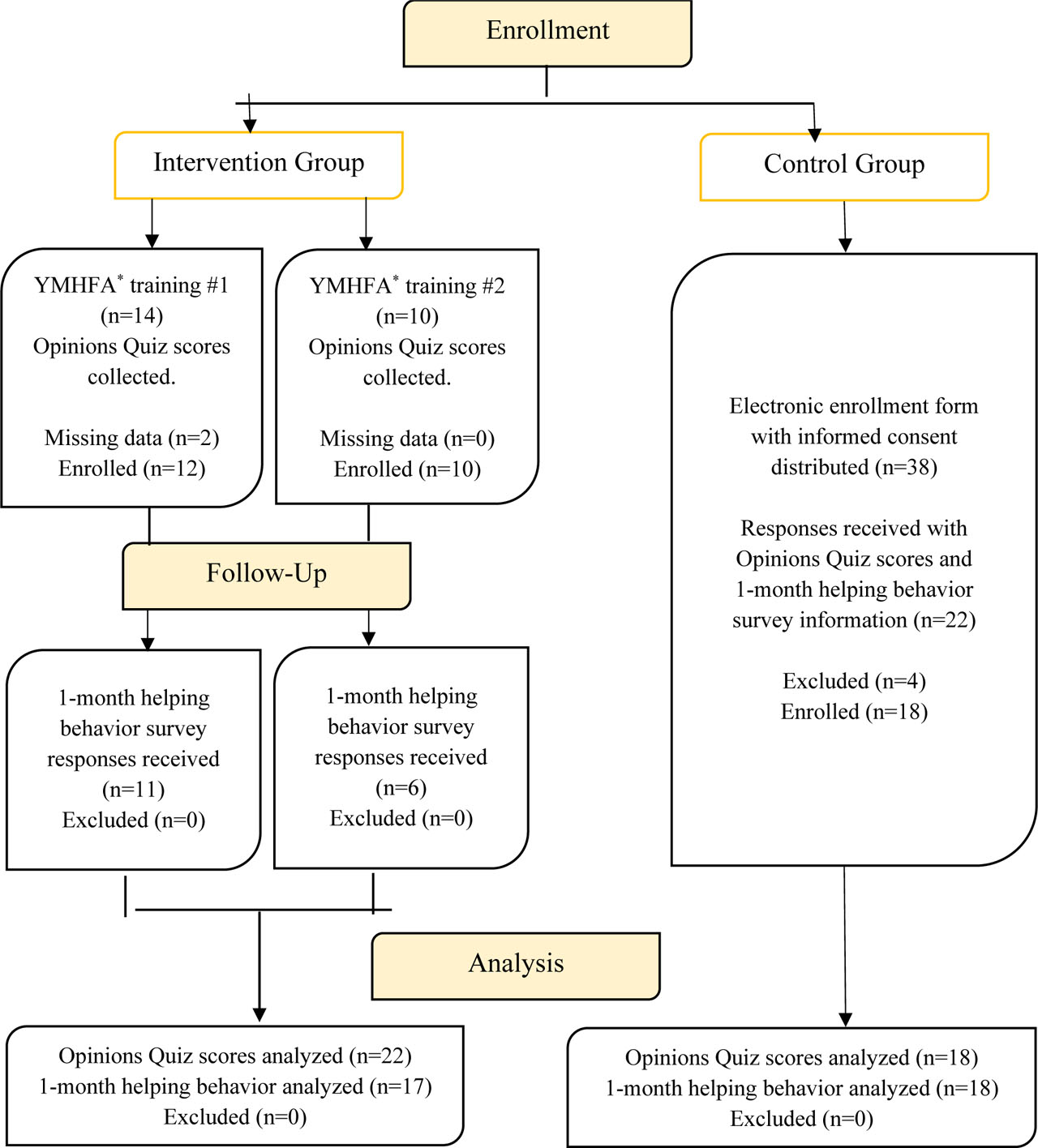
Figure 1.
Study design
*YMHFA: Youth Mental Health First Aid
Table 1
Baseline sociodemographic characteristics of intervention and control groups for comparison of Mental Health First Aid Opinions Quiz scores
| Variables | Intervention Group (n=22) | Control Group (n=18) | χ2 |
|---|---|---|---|
| Frequency (%) | Frequency (%) | p-value* | |
| Age | |||
| 18–24 | 3 (13.6) | 1 (5.6) | 0.397 |
| 25–44 | 9 (40.9) | 9 (50.0) | 0.565 |
| 45–64 | 6 (27.3) | 6 (33.3) | 0.677 |
| ≥ 65 | 4 (18.2) | 2 (11.1) | 0.533 |
| Sex assigned at birth | |||
| Female | 13 (59.1) | 16 (88.9) | 0.036a |
| Male | 9 (40.9) | 2 (11.1) | 0.036a |
| Highest education completed | |||
| High school | 10 (45.5) | 3 (16.7) | 0.053 |
| Undergraduate | 6 (27.3) | 5 (27.8) | 0.972 |
| Graduate | 6 (27.3) | 10 (55.6) | 0.069 |
| Job role | |||
| Direct youth-serving role | 19 (86.4) | 17 (94.4) | 0.397 |
| Direct youth mental health role | 3 (13.6) | 5 (27.8) | 0.266 |
| Prior youth mental health training | |||
| Yes | 5 (22.7) | 3 (16.7) | 0.634 |
| No | 17 (77.3) | 15 (83.3) | 0.634 |
Table 2
Baseline sociodemographic characteristics of intervention and control groups for comparison of helping behavior
| Outcomes | Intervention Group (n=17) | Control Group (n=18) | χ2 |
|---|---|---|---|
| Frequency (%) | Frequency (%) | p-value* | |
| Age | |||
| 18–24 | 2 (11.8) | 1 (5.6) | 0.512 |
| 25–44 | 7 (41.2) | 9 (50.0) | 0.600 |
| 45–64 | 6 (35.3) | 6 (33.3) | 0.903 |
| ≥ 65 | 2 (11.8) | 2 (11.1) | 0.952 |
| Sex assigned at birth | |||
| Female | 9 (52.9) | 16 (88.9) | 0.019a |
| Male | 8 (47.1) | 2 (11.1) | 0.019a |
| Highest education completed | |||
| High school | 7 (41.2) | 3 (16.7) | 0.109 |
| Undergraduate | 4 (23.5) | 5 (27.8) | 0.774 |
| Graduate | 6 (35.3) | 10 (55.6) | 0.127 |
| Job role | |||
| Direct youth-serving role | 16 (94.1) | 17 (94.4) | 0.967 |
| Direct youth mental health role | 3 (17.6) | 5 (27.8) | 0.476 |
| Prior youth mental health training | |||
| Yes | 3 (17.6) | 3 (16.7) | 0.939 |
| No | 14 (82.4) | 15 (83.3) | 0.939 |
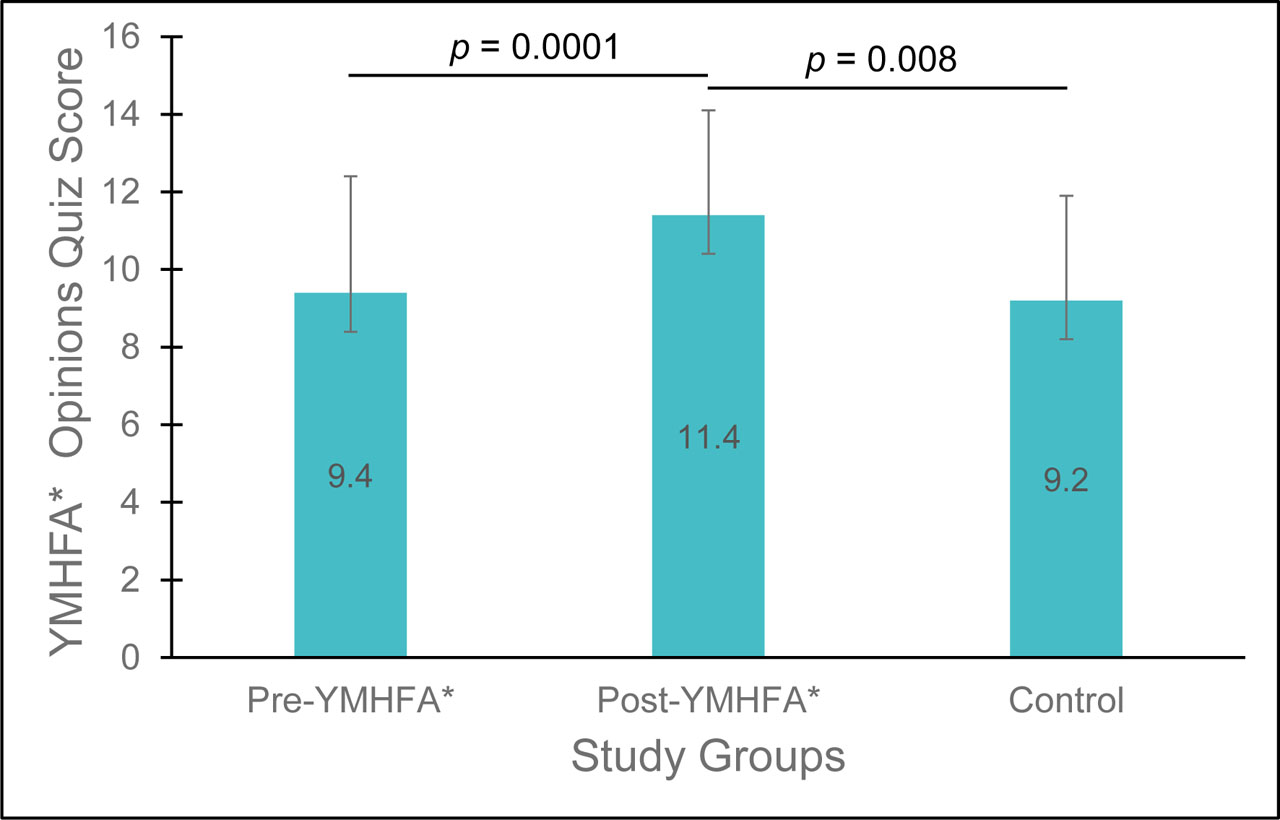
Figure 2.
Comparison of YMHFA Opinions Quiz scores of pre-YMHFA intervention group, post-YMHFA intervention group, and control group
*YMHFA: Youth Mental Health First Aid
Table 3
Helping behavior outcomes of intervention and control groups
| Outcomes | Intervention Group (n=17) | Control Group (n=18) | χ2 |
|---|---|---|---|
| Frequency (%) | Frequency (%) | p-value* | |
| Helped youth experiencing mental health and/or substance use challenges in the last 30 days | 16 (94.1) | 12 (66.7) | 0.042a |
| Help frequency | |||
| Once | 6 (37.5) | 2 (16.7) | 0.227 |
| ≥ Twice | 10 (62.5) | 10 (83.3) | 0.227 |
| Help recipient | |||
| Family | 3 (18.8) | 4 (33.3) | 0.378 |
| Friend | 3 (18.8) | 2 (16.7) | 0.887 |
| Self | 1 (6.3) | 0 (0.0) | 0.378 |
| Neighbor | 1 (6.3) | 0 (0.0) | 0.378 |
| Stranger | 3 (18.8) | 1 (8.3) | 0.436 |
| Student | 8 (50.0) | 4 (33.3) | 0.378 |
| Youth client/patient | 6 (37.5) | 4 (33.3) | 0.820 |
| Skills used | |||
| Ab | 8 (50.0) | 7 (58.3) | 0.662 |
| Lc | 14 (87.5) | 11 (91.7) | 0.724 |
| Gd | 14 (87.5) | 11 (91.7) | 0.724 |
| E1e | 8 (50.0) | 9 (75.0) | 0.229 |
| E2f | 13 (81.3) | 9 (75.0) | 0.690 |
| Reason for help | |||
| Mental health challenge | 9 (56.3) | 6 (50.0) | 0.743 |
| Substance use challenge | 5 (31.3) | 0 (0.0) | 0.033a |
| Mental health and substance use challenges | 6 (37.5) | 5 (41.7) | 0.823 |
| Other | 2 (12.5) | 1 (8.3) | 0.724 |