
1. Introduction
The distinction between online and blended learning is rapidly dissolving into a single, algorithmically mediated reality. AI agents are rapidly moving from the periphery of educational life to its operational core. More precisely, these agents are reconfiguring the three foundational dimensions of the Community of Inquiry (CoI) framework (Stenbom et al., 2026): Teaching Presence—the design, facilitation, and direction of cognitive and social processes toward intended learning outcomes; Social Presence—participants’ capacity to project themselves socially and emotionally, sustaining the open communication and group cohesion on which collaborative inquiry depends; and Cognitive Presence—the extent to which learners construct and confirm meaning through sustained reflection and discourse. As AI agents assume roles historically enacted by human instructors and peers within each of these dimensions, critical scrutiny of the conditions under which human intentionality and agency are preserved becomes not merely desirable but educationally urgent. In this new educational landscape, the pedagogical blend is no longer merely a logistical arrangement of physical desks and digital screens; it is a cognitive partnership where AI agents mediate how students set goals, receive feedback, and exercise agency.
However, as these boundaries fade, a critical tension emerges: did the integration of AI into K–12 education serve as a catalyst for a more agentic, self-regulated learner, or was it a sophisticated mirage that simulated personalization while enforcing a new form of digital standardization? To ensure that the algorithmic turn led to empowerment rather than disenfranchisement, this study critically mapped the intellectual landscape of this transition, a process that aligns with calls for multi-stakeholder governance frameworks to maintain policy relevance amidst rapid technological evolution (Crompton et al., 2026a). In this regard, this paper sought to determine if we were building a foundation for a new era of hybrid intelligence or simply repackaging restrictive pedagogies under the rhetoric of innovation.
To explore the algorithmic turn, this study employs a computationally assisted CLR — a design in which systematic corpus-construction procedures and computational visualization (t-SNE, lexical concept mapping) serve as organizational heuristics that support, rather than supplant, the primary contribution: a deep-reading interpretive critique of how AI infrastructures reconfigure the conditions for learner autonomy in K–12 online and blended settings. The computational maps render thematic proximity visually interpretable and reduce the risk of researcher-imposed narrative in corpus organization; the analytic and argumentative weight of the paper rests on the qualitative synthesis and governance critique that follows.
Based on the aforementioned considerations, the primary aim of this study is to critically evaluate the algorithmic turn by mapping how AI-driven infrastructures, specifically predictive systems, platformized personalization, and automated feedback, reconfigure the conditions for learner autonomy in K–12 settings. To achieve this, the research addresses the following specific research questions:
RQ1: What are the dominant intellectual clusters and relational conceptual pathways currently organizing the research on AI in K–12 online and blended learning?
RQ2: How do these identified clusters, particularly those focused on prediction, monitoring, and automation, align with or diverge from the theoretical requirements for fostering student agency?
RQ3: To what extent does the existing literature provide evidence that AI functions as a pedagogical mirage of standardized efficiency versus a new foundation for agentic, self-regulated learning?
2. Literature Review
The algorithmic turn in K-12 education necessitates a rigorous re-examination of how online and blended modalities are structured and sustained. To move beyond the dichotomy of AI as either a pedagogical mirage or a new foundation, this review synthesizes recent evidence across four critical dimensions: the strategic integration of learning modalities, the mapping of the artificial intelligence in education intellectual landscape, the affordances of adaptive and generative systems, and the emerging challenges to student agency.
To conceptualize this shift, this study defines the algorithmic turn as the transition in educational governance where decision-making authority, traditionally held by teachers and students, is incrementally delegated to automated systems. This turn is not restricted to a single technology but encompasses a spectrum of Agentic AI architectures (Crompton et al., 2026b; Öncü et al., 2026), which this study categorizes into three primary types identified within the K–12 literature: (1) Symbolic and Rule-Based AI, such as traditional intelligent tutoring systems; (2) Machine Learning-driven Predictive Analytics, including at-risk early warning systems; and (3) Generative and Agentic AI/Large Language Models (LLMs), such as conversational agents and automated feedback tools. By examining these diverse manifestations, the review traces the evolution of algorithmic logic from a peripheral tool to an infrastructural partner that redefines the pedagogical relation in online and blended settings. These dimensions were determined through a preliminary scoping of high-impact systematic reviews and meta-analyses (e.g., Crompton & Burke, 2022; Martin et al., 2024), which identified the shift from logistical design to algorithmic governance as the primary research gap in K–12 education. While these AI systems promise to increase the capacity of educational systems, their integration is rarely value-neutral; rather, they are shaped by evolving social and political structures that can perpetuate systemic bias (Akgun & Greenhow, 2022). In all, high-quality applications must go beyond technical efficiency to prioritize the specific developmental and critical thinking needs of K–12 learners (Chiu, 2025).
To establish a foundation for the computationally assisted CLR procedures in Section 3, this literature review is organized into four interconnected dimensions that trace the evolution from logistical design to algorithmic governance. First, the strategic blend is defined (Section 2.1) to establish the baseline pedagogical requirements for K–12 online and blended learning. Second, the intellectual landscape is mapped (Section 2.2) to identify the roles AI currently occupies within these spaces. Third, the analysis transitions from these roles to specific affordances (Section 2.3), examining how AI-driven personalization is marketed as a support for learners. Finally, these developments are synthesized to highlight the critical tension (Section 2.4) between AI as a foundation for agency versus a pedagogical mirage of standardization. Together, these sections provide the theoretical lens necessary to interpret the thematic clusters surfaced by the t-SNE and concept mapping analyses. To anchor this analysis, three core concepts are operationalized: the algorithmic turn (the incremental delegation of educational decision-making authority to automated systems), agentic AI (architectures capable of goal-directed action and environmental sensing, such as LLMs and adaptive tutors), and student agency (the learner’s capacity to set goals, exercise choice, and self-regulate within digitally mediated environments; Bandura, 2006; Zimmerman, 2002).
2.1. The Convergence of Modalities: Defining the Strategic “Blend”
In the K-12 settings, the distinction between online and blended learning has often been treated as a logistical rather than a pedagogical boundary; however, the efficacy of these models is deeply tied to a strategic combination where onsite and online modalities are purposefully connected to provide an integrated learning experience (Christensen et al., 2013; Graham et al., 2019). The value of the blend lies in this sophisticated pedagogical formulation, the strategic interplay of time, space, path, and pace (Bozkurt, & Sharma, 2021), which is significantly more effective than purely online models because it maintains a vital human-in-the-loop to support student self-regulation (Topping et al., 2022). In this ecosystem, AI enables cross-modality continuity by synchronizing behavioral and performance data across physical and digital environments and by sustaining pedagogical scaffolding across the transition from autonomous digital work to collaborative classroom activity. Without such pedagogical grounding, however, there is a risk that AI will merely automate rigid structures rather than foster innovative continuity (Bozkurt et al., 2024).
2.2. Mapping the Intellectual Landscape of AI in K-12
The rapid surge in AI research within K-12 education reflects a field in transition, one that has given rise to the interdisciplinary research community known as Artificial Intelligence in Education (AIEd)—a field whose central preoccupation is understanding how computational systems can support, augment, or reconfigure the conditions of human learning (Holmes et al., 2022). Martin et al. (2024) identify that research since 2017 has moved from basic performance prediction toward more complex augmented learning experiences. This shift is mirrored in the broader literature, where bibliometric and computational mapping studies — distinct from the CLR procedures employed in Section 3 of the present inquiry — have charted AI’s expanding domains: instructional support, personalized learning, and automated assessment, with synthesis work confirming a dominant orientation toward AI applications over AI literacy or theoretical grounding (Huang et al., 2026; Martin et al., 2024; Zhou et al., 2025).
The current landscape is characterized by three primary roles for AI: AI as a teacher (e.g., intelligent tutors), AI as a partner (e.g., pedagogical agents), and AI as a tool for the learner (e.g., generative assistants). Huang et al. (2026) highlight that while the potential for innovation is vast, there is a persistent deficiency in empirical testing of theoretical frameworks, particularly those addressing how AI impacts the fundamental relationship between teacher, student, and content; a gap confirmed across narrower K-12 syntheses (Martin et al., 2024) and AI literacy research specifically (Zhou et al., 2025).
2.3. Affordances: From Optimization to Agency
The pedagogical affordances of AI are often framed through the lens of personalization. Crompton and Burke (2022) identify four central themes for educators: student monitoring, group management, automated grading, and data-driven decision-making. For students, the primary affordance is Just-for-You-Learning, which provides a learning experience tailored to individual strengths, weaknesses, and interests (Bozkurt, 2025; Crompton & Burke, 2022).
A significant portion of this bespoke experience is driven by adaptive learning platforms. For instance, Gligorea et al. (2023) note that machine learning algorithms are now capable of optimizing learning paths in real-time, providing interventions that were previously impossible in large-scale online environments. Furthermore, as students move from being passive consumers to active creators, AI literacy has emerged as a global strategic objective. Yim and Su (2025) argue that age-appropriate tools, ranging from kindergarten-level to secondary-school, are essential for developing the computational thinking required for students to navigate an algorithmically mediated world — and Zhou et al. (2025) extend this to distinguish AI literacy (knowledge and skills) from AI competency (confidence, self-reflection, and the capacity to ethically apply AI), arguing that most current K-12 AI education addresses the former but not the latter.
Crucially, the translation from AI affordance to student agency is neither automatic nor guaranteed. Drawing on Bandura’s (2006) conception of human agency as the capacity to act intentionally, exercise self-efficacy, and reflect on one’s own cognitive processes, and on Zimmerman’s (2002) self-regulated learning model — which identifies goal-setting, strategic planning, self-monitoring, and adaptive self-evaluation as core agentic capacities — this review operationalizes student agency as the learner’s demonstrated ability to set meaningful goals, exercise informed choice among alternatives, regulate their own learning strategies, and critically evaluate both process and outcome in digitally mediated environments. Against this benchmark, the affordances described above (adaptive pathways, automated feedback, just-for-you personalization) support agency only when they are transparent to the learner, contestable by the learner, and calibrated to build rather than substitute for learner judgment. Where these conditions are absent — where the system sets goals by default, selects pathways opaquely, or provides feedback without criteria — personalization may simulate agency while structurally foreclosing it. Recent synthesis work specifies what such design support could look like in practice: across 73 studies, generative AI is shown to scaffold the forethought, performance, and self-reflection phases of self-regulated learning through six recurring affordances, including personalized goal-setting, resource integration, and progress monitoring (Xia et al., 2026). Yet this same review finds that the mechanisms linking these affordances to durable self-regulatory gains remain unclear, and that teachers face persistent difficulty translating these affordances into classroom practice — an open question this review’s K–12 corpus echoes in starker form.
2.4. The Critical Tension: Mirage vs. Foundation
Despite the optimistic narrative of personalization, the arrival of Generative AI (GenAI) has introduced a shock and awe phase in K-12 education. Mintz et al. (2023) describe this not merely as a technological update but as an access revolution that challenges traditional notions of academic integrity and teacher roles. The danger of the pedagogical mirage becomes most apparent here: if AI is used to simulate human interaction or automate creative processes without a foundational shift in pedagogy, it may inadvertently atrophy the very student agency it claims to support.
The integration of AI presents challenges that are far more than technical; they are fundamentally ethical and socio-cultural. Crompton et al. (2024), for instance, highlight a significant gap between the proclaimed affordances of AI and the reality of its implementation, citing negative perceptions, skill deficits, and ethical complexities as major hurdles. These systemic challenges — including technological limitations, insufficient teacher training, and the risk of bias — recur consistently across the broader AIEd synthesis literature (Huang et al., 2026), while AI ethics as a focus of K-12 educational research remains critically underrepresented in both empirical practice (Martin et al., 2024) and AI literacy curriculum design (Zhou et al., 2025). For AI to serve as a new foundation for education, the field must transcend the efficiency trap, where success is measured solely by the speed of content mastery, and instead focus on empowering students as critical, agentic participants in a post-digital society. All in all, as the literature shifts from if we should use AI to how it influences foundational constructs, we must ensure that the algorithmic turn does not inadvertently atrophy the very self-regulation skills that education is designed to foster.
3. Methodology
3.1. Research Design: A computationally assisted CLR Framework
This study adopts a computationally assisted CLR framework that integrates transparent corpus-construction procedures drawn from PRISMA 2020 (Page et al., 2021) with computational visualization techniques (t-SNE, lexical concept mapping) and deep-reading qualitative synthesis. While a purely manual review of the 31 articles was feasible, a computationally assisted CLR design was selected to provide an organizational scaffold that minimizes researcher-imposed narrative bias in corpus structuring. Because the computational outputs function as heuristic tools for spatial visualization rather than causal inference, this framework is well-suited for single-author interpretive synthesis where traditional inter-rater reliability metrics are absent (Donthu et al., 2021).
Following the computational mapping, the authors conducted a deep-reading qualitative synthesis of the finalized corpus to contrast the pedagogical mirage with foundational affordances, ensuring that the micro-level critical synthesis (Section 4) benefits from both systematic organization and human interpretive depth.
To ensure structural validity, the present inquiry employs a triangulated discovery protocol that connects metadata patterns to latent lexical clusters, surfacing links between infrastructural capabilities and pedagogical outcomes that manual coding may overlook. Notably, while some themes do not explicitly articulate AI, they emerged from a corpus strictly pre-filtered for substantive AI involvement. These clusters represent the algorithmic traces of the field; domains where AI has become an invisible, foundational infrastructure for governance and monitoring. By triangulating these patterns, this computationally assisted CLR maps the full reach of the algorithmic turn beyond superficial keyword mentions.
The design is anchored in methodological triangulation, utilizing multiple analytical lenses to ensure the reliability and validity of the findings (Thurmond, 2001). This approach facilitates a “macro-meso-micro” examination:
Macro-level (Corpus-level mapping): Characterizing the corpus at a high level (e.g., publication patterns, topical coverage, and descriptive metadata) to situate the field’s contours and identify broad trends.
Meso-level (Computational semantic mapping): Employing t-SNE to visualize proximity-based thematic groupings, alongside Leximancer-generated lexical concept mapping (Smith & Humphreys, 2006) to trace relational pathways and co-occurrence structures among core concepts.
Micro-level (Critical synthesis): Interrogating the finalized corpus to contrast the pedagogical mirage with the foundational affordances of AI.
The ‘Pedagogical Mirage versus New Foundation’ heuristic that organizes the synthesis warrants explicit derivation. This dichotomy was developed a priori as an analytical sensitizing device, informed by prior critical literature on ed-tech solutionism (Selwyn, 2011) and on the governance implications of AIEd (Holmes et al., 2022), and adopted before corpus construction began. It was then stress-tested against the computational outputs: the t-SNE clustering and lexical concept map were examined to assess whether the patterns in the corpus supported, challenged, or complicated the framing. Where the corpus introduced nuance that the binary did not capture — for instance, where acceptance and trust functioned as both enabling conditions and as legitimating mechanisms for AI authority — this is reflected in the thematic analysis and synthesis discussion. The framing should therefore be read as a heuristic lens that sharpens the research questions, not as a predetermined conclusion imposed on the literature.
3.2. Inclusion Criteria and Sampling Strategy
The research corpus was curated from the Scopus and Web of Science databases, selected for their stringent indexing standards and comprehensive coverage of interdisciplinary research in education and computer science. In addition, complementary searches were conducted in Google Scholar Lab to reduce database-specific omissions and to cross-check coverage of recently published or in-press work. The search was deliberately restricted to the Article Title field.
To evaluate the implications of this constraint, a pilot sensitivity check was conducted by expanding a sample query to titles, abstracts, and keywords. The expanded search yielded a substantially higher volume of false positives — articles in which AI or the specified learning modality appeared only as a peripheral implication rather than a central focus. Restricting to titles therefore ensures that the 31 selected articles represent the thematic core of the field; the trade-off — potential exclusion of interdisciplinary studies where AI is embedded within broader frameworks — is acknowledged as a boundary condition in Section 3.4.
The search string (See Figure 1) was developed through an iterative building-block approach, combining established descriptors for K–12 levels, online/blended modalities, and AI technologies identified in previous review and meta-analysis studies.
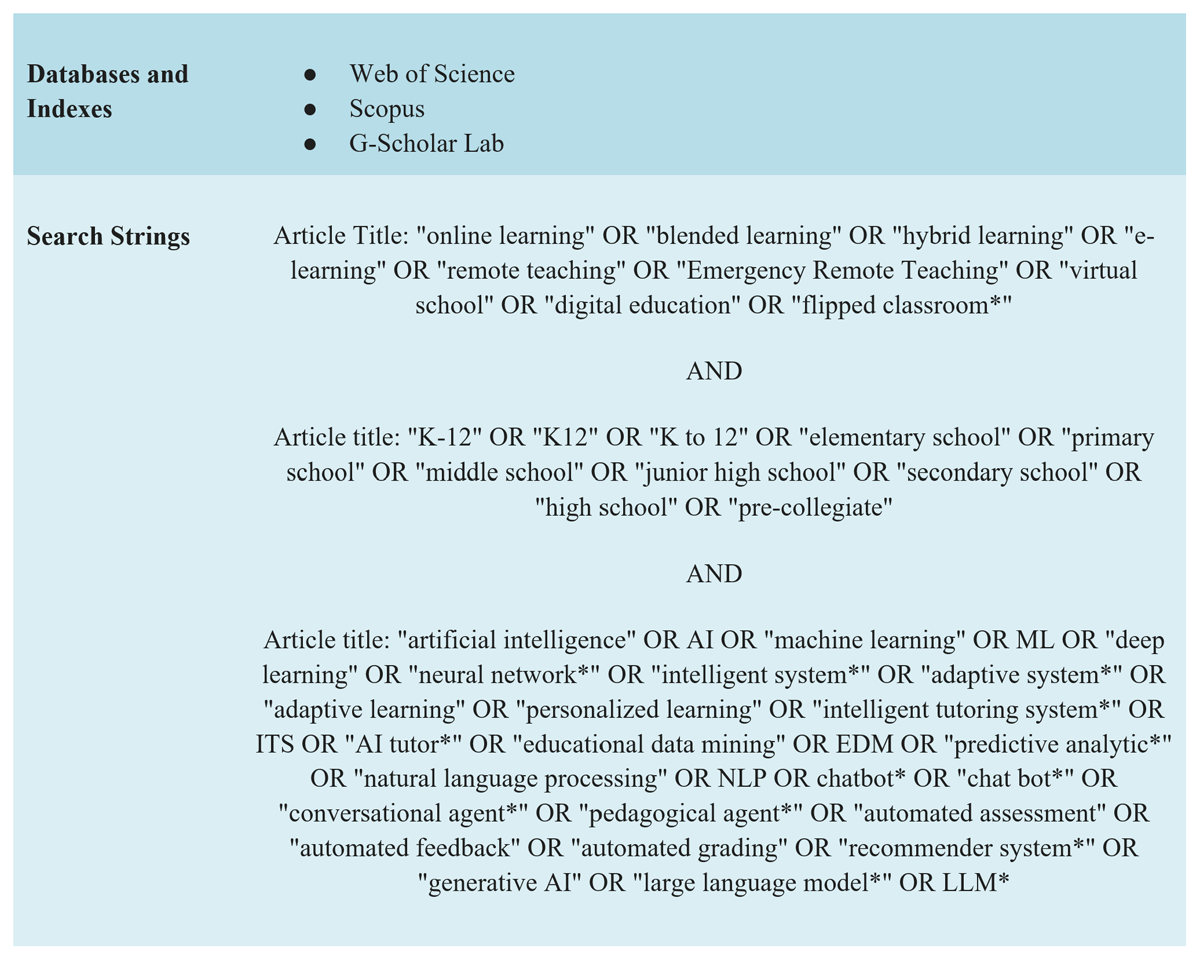
Figure 1
Search strings.
The search strategy employed a Boolean-driven protocol targeting three specific intersections: (1) educational level (K-12, primary, secondary), (2) modality (online, blended, hybrid), and (3) technology (Artificial Intelligence, GenAI, chatbots, pedagogical agents). Because our aim was to capture studies with a strong and explicit focus on AI in K–12 online and blended learning (rather than studies where these constructs appear peripherally), this paper restricted the query to the Article Title field.
Adhering to the PRISMA 2020 guidelines (Page et al., 2021), the selection process followed a transparent three-stage protocol: identification, screening, eligibility and inclusion. To ensure the study captures the shift from crisis to continuity, the sampling period encompasses the evolution of the field up to the most recent disruptive developments in 2025. The selection funnel from 1,574 records to 31 articles followed a strict exclusionary logic (See Figure 2). Screening of titles and abstracts (n = 1,574) removed 1,460 records lacking a primary K–12 and AI focus. Of the remaining 114 full-text reports, 83 were excluded via three rigor checks: (1) Modality (must be online/blended); (2) Developmental (strictly pre-collegiate); and (3) Substantive AI (AI must be a pedagogical/governance intervention rather than a research analysis tool). This multi-stage filtering ensures the corpus directly represents the algorithmic turn.
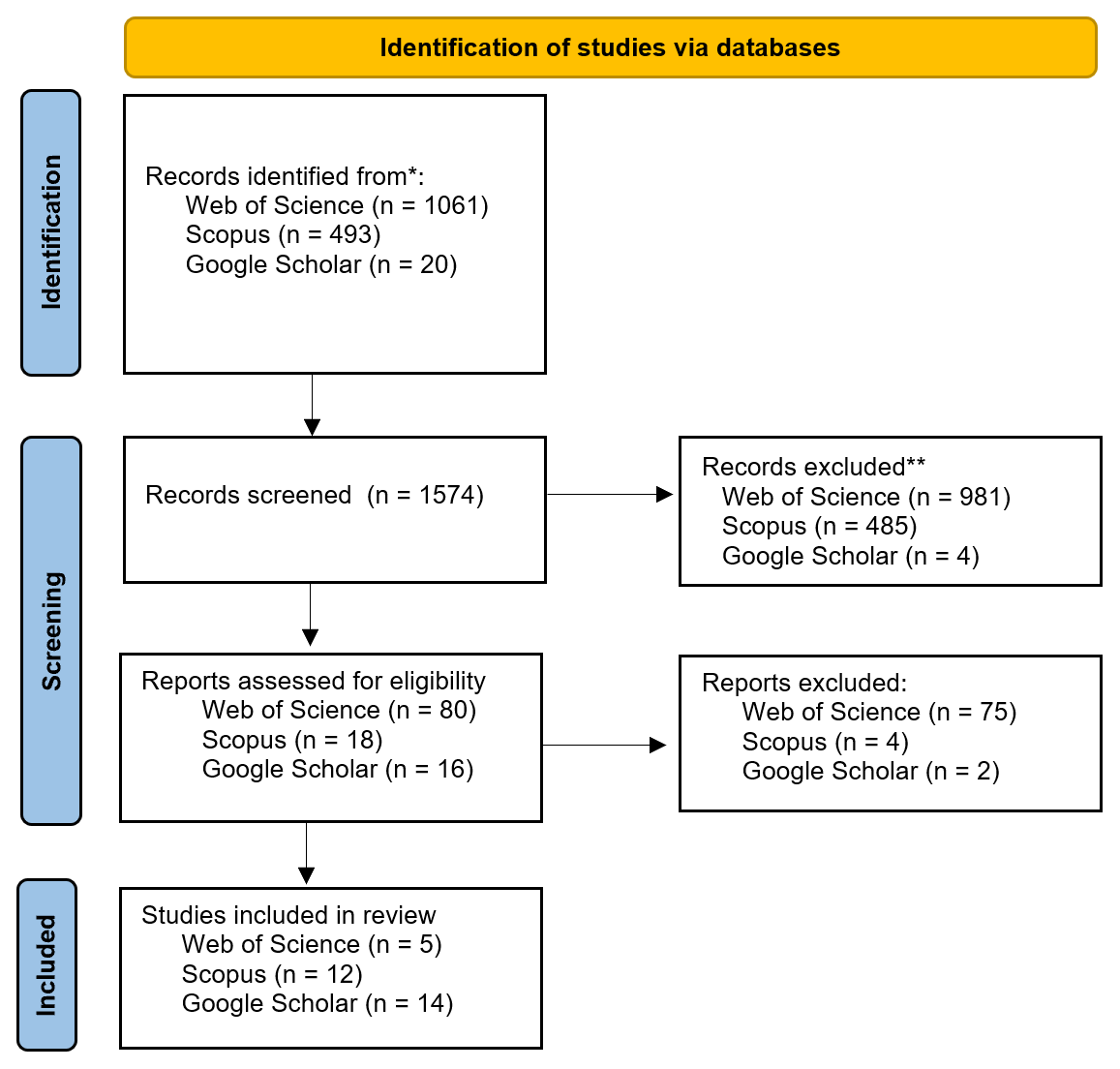
Figure 2
Prisma Protocol.
3.3. Advanced Analytical Heuristics
To explore the intricate dynamics of the research landscape, the current inquiry implemented a suite of computational visualization techniques to render lexical proximity spatially interpretable and to provide an organizational scaffold for qualitative synthesis (Fayyad et al., 2002). The computational visualization procedure proceeded in five sequential phases:
Data extraction: From each of the 31 included articles, the following fields were extracted: title, abstract, author-assigned keywords, and concluding sentences. These fields were concatenated into a single metadata string per article.
Pre-processing: Metadata strings underwent stopword removal, lemmatization, and normalization to produce the cleaned corpus used for both the t-SNE visualization and the Leximancer concept map (see Section 3.3 below for tool-specific procedures).
t-SNE visualization: The pre-processed metadata served as input to t-SNE (van der Maaten & Hinton, 2008), producing a two-dimensional spatial map in which proximity indicates shared conceptual vocabulary. The resulting plot (Figure 3) was used to identify candidate thematic groupings.
Lexical concept map: The pre-processed metadata was submitted to Leximancer (Smith & Humphreys, 2006), which calculates asymmetric co-occurrence frequencies between automatically extracted concepts across the corpus and groups strongly associated concepts into color-coded thematic clusters (Figure 4).
Theme derivation: Candidate themes (from t-SNE) and thematic clusters (from the Leximancer concept map) were treated as hypotheses. All 31 articles within each candidate cluster were read in full; themes were confirmed, merged, or split based on substantive content. Final themes were anchored in the Mirage/Foundation analytical frame and reported in a consistent claim–evidence–interpretation format in Section 4.
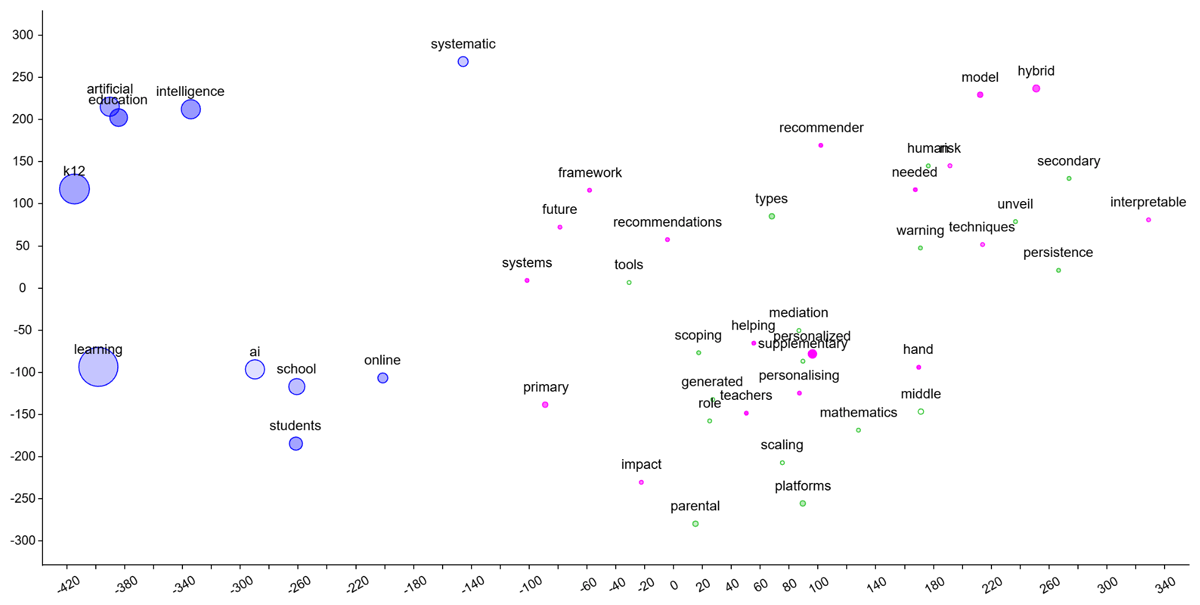
Figure 3
t-SNE analysis of the articles in the research corpus.
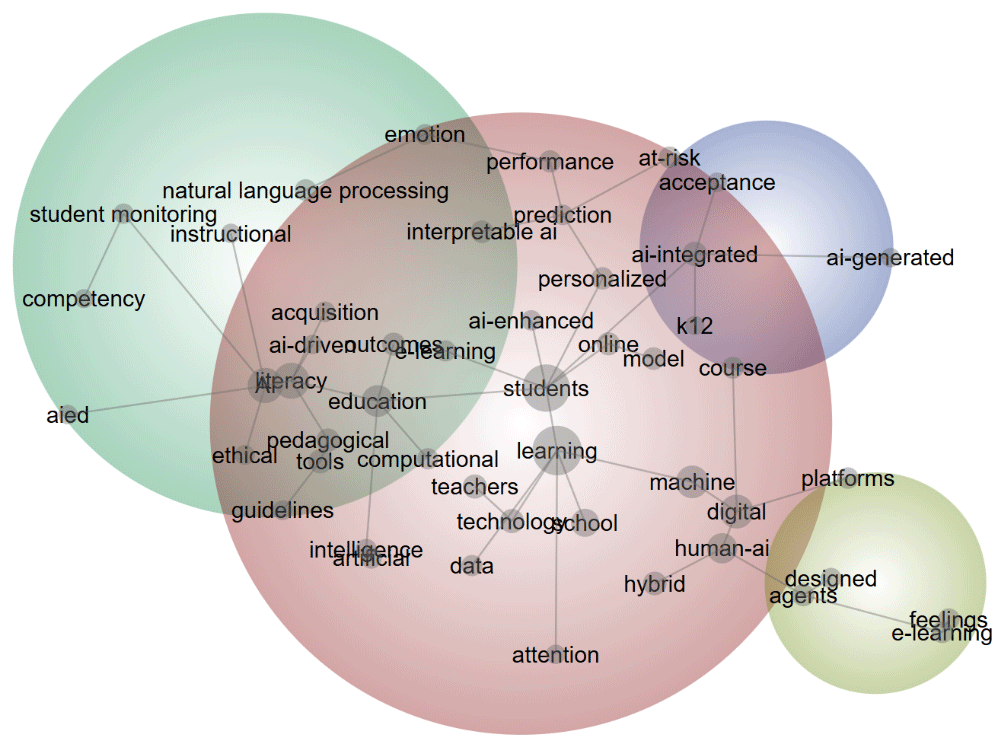
Figure 4
Lexical concept map analysis of the articles in the research corpus.
Two complementary computational visualizations support the thematic synthesis. Figure 3 (t-SNE) renders lexical proximity spatially, enabling the identification of candidate thematic groupings. Figure 4 (Lexical Concept Map) was generated using Leximancer (Smith & Humphreys, 2006), which traces relational pathways among core concepts by calculating asymmetric co-occurrence frequencies across the corpus metadata; concepts that co-occur frequently are placed in proximity, and strongly associated concepts are grouped into color-coded thematic clusters. Together, these maps move analysis from candidate groupings (Figure 3) to relational co-occurrence structure (Figure 4), both of which informed the theme derivation procedure described below.
The five themes reported in Section 4 were derived through a three-phase iterative process. In Phase 1 (Computational Nomination), t-SNE islands and Leximancer clusters generated candidate labels based on dominant lexical content. In Phase 2 (Qualitative Refinement), full-text reading of all 31 articles confirmed, merged, or split clusters based on substantive pedagogical alignment. In Phase 3 (Theoretical Anchoring), themes were evaluated against the Mirage/Foundation heuristic to determine alignment with efficiency/standardization logics versus explicit support for student agency.
Automated text extraction provided the statistical foundation for both the t-SNE visualization and the lexical concept map. Specifically, text mining in this study refers to the pre-processing and salient-term extraction described in Phase 2 above, not to a separate topic-modeling procedure such as Latent Dirichlet Allocation, which was not performed and is not reported. The outputs of this extraction — term-frequency distributions and the highest-frequency nodes per cluster — are reported within the thematic analysis in Section 4, where they serve as supporting evidence for each theme’s conceptual characterization.
3.4. Limitations and Critical Reflections
While this study provides a comprehensive mapping of the algorithmic turn, it acknowledges several boundary conditions. Primarily, the reliance on Scopus and Web of Science, while ensuring high peer-review standards, may exclude emerging research published in specialized regional databases or grey literature such as technical white papers. Consequently, the findings represent the academic consensus rather than the full spectrum of industry-led technical developments.
The restriction of the search to article titles, while ensuring a focused corpus, may have excluded interdisciplinary contributions in which AI or the learning modality is a secondary rather than primary frame; future reviews should complement title-field searches with abstract and keyword field expansion.
A further boundary condition concerns the single-author design of this review. Because screening and eligibility decisions were made without independent verification or inter-rater reliability checks, the corpus is subject to interpretive subjectivity that a multi-reviewer process would partially mitigate. To reduce this risk, inclusion decisions were based on pre-specified, operationalized criteria (Section 3.2), the full PRISMA 2020 decision trail is documented transparently (Figure 2), and the final corpus is identified explicitly in the reference list (asterisked entries) to facilitate audit and replication. Nonetheless, readers should interpret the thematic synthesis as reflecting one researcher’s theoretically informed reading of a computationally organized corpus rather than an inter-subjectively verified consensus.
Furthermore, the rapid velocity of AI innovation means that any systematic review is a temporal snapshot of a moving target. The mirage of today may become the foundation of tomorrow as technologies mature. Additionally, because the analysis focused on English-language peer-reviewed articles, there remains an inherent risk of Western-centric bias in the pedagogical frameworks identified. These limitations do not invalidate the findings but rather highlight the necessity for longitudinal, multi-database mapping to track the continued evolution of student agency in algorithmically mediated K-12 environments.
4. Findings and Discussion
The finalized thematic taxonomy evaluates the text corpus through a consistent claim, evidence, and critical interpretation framework. Each theme pairs spatial and lexical patterns derived from the computational maps (Figures 3 and 4) with a qualitative critique of its implications for student agency, systemic governance, and equity in K–12 online and blended settings.
Theme 1: Predictive governance and the institutionalization of at-risk learners
The K–12 online/blended AI literature increasingly frames prediction as governance: risk scores, stage-based early warning, and intervention timing become institutional levers for accountability and control, not merely supports for learning. As the t-SNE visualization suggests (Figure 3), strategic nodes such as k12, students, school, online, risk, warning, model, interpretable cluster in ways that foreground early-warning logics and justificatory explainability. As concept map connected paths show (See Figure 4), lexically connected terms such as students → learning → prediction → performance → at-risk → acceptance form a pipeline from inference to normalization: where acceptance signals not only adoption but legitimation of predictive governance.
In K–12 settings, predictive systems do not simply describe risk; they can produce it by reorganizing how learners are seen, monitored, and acted upon. Large-scale early warning work illustrates how prediction is operationalized through staged course requirements and the identification of multiple at-risk types, with risk probability in one stage strongly shaping labeling in the next: creating path-dependence and the potential for self-fulfilling trajectories (Hung et al., 2025). At system level, policy-facing learning analytics initiatives explicitly position prediction as an instrument for institutional action (e.g., mitigating disengagement/retention via government-facing models), while simultaneously revealing that risk is entangled with structural factors, evidenced by the need to test for bias across protected attributes such as gender, school zone, and social welfare participation before models are approved for use (Queiroga et al., 2022).
Yet, the more predictive AI becomes an infrastructure for decision-making, the more it risks slipping from support into surveillance. Youth data-justice analyses warn that AI-enabled monitoring and school surveillance can expand disciplinary and policing logic beyond the classroom, intensifying harm for historically marginalized students and blurring boundaries between school and carceral systems (Okoh, 2024). While interpretability is frequently invoked as an answer to trust, the ethics literature emphasizes that explainability must be paired with stakeholder agency, appeal/contestability, and robust governance; otherwise, explainable outputs can function as procedural window-dressing over opaque or inequitable interventions (Janahi & Obeidat, 2024).
Theme 2: Platformized personalization and agent mediation redefining the “blend”
Across K–12 online and blended learning, personalization is increasingly platformed: pedagogical decisions are delegated to infrastructural systems (LMS/VLE ecosystems) and mediated through recommender logics and agentic interfaces, which quietly re-encode what the blend is allowed to mean (Cope & Kalantzis, 2026). As the t-SNE visualization suggests (Figure 3), the following nodes such as platforms, systems, tools, recommender, scaling, hybrid, model cluster around an infrastructural vocabulary, suggesting that the field is treating personalization less as a pedagogical relation and more as an architectural capacity. As concept map connected paths show (See Figure 4), lexically connected terms such as learning → human-ai → hybrid → digital → platforms → designed agents → e-learning foreground agent mediation as a structural feature of contemporary learning environments. This alignment matters because platforms are not neutral containers: they organize interactions while enabling systematic collection and algorithmic processing of user data, turning personalization into an operational regime rather than a situated practice. Empirical work on AI-enabled recommendation in flipped classrooms illustrates this operational logic directly: personalized recommendations measurably improved learners’ engagement, motivation, and outcomes, yet the mechanism of improvement was the system’s sequencing and content-selection authority rather than any explicit cultivation of learner choice or self-direction (Huang et al., 2023).
This trajectory risks collapsing personalization into platform governance. Cope and Kalantzis (2026), for example, argue that platform-based learning can reconstitute the conditions of learning while educators sleepwalk through changes to pedagogical form: an instrumental reason problem where the system is optimized for outputs without sufficient attention to what learning is being shaped into. In K–12 settings, that risk is amplified because developmental appropriateness, safeguarding, and parental accountability are non-negotiable. Empirically, platform effects cannot be inferred from affordances alone: teachers may retain control in practice, yet this control is ambiguous and co-produced with platforms, generating conflicting conceptions of autonomy and (self-)governance rather than guaranteeing learner agency (Hangartner et al., 2025). Meanwhile, GenAI-driven personalization proposals explicitly emphasize scalability, automated content generation, and hybrid AI–human models, while also conceding persistent problems of privacy, bias, transparency, and standardization (Puvvadi et al., 2025). The deeper concern is therefore design-as-policy: defaults (what is recommended, sequenced, surfaced, and logged) become a de facto curriculum and a de facto theory of learning; often without explicit pedagogical justification or contestable governance mechanisms. This concern is reinforced by systematic evidence on pedagogical agent design in K–12 settings: agent appearance and role are tightly intertwined, learner preferences for particular agent types do not reliably translate into improved learning outcomes, and pedagogical strategies effective for human teachers transfer to agents only when explicitly designed in — underscoring that agent mediation is a design choice with consequences for learning, not a neutral interface feature (Zhang et al., 2024).
Theme 3: Automation of assessment and feedback and the efficiency trap
In K–12 online/blended learning, the rapid uptake of AI-enabled assessment and feedback is normalizing an efficiency-first epistemology: what can be scored quickly, consistently, and at scale becomes what is treated as educationally valuable, often without an explicit account of the pedagogy, developmental appropriateness, or consequences for student agency (González-Calatayud et al., 2021; Owan et al., 2023). As the t-SNE visualization suggests (Figure 3), the following candidate operational deployment terms such as techniques, systems, model, helping, impact cluster with implementation-oriented vocabulary, signaling a pragmatic how-to-scale orientation rather than a learning-theory-first one. As concept map connected paths show (See Figure 4), lexically connected terms such as instructional → learning outcomes → performance foreground outcome-optimization as the dominant evaluative logic, with feedback implicitly framed as throughput rather than dialogue.
Reviews of AI assessment repeatedly report benefits that align neatly with platform-scale schooling; automation, immediacy, and workload reduction (Apetorgbor et al., 2024; Owan et al., 2023). Yet, the same literature also flags a structural weakness: pedagogy is often under-specified, so formative becomes a label attached to faster feedback rather than a commitment to dialogic sense-making, criteria transparency, and iterative improvement (González-Calatayud et al., 2021). In K–12 settings, where learning is developmental, relational, and safeguarding-sensitive, this drift can reconfigure assessment from a practice of supporting judgement to a system of outsourcing judgement. Ethical syntheses warn that algorithmic bias, data privacy risks, and the diminishing role of human judgement are not peripheral implementation issues, but predictable effects when automated scoring and feedback become default decision infrastructure (Christyodetaputri & Marwa, 2024; Ogunsakin, 2024). A top-tier concern, then, is not merely whether AI feedback is accurate, but whether it is educationally consequential in the right way: if evaluative authority is externalized into systems that prioritize standardizable outputs, students may receive more feedback while gaining fewer opportunities to practice self-assessment, reflective revision, and epistemic responsibility. These are the very capacities that constitute student agency, which includes goal-setting, meaningful choice, and self-regulation and judgment in online and blended learning. Empirical evidence reinforces this concern: in a controlled peer-feedback context, students who received AI-assisted prompts performed well while the assistance was present, but showed no equivalent gains in self-regulatory behaviour once the assistance was withdrawn — suggesting that AI assistance can scaffold performance without building the underlying self-regulatory capacity it appears to support (Darvishi et al., 2024). This raises another question: how AI-driven infrastructures (platforms, recommenders, agents) move from supporting pedagogy to writing pedagogy into defaults, turning design choices into de facto policy. For practitioners, this synthesis highlights a critical transition: moving from AI as a tool to AI as a partner. Designers, thus, must prioritize Human-in-the-Loop configurations where AI provides recommendations rather than final decisions, ensuring that the teacher’s relational expertise remains the primary driver of the educational blend.
Theme 4: Student monitoring and NLP as infrastructural surveillance in online/blended schooling
In K–12 online/blended learning, AI-enabled monitoring, particularly when coupled with NLP, functions less like a neutral instructional aid and more like infrastructural surveillance: it expands schools’ capacity to capture, infer, and act on students’ behavior across time and space, often without commensurate democratic oversight, proportionality, or child-centered due process. As the t-SNE visualization suggests (Figure 3), the following candidate strategically positioned terms such as students, school, online, learning, risk, warning, techniques, systems cluster in a way that links participation to detection and intervention logics. As concept map connected paths show (See Figure 4), lexically connected terms such as student monitoring → natural language processing → instructional → acquisition → learning outcomes position monitoring (and NLP inference) as an upstream prerequisite for instructional action: effectively hardwiring datafied attention into the pedagogical workflow.
The related literature often frames monitoring as a pathway to safety and improved learning, yet the evidence base for many surveillance tools is described as thin, while the countervailing harms are substantial; especially for marginalized students and for child development more broadly (Fedders, 2019). In online/blended settings, where interaction is already platform-mediated, NLP intensifies the asymmetry: students’ everyday language becomes analyzable behavioral exhaust, and interpretive categories (e.g., engagement, compliance, threat) can be operationalized at scale. This is not merely a technical choice; it is a governance decision about what kinds of selves are legible and actionable in school.
In this context, the key critique is that surveillance becomes constitutive of schooling: it expands the classroom into homes and after-hours spaces via monitoring of emails/social media and related safety platforms, while shifting oversight from relational pedagogy toward continuous inspection (Fedders, 2019). In parallel, privacy and data protection concerns are amplified because students, especially in secondary education, are structurally compelled to use school-provided technologies; vulnerability is not incidental but built into the institutional setting, with disabled and socioeconomically disadvantaged learners rendered even more exposed (Paludi, 2024). A defensible path forward therefore requires moving beyond generic calls for responsible AI toward enforceable safeguards, minimization, meaningful notice and transparency, time-bounded retention/deletion, and ongoing recalibration of benefits versus harms, otherwise monitoring becomes surveillance-by-default, normalizing a pedagogical culture of mistrust that undermines autonomy and an open future for learners (Artsın et al. 2025; Fedders, 2019; Paludi, 2024; Üstün et al., 2026a, 2026b). This sets up the next analytical step: whether K–12 AI research treats these safeguards as central design constraints or as afterthoughts appended to an otherwise expansionary monitoring regime.
Theme 5: Acceptance, affect, and trust: the emotional conditions of agency
In AI-mediated K–12 online and blended learning, agency is increasingly regulated through affect: acceptance is produced not only by what AI does (accuracy, personalization) but by how AI feels (responsiveness, anthropomorphic cues, reduced anxiety). This matters because affective alignment can legitimate AI authority in ways that are developmentally risky for minors; amplifying over trust, narrowing critical judgement, and quietly reconfiguring who (or what) counts as a credible pedagogical actor (Vahedian Movahed & Martin, 2025; Zhang & Fan, 2026). This pattern echoes a broader synthesis of generative AI engagement research, which finds that ChatGPT consistently boosts behavioural and emotional engagement markers but shows far less consistent evidence for the cognitive engagement processes — strategic thinking, self-monitoring — that underpin durable learning (Lo et al., 2024). As the t-SNE visualization suggests (Figure 3), the following candidate experience-oriented nodes such as mediation, helping, personalized, persistence (and adjacent support terms like comfort/need) cluster as an “affect-and-support register,” signalling that the field’s discourse about effectiveness is increasingly tethered to felt experience rather than only instructional design or learning theory. As concept map connected paths show (See Figure 4), lexically connected terms such as emotion → attention → learning → feelings → acceptance position affect as connective tissue; bridging technical system talk with legitimacy and uptake.
For K–12 learners, trust is not a neutral psychological by-product; it is a designable educational outcome with governance consequences. Child-facing conversational agents show that students can exhibit openness and comfort and report high trust in AI as an information source, often describing systems as smart and trustworthy, while simultaneously displaying gaps in critical engagement that require explicit scaffolding for AI literacy and digital safety (Vahedian Movahed & Martin, 2025). This is where the agency risk becomes subtle: a system that feels supportive can shift learners from epistemic agency (questioning, verifying, judging) to epistemic compliance (accepting, relying, outsourcing judgement).
Moreover, affective optimization can escalate into affective surveillance. Emotion AI work makes clear that classroom affect-tracking (facial/vocal analytics) is frequently justified via an affective loop (continuous adaptation to learners’ emotional signals), yet it raises high-stakes ethical problems in schooling, especially privacy, consent, bias, and the Big Brother effect, because minors cannot meaningfully consent to pervasive monitoring and because emotion inferences can be culturally misread or unevenly accurate (Sadegh-Zadeh et al., 2026). In other words, trust can be coerced structurally (through omnipresent sensing and classification) rather than earned pedagogically.
Finally, even without explicit emotion recognition, affective dynamics are already reconfiguring participation: secondary teachers report that AI-mediated feedback can reduce anxiety compared to human correction and increase motivation and willingness to participate; yet, they also observe over-reliance and answer-taking behaviours that erode critical thinking unless guided autonomy is deliberately designed (Mingfeng & Wang, 2026). Thus, the field and the practitioners must treat affect not as engagement icing, but as a core condition of agency: what looks like improved persistence may, in practice, be dependency masked as motivation.
5. Synthesis Discussion: From Clusters to Consequences
The five themes collectively suggest — though do not causally demonstrate — a significant directional shift: AI in K–12 online and blended learning is becoming less a set of discrete tools and more an infrastructural logic that governs what is visible, measurable, and actionable. This pattern is not asserted as a universal finding but as the dominant orientation in the 31-article corpus: across the mapped landscape, the field’s center of gravity clusters around prediction, platforms, monitoring, automation, and acceptance — an ecosystem optimized for scale and managerial visibility. Where the corpus includes counter-examples or under-theorized cases, these are noted within the thematic analyses; the synthesis reflects dominant patterns rather than an exhaustive characterization of the field. Yet, the conceptual network suggests that agency is often invoked as an aspiration rather than operationalized as a measurable outcome. In practice, the dominant pathways such as monitoring → prediction → performance → at-risk → acceptance and platforms → recommenders/agents → personalization → progression—risk positioning learners as objects of inference and intervention. For minors in compulsory schooling, this is not pedagogically neutral; it is a redistribution of authority where platforms and models increasingly set the terms of learning, while teacher and student discretion becomes conditional, local, and frequently overridden by defaults. This conclusion reflects the dominant patterns in the 31-article corpus; this paper does not claim that agency-supporting implementations are absent, but that they are not yet structurally central in the mapped discourse.
The mirage is not that AI cannot personalize; it is that personalization, as implemented in the reviewed corpus, frequently functions as standardization-by-analytics — a smoother route to the same measured endpoints. This dynamic is evidenced across themes: predictive risk systems produce path-dependent labeling that can shape subsequent intervention (Hung et al., 2025; Queiroga et al., 2022); platform recommenders convert design defaults into de facto curriculum (Cope & Kalantzis, 2026; Hangartner et al., 2025); automated feedback externalizes evaluative authority while framing throughput as formative practice (González-Calatayud et al., 2021; Owan et al., 2023); and engineered affective acceptance can legitimate AI authority through responsiveness rather than accountability (Vahedian Movahed & Martin, 2025; Zhang & Fan, 2026). These are not peripheral implementation failures; they are structurally predictable effects when efficiency-optimization is the primary success criterion and when agency is an aspiration rather than a first-order design constraint.
Against this paper’s central research questions, the corpus-grounded evidence positions the current trajectory as closer to a pedagogical mirage than a stable foundation for student agency. This assessment rests on three convergent patterns in the reviewed literature: first, that the most prevalent AI implementations — predictive risk scoring, adaptive platform sequencing, and automated assessment — prioritize measurable outcomes over the metacognitive and self-regulatory processes that constitute agency (Hung et al., 2025; González-Calatayud et al., 2021; Owan et al., 2023); second, that governance safeguards — contestability, transparency, minimization, child-centered due process — are consistently described as absent, nascent, or aspirational rather than operational (Fedders, 2019; Janahi & Obeidat, 2024; Paludi, 2024); and third, that acceptance and trust, rather than being treated as conditions that require critical cultivation, are often engineered through affective design without adequate attention to overtrust, epistemic compliance, or developmental appropriateness (Sadegh-Zadeh et al., 2026; Vahedian Movahed & Martin, 2025). The inference that these patterns constitute a ‘mirage’ is interpretive; the patterns themselves are observable in the corpus.
It is necessary to acknowledge an epistemic limitation of this synthesis: the reviewed literature rarely operationalizes or directly measures student agency in the terms used here. The association between prediction, monitoring, personalization, and reduced agency is therefore an inferential claim grounded in theoretical necessity — drawing on Bandura’s (2006) argument that opaque, non-contestable systems undermine self-efficacy by design — rather than an empirical observation from within the corpus. The evidence supports the claim that the literature prioritizes scalable infrastructure over agency theorization; it does not yet support the stronger claim that measured agency is reduced as a consequence. Closing this gap is the field’s most urgent empirical priority.
6. Implications
6.1. Implications for pedagogy and design in K–12 online and blended learning
The findings suggest the central pedagogical question is not whether AI can support learning, but whether it can support agentic learning under K–12 constraints. This requires designing personalization as a choice architecture rather than a pathway lock-in: recommenders should surface transparent options, explain why, and allow learners (and teachers and also parents) to override and reflect, turning personalization into a metacognitive scaffold. Likewise, AI feedback should function as dialogue that builds judgement, not automated correction: prompts for justification, criteria use, and iterative revision protect epistemic agency and keep teachers’ interpretive authority intact. Finally, K–12 designs must explicitly target agency outcomes, goal-setting, reflection, strategy selection, and age-appropriate autonomy, while calibrating trust through uncertainty signaling and verification prompts so acceptance does not become overreliance.
6.2. Implications for governance and policy: minimum viable safeguards for K–12 AI
Because the algorithmic turn is as much a governance shift as a technical shift, safeguards must move upstream into procurement and everyday use. A minimum viable governance baseline includes purpose limitation and data minimization, clear documentation of what systems collect and infer, and contestability (appeal, correction, and audit trails) for risk flags and automated decisions. Equity demands routine bias testing and reporting across relevant attributes, while human-in-the-loop must be specified as accountable roles with authority to override and responsibility for harms. Finally, K–12 deployments require strict retention/deletion limits, procurement standards (e.g., Data Protection Impact Assessments/model documentation, independent review for high-risk systems), and child-centered protections against manipulative nudges and opaque defaults that silently re-write pedagogy into policy.
6.3. Implications for equity, inclusion, and child rights
Embedded within historically unequal educational structures, K–12 AI applications require equity to operate as an upstream design constraint rather than a downstream evaluative metric. Unchecked predictive governance risks intensifying deficit framings, cementing platformized cultural norms, and concentrating surveillance harms on marginalized learners—vulnerabilities exacerbated by minors’ structural inability to refuse or contest automated decisions. Accordingly, a critical child-rights perspective expands student agency to encompass privacy, proportionality, and legal due process over automated educational trajectories. Deployments must prioritize rights-respecting governance and pedagogies of care that actively expand learner autonomy over control architectures masked as personalization.
7. Research Agenda
First and most urgently, future research must operationalize and directly measure student agency in AI-mediated K–12 settings. This requires validated instruments that capture goal-setting quality, meaningfulness of choice, self-monitoring accuracy, and epistemic self-regulation across online/blended contexts — and studies designed to isolate the effect of specific AI design features (opacity, contestability, recommendation authority) on these outcomes. Second, prediction studies should shift from reporting accuracy to examining decision consequences. Third, assessment and feedback research should prioritize outcomes that signal agency (e.g., self-assessment, reflective revision quality, metacognitive strategy transfer) and explicitly test when AI support becomes dependency. Fourth, monitoring and NLP inference should be treated as high-risk: studies must establish validity across linguistic/cultural contexts, specify proportional governance conditions, and compare minimally invasive supports against surveillance-heavy regimes. Finally, affect and acceptance research should distinguish calibrated trust from engineered legitimacy, mapping how anthropomorphism, tone, and immediacy influence overtrust in minors.
8. Conclusion
This study examined the algorithmic turn in K–12 online and blended learning through a computationally assisted CLR. By triangulating proximity-based clustering (t-SNE) and relational lexical structures (concept mapping), the present inquiry identified five dominant themes: predictive governance and risk labeling; platformized personalization and agent mediation; automation of assessment and feedback and the efficiency trap; monitoring and NLP as infrastructural surveillance; and acceptance, affect, and trust as emotional conditions of agency. Together, these themes depict a field whose rapid expansion is increasingly organized around infrastructural capabilities that scale—prediction, automation, monitoring, and platform mediation—rather than around explicit theorization and measurement of student agency.
By returning to our initial research questions, this review clarifies that while the field is rapidly conceptualizing AI as an infrastructural necessity (RQ1), these clusters are currently misaligned with the foundational requirements of student agency (RQ2). Consequently, for K–12 online and blended learning, the current algorithmic turn remains a pedagogical mirage: it offers the illusion of personalization through prediction and monitoring but lacks the design and governance structures required to serve as a genuine foundation for learner autonomy (RQ3). Strengthening this foundation requires moving beyond technical optimization toward a model of hybrid intelligence that explicitly protects self-regulation and human judgment.
In all, the algorithmic turn is a choice point. If AI is deployed primarily to optimize performance and manage learners through prediction and monitoring, it will likely reproduce standardization in new forms while weakening autonomy. If, however, AI is designed to expand meaningful choice, support reflective judgement, and strengthen relational pedagogy, while operating under enforceable governance constraints, then it can contribute to a new foundation for student agency in K–12 hybrid online and blended learning futures.
Data Accessibility Statement
The datasets used and/or analyzed during the current study are available from the corresponding author upon reasonable request.
Sustainable Development Goals (SDGs)
This study is linked to the following SDG(s): Quality education (SDG 4), Industry, innovation and infrastructure (SDG 9), and Partnerships for the goals (SDG 17).
Acknowledgements
The author acknowledges the enduring dialogue between Thomas Hobbes’s Leviathan (1651) and Immanuel Kant’s Critique of Pure Reason (1781), whose classical insights into systemic governance and human autonomy echo loudly across today’s digital landscape. As artificial intelligence transitions from an instructional tool into an overarching infrastructure of predictive governance and platformized personalization, it risks creating an educational Leviathan—an automated authority that optimizes efficiency while quietly demanding epistemic compliance. This study is deeply indebted to this classical dialectic, serving as an urgent reminder that if we fail to cultivate autonomous critique and human judgment in algorithmically mediated spaces, the personalization we promise will become a sophisticated mirage of standardization, forfeiting the very student agency education is designed to protect.
Author Contributions (CRediT)
Aras Bozkurt: Conceptualization, methodology, formal analysis, investigation, data curation, writing—original draft preparation, writing—review and editing. The author has read and agreed to the published version of the manuscript.
Author Notes
Based on Academic Integrity and Transparency in AI-assisted Research and Specification Framework (Bozkurt, 2024), the authors of this paper acknowledge that the paper was reviewed, edited, and refined with the assistance of Anthropic Claude and Google’s Gemini (Versions as of June 2026), complementing the human editorial process. The human authors critically assessed and validated the content to maintain academic rigor. The authors also assessed and addressed potential biases inherent in the AI-generated content. The final version of the paper is the sole responsibility of the human authors.