
Table 1
Inclusion Criteria.
| CRITERION | DETAILS |
|---|---|
| Type of Study | Original research (not reviews or meta-analyses) |
| Publication Type | Peer-reviewed journal articles |
| Language | English |
| Publication Date Range | Between 2010 and 2024 |
| Educational Level | Higher education |
| Region/Context | Global South and Asia |
| Focus | HyFlex |
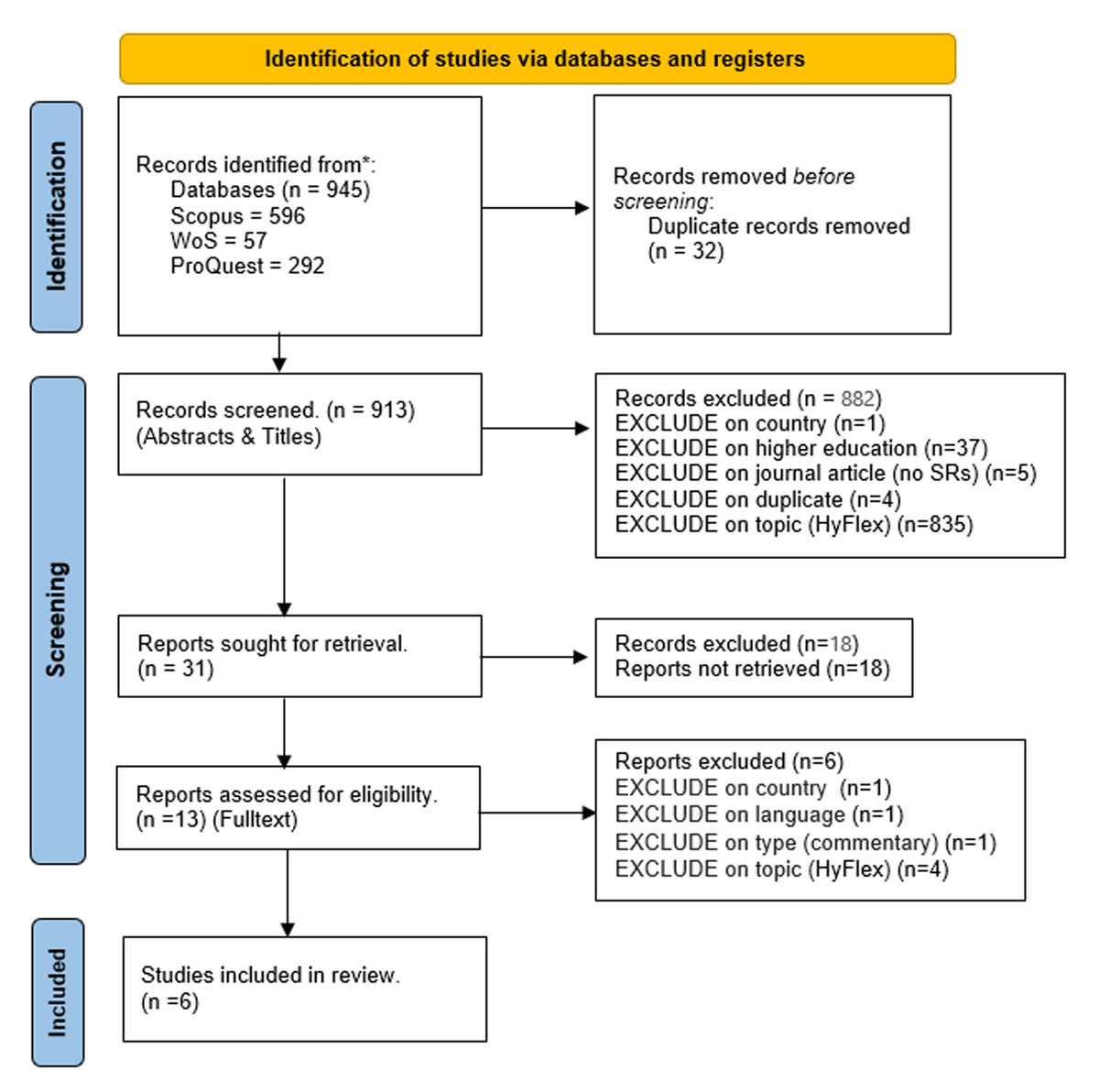
Figure 1
PRISMA flow diagram (Page et al., 2021).
Table 2
Included studies.
| # | AUTHORS | YEAR | STUDY TITLE |
|---|---|---|---|
| 1 | Amirova A, Zhumabayeva A and Zhunusbekova A ; Kalbergenova S ; Nygymanova N ; Arenova A | 2023 | Effect of using Hyflex technology learning on pre-service teachers’ success and attitudes |
| 2 | Kohnke L and Moorhouse BL | 2021 | Adopting HyFlex in higher education in response to COVID-19: Students’ perspectives |
| 3 | Li KC, Wong BTM and Kwan R ; Chan HT ; Wu MMF ; Cheung SKS ; | 2023 | Evaluation of Hybrid learning and teaching practices: The perspective of academics |
| 4 | Mahande R D and Abdal N M | 2022 | A HyFlex learning measurement model based on students’ cognitive learning styles to create equitable learning |
| 5 | Nweke L O, Bokolo A J; Mba G and Nwigwe E | 2022 | Investigating the effectiveness of a HyFlex cybersecurity training in a developing country: A case study |
| 6 | Shek DTL, Zhu XQ and Li X ; Dou DY | 2022 | Satisfaction with HyFlex teaching and law-abiding leadership education in Hong Kong University students under COVID-19 |
Table 3
Study characteristics.
| ITEM | AUTHORS, YEAR | COUNTRY | AUTHOR AFFILIATIONS | JOURNAL | STUDY FOCUS |
|---|---|---|---|---|---|
| 1 | Amirova et al. (2023) | Kazakhstan | Abai Kazakh National Pedagogical University The Eurasian Humanities Institute | International Journal of Education in Mathematics, Science and Technology | HyFlex technology-enhanced learning among pre-service teachers |
| 2 | Kohnke & Moorhouse (2021) | Hong Kong | The Education University of Hong Kong | Open Learning: The Journal of Open, Distance and e-Learning | Explored students’ perspectives on adopting HyFlex during COVID-19 |
| 3 | Li et al. (2023) | Hong Kong | Hong Kong Metropolitan University | Sustainability | Evaluated hybrid learning practices from academics’ perspectives |
| 4 | Mahande & Abdal (2022) | Indonesia | Universitas Negeri Makassar | World Journal on Educational Technology: Current Issues | Developed a HyFlex learning measurement model based on students’ cognitive style |
| 5 | Nweke et al. (2022) | Nigeria | Norwegian University of Science and Technology, Trondheim, Norway; Noroff Accelerate, Oslo, Norway; Institute for Energy Technology (IFE), Halden, Norway; Foretrust Digital Consulting, Enugu, Nigeria; Assiniboine Credit Union, Winnipeg,Canada | Education and Information Technologies | Investigated HyFlex cybersecurity training effectiveness in a developing country context |
| 6 | Shek et al. (2022) | Hong Kong | Hong Kong Polytechnic University | Applied Research in Quality of Life | HyFlex teaching and leadership education among university students |
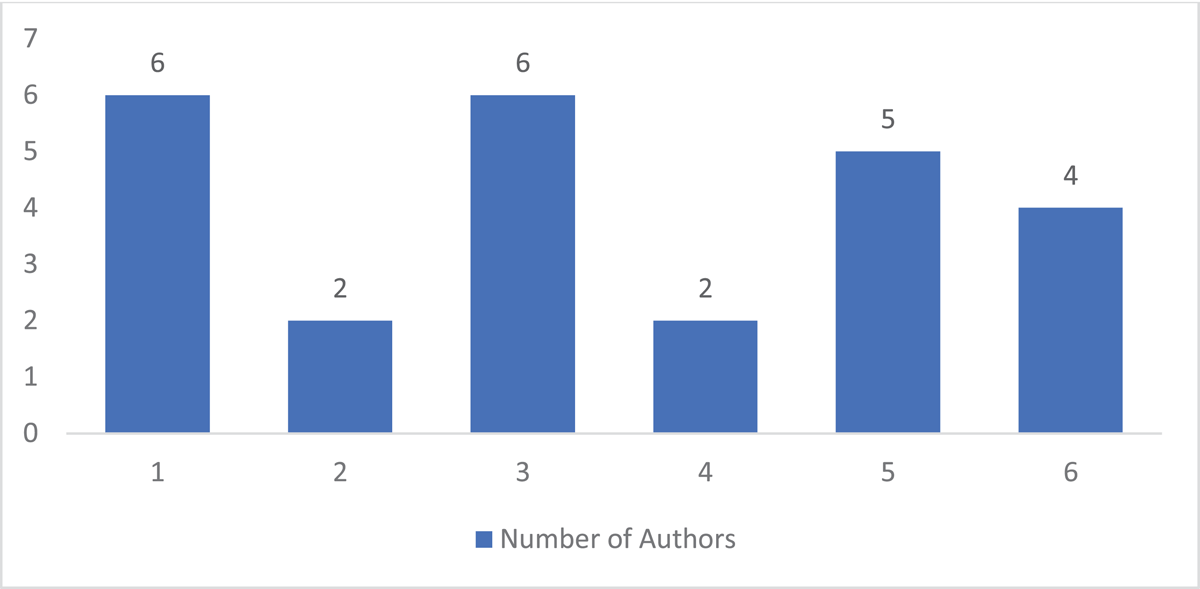
Figure 2
Authorship patterns.
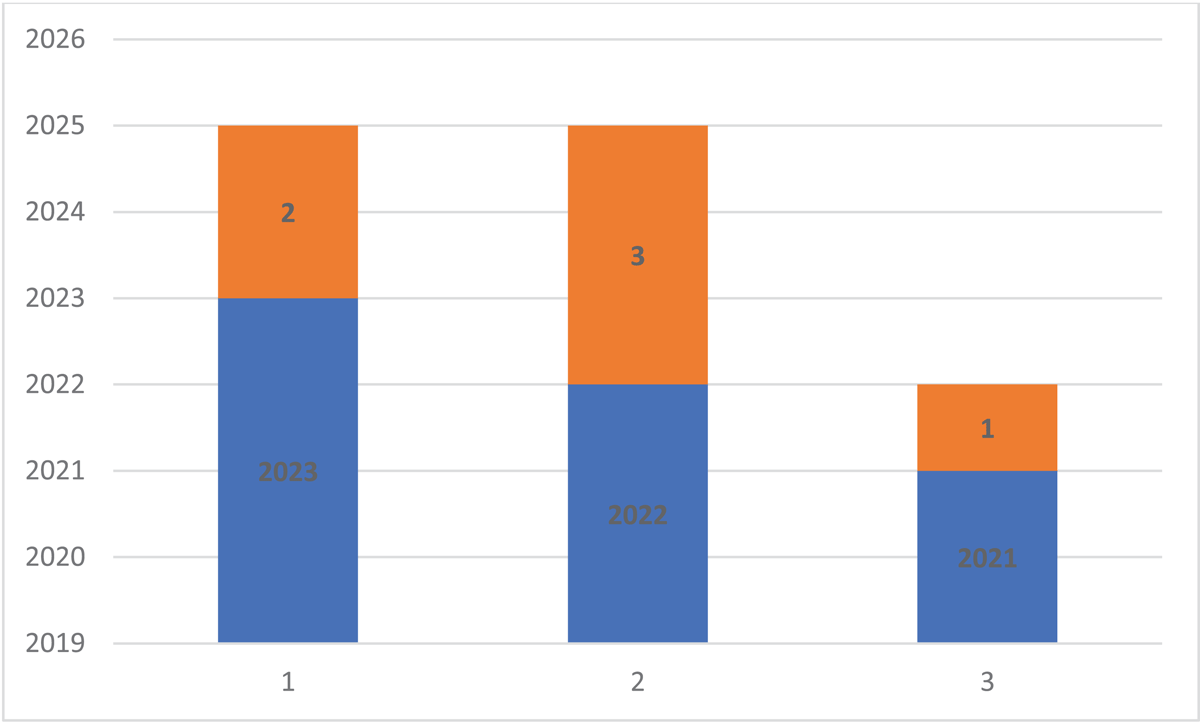
Figure 3
Studies year of publication.
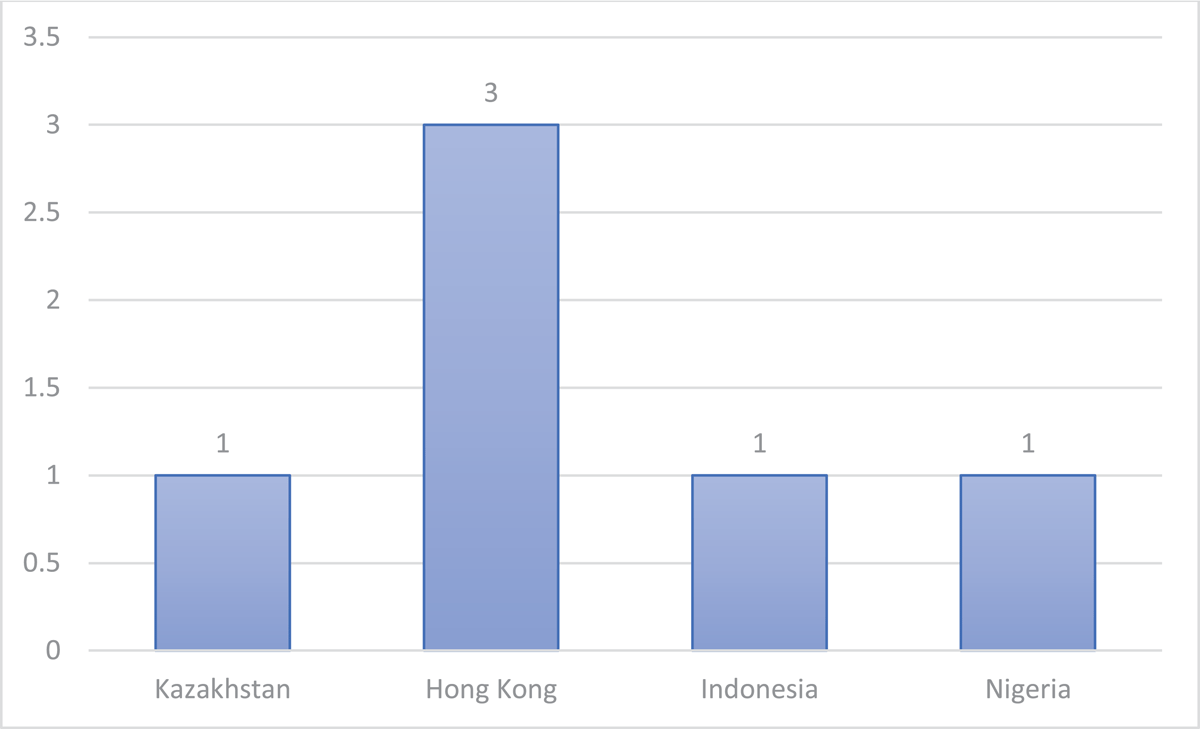
Figure 4
Studies countries of origin.
Table 4
Methodological characteristics.
| ITEM | AUTHORS, YEAR | RESEARCH DESIGN | DATA COLLECTION | DATA ANALYSIS | APPROACH |
|---|---|---|---|---|---|
| 1 | Amirova et al. (2023) | True experimental design types, pre-test-post-test control group, randomised design. | Standardised tests and scales (Achievement test) | Descriptive statistics | Quantitative |
| 2 | Kohnke & Moorhouse (2021) | Exploratory qualitative design | Interviews | Thematic analysis | Qualitative |
| 3 | Li et al. (2023) | Mixed methods descriptive-exploratory design | Questionnaire Focus group interviews | Thematic analysis & Descriptive Statistics | Mixed-methods approach |
| 4 | Mahande & Abdal (2022) | Survey | Likert-scale questionnaire | Structural equation modelling (SEM) measurement model analysis with SmartPLS | Quantitative |
| 5 | Nweke et al. (2022) | Case study design | Questionnaire (open-ended and Likert-scale questions) | Descriptive statistics | Quantitative |
| 6 | Shek et al. (2022) | Survey design | Post-lecture evaluation survey | Descriptive statistics | Quantitative |
Table 5
Participants characteristics.
| ITEM | STUDY | PARTICIPANTS |
|---|---|---|
| 1 | Amirova et al. (2023) | 44 pre-service teachers (experimental & control groups) |
| 2 | Kohnke & Moorhouse (2021) | 9 postgraduate students |
| 3 | Li et al. (2023) | 76 academics (survey), 10 academics (focus group) |
| 4 | Mahande & Abdal (2022) | 451 undergraduate students |
| 5 | Nweke et al. (2022) | 113 students and staff |
| 6 | Shek et al. (2022) | 1,164 undergraduate students |