
Table 1
Definitions of variables.
| # | TYPE OF VARIABLE | DEFINITION | INDICATORS | REFERENCES |
|---|---|---|---|---|
| 1. | Awareness of ChatGPT | An individual understands its functionalities and implications for practical integration into educational practices. | Familiarity with ChatGPT’s benefits | Shahzad et al. (2024) |
| 2. | Knowledge application | The ability to apply knowledge gained from AI tools in practice | Easy access to knowledge | Jo (2024) |
| 3. | ChatGPT usage | An individual’s positive or negative experience producing target behavior | Perceived utility of ChatGPT in education | Acosta-Enriquez et al. (2024) |
| 4. | Intention to use | The likelihood that a user intends to use AI technologies in the future | Intention to use it in future | Lai et al. (2024) |
| 5. | Perceived ethics | The perception that there is personal and social ensure. The extent to which ethical implication of AI influences user behavior | Moral perception of ChatGPT outcome | Farhi et al. (2023) |
| 6. | Risk of plagiarism | The degree to which a person understands the potential for loss or uncertain consequences pursuing desired outcomes of using a technology | Concern about plagiarism | Lai et al. (2024) |
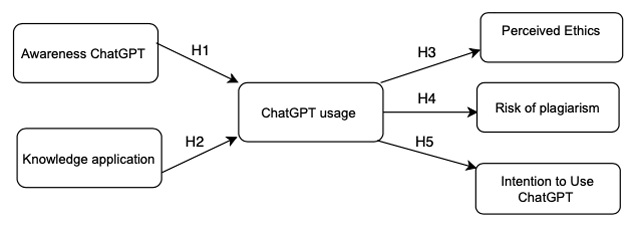
Figure 1
Structural model of research.
Table 2
Respondent profiles.
| DEMOGRAPHICS | FREQUENCY | PERCENTAGE |
|---|---|---|
| 18–19 | 64 | 19.51% |
| 20–25 | 158 | 48.17% |
| 26–30 | 80 | 24.39% |
| 31–40 | 26 | 7.93% |
| Gender | 328 | |
| Male | 184 | 56.10% |
| Female | 144 | 43.90% |
| Highest academic degree | ||
| High school | 130 | 39.63% |
| College | 24 | 7.32% |
| BA | 134 | 40.85% |
| MA, PhD | 40 | 12.20% |
| ChatGPT experience | ||
| 1–6 months | 134 | 40.85% |
| 7–12 months | 75 | 22.87% |
| 1–2 years | 99 | 30.18% |
| > 2 years | 20 | 6.10% |
| Negative experience | ||
| yes | 132 | 40.24% |
| no | 196 | 59.76% |
| Frequency of ChatGPT usage | ||
| never | 20 | 6.09% |
| rarely | 54 | 16.47% |
| sometimes | 102 | 31.10% |
| often | 84 | 25.61% |
| regularly | 68 | 20.73% |
| Total | 328 |
Table 3
Students’ experience with AI applications.
| EDUCATION APPLICATION | DO NOT KNOW THIS APPLICATION | KNOW BUT NOT USE | KNOW AND USE |
|---|---|---|---|
| ChatGPT | 1.23% | 17.07% | 81.70% |
| Grammarly | 15.85% | 30.49% | 53.66% |
| QuillBot | 32.32% | 28.66% | 39.02% |
| Google Gimini | 54.27% | 31.10% | 14.63% |
| Semrush AI assistant | 71.34% | 17.68% | 10.98% |
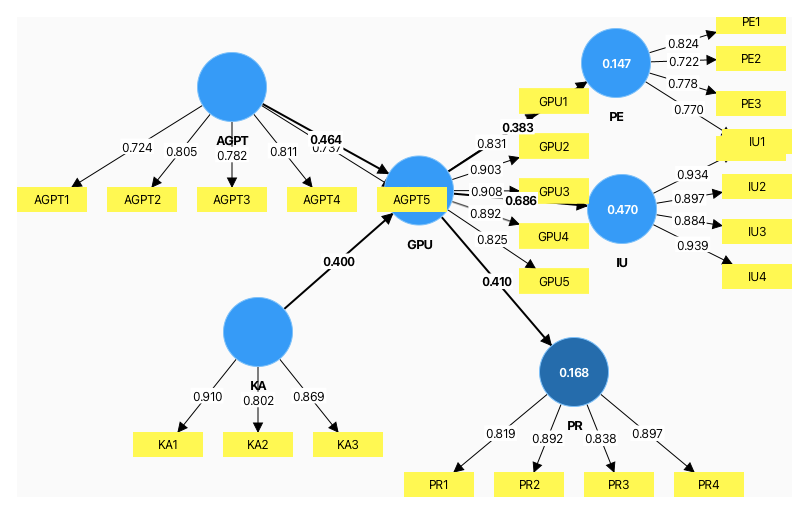
Figure 2
A structural model with results.
Table 4
Measurement model’s results.
| FACTOR | ITEMS | FACTOR LOADING (>0.5) | CRONBACH ALPHA (>0.7) | COMPOSITE RELIABILITY | AVERAGE VARIANCE EXTRACTED |
|---|---|---|---|---|---|
| Awareness of ChatGPT | AGPT1 | 0.724 | 0.836 | 0.861 | 0.597 |
| AGPT2 | 0.805 | ||||
| AGPT3 | 0.782 | ||||
| AGPT4 | 0.811 | ||||
| AGPT5 | 0.737 | ||||
| Knowledge application | KA1 | 0.910 | 0.829 | 0.880 | 0.742 |
| KA2 | 0.802 | ||||
| KA3 | 0.869 | ||||
| ChatGPT usage | GPU1 | 0.831 | 0.921 | 0.922 | 0.762 |
| GPU2 | 0.904 | ||||
| GPU3 | 0.908 | ||||
| GPU4 | 0.892 | ||||
| GPU5 | 0.825 | ||||
| Perceived ethics | PE1 | 0.824 | 0.789 | 0.841 | 0.600 |
| PE2 | 0.722 | ||||
| PE3 | 0.778 | ||||
| PE4 | 0.770 | ||||
| Risk of plagiarism | PR1 | 0.819 | 0.885 | 0.894 | 0.743 |
| PR2 | 0.892 | ||||
| PR3 | 0.838 | ||||
| PR4 | 0.897 | ||||
| Intention to use | IU1 | 0.934 | 0.934 | 0.946 | 0.835 |
| IU2 | 0.897 | ||||
| IU3 | 0.884 | ||||
| IU4 | 0.939 |
Table 5
Discriminant validity, Fornell–Larcker scale.
| AGPT | GPU | IU | KA | PE | PR | |
|---|---|---|---|---|---|---|
| AGPT | 0.773 | |||||
| GPU | 0.535 | 0.873 | ||||
| IU | 0.505 | 0.686 | 0.914 | |||
| KA | 0.179 | 0.483 | 0.451 | 0.861 | ||
| PE | 0.171 | 0.384 | 0.156 | 0.220 | 0.774 | |
| PR | 0.278 | 0.410 | 0.260 | 0.149 | 0.475 | 0.862 |
Table 6
Results of structural modeling testing of the hypotheses.
| HYPOTHESIS | PATH COEFFICIENT β | T-STATISTICS | P-VALUE | R2 | RESULTS |
|---|---|---|---|---|---|
| H1: AGPT → GPU | 0.464 | 4.113 | 0.000 | 44.1% | supported |
| H2: KA → GPU | 0.400 | 4.421 | 0.000 | 44.1% | supported |
| H3: GPU → PE | 0.383 | 3.127 | 0.002 | 14.7% | supported |
| H4: GPU → PR | 0.410 | 3.838 | 0.000 | 16.8% | supported |
| H5: GPU → IU | 0.686 | 9.900 | 0.000 | 47.0% | supported |
[i] Note. AGPT = awareness ChatGPT; KA = knowledge application; GPU = ChatGPT use; PE = perceived ethics; PR = risk of plagiarism; IU = intention to use ChatGPT. Significant at p < 0.05*, p < 0.01**, and p < 0.001***.