
Introduction
The prevalence and impact of AI in today’s world are unmistakable, especially in education, where AI’s use is transformative while presenting unique opportunities and challenges. AI technology has become an integral part of life to carry out reasoning, analyzing, and problem-solving tasks that are typically performed by humans. Educators are debating the prevalence of AI chatbots in academia and its long-term impacts (Li et al., 2025). To consider the factors of awareness, ethics, and plagiarism risk which contribute to the acceptance of artificial intelligence usage, we shall define this phenomenon as an innovation system with the ability and capacity to exceed human efficiency in tasks (Kelly et al., 2023). Students’ awareness of ChatGPT, as a regular AI assistance tool, typically encompasses routine academic activities, including essay composition, text revision, error detection in calculations, and performing statistical analyzes (van Dis et al., 2023). A recent report by the World Economic Forum (2024) underlines crucial ways AI transforms the education industry and creates bespoke learning approaches.
The uniqueness of virtual assistance renders it more attractive and easier to use in education, and its ubiquity could enhance student involvement and transform learning into an enjoyable and engaging experience. There is a notable literature gap on assessing students’ awareness and knowledge application using ChatGPT vs the consequences of such technological impact on the educational process and its quality (Bezanilla et al., 2021; Mai et al., 2024). Despite the numerous publications on AI, there is a lack of synthesis of the current literature about ethical governance and institutional integrity in the acceptance of AI in education process.
Education is not immune to recent global trends of digitalization and automation, though integrating emerging digital infrastructures into education systems faces unique obstacles. Educators and students are generally aware of AI’s effectiveness in helping students study, resulting in its increased use over time (Albayati, 2024). Generative Artificial Intelligence (GenAI) possesses distinctive features such as being able to come up with creative ideas, analyze vast quantities of data, and provide predictive insights and personalized solutions, all of which factor into students’ decision to use it (Bozkurt, 2024). Awareness forms the first stage in any innovation adoption process, although some practitioners warned that ChatGPT may lead to increased cheating in homework and examinations (Cotton et al., 2024; Alawida et al., 2024). However, it is undeniable that the younger generation, armed with ChatGPT knowledge application, can augment their academic performance significantly (Barakat et al., 2025). They are able to learn continuously and are likely to be better educated and trained.
Understanding the factors affecting students’ interactions with AI could provide essential insights leading to better utilization of this tool for educational purposes (Valenzuela et al., 2025). Zhang and Dafoe (2019) explored popular uses and impacts of Siri and Google among Americans, detailing endorsements and anxiety related to AI. They reported that 42% of participants favored it, while 22% were against it. They also reported that 82% urged caution and concluded that careful management of AI-driven technologies is necessary. Other researchers argue that progress in machine intelligence research could pose an existential risk to humanity (Statista, n.d.). The advent of AI assistance has reinvigorated various contradictory discussions within the academic community. Critics noted the lack of regulation, data privacy issues, and inadequate teacher training around these tools. Despite the increasing use of AI tools, such as ChatGPT, there is a significant lack of research on how they affect students’ behavior in an educational environment.
This research explores students’ awareness and knowledge of the application of ChatGPT. It also elucidates the complexities of GenAI integration in higher education institutions (HEI), providing insights that could inform policy development. Chatbots in education raise concerns about ethics and AI-related plagiarism, which educational institutions aim to regulate for quality assurance (Von Garrel & Mayer, 2023). AI ethics in the context of daily academic undertakings shape the students’ experience; therefore, expanding an individual’s pool of knowledge by exploring AI functionality is another core academic interest. This research contributes to the academic discussion on using AI chatbots in education and has made practical suggestions for its better use in higher education. This study addresses these research questions:
RQ1. How do students’ awareness and knowledge application influence their decision to integrate ChatGPT into their studies?
RQ2. What are the ethical concerns and perceived risks of plagiarism associated with ChatGPT usage among university students?
RQ3. To what extent does prior experience with AI tools shape students’ intention to continue using ChatGPT?
This study explores the primary factors influencing university students’ engagement with ChatGPT, focusing on their awareness and knowledge application to track the effect on ethical considerations. By analyzing students’ perceptions of plagiarism risks and behavior, this study offers insights for integrating AI-powered chatbots into higher education.
The article is organized in the following order: First, the background of AI usage in education is discussed, along with related theoretical models. Next, the research model and hypotheses regarding the application of AI assistants in the education process are discussed. The research model was tested, and the findings presented in the following section and the subsequent section outline the study’s limitations and consider possible biases in the research. Finally, the article discusses the research’s contributions and future implications.
Literature Review
This study is grounded in several theories to provide a comprehensive view of the factors influencing the use of AI technologies. To address this issue, the literature review examines recent publications on students’ perceptions and engagement with ChatGPT through the lenses of the Technology Acceptance Model (TAM) and the Self-Determination Theory (SDT). The framework for technology adoption proposed by Davis (1989) has been recently validated in AI contexts by Zogheib and Zogheib (2024), and remains relevant for analyzing students’ intentions to use generative AI (Kelly et al., 2023). Initially, Davis developed his model based on the theory of reasoned action (TRA) (Ajzen & Fishbein, 1980) to explore users’ acceptance of technologies and behavioral intention to use them in the future. Over time, this model has evolved, expanding TAM applications in the AI era. Alzoubi (2024) further argues that its flexibility allows it to be applied across diverse fields, including emerging technologies. According to Ryan and Deci (2020), the SDT posits that when individuals engage in activities and feel competent, their performance improves. This theoretical framework reinforces the idea that knowledge application is a personally relevant learning component. Incorporating SDT into the analysis provides a deeper understanding of student opportunities and challenges related to AI adoption in education.
The Technology Acceptance Model (TAM) asserts that users’ perceived usefulness and perceived ease of use influence their behavioral intention (BI) to accept technology in an educational context (Zogheib & Zogheib, 2024). At the same time, TAM has been criticized for its lack of psychological perspective and focus on functionality over motivation (Wang et al., 2025; Mogaji et al., 2024). As a result, academics have attempted to expand TAM by incorporating psychological dimensions that can explain the point – why people think technology is helpful and simple to use. Empirical research indicates that the psychological constructs significantly improve TAM’s ability to predict students’ engagement in technology-enhanced learning (Fathali & Okada, 2018). Similar to the research of Hew and Kadir (2016) and Lee (2023), we intend to show that SDT constructs – perceived ethics, risk of plagiarism, knowledge application, and awareness of ChatGPT could effectively link motivation, cognition, and behavior in technology acceptance (Jo, 2024). Students’ awareness of ChatGPT is a paramount precursor in education for understanding technology’s potential benefits and functionality (Albayati, 2024). While the knowledge application points the ability to leverage their previous experience to enhance both personal performance and intention to use ChatGPT. Recent research warns that students could fail to demonstrate their subject knowledge if they plagiarize chatbot-generated content (Cotton et al., 2024; Lai et al., 2024). Predicting students’ technology acceptance behavior, academic integrity, and plagiarism acceptability levels play an important role in the education context. The conceptual definitions of variables used in this article and its indicators are detailed in Table 1.
Table 1
Definitions of variables.
| # | TYPE OF VARIABLE | DEFINITION | INDICATORS | REFERENCES |
|---|---|---|---|---|
| 1. | Awareness of ChatGPT | An individual understands its functionalities and implications for practical integration into educational practices. | Familiarity with ChatGPT’s benefits | Shahzad et al. (2024) |
| 2. | Knowledge application | The ability to apply knowledge gained from AI tools in practice | Easy access to knowledge | Jo (2024) |
| 3. | ChatGPT usage | An individual’s positive or negative experience producing target behavior | Perceived utility of ChatGPT in education | Acosta-Enriquez et al. (2024) |
| 4. | Intention to use | The likelihood that a user intends to use AI technologies in the future | Intention to use it in future | Lai et al. (2024) |
| 5. | Perceived ethics | The perception that there is personal and social ensure. The extent to which ethical implication of AI influences user behavior | Moral perception of ChatGPT outcome | Farhi et al. (2023) |
| 6. | Risk of plagiarism | The degree to which a person understands the potential for loss or uncertain consequences pursuing desired outcomes of using a technology | Concern about plagiarism | Lai et al. (2024) |
Awareness of ChatGPT
According to Shahzad et al. (2024), human cognitive ability lies at the core of ChatGPT’s awareness. This study conceptualizes awareness as understanding the advantages of using AI chatbots like ChatGPT for task-related purposes. Individual awareness of benefits refers to the user’s direct experience of how ChatGPT improves efficiency and task performance. It represents the tangible and visible enhancements in a user’s productivity and speed of accomplishing tasks when AI chatbots are used (Jo, 2024; Wang et al., 2025). Initially, people must acknowledge its presence, comprehend its functions, and value its possible benefits. For ChatGPT, awareness entails understanding its functionalities, uses, and constraints (Albayati, 2024). Studies have demonstrated a significant relationship between awareness levels and the willingness to use technology (Lee, 2023). GenAI’s sophisticated capability to generate coherent replies significantly contributes to raising awareness, which could be enhanced via social influence from friends, peers, or online groups, significantly impacting users’ perspectives (Yurt & Kasarci, 2024). This factor was incorporated into this research to assess the degree of awareness of ChatGPT use among students. Based on the literature, the following hypothesis is proposed:
H1: ChatGPT awareness positively influences ChatGPT usage.
Students’ Knowledge Application
The knowledge application of ChatGPT refers to users’ ability to apply the knowledge acquired through AI tools in practical scenarios (Jo, 2024). Al-Emran and Teo (2020) asserted that ChatGPT facilitates users’ ease of knowledge utilization via efficient storage and retrieval systems. Per the literature, effective knowledge application positively influences individuals, and to date, practitioners have agreed on the importance of knowledge management in enhancing efficiency and productivity and are researching ways to improve knowledge reuse with machine learning (Acosta-Enríquez et al., 2024; Ngo et al., 2024). The self-determination theory (SDT) is an extensive model of human personality and motivation that focuses on how individuals interact with the environment and respond to external factors. SDT posits that when users believe ChatGPT will enhance their educational results and appreciate these enhancements, they are incentivized to utilize this technology (Chiu, 2024). In line with the SDT, this study hypothesizes that knowledge application, as a form of intrinsic motivation, leads to AI technology usage with a positive individual intention. Based on the above, we formulate the following hypothesis:
H2: Knowledge application has a positive effect on ChatGPT usage.
ChatGPT Usage and Students’ Perceptions of Ethics
The use of AI in education has gained prominence due to improvements in machine learning, language processing, and data analytics. Several researchers recognized the potential of AI to transform educational methods by improving adaptability and accessibility in learning (Williams, 2024). The effectiveness of using certain information technologies or work processes is linked to personal evaluation (Kanashina et al., 2023; Shahzad et al., 2024). The decisive question is understanding how students with different backgrounds perceive and adopt tools like ChatGPT. The key barrier that could prevent individuals from using ChatGPT is their idea of right and wrong and the opportunity to plagiarize. Certain ethical principles are fundamental to responsible and fair use. Privacy, data, transparency, and regulation play a role in the moral dilemma of using AI in higher education (Acosta-Enríquez et al., 2024). Policies and institutional guidance are necessary for ethical reasons vis-à-vis AI usage in education (Cotton et al., 2024). Students have expressed concern about the potential negative consequences of over-reliance on ChatGPT. Based on the above, we propose the following hypothesis:
H3: ChatGPT usage positively influences students’ perceptions of ethics.
ChatGPT Usage and Students’ Concern Toward the Risk of Plagiarism
Although ChatGPT can act as a virtual tutor and offers students substantial advantages, one significant drawback is its association with plagiarism. For instance, the American theoretical linguist Noam Chomsky describes ChatGPT as “a high-tech plagiarism and a way of avoiding learning” (Stewart, 2023). The potential misuse of AI for academic dishonesty, including unethical practices such as plagiarism, falsification of data, or conflicts of interest, has recently attracted attention globally, and numerous publications have outlined the concerns of academic integrity and plagiarism amongst students (King & ChatGPT, 2023; Khalaf, 2024; Cotton et al., 2024). ChatGPT can automate interactive learning outcomes via quick feedback, support, and bespoke learning approaches (Lai et al., 2024). To ensure a successful educational outcome, determining and elucidating the risks of ChatGPT is essential. This parameter was evaluated to assess students’ intentions behind plagiarism. By distinguishing between risks and advantages, this research offers a deeper assessment of how learners interact with ChatGPT. The hypothesis below is formulated based on the above assumption:
H4: ChatGPT usage positively affects students’ perception of the risk of plagiarism.
ChatGPT Usage and Intention to Use
Behavioral intention is an individual’s readiness to engage in a particular experience (Zogheib & Zogheib, 2024). Several studies demonstrated that human intention influences actual behaviors (Ngo et al., 2024; Acosta-Enríquez et al., 2024). The Theory of Reasoned Action (TRA) views intention as a key construct in assessing users’ actual behavior in adopting a given technology. It provides the theoretical underpinning to predict individual adoption and use of emerging technologies. In this context, the intention to use such revolutionary technology, such as ChatGPT, plays a pivotal role in users’ experience (Lai et al., 2024). This research examines the connection between BI and students’ preparedness to utilize ChatGPT for help with studying. Its key focus is exploring the actual usage of ChatGPT and students’ intentions. ChatGPT usage was measured by how much students rely on it for academic purposes (Acosta-Enriquez et al., 2024). Researchers have applied TAM to predict and explain a broad spectrum of information technologies. Other studies suggest that ongoing exposure to AI tools drives users’ behavioral intention toward using chatbots. Based on TAM, the study investigates university students’ intention to use AI technologies and relevant influencing factors. Accordingly, the following research hypothesis is proposed:
H5: ChatGPT usage has a positive effect on students’ intention to use ChatGPT.
Methodology
Using the TAM, SDT, and TRA and context-specific constructs, including awareness of ChatGPT (AGPT), knowledge application (KA), ChatGPT usage (GPU), behavioral intention (IU), perceived ethics (PE), and risk of plagiarism (PR), the proposed model is presented in Figure 1. The model aims to analyze users’ motivation for adopting new information technologies. Identifying the determinants influencing information system acceptance is important to better predict and explain users’ information technology mechanisms.
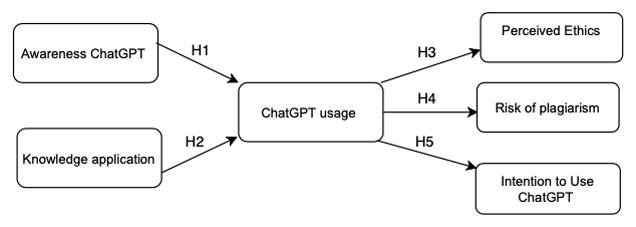
Figure 1
Structural model of research.
Materials and Methods
This research aims to evaluate the knowledge application, awareness of ChatGPT, and students’ perceptions of ethics and plagiarism. The survey instrument was crafted, leveraging a structured questionnaire to examine the principal factors of ChatGPT use. Twenty-four questionnaire items were adapted from validated scales of prior studies. ChatGPT (AGPT) awareness reflects the students’ understanding of using AI effectively, measured by five items adapted from Shahzad et al. (2024). The knowledge application assesses users’ familiarity and competence in ChatGPT use via three items based on Jo (2024). Perceived ethics (PE) evaluates students’ social norms and institutional standards by adapting three items from Acosta-Enriquez et al. (2024). Risk of plagiarism (PR) captures an individual’s understanding of the potential for loss or uncertain consequences, assessed with four items adapted from Khalaf et al. (2024). Finally, the items used to measure ChatGPT usage (GPU) and behavioral intention (IU) were adapted from Acosta-Enriquez et al. (2024) and Lai et al. (2024), respectively.
Reliability and validity. To ensure instrument reliability, internal consistency was assessed through Cronbach’s alpha and composite reliability (CR). The convergent validity of the constructs was estimated by items of factor loading and average variance extracted (AVE). While the Fornell–Larcker criterion allows us to evaluate discriminant validity. All measurements met the thresholds and details are presented in the Findings section.
Research Design
The data collection took place between March and April 2025 using an online survey, which was presented in English. The study received ethics approval from the university’s Ethics Committees, and informed consent was collected electronically. All responses remained anonymous to ensure full protection of participants’ data.
A 5-point Likert scale was used as the instrument for data collection (1 = strongly disagree to 5 = strongly agree) to examine students’ AI learning process and practical skills. The survey questionnaire consisted of socio-demographics and factors affecting ChatGPT usage in education. Initially, participants categorized various Gen AI platforms for education based on their experience, frequency, actual usage time, and negative experiences. Responses were collected through a non-probability sampling method and convenience-based approach. All participants were recruited via class invitations and an online survey link. Although this method enabled efficient data collection from a diverse international student cohort, there are several limitations such as self-reported data and limited generalizability.
This research engaged millennials as they are a technologically advanced generation with a high awareness of trends. Their involvement in the AI industry specifically targets the younger generation that rapidly embraced new technologies. Lai et al. (2024) and Jo (2024) followed a similar approach to Sanchez-Prieto et al. (2020). Structural equation modeling (SEM) is a widely used analytical tool for validating research models with AI (Hair et al., 2019; Mohd Rahim et al., 2022). PLS-SEM was chosen because it is more appropriate for exploratory research, predictive analysis, and models with multiple latent constructs. It represents a causal–chain approach to SEM that emphasizes prediction in accommodating non-normal data and moderate sample sizes.
Sample Characteristics
This study empirically illustrates ways universities can anticipate ChatGPT usage in education. After a pilot study involving 32 students to assess questionnaire clarity and preliminary reliability (Cronbach’s α = .82), 344 participant responses were collected. However, sixteen questionnaires were eliminated due to incomplete information, leaving 328 valid responses. Per Table 2, the sample consists of 40.14% African students, Asian participants – 20.02%, Middle Eastern participants – 18.19%, and 21.65% EU residents. The majority of respondents (48.17%) are from the younger demographic, aged 20 – 25 years, followed by 24.39% aged 26–30 years, 7.93% aged 31–40 years, and finally 19.51% are teenagers between 18–19 years. Most respondents (56.1%) are males, while 43.9% are female. Regarding the respondents’ educational qualifications, the majority hold bachelor’s degrees (40.85%) and high school diplomas (39.63%), followed by Masters and PhDs (12.20%) and college-level diplomas (7.32%). Participants came from various business disciplines. A large proportion of the sample reported 1–6 months of experience with ChatGPT usage (40.85%), followed by mature users with 1–2 years’ experience (30.18%), 7–12 months experience (22.87%), and more than 2 years (6.10%). The largest group reported positive experiences with ChatGPT (59.76%), while 40.24% reported negative experiences. In terms of frequency of ChatGPT usage, the category of respondents reported “sometimes” using ChatGPT (31.10%) was predominant, followed by “often” (25.61%), “regularly” (20.73%), “rarely” (16.47%) and “never” (6.09%). This proportion of participants is acceptable and representative of our research, focusing on international students from various backgrounds.
Table 2
Respondent profiles.
| DEMOGRAPHICS | FREQUENCY | PERCENTAGE |
|---|---|---|
| 18–19 | 64 | 19.51% |
| 20–25 | 158 | 48.17% |
| 26–30 | 80 | 24.39% |
| 31–40 | 26 | 7.93% |
| Gender | 328 | |
| Male | 184 | 56.10% |
| Female | 144 | 43.90% |
| Highest academic degree | ||
| High school | 130 | 39.63% |
| College | 24 | 7.32% |
| BA | 134 | 40.85% |
| MA, PhD | 40 | 12.20% |
| ChatGPT experience | ||
| 1–6 months | 134 | 40.85% |
| 7–12 months | 75 | 22.87% |
| 1–2 years | 99 | 30.18% |
| > 2 years | 20 | 6.10% |
| Negative experience | ||
| yes | 132 | 40.24% |
| no | 196 | 59.76% |
| Frequency of ChatGPT usage | ||
| never | 20 | 6.09% |
| rarely | 54 | 16.47% |
| sometimes | 102 | 31.10% |
| often | 84 | 25.61% |
| regularly | 68 | 20.73% |
| Total | 328 |
Table 3 illustrates the students’ experience with AI applications such as ChatGPT, Grammarly, QuillBot, Google Gemini, and Semrush AI Assistant. The most popular AI applications for studying are ChatGPT (81.70%), Grammarly (53.66%), and Quillbot (39.02%), while Google Gemini and the Semrush AI assistants reported a relatively low usage rate of 14.63% and 10.98%, respectively.
Findings
The Exploratory Factor Analysis (EFA) was performed to determine the number and nature of latent factors. The KMO (Kaiser–Meyer–Olkin) value was 0.935, and Bartlett’s test of sphericity produced a chi-square value of 1925.49 (df = 238), indicating a significance level lower than 0.001. Ladhari (2010) recommended that all items exceed a commonality threshold of 0.50. The eigenvalues and scree plots confirmed the existence of six factors.
This study conducted a Confirmatory Factor Analysis (CFA), encompassing the six constructs of AGPT, KA, GPU, PE, PR, and IU (see Figure 2). Both convergent and discriminant validities were carried out in this analysis. Per Table 4, the CFA analysis had strong convergent validity as all item factor loadings exceeded 0.70. This meant that the items could be used for further statistical analysis. Fornell and Larcker (1981) introduced the concept of discriminant validity. This set of findings consists of the relationships between variables, average variance extracted (AVE), and the contrast between item loadings and cross-loading. The discriminant validity showed high effectiveness (see Table 5). The constructs’ composite reliability (CR) analysis revealed strong internal consistency, with composite reliability (CR) above 0.8 and Cronbach’s Alpha values above 0.7. Convergent validity was confirmed by average variance extracted (AVE) values greater than 0.5. Together, these results establish strong construct validity and reliability of the measurement model. As a result, they indicate that the constructs were measured consistently and captured the intended theoretical concepts, allowing reliable interpretation of the structural relationships. Beyond statistical significance, the effect sizes reveal that awareness and knowledge application are the strongest practical drivers of ChatGPT usage.
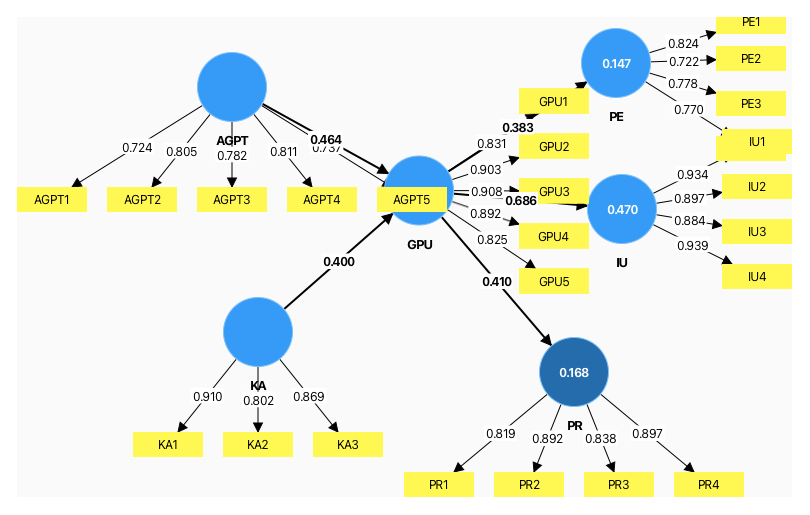
Figure 2
A structural model with results.
Table 4
Measurement model’s results.
| FACTOR | ITEMS | FACTOR LOADING (>0.5) | CRONBACH ALPHA (>0.7) | COMPOSITE RELIABILITY | AVERAGE VARIANCE EXTRACTED |
|---|---|---|---|---|---|
| Awareness of ChatGPT | AGPT1 | 0.724 | 0.836 | 0.861 | 0.597 |
| AGPT2 | 0.805 | ||||
| AGPT3 | 0.782 | ||||
| AGPT4 | 0.811 | ||||
| AGPT5 | 0.737 | ||||
| Knowledge application | KA1 | 0.910 | 0.829 | 0.880 | 0.742 |
| KA2 | 0.802 | ||||
| KA3 | 0.869 | ||||
| ChatGPT usage | GPU1 | 0.831 | 0.921 | 0.922 | 0.762 |
| GPU2 | 0.904 | ||||
| GPU3 | 0.908 | ||||
| GPU4 | 0.892 | ||||
| GPU5 | 0.825 | ||||
| Perceived ethics | PE1 | 0.824 | 0.789 | 0.841 | 0.600 |
| PE2 | 0.722 | ||||
| PE3 | 0.778 | ||||
| PE4 | 0.770 | ||||
| Risk of plagiarism | PR1 | 0.819 | 0.885 | 0.894 | 0.743 |
| PR2 | 0.892 | ||||
| PR3 | 0.838 | ||||
| PR4 | 0.897 | ||||
| Intention to use | IU1 | 0.934 | 0.934 | 0.946 | 0.835 |
| IU2 | 0.897 | ||||
| IU3 | 0.884 | ||||
| IU4 | 0.939 |
Table 5
Discriminant validity, Fornell–Larcker scale.
| AGPT | GPU | IU | KA | PE | PR | |
|---|---|---|---|---|---|---|
| AGPT | 0.773 | |||||
| GPU | 0.535 | 0.873 | ||||
| IU | 0.505 | 0.686 | 0.914 | |||
| KA | 0.179 | 0.483 | 0.451 | 0.861 | ||
| PE | 0.171 | 0.384 | 0.156 | 0.220 | 0.774 | |
| PR | 0.278 | 0.410 | 0.260 | 0.149 | 0.475 | 0.862 |
The Hypothesis Testing
The goodness-of-fit indices were considerably acceptable: χ2 = 556.817, SRMR = 0.110, d_ULS = 3.966, d_G = 1.317, and NFI = 0.667. The research model describes ~44.1% of the variability in behavior when using ChatGPT. Furthermore, R2 values of 0.147 for PE and 0.168 for PR can be deemed acceptable in social science research (Moksony & Heged, 1999).
Table 6 shows the standardized path analysis, testing the hypothesized relationships between independent and dependent variables. The analysis confirmed that awareness of ChatGPT and knowledge application positively influence ChatGPT usage (β = 0.464, p < 0.001) and (β = 0.400, p < 0.001), thereby supporting H1 and H2. ChatGPT usage strongly affects perceived ethics (β = 0.383, p < 0.001), confirming H3. A significant relationship was found between ChatGPT usage and risk of plagiarism (β = 0.410, p < 0.001), resulting in acceptance of H4. As expected, ChatGPT usage significantly affected intention to use (β = 0.686, p < 0.001), thus supporting H5 (see Figure 2).
Table 6
Results of structural modeling testing of the hypotheses.
| HYPOTHESIS | PATH COEFFICIENT β | T-STATISTICS | P-VALUE | R2 | RESULTS |
|---|---|---|---|---|---|
| H1: AGPT → GPU | 0.464 | 4.113 | 0.000 | 44.1% | supported |
| H2: KA → GPU | 0.400 | 4.421 | 0.000 | 44.1% | supported |
| H3: GPU → PE | 0.383 | 3.127 | 0.002 | 14.7% | supported |
| H4: GPU → PR | 0.410 | 3.838 | 0.000 | 16.8% | supported |
| H5: GPU → IU | 0.686 | 9.900 | 0.000 | 47.0% | supported |
[i] Note. AGPT = awareness ChatGPT; KA = knowledge application; GPU = ChatGPT use; PE = perceived ethics; PR = risk of plagiarism; IU = intention to use ChatGPT. Significant at p < 0.05*, p < 0.01**, and p < 0.001***.
Discussion
AI chatbots have become integral components of the digital ecosystem in education. The critical objective of this research is to evaluate university students’ awareness, knowledge, plagiarism, ethics, and intention to use ChatGPT. Examining the elements influencing AI adoption and usage among students in higher education is particularly important for future research. At this point, the findings imply that students’ awareness and knowledge are paramount components in enhancing their studying performance. This study highlights students’ complex perceptions by examining the unique convergence of plagiarism concerns and ethical problems associated with AI chatbot use.
The research outcomes supported all six hypotheses. The findings indicated that hypotheses H1-H5 had a significant positive path coefficient at p < 0.001. Therefore, the evidence confirms these hypotheses. The proposed parsimonious model, which is built on different theories (TAM, SDT, and TRA), is suitable for examining student perceptions of plagiarism and ethics related to ChatGPT usage. The R2 is relatively good for the sample size (238 participants), ChatGPT usage (GPU) R2 = 41.1%. This R2 value indicates a strong influence of independent variables on users’ desire to utilize ChatGPT for their daily studying tasks.
H1: ChatGPT awareness positively influences ChatGPT usage
The findings indicate that awareness enhances ChatGPT usage significantly, showing the strongest effect among antecedents. This reinforces the TAM framework, which proposes that initial cognitive familiarity and comfort reduce uncertainty and increase usefulness. People who have a clearly understanding of ChatGPT’s functions for study are more likely to use it to improve academic performance. This is consistent with other research by Mutahar et al. (2018), Lee (2023), Alshammari et al. (2025) who demonstrated that the higher awareness drives greater ChatGPT usage among students. Consequently, learners are more likely to use this tool more for their learning tasks – prompting and revising text, generating ideas, thereby increasing adoption level. At the next stage, users will feel more competent and motivated to repeat their positive experience. Conversely, limited understanding its benefits makes young people feel that ChatGPT is too complicated or limited a tool to apply.
H2: Knowledge Application Has a Positive Effect on ChatGPT Usage
Also, the research found that the knowledge application significantly shapes students’ use of ChatGPT. It supports the results by Jo (2024) who claimed a positive correlation between technology perceptions and students’ acceptance of AI chatbots. These findings confirm the suggestion of Al-Emran & Teo (2020), who affirmed that ChatGPT can benefit the learning process thanks to the ease and simplicity of use, which impacts user acceptance and satisfaction. It should be noted that while ChatGPT is a free and open AI chatbot, knowledge acquisition and application are expected to grow tremendously. This aligns with SDT, where competence is a key driver of autonomous motivation. In turn, the results also imply that superficial exposure is insufficient; hands-on experience is required to keep sustainable engagement.
H3: ChatGPT usage positively influences students’ perceptions of ethics
Moreover, the results revealed that ChatGPT usage significantly influences students’ perceptions of ethics. Acosta-Enriquez et al. (2024) reported similar outcomes, such as ChatGPT is a valuable tool for studying, with concerns about deception, fraud, and ethical issues related to its use. The usage of ChatGPT in academia comes with positive and negative outcomes. Apparently, its application needs to be governed by ethical guidelines to form accurate student opinions (Singh et al., 2024). This fact voiced anxiety regarding academic dependence on technology and students’ lack of critical thinking, originality, and integrity after prolonged use of AI. To avoid ethical problems, universities should incorporate a protocol with a proactive approach, offering specific training on the ethical use of ChatGPT. To ensure students’ understanding of how to use chatbots for educational purposes, educators should facilitate open dialogues with students about the consequences of unethical behavior in using AI technologies. Finally, this practice supports the integrity of academic pursuits and encourages individual development throughout students’ educational journey.
H4: ChatGPT usage positively affects students’ perception of the risk of plagiarism
The findings demonstrated that ChatGPT usage significantly affects students’ perception of the risk of plagiarism. They become more concerned about unintentional copying, misuse, or academic dishonesty. Given concerns regarding academic integrity, universities should provide more explicit policies on how and where AI tools can be used for academic activities. Many students are unaware of the university’s plagiarism detection mechanisms or ways to circumvent them (Lai et al., 2024). The results emphasize the need for a comprehensive policy-making framework to address challenges presented by ChatGPT usage in the educational realm. According to Cotton et al. (2024), academics should mitigate students’ plagiarism using ChatGPT with several approaches: AI detection, specific training, school guidelines, and checking for sources and citations. However, familiarity may normalize over-reliance on AI or reduce critical evaluation (Kasneci et al., 2023).
H5: ChatGPT usage has a positive effect on students’ intention to use ChatGPT
The results suggest that ChatGPT usage positively affects students’ intention to use ChatGPT for studying, which is significant and in line with previous findings of Zogheib & Zogheib, (2024). These findings explain that once students perceive ChatGPT as useful, having a positive experience in usage, the willingness increases to develop a positive intention to interact and acquire knowledge through these technologies. At the same time, negative experiences associated with using ChatGPT might negatively influence behavioral intention to use it (Jo, 2024). In general, young people feel confident using AI chatbots for studying and find them engaging and informative (Lai et al., 2024). This might indicate a positive sign for educators and emerging technologies, resulting in beneficial planned effects for users. Acosta-Enriquez et al. (2024) found that students revealed a favorable perspective by stating their desire to utilize ChatGPT for academic activities. The debate surrounding the perspectives of AIs in education still lacks information about students’ current practices and intentions to use them. This generates greater interest in exploring ChatGPT in their academic activities from both sides – academics and users.
This study revealed that most respondents (98.77%) were familiar with ChatGPT as an educational platform, but only 81.70% used it. Also, 20.73% of them utilize it regularly vs 6.09% – never. This survey discovered that many students reported negative experiences using ChatGPT (49.24%). Regarding the utilization of ChatGPT in the study, 40.85% of respondents used it for 1–6 months, and 6.10% had experience of more than 2 years. These findings are similar to (Cao et al., 2023; Shahzad et al., 2024), while Bodani et al. (2023) reported that ~77% of respondents were familiar with ChatGPT, only half used it frequently.
Conclusion, Implications and Limitations
This paper explored the Technology Acceptance Model (TAM) by integrating knowledge acquisition and awareness constructs as external components to examine e-learning adoption. While awareness indicates a student’s informed comprehension of AI’s capabilities, applications, and ethical implications in the educational contexts, knowledge acquisition refers to the capacity to employ knowledge acquired from AI efficiently. This synthesis advances conceptual understanding of user engagement with e-learning tools to close theoretical gaps in current AI work. The aim was to gather information on private university students’ opinions and experiences using ChatGPT as a routine academic support tool. This research intended to understand learners’ familiarity with ChatGPT, its current use in daily educational routines, the potential future of applications, and ethical and plagiarism considerations. It contributes to increasing our knowledge of students’ beliefs concerning the moral and ethical consequences of using AI chatbots. By extending the TAM model with particular constructs – awareness (AGPT), knowledge application (KA), perceived ethics (PE), risk of plagiarism (PR), ChatGPT usage (GPU), and intention to use (IU) – a framework that clarifies students’ perceptions of using ChatGPT for educational and learning purposes was developed. The tested model explains 44.1% of the variance in ChatGPT usage. The findings regarding understanding the risk of plagiarism and ethics in AI chatbot applications indicate that students’ understanding of plagiarism and ethics remains limited. As with any other emerging technology, ChatGPT will encounter various obstacles. Scholars must elucidate its usage to find ethical and suitable solutions to advance young people’s experience in AI technology. The data demonstrated strong interest in using this technological innovation, with respondents acknowledging its benefits despite negative experiences.
This research makes several practical contributions to the understanding of AI chatbots’ use in the educational context. The results inform policymakers in higher education that AI literacy training to promote responsible AI usage will support educational efforts to mitigate unethical behavior. Then, increasing AI technology-assisted integration into studying can enrich learning activities, resulting in students’ satisfaction and quality of education. Another advantage is that universities might benefit from clear AI policies for academic integrity and plagiarism prevention. These findings reflect the promising usage of ChatGPT for academia, highlighting that students effectively interact with AI-driven educational tools such as ChatGPT. It will further contribute to integrating education and emerging technology and provide a solid theoretical background for promoting sustained AI usage in education. The results underscore the importance of educational institutions addressing the moral implications of AI-generated content to promote transparent and responsible use of technology. In addition to teaching students how to use AI, it is crucial to set up a strong management system for detecting plagiarism through specialized tools to ensure the quality of education.
This research faced some limitations. These findings may not be generalized to encompass all student populations, because the respondents were enrolled in private universities. In future studies, the moderating roles of age and culture on the perception of the ethics and plagiarism risks could be assessed. Moreover, a broader demographic sample across various geographical locations could enhance validity. This research was performed in an educational context and does not represent differences in acceptance and application of ChatGPT that could arise in other tasks. Additionally, this study did not explore how universites’ policies shape students’ attitudes toward ethical and moral issues related to using ChatGPT. Further study should also examine different academic disciplines to determine whether students in various academic fields perceive and adopt ChatGPT in distinct ways.
This research makes several practical contributions to the understanding of AI chatbots’ use in an educational context. The results inform policymakers in higher education that AI literacy training to promote responsible AI usage will support educational innovation efforts to mitigate unethical behavior. Then, increasing AI technology-assisted integration into studying can enrich learning activities, resulting in students’ satisfaction. Another advantage is that universities might benefit from clear AI policies for academic integrity and plagiarism prevention. These findings reflect the promising usage of ChatGPT for academia, highlighting that students effectively interact with AI-driven educational tools such as ChatGPT. It will further contribute to integrating education and emerging technology and provide a solid theoretical background for promoting sustained AI usage in education. The results underscore the importance of educational institutions addressing the moral implications of AI-generated content. In addition to teaching students about AI use, it is crucial to set up a strong management system for identifying plagiarism through specialized tools.
Data Accessibility Statement
The datasets used and/or analyzed during the current study are available from the corresponding author on reasonable request.
Sustainable Development Goals
Quality education (SDG 4), Peace, Justice and Strong Institutions (SDG 16), and Industry, Innovation and Infrastructure (SDG 9).
Ethics and Consent
An electronic informed consent was obtained from all participants involved in the study. All collected data were anonymized, and participants participated voluntarily.
Acknowledgements
The authors gratefully acknowledge the support of GBSB Global Business School in facilitating this research.
Competing Interests
The author has no competing interests to declare.
Author Contributions
Olga Kanashina: Conceptualization, methodology, formal analysis, investigation, data curation, visualization, writing—original draft preparation, writing—review and editing. The author has read and agreed to the published version of the manuscript.
Author Notes
Based on Academic Integrity and Transparency in AI-assisted Research and Specification Framework (Bozkurt, 2024), the author of this paper acknowledge that The development of ideas and conceptual frameworks in this paper involved sessions assisted by ChatGPT 4.0, February, 2025. These concepts of Ethics, and Plagiarism Risks their and frameworks were subsequently refined and finalized solely by the human authors, ensuring academic integrity and ethical compliance. The authors also assessed and addressed potential biases inherent in the AI-generated content. The final ideas and frameworks presented are the responsibility of the human authors.