
Introduction
Video conferencing tools (VCTs) are widely used by both individuals and institutions to undertake various activities in order to accomplish goals in many fields (Alajmi & Said Ali, 2021). Used via computers or smartphones to maintain a normal flow in both business and educational life, VCTs have increased in both their impact and popularity in the 21st century (Koç, 2022). VCTs help individuals minimize the need to travel through the facilitation of online audiovisual communication within digital environments that negate the need for face-to-face participation (Panteli & Dawson, 2001), thus enabling users to both see and hear each other at the same time (Nguyen, 2021). Additionally, these platforms allow users to work collaboratively, to share documents, and to express their ideas without needing to physically leave their office or existing location (Panteli & Dawson, 2001). Recently, these platforms have aimed at meeting the needs of organizations (Hurst, 2020). On this, Panteli and Dawson (2001) stated that VCTs offer an enhanced communication environment appropriate for meetings to be conducted with a diverse range of individuals located in different geographical places. During the recent COVID-19 pandemic, the necessity to maintain continuity in teaching and learning practices made VCTs a necessity to use, with many existing processes having to be adapted accordingly (Nguyen, 2021).
Problem Statement
Organizations often set up inservice training programs for their employees which aim to develop the knowledge, skills, and attitudes within the organization so that employees can perform more effectively and also to feel more satisfied with their work (Aydın, 2014). Meetings can serve several functions within organizations, such as to study projects, for the assignment of tasks and duties, to resolve problems and issues, and to strengthen interworking relationships with others in the organization. Meetings are therefore important for the achievement of both individual and institutional goals (Denstadli et al., 2012) and can be conducted either digitally (online), face-to-face, or as a hybrid mix of both contemporary and traditional approaches. Integrating VCTs has become significantly more practical and realistic for organizations, schools, and universities due to the rapid developments seen in digital technology in many developed and developing countries (Al-Samarraie, 2019).
Whilst VCTs were beneficial platforms used prior to the COVID-19 pandemic for meetings, training, and to deliver and track instructions, the global crisis forced many organizations to close their doors, hence most education institutions worldwide moved to conduct their teaching activities on a remote basis, i.e., online (Bozkurt & Sharma, 2020). To enable teaching to be conducted remotely, instructors and teachers were required to migrate their instructional activities to learning management systems or digital platforms (Bozkurt et al., 2022). A variety of different digital tools were employed to support this emergency remote education such as social networks, VCTs, television and radio programs, and learning management systems (Cavus & Sekyere-Asiedu, 2021). Among these tools, VCTs were often employed by instructors and teachers to maintain instructional continuity, particularly during the initial controlled environment of the pandemic (Camilleri & Camilleri, 2022). Even though VCTs were not considered new technology, they were soon considered to be an emerging tool due to the significant and widespread demand increase. This broad new user base included students from all levels of education, doctors and others working in the medical profession, and institutional employees who utilized VCTs to support their instructional and training activities (Okabe-Miyamoto et al., 2022). As such, the COVID-19 outbreak led to a significant and ongoing usage increase of VCTs (Yazici, 2025).
VCTs can significantly impact across many areas (Carvalho, 2000), since these computer-mediated systems allow individuals in different places to work collaboratively on shared goals (Alajmi & Said Ali, 2021). As such, these tools can provide a suitable environment for the training of employees in many different businesses, hence institutions often employ VCTs for training purposes and to meet their wider business communication needs (Grant & Cheon, 2007). VCTs are often considered the preferred form of technology due to their time and access-related advantages, as well as their low operating cost (Carville & Mitchell, 2000), general ease of use (Baturay, 2010; Onur, 2021), and suitability for many teaching and learning processes (Smyth, 2005). Although VCTs offer many positive and beneficial features, they are also known to have certain limitations such as increased stress levels when used for prolonged periods or for purposes other than those for which they were originally intended or designed (Riedl, 2022). Okabe-Miyamoto et al. (2022) reported that when students were forced to use VCTs during the pandemic, they developed increased levels of negative feelings and emotions, which is often seen as a limitation of the technology. Moreover, concerns raised over the privacy of meeting sessions and students’ engagement and focus problems during in virtual meetings (Yazici, 2025) are common challenges facing VCT users; although the technology can also be said to offer different opportunities for different people.
Public institutions, as a key part of the modern-day business sector, often utilize VCTs in their daily operations, and this has been the case both during and prior to the pandemic. Employees in public institutions often use VCTs intensively due to being unable to participate in face-to-face meetings or inservice training programs held in different locations. It is widely recognized that inservice training is crucial to the business sector. For example, meetings and inservice training can be organized in order to adapt to new technologies, to meet the requirements of legislator changes, and for the purposes of professional development (Aydın, 2014). Inservice training activities enable employees to improve their qualifications, keep themselves up to date with the latest technological and industry developments, and to maintain the skills necessary to conduct their duties. As a result, public employees have gained considerable experience in the use of online conferencing tools, and thus, it is considered worth examining the factors that affect their acceptance of VCTs and their intention to use these tools. Understanding how individuals adopt different information technologies has become a significant area of academic research (Venkatesh & Davis, 2000), with numerous models and theories developed on technology acceptance published in the literature (Venkatesh, 2000). One of the most prominent models is the Technology Acceptance Model (TAM), which is derived from the Theory of Reasoned Action, was introduced by Davis in 1986 to assess users’ acceptance of information systems (Davis et al., 1989). The TAM is considered a pioneering model that explains individuals’ behaviors towards technology use. In addition to the core variables of the TAM, behavioral intention can also be explained comprehensively by incorporating various external variables into the model (Marangunić & Granić, 2015) to form what is known as the Extended TAM.
The literature indicates that research investigating public employees’ acceptance of information systems varies. For instance, the Extended TAM has been employed in various contexts, such as physicians’ acceptance and use of tablet computers in medical practice (Ducey & Coovert, 2016), employees’ e-learning system adoption (Lee et al., 2013), employees’ acceptance of teleconferencing systems (Park et al., 2014), and teachers’ intentions to adopt technology (Hong et al., 2021). From the perspective of the adoption of VCTs, prior research has been conducted with university students (Alturki & Aldraiweesh, 2022; Soria-Barreto et al., 2021), lecturers (Nalaka et al., 2023), higher education staff (Hussain et al., 2023), and individuals (Wu & Yu, 2023). Furthermore, Taş and Kiraz (2023) explored the intentions of private sector employees to adopt online conferencing tools in remote or hybrid work settings.
To the best of our knowledge, however, no existing study has addressed public employees’ intentions to use VCTs. Accordingly, the aim of the current study was to assess the extent to which an integrated model, derived from the Extended Technology Acceptance Model, can predict public employees’ intentions to adopt video conferencing tools (VCTs). The significance of the study can be articulated in several ways. First, by identifying the key factors that influence public employees’ intentions to use VCTs, the current research aimed to enrich the existing body of knowledge on technology acceptance. Second, since this is among the first studies to incorporate external variables into the TAM in the context of VCTs, the aim was to offer empirical validation of the proposed theoretical model. Finally, by highlighting which factors have the most influence, the current study aimed to provide guidance to managers working within public institutions on how best to effectively integrate these technological tools into the workplace.
Theoretical Framework and Hypotheses
The objective of this research was to identify the determinants of public employees’ acceptance of VCTs using the Extended TAM. Therefore, following after a detailed review of the related literature, in addition to TAM factors (perceived usefulness, perceived ease of use, attitude, and behavioral intention) external variables such as subjective norms, output quality, technostress, self-efficacy, facilitating conditions, technological complexity, and perceived enjoyment were considered for inclusion in the proposed model.
Davis (1985) introduced the TAM as a theoretical model to investigate factors that can affect users’ acceptance of information technologies based on the Theory of Reasoned Action (TRA). The TAM is similar to the TRA in that the acceptance and use of a technology is determined through behavioral intention. However, unlike the TRA, the TAM takes a different tack in that perceived usefulness and attitude affect behavioral intention (Davis et al., 1989). As such, the TAM includes the constructs of Perceived Usefulness (PU), Perceived Ease of Use (PEU), Attitude (AT), and Behavioral Intention (BI).
PU was defined by Davis (1989) as “the degree to which a person believes that using a particular system would enhance his or her job performance,” while PEU is defined as “the degree to which a person believes that using a particular system would be free of effort” (p. 320). These two factors are considered as critical to the acceptance of a technology (Davis, 1989). On this, Davis (1989) stated that individuals consider whether or not to use a technology whilst undertaking a certain job or task in a way that will help or benefit them, and Davis defined this as perceived usefulness. Additionally, even if individuals consider an application to be useful, its employment in situations where it is seen as being either easy or difficult to use is affective to the individual’s performance. PU can be explained as the perception that users consider a technology will contribute to and help them in doing their job. In addition to PU there is PEU, which is a user’s belief that using a technology or system is considered to be easy or difficult to use. The current study, therefore, aimed to determine the beliefs of public employees about the benefits of using VCTs on their work performance. In addition, their perceptions about the ease or difficulty of using VCTs was considered to be a core factor. Many previous studies in the literature have confirmed these relationships. For example, several studies established that PU positively impacts BI (Miao et al., 2017; Saheb, 2020; Teo et al., 2011), whilst both Teo et al. (2011) and Deng (2013) revealed that PU positively predicts attitude. Studies have also demonstrated that PEU positively predicts AT (Hashim, 2008; Wu & Yu, 2023) and PU (Deng, 2013; Miao et al., 2017; Saheb, 2020). In light of the literature, the following hypotheses were proposed.
H1: PEU positively and significantly predicts the PU of VCTs.
H2: PEU positively and significantly predicts AT toward using VCTs.
H3: PU positively and significantly predicts AT toward using VCTs.
H4: PU positively and significantly predicts BI to use VCTs.
Attitude is a person’s positive or negative feelings towards performing a particular behavior (Finlay et al., 2002). In terms of the current study, it was crucial to determine the employees’ feelings about using VCTs in public institutions. Put differently, it was necessary to understand the positive or negative feelings that affect employees’ use of VCTs. Numerous research studies have demonstrated that AT significantly and positively predicts BI (Cheon et al., 2012; El-Gayar et al., 2011; Teo et al., 2012), hence, based on the literature, the following hypothesis was proposed.
H5: AT toward using VCTs positively and significantly predicts BI to use VCTs.
Subjective norm (SN) was defined by Ajzen and Fishbein (1980) as the perception of whether the performance of a behavior is approved of by others. In the current research, managers’ views about the use of VCTs by public employees within the institution, or the views of other significant people, may affect the public employees’ perceptions regarding the VCTs’ usefulness. Moreover, this relationship has been validated by several prior studies (Ducey & Coovert, 2016; Lee et al., 2011) and, according to a meta-analysis conducted by Schepers and Wetzels (2007), a relationship exists between SN and PU. As such, the following hypothesis was derived from the existing literature.
H6: SN positively and significantly predicts the PU of VCTs.
Output quality (OQ) was defined by Venkatesh and Davis (2000) as users’ beliefs of how well a system or technology performs certain work-related tasks. In other words, users’ evaluations and perceptions of how successfully a technology can complete a certain work task is related to output quality. The literature has indicated that OQ positively affects PU (Nguyen et al., 2021; Venkatesh & Davis, 2000). Regarding the current study, public employees will have perceptions about OQ when considering the use of VCTs which may then significantly impact upon their PU of these tools; therefore, the following hypothesis was proposed.
H7: OQ positively and significantly predicts the PU of VCTs.
Torres (2021) explained the technostress (T) variable as an adaptation problem when employees believe that they cannot adequately manage the utilization of a new technology or system. As such, this factor becomes an integrated element in acceptance and adoption research. In terms of the current study, public employees may feel a sense of fear or anxiety when using online conferencing tools, and these feelings may then affect their perception of the usefulness and ease of use of VCTs. Studies have also shown that technostress negatively affects PU (Wu & Yu, 2023) and PEU (Gabbiadini et al., 2023), hence the following hypotheses were generated.
H8: Technostress negatively and significantly predicts the PEU of VCTs.
H9: Technostress negatively and significantly predicts the PU of VCTs.
Bandura (1997) referred to self-efficacy (SE) as “beliefs in one’s capabilities to organize and execute the courses of action required to produce given attainments” (p. 3). Compeau and Higgins (1995) stated that people with high levels of self-efficacy believe that they can succeed in any challenge, while those with low self-efficacy may believe that they can only perform certain behaviors in what they perceive to be easy situations. Thus, the self-efficacy factor can be used to determine users’ technology acceptance (Ursavaş, 2014). In the current study, public employees’ self-confidence levels and their abilities in terms of using VCTs may relate to their perceptions of the ease of use of these tools. Numerous studies have shown SE to be associated with PEU (Lee et al., 2013; Luarn & Lin, 2005; Park et al., 2014), hence the following hypothesis was formulated.
H10: SE positively and significantly predicts the PEU of VCTs.
Facilitating conditions (FC) can be explained as environmental factors such as technical support, helpdesks, or online support systems that are affective in individuals using a system or adopting a certain piece of technology (Teo, 2009). These types of supportive mechanism can be provided at the point where a technology or system is being used. In terms of the current study, providing support, assistance, and user guides for the utilization of VCTs by public employees may affect their perceived ease of use of these tools. This relationship between FC and PEU has been corroborated by previous research (El-Gayar et al., 2011; Teo et al., 2012; Venkatesh & Davis, 2000); hence, based on the literature, the following hypothesis was generated.
H11: FC positively and significantly predicts the PEU of VCTs.
Technological complexity (TC) is defined as the level of difficulty in using and understanding a certain technology or system (Thompson et al., 1991). On this, Ursavaş (2014) stated that complex technology negatively affects the perceived ease of use variable. Therefore, for the current study, public employees may experience technology-related issues when using VCTs, and this perception may affect their ease of use of such tools. Prior research has revealed that TC negatively affects PEU (Teo et al., 2012; Ursavaş, 2014), thus the following hypothesis was developed.
H12: TC negatively and significantly predicts the PEU of VCTs.
Perceived enjoyment (PE) refers to the utilization of a system that is considered to provide an enjoyable experience, and that this is independent from any performance-related outcomes that may arise from using the system (Davis et al., 1992). PE therefore influences an individual’s behavior (Agrebi & Jallais, 2015) and has a positive impact of their perceived ease of use (Venkatesh & Davis, 2000). In terms of the current study, determining the enjoyment factor that public employees perceive when using VCTs will be influential in forming their perceptions about the use of such tools. Several research studies have indicated that a positive relationship exists between PE and PEU (Teo & Noyes, 2011; Terzis & Economides, 2011). Based on the literature, the following final hypothesis was formed.
H13: PE positively and significantly predicts the PEU of VCTs.
The model proposed for the current study, which is formed based on the 13 specified hypotheses, is visualized as shown in Figure 1.
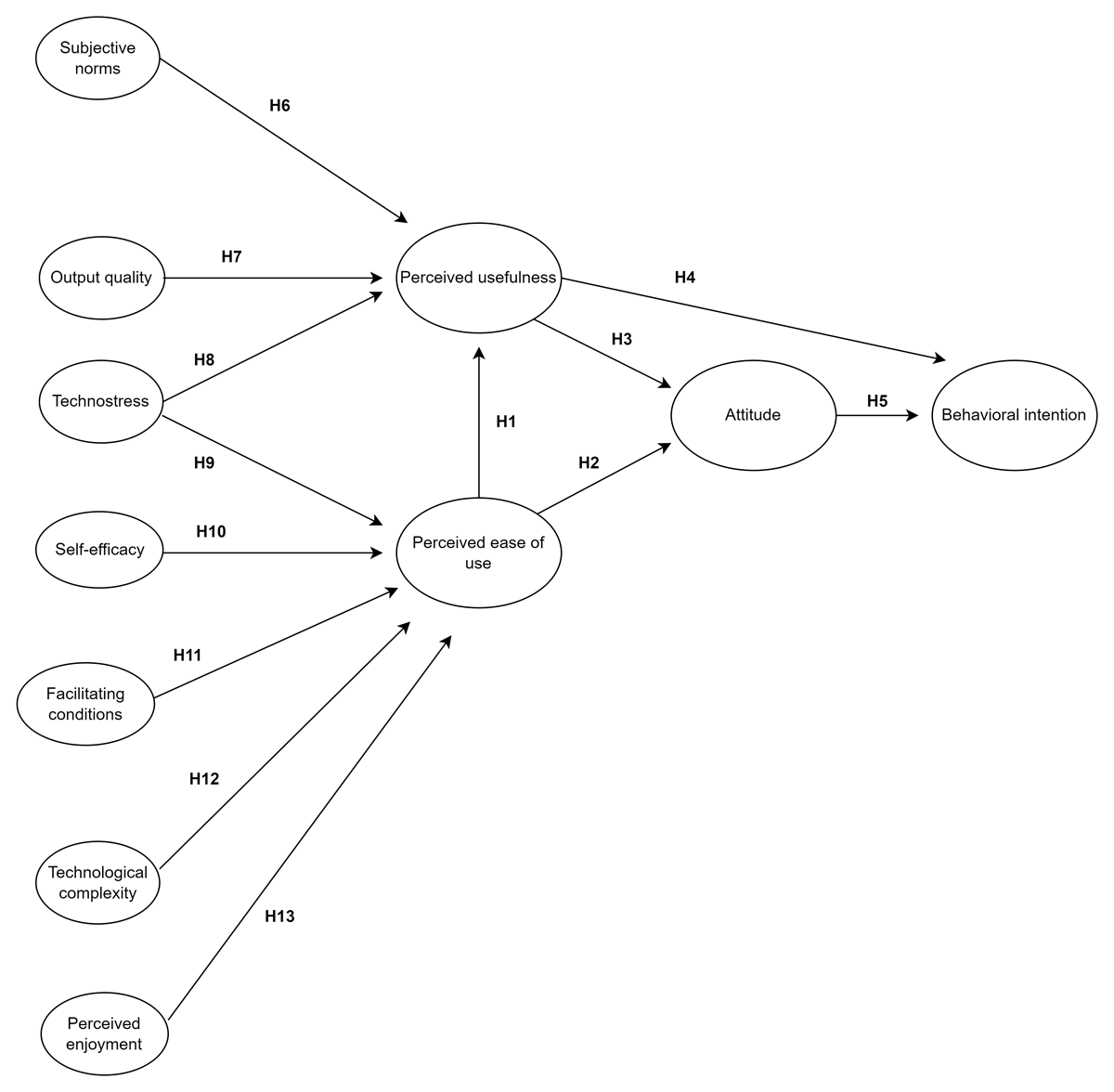
Figure 1
Research model of the study.
Research Methodology
Procedure and Participants
A cross-sectional survey research design was used, where study participants’ perceptions of VCTs were gathered in a single instance. First, the convenience sampling method was utilized in order to select a sample of 240 participants working at different public institutions. After seven survey responses were found to have been incomplete, these were deleted and a total of 233 valid responses were subjected to analysis. The demographic features of the study participants are presented in Table 1.
Table 1
Demographic characteristics.
| n | % | ||
|---|---|---|---|
| Gender | Female | 103 | 44.2 |
| Male | 130 | 55.8 | |
| Age (years) | 19–25 | 21 | 9.0 |
| 26–40 | 149 | 63.9 | |
| 41–55 | 63 | 27.1 | |
| VCT usage experience | Less than 1 year | 72 | 30.9 |
| 1–3 years | 87 | 37.3 | |
| 4 years or more | 74 | 31.8 |
More than half of the respondents were male (n = 130, 55.8%), while 44.2% (n = 103) were female. In addition, 63.9% (n = 149) of the public employees were aged between 26 and 40 years old, while 27.1% (n = 63) were between 41 and 55 years old, and 9% (n = 21) were aged between 19 and 25 years old. In total, 87 (37.3%) of the public employees had used online conferencing platforms for between 1 and 3 years, whereas 72 (30.9%) had used these tools for less than 1 year, and 74 (31.8%) had used VCTs for 4 years or more. Regarding which VCT the public employees had used, 193 had used Zoom, 114 had used Skype, 47 had used Google Meet, 43 had used Microsoft Teams, three had used Discord, and one had used Teamlink. Overall, 163 participants stated having previously used VCTs via their smartphone, whilst 153 had used a laptop, 140 had used a desktop computer, and 47 had used a tablet computer.
Data Collection Instruments
The self-report instrument that was applied in the study consisted of a questionnaire and a scale. The questionnaire items were about the participants’ demographic information: gender, age, experience of VCT usage, and type of technology for VCT usage. The second section consisted of scale items related to the Extended TAM, with each construct item adapted from previous research as depicted in Table 2. The assistance of three experts were consulted in the adaption of the items. The participants were then asked to respond to each item using a 7-point, Likert-type rating from 1 = I strongly disagree to 7 = I strongly agree.
Table 2
Scale items and constructs.
| CONSTRUCT | ITEM NUMBER | SOURCE |
|---|---|---|
| Perceived usefulness (PU) | PU1 | Wu & Yu (2023), adapted from Davis (1989) |
| PU2 | ||
| PU3 | ||
| Perceived ease of use (PEU) | PEU1 | Wu & Yu (2023), adapted from Davis (1989) |
| PEU2 | ||
| PEU3 | ||
| Subjective norms (SN) | SN1 | Venkatesh & Bala (2008), adapted from Taylor & Todd (1995) |
| SN2 | ||
| SN3 | ||
| SN4 | ||
| Output quality (OQ) | OQ1 | Venkatesh & Bala (2008), adapted from Davis et al. (1992) |
| OQ2 | ||
| OQ3 | ||
| Technostress (T) | T1 | Wu & Yu (2023), adapted from Verkijika (2019) |
| T2 | ||
| T3 | ||
| Self-efficacy (SE) | SE1 | Lee et al. (2013), adapted from Compeau & Higgins (1995) |
| SE2 | ||
| SE3 | ||
| SE4 | ||
| SE5 | ||
| SE6 | ||
| Facilitating conditions (FC) | FC1 | Teo et al. (2018), adapted from Thompson et al. (1991) |
| FC2 | ||
| FC3 | ||
| Technological complexity (TC) | TC1 | Teo (2009), adapted from Thompson et al. (1991) |
| TC2 | ||
| TC3 | ||
| Perceived enjoyment (PE) | PE1 | Venkatesh & Bala (2008), adapted from Davis et al. (1992) |
| PE2 | ||
| PE3 | ||
| Behavioral intention (BI) | BI1 | Baber (2021), adapted from Chen (2011) |
| BI2 | ||
| BI3 | ||
| BI4 | ||
| Attitude (AT) | AT1 | Taylor & Todd (1995) |
| AT2 | ||
| AT3 | ||
| AT4 |
Data Analysis
Partial Least Squares Structural Equation Modeling (PLS-SEM), which is a “causal modeling approach aimed at maximizing the explained variance of the dependent latent constructs” (Hair et al., 2011, p. 139), was used to test the hypothetical relationships using SmartPLS software. The data analysis was conducted in two phases, with the first phase concentrated on evaluating the measurement model for reliability and validity, whilst the second phase focused on the structural model in order to assess the relationships between the constructs (Hair et al., 2011).
Results
Measurement Model
Measurement model analysis was performed as the first step. To test reliability, item loadings, composite reliability values, and Cronbach’s alpha values were used, whilst average variance extracted (AVE) values, Fornell Larcker criterion, and Heterotrait-Monotrait ratio were utilized for validity testing; the results of which are presented in Table 3.
Table 3
Measurement model evaluation results.
| CONSTRUCT | ITEM | LOADING | AVERAGE VARIANCE EXTRACTED | CRONBACH’S ALPHA | COMPOSITE RELIABILITY |
|---|---|---|---|---|---|
| Perceived usefulness | PU1 | .95 | .86 | .92 | .95 |
| PU2 | .95 | ||||
| PU3 | .88 | ||||
| Perceived ease of use | PEU1 | .90 | .83 | .90 | .94 |
| PEU2 | .90 | ||||
| PEU3 | .93 | ||||
| Perceived enjoyment | PE1 | .96 | .90 | .94 | .96 |
| PE2 | .97 | ||||
| PE3 | .92 | ||||
| Technostress | T1 | .90 | .77 | .85 | .91 |
| T2 | .91 | ||||
| T3 | .81 | ||||
| Output quality | OQ1 | .90 | .76 | .84 | .90 |
| OQ2 | .82 | ||||
| OQ3 | .88 | ||||
| Self-efficacy | SE1 | .80 | .73 | .92 | .94 |
| SE2 | .81 | ||||
| SE3 | .88 | ||||
| SE4 | .93 | ||||
| SE5 | .87 | ||||
| SE6 | .82 | ||||
| Facilitating conditions | FC1 | .95 | .86 | .92 | .95 |
| FC2 | .95 | ||||
| FC3 | .88 | ||||
| Technological complexity | TC1 | .91 | .86 | .92 | .94 |
| TC2 | .93 | ||||
| TC3 | .93 | ||||
| Subjective norms | SN1 | .87 | .73 | .87 | .91 |
| SN2 | .90 | ||||
| SN3 | .83 | ||||
| SN4 | .79 | ||||
| Behavioral intention | BI1 | .92 | .82 | .93 | .95 |
| BI2 | .93 | ||||
| BI3 | .92 | ||||
| BI4 | .85 | ||||
| Attitude | AT1 | .85 | .76 | .89 | .92 |
| AT2 | .83 | ||||
| AT3 | .91 | ||||
| AT4 | .90 |
Item reliability was ensured according to the standard that item loadings (Hair et al., 2011), composite reliability values (Hair et al., 2011), and Cronbach’s alpha values (Nunnally, 1978) of all constructs should exceed the value of .70. For the evaluation of convergent validity, Hair et al. (2011) stipulated that AVE values should exceed .50, which were achieved for all factors in the current study. Finally, Fornell-Larcker criteria were used to measure discriminant validity, as shown in Table 4.
Table 4
Fornell-Larcker criteria analysis.
| PE | PEU | PU | BI | FC | TC | T | AT | OQ | SE | SN | |
|---|---|---|---|---|---|---|---|---|---|---|---|
| PE | .95 | ||||||||||
| PEU | .44 | .91 | |||||||||
| PU | .51 | .41 | .93 | ||||||||
| BI | .72 | .35 | .41 | .90 | |||||||
| FC | .31 | .35 | .25 | .31 | .93 | ||||||
| TC | –.22 | –.29 | –.15 | –.18 | –.04 | .92 | |||||
| T | –.33 | –.22 | –.30 | –.27 | –.04 | .50 | .88 | ||||
| AT | .54 | .34 | .39 | .46 | .22 | –.20 | –.24 | .87 | |||
| OQ | .59 | .49 | .65 | .47 | .42 | –.10 | –.31 | .42 | .87 | ||
| SE | .43 | .63 | .38 | .39 | .34 | –.18 | –.07 | .32 | .49 | .85 | |
| SN | .48 | .38 | .63 | .42 | .49 | –.06 | –.22 | .37 | .70 | .43 | .85 |
Table 4 indicates that correlation among the proposed model’s constructs was lower than the square root of the AVE values, and therefore deemed to be satisfactory according to Fornell and Larcker (1981). Additionally, the Heterotrait-Monotrait ratio (HTMT) approach was employed and the results are presented as shown in Table 5.
Table 5
Heterotrait-Monotrait Ratio (HTMT) analysis.
| PE | PEU | PU | BI | FC | TC | T | AT | OQ | SE | SN | |
|---|---|---|---|---|---|---|---|---|---|---|---|
| PE | |||||||||||
| PEU | .47 | ||||||||||
| PU | .54 | .45 | |||||||||
| BI | .77 | .38 | .44 | ||||||||
| FC | .33 | .38 | .28 | .33 | |||||||
| TC | .24 | .31 | .17 | .20 | .05 | ||||||
| T | .36 | .25 | .33 | .30 | .07 | .56 | |||||
| AT | .58 | .38 | .42 | .50 | .24 | .22 | .27 | ||||
| OQ | .66 | .56 | .72 | .53 | .48 | .12 | .38 | .48 | |||
| SE | .46 | .68 | .41 | .42 | .37 | .19 | .14 | .35 | .55 | ||
| SN | .53 | .44 | .69 | .47 | .56 | .07 | .26 | .42 | .82 | .47 |
As can be seen from Table 5, all HTMT values were found to be lower than .85, which supported discriminant validity (Henseler et al., 2015). As a result of the measurement model analysis, the proposed model reached a satisfactory level prior to structural model analysis.
Structural Model
All hypothetical relationships were tested through structural model analysis. The standardized path coefficients, path significances, t-value, and the proposed model’s ability to predict dependent variables following analysis using a 5,000-sample bootstrapping procedure are presented in Table 6.
Table 6
Results of hypothesis testing.
| HYPOTHESIS | PATH COEFFICIENT | p VALUE | t VALUE | DECISION |
|---|---|---|---|---|
| H1: PEU ➔ PU | .099 | .104 | 1.627 | Not supported |
| H2: PEU ➔ AT | .226 | .003** | 2.957 | Supported |
| H3: PU ➔ AT | .297 | .000*** | 4.024 | Supported |
| H4: PU ➔ BI | .275 | .000*** | 3.994 | Supported |
| H5: AT ➔ BI | .357 | .000*** | 4.985 | Supported |
| H6: SN ➔ PU | .328 | .000*** | 3.995 | Supported |
| H7: OQ ➔ PU | .344 | .000*** | 3.800 | Supported |
| H8: T ➔ PU | –.096 | .072 | 1.799 | Not supported |
| H9: T ➔ PEU | –.069 | .250 | 1.150 | Not supported |
| H10: SE ➔ PEU | .499 | .000*** | 8.963 | Supported |
| H11: FC ➔ PEU | .130 | .022* | 2.291 | Supported |
| H12: TC ➔ PEU | –.128 | .030* | 2.166 | Supported |
| H13: PE ➔ PEU | .135 | .022* | 2.287 | Supported |
[i] *p < .05; **p < .01; ***p < .001.
Of the study’s 13 hypotheses, a total of 10 were confirmed. The results showed that AT (β = .357, p < .001) and PU (β = .275, p < .001) significantly influenced BI, and that PU (β = .297, p < .001) and PEU (β = .226, p < .01) had a significant impact on AT. Regarding the predictors of PU, OQ (β = .344, p < .001) and SN (β = .328, p < .001) were shown to be significant predictors, while PEU (β = .099, p > .05) and T (β = –.096, p > .05) were not. Additionally, PEU was found to be significantly and positively predicted by SE (β = .499, p < .001), PE (β = .135, p < .05), and FC (β = .130, p < .05). Moreover, TC (β = –.128, p < .05) was shown to be a significant but negative predictor of PEU. However, the path between T and PEU was not revealed to be significant (β = –.069, p > .05).
From these results, hypotheses H2, H3, H4, H5, H6, H7, H10, H11, H12, and H13 were all accepted, whereas H1, H8, and H9 were rejected as depicted in Figure 2. Additionally, the indirect effects of the constructs on BI were analyzed, with the results having revealed that PU had an indirect effect on BI through AT (β = .106, p < .01), SN significantly influenced BI through PU (β = .090, p < .01), OQ significantly predicted BI through PU (β = .094, p < .01), PEU had an positive and indirect effect on BI through AT (β = .081, p < .05), and SE influenced BI via PEU and AT (β = .040, p < .05).
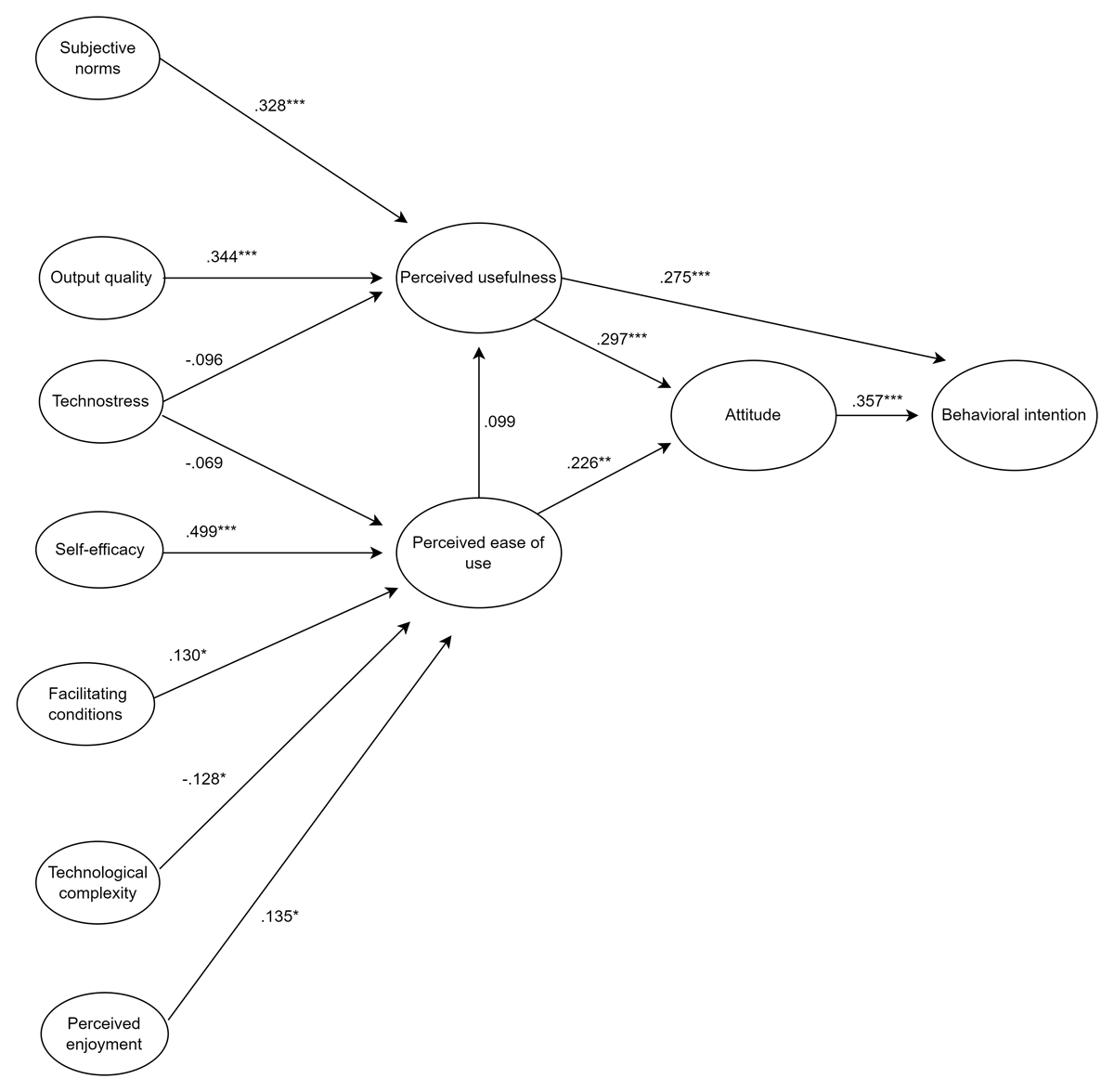
Figure 2
Structural model evaluation (*p < .05; **p < .01; ***p < .001).
Finally, the proposed model was able to explain 27.9% of the variance in individuals’ behavioral intention to adopt VCTs. Overall, the proposed model was shown to be satisfactory in explaining public employees’ intention to use VCTs.
Discussion
The current study focused on the determinants affecting public employees’ acceptance of VCTs, with the TAM extended to include external variables to explain their intentions. The analysis showed that of the 13 hypotheses formulated, 10 were accepted.
Regarding the BI construct, AT was shown to be the more important predictor over PU. Similar research in the literature (Cheon et al., 2012; El-Gayar et al., 2011; Teo et al., 2012) also established a positive relationship between AT and BI, which supports the current study’s finding. In a more recent study conducted by Nguyen et al. (2021), students’ intention to use VCTs for distance learning during the COVID-19 pandemic were examined, with their findings supporting the current study’s result. In Nguyen et al.’s (2021) study, researchers evaluated this positive relationship noting that as students developed their attitudes during distance education experienced during the pandemic which in turn influenced their intentions to continue using VCTs. In the context of e-learning systems, Zobeidi et al. (2023) found that if learners’ opinions or feelings toward online learning systems were shaped as positive or that the use of online learning systems were deemed to be a good idea, they tended to continue to use the system in the future. According to this result, public employees in the current study may have developed positive feelings towards the VCT tools they had used since most of the participants stated having used VCTs for a period of more than 1 year. As their experiences with using VCTs increased, positive opinions may have been shaped, motivating them towards using these tools in the future. Additionally, their perceptions of usefulness were also found to be a predictor of BI; a result which corresponds with previous works by Miao et al. (2017), Saheb (2020), Sonmez and Ozdamar (2024) and also Teo et al. (2011). According to the TAM, users’ behavioral intentions toward the adoption of new technologies are determined by PU and PEU (Davis, 1989). In the context of VCTs, the public employees in the current study had intentions to engage with these platforms driven directly and indirectly by their PU. In addition to having used these tools in their daily tasks, VCTs are also seen as communication and collaborative working tools available both on desktop computer and mobile digital devices. The recent pandemic led to significantly increased use of these tools in both business and educational contexts (Hacker et al., 2020), hence, it can be said that VCTs support interaction between public employees. As such, their experience may have led them to believe that VCTs positively contribute to their work performance. Furthermore, if public employees believe that VCTs are beneficial to their work, they are more likely to consider using them in the future.
In terms of AT, PU was found to have a higher path weight than PEU. The literature also confirms the significant relationship between PU and AT (Karaali et al., 2011; Teo et al., 2011) and between PEU and AT (Karaali et al., 2011; Wu & Yu, 2023). In the context of online learning during the pandemic, according to research conducted by Huang (2023), the operability of learning platforms and the perceived usefulness of online course materials also helped to improve students’ attitudes toward online learning as a whole, which in turn increased their desire to participate in their online courses. Regarding the current study’s results, when the public employees considered VCTs as being useful in their work, their attitudes towards the use of these tools was positively affected. Additionally, PEU was found to have a significant and indirect influence on BI via AT. Thus, if public employees use VCTs without much effort, they tend to develop positive attitudes towards them and are likely to continue using them in the future.
As to what predicts PU, the current study found that OQ and SN significantly impacted PU, while T and PEU had no influence. These results are similar to the findings of previous research on the link between OQ and PU (Nguyen et al., 2021; Venkatesh & Davis, 2000) and between SN and PU (Ducey & Coovert, 2016; Lee et al., 2011). In a study by Ji et al. (2019), output quality was found to be an essential factor for the continuous intention to use online learning applications, supporting the indirect effect on BI established in the current study. In addition, Zobeidi et al. (2023) empirically demonstrated that PU and PEU are directly influenced by output quality, and recommended that users assess the efficacy of online learning by comparing it with face-to-face learning. In order to near enough guarantee that users will find online learning both advantageous and prosperous, these links emphasize the need to ensure a good level of output quality. Empirical evidence from prior research supports that employees’ perceptions of VCTs’ usefulness are positively and significantly influenced by output quality. VCTs can offer the capability for screen sharing, document sharing, and interactive whiteboards, as well as real-time interaction regardless of physical location (Correia et al., 2020). From this perspective, public employees may attend inservice training, hold meetings with their colleagues, or collaborate in teamwork as they carry out their assigned duties. They may also seek to benefit from features of VCTs such as note-taking applications and the use of various audiovisual contents as a means to helping them to learn new skills or knowledge. All of these results point to the possibility that improvements in output quality may help to develop a more positive user opinion about its value, which in turn is likely to encourage them to embrace and use online conferencing solutions within business contexts. Public employees may therefore realize positive outputs both during and after use of VCTs in their work.
Regarding the relationship between SN and PU within the context of e-learning, whether or not employees choose to make use of e-learning platforms may be somewhat explained by their desire to remain close to their social environment (Lee et al., 2011). Thus, it may be argued that public employees could take note of or follow the suggestions of those within their social circuit with regards to the usefulness of VCTs. Moreover, public employees’ managers, colleagues, or other important or influential people around them may suggest that VCTs can aid performance improvements in their work. With regards to the indirect effect of SN on BI, public employees may intend to use VCTs in the future. As a result, their perceptions of the usefulness of VCTs may be positively affected according to their social environment.
The insignificant relationship revealed in the current study between PEU and PU was contradicted by some of the prior research (Deng, 2013; Miao et al., 2017; Saheb, 2020; Terzis et al., 2013), while overlapping with other studies (Escobar-Rodriguez & Monge-Lozano, 2012). It can be assumed, however, that public employees may be familiar with using VCTs since more than half of the respondents had made use of VCTs for a period of more than 1 year. As VCT users, they would likely have gained adequate experience to become familiar with the technology, and as a result, their perceived usefulness of such systems would not be influenced by their PEU of technology (Escobar-Rodriguez & Monge-Lozano, 2012).
Furthermore, the current study’s finding that T did not predict PU was contradicted in previous research by Wu and Yu (2023). Additionally, Wang and Yu (2024) reported a negative significant relationship between T and both PU and BI, but could find no significant link between T and satisfaction with mobile educational applications. Technostress relates to a person’s mental health condition brought on by their incapacity to handle the demands of using technology (Steelman & Soror, 2017). This conflicting result regarding a link between T and PU could be explained as public employees maybe feeling relaxed when using VCTs and not having experienced any disadvantaged situations when using VCTs in their work. As a result, technostress level may not lead to a decrease in perceived usefulness.
Regarding the PEU determinants, analysis in the current study showed that PEU was positively predicted by SE, FC, and also PE, whilst negatively predicted by TC. However, the results did not show T as having significantly influenced PEU. Previous literature for the SE-PEU link (Al-Madadha et al., 2022; Park et al., 2014; Tırpan & Bakırtaş, 2024) supported these results. In explaining this positive link, Lee et al. (2011) stated that employees are more likely to find e-learning systems easy to use when they have confidence in their skills. Regarding the context of the current study, public employees may have belief in themselves related to the use of online conferencing tools. Additionally, according to the positive and significant indirect effect of SE on BI, they may have a desire to use VCTs in their future work.
In terms of the significant link established between FC and PEU, this was supported by prior research (El-Gayar et al., 2011; Karaali et al., 2011), where FC represents the availability of technical and administrative assistance and access to technological resources (Teo et al., 2018). In this regard, employees might receive support via the Internet, computers, booklets or guides, and also expert support in order to use VCTs. Thus, supportive resources for the use of VCTs were shown to be an influential factor affecting the public employees’ perceptions about the operability of VCTs.
Similar results in the literature (Chatzoglou et al., 2009; Terzis & Economides, 2011) have confirmed this link between PE and PEU. From the theoretical perspective, enjoyment promotes a positive user perception by reducing the cognitive load related to using a certain system (Park et al., 2012). In their study of learners’ acceptance of using the Internet for learning purposes, Huang et al. (2020) reported that university students were less likely to experience Internet anxiety when they like participating in online activities, since the Internet provides various different functions, and therefore may believe that using the Internet is considered by them to be easy. According to the current study’s finding, public employees may enjoy using VCTs due to the various functions they offer and their ability to operate VCTs easily and efficiently.
The negative relationship revealed between TC and PEU was also supported by previous literature (Teo et al., 2012; Ursavaş, 2014). If a technology is considered difficult to learn and use, its users will probably think it is significantly time-consuming and boring that it requires a considerable amount of work in order to use it effectively (Teo, 2009). Similarly, the findings in the current study also suggest that if VCTs are considered to be complex or take too much time to use, this can negatively affect the perception of users regarding the operability of those systems.
The insignificant relationship revealed between T and PEU was consistent with a recent study by Wu and Yu (2023), in which they attributed their finding to users’ experience with VCTs since they encountered no significant challenges when using these tools and did not feel overly stressed. Regarding the current study, the public employees did not experience feelings such as fear or anxiety during their VCT usage. As such, it may be said that their technostress levels did not influence their perceptions of the ease of using the VCTs.
Conclusion and Suggestions
This study put forth a model to predict public employees’ behavioral intention to use VCTs. The findings showed how the TAM may be extended to predict users’ adoption of online conferencing tools in different contexts, with seven external variables incorporated into an extended TAM. Overall, the study offers empirical proof that both AT and PU were shown to be significant predictors of BI to use VCTs. Additionally, AT was shown to be predicted by both PU and PEU. The results also reflected significant correlations between PU and OQ, and also between PU and SN. Furthermore, the study demonstrated that SE, PE, FC, and TC all predicted PEU. The model, extended with external constructs in the context of VCTs’ acceptance by public employees, was shown to be satisfactory and therefore enriches the existing body of knowledge on technology acceptance. Additionally, the current research presents one of the first studies to have examined public employees’ acceptance of VCTs.
The results provide a basis for offering practical recommendations. First, public employees should be informed about the advantages of using VCTs over holding traditional face-to-face meetings or training sessions, including how these tools can enhance their overall work-related performance. In addition, since the social influence of their colleagues and managers on the use of these tools is also seen as important, additional encouragement from within their own social environment or network to make use of these tools could be beneficial. Moreover, providing Internet access, appropriate computer equipment and software, and personnel and/or guidelines to support the use of VCTs may help to influence their usage in the future. Furthermore, managers of institutions could work to ensure that only VCTs that are considered easy to use and with a simple and unsophisticated interface are recommended or made available within their organization. Sufficient rest time for employees could be mandated since the intensive use of VCTs may result in boredom or tiredness.
In terms of the educational perspective, the pandemic significantly accelerated the adoption of online learning resources and highlighted their benefits, which has notably continued since the crisis has abated (Giday & Perumal, 2024). Thus, with online learning platforms offering several different features such as video conferencing, forums, and interactive quizzes (Giday & Perumal, 2024), online learning systems can offer significant benefit for institutions. Following on from the results of the current study, researchers could work to integrate VCTs into educational institutions and then examine the factors affecting their adoption by learners through acceptance and adoption models. More specifically, learners’ perceptions toward VCTs and adoption behaviors could be investigated during open and distance learning within the framework of educational institutions.
The current study presents several limitations. Future researchers could opt to integrate other external variables into the TAM and other models in order to further understand this issue. Additionally, the same study could be repeated with employees of private companies as participants. Since the current study followed a cross-sectional design, researchers could opt for one of the mixed-method approaches to help improve our understanding of the topic. The current study can be said to have contributed to the literature in terms of using different tools such as VCTs at a distance, hence the effect of using VCTs on training or instruction could be further investigated, and especially in terms of the roles that these tools could play in distance learners gaining new knowledge and skills.
Data Accessibility Statement
The datasets used and/or analysed during the current study are available from the corresponding author on reasonable request.
Sustainable Development Goals (SDGs)
This study is linked to the following SDG(s): Decent work and economic growth (SDG 8) and Partnerships for the goals (SDG 17).
Ethics and Consent
Ethics approval was obtained from Afyon Kocatepe University (20.02.2023/165247). Informed written consent was also obtained from participants before the data collection.
Competing Interests
The authors have no competing interests to declare.
Author Contributions (CRediT)
Baki Bulduk: Conceptualization, methodology, formal analysis, investigation, data curation, visualization, writing—original draft preparation, writing—review and editing; Erhan Ünal; supervision, conceptualization, methodology, formal analysis, writing—original draft preparation, writing—review and editing. All authors have read and agreed to the published version of the manuscript.
Author Information
This article was produced from the master thesis prepared by the first author under the supervision of the second author.