
Introduction: An Academic Journal is a Living Entity
An academic journal is more than simply a platform for publishing articles; it serves as a vital medium for disseminating scientific knowledge from credible sources, where intellectual contributions are rigorously condensed, filtered, and curated. Individual articles, published across different issues, collectively contribute to a broader scholarly discourse. Viewed from this perspective, the aggregation of these articles constitutes a form of collective discourse, emerging from the convergence of independent scholarly voices. Over time, this collective discourse reveals discernible patterns and thematic developments. Furthermore, as published articles engage with and cite prior studies, they contribute to the construction of an interconnected citation network. Through the analysis and interpretation of these patterns and networks, it becomes possible not only to gain deeper insight into the current state of the field but also to make informed projections about its future trajectories.
Approaching from this perspective, this study conducted a systematic analysis of articles published in Open Praxis throughout 2023 and 2024, aiming to uncover emerging trends, prominent themes, and shifting scholarly patterns within the journal.
Open Praxis
Open Praxis is a peer-reviewed, open-access academic journal published under the auspices of the International Council for Open and Distance Education (ICDE). The journal is dedicated to advancing research and innovation in the fields of open, distance, and flexible learning. Historically, Open Praxis has undergone several significant transformations. Initially, it succeeded the ICDE Bulletin, functioning as a printed journal published biannually between 1993 and 2003. Following a brief hiatus, the journal was reintroduced as an electronic publication accessible exclusively to ICDE members from 2006 to 2010, during which time it was hosted by Lillehammer University College in Norway. In 2011, ICDE articulated a strategic vision to relaunch Open Praxis as a fully peer-reviewed, open-access journal to enhance its global visibility and academic impact. The Universidad Nacional de Educación a Distancia (UNED) in Spain was appointed as the hosting institution for the period spanning 2011 to 2022. Beginning in 2023, the responsibility for hosting the journal transitioned to Anadolu University in Türkiye, continuing its mission to contribute to the scholarly discourse in open and distance education.
The philosophy underlying Open Praxis is rooted in the principle of openness in education (Bozkurt et al., 2023; Koçdar et al., 2023). The journal publishes articles that explore the theoretical and practical reflections of the concept of openness in educational contexts and critically examine the technologies that expand the reach, flexibility, and operational capacity of openness in education. Over the past decade, several studies have investigated the trends and patterns emerging from the body of literature published in Open Praxis (Bozkurt & Gil-Jaurena, 2023; Gil-Jaurena, 2013; 2022). Building upon the same motivation as these previous analyses, the present study systematically examined the articles published in Open Praxis during 2023 and 2024, to identify key emerging trends, dominant themes, and evolving scholarly patterns within the journal.
Methodology
To develop a comprehensive and reflexive understanding of the evolution of the Open Praxis journal between 2023 and 2024, we adopted a multi-method approach combining principles of systematic review (Gough et al., 2012), bibliometric analysis techniques (Donthu et al., 2021), and data mining and analytic strategies (Fayyad et al., 2002). The Web of Science (WoS) database served as the primary source for the collection and compilation of the research corpus. Given that the scope of our research was limited to Open Praxis only, we did not adhere to a predetermined systematic review protocol, such as PRISMA, which is often used in broader or comparative reviews. Instead, we conducted a comprehensive review of all publications indexed under Open Praxis in WoS during the specified time period. This comprehensive approach allows for a detailed mapping of publication trends, thematic developments and intellectual trajectories, providing valuable insights into the journal’s recent scholarly progress.
Findings and Discussion
Bibliometric Trends
This study covers two years of publications in the Open Praxis journal, specifically analyzing articles published in 2023 and 2024 (see Figure 1). A total of 81 articles were included in the corpus, with 29 articles published in 2023 and an increased number of 52 articles in 2024, indicating a notable rise in scholarly activity within the journal over this period. Of the 81 articles, 19 were authored individually, whereas 62 were the result of collaborative research efforts involving multiple authors. This distribution reflects a growing trend toward collaborative scholarship, which is consistent with broader patterns observed in educational research, where interdisciplinary and co-authored studies have increasingly become the norm (Bozeman & Corley, 2004).
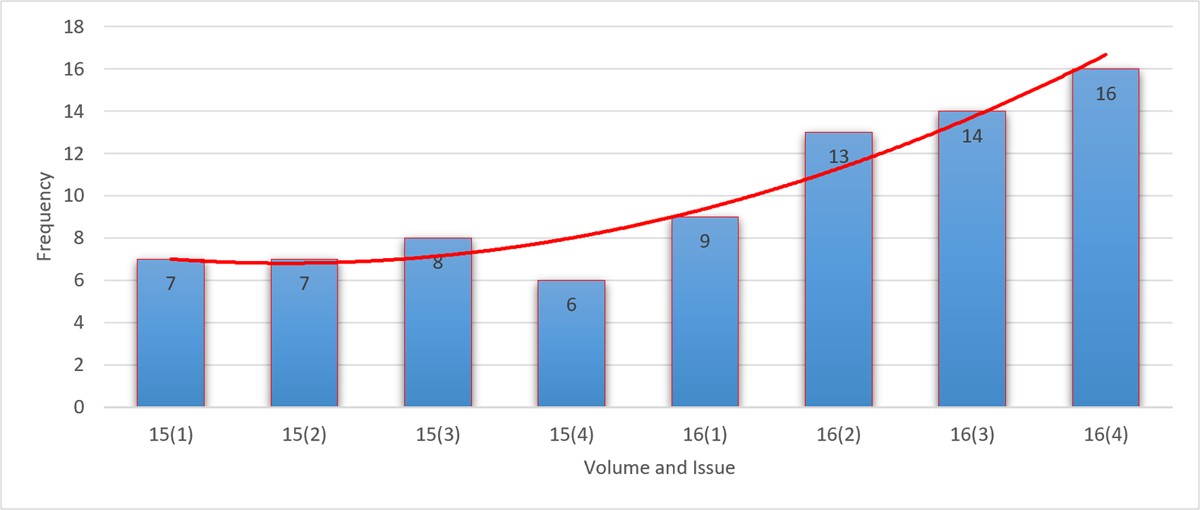
Figure 1
Number of publications by volume and issue between 2023 and 2024.
In terms of researcher involvement, a total of 284 individual scholars contributed to the 81 articles, further highlighting the collective and networked nature of contemporary academic publishing. The studies also demonstrated substantial conceptual breadth, employing 431 distinct keywords across the articles. This diversity of keywords suggests a wide-ranging engagement with various dimensions of openness, educational technology, and distance education. Furthermore, the articles collectively cited 3,366 references, illustrating both the depth and intertextual richness of the research landscape within Open Praxis during the examined period. Moreover, the relatively high number of references points to a strong engagement with existing literature (Small, 2018). In brief, the observed trends — growth in publication output, increased multi-authorship, diversity in thematic focus, and extensive citation practices — collectively paint a picture of a dynamic, yet increasingly complex scholarly ecosystem. These developments call for continued reflection on maintaining both the quality and the coherence of the journal’s contributions in alignment with its core philosophy of openness in education.
In terms of geographic distribution, researchers from a total of 38 different countries contributed to the articles published during the 2023 and 2024 (see Figure 2). The top contributing countries were the United States (n = 26), Türkiye (n = 20), Canada (n = 10), South Africa (n = 9), Germany (n = 8), China (n = 7), England (n = 6), Spain (n = 6), New Zealand (n = 5), Egypt (n = 4), the Netherlands (n = 4), and South Korea (n = 4).
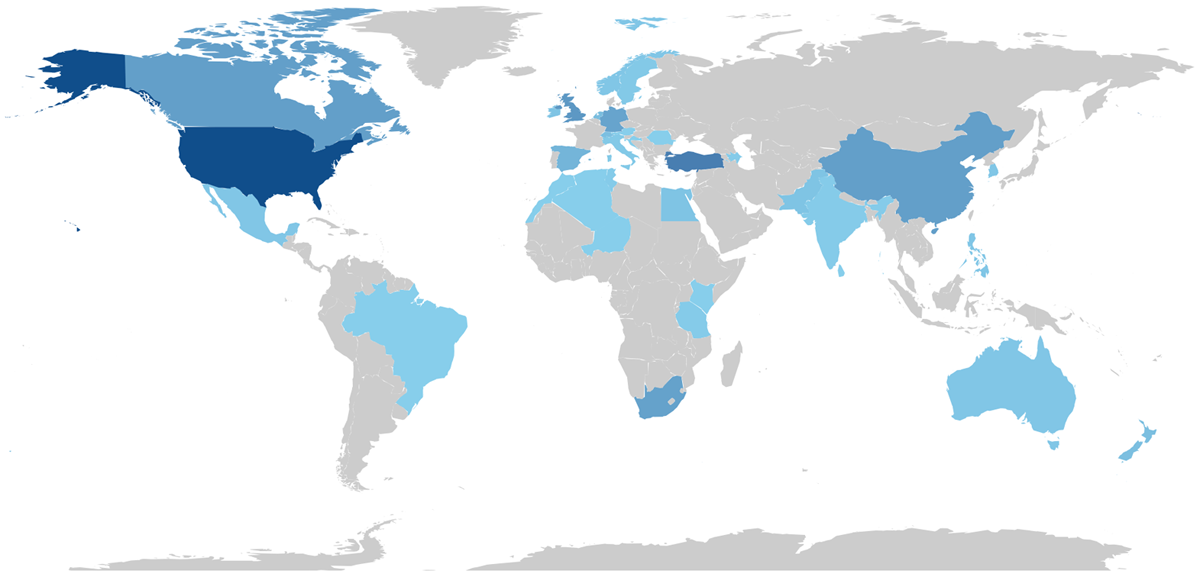
Figure 2
The geographical distribution of the contributing authors.
An evaluation of the countries represented reveals a generally broad continental distribution, indicating a degree of global participation. However, a closer examination suggests that scholarly contributions are disproportionately concentrated in specific countries and regions, particularly in North America, Europe, and parts of Asia. While this pattern reflects the strong research infrastructure and academic traditions present in these countries, it also highlights a relative underrepresentation from other global regions, notably Latin America, Sub-Saharan Africa (beyond South Africa), and parts of Southeast Asia.
An analysis of the studies published in Open Praxis during 2023 and 2024 in relation to the United Nations’ Sustainable Development Goals (SDGs) (United Nations, 2015) revealed that only 5 of the 17 goals were explicitly or implicitly addressed (see Table 1). Of all the articles included in the analysis, 81% were associated with at least one SDG. The most frequently addressed SDG was, expectedly, Quality Education (Goal 4), which appeared in 67.90% of the studies, followed by Good Health and Well-Being (Goal 3) at 13.5%, Peace, Justice and Strong Institutions (Goal 16) at 6.17%, Gender Equality (Goal 5) at 2.47%, and Reduced Inequalities (Goal 10) also at 2.47%.
Table 1
Associated SDGs in articles published in Open Praxis between 2023 and 2024.
| NO | SDGs | n | % |
|---|---|---|---|
| 04 | Quality Education | 55 | 67.90% |
| 03 | Good Health And Well Being | 11 | 13.58% |
| 15 | Peace And Justice Strong Institutions | 5 | 6.17% |
| 05 | Gender Equality | 2 | 2.47% |
| 10 | Reduced Inequality | 2 | 2.47% |
The 2030 Agenda for Sustainable Development outlines 17 interlinked goals that call for urgent action by all countries to promote prosperity while protecting the planet (United Nations, 2015). Given the thematic scope and mission of Open Praxis, it is expected that a strong emphasis would be placed on Goal 4 (Quality Education). Indeed, the prominence of this goal among the published studies aligns well with the journal’s focus on open, flexible, and distance education. Nevertheless, it is noteworthy that only four additional SDGs were addressed during the period under review, and that studies related to the remaining 12 goals were absent.
Critically, considering that education is inherently a social enterprise that intersects with numerous societal, environmental, and economic dimensions, the limited engagement with a broader range of SDGs represents a missed opportunity. Education has a transformative role in advancing goals such as Climate Action (Goal 13), Decent Work and Economic Growth (Goal 8), Industry, Innovation, and Infrastructure (Goal 9), and Sustainable Cities and Communities (Goal 11), among others. To more fully align with the global vision articulated in the SDGs and to strengthen its contribution to a sustainable future, Open Praxis could encourage and prioritize research that explicitly connects educational practices and technologies to a wider array of sustainable development challenges. Such an expansion would not only diversify the journal’s thematic reach but also position it as a leading venue for interdisciplinary scholarship addressing the complex interdependencies that define education in the 21st century.
Research Patterns
The triangulation method was employed to ensure the validity, reliability, and representativeness of the identified research trends (Denzin, 1978; Thurmond, 2001). Through the integration of multiple analytical techniques—including three-field plot analysis, social network analysis, and factorial analysis—the study systematically examined the metadata (titles, abstracts, and keywords) of articles published in Open Praxis during 2023 and 2024 (see Figures 3, 4, and 5). The use of triangulation strengthened the robustness of the findings by allowing the convergence of results from different methodological angles. Accordingly, the analyses revealed three major thematic clusters that characterize the scholarly discourse during the examined period.
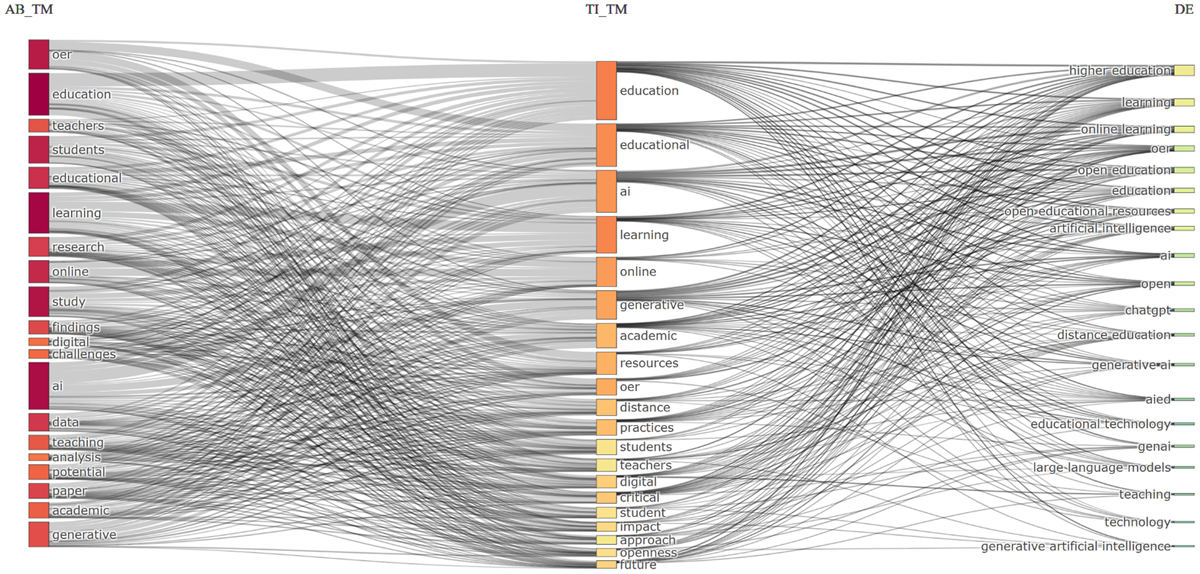
Figure 3
Three-field plot analysis of the titles, abstracts and keywords.
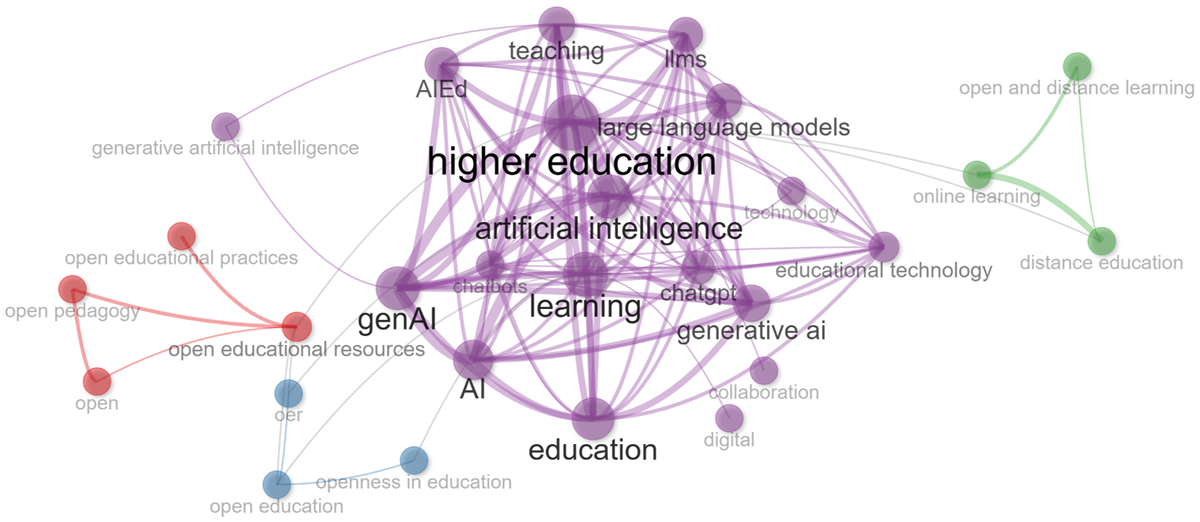
Figure 4
Social network analysis of the keywords.
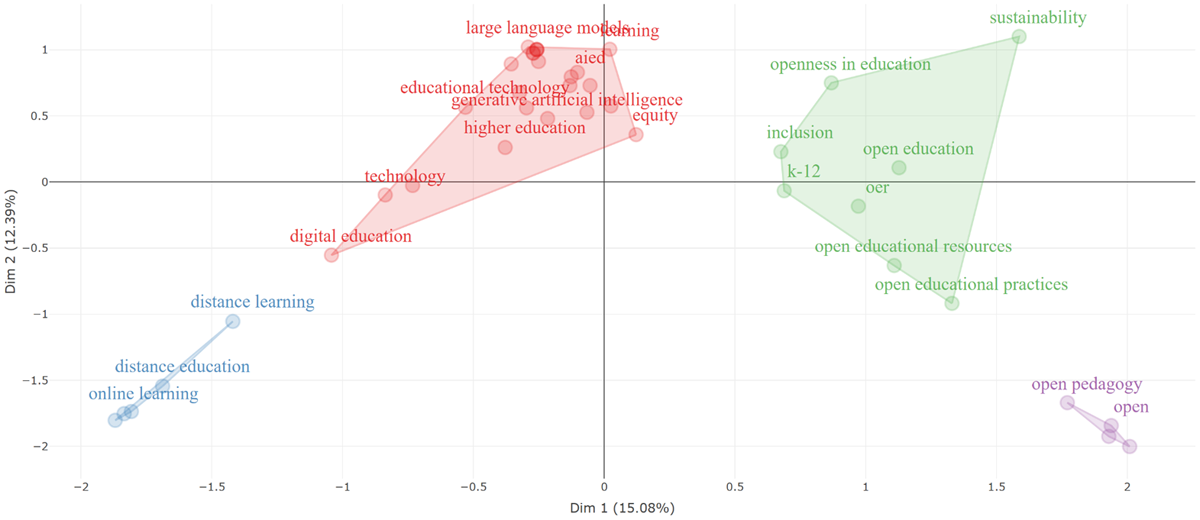
Figure 5
Factorial analysis of the titles, abstracts and keywords.
The first theme, “Openness in Education,” represents a macro-level understanding and encompasses key concepts such as teaching, learning, lifelong learning, higher education, openness in education, open education, Open Educational Resources (OER), and Open Educational Practices (OEP). This theme reflects the journal’s foundational philosophy and ongoing commitment to exploring theoretical and practical dimensions of openness in various educational settings.
The second emergent theme, “Technology-empowered Open and Distance Learning (ODL) Practices,” provides a meso-level understanding of how technological innovations are shaping the evolution of educational delivery. Concepts such as digital transformation, educational technology, online learning, and distance education were central within this cluster, highlighting the increasingly pivotal role of digital technologies in enhancing access, flexibility, and learner engagement in ODL contexts.
The third and final theme, “Human-AI Symbiosis and AI-powered Education,” was identified at the micro-level. This theme captures the growing scholarly focus on artificial intelligence applications in education, with concepts including artificial intelligence (AI), AI in education (AIEd), generative AI (GenAI), chatbots, and large language models (LLMs) becoming increasingly prominent. The emergence of this theme indicates a forward-looking trend, signaling the journal’s responsiveness to technological disruptions and its role in critically examining the implications of AI for learning, teaching, and educational institutions.
The distribution of these themes suggests that while Open Praxis continues to maintain its historical focus on openness, it is simultaneously evolving to engage with emerging technological trends, particularly the rise of AI in education. This thematic diversification not only broadens the journal’s scholarly reach but also positions it at the intersection of traditional open education paradigms and future-oriented technological transformations.
Conclusions and Implications
This study critically examined the evolution of Open Praxis over the period of 2023–2024, revealing both significant developments and emerging tensions within its scholarly ecosystem. While the journal demonstrated an increase in publication volume, greater collaborative authorship, and thematic diversification, these trends also raise important questions regarding the coherence, inclusivity, and future direction of its academic contributions. Although Open Praxis continues to affirm its commitment to the philosophy of openness, the growing emphasis on technological innovation—particularly in the domains of AI and digital transformation—risks overshadowing critical engagements with the social, ethical, and political dimensions of education.
The analysis of Sustainable Development Goals (SDGs) highlights a concerning pattern: despite the broad transformative potential of education across all 17 SDGs, the majority of published articles were concentrated narrowly around Goal 4 (Quality Education). This limited engagement suggests a missed opportunity for Open Praxis to position itself as a leading journal in addressing the complex, interconnected challenges articulated in the 2030 Agenda for Sustainable Development.
In light of these findings, several implications emerge. First, Open Praxis should adopt a more critical and expansive understanding of openness, one that foregrounds issues of equity, justice, and systemic transformation. Second, strategic efforts are needed to promote genuinely global participation, perhaps through initiatives such as mentorship programs or partnerships with regional scholarly networks. Third, while engaging with technological advancements is essential, the journal must remain vigilant against technocentric narratives that depoliticize education and reduce complex human-centered processes to technical problems with purely technical solutions.
Moving forward, Open Praxis is well-positioned to act not merely as a chronicler of educational change but as an active agent shaping a more inclusive, critical, and socially responsive vision for open and distance education worldwide. Achieving this, however, will require a conscious and sustained commitment to reimagining the very foundations of what openness means in a rapidly transforming world.
As Open Praxis navigates the complexities of a rapidly evolving educational landscape, it faces a crucial moment: the choice between simply adapting to emerging trends or critically leading the debate on what education should be in an era of digital transformation and global crises. Adopting a more critical, pluralistic and future-oriented understanding of openness is essential for the journal to fulfill its potential not only as a platform for research dissemination but also as a catalyst for systemic change. Only by holding openness accountable to these broader humanitarian principles can Open Praxis truly embody the transformative spirit it seeks to promote.
Data Accessibility Statement
The datasets used and/or analysed during the current study are available from the corresponding author upon reasonable request.
Sustainable Development Goals (SDGs)
This study is linked to the following SDG(s): Quality education (SDG 4), reduced inequalities (SDG 10), and Partnerships for the goals (SDG 17).
Acknowledgements
The editorial team of Open Praxis would like to express their profound gratitude to Professor Cevat Alkan, a pioneer in the field of Educational Technology in Türkiye. His visionary work and lifelong dedication to advancing educational technology, distance education, and open and distance learning have left an enduring mark on the academic community. As the editorial team, we recognize him as a role model whose invaluable contributions have shaped not only the field in Türkiye but also the broader landscape of open and flexible education. It is with deep respect and appreciation that we acknowledge his legacy in this work.
Competing Interests
The authors have no competing interests to declare.
Author Contributions (CRediT)
Aras Bozkurt: Conceptualization, methodology, formal analysis, investigation, data curation, visualization, writing—original draft preparation, writing—review and editing; Hasan Uçar; writing—original draft preparation, writing—review and editing. Serpil Koçdar; writing—original draft preparation, writing—review and editing. All authors have read and agreed to the published version of the manuscript.
Author Information
Based on Academic Integrity and Transparency in AI-assisted Research and Specification Framework (Bozkurt, 2024), the authors of this paper acknowledge that the paper was reviewed, edited, and refined with the assistance of DeepL, Google’s Gemini, and OpenAI’s ChatGPT (Versions as of April 2025), complementing the human editorial process. The human authors critically assessed and validated the content to maintain academic rigor. The authors also assessed and addressed potential biases inherent in the AI-generated content. The final version of the paper is the sole responsibility of the human authors.