
Introduction
Our world is changing. From the widespread adoption of technology to facilitate teaching and learning during the COVID-19 pandemic to the rise of artificial intelligence (AI), post-secondary education is being reimagined and reshaped. In essence, post-secondary education appears to be undergoing a digital transformation, which is “a series of deep and coordinated culture, workforce, and technology shifts that enable new educational and operating models and transform an institution’s operations, strategic directions, and value proposition” (Grajek & Reinitz, 2019, para. 2). The purpose of this study is to examine perceptions of the future, readiness for change, and feelings of optimism and pessimism through the lens of digital transformation.
The COVID-19 pandemic was a landmark moment in post-secondary education in Canada and the USA. Although the rapid transition to emergency remote learning was wrought with challenges, it sparked overall growth in online and hybrid course offerings that continued after health restrictions were lifted (Janzen & Pizarro Milian, 2023a; Garrett et al., 2023). During the pandemic, many administrators, faculty, and students in these countries became more comfortable using technology in educational contexts, which has led to a greater demand for flexible, technology-supported learning among students. Lockee (2021) predicted that online education would find new audiences and that there would be a greater demand for more offerings that incorporate the flexibility that online learning affords as a result of the pandemic. As our new learning landscape takes shape, it is apparent that technology-integrated learning will play a far more prevalent and pervasive role than pre-pandemic.
In late 2022, the launch of ChatGPT, and its widespread adoption by students in Canada and the USA (Janzen & Pizarro Milian, 2023b; Shaw et al., 2023), has also raised questions for post-secondary education, particularly regarding traditional forms of assessment and academic integrity. These questions are not unique to Canada and the USA: scholars globally are discussing and debating the benefits and challenges of AI as it pervades systems of higher education (Peters & Green, 2024). Once again, institutions have had to quickly adapt to a major disruptor in the teaching and learning landscape. Adapting to disruptive change can feel akin to “juggling with a blindfold on” (VanLeeuwen et al., 2021, p.1314) and the need to manage change after change keeps impacting those who work at post-secondary institutions.
Considering the changes to teaching and learning practices brought about by the pandemic, and the potential impacts of the growing influence of AI, one may wonder whether those working on the front lines of post-secondary education expect a sense of stability soon or ongoing change going forward.
To better understand the range of perspectives about the future within post-secondary education, this study investigates the following research questions:
To what extent do those working at post-secondary institutions expect post-secondary education to change over the next five years compared to the present state?
Do they feel ready for the changes that the future might bring?
Are they feeling optimistic or pessimistic about the future?
Literature
Our study explores perceptions of the future through a lens of digital transformation. The term digital transformation has been in use for over two decades and carries a broad range of meanings within the literature (Gong & Ribiere, 2021). For this study, we used the definition put forth by Grajek & Reinitz that described digital transformation as shifts in culture, workforce, and technologies. In this section, we will examine the literature related to imagining the future, preparedness for the future, and feelings about the future, particularly as they relate to technology shifts. The selected literature primarily focuses on post-secondary education in Canada and the USA as that is the context for this study.
Both Bay View Analytics and the Canadian Digital Learning Research Association (CDLRA) have conducted numerous studies on the impact of digital learning in post-secondary education (Bay View Analytics, n.d.; Canadian Digital Learning Research Association, n.d.). Findings from these studies, such as trends toward more online and hybrid learning experiences (e.g., Irhouma & Johnson, 2022; Seaman & Seaman, 2022) are consistent with other studies examining current trends (e.g., Garrett et al., 2023). For example, Bozkurt et al. (2022) conducted a meta-narrative review of scholarly publications to explore the impact of the pandemic on education. One of the thematic patterns that they found was the expectation that technology use in teaching and learning would persist in a post-pandemic era, after becoming essential and widely used across the globe as part of the pandemic response. In their study of pedagogical practices used in 2019 compared to those used in 2022–23, Broadbent et al. (2023) reported an increase in online learning activities and a change in pedagogical practices to some extent among most participants. As a whole, the literature indicates that there has been a change in practices and that there is an expectation of continued change in the post-secondary education, especially as it relates to technology use. In other words, higher education appears to be in a state of digital transformation.
Imagining the Future
For years, scholars have pondered how the future of post-secondary education might unfold, especially when juxtaposed with technological advancement (e.g., Kim & Bonk, 2006; Educause, 2023). From the use of speculative methods to imagine a variety of future possibilities (e.g., Conrad & Wiebe, 2022; Costello et al., 2020; Houlden & Veletsianos, 2023; Ross, 2017) to more conventional methods (e.g., surveys, interviews) asking participants to share their thoughts about what might happen in the near future (e.g., Veletsianos & Johnson, 2022; Watermeyer et al., 2021), the literature is rich with discussion about potential post-secondary futures. In discussing the purpose of imagining the future, Facer and Sanford (2010) cited Bell (1997) writing that that “futures research can best be understood as an attempt to explore the relationships between ‘possible, probable, and preferable’ futures.” They added that, “the first task of futures research must necessarily be to critique the assumption that there is an inevitable future to which we must simply adapt or resist” (p. 76).
In general, speculations and predictions about the future of post-secondary education point to scenarios that are different, sometimes vastly different, from the now. Yet, it is important to remember that speculations are more useful as a tool for gaining insights about our present state than as reliable predictors for determining what is to come. During the pandemic Eringfield (2021) interviewed a small group of students and academics within the field of education to explore their perceptions of what a post-COVID future might entail. He found that while respondents described “a plurality of possibilities,” their hopes and fears tended to relate to “pre-existing issues in HE [higher education] such as marketization, exclusivity, and disembodiment” (p.155). There is an ongoing sense of tension between innovative change and maintaining the status quo however, the notion that the future will be different to some extent prevails.
Preparedness for the Future
There is a dearth of research exploring faculty and administrator preparedness for adopting new ways of teaching and learning. The literature is rich with discussion about faculty acceptance of technology (e.g., Wingo et al., 2017) and faculty experiences using new technologies (e.g., Conrad, 2004, Majors, 2010; Van Leeuwen et al., 2021). At the same time, there are a plethora of publications that detail what institutions need to do and teach in order be future-ready (e.g., Aoun, 2017; Grajek & Reinitz, 2019; Veletsianos & Houlden, 2020). For example, Aoun (2017) wrote that institutions must shift to an interdisciplinary approach in their educational programs, with an emphasis on creative thinking and relationship skills in order to be “robot-proof” (which is the title of his book). Similarly, Grajek & Reinitz (2019) outlined expected shifts to post-secondary education as a result of digital transformation and provide recommendations for navigating and supporting change. Veletsianos and Houlden (2020), argued the need for radically flexible systems of education to ensure resilience amidst the many forces (they emphasize the climate crisis, as an example) impacting institutions today. Gauging whether faculty and administrators actually feel prepared as a result of their experiences with technology and the resources on digital transformation available to them, is an important question that we seek to answer in this study.
Feelings about the Future
Our present study builds on previous work done jointly by the CDLRA and Bay View Analytics within the first year of the COVID-19 pandemic (Johnson, 2020; Johnson & Veletsianos, 2020; Johnson et al., 2021). Together, the organizations conducted surveys that asked about feelings of optimism and pessimism about the future of post-secondary education. In the first few months of the pandemic, Canadian and US participants showed similar optimism about the overall future of post-secondary education (48% of Canadian participants reported optimism, as did 46% of US participants). By the fall of 2020, however, a second survey in Canada showed that 69% of Canadian respondents reported feelings of optimism, and only 15% reported feelings of pessimism. Given the current expectation for ongoing change, Bay View Analytics and the CDLRA collaborated to investigate not only current perceptions about the future of higher education, but the associated sense of preparedness and accompanying feelings of optimism and pessimism as well.
Research conducted by Veletsianos and Johnson (2022) also provides insight into feelings about the future. They interviewed Canadian faculty members to identify hopes and anxieties about the near future (five years) of post-secondary education and found that factors such as supports (e.g., government, institution, societal), external matters beyond faculty control (e.g., the sociopolitical landscape, institutional governance) and a desire for positive outcomes (for students and more broadly), impacted faculty feelings of hope and anxiety. Our current study extends this research further and aims to understand why participants might feel optimistic or pessimistic about the next five years.
Methods
In Spring 2023, the CDLRA and Bay View Analytics partnered to conduct a study that sought to explore perceptions of the future, perceptions of readiness for future changes, and feelings of optimism or pessimism about the future within post-secondary education.
Research Method
A survey research design was used and data for this study were collected through two surveys: one conducted in Canada by the CDLRA and the other conducted in the USA by Bay View Analytics. The two organizations worked in partnership, and the same questions about future perceptions were asked in both surveys, with one additional question asked in the USA. The surveys used a mixed methods approach, asking multiple choice (quantitative) and open-ended (qualitative) responses.
Data Collection Tools
The questions posed to the Canadian group participants were part of a larger survey on digital learning trends that targeted individuals in various roles (e.g., senior administrators, deans and directors, teaching and learning leaders, educational developers, and faculty) at post-secondary institutions across Canada. In the USA, the survey questions were administered as a standalone short survey targeting post-secondary faculty nationwide. USA participants were asked an additional question in their survey about optimism-pessimism for their personal future in post-secondary education, which was excluded from the present study. In total, four questions were asked in both surveys, enabling a cross-country comparison. The first three questions were multiple choice, and the fourth question provided participants with the opportunity to give an open-ended response.
Survey questions asked in Canada and the USA:
How different do you think post-secondary education will be from the present state in 5 years’ time?
Do you feel ready for the changes that the future might bring to your institution?
Considering the current situation, are you optimistic or pessimistic about the overall future of higher education over the next 5 years?
In a few sentences, please describe your reasoning for your choice [pertaining to optimism-pessimism].
Research Group
The surveys conducted in Canada and the USA captured the perspectives of three groups: 1) 254 institutional administrators and staff from colleges and universities across Canada (e.g., senior administrators, deans and directors, teaching and learning leaders), 2) 116 university faculty from the Maritime provinces of Canada (Nova Scotia, New Brunswick, and Prince Edward Island) –the other regions of Canada did not have a sufficient response to support a faculty-specific analysis, and 3) 224 college and university faculty from across the United States.
Research Procedures
Quantitative
The quantitative data was gathered from three survey questions asking participants their views on the extent they expected post-secondary education to change over the next five years if they felt ready for the changes that the future might bring, and whether they felt optimistic or pessimistic about the future. In Canada, 116 Maritime faculty and 254 administrators and staff provided responses. In the USA, 234 faculty responded. In total, 604 participants provided responses for analysis.
In Canada, the questionnaires were provided in both French and English, and in the USA, the questionnaires were only provided in English. Participants in the USA were invited to participate using a direct email invitation sent to a random sample of teaching faculty, defined as those teaching at least one course. The sample was designed to represent the full range of degree-granting higher education institutions in the USA. To ensure informed consent, all survey invitations included complete information about the project’s nature, the organizations involved, and how the data would be collected and shared. The sample was checked to remove all those who had opted out from any previous research project by the participating organizations. Links to full privacy policies were also provided to all potential survey participants.
Invitations in Canada were delivered by direct emails to those who had agreed to be included on the CDLRA survey roster, which covers all publicly supported post-secondary Canadian institutions. Canada also employed a secondary outreach effort using multiple academic partners who sent a survey invitation to their members and shared the survey link on social media. A link to a letter of information was attached the email and a link to the letter of information was included on the first page of the survey. The first page of the survey informed participants that by clicking “next” to start the survey, they were providing their consent.
Qualitative
The qualitative data was gathered from the open-ended survey questions asking participants to describe their reasons for optimism or pessimism. In Canada, 59 Maritime faculty and 108 administrators and staff provided comments. In the USA, 77 faculty provided comments. In total, 244 participants provided comments. The only edits to respondents’ comments were to correct obvious typos and to mask any personally identifying data. Only those responses where the participant provided permission to be quoted are included in this paper.
Validity and Relaibility Measures
For the quantitative analysis, all three datasets were checked for potential duplicate responses. All three surveys used the same coding system for all questions to facilitate comparisons. For the qualitative analysis, one researcher sorted the comments: first by group, next by perceptions of the future, then by feelings of preparedness, and finally by feelings of optimism, pessimism, or neutrality. That same researcher then performed a constant comparative analysis (Glaser & Strauss, 1999) to generate a list of codes, which were then sorted into overarching themes. The two other researchers reviewed the analyses to reduce bias, and ensure rigour and consensus.
The survey questions analysed in this report are based on questions asked in previous surveys conducted by the CDLRA and Bay View Analytics. The CDLRA asked these questions as part of a larger survey and the full survey instrument was validated by other scholars and organizational partners with experience in digital learning research in the survey design stage. The specific questions used for this research were developed and tested on several prior research projects. The initial design and testing were conducted with Cengage, the Association of Community College Trustees, the Association of College and University Educators, the United States Distance Learning Association, and CollegePulse. Several revisions were made to the initial wording based on feedback and testing.
Limitations
This study is exploratory in nature and the researchers designed it with the intent to generate initial findings that could be used as a springboard for more in-depth studies. The findings from this study are not generalizable, and we recommend further research using different sample populations to test whether certain groups hold differing perceptions about the future. The findings from this study highlight the need to be cognizant of differences between countries and cultures. We recommend that future studies explore these questions across countries and across institutional roles.
Findings and Discussion
The survey results provide insight into faculty perceptions of the future, their preparedness for anticipated change, and their feelings of optimism or pessimism. The quantitative (multiple choice) findings are presented first, followed by a detailed discussion of the qualitative (open-ended) survey responses.
A Different Future
To determine the extent of digital transformation expected by participants, the American and the Canadian surveys asked how different participants thought post-secondary education would be from the present state in 5 years’ time (see Figure 1). The vast majority of participants reported that they anticipate further change to some extent. The three groups did not differ much in terms of their responses. Although Canadian administrators and staff and USA faculty were most likely to imagine a very different future (28% of participants in both groups), the most common response in all groups was a “somewhat different” future. Very few participants envisioned a future that is the same as now.
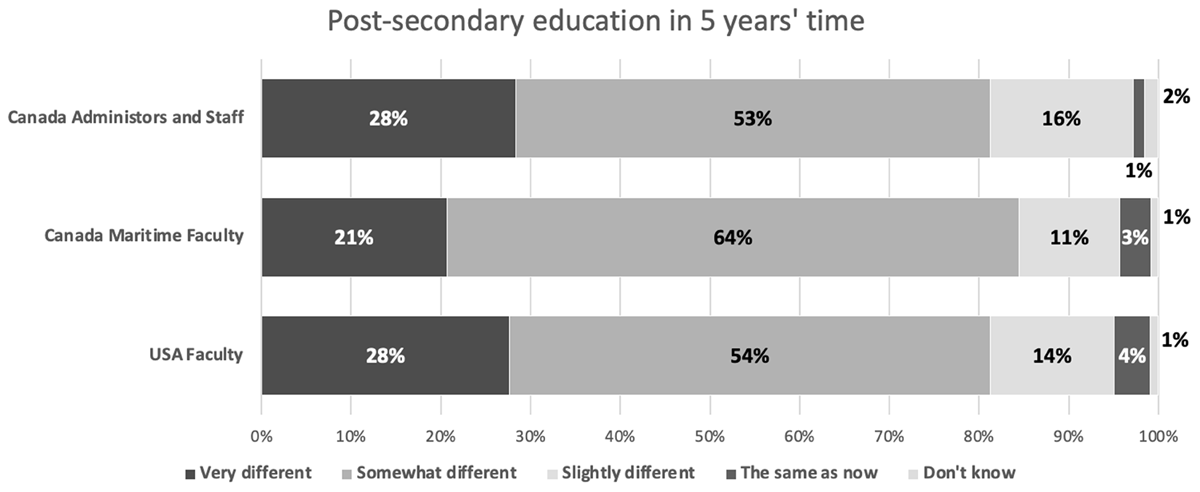
Figure 1
How different will post-secondary education be from the present state in 5 years’ time?
Feelings of Preparedness
In response to the question about readiness for the changes that the future might bring to their institution, most participants reported that they felt ready or somewhat ready. Canadians reported slightly higher feelings of readiness than their counterparts in the USA (see Figure 2).
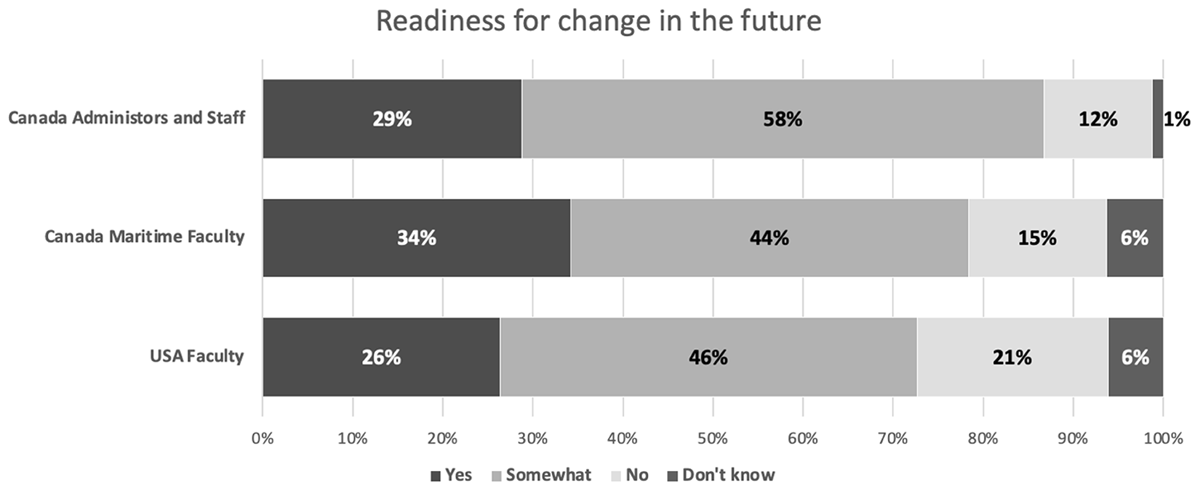
Figure 2
Do you feel ready for the changes that the future might bring to your institution?
Feelings of Optimism/pessimism
The responses to the feelings of optimism and pessimism showed the largest contrast between the groups (see Figure 3). Canadian administrators and staff were, by far, the most optimistic about the future of higher education, with two-thirds of participants in this group reporting optimism. Canadian Maritime faculty were less optimistic than their administrative counterparts, with just under half of these participants expressing optimism. USA faculty were least optimistic and most pessimistic, with slightly more than one-quarter of participants expressing optimism and just under half expressing pessimism.
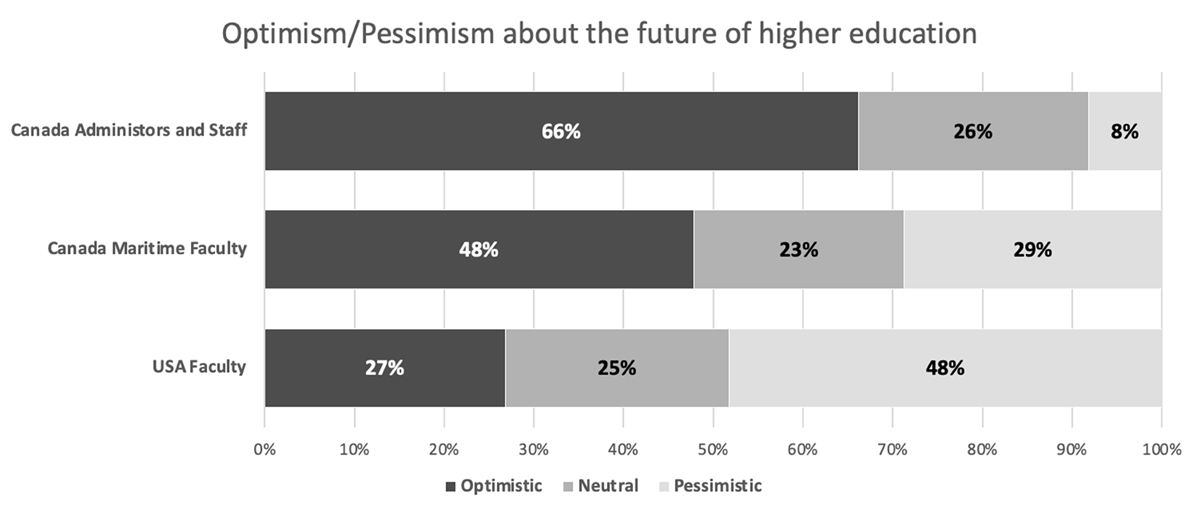
Figure 3
Are you optimistic/pessimistic about the overall future of higher education over the next 5 years?
During the qualitative analysis, the open-ended responses were sorted by participant group and by participants’ corresponding responses to the multiple-choice questions. This enabled the researchers to connect comments with participants’ feelings of optimism or pessimism while identifying which participant group they represented. Overall, participants from the USA did not share any unique responses that would provide an explanation for their greater sense of pessimism. Regardless of whether they were optimistic or pessimistic, their reasons tended to be the same as their Canadian counterparts, just with a higher incidence of pessimism.
Reasons for Optimism/pessimism
The responses to the question, “In a few sentences, please describe your reasoning for your choice above,” provided insight into why participants felt optimistic or pessimistic (or neutral). Of the 244 comments provided by the three participant groups, the researchers deemed 239 as relevant and included these comments in the analysis. The comments deemed irrelevant included responses that thanked the research team for doing this work or gave opinions about the survey instrument. Within the relevant comments, six themes emerged: adaptability, AI, change, institutional issues, students, and systemic issues. Although the themes are distinct, there is some overlap, given the interconnected nature of the issues mentioned in the responses. Each response was placed into the theme that fit best with its focal point, even though the comment may touch upon aspects of another theme (e.g., adopting new practices is one way institutions adapt to change; however, this may also overlap with the theme of students, particularly their needs and desires). An overview of each theme is presented in Table 1, along with the total number of comments (N) that fell within that theme.
Table 1
Common Themes.
| THEME | DESCRIPTION | N |
|---|---|---|
| Adaptability | An individual’s or institution’s ability to adapt to new technologies or institutional/societal demands. Some respondents also described adaptation through adopting new teaching practices or course delivery options. | 20 |
| Artificial intelligence (AI) | Thoughts and opinions about AI (e.g., its role, concerns with AI use, opportunities for AI to improve teaching and learning). | 17 |
| Change | Thoughts and opinions about changes that have occurred or might occur in the future, including comments about the potential for positive change and resistance to change | 74 |
| Institutional issues | Thoughts and opinions related to leadership, faculty burnout, institutional constraints, and support. | 15 |
| Students | Thoughts and opinions related to students including student competencies, student outcomes, and student well-being. | 30 |
| Systemic issues | Complex issues that impact the post-secondary system as a whole, including corporatization, funding, politics, and the role of post-secondary education. | 71 |
Additionally, 12 responses did not fit into any categories and were coded as “other.” Several participants commented on the fact that they would be retiring soon. Other participants wrote short, vague statements such as, “I’m always optimistic” and “It is unanswerable because it is an unknown future.” Two participants explicitly stated that the climate crisis impacted their feelings about the future (one participant expressed pessimism and the other neutrality).
Adaptability
The participants who made comments related to adaptability were overwhelmingly optimistic. Administrators and staff spoke of their institution being “well poised to move forward quickly and innovatively” and having “a lot of smart staff and students who care about improving and enhancing post-secondary and will continue to adapt and grow in response to future trends.” Remarks made by faculty participants also reflected a sense of hope and belief that their institutions and colleagues would adapt to whatever the future might bring. One faculty participant wrote, “Universities have a long record of adapting and surviving.”
AI
The responses within the AI category carried a mix of optimistic and pessimistic sentiments about AI. For instance, one participant who reported feeling optimistic about the future of higher education wrote, “AI holds the promise to reduce paperwork and will also increase the value of critical thinking, thus raising the bar in education,” while another who reported feelings of pessimism said, “students will only need to take one course titled: How to properly ask artificial intelligence a question.” Other comments that touched on AI but situated it within a myriad of other issues were categorized into other themes that best fit the central focus of the response (e.g., change, systemic issues).
Change
Many participants mentioned change as a reason for their optimism or pessimism. Most participants who talked about change felt optimistic about the future. Optimistic participants noted opportunities to adopt new practices and the potential for positive change. Several comments from participants who anticipate a very different future illustrate this sense of optimism:
The pandemic and now artificial intelligence (AI) have relentlessly shone light on the need for well-developed learning outcomes, aligned authentic assessments and for accessibility. This has been excellent for post-secondary education. I have seen the kind of change and response that I never thought I would in my life, e.g. full adoption of the Learning Management System, the questioning of proctoring with AI, more flexibility, advances in accessibility.
Times are changing. Higher Education has an opportunity to address long-standing inequities by providing a more accessible mode of course delivery. This is also a great opportunity for higher education to invest in open access and open educational resources to help address the financial burden many students face with access to information.
I think that current constraints and the learning needs of students will force universities to rethink current teaching methods and formulas. It is not normal that the majority of courses are taught in exactly the same way as twenty years ago!
Participants who felt pessimistic about the future of post-secondary education tended to give responses that centred on a couple of key reasons: an inability to meet students’ needs and resistance to change. For example, one participant said, “The pandemic has changed the students’ learning and expectations in ways that we cannot yet understand or adapt to meet.” Other participants talked about how resistance to change could harm post-secondary education going forward:
Universities continue to press for an educational format that has been in place for centuries. It has always worked—yes. But the students are different. They face challenges never experienced by the faculty. We do not know how to respond. We do not know how to adapt. The tried and true method/format is no longer effective and yet universities cannot break the old cycle to meet the changing educational needs of the students. In essence, we are killing ourselves quickly.
The world has changed very quickly in the last few years and it continues to evolve rapidly. Student and employee expectations have changed, but my university is trying to go back to pre-pandemic times with all employees and students on campus/in person 100% of the time. This isn’t realistic or competitive. In general, I think students are seeing less and less value of university education and many are turning to community college and other paths for future employment and financial security.
Overall, participants felt mostly hopeful that any changes to post-secondary education, either in the recent past or coming up in the near future, would bring about opportunities to innovate and enhance teaching and learning. As one participant wrote:
I feel that COVID-19 has forced us to look at education and how it’s delivered more closely. It has challenged our traditional thoughts around how people should be educated and opened our minds to what is possible. It was a steep learning curve, but it has created a more flexible learning environment in many cases. I feel the flexibility in program delivery will lead to a larger population of individuals gaining access to education when they may not have seen it as an option before.
Institutional Issues
Comments within the theme of institutional issues included topics related to leadership and support, rigidity within the institution, and faculty burnout. Again, responses reflected optimistic and pessimistic feelings about the future. For instance, one optimistic participant who discussed leadership described their dean as a “visionary” and added that their dean’s leadership style “is pivotal to be in line with the societal trend of increasing technology.” Other participants felt more disillusioned with the leadership at their institution and spoke of a disconnect between the administrative objectives and the day-to-day realities faced by faculty. A couple of participants discussed different aspects of support within their institution, including faculty support and the importance of having “a strong and dedicated teaching and learning team that is well-supported by other areas at the college.”
Participants also mentioned faculty burnout and rigid structures within the institution as reasons for pessimism, although two participants who spoke directly about institutional constraints felt optimistic overall. One participant stated that they felt mostly optimistic about their institution’s ability to meet future needs but was not very optimistic “because the structures are still very rigid to take advantage of these opportunities and to adjust to this demand.” Two participants explicitly mentioned faculty burnout as a factor that either reduced their feeling of optimism (e.g., “I am neutral because I am unsure what can be realistically done by admin to relieve faculty burnout”) or contributed to a feeling of pessimism.
Students
Over half of the participants’ comments about students focused on student competencies. The other student-related comments touched on issues like student outcomes, student preferences, and student well-being. Nearly all the participants who made comments related to student competencies felt pessimistic about the future of post-secondary education, whereas the participants who talked about other student issues had a mix of feelings about the future.
Comments related to student competencies tended to centre on a lack of preparedness among students for the academic rigour of a post-secondary learning experience. One participant remarked that they were “surprised by the students entering university (poor writing skills, interpersonal skills),” and another said that they were “unable to teach at what I consider a university level” due to students’ lack of capability. Several participants called for changes at the K-12 level of education to better prepare students for the post-secondary experience. One person shared that they “have been asked by admin to make unethical changes to a transcript,” while another noted that students “have very high expectations for accommodating every slight inconvenience they encounter (“it is too cold outside to walk to campus today so I would like to have a make-up midterm” for example).”
Student-focused comments unrelated to competencies included mentions of student outcomes and well-being. One participant talked about anecdotal conversations with recent graduates who “can’t find a job in a field they spent four years learning about and having to go back to school for a different degree.” Another indicated that higher education provided students with positive employment outcomes, saying:
Employers are looking for employees that have advanced education and can be held accountable for the work that is being completed within the job environment. Higher education gives the students (learners) the ability to achieve these higher-level skill sets and abilities.
Other participants commented that mental health issues were a major problem for students, with one person noting that “mental health issues in first-year classes have increased dramatically compared to pre-COVID.” Another wrote, “I think the issues PSE will face will not be so much about digital learning/capacity but more about the emotional, mental health and wellbeing of our students.”
Systemic Issues
Comments relating to systemic issues were mostly associated with feelings of pessimism. Some participants focused on a single issue in their responses (e.g., corporatization of post-secondary, funding, politics) while others described an interplay of multiple negative factors impacting their feelings about the future of post-secondary education, as seen in the comment below:
Reduced or stagnant government funding, more aggressive government policies and claw backs, technology challenges (costs, defending against cyberattacks, all challenges for a small institution), challenges attracting faculty and staff to small, rural communities (for programs that require face-to-face instruction at least part of the time).
Regarding corporatization, several participants stated concerns about post-secondary education becoming more like “businesses that offer ‘experiences’ rather than ‘education’.” transaction or “in effect: money money money jobs jobs jobs, and maybe learn something, in that order.” One participant said, “We’re continuing on a neoliberal trend where education is not valued. Credentialing is the only important thing.” Another participant wrote, “My pessimism mainly started since the time that educational institutions turned to businesses and lost their compass.”
The political climate also impacted feelings of optimism and pessimism among participants, with concerns expressed by some about ideologies infiltrating post-secondary education from the far right and the far left. One participant remarked, “I also perceive an increasing resistance to open-mindedness, tolerance, and free, but respectful, discussion of controversial issues. I’ve also seen a decline in the level of intellectual and ideological diversity among the faculty since I began teaching.”
Lastly, several participants commented on the overall role of post-secondary education in society. These participants reported feeling mostly optimistic about the future. As one participant said, “Universities are sites of transformation. Transforming knowledge, transforming lives, and creating possibilities where none existed before. Despite disruptions and political pressures, universities are optimistic spaces.”
Conclusion, Implications, and Suggestions
The findings from this study build upon the existing literature and primarily contribute to the field by identifying reasons for optimism and pessimism during a time of digital transformation. Our study also provides evidence to support the notion in the literature that the near future will differ from the present state and fills a gap in the literature by providing insights on faculty and administrators’ feelings of preparedness for ongoing change.
Expectations of Change and Feelings of Preparedness
Our findings align with the common sentiment expressed in the literature: that notions about what might happen in the future tend to be different from the now. Similarly, very few survey participants in Canada and the USA envisioned that post-secondary education would be the same in five years’ time. Rather, most participants expected the near future to be different to some extent with roughly one-quarter imagining a future that is very different. Similarly, within the literature, scholars tend to imagine a future in which technology will create significant shifts in how we work and learn (Conrad & Wiebe, 2022; Costello et al., 2020; Veletsianos & Houlden, 2020).
Specifically, digital transformation includes shifts in culture, workforce and technology (Grajek & Reinitz (2019). Both Bozkurt et al. (2022) and Broadbent et al. (2023) found that technology use and online learning practices are expected to continue in the post-pandemic context. Similarly, underlying participants’ reasons for optimism or pessimism was the expectation that technological innovation in post-secondary education would continue. Participants spoke of technologies impacting the academic culture and workforce (e.g., the impact of AI on how faculty teach and how students prepare themselves for future careers). A sense of optimism was expressed among participants who believed their institution could adapt to future trends and technologies.
The findings from this study also support the call made by Veletsianos and Johnson (2022) for an emphasis on hopeful futures. Although the challenges brought about by the COVID-19 pandemic may have spurred dystopian imaginings (e.g., Costello et al., 2020), participants in the study gave many reasons for an optimistic outlook (e.g., a sense that their institution could adapt to change, the potential for digital transformation to bring about positive change, and confidence in institutional leadership).
Prior to this study, literature discussing preparedness for the future tended to focus on what institutions should do to prepare (e.g., Aoun, 2017) and not whether those who work in post-secondary education feel prepared for future changes. Our study provides evidence to suggest that most faculty and administrators feel prepared to some extent for future change. Given that many imaginings about the future carry a dystopian or negative tone (Houlden & Veletsianos, 2023), the sense of readiness for change was a surprising finding; however, our study did not investigate how individuals operationalized the concept of preparedness, nor did we identify contexts, tasks, or practices that helped some participants feel more prepared than others. More research is needed to further investigate the nuances related to feelings of preparedness amongst those who work in post-secondary education.
Optimism, Pessimism, and Digital Transformation
Whereas perceptions about the future and subsequent readiness were similar between the two countries, there was a substantial difference in optimism versus pessimism. Both Canadian participant groups were much more optimistic about the future of post-secondary education compared to the USA participants. Further, the qualitative analysis did not reveal any distinct reasons for the greater sense of pessimism within the USA group. The higher prevalence of USA participant comments within themes that corresponded to pessimism may be indicative of contextual differences between Canadian and American cultures that cause pessimistic feelings to be more pronounced. More research is needed to further explore the higher prevalence of pessimism among participants from the USA.
Understanding the prevalence of optimism and pessimism and the accompanying reasons is important for fostering a sense of hopefulness about digital transformation. The literature on technology use in post-secondary education provides ample evidence that a digital transformation of our educational systems is taking place; however, the research on faculty and administrators’ feelings about ongoing digital transformation is limited. Similar to the findings presented by Veletsianos and Johnson (2022), participants who reported optimistic (or hopeful) feelings described feeling supported and well-positioned to adapt to change. Optimistic participants also focused on the benefits of change and the opportunity to improve the educational experience for students. Participants who felt pessimistic about the future of post-secondary education tended to describe factors beyond their control, such as institutional or systemic constraints that impacted their ability to meet student needs, the political climate, or students being inadequately prepared. This also aligns with Veletsianos and Johnson’s finding that if one feels they are “lacking the agency and ability to influence change” (p.16), it corresponds to feelings of anxiety (or pessimism).
Final Thoughts
Overall, this study found that participants expect the future to be different from the present and are feeling ready to some extent for these changes. Feelings of optimism and pessimism varied by country for reasons that are not overly clear but might be explained by contextual factors unique to the differences between Canadian and US culture and policies. Overall, feelings of optimism related to adaptability, perceived benefits of change, and feeling supported. Feelings of pessimism related to factors beyond one’s control, including politics, student competencies, and institutional or systemic problems. Longitudinal research, asking these same questions over several years, would be beneficial for understanding whether perspective on anticipated change, feelings of readiness, and optimism or pessimism about the future are shifting as technological advances and crisis events (e.g., pandemics, climate change, political unrest) impact post-secondary education.
Thus, we conclude by answering the question posed in our title: is the future hopeful? Our study shows that some participants are very hopeful indeed, while others have a bleaker outlook. Digital transformation clearly holds the potential for wonderful possibilities, as evidenced by participants’ reasons for optimism. Yet, the more pessimistic responses also serve as important indicators of areas where attention and improvement are needed. The reasons for optimism or pessimism also shed light on the possible advantages or disadvantages of technological innovation. Facer and Sandford (2010) cautioned against imagining or assuming an inevitable future and we respond to our question in the affirmative: yes, the future is hopeful because it is malleable. Research on feelings about the future provides important insights to guide us in charting a course to a preferable future. Taking all this into consideration, we remain hopeful that post-secondary leaders and educators are becoming increasingly aware of the pros and cons of digital transformation and will reshape our educational system to be well-positioned to navigate whatever changes the near future may bring.
Data Accessibility Statement
The CDLRA and Bay View Analytics do not share raw data as per their confidentiality and privacy protocols. Both organizations provide deidentified qualitative data (in which the survey respondent has given permission to quote their comments) and aggregated quantitative data to researchers upon reasonable request.
Ethics and Consent
The CDLRA and Bay View Analytics follow stringent ethics protocols within their own organizations and are not required to gain approval from an institutional ethics review board. Both organizations use a variety of measures to ensure that confidentiality and privacy protocols (including password-protected devices, documents, and research software to ensure that any identifiable information is stored securely) are followed according to best research practices established by each country. Both organizations limit the number of researchers who can access identifiable data to an essential minimum for every project they undertake. Protocols for ensuring informed consent are described in the methodology section of this paper.
Acknowledgements
As a non-profit organization, the CDLRA thanks the following the sponsors and partners for supporting our organization in 2023: eCampusOntario, D2L, BCcampus, Campus Manitoba, Maritime Provinces Higher Education Commission, Contact North, Québec Ministry of Education, Bay View Analytics, Academica Group, and WCET. This support made the CDLRA research efforts possible. Bay View Analytics thanks the organizations that supported previous projects in developing and validating the survey instrument, including Cengage, the Association of Community College Trustees, the Association of College and University Educators, the United States Distance Learning Association, and CollegePulse.
Funding Information
The CDLRA received financial funding to support their 2023 research efforts, including all survey efforts from the following organizations: eCampusOntario, D2L, BCcampus, Campus Manitoba, Maritime Provinces Higher Education Commission, Contact North, Québec Ministry of Education. Bay View Analytics did not receive funding for this project.
Competing Interests
The authors have no competing interests to declare.
Author Contributions
All three authors contributed to the conceptualization, investigation, methodology, resources, validation, and review and editing. Nicole Johnson and Jeff Seaman contributed to the formal analysis and project administration. Nicole Johnson contributed to the funding acquisition (for the Canadian portion of the project) and the writing of the original draft. Jeff Seaman contributed to the data curation, software, and visualization.