
Introduction
“I’m not going to school. All the schools in Sarajevo are closed. There’s danger hiding in these hills above Sarajevo. But I think things are slowly calming down. The heavy shelling and explosions have stopped. There’s occasional gunfire, but it quickly falls silent.” Zlata’s Diary, Thursday, April 9, 1992
These words come from a translated diary of a student, Zlata Filipovic, during the Bosnian War (1992–1995) when she was supposed to go into fifth grade (Filipovic, 2006). Her diary, titled “Zlata’s Diary: A Child’s Life in Sarajevo,” documented her experiences and the impact of the war on her education and daily life. It is easy to talk about wars but to live the experiences as a child, who would otherwise be enjoying a normal day in school, goes through during wars, is not easy to comprehend. By sharing her story, Filipović shed light on the struggles faced by children during times of conflict and became an advocate for peace and education (Todorova & Ahrens, 2023). However, wars still exist, and the education struggles continue.
War has catastrophic and radical outcomes, especially the children’s loss of peace, security, health, equality, and psychological well-being that education creates (Mayai, 2020). Despite the fact that the right of children to education in armed conflicts is protected by international laws like the International Humanitarian Law (IHL) which is based on the 1949 Fourth Geneva Convention (Doswald-Beck, 1989), these laws usually fall behind. Education itself is under attack around the world, from Afghanistan to Colombia, Mali to Thailand, where students and teachers are killed, raped, and abducted, while schools and universities are bombed, burned down, and used for military purposes (Global Coalition to Protect Education from Attack, 2022). Wars significantly impact the quality of education which is a key issue for state policy and has a great impact on the economic and social development of society (Mandragelia, 2022).
UNICEF (2024b) declares that attacks on schools, students and educators eliminate children’s right to education – and on their futures. Akresh and de Walque (2008) demonstrate the strong negative impact of genocide in Rwanda on children’s schooling, with exposed children completing one-half year less education, resulting in an 18.3% decline in school completion. Without education, children under war will lose the knowledge and skills they need to build their nations. More broadly, the Global Coalition to Protect Education from Attack (2022) records over 5,000 reported attacks on education and military use of schools and universities between 2020 and 2021. These attacks and destructions will limit the possibility of returning back to schools. Moreover, electricity and internet connections are huge challenges, even before the war.
During wars schools are destroyed or abandoned (Clover, 2002; Hicks, 2001). Ichino and Winter-Ehmer (2004) argued that “… an important component of the long-run cost of a war is the loss of human capital suffered by school-age children who receive less education.” Muthanna et al. (2022) further highlighted various impacts of war on education such as displacement discrimination, use of child soldiers, conflict of identities among children, destruction of children’s physical and mental health, exploitation of education for financial benefits, normalization of negative behaviors, and destruction of teacher’s dignity. Safonov and Fliarkovska (2023) mentioned psychological factors as the main things that can affect the quality of education during war and post-war era. Weldeegzie (2017) concluded that children during and post war are likely to drop out of school, struggle with reading, and have relatively low educational performance.
It is important to maintain education during wars as it can help to prevent or reduce violence and contribute to rebuilding conflict-affected societies through social justice, equality and inclusive citizenship, heal psychological effects, address youth unemployment, promote a democratic environment, and contribute to economic and social development (Kheang, O’Donoghue & Clarke, 2018). Roger (2002) recognized the importance of ensuring continued education in situations of armed conflict. Vyortkina (2023) indicated that learning and teaching during wars should focus on academic resilience, support well-being and mental health of teachers, students, and their parents, and activities to minimize learning loss. In this context, Annelies Oulliez, a former NORCAP education in emergencies expert stated:
“War creates chaos. From a child psychology perspective, it is important that all children have some routine in their lives. If children living in a warzone cannot go to school, the routine disappears, and they will have trouble recovering from the crisis.”
In light of the importance of education during wars, several organizations have launched various initiatives. For instance, UNICEF’s Education in Emergencies program promotes access to quality education through the establishment of temporary schools, psychosocial support, and resources for children affected by conflicts and emergencies (UNICEF, 2023 & 2024a). Education Cannot Wait (ECW), a global fund, mobilizes resources and provides funding to ensure education for children and youth affected by emergencies, including wars and conflicts (Wait, 2021). The Malala Fund advocates for girls’ education in conflict-affected areas, investing in initiatives that provide quality education and supporting local education activists (Ikrama & Qumer, 2023). Save the Children establishes temporary learning spaces, provides educational materials, and offers teacher training programs to ensure children’s access to education during times of war (Burde et al., 2015). Jesuit Refugee Service (JRS) provides education and psychosocial support to displaced children in war-affected areas, establishing schools and programs focused on healing and resilience (O’Brien, 2005). The Inter-agency Network for Education in Emergencies (INEE) focusses on crisis situations including war and provides a minimum standard of education (INEE, 2010) under five domains (foundational, access and learning environments, teaching and learning, teachers, and educational policy). These initiatives and organizations, among many others (Burde et al., 2015), provide good solutions to maintain education during wars, recognizing its significance in providing stability, hope, and a brighter future for children and youth in crisis-affected areas.
Despite the fact that several initiatives have been launched to maintain education, scant information exists in the literature on how education is really maintained, i.e., what educational scenarios or teaching strategies have been implemented and how learning occurs in the absence of schools and infrastructure. Most studies related to education during wars focus on the negative effects brought by wars on education (Abou Khashabh, 2021), education enrollment or learners (Poirier, 2011). Other studies, on the other hand, discuss education strategies in the post-war period (Jusko & Mulija, 2022). While previous studies extensively addressed the challenges and needs of displaced and refugee students, the emphasis primarily centered on their multifaceted challenges. This encompassed issues such as welcome policies, placement, psychological, social, and educational needs, along with the overall capacity of the entire community to integrate them into new education systems and cater to their requirements (Arar, 2020; Crawford, 2023). Although, the research on war is still scant, and no study, to the best of our knowledge, provided a synthesis of how educational scenarios and teaching strategies were implemented to maintain education in different war contexts. Therefore, special attention is needed in this regard.
The aim of this present conceptual paper is to trouble the notion of education as a human right, while stretching our knowledge about education provision in volatile regions and under war circumstances in order to engage scholars, policymakers, agencies of education provision, and other stakeholders in meaning-making, and action. More specifically the following questions guide our inquiry: (1) how education is provided under war situations? and (2) what are the lessons learned from educational scenarios and teaching strategies that were implemented to maintain education in different war contexts? Our present study extends the literature from this perspective by following an integrative review approach to synthesize educational scenarios and teaching strategies under various wars in different countries over time. Providing such knowledge can help several stakeholders (policy makers, educators, parents, learners, etc.) better prepare for future education in crises, specifically under wars. Wars are considered particularly devastating compared to other crises or pandemics since they are man-made and result in intensified shock and destruction. Most importantly, wars deprive humanity of one of its greatest qualities, i.e. being human, and sharing our future together. Research has further shown that war as a crisis is much worse than natural disasters since it disrupts children from their family life, where family is considered the foundation to establish a sense of normalcy and wholesomeness (Machel, 996). In the long run, we really hope that peace can be achieved all over the world, and these educational strategies won’t be needed anymore.
In the subsequent section, we introduce the methods adopted for this conceptual synthesis, as a methodological framework. This is succeeded by the redefinition and presentation of various scenarios of education provision in a war context. The “re-definitions” of education provision under war, concerning schooling and education, pose critical questions for educational leadership, policy, pedagogy, and theory, along with offering recommendations for future research. Ultimately, we invite ourselves and our readers to contemplate a fundamental question posed by scholars before us (e.g., Dewey, 1916; Biesta, 2022): “What is the purpose of education as epitomized by, and how does it manifest under war circumstances?”
Method
This present study was framed through an integrative literature review (Torraco, 2005). Integrative reviews are a type of non-systematic reviews (Souza, Silva, and Carvalho, 2010) aiming to cover “new or emerging topics that would benefit from a holistic conceptualization and synthesis” (Torraco, 2016, p.410). In presenting this integrative review paper, which delves into the critical examination of education under the war concept as portrayed in the literature, it is essential to provide the reader with clarification regarding the origin of the conceptual definitions under scrutiny and critique. It’s crucial to note that this paper does not align with the structure of a systematic literature review, as exemplified by works such as Oplatka and Arar (2017) or Gumus, Arar and Oplatka (2021). The focus here is not on exploring education under war and its representation in connection to education provision (Arar & Mifsud, 2023).
While systematic reviews might inadvertently amplify knowledge inequalities by focusing on specific databases or article types (Atenas et al., 2023), the integrative approach on the other hand overcomes this issue by covering knowledge in different types from different sources, regions and languages (Almeida & Goulart, 2017; Kordzadeh & Ghasemaghaei, 2022). This is crucial especially in the present study as too many articles discussing education during wars are very old and not indexed in electronic databases (e.g., exist in some university libraries) or they are published as news coming from different leading organizations in this field like UNESCO and UNICEF. Our approach distinctly adopts the methodology proposed by Raffo et al. (2007), known as “conceptual synthesis,” which goes beyond synthesizing substantive research findings. Instead, it aims to identify the conceptual foundations from which these findings emerge. This methodology is rooted in Nutley et al. (2002) concept of “conceptual synthesis,” designed to identify key ideas, models, debates, scenarios, and review their significance for developing a better understanding of research utilization, evidence-based policy, and practice implementation. This aligns seamlessly with the scope of our paper.
During the search process, the keywords education in wars and education in armed conflicts were used. While the terms “wars” and “armed conflicts” are different in meaning, they are usually used interchangebly in the literature. War is related to a socially acknowledged situation, where a conflict carried on by force of arm is waged between two or more nations, states, or governments (Gould & Kolb, 1964). Armed conflict, on the other hand, is defined as a political conflict where the use of armed force by two parties of which at least one is the Government of a state, resulting in at least 25 battle-related deaths (Wallensteen & Margareta, 1998). As this present study focuses on education in circumstances raised by both terms (i.e., wars and armed conflicts), they were both covered regardless of their exact definitions and differences.
As a result, several educational scenarios and teaching strategies of maintaining education under wars were identified and discussed (see section Educational scenarios during wars), hence advancing existing knowledge on this research topic which is limited and scattered. This can lead to a better preparation of future education in crises.
Educational scenarios during wars
The integrative review approach revealed 14 educational scenarios implemented in various contexts and times to maintain education during wars. Some of the scenarios have been found to be used in more than one country. This proves that while war brings massive psychological shock and infrastructure destruction, most countries believe that education should continue even from a distance. The following sections discuss each of the identified educational scenarios during wars.
Radio-enabled learning
Radio is considered a cheap, but effective technology that could be used to reach out to everyone at their home, where they are isolated from war. Several countries have harnessed the power of radio to provide radio-based education to broadcast courses and also news about the war. In Afghanistan, educational programs were diffused during prime time and repeated twice per day to facilitate knowledge sharing (Adam, 2005).
In South Sudan, where armed conflicts have disrupted the education system, UNICEF implemented radio-based education programs. For instance, an education program Speak-Up, aimed at increasing learning for those who dropped out of school, often due to the conflict. Speak-Up was a 6-month course with bi-weekly lessons provided via two mediums: (1) Local radio stations are provided with lessons to be broadcasted for 6 months, hence ensuring a large reachability of the students; and (2) registered classes, where teachers lead participants through the lessons using MP3 recordings (Coxall, 2017).
Somalia too has used radio as a medium for the continuation of education during the long-protracted conflict that raged on in the country for over two decades since 1991. The Somali Interactive Radio Instruction Program (SIRIP) was launched in 2005 and ran to the end of 2011. During this time, radio programs were broadcast daily and “In addition to basic reading and math in Somali, the programs teach life skills, such as health and conflict prevention and mediation” (EDC, 2024).
Online learning
Online learning can be effective in wartime conditions. In Palestine, where school closures, curfews and checkpoints limit the ability of students and teachers to access education (Newby, 2009), teachers used digital technology such as social media (Facebook, WhatApp) and MS Teams for teaching and to support the progress and well-being of their students to overcome the daily challenges and to enhance the identity, movement and contact of communities that were physically restricted by the occupation (Fassetta et al., 2017; Traxler et al., 2019). In Saudi Arabia, a study by Rajab (2018) demonstrated the effectiveness of online learning during war. In Ukraine, online and blended limited sessions with an integration of social emotional learning, self-resilience and wellbeing, was an effective method to deal with children affected by war. In the same context of digital solutions in Ukraine, the All-Ukrainian School Online (AUSO) platform has the potential to evolve and become a valuable learning resource, supporting personalized approaches to learning and learning recovery (The World Bank, 2023). This mixed approach enables children to adapt well against trauma, tragedy, threats, stress, and catastrophic situations (APA, 2024).
Low-bandwidth learning
Learning with low-bandwidth has emerged as a critical approach for areas with limited internet connectivity, ensuring education reaches even the most remote and underserved communities. Through offline learning solutions, such as offline educational apps and preloaded digital content, students can access educational materials without relying on a stable internet connection. Innovations like offline digital libraries and offline learning management systems have facilitated the dissemination of educational resources while overcoming the challenges of limited bandwidth. Additionally, optimization solutions such as Mobile Data Compression Techniques (Ruxanayasmin et al., 2013) or Offline Learning Platforms (Ngom et al., 2012) have been instrumental in delivering education to areas with minimal internet access. These low-bandwidth learning solutions showcase the resilience of education in the face of connectivity constraints, enabling learners to acquire knowledge and skills irrespective of their digital limitations.
Community-based learning or popular education
As people cannot go to schools during an active conflict situation, temporary learning spaces (TLSs) were created in each community to bring people together for learning safely. These spaces are community centers, shelters, tents, or even open spaces. For instance, to overcome the unavailability or lack of schools in South Sudan, TLSs were created in displacement sites and marginalized areas where displaced children are sheltering. These temporary learning spaces allow teachers to hold interim classes and activities for at-risk children, ensuring they can study and learn under the unstable environment. Also, during the Sino-Japanese war, several Chinese schools decided to maintain education in shelters and caves to be protected while learning. The Democratic Republic of Congo (DRC) has also utilized the setting up of TLSs in areas of active conflict in the country. According to UNICEF, “The education of around 750,000 children has been disrupted in two most conflict-affected provinces in the eastern Democratic Republic of the Congo (DRC). Figures released by UNICEF (2024a) show that between January 2022 and March 2023, at least 2,100 schools in North Kivu and Ituri provinces have been forced to stop operating because of the deteriorating security situation. UNICEF supported the construction of temporary learning spaces and provided school materials for students (UNICEF, 2024a).
In the same vein, popular education, a collective effort shared by everybody including teachers, students, parents and volunteers in a community was adopted to produce a high level of participation and engagement, which leads to the empowerment and the education of the oppressed (Braster et al., 2013). This type of education is also referred to as Popular education: Between all of us we know everything. It intentionally creates the space for directly-impacted learners to challenge current surroundings and explore new possibilities. The learning materials of popular education are based on the tangible experience and interests of children in communities of conflict and emergencies. In Palestine, the approach of popular education was organized in neighborhood “rooms or classes” in different spaces (Jad et al., 2021). During the civil war in El Salvador, communities organized locally run schools known as “escuelas populares” (popular schools) to restore the learners’ access to education (Vargas, 2022). Popular education creates the initiatives and opens the doors to non-formal and informal community education.
Mobile schools
A UNESCO-FAO project in South Sudan used mobile schools as a modality for providing education to pastoralist communities who are faced with similar challenges as their sedentary compatriots during the conflict in South Sudan. In fact, the mobile school modality can also be used among displaced populations who flee conflict affected areas. These mobile schools targeted students aged between 14 and 30 years who missed out education as result of the long war between the North and the South (OCHA, 2012). The mobile school teachers and school materials – textbooks, chalkboard, stationary, etc. – go from place to place following the pastoralist communities. This allows that the education of the children and youth of the pastoralists is not interrupted either during their seasonal migration or when armed conflict erupts in their areas.
Multigrade teaching
In areas where the population density goes down due to conflict or other calamities, the introduction of a multigrade modality of providing education has been tried. This has, for example, been implemented in Ethiopia where the number of children did not justify the setting up of a proper school with one class per grade basis. In 1990, the government of Vietnam relied on a multigrade teaching program for meeting the needs of children belonging to war-isolated ethnic groups (Quesada, 2006). A teacher is trained to handle multigrade classes where learners of different ages and grade levels (two or even three grade levels) are studying together in one class.
Self-guided learning from home
Education during wars was based more on self-education and not merely on lectures (Warren, 1944). Therefore, teaching programs relied on self-guided books to help kids learn. For instance, in Syria, school books were written for children who are studying without teachers. These books use the principles of writing distance learning materials using conversational style to have the teacher in-built into the text (Holmberg, 1983; Lin et al., 2020), and are written in a way for example, saying “Now you’ve worked very hard, so you may take a ten-minute break” (Norwegian Refugee Council, 2018).
Hands-on and practical learning
Finding resources like food, water, and electricity is a crucial component of education programs in war-affected regions, aiming to equip students with innovative thinking and resourcefulness to sustain their basic needs. These programs should empower students to think creatively and find solutions to overcome scarcity and limited resources. Students would be taught techniques to handle food and nutrition needs during emergencies and disasters, such as identifying and gathering nutritious food from their surroundings (World Health Organization, 2004). They would also learn practical skills like collecting water through innovative methods, such as using a hydrogel, a sponge-like material to absorb water from the air (Nandakumar et al., 2019; SCMP, 2022), or using solar-powered water systems to keep children learning in Yemen (UNICEF, 2023). Moreover, education programs should foster knowledge about renewable energy sources or other sustainable energy solutions to generate electricity (CSIS, 2023). By encouraging innovative thinking, these programs would enable students to adapt and survive in a challenging environment of war-affected regions, by utilizing the resources available to them. During World War II, teachers were asked to “make their subject matter more practical and directly applicable by including problems based on wartime situations arising from the military, industrial, and home fronts” (Garrett, 1991, p. viii).
Fun-based learning
As people during wars are traumatized and might be unmotivated to learn, educational methods that combine learning with fun were adopted during the Sino-Japanese war. For example, songs with simple but catchy rhythms, dramas that were widely popular in Chinese rural areas, Yangge dance, fast-paced storytelling, street poetry, New Year paintings, and murals were all used for educational purposes (Qin, 2018). Various art forms that were popular among the people were also used for educational purposes during wartime. Through such rich forms, the intuitive perception and learning interest of most farmers who were not well-educated could be more effectively stimulated. In Uganda, singing and dancing helped students forget, took their mind off their suffering and provided self-confidence while learning (Stewart et al., 2016).
“Few but crucial” learning
As people do not have enough time to learn during wars, curricula were adopted to cover only the most important subjects based on the context and vision of countries, instead of covering everything. For instance, UNICEF developed during the war educational materials according to the standard of the South Sudan curriculum and it was limited to English, mathematics, science, social studies and religion. During the Sino-Japanese war, several schools focused on teaching Chinese literacy to educate farmers. During World War II, more focus was on teaching mathematics and physical education (Garrett, 1991).
Inspirational learning
It was used to increase people’s motivation to learn by connecting education to the war context. For instance, during World War II, several professors highlighted the importance of learning mathematics to build tools and machines as different applications of math were found in the different branches of the military. In this context, Nimitz, an admiral in the United States Navy, reported that a soldier without sufficient knowledge of mathematics and cognitive processing cannot be considered adequate (Burr et al., 2013; Schoenfeld & Pearson, 2008). This motivated people to learn math and join the military industry. Morrison (2007) stated that such educational activities, even with the absence of the appropriate educational resources, have given children hope and took their misery during the war in Lebanon.
Learning to survive
It is a crucial aspect of education within war-affected zones, where children face numerous dangers and threats on a daily basis. In these challenging environments, it becomes essential to equip children with the knowledge and skills necessary to protect themselves and navigate through hazardous situations. Education programs should focus on teaching children how to identify and avoid unknown objects that may pose a risk, such as bombs or explosive devices (CISA, 2023; UNMAS, 2015). Additionally, children should be educated on how to respond to emergencies, including understanding and dealing with poisonous gas or liquids like different phosphorus forms (CDC, 2014). Basic survival skills, such as first aid training, finding shelter, and accessing clean water, need also be emphasized (Britannica, 2023). Through these educational initiatives, teachers and children would gain the essential knowledge and resilience needed to increase their chances of survival and mitigate risks in war-affected zones. For instance, during the Second World War, students received various courses to protect themselves, including on war emergency and defense training, first aid, home nursing, and air raid precautions (Giordano, 2004).
Flexible learning
This modality was adopted, for instance, during the Sino-Japanese war. Specifically, Chinese universities provided school education, where to facilitate learning for the general public, a variety of flexible methods were provided at that time, such as literacy classes for specialized learning of characters; night schools for farmers who needed to work during the day; half-day schools for farmers who could not attend all day, etc. Besides, winter schools were established as during the winter season fewer farming activities were conducted, hence attracting more farmers (Educational Research Institute of Shaanxi Normal University, 1981a). The winter school education period generally started from December 1 st each year and ended at the end of February the following year. From a learning content perspective, there was also some flexibility in terms of what people learn. Initially, the learning content focused on Chinese characters, but it was later found that learners did not have enough interest in it since most of them were farmers. Therefore, a richer content that could help in farming was provided, including abacus calculation, agricultural and handcraft skills, and simple medical and health knowledge (Educational Research Institute of Shaanxi Normal University, 1981b). This gave learners a stronger motivation to learn.
Psychosocial support education
Education during war goes beyond academic learning. Children and communities affected by conflict often require psychosocial support to cope with the trauma and stress they have experienced. Schools and education programs integrate psychosocial support services to help students heal and recover emotionally. Schools and education programs should recognize this need and integrate psychosocial support services to facilitate emotional healing and recovery for students. For example, teachers in South Sudan were trained to meet the essential needs of the at risk-children that extend beyond the classroom, including psychosocial support to cope with trauma and stress, proper hygiene to combat disease (Newnham et al., 2018). The need for psychosocial support is particularly important in conflict zones marked by cultural destruction and manipulation where education faces internal challenges. For instance, amid the rise of the Taliban, which specifically targeted girls’ education, Malala Yousafzai emerged as an inspiring symbol of resilience. Despite oppressive circumstances, her unwavering advocacy for girls’ right to education garnered global attention, sparking a movement that underscored education’s transformative power for empowerment and peace in conflict-affected areas (Ikrama & Qumer, 2023). Malala’s story serves as a testament to the vital role of education, not only in acquiring knowledge but also in combating cultural destruction, empowering marginalized communities, and fostering a more harmonious future.
What should be changed during post-war to heal education
Any conflict, however protracted, shall come to an end when the protagonists realize that they cannot go on fighting forever. When that happens, survivors of the conflict will be faced with the daunting task of rebuilding their shattered infrastructure and the social fabric that has been torn apart during the time of the conflict. Studies reported that educational systems after wars are not immediately any better than they were prior to war (Machel, 2000). Jusko and Mulija (2022) recommend a post-war reconstruction plan to include solutions to the psychosocial consequences of the war, and the rehabilitation of the whole society. This section therefore discusses how to heal education during post-wars from different perspectives.
Governmental, non-governmental and international involvement
Between 2000 to 2020, humanitarian support to education was just 2.4% of the total humanitarian aid distributed to all countries (INEE, 2020). Increased funds for supporting education in conflict areas is vital to avoid the need to raise resources from parents and to compensate for the disadvantages of resource poor schools (Azam & Thelen, 2008; USAID, 2021). Government should be the first stakeholder to do so as this is part of its responsibility to get the country back to life after any crises, including wars. For example, in his study of African conflicts and education, Poirier (2011) clarifies that government expenditures are a positive factor in increasing school enrollment. While military expenditure is inversely related to schooling, opportunities and investment in education provides a better retention of learners in the school system. Governments can also work with international organizations like the World Bank to design funding strategies for supporting education in conflict areas, hence promoting children in poor households to secondary education and beyond (The World Bank, 2018). Additionally, governmental involvement is not only seen in terms of investments and funds, but also in terms of launching national policies and initiatives that could cater to the needs of students affected by war, hence providing a good environment for learning and peace promotion.
Besides, since education spending often loses out in conflict settings as resources are diverted to military budgets (Lai and Thyne, 2007), there is a range of ways in which funding could be provided to fragile and conflict-affected states. Funding can be disbursed through pooled mechanisms such as NGOs which is often the recommended strategy (UNESCO, 2009). In 2005, in Zimbabwe, seven INGOs developed the Joint Initiative, a multisectoral programme supported by pooled funds from donors, with a plan for the medium to long term. In Myanmar, UNICEF manages a pooled fund with a five-year plan supported by several donors.
Education for resilience
Smith (2010) mentioned the increasing global awareness of the impact of conflict and war on education systems and the role of education for students as part of post conflict reconstruction, while most countries responded to post-war education by recognizing the importance of education in rebuilding societies and addressing the consequences of war (Jusko & Mulija, 2022). Therefore, education during post-war periods requires a comprehensive approach that addresses the physical, psychological, and social health of individuals affected by war, as well as the rehabilitation of the entire society. In addition, civic education has a crucial responsibility in societies with recent histories of armed conflicts, as it can help students understand the complexities of post-war societies (Davies, 2004). Furthermore, the establishment of various trainings can be a part of post-war education, as it contributes to the development of the society. In a similar context, Suhonen et al. (2023) suggested that technical and vocational education could play a significant role in preparing reflective citizens in a conflict context and controversial global issues. Shah et al. (2020) emphasizes the need for focusing on resilience as a common denominator in education in emergencies and post-conflict peace building in communities.
Culture and community awareness
Another approach to heal education during post-war periods is through raising solidarity and acceptance of each other’s differences, including culture. Mitra (2023) pointed to the post conflict education in Kosovo, which could be reshaped through initiatives such as multi-ethnic teacher training, workshops to build cultural awareness of the different ethnic groups represented in Kosovo or through promoting critical thinking through the use of distant wars that happened in the country’s past history. A different perspective proposed by Cohen et al. (2017) to facilitate resettlement is that war-affected refugee youth sought connections beyond school – in the form of peers, surrogate families, or community members from the same country of origin. There is a need for greater consideration of both pre-and post-migratory experiences, as well as for increased bridging and social capital to strengthen the linkages across student-school-community in ways that both build upon and respond to the challenges of war-affected children. In Colombia, during and post-war, education focused on democracy, the rights of civil society, the causes, dynamics and consequences of social conflicts. This was done to deal with conflicts and to reduce violence through engaging students in narratives in several sociocultural contexts (Georgi, 2023; Palacios, 2019).
Technology integration
Technology could improve post-war education in several ways. One approach is the use of digital education platforms, which provide access to education for displaced students, those in refugee camps and damaged buildings (Almasri et al., 2018). These platforms consist of hardware, software, curriculum, and support services, and are designed to address the challenges faced in war situations, such as insecurity, instability, lack of resources, and lack of supervision (Sarnovska, 2022). Dahya (2016) identified the possibilities of technology for education in conflict areas are entirely tied to the ongoing, thoughtful, complex work of the people teaching, developing tools, and designing curriculum. Burde et al. (2015) clarify that learning, in crisis-affected contexts, through technology is showing potential for success, and that using multiple modalities can better support distance learning. One of the examples of technology integration in education during war, is the project of eLearning Sudan (eLS) which introduces various approaches related to the development of educational games and use of tablets in rural villages in Sudan (Stubbé et al., 2016). The use of technology and digital resources can also cover the shortage of teachers who flee to safety as reported in several war contexts like Indonesia, Sierra Leone, Angola and Iraq (Clover, 2002; Gislesen, 2006; MacBeth, 2002; Salvage, 2007). Despite the role of technology in supporting education, Burgos, Tlili, and Tabacco (2021) pointed to inequality as a challenge of accessing technology for learning during crises.
Discussions and future directions
This present study revealed that maintaining education during wars is critical but possible. Particularly, several digital and non-digital educational scenarios were identified and described (see section Educational scenarios during wars) to maintain education during wars, hence fulfilling the right to education. Based on the findings obtained, several implications are discussed in the following sections.
Digital-based educational scenarios should be thought of and designed in a holistic approach keeping in mind the sustainability of other interventions
It is seen that technology can play a crucial role in this regard. Our findings revealed that two types of technology can be used: low-tech, such as the use of radios or digital kits to easily access knowledge from home. Such technology is usually used when the infrastructure is completely destroyed and it is very difficult to have a stable internet connection; and high tech, such as the use of online learning and digital platforms where connectivity and constant power supply is not an issue. This is possible where the infrastructure is still working and maintained. However, it is important that when proposing digital-based educational scenarios to also keep in mind the sustainability of other fields under wars. A digital learning scenario should keep in mind, for instance, that internet and/or electricity might not be available under war. Therefore, to overcome the cut-off of electricity under wars, it is possible to rely on devices that are based on solar rechargeable batteries. In this context, motion-powered, or self-charging, educational smartwatches offer a promising solution for education in war-affected regions, where access to electricity may be limited or unreliable. These innovative devices harness kinetic energy generated by the wearer’s movements to power their functionalities, eliminating the need for external power sources (Kim et al., 2021). Designed specifically for educational purposes, these smartwatches feature interactive learning modules, language lessons, math exercises, and educational games (Takiddeen & Zualkernan, 2020). The motion-powered technology not only ensures uninterrupted access to educational content but also encourages physical activity among children, fostering their holistic development (Ankrah et al., 2023). With their durable design and offline capabilities, these smartwatches can withstand the challenging conditions of war-affected regions, providing children with a valuable tool for continued learning and empowerment, regardless of the constraints imposed by the conflict. To sum up, digital-based educational scenarios should be thought of and designed in a holistic approach keeping in mind the sustainability of several other inputs (e.g., electricity). Additionally, low-tech and self-rechargeable devices and kits could facilitate knowledge acquisition. However, these devices should be personalized according to each country’s curricula and culture. Affordability of the devices should also be considered when adopting such technology.
Prioritize what to be learned
With the critical situation under wars, the time dedicated to education is limited and the psychological state of learners is fragile. It is therefore important to make plans on what should be learned instead of trying to cover everything. Identifying what to learn (e.g., math, literacy, etc.) depends mostly on the current needs of a given country under war or on its future needs in the post-war period to facilitate recovery. For instance, it is necessary to educate learners in some kind of technical and/or vocational skills. These may range from relatively low-level skills of handicrafts to higher level skills of masonry, carpentry, metal work, plumbing and electricity. It’s admitted that the demands of the war may not allow resources for the provision of technical skills. But efforts must be made to find opportunities for this to happen. In such cases, regular curricula or educational materials might not be helpful and designing “curricula-in-wars” is crucial. The design of these curricula includes interdisciplinary approaches, which bring together experts in education, pedagogy, psychology, humanities, etc. These curricula should also be designed keeping in mind the critical situation of the learning context, for instance: (1) learners are learning by themselves; (2) learners are traumatized or scared; (3) learners cannot devote too much time for learning, among others.
Teachers and students’ competency should go beyond technology and pedagogy
Research has shown that teachers lack the adequate training and credentials to cater to the needs of children during wars (Zehr, 2008). While several competency frameworks like ICT competency framework (UNESCO, 2018) or AI literacy framework (Miao & Shiohira, 2022) have been developed in the literature to enhance education outcomes, the findings of this present study revealed that education in crises like wars require competencies beyond the technological or pedagogical perspectives. These competencies are “survival” competencies which aim to equip learners with the basic skills to survive in crises. They could include first aid skills, firefighting, shelter building, survival psychology, etc. Also, skills such as communication and interpersonal skills, decision-making and problem-solving skills, resilience and stress control skills, negotiation skills, etc can go a long way in enabling children, youth and women to cope with the uncertainties and dangers of wars. Developing such a framework requires the involvement of experts from different fields (e.g., education, health, psychology, military, etc.). Training programs should then be launched to help people acquire these “survival” skills on a national level. In the same vein, the role of teachers during wars will be more than simply being teachers, as they will also need to provide more support to their learners when needed, as our study revealed. Therefore, teacher training and professional development programs should consider psychosocial support to prepare teachers for future education in crises.
Inspirations from nature for better optimization of learning in war-affected regions
Just as ecosystems adapt to survive and thrive, educational approaches can be tailored to the unique challenges of conflict-impacted environments. Taking inspiration from the resilience of plants, like the cactus withstanding long periods of drought, low-bandwidth applications and platforms can be designed to function efficiently with limited internet connectivity (Ali et al., 2019). Similarly, the efficiency of systems in nature, such as the human brain (Jiao et al., 2020), or the nerve impulses in the ear (Peckens & Lynch, 2013) can inform optimizing data transmission and compressing content through the use of bio-inspired algorithms (Fan et al., 2020). The use of such bio-inspired algorithms has the potential to ensure that educational resources can be accessed even in areas with unreliable or low-speed internet connections (Ramamoorthy & Thangavelu, 2022). For example, ant colonies exhibit remarkable efficiency in finding the shortest path between their nest and food sources. This behavior has inspired the development of ant colony optimization algorithms, which can be applied to various optimization problems, even in education (Wong & Looi, 2009). By drawing lessons from nature, we can cultivate innovative, adaptive, and sustainable approaches to education that empower learners and promote their well-being even in the most challenging circumstances.
Education for peace or peace for education
While education for peace emphasizes the role of education as a means to promote and cultivate peace, the peace education shifts the perspective to the idea that peace is a prerequisite for effective education. Through education, individuals can develop the knowledge, skills, and values needed to foster peaceful coexistence, resolve conflicts peacefully, and create a harmonious society. However, without peace, educational efforts may be hindered or disrupted, preventing individuals from fully benefiting from educational opportunities. From this sense, both concepts are interconnected and mutually reinforcing, and require innovative thinking skills to be catalyzed during times of conflict, such as creative thinking (Gurdogan-Bayir & Bozkurt, 2018; Kässmann, 2011), design thinking (Cheng et al., 2023; Hatzigianni et al., 2021), and critical thinking (Sun, 2017). Creative thinking is the ability to generate innovative and original ideas, approaches, or solutions, and in times of war, it involves breaking free from traditional patterns of thinking and exploring new perspectives to reestablish peace and development. Design thinking is a problem-solving approach that emphasizes empathy, defining problems, ideating solutions, prototyping these ideas into tangible solutions, and finally testing them. In conflict-affected regions, design thinking has the potential to be used as an instrument in generating innovative solutions for learning (Hatzigianni et al., 2021). Critical thinking involves analyzing, evaluating, and interpreting information or arguments in a systematic and objective manner. In times of war and peace, a common phrase is “don’t believe everything you hear,” and from this perspective, critical thinking entails questioning assumptions, recognizing biases, and examining evidence to form well-reasoned judgments or make informed decisions. So, education during times of conflict can in fact be considered an opportunity to reestablish norms about education for peace and peace for education by developing different thinking strategies, such as creative thinking, design thinking, and critical thinking.
Open science— open educational resources, Open infrastructure and OPEN data— for maintaining education
To maintain education during wars, it is possible to rely on open science, specifically open infrastructure which relies on shared technologies, services and resources to access and disseminate knowledge (Okune et al., 2018). In this context, developing and establishing a shared network for satellite-based internet connectivity may hold immense potential for supporting education in regions affected by wars or conflicts. By leveraging satellite technology, this network can bridge the digital divide and provide reliable internet access to remote and marginalized communities, including conflict-affected regions like how SpaceX had sent Starlink terminals to Ukraine to allow for access to the Starlink network during the Russian-Ukraine armed conflict (Aviv & Ferri, 2023). With internet connectivity, educational resources, online learning platforms, and digital tools can be made accessible to students and educators in war regions even when the infrastructure is destroyed, enabling continuous learning despite the challenging circumstances. This initiative would empower individuals with knowledge, facilitate collaboration, and foster global connections, ultimately contributing to the reconstruction and development of education in conflict-affected regions while nurturing hope and resilience in the face of adversity.
Availability of teaching and learning materials in crises, especially during warzones is also a major problem for education (Vanner et al., 2017). Providing access to open educational resources (Miao et al., 2019) that offer both digital and non-digital access to learning materials with an open license to reuse, revise and remix will help teachers and parents engage children during crises with reading and activities.
Relying on open databases that contain information on qualified and retired teachers, counselors and other professionals would also be helpful during wars, as to easily know who to reach out to during emergencies of armed conflict (Ihedioha, 2009). The safe school declaration encourages “collecting reliable data on attacks and military use of schools and universities as well as the victims of attacks” to take appropriate and timely measures and reduce the negative consequences (Raqib, 2017).
What is the point of having international laws that are not respected?
This question is echoed in the case of Paulo Freire, a Brazilian educator and philosopher, who championed the cause of freeing education during times of conflict (Freire, 2020, Betzabe, 2021). Freire’s work emphasized education as a tool for social transformation and empowerment, particularly for marginalized communities. However, despite the existence of international laws and declarations, such as the Safe Schools Declaration, which outlines commitments to protect education from attack and prevent the military use of schools and universities (Zwanenburg, 2021), the reality in conflict-affected areas often falls far shorter than expected. Freire’s struggle can be witnessed today in the disconnection between the existence of legal frameworks and their actual implementation. This underscores the need for concerted efforts to ensure that international laws protecting education, especially in war regions, are not merely rhetorical gestures but are actively upheld, enabling equitable access to education for all, even in the midst of conflict.
Concluding remarks: reimagining education during war
This study conducted an integrative review approach to identify and synthesis the literature on the educational scenarios and teaching strategies implemented to maintain education during wars. Scant information exists in this regard. This study is therefore considered one of the early attempts to tackle this research topic, enabling the fulfillment of the right to education during wars. Chapman (2005) characterizes schools facing challenging circumstances as those having “a disproportionately large number of negative factors acting on [them]” (p. 23). Our findings reflect a multitude of interconnectedly complex negative factors, contributing to the complete destruction of schools, universities, and other community infrastructures. Defining education provision during the war is inherently challenging. While Reed and Sautter (1990) argue that the common denominator for children under war or in poverty is growing up in desperate conditions beyond their control, this present study introduces another dimension—severe life security challenges—when seeking education provision, not to mention equal provision.
Specifically, 14 educational scenarios and teaching strategies were identified and discussed. These scenarios and strategies are found to be adapted based on the needs (e.g., need for joy, smile, etc.) and critical situations (e.g., destroyed infrastructure) caused by wars on the infrastructure, people, and the society as a whole. Therefore, it is important to rethink education during wars keeping in mind that several interconnected dimensions should be considered for the well-being of learners, as well as for better learning outcomes. The findings also revealed that the war context can be used as a source of motivation to learn despite the destruction it brings. This further opens-up discussions on the motivation theories in teaching during wars and beyond for future education. Based on these scenarios (see section Educational scenarios during wars), it is seen that in reconsidering education provision during wartime, our focus must extend to exploring access pathways and possibilities, including community-engaged dynamics. Collaboration among educational and community leaders, donors, agencies, teachers, students, and families becomes essential to seek collective endeavors and explore potential scenarios for education. Ultimately, sustainable education provision is crucial for better alignment efforts. This prompts us to pose critical questions: What does education provision look like in times of war when catering to students’ needs under challenging, and often seemingly impossible, circumstances in various contexts and ecologies? The perspective we choose regarding education during war will significantly impact the public policies we advocate for.
In terms of what to learn, regular curricula or educational materials might not be helpful and designing “curricula-in-wars” is crucial. In severe cases in war emergency conditions, the school’s priority often shifts predominantly to addressing the basic needs of students, with school improvement or academic achievement not even being considered (Potter et al., 2002). Hence, our identified 14 educational scenarios acknowledge that providing education during war is more problematic. Even within the same country context or region, education during war might differ, not to mention global variations. In this regard, rethinking the relative challenges of education provision is inevitable, urging us to reconsider contextual variations and what the key actors within such spaces experience. School leaders and teachers play a crucial role in ensuring a secure environment within challenging school contexts.
Finally, our obtained results pointed out the importance of creating open educators and adopting open education to ensure the continuity of learning and teaching in crises, especially in war zones. In fact, several of the identified scenarios (see section Educational scenarios during wars) reveals that teaching can be from all people not only from the teachers themselves, and this is in line with the open pedagogy concept, where learners are co-creators of the teaching content and process (Huang et al., 2020). Additionally, in such war conditions, competencies should be revisited to also cover survival and socio-psychological competencies
To sum up, based on our obtained results and discussions, Figure 1 depicts a contextual model for education during war that different stakeholders (e.g., policy-makers, educators, etc.) can refer to in their contexts.
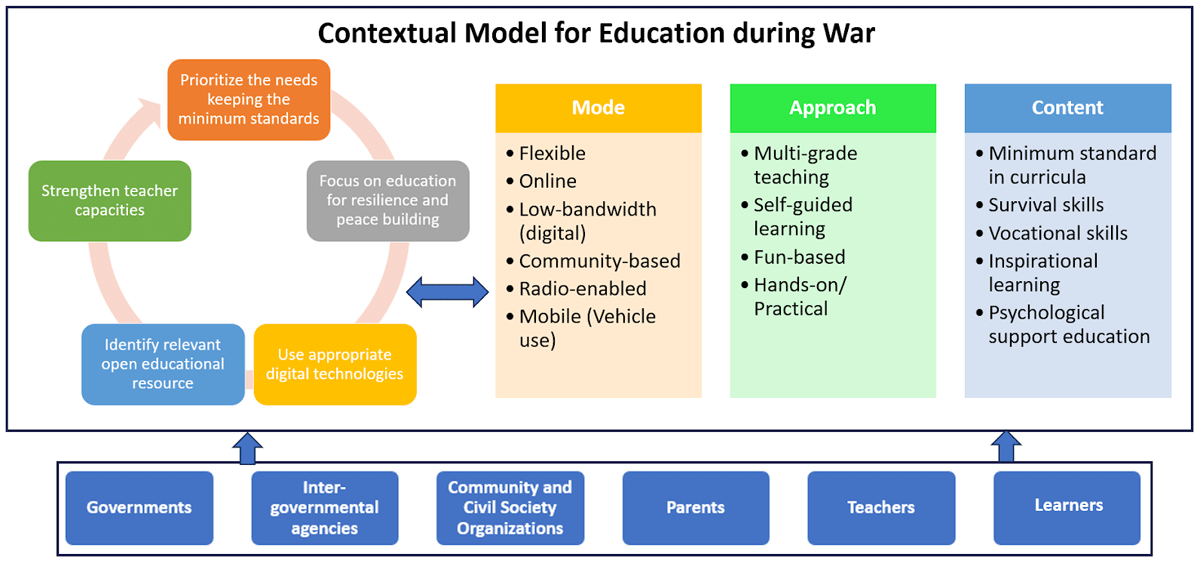
Figure 1
Contextual model for education during war.
This study has some limitations that should be acknowledged and further researched. For instance, the potential educational scenarios found might be limited by the search keywords used. Additionally, the educational scenarios that were written in a language that the authors do not speak or understand were not covered. The present study also did not approach and interview various stakeholders (e.g., policymakers, parents, learners, etc.) in war contexts who might share more insights from their personal experiences on the implemented educational approaches during wars. Therefore, we encourage researchers to further complement this research and further work on those future research directions proposed.
Despite these limitations, this study provided a comprehensive understanding on education and how to maintain it during wars, hence contributing to the Sustainable Development Goals (SDGs) of United Nations (UN), particularly SDG 4 related to quality education. Specifically, the reported findings can ensure a safe, inclusive and equitable education that might be disrupted in war contexts. Particularly, we invite readers to reflect and act upon the following questions when dealing with the issue of education provision under war at the global, national, regional, system, school, or classroom level: What does education provision under war mean in your space and context? Is there a way to provide education to mitigate its effects on students’ holistic development? What are the possibilities and ventures for education provision that can translate to homes, communities, schools, and classrooms? Who are the students you consider to be “at risk”?
Data Accessibility Statement
Data sharing is not applicable to this article as no datasets were generated or analysed during the current study.
Competing Interests
The authors have no competing interests to declare.
Author Contributions (CRediT)
Soheil Salha: writing—original draft preparation; Ahmed Tlili: Conceptualization, methodology, writing—original draft preparation; Boulus Shehata: writing—original draft preparation; Xiangling Zhang: Writing – review & editing; Awol Endris: Writing – review & editing; Khalid Arar: Writing – review & editing; Sanjaya Mishra: Writing – review & editing; Mohamed Jemni: Writing – review & editing. All authors have read and agreed to the published version of the manuscript.