
Introduction
In general, academic writing in Spanish has problems, this is a common diagnosis (Martínez, 2021; Ruiz & García, 2021). These problems are expressed, among other things, in the lack of comprehensive perspectives for its analysis, such as the qualitative method developed by Rey-Castillo & Gómez-Zermeño (2021), which considers three main aspects and not just one, which is the usual way of treating it (Boillos, 2020; Martínez, 2021). The aim of this paper is to address this situation by considering aspects of communication theory, distinguishing between conceptions of communication and communicative skills. The following are the results, based on a mixed design study, of a comprehensive analysis of the homework assignments (n = 238) that constituted the corresponding continuous assessment (n = 4) of first-year Spanish-speaking university students (n = 81) in a course on persuasive communication, which conform the first qualitative part of the study; the second is the interpretation of the qualitative and quantitative part as a whole. These results form the basis for the construction of a communication model, expressed here through the development of a typology of analysed homework assignments, which identifies dominant and alternative conceptions of communication and signifies the operation of a situated theoretical-practical disciplinary stance.
AI has been used in a statistical sense through the structuring of the data obtained from the qualitative part of the study (Cluster Analysis) and in its subsequent recognition of patrons (typology), which conform the quantitative part of the study. The use of other AI applications, such as Natural Language Processing, defines the future work with the data obtained in this study to design and operate a semi-automated written analysis based on approaches such as Active Learning (Nguyen et al., 2022). This expresses that the method implies, in time, the management and integration of different AI dimensions, which allow to identify very highly situated potentials and limitations of this group of technologies.
Literature
The literature mainly refers to quality issues in academic writing in Spanish, especially at the university level, highlighting the diagnosis of a lack of systematic teaching of reading and writing skills (Martínez, 2021; Ruiz & García, 2021). The main causes are linked to quality problems in basic education, which are exacerbated over time by a lack of personal interest and enjoyment in reading. In later stages, such as higher education, this culminates in the student’s lack of understanding of the academic environment, which explains significant phenomena such as plagiarism (Boillos, 2020).
It is common to view problems with the quality of academic writing from the perspective of competences, including written, reading, and oral competences, often referred to as communication competences or skills. With the continuous technological advances that allow a wider dissemination of messages in different sociocultural contexts, including the academic, these competencies and its analysis are usually associated with expressive writing (López & Ruiz, 2022; Rey-Castillo & Gómez-Zermeño, 2021) and oral skills (Maqueda Cuenca et al., 2021), as well as reading writing competence skills (Martínez, 2021). In contrast, perspectives that consider sociocultural skills such as understanding the academic environment and the ability to be reflexive about one’s own understanding and practice of communication are marginalised.
There is a growing tendency to equate the process of sending and receiving (transmission) messages with communication (Tison & Poirier, 2021), rather than understanding it as a coordinated action determined by the specific context in which it occurs, which is a seminal and transdisciplinary finding of Maturana (1970). This coordinated action is understood in terms of intersubjective communication as more than a transmission of meaning sent through a conduit, understood as a dominant metaphor, but rather as a negotiation of meaning (Varey, 2008), which is a process asset that is continually “negotiated and evaluated”, as Boromisza-Habashi & Fang (2021, p. 6) point out. Avoiding the understanding of norms as ‘predetermined values’ themselves, as the aforementioned authors also point out, norms are an element that participates in that negotiation process.
This coordinated action implies a normative communication stance, pointed out and reiterated by Craig (1999, 2015) and recognised by Maqueda Cuenca et al. (2021), which loses importance due to the emphasis on communicative effectiveness and the consequent influence of the norm, which tends to be evaded; the communication norm is skipped in order to privilege the value of daily practices (Boromisza-Habashi & Fang, 2021). This expresses a pragmatic-utilitarian view of communication. Nevertheless, the importance of maintaining norms and routines in the understanding of formal communication, especially written communication, as in highly specific contexts such as hospitality, is pointed out by Guedes dos Santos et al. (2011). Also in non-formal communication, normativity is understood as an ideal of dialogue with the characteristic of cooperativity according to Kuhar (2015), based on the co-creation of meanings in a shared interpersonal space. In this sense, negotiation of meaning can be understood as the co-creation of meanings between interlocutors from a broad sociocultural perspective.
These sociocultural perspectives, far from being alternatives to communicative competence, explain it to a large extent in terms of its implementation or lack of development: the lack of development of what are called communicative competences stems from the idea and the consequent practice that individuals have implicitly generated and expressed about what communication is. When problems arise with these competences, the communicational aspects determined by a specific context, such as the academic one, may not be part of the subject’s conception of communication or their communicative practice. This discrepancy can be attributed to the difference between their usual environment and the specific academic environment, which is expressed in an inability to adapt the written record to a different and more formal environment, as indicated by the notion of ‘diafasic variation’ (Portal de Lingüística Hispánica, 2020b), that is, the ability to adapt one’s oral or written expression or register according to the context in which they operate, as opposed to their more habitual environment.
Furthermore, the term ‘conception’ is understood in this context as ‘having an idea of something without generating any kind of judgement and belief’ (Yáñez, 2016). Thus, it is established that diafasic variation is not part of the communicative conception of a significant number of students who encounter difficulties related to the academic context, such as writing. Therefore, it refers to a dominant conception of communication, as will be explained in more detail below.
The Dominant and Alternative Conceptions of Communication
Based on insights from evolutionary biology (Maturana, 1970) and in sociocultural terms, the dominant conception of communication emphasises the process of sending and receiving messages, while downplaying the coordinated action related to the demands of a specific environment. On the other hand, the alternative conception of communication involves understanding the information in the message (Corsi et al., 1996). However, the dominant conception puts more emphasis on the use of a channel to exchange information and is defined by Carey (2009) as the ‘transmission conception’, according to Garcia-Jimenez (2015).
On the other hand, and in contrast to the dominant conception of communication described above, the alternative conception of communication can be explained in terms of students’ understanding of the task instructions and acting accordingly. If they have the necessary knowledge, they would carry out the task, and if not, they would ask the teacher or do some research on the subject, thanks to the availability of many electronic resources. Each of these scenarios implies a different strategy to achieve the same goal, which is to complete the task according to the pre-defined markers. Conversely, the dominant conception of communication focuses more on sending the response message (homework submission), without considering the instructions or acting accordingly, for various reasons such as cognitive and organisational factors, leading to a disregard of the predefined comprehension markers.
In both cases, the process of sending and receiving related messages, instructions and homework performance is verified. However, the response to the first message received (homework instructions) differs qualitatively between the two cases, favouring those identified with the alternative conception of communication and disadvantaging those associated with the dominant conception of communication. The coordinated action envisaged by the alternative conception of communication involves identifying the performance of the task as closely following the instructions given. Any deviation from these instructions would indicate a dominant conception of communication.
Thus, the alternative conception of communication is related to the idea of a negotiation or co-creation of meaning (Boromisza-Habashi & Fang, 2021), while the dominant conception of communication is related to the idea of the transmission of meanings (Kuhar, 2015), through a conduit (Varey, 2008), in accordance with the bases established in the previous section. The interaction between the two conceptions among the different participants in the tasks, students, and teacher, can lead to a problem of what is theoretically understood as communication, a ‘intersubjective mediation by signs’ (Craig, 1999, p. 136), as recovered by Garcia-Jimenez (2014). A communication problem is explained as a failure in the intersubjective negotiation of meanings. In the present case, this problem hinders the coordinated action determined by a context based on expectations of quality writing, which can be identified through a typology of homework submissions and their respective analysis, when the values of the variables used per case express a good negotiation of the meaning involved in the given interaction (alternative conception of communication), or express a problem with the mediation by signs involved and the consequent failure in the intersubjective negotiation related (dominant conception of communication), both in several terms and different measures that, methodologically and on the whole, require the use of IA statistical applied in order to structure a considerable amount of data and to recognise its main patterns (typology).
When significant aspects of the communication required by an academic context do not match the students’ conceptions of communication, as evidenced by the teacher’s analysis of related writing, a dominant conception of communication is present. In such cases, the exchange of messages may take place, but the response (homework submission) to the original message (homework instructions) differs from what was originally required.
Finally in this section, it is important to recognise that the use of the adjectives alternative and dominant come from a sociocultural stance in the sense that dominant is the most common action which is related with the creation of communication problems, while alternative is the less common situation related with the succeed in the communication processes, where the variables involved between interactants are positive related as happens in the scientific relation between null hypothesis and alternative hypothesis and, applied in the education field, search to express the common idea that education goes against the normal distribution as well as exploring the conceptions of the students debates the role that plays the idea of normality based on student’s abilities that traditionally has promote inequities (Moore, 2022) and attend quality education just partially.
A Situated Theoretical-Practical Communicational Stance
A normative communicational stance, mainly pragmatic in nature, seeks to recognise and address everyday and complex communicational issues through a situated theoretical-practical instrumentation, assessing the extent to which communication is in line with the determinants set by a particular context (Craig, 1999, 2015; Garcia-Jimenez, 2015). The understanding of ‘pancommunication’ is debated in terms of its little relevance in the context of interest, as it implies that every message communicates in a highly regular way within the general sociocultural space. While this perspective is dominant in communication studies in general, it does not apply to the field of communication theory, which remains alternative or emergent in relation to the aforementioned studies.
The distinction between the adjectives ‘communicative’ and ‘communicational’, as used here, is also determined by this relationship between communicational dominance and alternativity within the field of communication theory. In this sense, for the purposes of this study and based on the references presented in the previous section, a semantic distinction is proposed between the use of the adjectives ‘communicative’ on the one hand and ‘communicational’ on the other. ‘Communicative’ can be understood as any act or circumstance in which an assumed transmission of meaning (Kuhar, 2015) plays a central role. In most cases, this meaning depends on the recipient’s effort to interpret the communicative intent of the sender. The sender may not adhere to the general norms associated with the communication and may assume that the interlocutor understands, along with a supposed shared understanding of the context in which the act or circumstance occurs.
Communicative approaches can be expressed colloquially with phrases such as ‘it doesn’t matter how you write it; the important thing is that I understand you’. In such cases, the applicable normative does not play a significant role (Portal de Lingüística Hispánica, 2020a). On the contrary, the use of the adjective ‘communicational’ in this context aims to distance itself from the use of ‘communicative’ by debating it it, considering as much of the normative for the correct use of signs in a given context as possible, as well as the problems that arise from non-compliance.
The consideration of linguistic, research and thematic comprehension norms in the academic context is not significant in itself, but it serves the purpose of taking them into account in order to identify complex communication problems, improvement markers and, in general, the level of communication. It also has other sociocultural benefits, such as the promotion of linguistic unity and the preservation of a tradition considered beneficial, namely the academic-scientific tradition (Lara, 2009). As far as continuous assessment is concerned, it is understood in terms of the analysis of writing related to it, as well as an everyday academic communication problem whose attention can provide objective markers of the degree of communication.
The hypothesis revolves around the communicative problem posed by the aforementioned assessment. It suggests that it is possible to identify dominant and alternative conceptions of communication through the analysis of academic writing by Spanish-speaking university students, using specific comprehension markers (11 variables). The above set of considerations would constitute a communication model in a typology of analysed homework submissions, from which it would also be possible to construct a communicational profile of the students.
The theoretical-methodological relationship expressed in the hypothesis is in line with perspectives such as ‘grounded practical theory’ (Craig, 1999) and ‘implicit theories’ (Hertel & Karlen, 2021). The former pertains to identifying and addressing complex everyday communication problems through appropriate contextualisation (Garcia-Jimenez, 2015). The latter refers to what individuals implicitly express in relation to a concept or, more precisely, a conception.
Certain aspects of academic writing, and the context in which it takes place, are virtually absent from some students’ conceptions of communication. This lack of development in what are often referred to as communicative skills is why it is suggested that a dominant conception of communication is associated with what Rey-Castillo & Gómez-Zermeño (2021) describe as difficulties in academic writing. Conversely, an alternative conception of communication is associated with the quality of such writing.
Each of these conceptions is expressed through different measures in which students consider the aspects that make up the analysis of their writing, aspects that have been grouped into 11 variables. The conceptions of communication can be identified on the basis of the different measures in which the students’ writing behaviour in their homework is in line with the predefined aspects. These measures would then be verified by the teacher through the corresponding analysis.
Finally, in this section, the consideration and integration of the theoretical and operational components identified, which are detailed below, allow the supporting research to be presented as a model because it is a primary proposal of unification of the elements presented so far, which need to be tested in more cases, and because of its prominent theoretical origin and interest.
Methods
Design
The present study is a mixed method as it used qualitative techniques such as Content Analysis and Self-Study, and a quantitative technique of a multivariate nature such as Cluster Analysis. A Content Analysis of homework submissions (Self-Study) based on 11 variables was carried out and the data collected was structured and systematised using a multivariate exploratory technique (Hair et al., 1999) known as ‘TwoStep Cluster Analysis’, included in the ‘SPSS Statistics’ package (IBM Corporation, 2022) (TSCA). The analysis is not strictly linguistic, but rather comprehensive, as it is determined by the number of aspects considered, 11 variables that act as markers of different types of comprehension, characterised by their specificity and depth of treatment.
Variables and sample
The selection of the 11 variables was based on a review of the most recent literature (See Table 1), together with a focus on the students’ understanding and subsequent actions according to the predefined rubric for the evaluation of the corresponding homework. This approach ensures the ‘comprehensive’ quality of the analysis carried out. In general, the analyses included in this study constitute a self-study (Vanassche & Kelchtermans, 2015) of the teacher’s comments during the analysis of the submitted homework (n = 238), which formed part of the continuous assessment (n = 4) in a course on persuasive communication. The participants were first-year Spanish-speaking university students (n = 81), mostly Mexican, enrolled in a leading international private online university. The sample, consisting of the analysed (annotated) assignments, was part of the continuous assessment for five groups over an equal number of academic cycles, from May 2020 to January 2022.
Table 1
Relationship between aspects and variables.
| NUMBER | ASPECT NAME | AUTHOR | GENERAL ASPECT | VARIABLE | |
|---|---|---|---|---|---|
| KEY | KIND | ||||
| 1 | Homework Mark | Standard | Academic performance | HM | Ordinal |
| 2 | Correction of Critical Apparatus | Proposal based on Boillos (2020) | Critical apparatus, unconscious plagiarism | CCA | Counting scale |
| 3 | Documentation Hits for Writing | Proposal based on Rey-Castillo & Gómez-Zermeño (2021) | Thematic | DHW | Counting scale |
| 4 | Correcting Deed Documentation | Rey-Castillo & Gómez-Zermeño (2021) | Thematic | CDD | Counting scale |
| 5 | General Initiative | Proposal | Analytical | GI | Dichotomous nominal |
| 6 | Correction of Phrase Order | Cassany (2007), Rey-Castillo & Gómez-Zermeño (2021) | Cohesion, Writing Style, Grammar | CPO | Counting scale |
| 7 | Spell Check | Cassany (2007), Rey-Castillo & Gómez-Zermeño (2021) | Normative, Writing Style | SC | Counting scale |
| 8 | Punctuation Correction | Cassany (2007) | Cohesion | PC | Counting scale |
| 9 | Selection Information Correction | Proposal based on Cassany (2007) | Cohesion, ideas not clear or relevant | SIC | Counting scale |
| 10 | Style Suggestion | Proposal based on Cassany (2007) | Other, writing corrections | SS | Counting scale |
| 11 | Deepening Suggestion | Proposal | Thematic | DS | Counting scale |
[i] Note: Source: authors’ calculations.
The comments supported the corresponding assessment, making this analysis a study of communicational interactions (mediations) between students and teacher, focusing on the study of teaching activities (Self-Study). Consequently, this work also includes the field of educational research in a specific context of everyday communicational action.
Students with irregular submissions (n = 20), those who submitted fewer than two of the four homework assignments that made up their continuous academic assessment, were not included. The submissions from this group of irregular students formed a specific Cluster that characterised a type of irregular submission (n = 80). In addition, the submissions that were not completed by the students included in the analysis were statistically treated as ‘missing values’ (n = 151). Furthermore, any observation that, due to its size or severity, could not be classified as a correction of a critical apparatus (CCA variable), or instead constituted blatant plagiarism (n = 13) with a homework grade (HM variable) of ‘zero’, was also excluded from the analysis.
Statistical recommendations regarding the treatment of outliers and missing values were followed to ensure the coherence and unity of the object of study, the homework submissions analysed, as opposed to focusing on continuous assessment or student cases. However, the main object of study was indeed focused on the homework assignments included in the analysis, regardless of their inclusion in the continuous assessment. Further analysis is needed to address cases of plagiarism and unsubmitted homework, leading to the determination of student communication profiles based on the typology obtained from the analysed homework.
The content analysis was guided by a selection of different aspects of academic writing assessment identified in the literature over the last five years, supplemented by previous findings (Cassany, 2007). The selected aspects were used to classify the teacher’s comments on the homework writing, based on what had already been established in the respective rubric.
Academic performance was taken into account by considering the grade obtained in each assignment (variable HM), justified by the comments made on the assignments. These different aspects were combined, some of which were specified as ‘Counting scale’ variables, mostly according to the rules detailed in Table 1.
The studies that included most of the aspects of interest, encompassing the 11 variables, were identified through a systematic review based on the principles established by Sundermann et al. (2019) and Codina (2020), using the ‘Web of Science’ and ‘Scopus’ databases with the search criterion: ‘TS = (communicative model OR communicative profile OR communicative ability OR communicative aptitude OR communicative competence) AND TS = (academic writing OR writing practice) AND TS = (higher education OR university)’. The review period spanned from April 2018 to April 2022, yielding a total of 107 records. The titles, keywords and abstracts of all records were examined, and 12 papers were consulted in full. Finally, four papers were considered, and it should be noted that one (Martínez, 2021) was included only for its value in terms of the state of the art in language use in academic-scientific writing, without contributing any variables.
Excluding the HM variable, six variables were evaluated in terms of corrections, one variable in terms of hits (DHW), one in terms of presence-absence relations (GI), identifying outstanding analytical aspects typically related to thematic elements, and two variables in terms of suggestions: one related to different aspects of writing corrections (SG) and the other thematic-analytical (DS), indicating the potential for further analytical depth in the student’s ideas or approaches.
Statistical stance
Thus, the study represents an empirical sample (Hair et al., 1999) that does not fully meet the requirements of independence and normal distribution to perform predictive multivariate techniques such as Discriminant Analysis (Torrado-Fonseca & Berlanga-Silvente, 2013) (DA). However, DA was performed to verify the significance of the 11 included variables. Several TSCA models were constructed by removing some or all of the variables identified by DA as not significant univariately. While this significantly reduced the stability of the TSCA, the inclusion of the 11 variables ultimately resulted in a stable TSCA.
In general, Cluster Analysis (CA) is useful for constructing typologies and analysing classifications based on data structuring in order to complete profiles for specific groups (Hair et al., 1999). In this section, the clustering results of the aforementioned technique were characterised using the ‘Compare Means’ procedure, also included in the ‘SPSS Statistics’ package. In this sense, the AI applied to order a large set of data in this CA, data obtained after an analysis conducted by the teacher, seeks, in further investigation steps, to treat the current use of language in a specific context as the academic in Spanish, in order to make a training program for Natural Language Processing IA’s for conducting semi-automated written analysis based on the Active Learning approach (Nguyen et al., 2022), for example, through the use of tags (Bengar et al., 2021).
Findings
Five Clusters of medium practical quality were obtained, sufficiently differentiated from each other, as indicated by the analysis of variance (ANOVA), which, in univariate terms, showed that all the variables were significant in characterising each Cluster, with all the results of the ‘Combined’ statistic having a Sig. 0.000. However, the results of the ‘Measures of Association’ test, specifically the ‘Eta squared’ statistic, suggest that the variables HM (0.676) and GI (0.829) are particularly significant in differentiating the Clusters. These variables measure both academic performance and the identification of outstanding analytical elements.
The suggestions for further thematic improvement (DS) practically defined Clusters 1, 2, 4 and 5 equally. The distribution of each Cluster is shown in Figure 1, while the characterisation of each Cluster and the overall results are shown in Table 2.
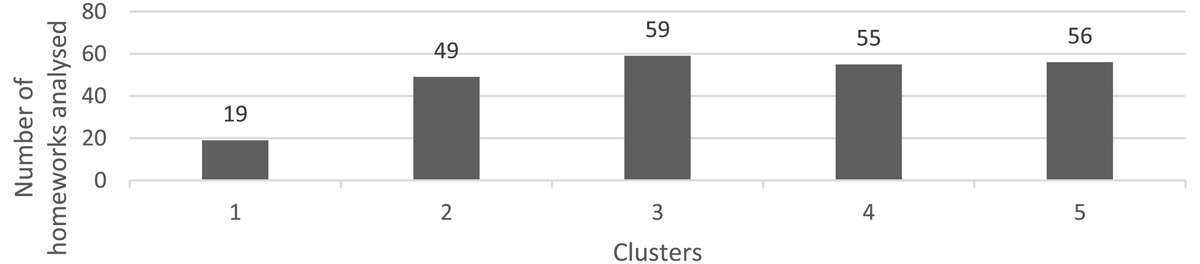
Figure 1
Clusters distribution.
Note: Source: authors’ calculations.
Table 2
Clusters characteristics.
| CLUSTER NUMBER | HM | CCA | DHW | CDD | GI | CPO | SC | PC | SIC | SS | DS | |
|---|---|---|---|---|---|---|---|---|---|---|---|---|
| 1 | Means | 7.68 | 5.32 | 6.21 | 8.53 | 0.58 | 11.21 | 11.26 | 8.53 | 11.53 | 7.68 | 0.84 |
| Deviation | 1.600 | 3.449 | 3.838 | 7.933 | 0.507 | 6.545 | 6.919 | 9.726 | 8.228 | 5.078 | 1.259 | |
| 2 | Means | 8.22 | 2.10 | 3.92 | 2.61 | 0.98 | 2.59 | 2.45 | 1.63 | 1.98 | 1.53 | 0.94 |
| Deviation | 0.848 | 2.201 | 3.278 | 2.540 | 0.143 | 2.483 | 3.731 | 2.316 | 3.065 | 2.132 | 1.737 | |
| 3 | Means | 6.34 | 1.93 | 1.75 | 3.56 | 0.08 | 2.98 | 3.75 | 1.59 | 3.12 | 0.93 | 0.31 |
| Deviation | 0.822 | 2.690 | 2.264 | 3.923 | 0.281 | 3.277 | 5.909 | 2.533 | 4.976 | 1.892 | 0.623 | |
| 4 | Means | 8.65 | 1.71 | 3.62 | 1.56 | 0.00 | 2.29 | 1.95 | 1.22 | 1.07 | 0.93 | 0.76 |
| Deviation | 1.158 | 2.105 | 3.587 | 1.854 | 0.000 | 2.409 | 3.015 | 1.802 | 1.620 | 1.345 | 1.122 | |
| 5 | Means | 10.00 | 1.95 | 9.93 | 1.45 | 1.00 | 1.50 | 1.61 | 0.93 | 1.32 | 1.82 | 0.71 |
| Deviation | 0.000 | 2.831 | 6.586 | 1.705 | 0.000 | 1.716 | 2.325 | 1.736 | 2.305 | 2.028 | 1.232 | |
| Total | Means | 8.23 | 2.19 | 4.91 | 2.80 | 0.50 | 3.05 | 3.16 | 1.91 | 2.66 | 1.80 | 0.68 |
| Deviation | 1.584 | 2.719 | 5.169 | 3.857 | 0.501 | 3.901 | 4.969 | 3.895 | 4.732 | 2.877 | 1.232 | |
[i] Note: Source: authors’ calculations.
Discussion
Four of the five Clusters are very similar in size, with an average of 55 items analysed, except for Cluster 1 which has 19 items. Cluster 1 has the second lowest academic achievement (HM, 7.68), as well as the lowest scores in eight of the eleven variables, including DS, indicating a need for improvement compared to the other Clusters, including Cluster 3, which has the lowest academic achievement. On the other hand, Cluster 1 has the second best result in the measurement of the DHW variable, which could explain its better performance compared to Cluster 3. Thus, Clusters 1 and 5 are the most distinctive, with a notable polarity. Cluster 5 has the best results in 8 of the 11 variables, including HM and GI, with absolute standard deviation results (0.000), indicating a significant distance from the other Clusters. For the remaining variables (CCA, SIC, DS), the results of Cluster 5 are only slightly lower than those of the immediately lower Clusters (4, 3 and 2).
Cluster 5, which is closest to the criteria defined in the corresponding rubric, is identified with the alternative conception of communication, while the other Clusters are increasingly associated with the dominant conception of communication as they deviate from the guidelines of the rubric. The analysed homework in Cluster 5 not only emphasises the implicit process of sending a response to the original message (homework submission), but also considers the requirements of the academic context (evaluation rubric). On the other hand, the dominant conception of communication is evident in the homework submissions in Clusters 1, 2, 3 and 4, as the teacher, through appropriate analysis, verifies a progressive implicit deviation from the coordinated action implied by the students’ failure to follow the task instructions or to question about them, as a capital part of a negotiation process.
This dominant conception, which puts more emphasis on sending the response to the original message (homework instructions) without sufficiently considering the aspects outlined in the original message (evaluation rubric), leads us to consider the analysed homework in Clusters 1, 2, 3 and 4 together, as they show significant irregularities in the 11 aspects considered, compared to the analysed homework in Cluster 5. The sociocultural dominance of these four Clusters was also confirmed, as most of the analysed homework (n = 182) were in the Clusters associated with the dominant conception, while only a significant minority (n = 56) were in the Cluster identified with the alternative conception.
In sociocultural terms, the dominant conception of communication is de facto validated in various habitual domains of the subject, including the academic domain, when it is not contextually identified. Furthermore, this conception is reinforced by various mechanisms, such as the recurrent lack of contextual and explicit identification, as studied in the context of the social theory of mass media, which can undermine the development of people’s agency (Bandura, 1995, 1997, 2009). This is a challenge to improve the quality of education, which could pay dividends in several ways in the generation of citizenship through a high individual internalised sense of normativity.
However, the importance of the division between the analysed homework in Cluster 5 and those in the other four Clusters is respected, as it indicates objective improvement scores for each Cluster in relation to the following one. Cluster 5 serves as a benchmark with a theoretical-normative improvement reference, verifying absolute excellence in all 11 aspects for each student, thus maintaining a situated normative perspective in concordance with the stablished by Craig (1999, 2015), Garcia-Jimenez (2015) and by Maqueda Cuenca et al. (2021). These scores would guide the design of improvement strategies for students whose homework submissions are dominated by the profile indicated in this Cluster, relative to the following Cluster and the absolute excellence referred to. The said division between Cluster 5 and the four rest is understood in terms that in the first one there is identified a success in the negotiation at the meanings directed by the instructions of the homework (alternative conception of communication), meanwhile in the rest of the Clusters, each of them represents a measure of failure in that negotiation, where it was just possible to verify the importance of the use of the channel in the sense of submitting a content (mismean) through a conduit in the sense that points Varey (2008) and Kuhar (2015).
The different levels of the importance of the academic writing problems expressed in the quantitative results of the Clusters 1, 2, 3, and 4 concord with the problems pointed out, in general, included, Punctuation Correction, by Martínez (2021), Ruiz & García (2021), Maqueda Cuenca et al. (2021) and López & Ruiz (2022) and, more specifically, by Boillos, 2020 (Correction of Critical Apparatus) and Rey-Castillo & Gómez-Zermeño (2021) (Correcting Deed Documentation, Correction of Phrase Order and Spell Check), all of the from qualitive studies.
The variance of the normative issues related to each variable used makes it possible to evaluate several formal and thematic aspects that go beyond the common academic skills and personalise the management of students in order to mitigate the inequalities (Moore, 2022) inherent in the educational process, making explicit the conceptions of communication expressed in the educational mediation, verifying the dominant sociocultural determinants, but scanning for any matter that could help to change this situation in terms of going against normality and moving as many cases as possible from dominant to alternative communication practices: For example, the variable Correcting Deed Documentation, recognising a pertinent idea, even if it is swallowed in comparison with a consolidated knowledge, or even with writing formal errors like those pointed out by variables such as Correcting Phrase Order, Spell Check, Punctuation Correction, or even Correcting Critical Apparatus, which in a whole expresses the personal student situation as specific as possible, in the last variable case, as Boillos (2020) develops.
The complexity of the integration of the 11 variables used and the theoretical assumptions (identification of conceptions of communication) expresses the pertinence of the use of statistical AI tools, independently of the use of other type of its applications such as the Natural Language Processing to design alternatives for the academic writing semi-automated analysis with the elements recognised so far, such as the variable Correction of Phrase Order, which tends to detect the most common language misuses in the order and elements of the production of phrases in academic Spanish, which implies the use of approaches like the Active Learning (Nguyen et al., 2022), which implies the collaboration man-machine in order that the human expertise helps to tag data (Bengar et al., 2021), in this case error phrases that the machine is not able to tag (Google, Bard, 2023), so that human expertise serves to train the machine learning program that surrounds the whole process.
It should be noted that, except for Cluster 1, only the CDD variable shows a progressive downward trend with respect to the order established by the HM variable. This shows that Clusters 2 and 4, although like the other Clusters, show significant differences. This confirms a relationship in which, in the case of corrections, as with most variables, more corrections in a homework assignment imply a closer alignment with the dominant conception of communication, while fewer corrections indicate a greater alignment with the alternative conception of communication.
About the HM variable, approaching the maximum possible score in homework performance reflects an alignment with the alternative conception of communication, while departing from this maximum score reflects an alignment with the dominant conception of communication, where the message is privileged in the homework submission and verified by the teacher through appropriate analysis.
The remaining variables show a complex behaviour between the Clusters, as they do not consistently follow an ascending or descending order with respect to the HM variable. This illustrates the complexity or limitations of the perspectives of communication conceptions, from their strictly theoretical understanding, but also highlights the complexity of studying language use in the academic context and, in general, situated communication acts.
Conclusion, Implications and Suggestions
A primary conclusion is that regardless of the number of cases included in each Cluster, each one represents a profile of homework submission and its respective review and evaluation, a profile of an academic communication act or educational mediation, which together form a typology. The potential for identifying groups of students is highlighted by the results, although caveats are considered as the results may be influenced by the interactional style of a particular teacher.
The results of the comprehensive analysis support the hypothesis of this research that the conceptions of communication, both dominant and alternative, can be identified through the analysis of the academic writing noted. These results are expressed in a typology of the homework analysed, bearing in mind that the technique used (CA) is statistically atheoretical. Therefore, they are interpreted in the light of the theoretical assumptions made in order to identify the conceptions mentioned. This is a step forward for the field of communication theory, especially in the grounded practice approach to identify and treat everyday complex communication problems, as planted by Garcia-Jimenez (2015), which pays dividends in the field of online university education and in general for individualised teaching.
With regard to the dominant conception of communication, which is related to the implicit identity of the students with it in their homework submissions, validated by the teacher, the verification of the hypothesis is explained by the fact that what initially begins as a lack of development of expressive (written and oral), analytical (reading) and sociocultural (understanding of the academic environment) (Boillos, 2020) skills, through conditioned and habitual communicative practice, leads over time to a particular way of implicitly understanding communication.
Another conclusion, however, is related to the difficulty of identifying communication conceptions only in the abstract. On the contrary, these conceptions are primarily identified through the study of situated sociocultural interactions in specific contexts, in this case the academic setting. This highlights the growing importance of studying mediations rather than isolated processes of message exchange, confirming important theoretical assumptions advocated here, such the active negotiation of meanings (Boromisza-Habashi & Fang, 2021). The results suggest a confirmation that the negotiation of meaning is a practical problem that, if not attended to, could be a significant source of communication problems based on broad and limited sociocultural assumptions (Garcia-Jimenez, 2015), based on the idea of the transmission of meanings (Varey, 2008). This idea was originally discussed by Skinner (2003) at the end of the seventies of the XX century, in terms of its limitations in the use of metaphors in education (transmission of knowledge), in parallel with the empirical evidence provided by Maturana (1970), which gave rise to a broad transdisciplinary theoretical stance, which overall shows that it is a very topical and pendant issue. This has been detailed, specifically from the field of communication theory, with a recognised influence there, by Krippendorff (1997) and Carey (2009), this second recovered by García-Jimenez (2015).
Thus, it is necessary to go beyond strictly ‘communicative’ approaches that emphasise the will of the sender (student) to communicate in his response (homework submission), assuming that the receiver (teacher) will make the necessary effort to understand the message. If the context that frames the interaction is not adequately considered, this approach adopts a normative communicational perspective. Ignoring this context could lead to disregarding related indicators of improvement and efforts to make assessment processes more objective. Globally, there is a growing demand for greater transparency, due diligence, and specific documentation management to make and support decisions, as in highly specialised contexts such as medicine (Twiggs & Goldstein, 2016) or science (Persson & Persson, 2022).
Moving beyond strictly ‘communicative’ understandings can shed light on the nature of highly complex everyday communication problems, while also problematising the general idea of communication for specific audiences such as university students. This becomes necessary as a sociocultural competence in the current context of sustained technological progress, in order to avoid consequences such as the lack of development in scientific professions, which require an understanding of their respective contexts, including academic writing.
At the statistical level, it is important to note that the calculation of the five clusters was based on the means of the 11 variables included, which does not fully express the real casuistry. Therefore, on the basis of the typology obtained, it is recommended that in future work, as part of a continuous evaluation, communication profiles of students be established based on the predominant location of the total homework done and analysed per student case within this typology.
Nevertheless, the consideration of the 11 variables represents a significant advance in the establishment of a comprehensive understanding criterion for the review of academic writing, with an eminently pragmatic vocation. Most of the recent works consulted in the specialised literature and considered here respond to a very specific vocation of isolated analysis, whether investigative or linguistic, with only one having a comprehensive approach, considering three main different aspects in relation to difficulties in academic writing (Rey-Castillo & Gómez-Zermeño, 2021).
Analysing the typology in terms of its predominance for each student case, i.e. identifying how many of the four homework items that make up continuous assessment are found in each Cluster, involves shifting the focus of homework analysis to individual student cases within the continuous assessment framework. This, in turn, is more closely related to the consideration of medium-scale educational individualisation processes, which are built on solid foundations within this presented model.
Despite the reservations regarding the procedure used, since it is a technique aimed at structuring data rather than making predictions, and the uncertainties regarding future work, the integration of a quantitative approach into the study of communication in academic writing is valuable because it is driven by considerable statistical rigour and is based on the works consulted, which have served as an important foundation for this study. The importance of future work lies in the continued search for parametric and non-parametric solutions for the treatment of the variables included, allowing for more detailed characterisations, such as the use of the full DA technique instead of the ‘Comparison of Means’ procedure.
The overall results of the analysis suggest the basic characteristics that could constitute the evaluation of a series of average homework submissions based on the obtained typology, as well as the overall results that could provide greater objectivity to the evaluation and greater efficiency in the operationalisation of aspects predefined in educational design and evaluation tools such as rubrics.
The data obtained from the typology can define parameters that guide the planning of aspects related to educational administration, such as the organisation of teachers, workload considerations, and the design of improvement strategies based on the identification of student cases in a particular predominant Cluster, in interaction with the teacher, and their corresponding mobilisation when necessary.
Finally, it is considered that the applications of the constructed typology and the model in general have the potential to operate within the framework of AI techniques, such as Natural Language Processing as detailed at the end of the third section. A possible implementation in semi-automatic revision processes of different types of written productions can be identified through the systematisation of the most common behaviours of the included variables, i.e., the identification of common writing strengths and corrections that express different levels of language use in relation to knowledge management in a specific context. This could also help to understand and anticipate changes and developments in such contexts.
Data Accessibility Statement
The datasets used and/or analysed during the current study are available from the corresponding author on reasonable request.
Ethics and Consent
The applicable corporate standard, the “Actualziación Protección de Datos 2022” (2022 Data Protection Update), states that the use of data obtained from teaching activities for scientific research is permitted without specific consent when, as in this case, no personal data is managed. In addition, the consent of the coordinator of the academic programme in question was verified: “Licenciatura en Comunicación”, Universidad Internacional de la Rioja in México.
Acknowledgements
The authors are grateful for the facilities provided by the different departments of the Universidad Internacional de la Rioja on both sides of the Atlantic, in Spain and in México, especially the authorities and teachers at the Escuela de Doctorados for the realisation of this work, as well as for the expert statistical guidance provided by Dr María Emelina López González of the Universidad de Valencia.
Funding Information
This work is funded by the Universidad Internacional de la Rioja through various mechanisms.
Competing Interests
The authors have no competing interests to declare.
Author’s Contributions (Credit)
Benito Ilich, Suárez-Bedolla; Conceptualization; Data curation; Formal Analysis; Investigation; Methodology; Software; Writing-original draft; Francisco, Cervantes-Pérez; Conceptualization; Formal Analysis; Methodology; Supervision; Writing-Review & editing; Beatriz, Feijoó-Fernández; Formal Analysis; Methodology; Software; Supervision; Writing-Review & editing. All authors have read and agreed to the published version of the manuscript.