
Introduction
The focus on the governmental Open Educational Resources (OER) policies gained its momentum in 2011 when several Intergovernmental Organisations (IGOs) initiated activities that led to OER policy proposals and policy declarations calling on governments to support the development and mainstreaming of OER by adopting enabling OER policies. An important step in this direction occurred in 2012 during the World OER Congress organised jointly by the United Nations Educational, Scientific and Cultural Organisation (UNESCO) and the Commonwealth of Learning (COL) when the Paris OER Declaration was adopted. The Declaration makes ten recommendations for governments concerning OER. One of the recommendations calls on governments to mandate the development of OER through the adoption of appropriate policies (UNESCO, 2012). The call for supportive OER policies at a governmental level was re-emphasised in 2017 in the Ljubljana OER Action Plan (OER Congress, 2017). The Plan makes 41 recommendations for mainstreaming OER in support of the Sustainable Development Goal (SDG) 4 to “ensure inclusive and equitable quality education and promote lifelong learning opportunities for all” (UNESCO Global Education Cooperation Mechanism Secretariat, n.d.). The most significant development in this regard occurred in 2019 with the adoption of the UNESCO Recommendation on OER. This standard-setting instrument reflects a major commitment by the international community to mainstreaming OER worldwide. The Recommendation (UNESCO, 2019) is structured around five action areas: Building the capacity of stakeholders to create, access, re-use, adapt and redistribute OER (1); Developing supportive policy (2); Encouraging effective, inclusive and equitable access to quality OER (3); Nurturing the creation of sustainability models for OER (4); Promoting and reinforcing international cooperation (5).
From 2009 onwards, several other IGOs were considering or issuing declarations, recommendations or communications to encourage the adoption of institutional or governmental policies on OER or Open Education, such as the Organisation of the French-speaking States (OIF), the French Association of Universities (AUF), that issued the Dakar Declaration on OER (OIF, 2009). In 2011, the Organisation for Economic Cooperation and Development (OECD) attempted to adopt a legal instrument on OER, and provided additional public policy recommendations for OER in the report published in 2015 (Orr, Rimini & van Damme, 2015). The European Commission (EC) set out a European agenda for OER in 2013 when it proposed actions for supporting the development and availability of OER at European Union (EU) and national levels (EC, 2013). In 2017, the European Commission provided additional policy recommendations for Open Education in the EU member states (Inamorato dos Santos, 2017).
Literature Review
In the context of the literature that examines the effects of globalisation on public educational policy, numerous authors (Inamorato dos Santos et al., 2017; Abeywardena, et al., 2018; Abeywardena, et al., 2019; Lingard et al., 2005; Rizvi & Lingard, 2010; Shahjahan, 2012; Jakobi, 2009a; Jakobi, 2009b) have argued that public policymaking is no longer confined within national boundaries and explored the roles of IGOs and policy networks in influencing public education policy processes. Increasingly, national policymakers have been interconnected with policy actors beyond nation-states such as IGOs and other policy networks (Rizvi & Lingard, 2010; Henry et al., 2001). Therefore, the process of the policy text production is affected by the processes of globalization and globalized discourses (Rizvi & Lingard, 2010; Henry et al., 2001). This phenomenon is described as an emergent global education policy field, space or community (Lingard et al., 2005; Rizvi & Lingard, 2010; Shahjahan, 2012; Jakobi, 2009a; Jakobi, 2009b).
During the past decades, numerous scholars have been examining different IGOs and their mechanisms of influence on education policies worldwide. A significant body of research has focused on the roles of IGOs such as the World Bank, UNESCO, OECD or the EU, in global and national education policy processes such as lifelong learning policies or the Bologna process at the EU level (McNeely, 1995; Chabbott, 2013; Mundy, 2002; Shahjahan, 2012; Resnik, 2006; Jakobi, 2009a; Jakobi, 2009b; Joachim & Verbeek, 2004; Balzer & Martens, 2004; Schuller & Vincent-Lancrin, 2009; Rizvi and Lingard, 2010). Collectively, researchers have identified multiple roles that IGOs perform that affect higher education policy at global and national levels. Amongst those roles, their discursive activities have been frequently highlighted as important functions that IGOs perform. IGOs produce and disseminate knowledge about higher education issues and thus provide important information to the field. They also play an important role in assembling and maintaining transnational policy networks to discuss or build consensus about specific policy ideas. Furthermore, IGOs can prescribe policy directions and monitor compliance through their standard-setting functions. Such roles can have both binding and non-binding implications for governmental policy makers and their application and types vary across the different IGOs. Another important role that IGOs perform is the provision of funding in that funds can be used in national settings to, for example, establish programs that address policy objectives articulated at an international level. Finally, IGOs can shape higher education policies through the provision of direct and indirect policy advice. All these roles of IGOs affect different governmental education policy processes including agenda-setting, policy formulation or implementation (McNeely, 1995; Chabbott, 2013; Jakobi, 2009a; Jakobi, 2009b; Mundy, 2002; Shahjahan, 2012; Resnik, 2006; Joachim & Verbeek, 2004; Balzer & Martens, 2004; Schuller & Vincent-Lancrin, 2009; Rizvi & Lingard, 2010).
Conceptual Framework
In his review of research on how IGOs influence higher education policy processes, Shahjahan (2012) provides a comprehensive overview of the different instruments used by IGOs. Focusing his review specifically on four different IGOs (the World Bank, OECD, UNESCO and the EU), Shahjahan notes that these IGOs possess multiple instruments with which they can assert their influence. The identified policy instruments include policy reports and proposals, research, policy advice, funding, sponsoring or organising conferences, meetings and networks, standard setting and coordination of policy implementation (pp. 373–379).
Similarly, Jakobi (2009b) argues that IGOs possess and utilize different instruments in the pursuit of their policy objectives and introduces a typology of five categories of instruments used by IGOs. Conceptualised as “governance instruments”, these include “discursive dissemination, standard setting, financial means, coordinative functions, and technical assistance” (Jacobi, 2009b, p.4). Discursive dissemination includes different activities carried out by IGOs for the purposes of information sharing to, for example, build international support for specific policy ideas. Standard setting instruments include activities that can have both binding and non-binding character for member states. An example of a standard-setting instrument includes a Convention or a Recommendation. Financial means as an instrument refers to different funding programs that are instituted by IGOs to encourage certain types of behaviour or support initiatives. Coordinative functions include formal or informal monitoring activities to, for example, monitor compliance with respect to the implementation of a policy developed through IGOs on a national level. Finally, technical assistance refers to various forms of capacity-building activities which may include policy advice, provision of model policy documents such as legislation or examples of public awareness-raising campaigns (Jakobi, 2009b).
For the purpose of the presented research, we combined and adapted the list of policy instruments compiled by Shahjahan (2012) and Jakobi (2009b) with comments from Balzer and Martenas (2004), Schuller & Vincent-Lancrin (2009) and Christensen (2006), to create a set of IGOs OER policy instruments. This list is shown in Figure 1. The typology of policy instruments by Jakobi (2009) allows for the classification of policy instruments into five distinct categories of OER policy instruments (see Figure 1). Correspondingly, we define OER policy instruments for this research as mechanisms of influence applied by IGOs that can directly or indirectly affect global and governmental OER policy processes such as agenda setting, policy formulation and implementation. OER policy instruments include discursive dissemination, standard setting, financial means, coordinative functions and technical assistance.
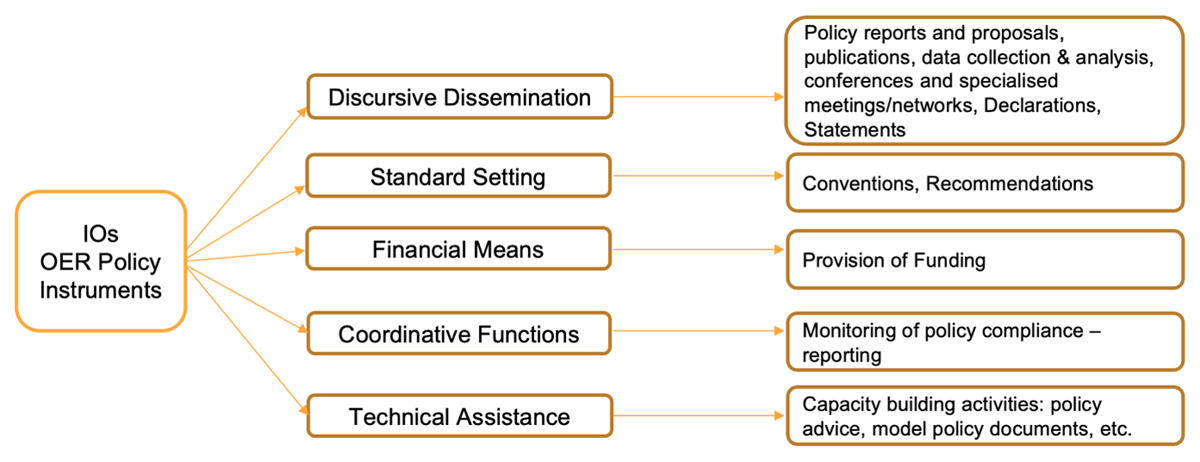
Figure 1
Proposed set of OER Policy Instruments used by IGOs.
Subsequently, we used the list of OER policy instruments, see Table 1, during interviews with stakeholders from IGOs to explore which OER policy instruments the selected IGOs were applying to influence the development of governmental OER policies.
Table 1
OER Policy Instruments – Consolidated responses per organisation (Example).
| OER POLICY INSTRUMENTS | Q2: INSTRUMENTS | Q3.1: PRIORITIES | Q3.2 ROLE – COLLABORATION | Q4.1 RATING |
|---|---|---|---|---|
| Producing policy reports | X | 1 | 1 & 2 | 1 |
| Providing policy advice | X | 1 & 3 | 1 & 3 | 1 & 2 |
| Data collection and analysis (R&D) | X | 1 | 2 | 1 & 2 |
| Sponsoring international/regional conferences, meetings and networks | _ | |||
| Organizing international/regional conferences, meetings and networks | X | 2 & 3 | 1 & 2 | 1 & 3 |
| Providing analytical advice | X | 1 | 2 | 1 |
| Carrying out country and thematic reviews (reports, journals) | X | 2 | 1 | 3 |
| Providing financial support through loans and funding initiatives | _ | |||
| Issuing guidelines | _ | |||
| Issuing declarations & recommendations | _ | |||
| Advocacy | X | 3 | 2 | 1 |
[i] Legend:
Q2: Selection of Instruments: X = YES, – = NO;
Q3.1: Organisational Priorities: 1 = Major, 2 = Intermediate, 3 = Minor;
Q3.2: Organisational Role in Collaboration: 1 = Singular, 2 = Participating and Leading, 3 = Participating, only contributing;
Q4.1: Rating of selected OER policy instruments in terms of perceived effectiveness: 1 = Effective, 2 = Uncertain, 3 = Not effective.
The interviews were conducted to address the following main research question: How did selected International Organisations (IOs) influence the development of governmental OER policies in selected countries from 2002 to 2019?
Research Gap and Aim
This paper explores what policy instruments the selected IGOs have been using to influence the development of governmental OER policies. The majority of previous research activities carried out in the period 2011–2020 primarily focused on documenting the adoption and growth of public OER policies worldwide and did not investigate the role of IGOs OER policy instruments on the development of the reported governmental OER policies (Hylén et al., 2012; Hoosen, 2012; Orr, Rimini & van Damme, 2015; COL, 2017; Inamorato dos Santos et al., 2017; Ossiannilsson, Hakan & Wetzler, 2020). The published information on this topic is limited to several studies or reports examining the effect of some OER policy instruments, such as technical assistance or discursive dissemination, of IGOs such as UNESCO, COL or EC, on the development of governmental OER or Open Education policies in a specific country or a group of countries in a particular geographical region (Inamorato dos Santos et al., 2017; ORS Impact, 2015; Abeywardena, et al., 2018; Abeywardena, et al., 2019). There is not yet a clear understanding of the instruments of OER policy influence, collectively applied by different IGOs, in the context of governmental OER policy processes and their effectiveness.
This paper addresses the identified research gap by providing empirical evidence on how different IGOs have been influencing the development of governmental OER policies from 2002 until 2019 and the perceived effectiveness of their OER policy instruments.
Methodology
Seven IGOs were pre-selected for inclusion in the study, based on consultations with experts in the field. The criteria for pre-selection of IGOs included observed or recorded history of activities with OER in general and OER policy instruments in particular. The initial list of pre-selected IGOs was subsequently refined and three IGOs were excluded in cases when prospective respondents did not respond to an invitation to participate in the study after several reminders and also when they reported minimal or no involvement in the OER policy landscape, or when it was not possible to identify a suitable respondent and organise interviews within a reasonable time frame. The following four IGOs complied with our selection criteria: UNESCO, COL, OECD and EC.
Two respondents in senior professional roles were sought per organisation to obtain a more representative view of the organisation’s intentions or strategies. The first confirmed respondent from an organisation was also asked to help identify the second potential respondent from the same organisation. The decision to select two representatives from each organisation proved to be beneficial, as the input given provided meaningful differentiation and nuance among the two responses. Furthermore, in addition to the interviews, we also monitored and documented relevant OER policy instruments applied by the selected IGOs up to 2022.
We conducted a total of eight semi-structured interviews with the representatives from the selected IGOs in the period from 2015 to 2017. A protocolled interview instrument focused on exploring the rationale of the selected IGOs for supporting the development of governmental OER policies, the organisational priorities and collaboration patterns with other stakeholders with respect to the selected OER policy instruments, the perceived successes and challenges with their actions and their future plans (see Appendix A for interview questions). The conceptual framework described in the previous section (see Figure 1) guided the data collection process. During the interviews, the respondents were asked to review the list of identified OER policy instruments (see the first column in Table 1) and select those that their respective organisations were applying to realise their intentions.
The interviews were conducted online and lasted on average two hours per interview. Respondents’ answers to the questions about the applied OER policy instruments (Q2), the organisational priorities and collaboration patterns with other stakeholders (Q3), and the perceived effectiveness of the OER policy instruments (Q4) were used to subtract quantitative information that was compiled into a table and shared with respondents for a review during the results verification stage (see Table 1). Thematic analysis was applied to analyse responses to open-ended questions to identify emerging themes across the interviews.
The results from the interviews reflect the opinions of senior professionals located within their respective organisational sectors, directorates and secretariats. These expressed views may not in any circumstances be regarded as an official position of their organisations. All participants in the interviews were informed about the purpose of the study and agreed to voluntarily participate in the research and to have the interviews recorded. Furthermore, they consented to the dissemination of results as stipulated in the interview protocol. All respondents were assured of anonymity and confidentiality and had the right to withdraw their participation at any stage.
Results
The results address our main research question: How did selected International Organisations (IOs) influence the development of governmental OER policies in selected countries from 2002 to 2019?
In addition to identifying OER policy instruments at the IGOs level, we also explored the observed successes and challenges with the identified instruments. We also provide a selection of quotes from respondents to substantiate the findings. Where applicable, the results also include examples of additional OER policy instruments that were applied by these organisations in the period 2017–2022, beyond the interview time-frames, to provide the most up-to-date overview of relevant developments.
Rationale for supporting the development of governmental OER policies
The findings indicate that the organisational mandates of the studied IGOs form the basis for their involvement with and work in OER. Collectively, their respective mandates include activities to explore innovations in education and learning, bridge research and innovation with the creation of good education policies, and promote the free sharing of knowledge, ideas, resources and technologies. The respondents emphasise that OER fits within their organisational mandates and helps advance their organisational priorities because of its potential to stimulate innovations in education, improve education quality, increase and widen access to educational opportunities, and help attain SDGs with SDG4 in particular. Furthermore, the rationale for supporting the development of governmental OER policies is determined by their organisational mandates to support member states in developing education policies, the beliefs that supporting OER through governmental policies is in the public interest, and that such policies will support and encourage educational institutions to produce and share OER and accelerate mainstreaming of OER within educational systems worldwide:
“We are aiming to support the development of governmental OER policies. In fact, the mission of CERI is actually to put on the map emerging topics, you know, the policy map, emerging topics, and so that was really one of them. When we touch on OER like any other topic, the ultimate question is what are the implications for policy making, and that was part of it from the very beginning.” (R1, OECD)
“We believe if there is a governmental policy on OER, institutions will be more proactive to use OER and to share educational materials. In the absence of a governmental policy, institutions often do not take steps to share educational materials. Nevertheless institutions are largely autonomous but having a governmental policy tells them ok the government is proactive on OER and they can also do it. That’s one of the biggest reasons [behind COL’s focus on governmental OER policies].” (R4, COL)
The IGOs started focusing on the development of governmental OER policies prominently in the years 2011 and 2012. During that period, all the IGOs initiated activities that led to OER policy proposals and policy declarations calling on governments to support the development and mainstreaming of OER by adopting OER policies. Within OECD’s Education Policy Committee, discussions took place about adopting a policy instrument on OER in the form of a declaration or a recommendation. In collaboration with COL, UNESCO carried out research activities and regional consultations that led to the adoption of the Paris OER Declaration in 2012. Finally, EC set the European agenda for OER through its 2013 Communication on Opening Up Education: Innovative teaching and learning for all through new Technologies and Open Educational Resources. All these developments within the respective IGOs, collectively, serve as a significant impetus and help to set an international agenda for mainstreaming OER within education systems worldwide vis-à-vis the adoption of governmental OER policies.
OER Policy Instruments
Returning to the typology of the five main categories of OER policy instruments outlined in Figure 1, it is evident that the selected IGOs use all categories of policy instruments to influence the development of governmental OER policies even though each organisation does not apply all of them (see Figure 2).
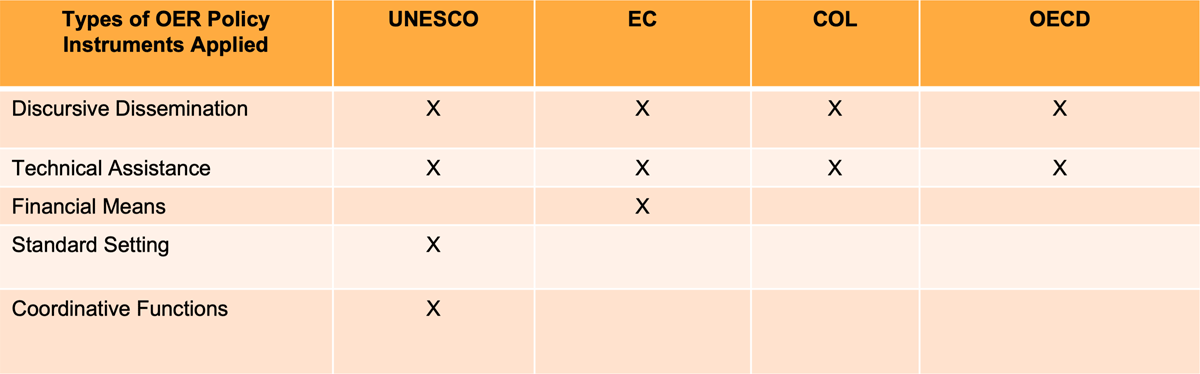
Figure 2
IGOs and OER Policy Instruments.
OER Policy Instruments – Discursive Dissemination
All of the IGOs focus prominently on disseminating ideas about OER and, to that end, apply a range of OER policy instruments such as publications, policy reports, guidelines, advocacy, recommendations and declarations. Furthermore, IGOs disseminate ideas and facilitate the exchange of knowledge and practices about OER through organising or supporting international and regional conferences, consultations, meetings and workshops. Collectively, their OER discursive dissemination activities are used to address several objectives, including:
Provide an overview of the state-of-the-art of the OER movement and related national and institutional policies;
Provide more evidence about the benefits of OER and its potential to address educational challenges and opportunities to support evidence-informed policy-making processes;
Highlight relevant policy implications, and provide policy recommendations (institutional and national);
Raise awareness and facilitate knowledge exchange about OER, related practices and policies;
Garner international and regional support and set agenda for OER and promote collaborations;
Support dissemination activities.
OER Policy Instruments – Technical Assistance
All IGOs also apply technical assistance OER policy instruments to influence the development and implementation of governmental OER policies. UNESCO and COL provide direct policy advice by organising workshops and meetings with policymakers within governments and education institutions. Furthermore, additional capacity-building activities are carried out by UNESCO and COL through workshops and meetings to support the implementation and mainstreaming of OER. Indirectly, all IGOs include capacity-building activities in their publications, such as guidelines. Collectively, the applied technical assistance OER policy instruments are used to:
Highlight relevant policy implications and provide policy recommendations;
Encourage, support and assist with the development and implementation of governmental and institutional OER policies;
Build capacities and capabilities of educational institutions to create, share and use OER and to integrate OER and Open Education within teaching and learning practices.
OER Policy Instruments – Financial Means
Out of the studied IGOs, only the European Commission applies OER funding instruments to support relevant projects and initiatives in the field following its 2013 Communication on Opening Up Education release.
OER Policy Instruments – Standard Setting & Coordinative Functions
Finally, standard-setting and coordinative functions OER policy instruments are only applied by UNESCO. However, some IGOs contributed to this standard-setting instrument indirectly by participating in meetings and consultations organised by UNESCO. The standard-setting instrument is related to adopting the 2019 Recommendation on OER. The coordinative function OER policy instrument includes monitoring activities with the implementation of the Recommendation that started in 2022.
It is also important to note that COL, UNESCO and EC adopted their own organizational policies, UNESCO in 2013, COL in 2011 and EC in 2019 specifying that their respective outputs such as reports and publications have to be released openly under Creative Commons Licenses. Examples of OER policy instruments that are applied by the respective IGOs are shown in Figure 3 below. For a comprehensive list of their OER policy instruments, please see Appendix B.
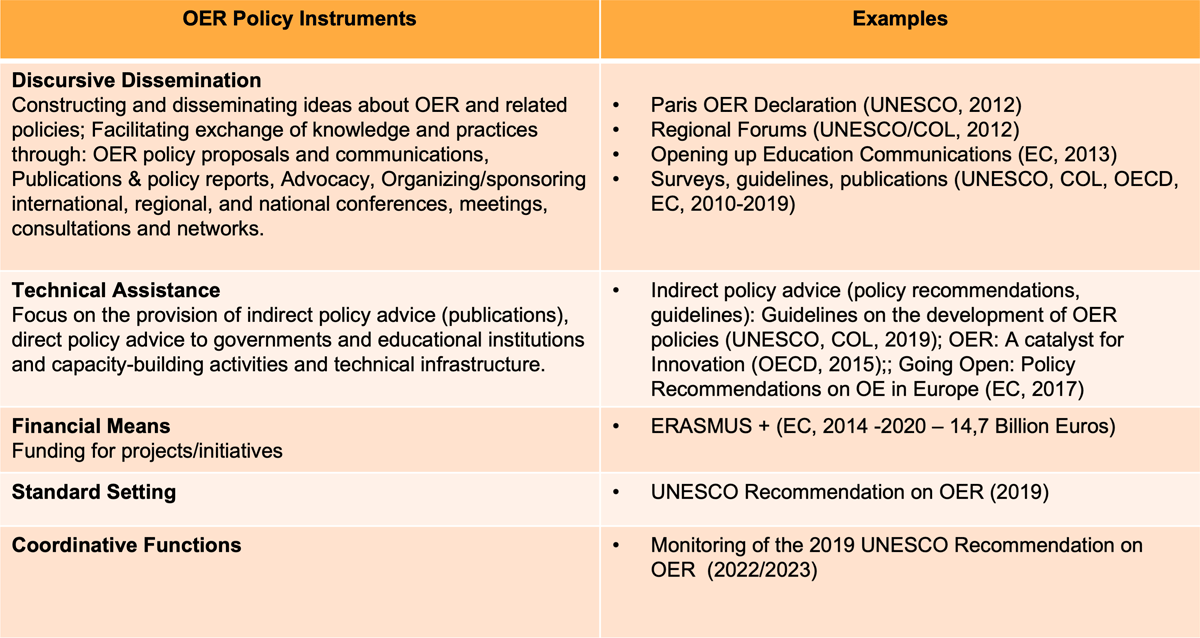
Figure 3
IGOs and OER Policy Instruments Examples.
Successes
The findings reveal several observed or perceived successes with the efforts of the IGOs to influence the development or implementation of governmental OER policies. First, all IGOs emphasise the successes of their OER policy proposals or policy declarations (2011–2013) in setting the international OER agenda and, consequently, leading to additional lines of action for these IGOs (see Figure 4).
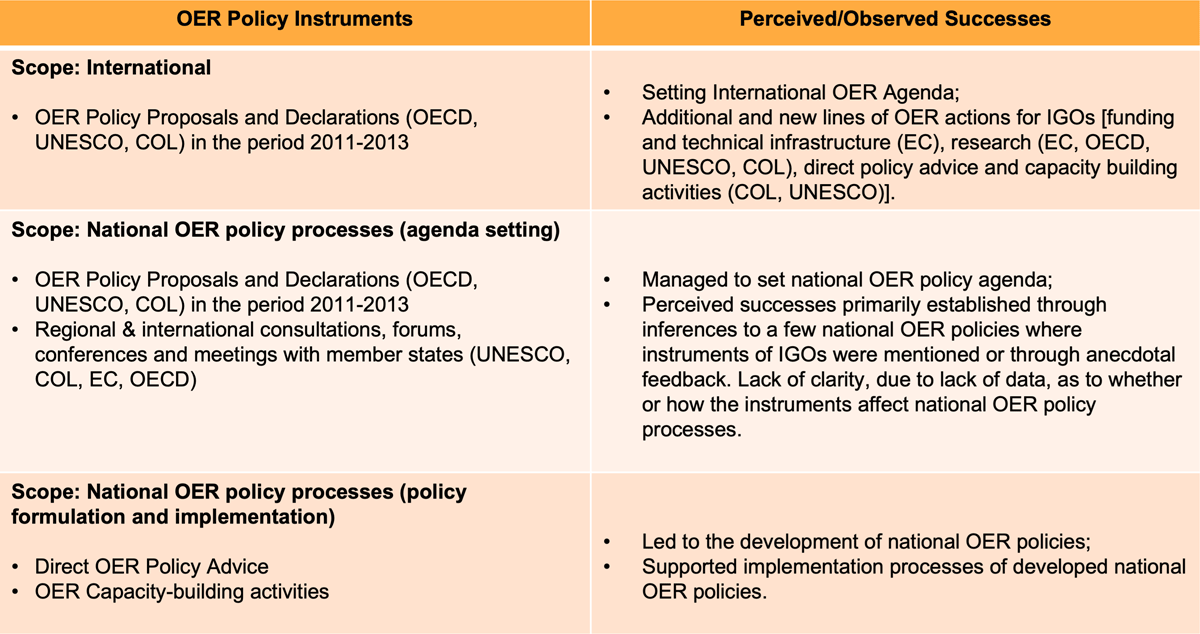
Figure 4
IGOs and OER Policy Instruments – Successes.
For example, UNESCO and COL have been focusing prominently on evidence-based OER advocacy and OER technical assistance policy instruments, such as direct and indirect evidence-informed policy advice and capacity-building activities to support the development and implementation of governmental OER policies. OECD’s Centre for Educational Research and Innovation (CERI) has turned its attention to discursive dissemination activities to provide more information and evidence about OER, its benefits, relevant policy implications, and recommendations. EC, directly and indirectly, has been funding the production of OER through its ERASMUS+ programme and set up an infrastructure, a European repository of OER, for the benefit of teachers, learners and researchers. It has also expanded its discursive dissemination activities to assist with opening up education, including formulating policies, in EU member states and at a European level.
“Actually, the main background is the Paris OER Declaration because in the OER Declaration, it states that UNESCO and the international community strongly recommend that governments develop national and institutional strategy to adopt OER. It is one of our organisation’s priorities to follow up with member states to develop national policy and strategy on OER. After the Paris OER Declaration, many member states governments also have put forth developing national policies, which means we need to do this work.” (R6, UNESCO)
“I think most successful probably is our Communications in getting people to look at the topics. Then, again, how much impact it really has is always a debate, but it is clear there has been some positive impact. The second thing is certainly the discussions and meetings at the EU level. We are quite sure that those have an impact because we occasionally hear that the ideas discussed there have been introduced in this or that project or policy.” (R7, EC)
Furthermore, concerning national OER policy development processes, the IGOs highlight their perceived successes in influencing agenda setting, policy development and, in some instances implementation processes (see Figure 4).
However, as noted by the respondents, the successes of the IGOs’ discursive dissemination OER policy instruments, such as declarations or policy recommendations, are primarily established through inferences to a few national OER policy texts where the instruments of IGOs are mentioned or through anecdotal feedback. Due to a lack of data, the respondents are uncertain whether, to what extent or how their instruments affect national OER policy processes. The IGOs have not systematically followed up with member states about the impact of the OER policy instruments on national OER policy processes:
“Of course, that’s based on very informal feedback, but I know thar our [OER] report really has raised a lot of interest in the policy community. Maybe I’m a little bit over exaggerating, but I do think that it’s in the process of changing the mindset and policy views of people with regard to OER.” (R2, OECD)
“You see, there is no direct measure. For example, how many institutions or governments have done OER policy because of the Declaration [Paris OER Declaration]? We don’t know.” (R4, COL)
Challenges
Several challenges are identified across the four IGOs that, according to the respondents, affect their ability to influence the development or implementation of governmental OER policies (see Figure 5).
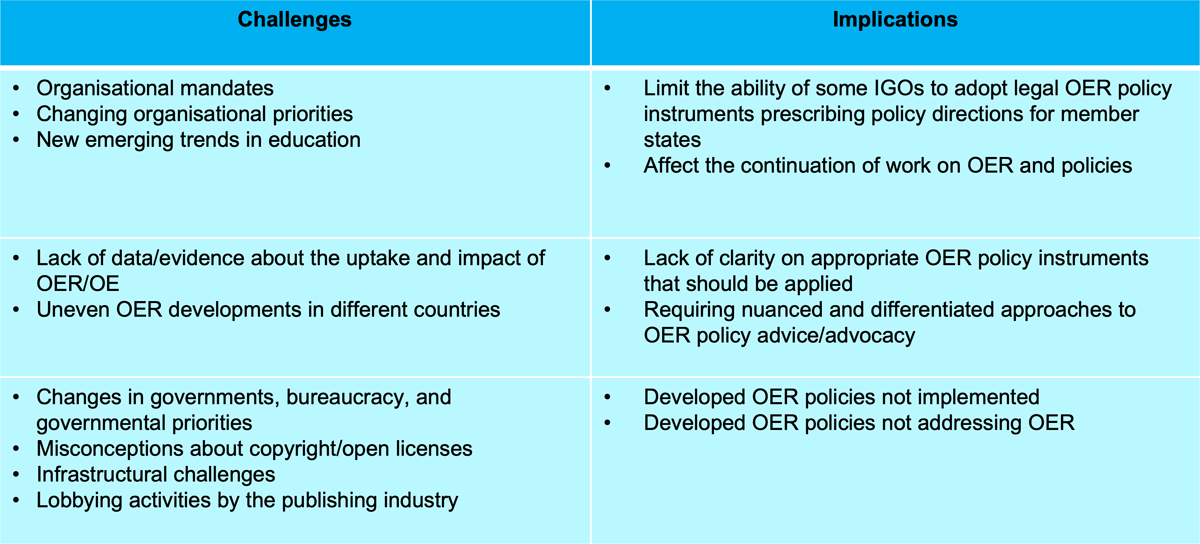
Figure 5
IGOs and OER Policy Instruments – Challenges.
One of the reported challenges is related to the IGO’s respective organisational mandates that limit their ability to adopt legal OER policy instruments prescribing policy directions for their member states. Only UNESCO has adopted a standard-setting instrument through its 2019 Recommendation on OER. Furthermore, the lack of data or evidence about the uptake and impact of OER/Open Education and related practices coupled with uneven OER developments in different countries are also cited as challenges by respective IGOs. Such challenges affect IGOs’ abilities to act in this domain resulting in a lack of clarity on appropriate OER policy instruments that should be applied.
“In the field of education, turning to these legal instruments is always very sensitive. We only have a very few examples of legal instruments in the field of education at the OECD. There was a lot of concern among countries that the OECD should not become, let’s say, the legislative of educational policy in the world.” (R2, OECD)
“On the country side, the picture is much more mixed. You have some countries who are really spearheading these developments and are really in the front line of fostering OER and OER policies, but you have other countries who, let’s say, are rather unaware of the development of OER…Then you have countries where OER is not yet on the radar screen. This is influencing also the capacity of the OECD to act as an organisation in this regard.” (R2, OECD)
“The question is how many people actually use OER? You can have some indication of how many OER there are in the world or in Europe, but no one knows how much they are really being used.” (R7, EC)
Changing organisational priorities or new emerging trends in education are also highlighted as challenges for some IGOs, affecting the continuation of their work with OER and policies. Finally, additional challenges are reported in the context of direct OER policy advice when such advice does not lead to national OER policies being developed; developed policies are not related to OER or, if developed, are not implemented. In their perception, the respective IGOs attribute these challenges to several factors, such as changes in governments, bureaucracy, and governmental priorities, misconceptions about copyright and open licenses, infrastructural challenges and lobbying activities by the publishing industry.
“Many of the countries think oh, we already have OER policy because the country developed digital content, put online, allow teachers to download. There’s a lot of misunderstanding. Secondly, is resistance from the publication sector, particularly if we’re talking about the openly licensed textbooks. Sometimes the government is willing to openly license textbooks, but after they develop the policy, they will encounter resistance from the publication sector. Sometimes the policy will be stuck from there and not being implemented.” (R6, UNESCO)
“See, the policy implementation means that policy is adopted. We have developed policies in several countries during the last three years but those policies are not adopted by the governments. If policies are developed but not adopted then what is the purpose of the policy development? Our approach to working with governments is now focusing on policy implementation rather than just drafting a policy and not adopting a policy.” (R4, COL)
Conclusions
Below, we draw conclusions, discuss the findings also in view of other scientific research and address the implications for further research and the work of IGOs. Intergovernmental Organisations (IGOs) have been playing a prominent role in the Open Educational Resources (OER) movement in advocating for and supporting the development of governmental OER policies and setting international OER policy agendas.
We explored what policy instruments the selected IGOs (UNESCO, COL, OECD and EC) used to influence the development of governmental OER policies from 2002 to 2019. The four IGOs have a global scope of influence. Collectively, their membership covers 190+ countries. We developed a conceptual framework for OER policy instruments and interviewed representatives from the IGOs. We conclude that their international activities ranged from constructing and diffusing ideas about OER and related policies to providing funding, technical assistance with developing governmental OER policies and standard-setting instruments (e.g. 2019 Recommendation on OER). While it is evident that the IGOs collectively used all categories of OER policy instruments (Figure 1) each organisation did not apply all of them. The differences between the studied IGOs concerning the types of OER policy instruments applied are determined by their respective organisational structures, mandates, priorities or policy fields, particularly in the context of legal policy instruments. For example, EC does not have the mandate to prescribe policy directions for its member states in education. However, in higher education, EC played an important role in agenda-setting processes through its policy proposals (Balzer & Martens, 2004; Shahjahan, 2012). Similarly, the OECD asserts its policy influence through knowledge construction and dissemination activities and rarely turns to standard-setting instruments (Jakobi, 2009a; Jakobi, 2009b; Shahjahan, 2012).
The identified successes with the activities of these IGOs were related to two dimensions – international and public OER policy processes. In the case of the former, the OER policy proposals and communications by these IGOs in 2011–2013, in particular, served as an important momentum to set the OER policy agenda and mainstream OER within education systems worldwide by calling on governments to adopt enabling OER policies. Furthermore, they led to additional OER policy instruments applied by these IGOs, such as technical assistance (UNESCO, COL, OECD, EC), funding (EC) and ultimately standard-setting OER policy instruments (UNESCO) to support the development of governmental OER policies worldwide. In the case of public OER policy processes, the identified successes were related to setting OER agenda, developing policies or supporting the implementation processes. However, those successes were primarily established through inferences to a few national OER policies where the IGOs’ instruments were cited or through anecdotal feedback.
The findings related to the perceived international successes identified by respondents from the selected IGOs are consistent with Jakobi’s arguments that once central ideas are established in global forums and policy communications, such as declarations, they are often followed by the application of other policy instruments to support the dissemination of ideas, such as policy recommendations, technical assistance or funding instruments (2009b, p.10). It is important to note, however, that the organisational priorities of these IGOs concerning the identified OER policy instruments are not constant. They represent a snapshot of activities and reported priorities within a particular time frame and can evolve or change depending on new emerging trends in education or changing organisational priorities.
The identified challenges that affect the work of IGOs in this space were primarily related to their respective organisational mandates, changing priorities or new developments in the field, lack of information about the uptake of OER and uneven OER developments in different countries. It is important to note, however, that the identified additional challenges such as changes in governments or bureaucracy, various misconceptions about copyright, infrastructural challenges or lobbying activities by the publishing industry are important considerations that can negatively affect the work of IGOs.
It is evident that available information or lack thereof, about the uptake of OER, policies and related practices in different countries plays a significant role in considering the types of OER policy instruments that should be applied by the respective IGOs and can lead to lack of clarity on the best way forward in terms of policy proposals. This challenge highlights the need for strengthening research activities in the field to provide ongoing evidence and statistics about OER and related practices for IGOs and to support evidence-informed policy advice and policy-making processes at a national level. Furthermore, it appears that awareness about the different OER policy instruments applied by these IGOs may be rather limited. For example, in 2017 the European Commission released a study on policy approaches to open education carried out with policy experts in 28 EU member states. Most of the respondents did not mention any key policy instruments with respect to Open Education during the interviews. These findings highlight the need for strengthening dissemination activities about IGO’s policy instruments within the policy community (Inamorato dos Santos et al., 2017).
Several questions remain concerning the influence of IGOs on the development of governmental OER policies. First, have the OER policy instruments applied by the different IGOs influenced the development of national OER policies? If yes, how? Based on the findings from interviews, representatives from different IGOs attributed their perceived successes primarily to having influenced national OER agenda-setting and policy development processes. However, they could substantiate their observations mainly through inferences to a few national OER policies where the IGOs and their instruments were referenced or cited or through anecdotal feedback. These findings resonate with research conducted by Shahjahan (2012), who could not establish the causal impact of IOs’ policy instruments on higher education policies. Instead, he identified numerous qualitative correlations demonstrating the IGOs’ influence, such as policy instruments being cited in policy texts (2012). Elaborating on the questions above necessitates further research with governmental policymakers and policy advisors to understand whether and how IGOs have influenced their national OER policy processes.
Data Accessibility Statement
The datasets used and/or analysed during the current study are available from the corresponding author on reasonable request.
Additional Files
The additional file for this article can be found as follows:
Appendix B
IGOs and OER Policy instruments – additional examples. DOI: https://doi.org/10.55982/openpraxis.15.4.594.s2
Ethics and Consent
The research complied with the following codes of conduct:
The Memorandum of Scientific Integrity adopted by the Dutch National Board for Scientific Integrity,
The OU’s Scientific Integrity Regulations,
The Netherlands Code of Conduct for Scientific Practice,
The Netherlands Code of Practice for the use of personal data in scientific and scholarly research.
Acknowledgements
The paper was presented at the Lillehammer 2023 Conference.
The authors would like to thank the following individuals and organisations: Interviewees for their willingness to participate in the research; (Late) Prof. Fred Mulder, Dr Dominic Orr and Dr Cable Green for their guidance in an earlier stage of the research; The Global OER Graduate Network for continued support; The William and Flora Hewlett Foundation for financial support.
Competing Interests
The authors have no competing interests to declare.
Author Contributions (CRediT)
Conceptualization, I.L., P.P. and H.B.; methodology, I.L. and P.P.; analysis, I.L. and H.B.; investigation, I.L.., writing—draft preparation, I.L.; writing – review and editing, I.L., P.P. and H.vdB. visualization, I.L.; supervision, P.P. and H.B. All authors have read and agreed to the published version of the manuscript.